Click image to open full size in new tab
Article Text
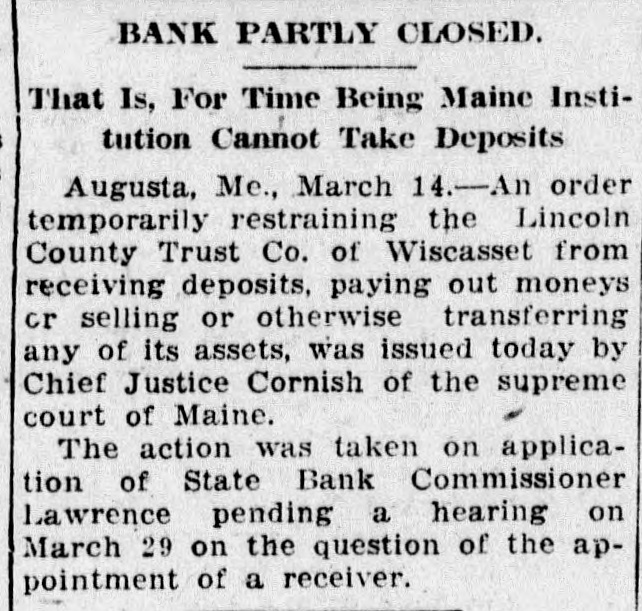
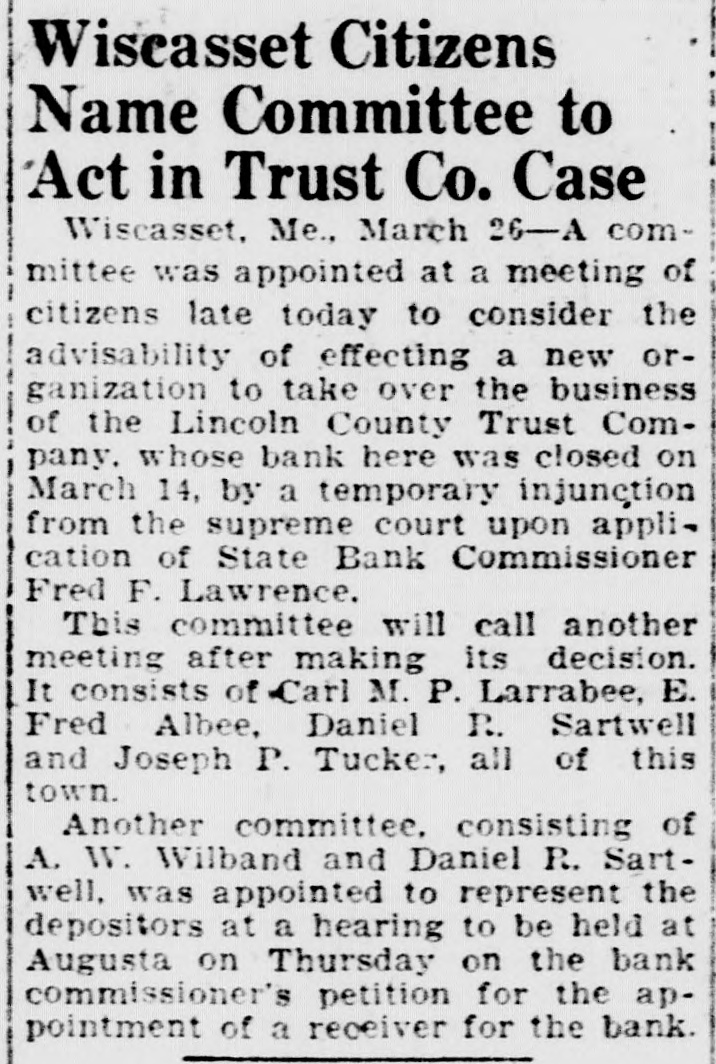
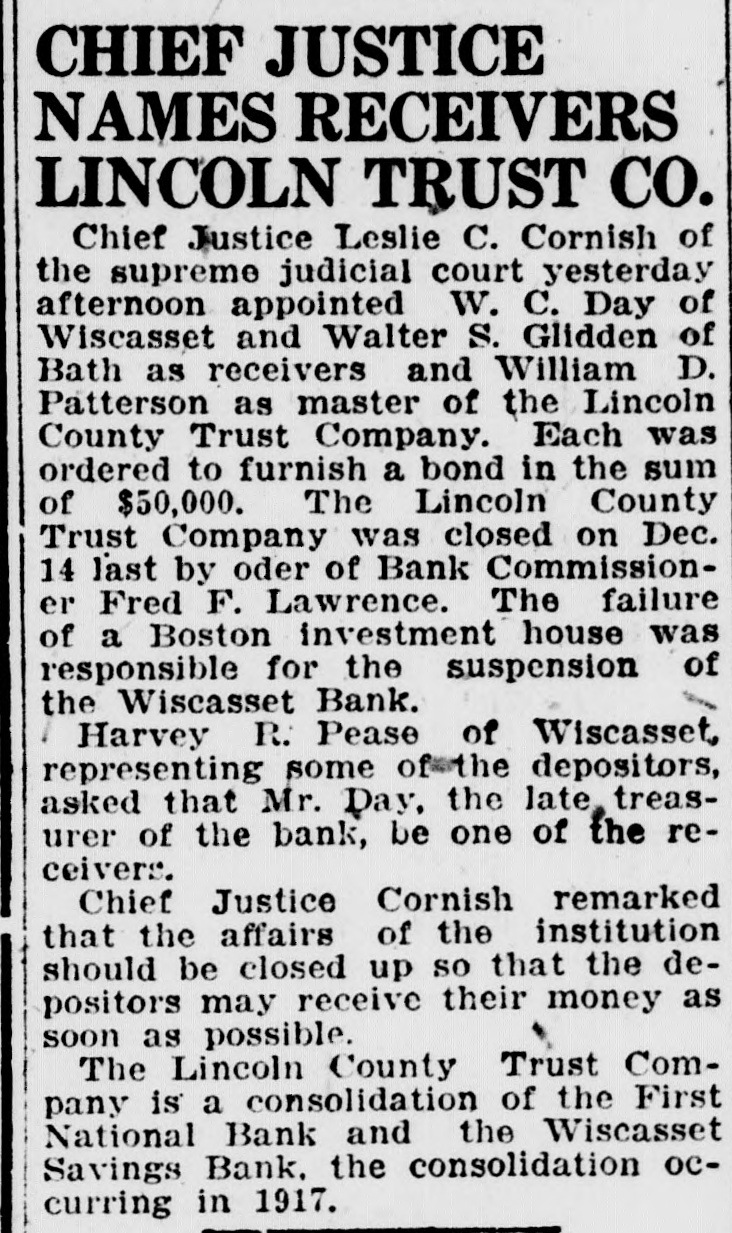
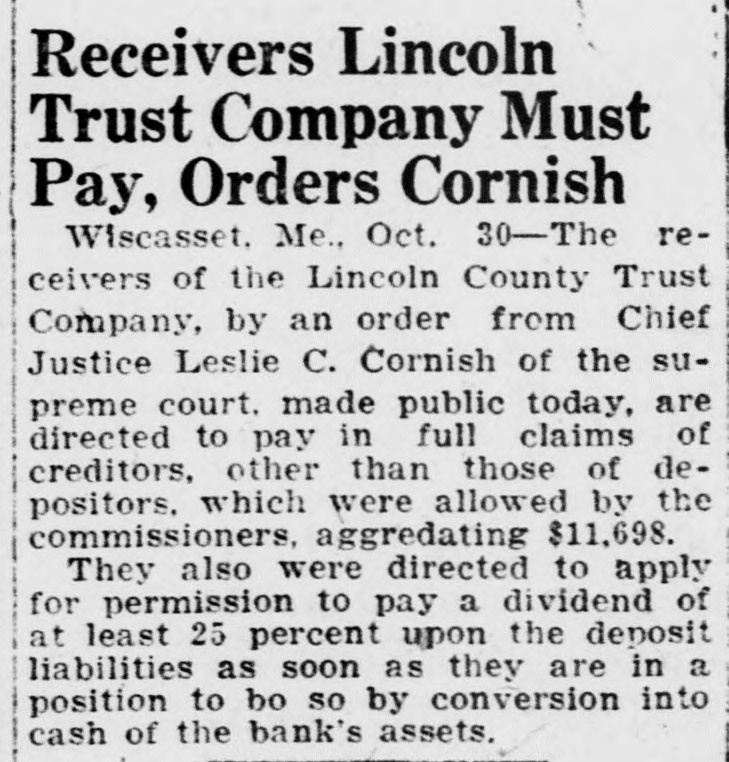
On application of Bank Commissioner, Fred F. Lawrence, Chief Justice Cornish on Wednesday issued a restraining order under which the Lincoln County Trust Company, doing business at Wiscasset, Me., was temporarily enjoined, pending a hearing for the appointment of a receiver which will be held at the court house in Augusta on Thursday, Mar. 29, from receiving deposits, paying out moneys or selling or otherwise transferrnig any of its assets. The commissioner's petition for liquidation, upon which the restraining order is based, alleges that the trust company is insolvent and that its condition is such as to render further proceedings hazardous to the public and to those having funds in its custody. The commissioner made the following statement with reference to the closing of the bank: "Depreciation in the value of certain securities of the Lincoln County Trust company has reached a point where, in my opinion, it cannot in justice to the public be allowed to continue business. The closing of this institution in no way involves, directly or indirectly, any other banking institution, but results wholly from unfortunate investment policies. The majority of the stock of the bank is owned by the investment house of Burgess, Lang & Co., of Boston, Mass., whose affairs were recently placed in the hands of receivers largely on account of their holdings of the same securities which have impaired the standing of the Lincoln County Trust company. The failure of this house has also operated to deprive the depositors of the 'added protection of the stockholders' liability so far as a majority I of the stock is concerned. Efforts to interest other institutions to intervene or to induce the stockholders to voluntarily contribute sufficient funds to make up the impairment have thus far proven ineffective, but it is hoped that action may yet be taken whereby the necessary funds can be supplied and the present bank reopened or a new institution organized to take over the business without loss to the depositors. Under the "segregation" law it is believed that the savings depositors will be fully protected." The Lincoln County Trust Company was organized April 6. 1917, as a consolidation of the Wiscasset Savings Bank and the First National Bank of Wiscasset. Its officers are Albert M. Card.. president: William J. Patterson and Samuel J. Sewall, vice presidents and W. C. Day, treasurer. Its savings deposits as of January 6th. 1923 aggregated $370,206.16: its demand deposits $87,534.71: its capital stock on the same date was $50,000 and its surplus and undivided profits $8,055.40.