Article Text
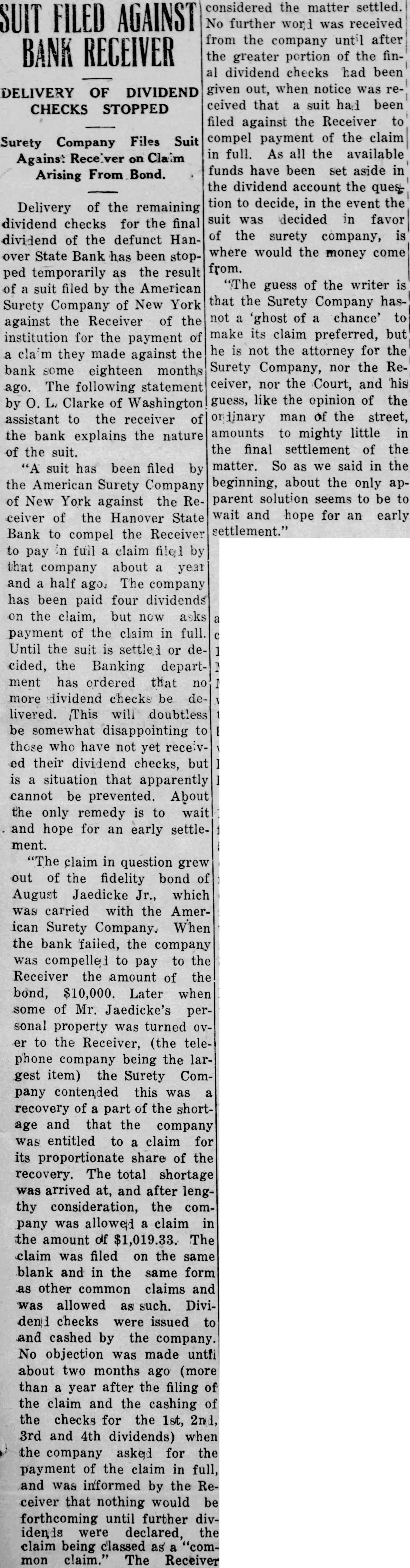
SUIT FILED AGAINST BANK RECEIVER DELIVERY OF DIVIDEND CHECKS STOPPED Surety Company Files Suit Against Receiver on Claim Arising From Bond. Delivery of the remaining dividend checks for the final dividend of the defunct Hanover State Bank has been stopped temporarily as the result of a suit filed by the American Surety Company of New York against the Receiver of the institution for the payment of a claim they made against the bank some eighteen months ago. The following statement by O. L. Clarke of Washington, assistant to the receiver of the bank explains the nature of the suit. "A suit has been filed by the American Surety Company of New York against the Receiver of the Hanover State Bank to compel the Receiver to pay in full a claim filed by that company about a year and a half ago. The company has been paid four dividends on the claim, but now asks payment of the claim in full. Until the suit is settled or decided, the Banking department has ordered that no more dividend checks be delivered. This will doubtless be somewhat disappointing to those who have not yet received their dividend checks, but is a situation that apparently cannot be prevented. About the only remedy is to wait and hope for an early settlement. "The claim in question grew out of the fidelity bond of August Jaedicke Jr., which was carried with the American Surety Company. When the bank failed, the company was compelled to pay to the Receiver the amount of the bond, $10,000. Later when some of Mr. Jaedicke's personal property was turned over to the Receiver, (the telephone company being the largest item) the Surety Company contended this was a recovery of a part of the shortage and that the company was entitled to a claim for its proportionate share of the recovery. The total shortage was arrived at, and after lengthy consideration, the company was allowed a claim in the amount of $1,019.33. The claim was filed on the same blank and in the same form as other common claims and was allowed as such. Dividend checks were issued to and cashed by the company. No objection was made until about two months ago (more than a year after the filing of the claim and the cashing of the checks for the 1st, 2nd, 3rd and 4th dividends) when the company asked for the payment of the claim in full, and was informed by the Receiver that nothing would be forthcoming until further dividends were declared, the claim being classed as a 'common claim.' The Receiver considered the matter settled. No further word was received from the company until after the greater portion of the final dividend checks had been given out, when notice was received that a suit had been filed against the Receiver to compel payment of the claim in full. As all the available funds have been set aside in the dividend account the question to decide, in the event the suit was decided in favor of the surety company, is where would the money come from. "The guess of the writer is that the Surety Company has not a 'ghost of a chance' to make its claim preferred, but he is not the attorney for the Surety Company, nor the Receiver, nor the Court, and his guess, like the opinion of the ordinary man of the street, amounts to mighty little in the final settlement of the matter. So as we said in the beginning, about the only apparent solution seems to be to wait and hope for an early settlement."