gpt-5-mini (chosen from majority vote of a three-model LLM ensemble)
Short Digest
1bd58e1b01279ea9
Response Measures
None
Description
Bank previously suspended in Jan 1908 and reopened Aug 1908; finally taken by state superintendent and closed April 1910.
Events (4)
1.January 30, 1908Suspension
Cause
Macro News
Cause Details
Suspended during the financial panic of 1907/early 1908; broad financial crisis affected the institution
Newspaper Excerpt
the Mechanics and Traders' Bank, which suspended in Manhattan on January 30, 1908
Source
newspapers
2.August 17, 1908Reopening
Newspaper Excerpt
reopened as the Union Bank of Brooklyn, with Edward M. Grout as president.
Source
newspapers
3.April 5, 1910Receivership
Newspaper Excerpt
state superintendent of banks has taken possession of the bank. The president of the bank is Edward M. Grout, ... deposits of $6,500,000.
Source
newspapers
4.April 5, 1910Suspension
Cause
Government Action
Cause Details
State superintendent of banks took possession and suspended operations amid insolvency/legacy liabilities from prior reorganization
Newspaper Excerpt
The doors of the Union Bank of Brooklyn were closed this morning. ... O. H. Cheney, state superintendent of banks, has taken possession of the bank.
Source
newspapers
Newspaper Articles (24)
1.August 6, 1908New-York TribuneNew York, NY
Click image to open full size in new tab
Article Text
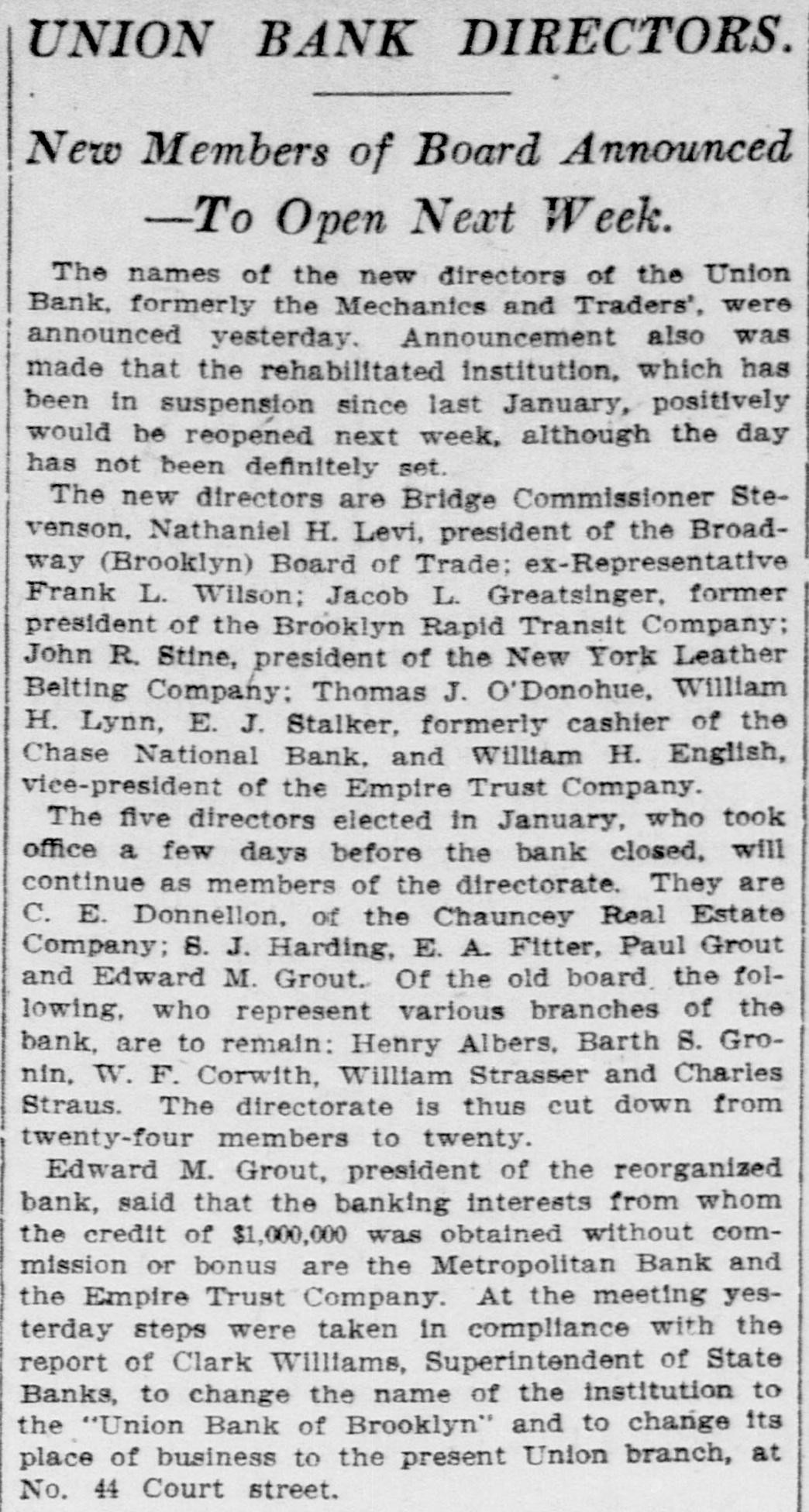
UNION BANK DIRECTORS. New Members of Board Announced -To Open Next Week. The names of the new directors of the Union Bank, formerly the Mechanics and Traders', were announced yesterday. Announcement also was made that the rehabilitated institution, which has been in suspension since last January, positively would be reopened next week, although the day has not been definitely set. The new directors are Bridge Commissioner Stevenson, Nathaniel H. Levi, president of the Broadway (Brooklyn) Board of Trade: ex-Representative Frank L. Wilson; Jacob L. Greatsinger, former president of the Brooklyn Rapid Transit Company; John R. Stine, president of the New York Leather Belting Company: Thomas J. O'Donohue, William H. Lynn, E. J. Stalker, formerly cashier of the Chase National Bank, and William H. English, vice-president of the Empire Trust Company. The five directors elected in January, who took office a few days before the bank closed, will continue as members of the directorate. They are C. E. Donnellon, of the Chauncey Real Estate Company; S. J. Harding, E. A. Fitter, Paul Grout and Edward M. Grout. Of the old board the following, who represent various branches of the bank, are to remain: Henry Albers, Barth S. Gronin, W. F. Corwith, William Strasser and Charles Straus. The directorate is thus cut down from twenty-four members to twenty. Edward M. Grout, president of the reorganized bank, said that the banking interests from whom the credit of $1,000,000 was obtained without commission or bonus are the Metropolitan Bank and the Empire Trust Company. At the meeting yesterday steps were taken in compliance with the report of Clark Williams, Superintendent of State Banks, to change the name of the institution to the "Union Bank of Brooklyn" and to change its place of business to the present Union branch, at No. 44 Court street.
2.August 12, 1908New-York TribuneNew York, NY
Click image to open full size in new tab
Article Text
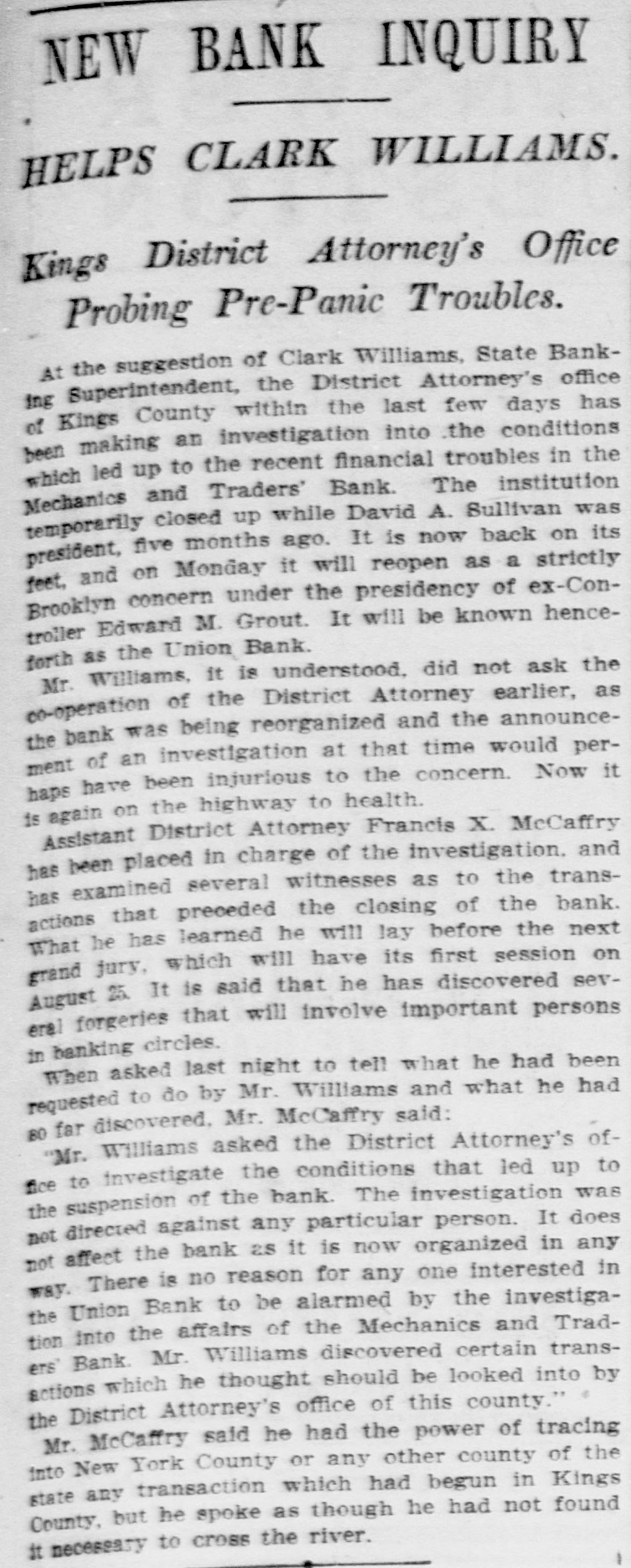
NEW BANK INQUIRY HELPS CLARK WILLIAMS. Kings District Attorney's Office Probing Pre-Panic Troubles. At the suggestion of Clark Williams, State Banking Superintendent, the District Attorney's office of Kings County within the last few days has been making an investigation into the conditions which led up to the recent financial troubles in the Mechanics and Traders' Bank. The institution temporarily closed up while David A. Sullivan was president, five months ago. It is now back on its feet, and on Monday it will reopen as a strictly Brooklyn concern under the presidency of ex-Controller Edward M. Grout. It will be known henceforth as the Union Bank. Mr. Williams, it is understood, did not ask the co-operation of the District Attorney earlier, as the bank was being reorganized and the announcement of an investigation at that time would perhaps have been injurious to the concern. Now it is again on the highway to health. Assistant District Attorney Francis X. McCaffry has been placed in charge of the investigation. and has examined several witnesses as to the transactions that preceded the closing of the bank. What he has learned he will lay before the next grand jury, which will have its first session on August 25. It is said that he has discovered several forgeries that will involve important persons in banking circles. When asked last night to tell what he had been requested to do by Mr. Williams and what he had 80 far discovered, Mr. McCaffry said: "Mr. Williams asked the District Attorney's office to investigate the conditions that led up to the suspension of the bank. The investigation was not directed against any particular person. It does not affect the bank 2S it is now organized in any way. There is no reason for any one interested in the Union Bank to be alarmed by the investigation into the affairs of the Mechanics and Traders Bank Mr. Williams discovered certain transactions which he thought should be looked into by the District Attorney's office of this county." Mr. McCaffry said he had the power of tracing into New York County or any other county of the state any transaction which had begun in Kings County, but he spoke as though he had not found It necessary to cross the river.
3.August 23, 1908New-York TribuneNew York, NY
Click image to open full size in new tab
Article Text
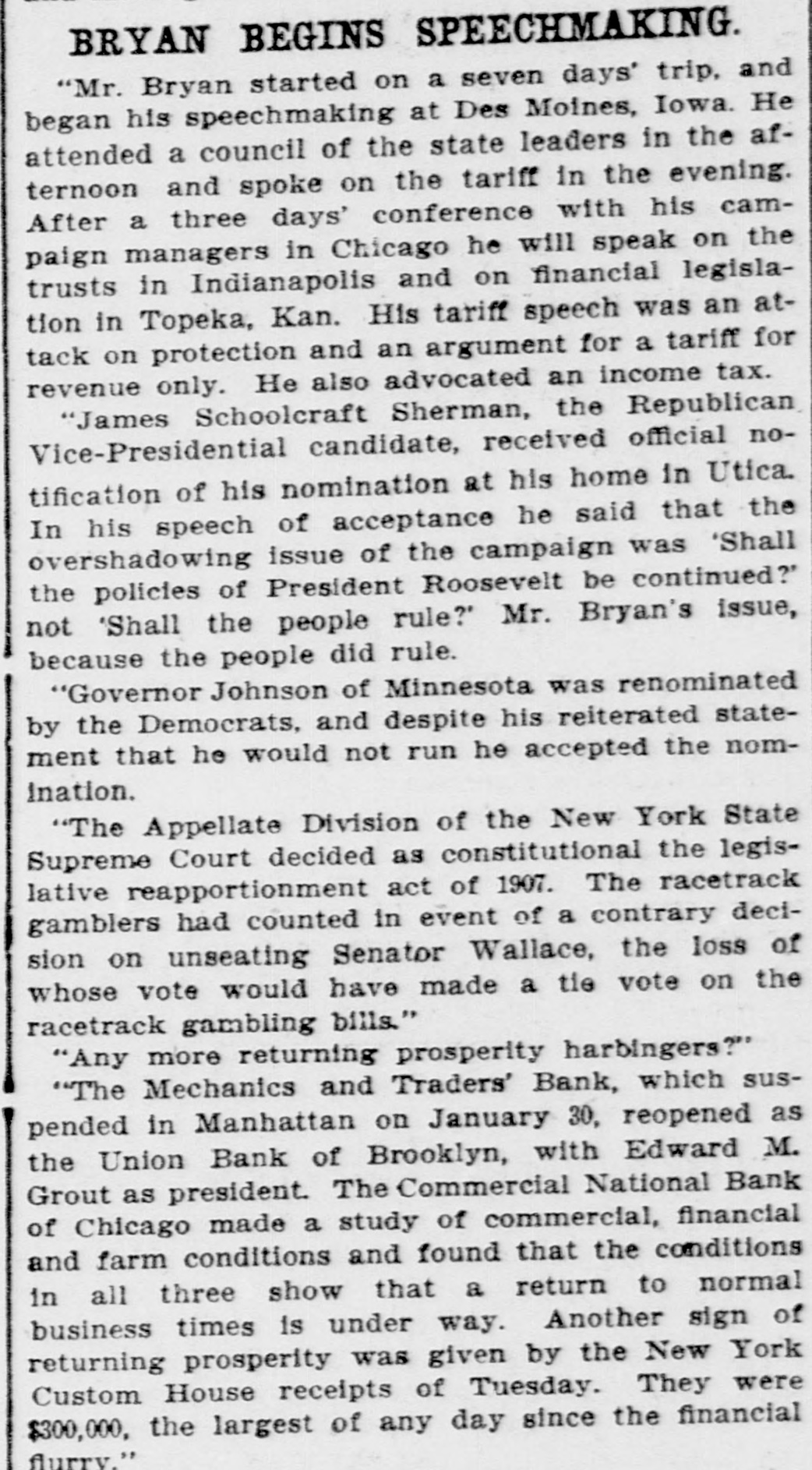
BRYAN BEGINS SPEECHMAKING. "Mr. Bryan started on a seven days' trip, and began his speechmaking at Des Moines, Iowa. He attended a council of the state leaders in the afternoon and spoke on the tariff in the evening. After a three days' conference with his campaign managers in Chicago he will speak on the trusts in Indianapolis and on financial legislation in Topeka, Kan. His tariff speech was an attack on protection and an argument for a tariff for revenue only. He also advocated an income tax. "James Schoolcraft Sherman, the Republican Vice-Presidential candidate, received official notification of his nomination at his home in Utica. In his speech of acceptance he said that the overshadowing issue of the campaign was 'Shall the policies of President Roosevelt be continued?' not 'Shall the people rule?' Mr. Bryan's issue, because the people did rule. "Governor Johnson of Minnesota was renominated by the Democrats, and despite his reiterated statement that he would not run he accepted the nomInation. "The Appellate Division of the New York State Supreme Court decided as constitutional the legislative reapportionment act of 1907. The racetrack gamblers had counted in event of a contrary decision on unseating Senator Wallace, the loss of whose vote would have made a tie vote on the racetrack gambling bills." "Any more returning prosperity harbingers?" "The Mechanics and Traders' Bank, which suspended in Manhattan on January 30, reopened as the Union Bank of Brooklyn, with Edward M. Grout as president. The Commercial National Bank of Chicago made a study of commercial, financial and farm conditions and found that the conditions in all three show that a return to normal business times is under way. Another sign of returning prosperity was given by the New York Custom House receipts of Tuesday. They were $300,000, the largest of any day since the financial flurry."
4.April 6, 1910The Pensacola JournalPensacola, FL
Click image to open full size in new tab
Article Text
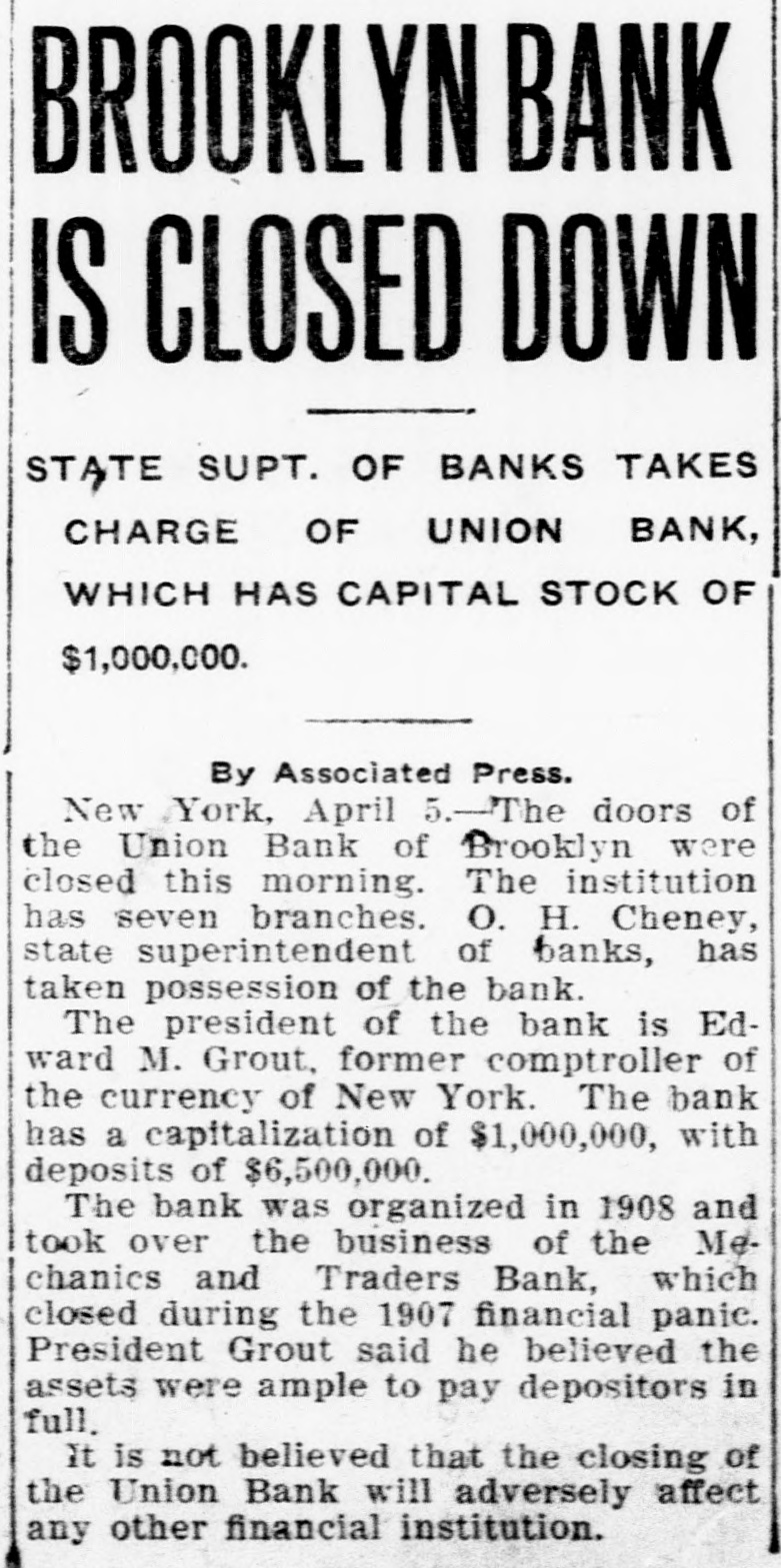
BROOKLYNI BANK IS CLOSED DOWN STATE SUPT. OF BANKS TAKES OF UNION CHARGE BANK, WHICH HAS CAPITAL STOCK OF $1,000,000. By Associated Press. New York, April 5.-The doors of the Union Bank of Brooklyn were closed this morning. The institution has seven branches. O. H. Cheney, state superintendent of banks, has taken possession of the bank. The president of the bank is Edward M. Grout, former comptroller of the currency of New York. The bank has a capitalization of $1,000,000, with deposits of $6,500,000. The bank was organized in 1908 and took over the business of the Mechanics and Traders Bank, which closed during the 1907 financial panic. President Grout said he believed the assets were ample to pay depositors in full. It is not believed that the closing of the Union Bank will adversely affect any other financial institution.
5.April 6, 1910New-York TribuneNew York, NY
Click image to open full size in new tab
Article Text
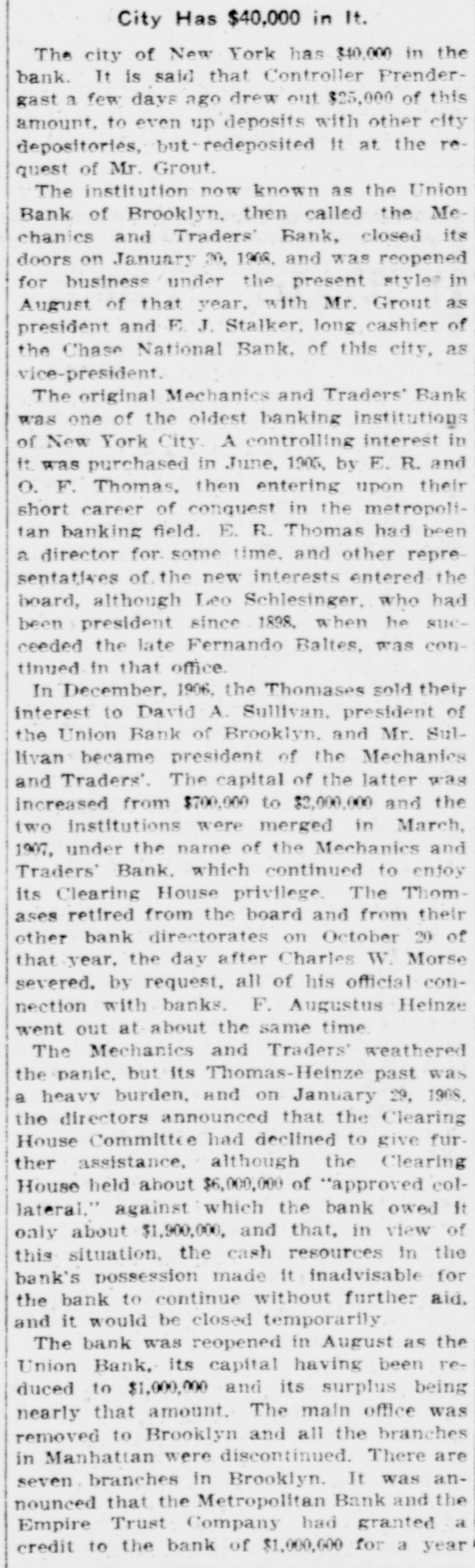
City Has $40,000 in It. The city of New York has $40,000 in the bank. It is said that Controller Prendergast a few days ago drew out $25,000 of this amount, to even up deposits with other city depositories, but-redeposited It at the request of Mr. Grout. The institution now known as the Union Bank of Brooklyn, then called the Mechanics and Traders' Bank, closed its doors on January 20, 1908, and was reopened for business under the present style in August of that year, with Mr. Grout as president and E. J. Stalker. long cashier of the Chase National Bank, of this city, as vice-president. The original Mechanics and Traders' Bank was one of the oldest banking institutions of New York City. A controlling interest in It. was purchased in June, 1905, by E. R. and O. F. Thomas, then entering upon their short career of conquest in the metropolitan banking field. E. R. Thomas had been a director for some time, and other representatives of the new interests entered the board, although Leo Schlesinger. who had been president since 1898, when he succeeded the late Fernando Baltes, was continued in that office. In December, 1906, the Thomases sold their interest to David A. Sullivan, president of the Union Bank of Brooklyn. and Mr. Sullivan became president of the Mechanics and Traders'. The capital of the latter was increased from $700,000 to $2,000,000 and the two Institutions were merged in March, 1907, under the name of the Mechanics and Traders' Bank. which continued to enjoy its Clearing House privilege. The Thomases retired from the board and from their other bank directorates on October 20 of that year, the day after Charles W. Morse severed. by request, all of his official connection with banks. F. Augustus Heinze went out at about the same time. The Mechanics and Traders' weathered the panic, but its Thomas-Heinze past was a heavy burden, and on January 29, 1908, the directors announced that the Clearing House Committee had declined to give further assistance, although the Clearing House held about $6,000,000 of "approved collateral." against which the bank owed It only about $1,900,000, and that, in view of this situation, the cash resources in the bank's possession made it inadvisable for the bank to continue without further aid, and it would be closed temporarily The bank was reopened in August as the Union Bank, its capital having been reduced to $1,000,000 and its surplus being nearly that amount. The main office was removed to Brooklyn and all the branches in Manhattan were discontinued. There are seven branches in Brooklyn. It was announced that the Metropolitan Bank and the Empire Trust Company had granted a credit to the bank of $1,000,000 for a year
6.April 7, 1910Santa Fe New MexicanSanta Fe., Santa Fe, NM
Click image to open full size in new tab
Article Text
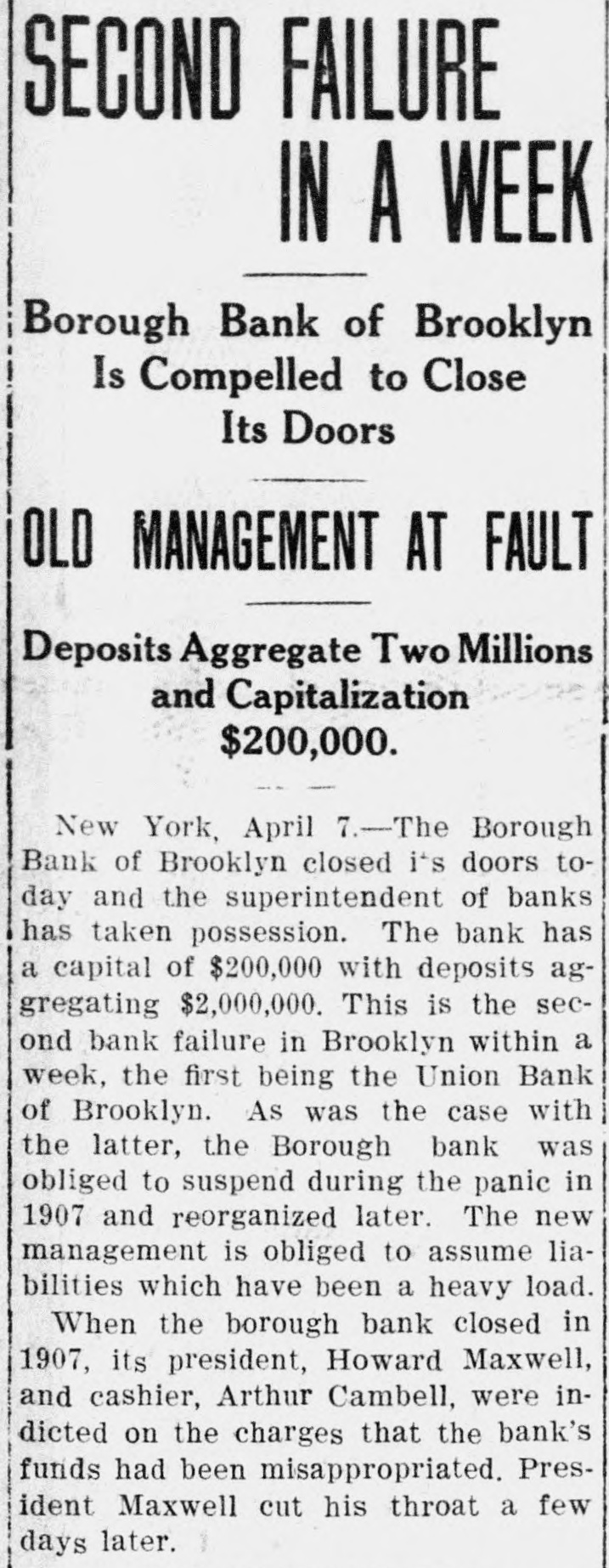
SECOND FAILURE IN A WEEK Borough Bank of Brooklyn Is Compelled to Close Its Doors OLD MANAGEMENT AT FAULT Deposits Aggregate Two Millions and Capitalization $200,000. New York, April 7.-The Borough Bank of Brooklyn closed its doors today and the superintendent of banks has taken possession. The bank has a capital of $200,000 with deposits aggregating $2,000,000. This is the second bank failure in Brooklyn within a week, the first being the Union Bank of Brooklyn. As was the case with the latter, the Borough bank was obliged to suspend during the panic in 1907 and reorganized later. The new management is obliged to assume liabilities which have been a heavy load. When the borough bank closed in 1907, its president, Howard Maxwell, and cashier, Arthur Cambell, were indicted on the charges that the bank's funds had been misappropriated, President Maxwell cut his throat a few I days later.
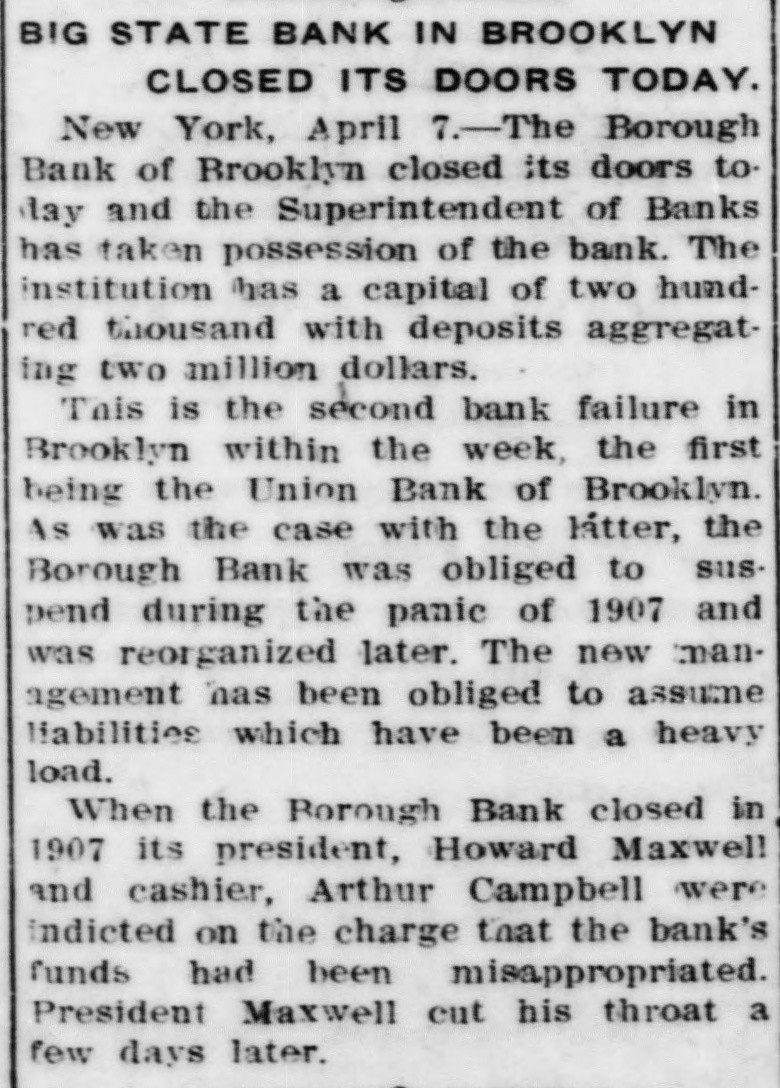
BIG STATE BANK IN BROOKLYN CLOSED ITS DOORS TODAY. New York, April -The Borough Bank of Brooklyn closed its doors to. lay and the Superintendent of Banks has taken possession of the bank. The institution has a capital of two hundred thousand with deposits aggregating two million dollars. This is the second bank failure in Brooklyn within the week, the first being the Union Bank of Brooklyn. As was the case with the latter, the Borough Bank was obliged to suspend during the panic of 1907 and was reorganized later. The new management 'nas been obliged to assume liabilities which have been a heavy load. When the Borough Bank closed in 1907 its president, Howard Maxwell and cashier, Arthur Campbell were indicted on the charge that the bank's funds had been misappropriated. President Maxwell cut his throat a few days later.
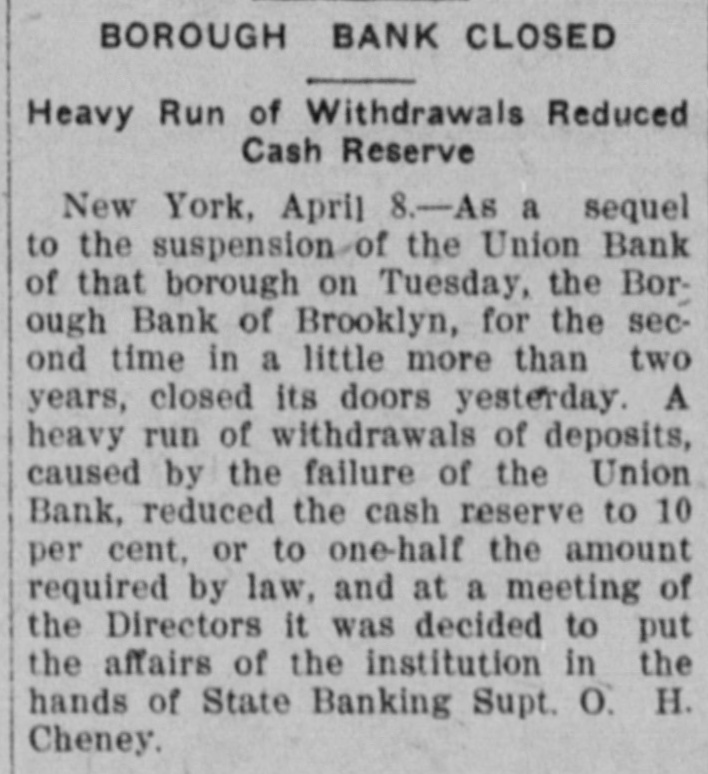
BOROUGH BANK CLOSED Heavy Run of Withdrawals Reduced Cash Reserve New York, April 8.-As a sequel to the suspension of the Union Bank of that borough on Tuesday, the Borough Bank of Brooklyn, for the second time in a little more than two years, closed its doors yesterday. A heavy run of withdrawals of deposits, caused by the failure of the Union Bank, reduced the cash reserve to 10 per cent, or to one-half the amount required by law, and at a meeting of the Directors it was decided to put the affairs of the institution in the hands of State Banking Supt. O. H. Cheney.
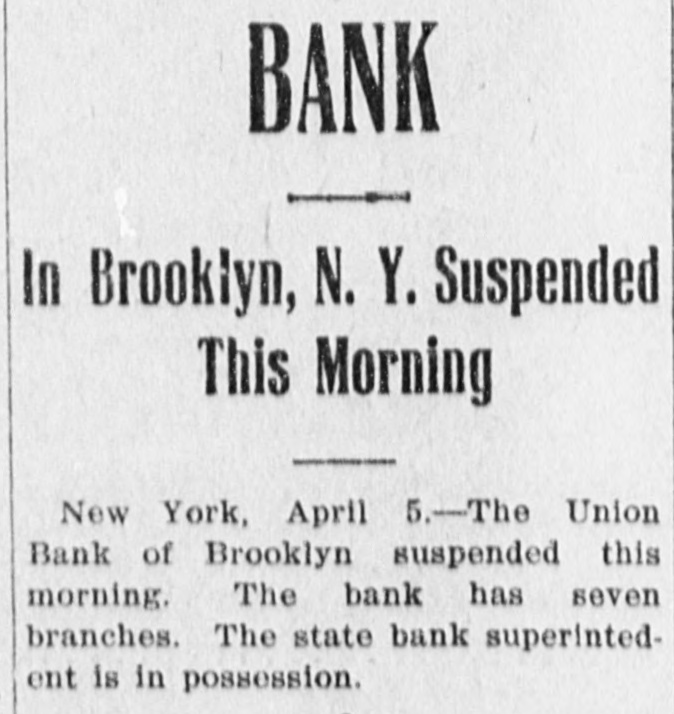
BANK In Brooklyn, N. Y. Suspended This Morning I New York, April 5.-The Union Bank of Brooklyn suspended this morning. The bank has seven branches. The state bank superintedent is in possession.
10.April 8, 1910Watertown LeaderWatertown, WI
Click image to open full size in new tab
Article Text
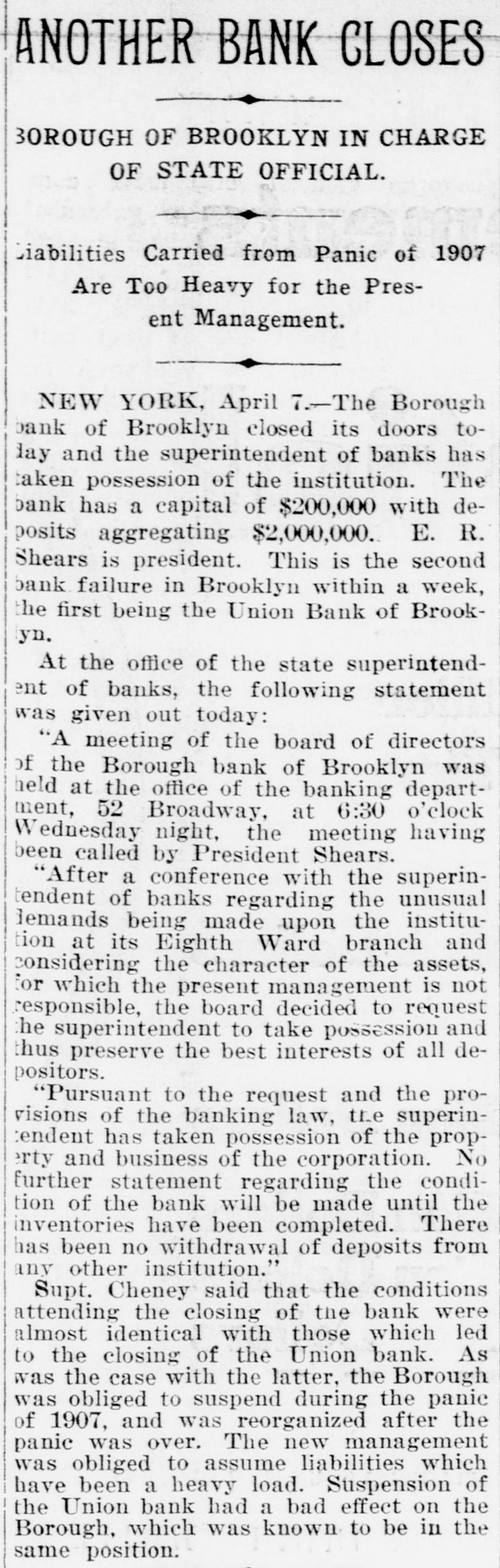
ANOTHER BANK CLOSES BOROUGH OF BROOKLYN IN CHARGE OF STATE OFFICIAL. Liabilities Carried from Panic of 1907 Are Too Heavy for the Present Management. NEW YORK, April 7.-The Borough bank of Brooklyn closed its doors today and the superintendent of banks has taken possession of the institution. The bank has a capital of $200,000 with deposits aggregating $2,000,000. E. R. Shears is president. This is the second bank failure in Brooklyn within a week, the first being the Union Bank of Brookyn. At the office of the state superintendent of banks, the following statement was given out today: "A meeting of the board of directors of the Borough bank of Brooklyn was held at the office of the banking department, 52 Broadway, at 6:30 o'clock Wednesday night, the meeting having been called by President Shears. "After a conference with the superintendent of banks regarding the unusual demands being made upon the institution at its Eighth Ward branch and considering the character of the assets, for which the present management is not responsible, the board decided to request the superintendent to take possession and thus preserve the best interests of all depositors. "Pursuant to the request and the provisions of the banking law, the superin:endent has taken possession of the property and business of the corporation. No further statement regarding the condition of the bank will be made until the inventories have been completed. There has been no withdrawal of deposits from any other institution.' Supt. Cheney said that the conditions attending the closing of the bank were almost identical with those which led to the closing of the Union bank. As was the case with the latter, the Borough was obliged to suspend during the panie of 1907, and was reorganized after the panic was over. The new management was obliged to assume liabilities which have been a heavy load. Suspension of the Union bank had a bad effect on the Borough, which was known to be in the same position.
11.April 9, 1910The Washington TimesWashington, DC
Click image to open full size in new tab
Article Text
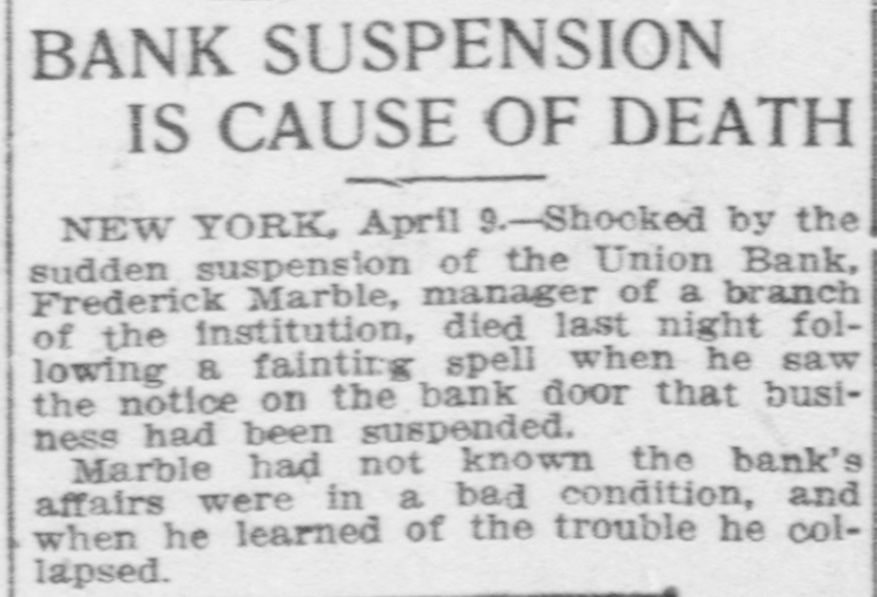
BANK SUSPENSION IS CAUSE OF DEATH NEW YORK, April 9.-Shocked by the sudden suspension of the Union Bank, Frederick Marble, manager of a branch of the institution, died last night following a fainting spell when he saw the notice on the bank door that business had been suspended. Marble had not known the bank's affairs were in a bad condition, and when he learned of the trouble he collapsed.
12.April 13, 1910New-York TribuneNew York, NY
Click image to open full size in new tab
Article Text
HORACE S. ANDREWS APPOINTED Horace S. Andrews, one of the examiners of the state Banking Department, was appointed by Superintendent Cheney yesterday to take charge of the liquidation of the Borough Bank of Brooklyn, which closed its doors on April 7 on account of heavy withdrawals by depositors who had become frightened at the suspension of the Union Bank of Brooklyn two days before
13.April 15, 1910Dakota Farmers' LeaderCanton, SD
Click image to open full size in new tab
Article Text
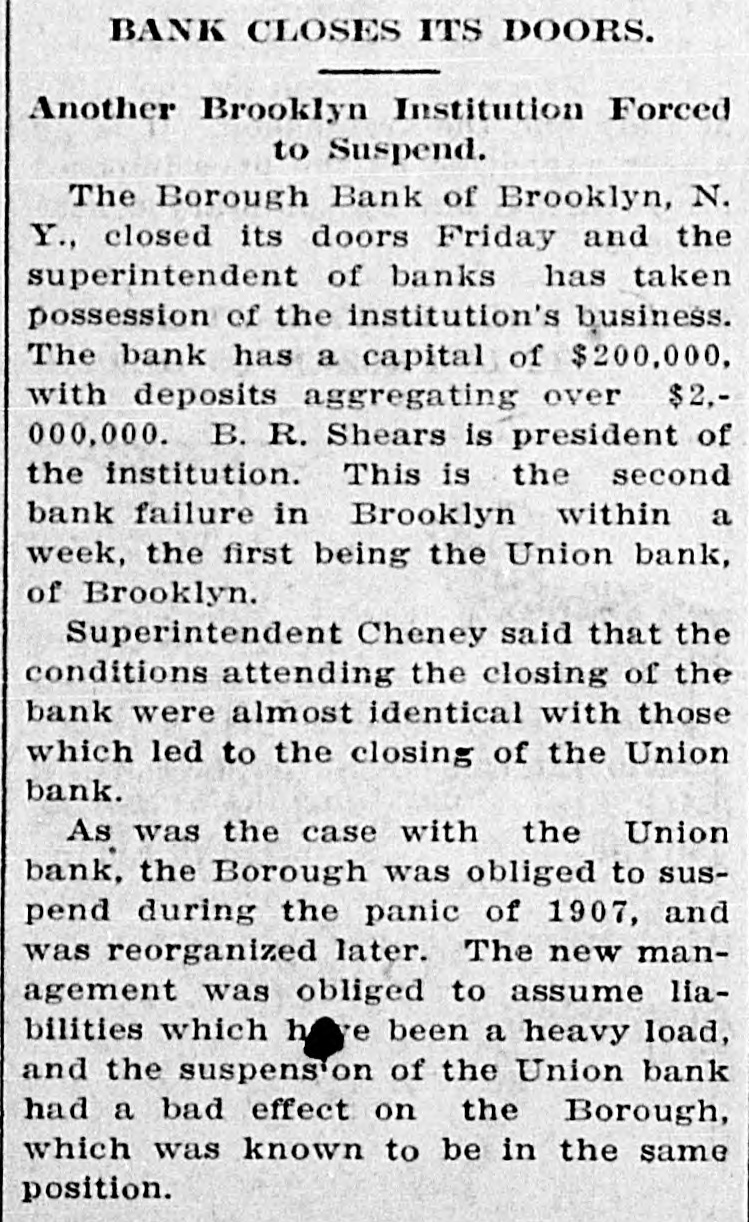
BANK CLOSES ITS DOORS. Another Brooklyn Institution Forced to Suspend. The Borough Bank of Brooklyn, N. Y., closed its doors Friday and the superintendent of banks has taken possession of the institution's business. The bank has a capital of $200,000, with deposits aggregating over $2,000,000. B. R. Shears is president of the institution. This is the second bank failure in Brooklyn within a week, the first being the Union bank, of Brooklyn. Superintendent Cheney said that the conditions attending the closing of the bank were almost identical with those which led to the closing of the Union bank. As was the case with the Union bank, the Borough was obliged to suspend during the panic of 1907, and was reorganized later. The new management was obliged to assume liabilities which h been a heavy load, and the suspension of the Union bank had a bad effect on the Borough, which was known to be in the same position.
14.December 29, 1910The Evening WorldNew York, NY
Click image to open full size in new tab
Article Text
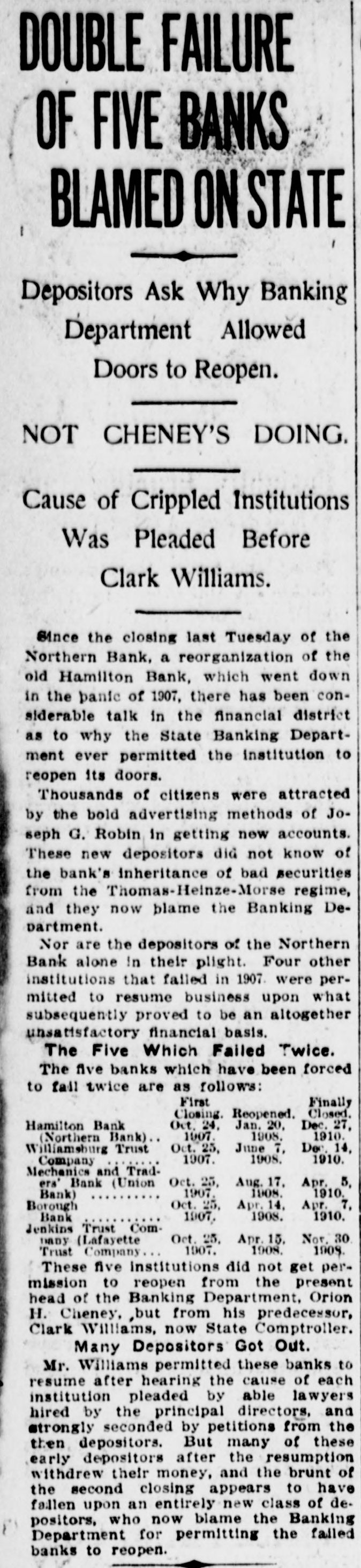
# DOUBLE FAILURE OF FIVE BANKS BLAMED ON STATE
Depositors Ask Why Banking Department Allowed Doors to Reopen.
NOT CHENEY'S DOING.
Cause of Crippled Institutions Was Pleaded Before Clark Williams.
Since the closing last Tuesday of the Northern Bank, a reorganization of the old Hamilton Bank, which went down in the panic of 1907, there has been considerable talk in the financial district as to why the State Banking Department ever permitted the institution to reopen its doors.
Thousands of citizens were attracted by the bold advertising methods of Joseph G. Robin in getting new accounts. These new depositors did not know of the bank's inheritance of bad securities from the Thomas-Heinze-Morse regime, and they now blame the Banking Department.
Nor are the depositors of the Northern Bank alone in their plight. Four other institutions that failed in 1907 were permitted to resume business upon what subsequently proved to be an altogether unsatisfactory financial basis.
The Five Which Failed Twice.
The five banks which have been forced to fall twice are as follows:
| | First Closing. | Reopened. | Finally Closed. |
| :---------------------------- | :------------- | :-------- | :------------- |
| Hamilton Bank (Northern Bank) | Oct. 24, 1907. | Jan. 20, 1908. | Dec. 27, 1910. |
| Williamsburg Trust Company | Oct. 25, 1907. | June 7, 1908. | Dec. 14, 1910. |
| Mechanics and Traders' Bank (Union Bank) | Oct. 25, 1907. | Aug. 17, 1908. | Apr. 5, 1910. |
| Borough Bank | Oct. 25, 1907. | Apr. 14, 1908. | Apr. 7, 1910. |
| Jenkins Trust Company (Lafayette Trust Company | Oct. 25, 1907. | Apr. 15, 1908. | Nov. 30, 1909. |
These five institutions did not get permission to reopen from the present head of the Banking Department, Orion H. Cheney, but from his predecessor, Clark Williams, now State Comptroller.
Many Depositors Got Out.
Mr. Williams permitted these banks to resume after hearing the cause of each institution pleaded by able lawyers hired by the principal directors, and strongly seconded by petitions from the then depositors. But many of these early depositors after the resumption withdrew their money, and the brunt of the second closing appears to have fallen upon an entirely new class of depositors, who now blame the Banking Department for permitting the failed banks to reopen.
15.May 3, 1911The Evening WorldNew York, NY
Click image to open full size in new tab
Article Text
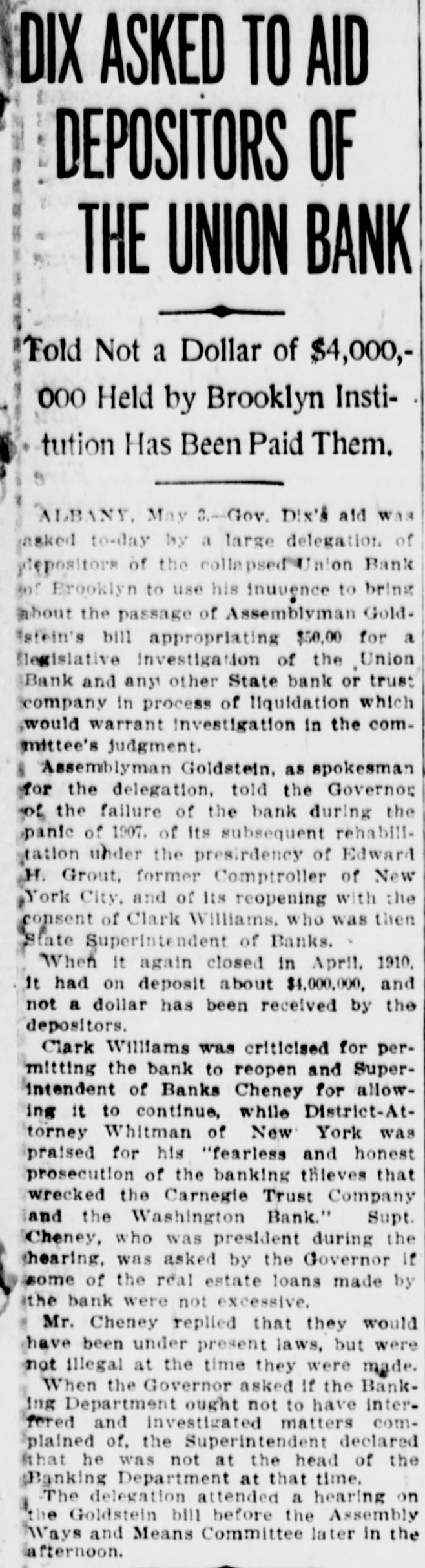
DIX ASKED TO AID DEPOSITORS OF THE UNION BANK Fold Not a Dollar of $4,000,000 Held by Brooklyn Institution Has Been Paid Them. ALBANY, May 3.-Gov. Dix's aid was asked to-day by a large delegation of depositors of the collapsed Union Bank Brooklyn to use his inuuence to bring bout the passage of Assemblyman Gold'stein's bill appropriating $50,00 for a legislative investigation of the Union Bank and any other State bank or trust company in process of liquidation which would warrant investigation in the committee's judgment. Assemblyman Goldstein, as spokesman for the delegation, told the Governor of the failure of the bank during the panic of 1907, of its subsequent rehabilltation under the presirdency of Edward H. Grout, former Comptroller of New York City, and of its reopening with the consent of Clark Williams. who was then State Superintendent of Banks. When it again closed in April, 1910. 1t had on deposit about $4,000,000, and not a dollar has been received by the depositors. Clark Williams was criticised for permitting the bank to reopen and Superintendent of Banks Cheney for allowing it to continue, while District-Attorney Whitman of New York was praised for his "fearless and honest prosecution of the banking thieves that wrecked the Carnegie Trust Company and the Washington Bank." Supt. Cheney, who was president during the thearing, was asked by the Governor if some of the real estate loans made by the bank were not excessive. Mr. Cheney replied that they would have been under present laws, but were not illegal at the time they were made. When the Governor asked If the Banking Department ought not to have interfered and investigated matters complained of, the Superintendent declared that he was not at the head of the Banking Department at that time. The delegation attended a hearing on the Goldstein bill before the Assembly Ways and Means Committee later in the afternoon.
16.July 31, 1911The Evening WorldNew York, NY
Click image to open full size in new tab
Article Text
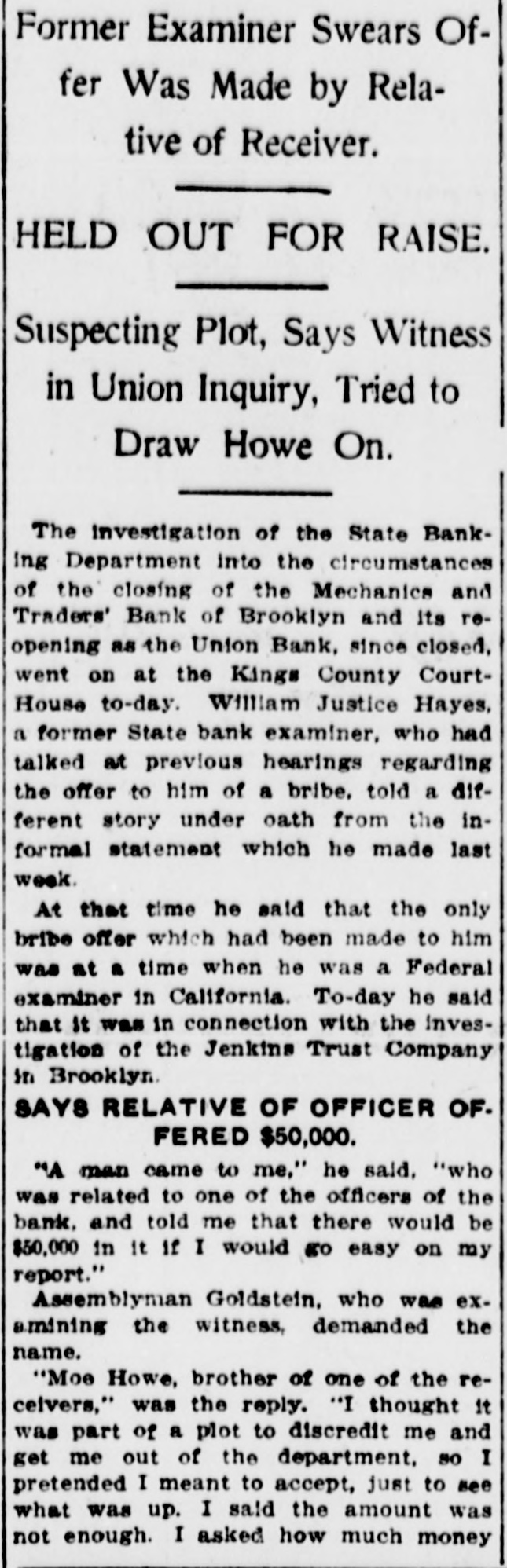
Former Examiner Swears Offer Was Made by Relative of Receiver. HELD OUT FOR RAISE. Suspecting Plot, Says Witness in Union Inquiry, Tried to Draw Howe On. The investigation of the State Banking Department into the circumstances of the closing of the Mechanics and Traders' Bank of Brooklyn and its reopening as the Union Bank, since closed, went on at the Kings County CourtHouse to-day. William Justice Hayes, a former State bank examiner, who had talked at previous hearings regarding the offer to him of a bribe, told a different story under oath from the informal statement which he made last week. At that time he said that the only bribe offer which had been made to him was at a time when he was a Federal examiner in California. To-day he said that it was in connection with the investigation of the Jenkins Trust Company in Brooklyn says RELATIVE OF OFFICER OFFERED $50,000. "A man came to me," he said, "who was related to one of the officers of the bank, and told me that there would be $50,000 in it if I would go easy on my report." Assemblyman Goldstein, who was examining the witness, demanded the name. "Moe Howe, brother of one of the receivers," was the reply. "I thought it was part of a plot to discredit me and get me out of the department, so I pretended I meant to accept, just to see what was up. I said the amount was not enough. I asked how much money
17.September 2, 1911The Evening WorldNew York, NY
Click image to open full size in new tab
Article Text
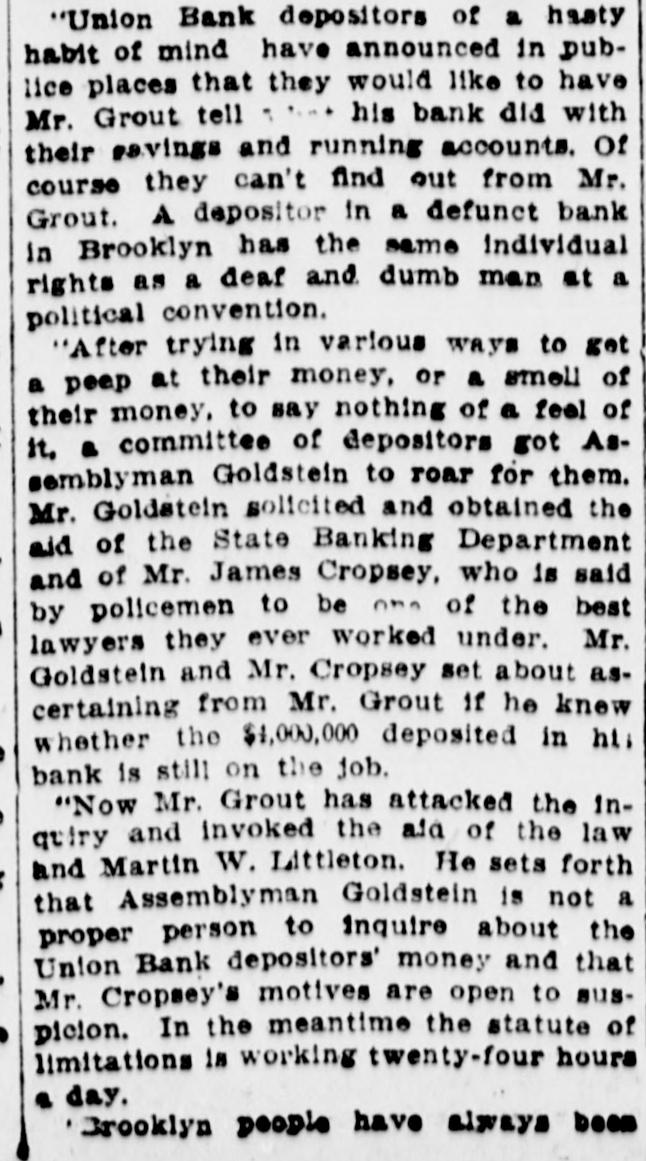
"Union Bank depositors of a hasty habit of mind have announced in publice places that they would like to have Mr. Grout tell - his bank did with their gavings and running accounts. of course they can't find out from Mr. Grout. A depositor in a defunct bank in Brooklyn has the same individual rights as a deaf and dumb man at a political convention. "After trying in various ways to get a peep at their money, or a smell of their money. to say nothing of a feel of it. a committee of depositors got Assemblyman Goldstein to roar for them. Mr. Goldstein solicited and obtained the aid of the State Banking Department and of Mr. James Cropsey, who is said by policemen to be one of the best lawyers they ever worked under. Mr. Goldstein and Mr. Cropsey set about a.scertaining from Mr. Grout if he knew whether the $4,000,000 deposited in hi; bank is still on the job. "Now Mr. Grout has attacked the inquiry and invoked the aid of the law and Martin W. Littleton. He sets forth that Assemblyman Goldstein is not a proper person to inquire about the Union Bank depositors' money and that Mr. Cropsey's motives are open to suspicion. In the meantime the statute of limitations is working twenty-four hours a day. Brooklyn people have always been
18.October 12, 1911The Salt Lake TribuneSalt Lake City, UT
Click image to open full size in new tab
Article Text
Charged With Falsifying Records. NEW YORK, Oct. 11.-Indictments charging misdemeanors in making false reports to the state banking department were found by the grand jury today against former City Comptroller Edward M. Grout and James T. Ashley, cashier of the suspended Union bank of BrookIsn. of which Grout was president. Both pleaded not guilty.
19.October 12, 1911The Barre Daily TimesBarre, VT
Click image to open full size in new tab
Article Text
# E. M. GROUT INDICTED.
Former City Comptroller Charged With Manslaughter.
New York, Oct. 12.-Indictments charging misdemeanors in making false reports to the state banking department were found by the grand jury yesterday against former City Comptroller Edward M. Grout and James T. Ashley, cashier of the suspended Union Bank of Brooklyn, of which Grout was president. Both pleaded not guilty and were paroled in the custody of their counsel. Mr. Grout issued a statement, assuring his friends of his innocence.
20.October 12, 1911Omaha Daily BeeOmaha, NE
Click image to open full size in new tab
Article Text
# FORMER CONTROLLER GROUT
# INDICTED BY GRAND JURY
NEW YORK, Oct. 11.-Indictments charging misdemeanors in making false reports to the State Banking department were found by the grand jury today against former City Comptroller Edward M. Grout and James T. Ashley, cashier of the suspended Union bank of Brooklyn, of which Grout was president. Both pleaded not guilty and were paroled in the custody of their counsel.
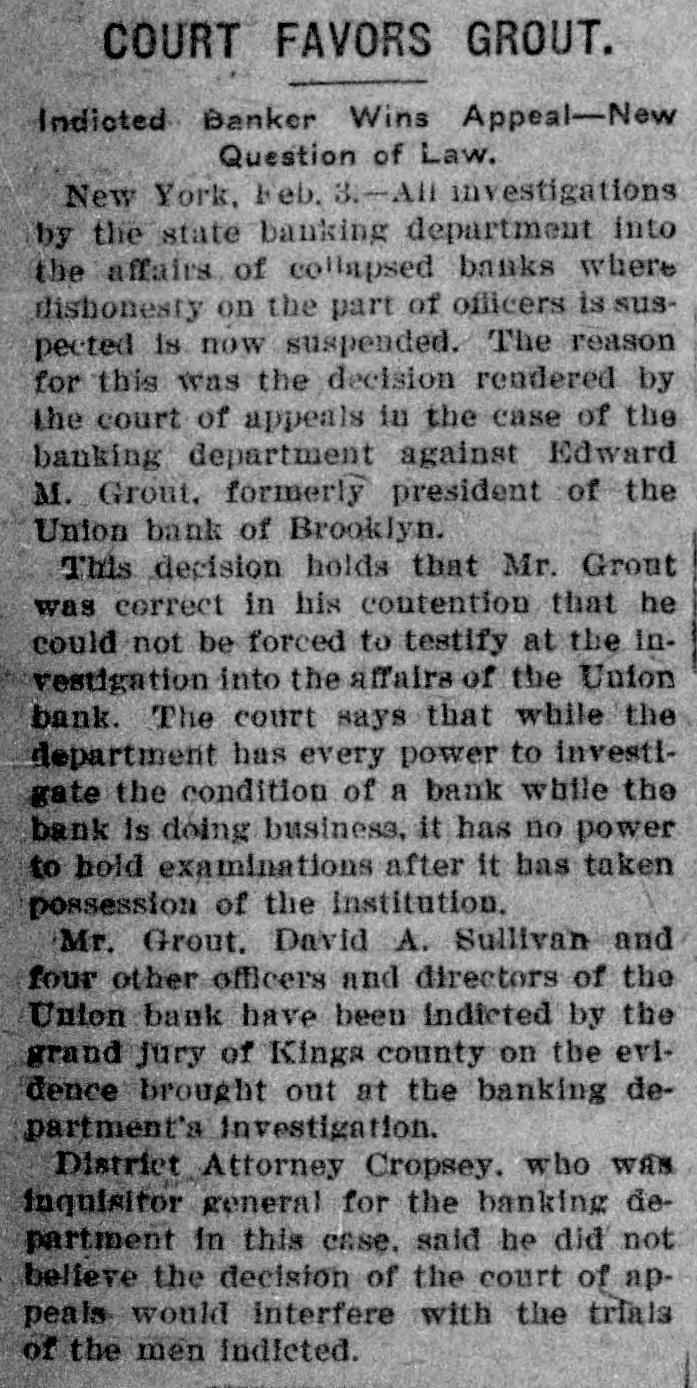
COURT FAVORS GROUT. Indicted Banker Wins Appeal-New Question of Law. New York, Feb. 3:-AH investigations by the state banking department into the affairs of collapsed banks where dishonesty on the part of officers is suspected is now suspended. The reason for this was the decision rendered by the court of appeals in the case of the banking department against Edward M. Grout, formerly president of the Union bank of Brooklyn. This decision holds that Mr. Grout was correct in his contention that he could not be forced to testify at the investigation into the affairs of the Union bank. The court says that while the department has every power to investigate the condition of a bank while the bank is doing business, it has no power to hold examinations after it has taken possession of the Institution. Mr. Grout. David A. Sullivan and four other officers and directors of the Union bank have been indicted by the grand jury of Kings county on the evidence brought out at the banking department's investigation. District Attorney Cropsey. who was inquisitor general for the banking department in this case. said he did not believe the decision of the court of appeals would interfere with the trials of the men indicted.
22.May 28, 1912New-York TribuneNew York, NY
Click image to open full size in new tab
Article Text
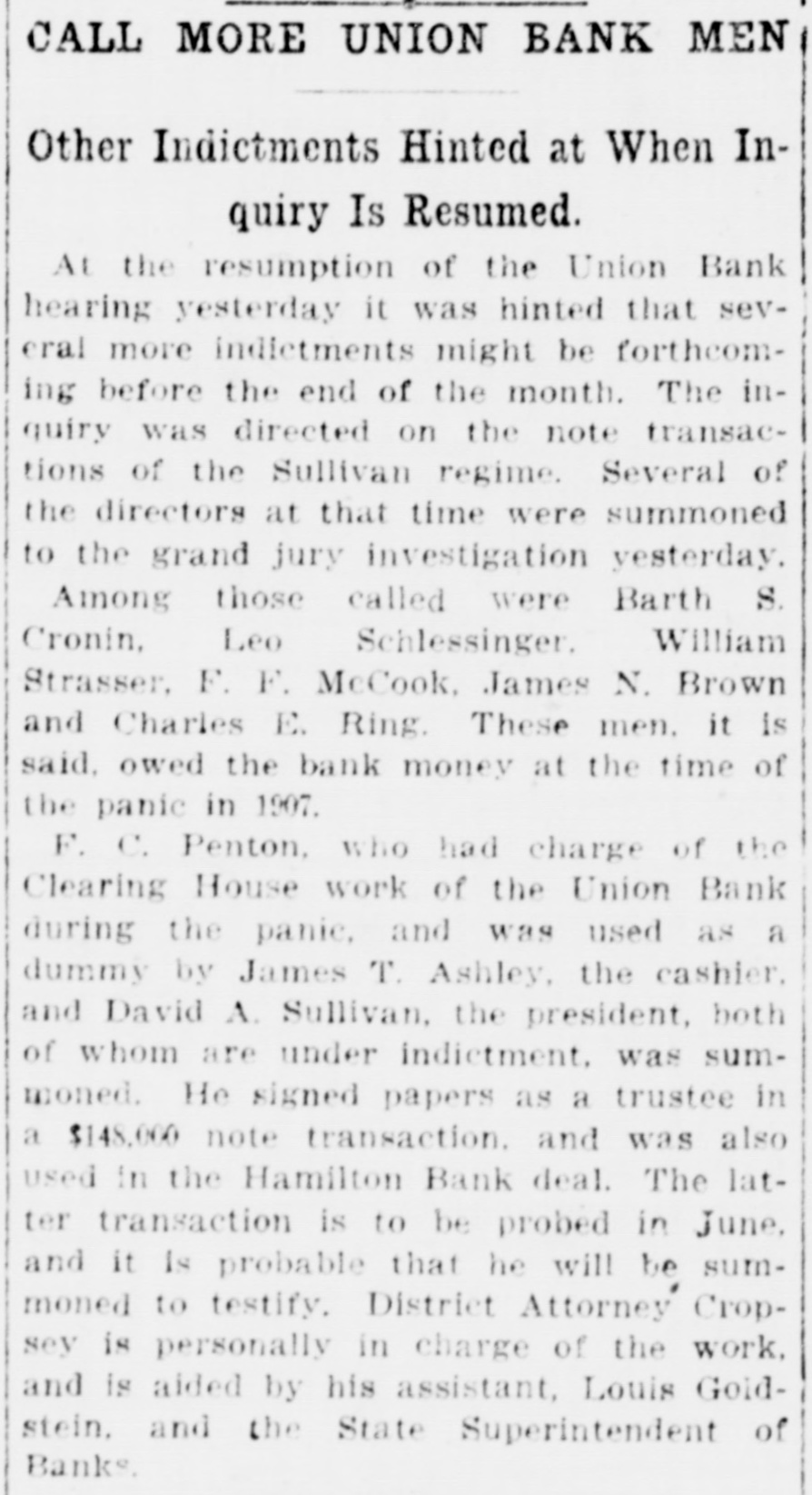
CALL MORE UNION BANK MEN Other Indictments Hinted at When Inquiry Is Resumed. At the resumption of the Union Bank hearing yesterday it was hinted that several more indictments might be forthcoming before the end of the month. The inquiry was directed on the note transactions of the Sullivan regime. Several of the directors at that time were summoned to the grand jury investigation yesterday. Among those called were Barth S. Cronin, Leo Schlessinger. William Strasser, F. F. McCook, James N. Brown and Charles E. Ring. These men. it is said, owed the bank money at the time of the panic in 1907. F. C. Penton, who had charge of the Clearing House work of the Union Bank during the panie, and was used as a dummy by James T. Ashley, the cashier. and David A. Sullivan, the president, both of whom are under indictment, was summoned. He signed papers as a trustee in a $148,000 note transaction. and was also used in the Hamilton Bank deal. The latter transaction is to be probed in June, and it is probable that he will be summoned to testify. District Attorney Cropsey is personally in charge of the work, and is aided by his assistant, Louis Goldstein. and the State Superintendent of Banks.
23.November 4, 1915The SunNew York, NY
Click image to open full size in new tab
Article Text
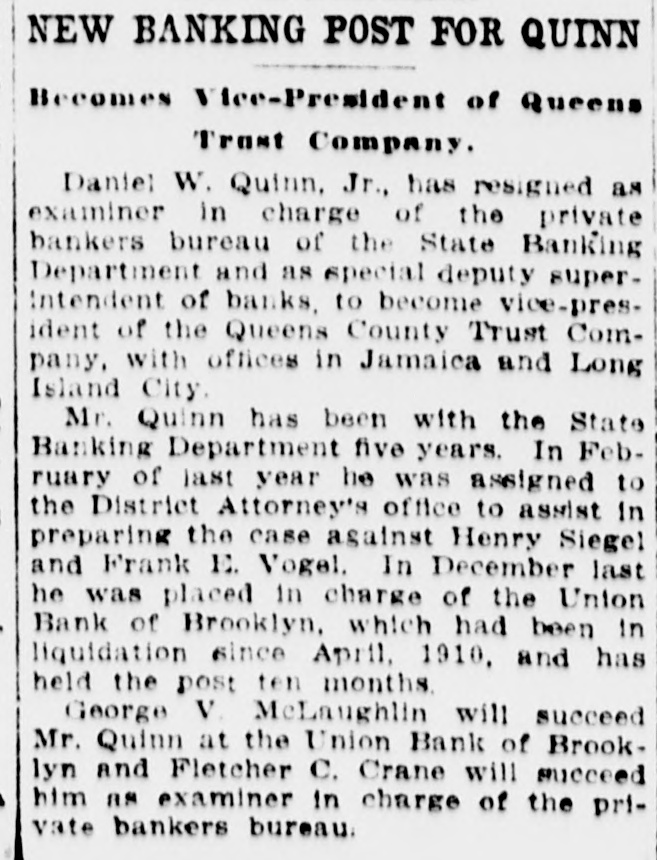
NEW BANKING POST FOR QUINN Becomes Vice-President of Queens Trust Company. Daniel W. Quinn, Jr., has resigned as examiner in charge of the private bankers bureau of the State Banking Department and as special deputy superIntendent of banks, to become vice-president of the Queens County Trust Company, with offices in Jamaica and Long Island City. Mr. Quinn has been with the State Banking Department five years. In February of last year he was assigned to the District Attorney's office to assist in preparing the case against Henry Siegel and Frank E. Vogel. In December last he was placed in charge of the Union Bank of Brooklyn, which had been in liquidation since April, 1910, and has held the post ten months. George V. McLaughlin will succeed Mr. Quinn at the Union Bank of Brooklyn and Fletcher C. Crane will succeed him as examiner in charge of the private bankers bureau.
24.November 11, 1916The SunNew York, NY
Click image to open full size in new tab
Article Text
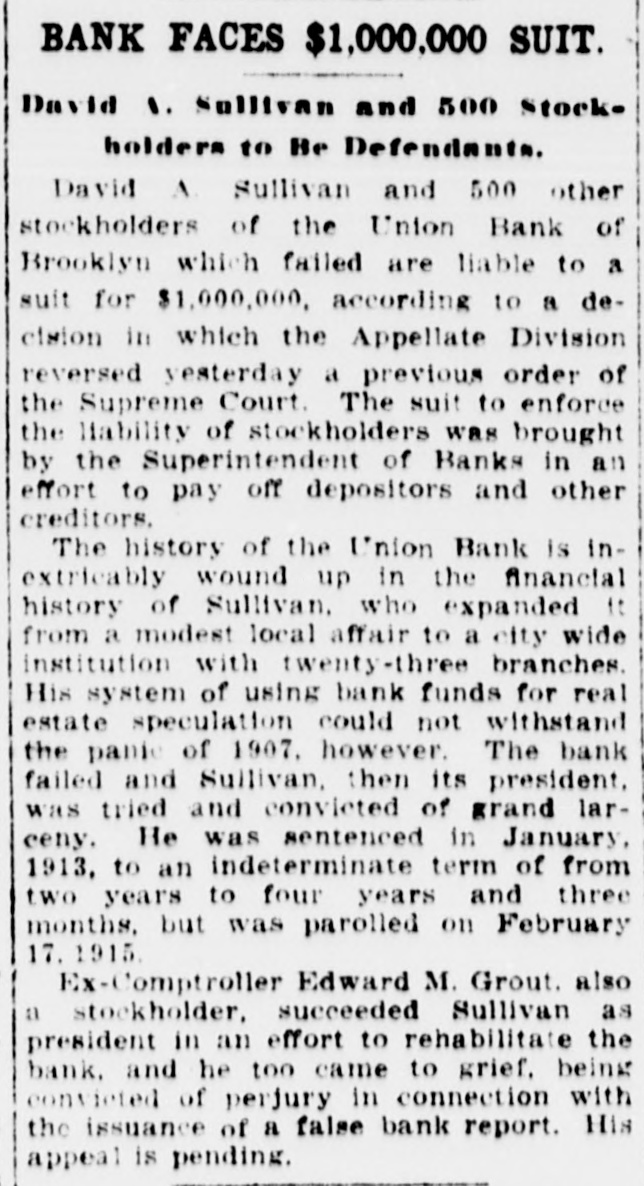
BANK FACES $1,000,000 SUIT. David 1. Sullivan and 500 Stockholders to Be Defendants. David A. Sullivan and 500 other stockholders of the Union Bank of Brooklyn which failed are liable to a suit for $1,000,000, according to a decision in which the Appellate Division reversed yesterday a previous order of the Supreme Court. The suit to enforce the liability of stockholders was brought by the Superintendent of Banks in an effort to pay off depositors and other creditors. The history of the Union Bank is inextricably wound up in the financial history of Sullivan, who expanded It from a modest local affair to a city wide institution with twenty-three branches. His system of using bank funds for real estate speculation could not withstand the panic of 1907. however. The bank failed and Sullivan, then its president. was tried and convicted of grand lareeny. He was sentenced in January, 1913, to an indeterminate term of from two years to four years and three months, but was parolled on February 17. 1915. Ex-Comptroller Edward M. Grout. also a stockholder. succeeded Sullivan as president in an effort to rehabilitate the bank. and he too came to grief. being convicted of perjury in connection with the issuance of a false bank report. His appeal is pending.
Bank runs are almost always and everywhere a deterioration of bank fundamentals.
But not for you.
You are the measure-zero exception: great fundamentals, solid bank, and yet the Diamond Dybvig fairy spread its rumor. Depositors woke up. Your collateral was not prepositioned. The Clearinghouse had it for you.
Do not pass Go. Do not collect $200. Go directly to jail… or worse.