Article Text
RUN ON BANK.
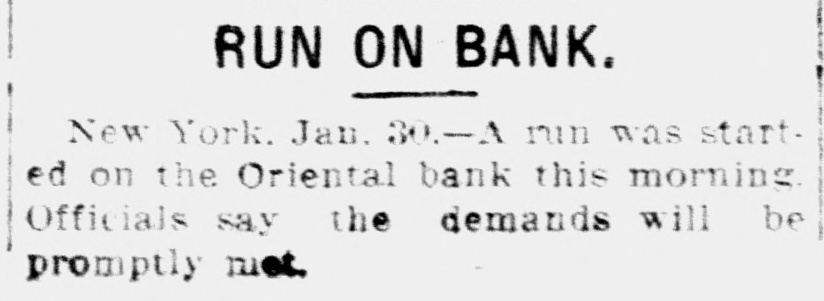
New York, Jan. 30.—A run was started on the Oriental bank this morning. Officials say the demands will be promptly met.
Click image to open full size in new tab
New York, Jan. 30.—A run was started on the Oriental bank this morning. Officials say the demands will be promptly met.
Click image to open full size in new tab
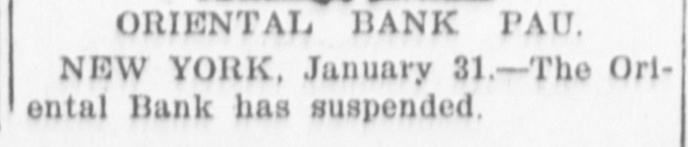
NEW YORK, January 31.-The Oriental Bank has suspended
Click image to open full size in new tab
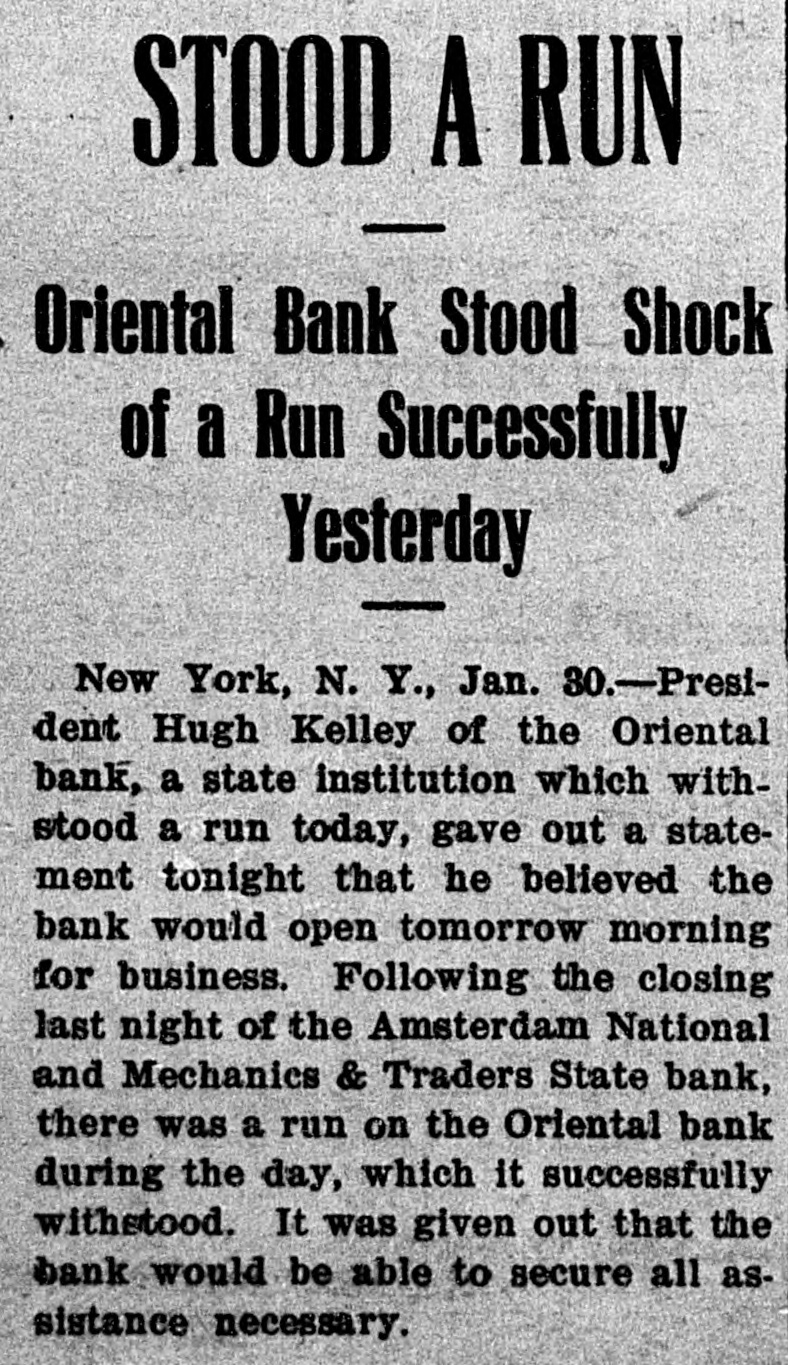
STOOD A RUN I Oriental Bank Stood Shock of a Run Successfully Yesterday I New York, N. Y., Jan. 30.-President Hugh Kelley of the Oriental bank, a state institution which withstood a run today, gave out a statement tonight that he believed the bank would open tomorrow morning for business. Following the closing last night of the Amsterdam National and Mechanics & Traders State bank, there was a run on the Oriental bank during the day, which it successfully withstood. It was given out that the bank would be able to secure all assistance necessary.
Click image to open full size in new tab
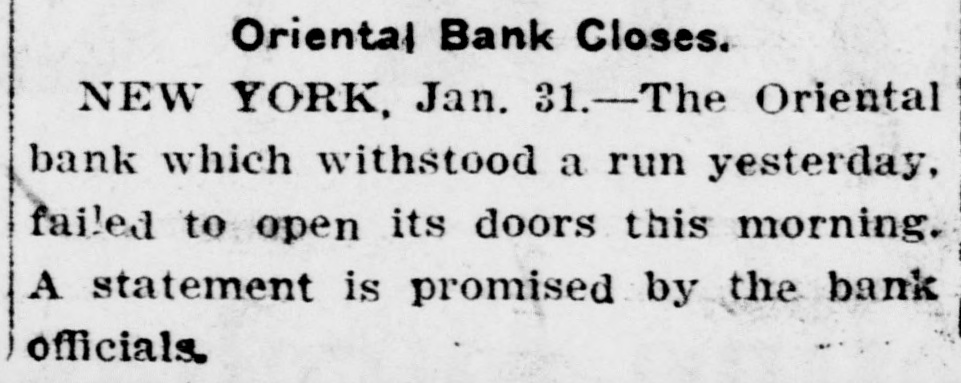
NEW YORK, Jan. 31.-The Oriental bank which withstood a run yesterday, failed to open its doors this morning. A statement is promised by the bank officials.
Click image to open full size in new tab
BANK REMAINS CLOSED NEW YORK, Jan. 31.-The Oriental bank, which withstood a run yesterday, failed to open its doors this morning. A statement is promised by the bank officials.
Click image to open full size in new tab
Another New York Bank Fails, New York, Jan. 31.-The Oriental bank, which withstood the run yesterdaq, failed to open its doors this morning. A statement is promised by the bank officials.
Click image to open full size in new tab
New York, Jan, 31.-The Oriental bank, on which a run was started yesterday, did not open for business today. A notice was posted announcing that the bank had been closed by order of the state superintendent of banks.
Click image to open full size in new tab
President Hugh Kelley of the Ortental Bank of New York, a state institution which withstood a run Thursday, issued a statement late Thursday night that he believed the bank would open Friday morning for business. A meeting of the directors will be held at 9 A. M. Friday. he added, at which the question of opening will be definitely determined.
Click image to open full size in new tab
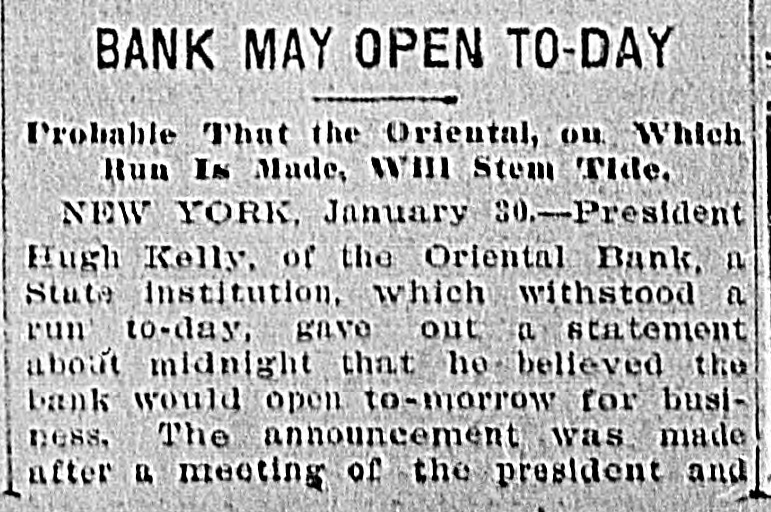
BANK MAY OPEN TO-DAY Probable That the Oriental, on Which Run Is Made, will Stem Tide. NEW YORK, January 30.-President Hugh Kelly, of the Oriental Bank, IL State institution, which withstood a run to-day, gave out a statement about midnight that he believed the bank would open to-morrow for business, The announcement was made after a meeting of the president and

Click image to open full size in new tab
NEW YORK, January 31.-The Oriental Bank has suspended. if
Click image to open full size in new tab
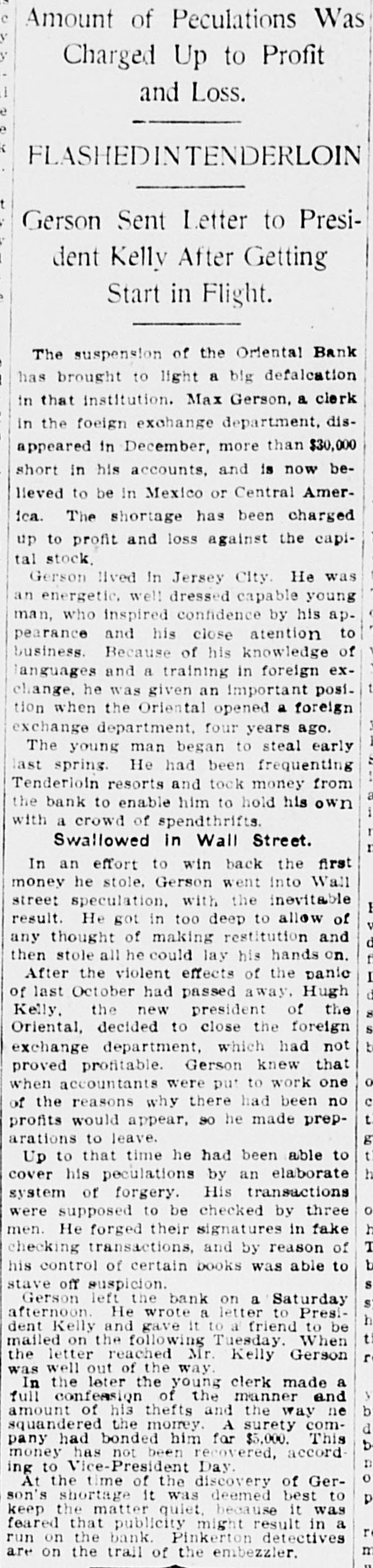
Amount of Peculations Was Charged Up to Profit and Loss.
Gerson Sent Letter to President Kelly After Getting Start in Flight.
The suspension of the Oriental Bank has brought to light a big defalcation in that institution. Max Gerson, a clerk in the foeign exchange department, disappeared in December, more than $30,000 short in his accounts, and is now believed to be in Mexico or Central America. The shortage has been charged up to profit and loss against the capital stock.
Gerson lived in Jersey City. He was an energetic, well dressed capable young man, who inspired confidence by his appearance and his close atention to business. Because of his knowledge of languages and a training in foreign exchange, he was given an Important position when the Oriental opened a foreign exchange department, four years ago. The young man began to steal early last spring. He had been frequenting Tenderloin resorts and tock money from the bank to enable him to hold his own with a crowd of spendthrifts.
Swallowed in Wall Street.
In an effort to win back the first money he stole, Gerson went into Wall street speculation, with the inevitable result. He got in too deep to allow of any thought of making restitution and then stole all he could lay his hands on. After the violent effects of the panic of last October had passed away, Hugh Kelly, the new president of the Oriental, decided to close the foreign exchange department, which had not proved profitable. Gerson knew that when accountants were put to work one of the reasons why there had been no profits would appear, so he made preparations to leave.
Up to that time he had been able to cover his peculations by an elaborate system of forgery. His transactions were supposed to be checked by three men. He forged their signatures in fake checking transactions, and by reason of his control of certain books was able to stave off suspicion.
Gerson left the bank on a Saturday afternoon. He wrote a letter to President Kelly and gave it to a friend to be mailed on the following Tuesday. When the letter reached Mr. Kelly Gerson was well out of the way.
In the leter the young clerk made a full confession of the manner and amount of his thefts and the way ne squandered the money. A surety company had bonded him for $5,000. This money has not been recovered, according to Vice-President Day.
At the time of the discovery of Gerson's shortage it was deemed best to keep the matter quiet, because it was feared that publicity might result in a run on the bank. Pinkerton detectives are on the trail of the embezzler.
Click image to open full size in new tab
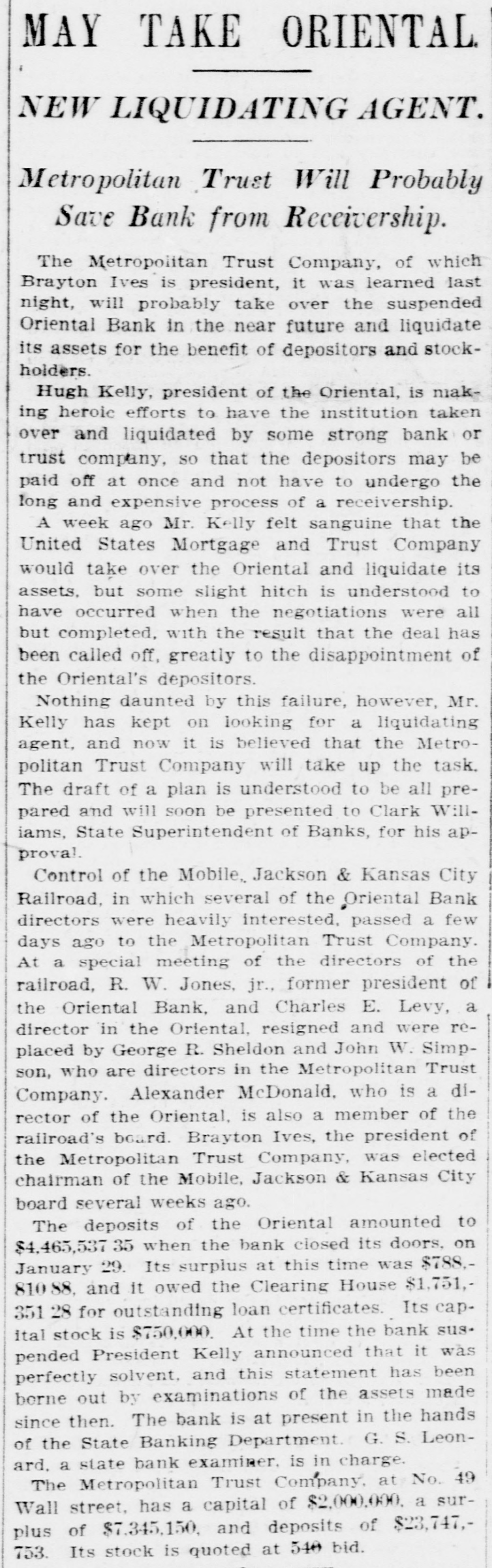
Metropolitan Trust Will Probably Save Bank from Receivership. The Metropolitan Trust Company, of which Brayton Ives is president, it was learned last night, will probably take over the suspended Oriental Bank in the near future and liquidate its assets for the benefit of depositors and stockholders. Hugh Kelly, president of the Oriental, is making heroic efforts to have the institution taken over and liquidated by some strong bank or trust company, so that the depositors may be paid off at once and not have to undergo the long and expensive process of a receivership. A week ago Mr. Kelly felt sanguine that the United States Mortgage and Trust Company would take over the Oriental and liquidate its assets. but some slight hitch is understood to have occurred when the negotiations were all but completed, with the result that the deal has been called off, greatly to the disappointment of the Oriental's depositors. Nothing daunted by this failure, however, Mr. Kelly has kept on looking for a liquidating agent, and now it is believed that the Metropolitan Trust Company will take up the task. The draft of a plan is understood to be all prepared and will soon be presented to Clark Williams, State Superintendent of Banks, for his approval. Control of the Mobile, Jackson & Kansas City Railroad, in which several of the Oriental Bank directors were heavily interested, passed a few days ago to the Metropolitan Trust Company. At a special meeting of the directors of the railroad, R. W. Jones, jr., former president of the Oriental Bank, and Charles E. Levy, a director in the Oriental, resigned and were replaced by George R. Sheldon and John W. Simpson, who are directors in the Metropolitan Trust Company. Alexander McDonald, who is a director of the Oriental, is also a member of the railroad's board. Brayton Ives, the president of the Metropolitan Trust Company, was elected chairman of the Mobile, Jackson & Kansas City board several weeks ago. The deposits of the Oriental amounted to $4,465,537.33 when the bank closed its doors. on January 29. Its surplus at this time was $788.81088, and it owed the Clearing House $1.751,351 28 for outstanding loan certificates. Its capital stock is $750,000. At the time the bank suspended President Kelly announced that it was perfectly solvent. and this statement has been borne out by examinations of the assets made since then. The bank is at present in the hands of the State Banking Department. G. S. Leonard. a state bank examiner. is in charge. The Metropolitan Trust Company, at No. 49 Wall street, has a capital of $2,000,000. a surplus of $7,345,150. and deposits of $23,747,753. Its stock is quoted at 540 bid.
Click image to open full size in new tab
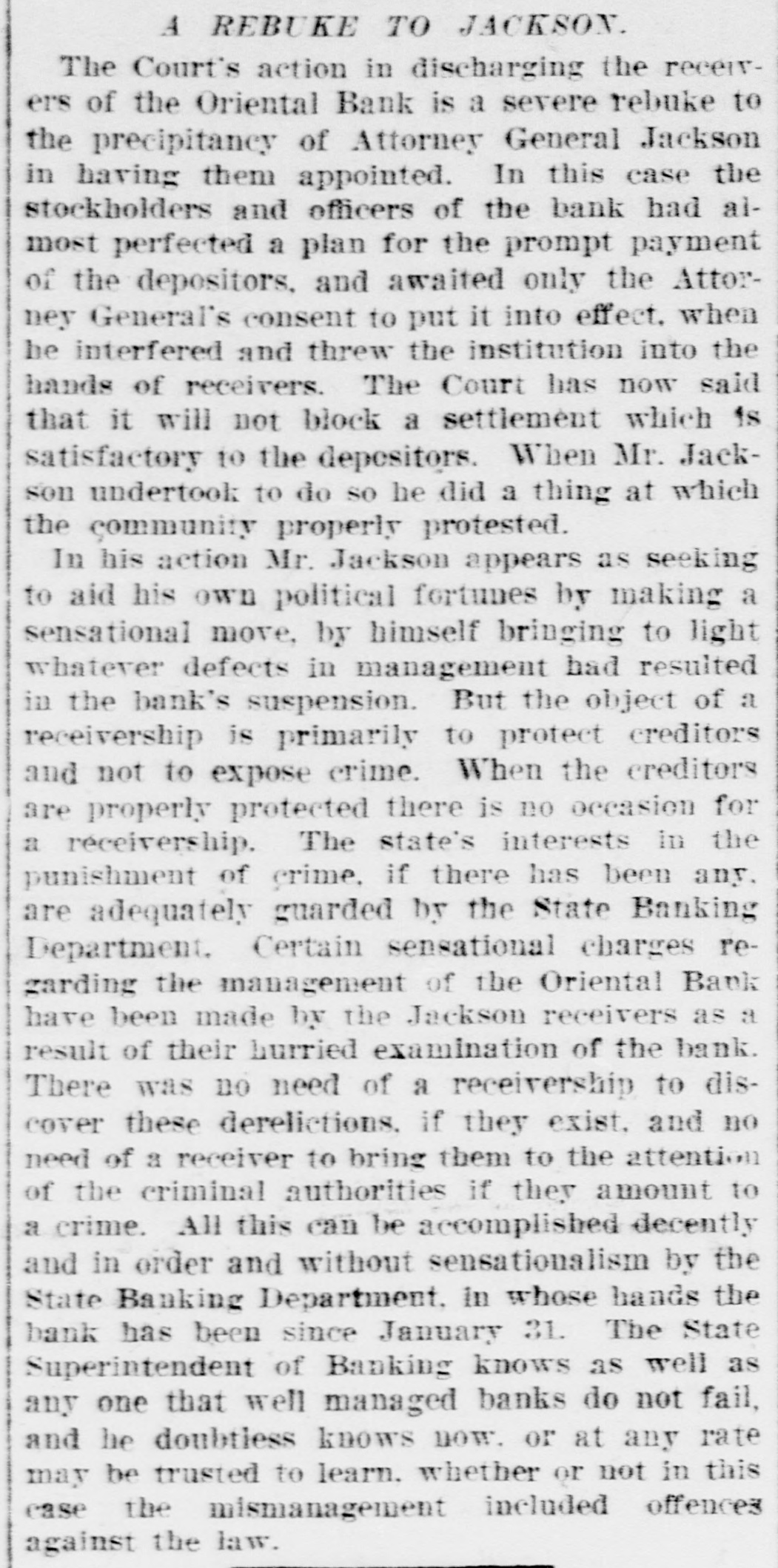
The Court's action in discharging the receivers of the Oriental Bank is a severe rebuke to the precipitancy of Attorney General Jackson in having them appointed. In this case the stockholders and officers of the bank had almost perfected a plan for the prompt payment of the depositors, and awaited only the Attorney General's consent to put it into effect. when he interfered and threw the institution into the hands of receivers. The Court has now said that it will not block a settlement which is satisfactory to the depesitors. When Mr. Jackson undertook to do so he did a thing at which the community properly protested. In his action Mr. Jackson appears as seeking to aid his own political fortunes by making a sensational move, by himself bringing to light whatever defects in management had resulted in the bank's suspension. But the object of a receivership is primarily to protect creditors and not to expose crime. When the creditors are properly protected there is no occasion for a réceivership. The state's interests in the punishment of crime. if there has been any. are adequately guarded by the State Banking Department. Certain sensational charges regarding the management of the Oriental Bank have been made by the Jackson receivers as a result of their hurried examination of the bank. There was no need of a receivership to discover these derelictions. if they exist. and no need of a receiver to bring them to the attention of the criminal authorities if they amount to a crime. All this can be accomplished decently and in order and without sensationalism by the State Banking Department. in whose hands the bank has been since January 31. The State Superintendent of Banking knows as well as any one that well managed banks do not fail, and he doubtless knows now. or at any rate may be trusted to learn. whether or not in this case the mismanagement included offences against the law.
Click image to open full size in new tab
vacates and sets aside the order made and entered herein February 28, 1908. appointing temporary receivers of the defendant in the above entitled action. Immediately upon the filing of such order today I served notice of appeal upon the Clerk of the County of New York and upon Messrs. Philbin, Beekman x Menken, attorneys for the defendant. a copy of which said notice of appeal. with a notice of such service. will be handed to you by the bearer of this letter. I am of the opinion that the service of the notice of appeal perfected the appeal and stays all proceedings under the order appealed from. as provided by section 1,313 of the Code of Civil Procedure. That there may be no question upon this point I intend to immediately apply to the court for an order staying all proceedings until the hearing and decision of the appeal. In my opinion there are several important legal questions involved in these proceedings, and I enclose a memorandum which I have prepared upon the subject, which defines my position. Yours truly. W. S. JACKSON, Attorney-General. The Attornev-General is the legal adviser of the State Superintendent of Banks and Mr. Williams was apparently up against the proposition of being advised not to do what the Court ordered him to do. After the refusal of the Carnegie Trust officer. however, there was nothing more for the State Superintendent to do and he left for Albany. Justice O'Gorman and also Justice FitzGerald remained at the County Court building until about 3 o'clock in the afternoon. In the meantime, however, the bank's lawyers had been conferring and had come to the conclusion to do nothing until the opening of court on Monday. The order signed by Justice O'Gorman besides vacating the receivership authorizes the Oriental Bank to enter into a contract with the Metropolitan Trust Company for the payment in full of its creditors under the terms set forth in the contract. It directs the State Superintendent of Banks to remain in control of the bank's property until the contract is executed and then to deliver the property to the Metropolitan Trust Company the liquidating agent. Mr. Jackson in his formal statement complains that no contract has as yet been entered into: that the proposed agreement as approved by the Court has not even been approved by the board of directors of the Metropolitan Trust Company or of the Oriental Bank. Furthermore, no bond has as yet been executed. "Up to this time." said the AttorneyGeneral "there has only been presented a proposition that it is said will be executed at some time. but which is not binding upon any one. The proposed agreement provides for the payment to the Clearing House of the amount due it by the bank. but no time is specified. The proposed agreement provides for the payment of depositors forthwith 'when the amount due each depositor shall be certified by expert accountants.'' Mr. Jackson said he could find no authority in law authorizing the Court to direct receivers to turn the property of an insolvent moneyed corporation over to the State Superintendent of Banks. The Court directs the State Superintendent upon the execution of the contract to turn over all the assets of the bank to the Metropolitan Trust Company. Mr. Jackson says: "I can find no law authorizing a court to direct the Superintendent of Banks to turn over to a third person the assets of a bank in his hands and which he has reported as unsafe and that it is inexpedient for it to continue in business. The only law I find requires the Superintendent of Banks in possession of the assets of a bank that he deems unsafe and inexpedient for it to continue business to report those facts to the Attorney -General, whose absolute duty it then becomes to bring an action for its dissolution." Mr. Jackson contends that the rights and liabilities of stockholders and others besides creditors are wholly unprotected by the Court's order. "This order," says the Attorney-General, 'establishes an entirely new practice and one wholly unauthorized and in effect it establishes the precedent for permitting insolvent corporations to select their own receivers and to administer their affairs regardless of the provisions of the law reQuiring their dissolution and the distriDution of their assets through officers appointed by the Court." Mr. Jackson promises to get as speedy a determination of the case as possible.
Click image to open full size in new tab
Will Argue Receiver's Case, New York, March 9.-The chances are the attorney general's appeal from Justice O'Gorman's decision removing the receivers of the Oriental Bank will be argued to-morrow.
Click image to open full size in new tab
Justice Patterson, of the Appellate Division. yesterday set Friday as the day for a hearing on the order to show cause why arguments should not be heard immediately upon Atterney General Jackson's appeal from Justice O'Gorman's order vacating the order appointing temporary receivers for the Oriental Bank A delay was asked for by Martin L. Stover, who represented the Attorney Generay. E. Stanwood Menken, of counsel for the Oriental Bank, vigorously opposed the granting of any delay, but was overruled.
Click image to open full size in new tab
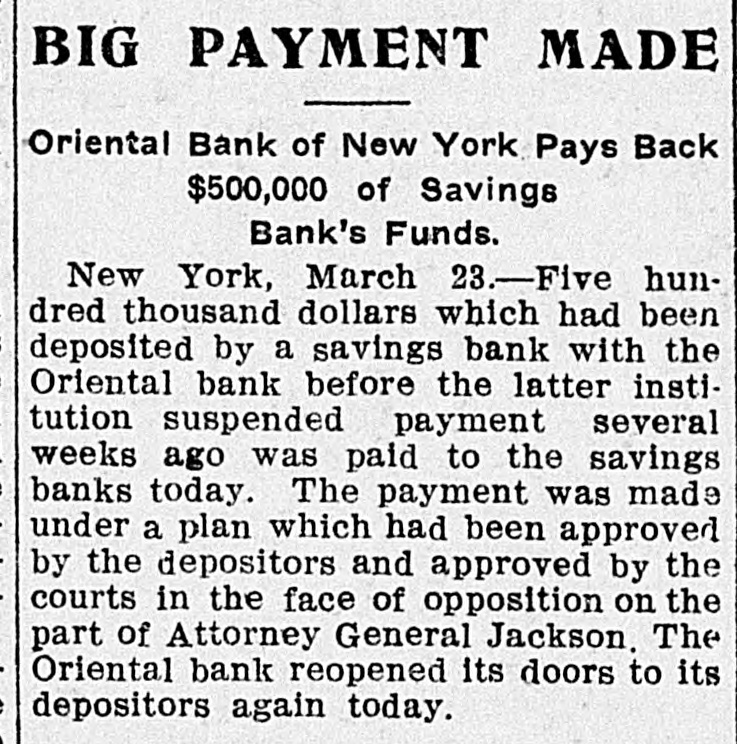
In Face of Opposition on Part of Attorney General Jackson. New York. March 23.-Five hundred thousand dollars, which had been deposited by savings banks with the Oriental bank before the latter institution suspended payment several weeks ago, was paid to the savings banks today. The payment was made under a plan which had been approved by the depositors, and approved by the courts, and in the face of opposition on the part of Attorney General Jackson, the Oriental bank reopened its doors to depositors again today.
Click image to open full size in new tab
BIG PAYMENT MADE Oriental Bank of New York Pays Back $500,000 of Savings Bank's Funds. New York, March 23.-Five hundred thousand dollars which had been deposited by a savings bank with the Oriental bank before the latter institution suspended payment several weeks ago was paid to the savings banks today. The payment was made under a plan which had been approved by the depositors and approved by the courts in the face of opposition on the part of Attorney General Jackson. The Oriental bank reopened its doors to its depositors again today.
Click image to open full size in new tab
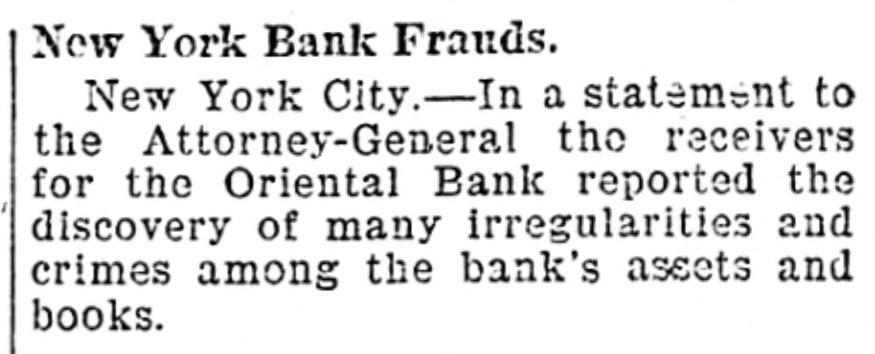
New York City. —In a statement to the Attorney-General the receivers for the Oriental Bank reported the discovery of many irregularities and crimes among the bank's assets and books.
Click image to open full size in new tab
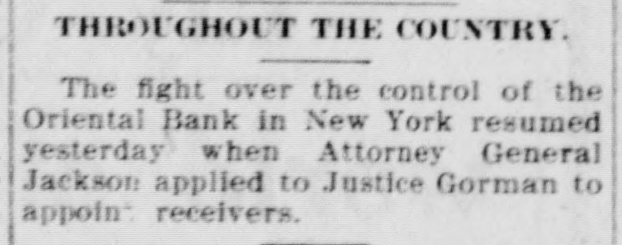
The fight over the control of the Oriental Bank in New York resumed yesterday when Attorney General Jackson applied to Justice Gorman to appoin receivers.

Click image to open full size in new tab
JUSTICE INGRAHAM OBJECTS Says There Was No Reason for Appointing Carnegie Trust and Schneider. The bitter controversy in 1908 between the depositors of the Oriental Bank and William Schuyler Jackson, who was then Attorney General of the State of New York, over the latter's action in having temporary receivers appointed was recalled yes. terday by a decision of the Appellate Division of the Supreme Court in passing on the expenses of the receivership which the court considered unnecessary. The majority of the bench decided in favor of cutting down the charges favorably passed on by former Judge D. Cady Herrick as referee. while Presiding Justice Ingraham in his dissenting opinion went on record as opposed to allowing any charges whatsoever. About the time that Attorney General Jackson had the Carnegie Trust Company and Henry Schneider appointed as receivers of the Oriental Bank he also made several applications for the appointment of receivers for other institutions. In the case of the Oriental Bank he explained his action by saying that the plan whereby the Metropolitan Trust Company was to advance the bank sufficient funds to pay off its creditors was an effort to loot the bank and deceive the depositors. Justice Platzek appointed the receivers asked for. and the depositors became aroused over the action of the Attorney General. which they assailed as unnecessary interference in the affairs of the institution just at a time when it was getting of out of its difficulties following the panic 1907. The bank officials also objected. An action was brought to have the receivership vacated. and Justice O'Gorman granted the application. His decision the Appellate Division upheld, saying that Jackson acted too hastily in having the receivers appointed. Justice Ingraham expressed the view yesterday that the receivership was established for the sole purpose of helping the receivers. Then came the claims for the expenses for that brief receiversnip, amounting to Former Judge Herrick was apto pass on the accounts, not all of pointed $10,872. he did approve them. further and the while Appellate Division favored a still cut. Justice Davis approved the report of Judge Herrick. One of the expenditures objected to was that of $3,750 for counsel fees paid to John B. Stanchfield and Professor Charles A. Collin. The latter is the man who recently bore the letter that Governor Dix sent to District Attorney Whitman instructing him to consult with Attorney General Carmody in his investigation into the affairs of the Carnegie Trust Company. It will be remembered that this communication was delivered to the District Attorney by Stephen C. Baldwin, counsel for the officials of the Carnegie Trust Company. This claim for counsel fees was cut to $2,000. The Carnegie Trust Company asked a $3,000 fee as receiver of the Oriental Bank. Only $1,000 was allowed, which amount Schneider will also receive. The referee's fees and expenses amount to $670 more. The presiding justice said that there was no need for the receivers, and all that their appointment could have accomplished was to enable them to appropriate to themselves fees and expenses from the assets belonging to the creditors and stockholders of the Oriental Bank. "No court ad. ministering justice." said Justice Ingraham, "if the facts were known, would even have entertained an application for the appointment of receivers." Justice Ingraham went over some of these facts that he referred to. It appeared. he said, that the Carnegie Trust Company had been negotiating with the Oriental Bank to advance the latter money to pay its indebtedness, but that the creditors were not satisfied with the arrangement, preferring that made with the Metropolitan Trust Company. It appeared further, said the justice, that the president of the Carnegie Trust Company. who at the time was Charles C. Dickinson, who recently died under unusual circumstances, had been in communication with Attorney General Jackson. He had asked, the justice said, to be appointed recelver of the Oriental Bank, which fact the Attorney General did not tell the court in asking for the appointment of the Carnegie Trust Company as one of the Oriental receivers. Justice Ingraham said that he could not see that the receivers were entitled to anything as fees, as there was no service rendered He declared that if they had any claim it should be preferred against the state. as the court had no power to
Click image to open full size in new tab
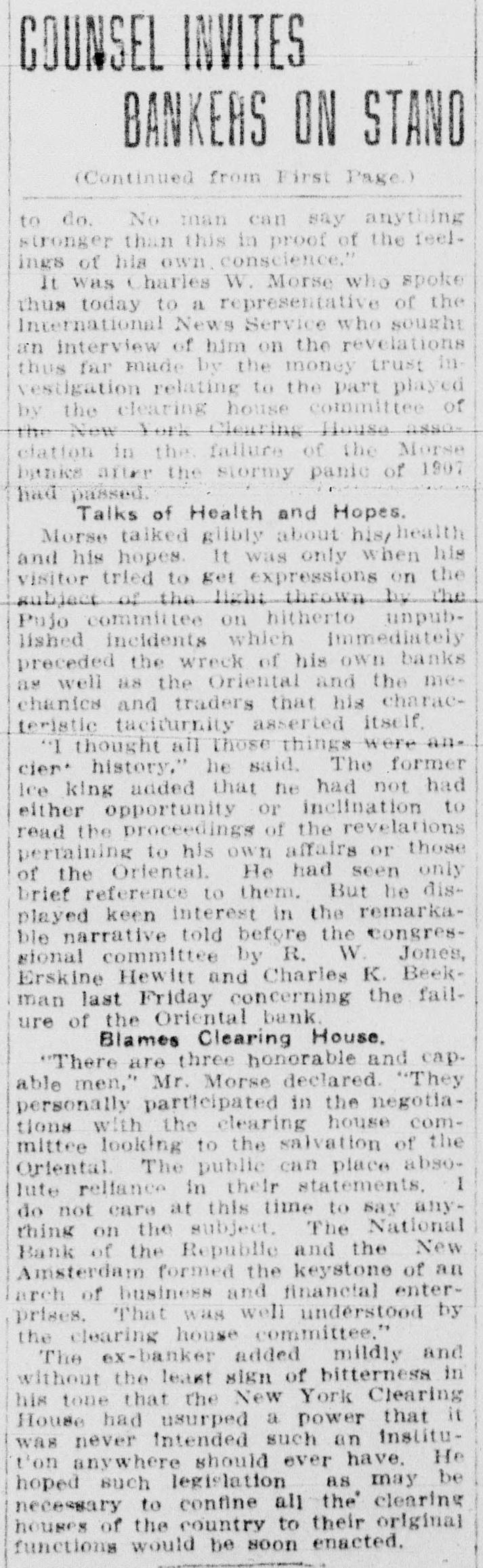
COUNSEL INVITES BANKERS ON STANO (Continued from First Page.) to do. No man can say anything stronger than this in proof of the feelings of his own. conscience." It was Charles W. Morse who spoke thus today to a representative of the International News Service who sought an interview of him on the revelations thus far made by the money trust investigation relating to the part played by the clearing house committee of the New York Clearing House assoclation in the failure of the Morse bunics after the stormy panic of 1907 had passed. Talks of Health and Hopes. Morse talked glibly about his/ health and his hopes. It was only when his visitor tried to get expressions on the subject of the light thrown by the Pujo committee on hitherto unpublished incidents which immediately preceded the wreck of his own banks as well as the Oriental and the mechanics and traders that his characteristic taciturnity asserted itself, "I thought all those things were ancier* history." he said. The former Ice king added that he had not had either opportunity or inclination to read the proceedings of the revelations pertaining to his own affairs or those of the Oriental. He had seen only brief reference to them. But he displayed keen interest in the remarkable narrative told before the congressional committee by R. W. Jones, Erskine Hewitt and Charles K. Beekman last Friday concerning the failure of the Oriental bank. Blames Clearing House, "There are three honorable and cap. able men," Mr. Morse declared. "They personally participated in the negotiations with the clearing house committee looking to the salvation of the Oriental. The public can place absolute reliance in their statements. 1 do not care at this time to say anything on the subject. The National Bank of the Republic and the New Amsterdam formed the keystone of an arch of business and financial enterprises. That was well understood by the clearing house committee." The ex-banker added mildly and without the least sign of bitterness in his tone that the New York Clearing House had usurped a power that it was never intended such an institut'on anywhere should ever have. He hoped such legislation as may be necessary to confine all the clearing houses of the country to their original functions would be soon enacted.
Click image to open full size in new tab
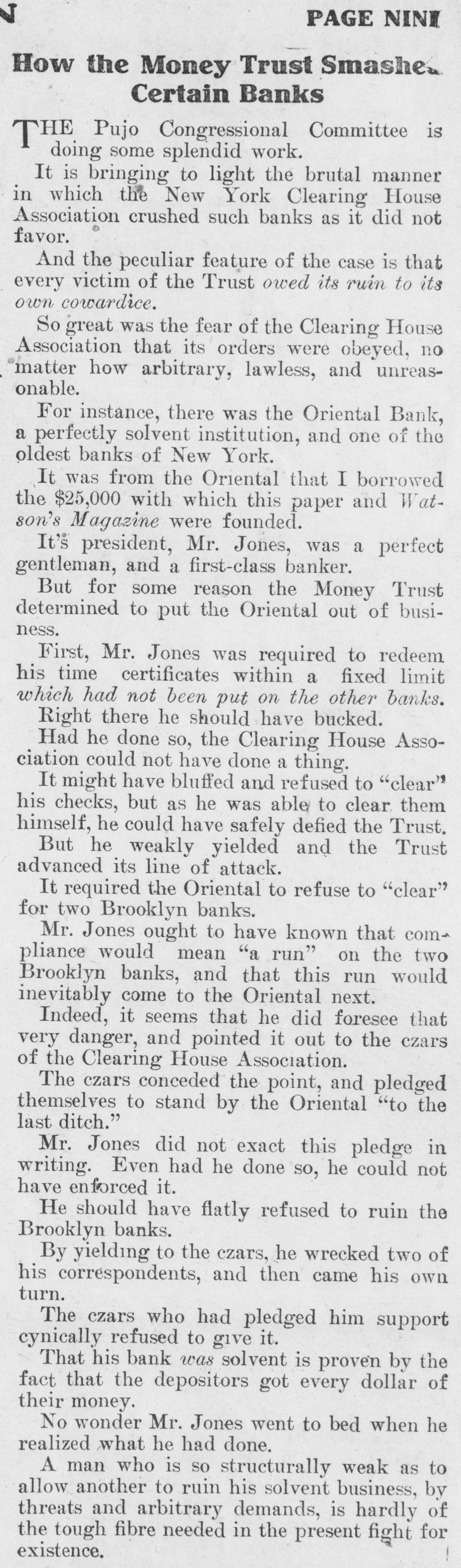
THE Pujo Congressional Committee is doing some splendid work. It is bringing to light the brutal manner in which the New York Clearing House Association crushed such banks as it did not favor. And the peculiar feature of the case is that every victim of the Trust owed its ruin to its own cowardice. So great was the fear of the Clearing House Association that its orders were obeyed, no matter how arbitrary, lawless, and unreasonable.
For instance, there was the Oriental Bank, a perfectly solvent institution, and one of the oldest banks of New York. It was from the Oriental that I borrowed the $25,000 with which this paper and Watson's Magazine were founded. It's president, Mr. Jones, was a perfect gentleman, and a first-class banker. But for some reason the Money Trust determined to put the Oriental out of business.
First, Mr. Jones was required to redeem his time certificates within a fixed limit which had not been put on the other banks. Right there he should have bucked. Had he done so, the Clearing House Association could not have done a thing. It might have bluffed and refused to "clear" his checks, but as he was able to clear them himself, he could have safely defied the Trust. But he weakly yielded and the Trust advanced its line of attack. It required the Oriental to refuse to "clear" for two Brooklyn banks. Mr. Jones ought to have known that compliance would mean "a run" on the two Brooklyn banks, and that this run would inevitably come to the Oriental next. Indeed, it seems that he did foresee that very danger, and pointed it out to the czars of the Clearing House Association. The czars conceded the point, and pledged themselves to stand by the Oriental "to the last ditch." Mr. Jones did not exact this pledge in writing. Even had he done so, he could not have enforced it. He should have flatly refused to ruin the Brooklyn banks. By yielding to the czars, he wrecked two of his correspondents, and then came his own turn.
The czars who had pledged him support cynically refused to give it. That his bank was solvent is proven by the fact that the depositors got every dollar of their money. No wonder Mr. Jones went to bed when he realized what he had done. A man who is so structurally weak as to allow another to ruin his solvent business, by threats and arbitrary demands, is hardly of the tough fibre needed in the present fight for existence.