7673. Louisiana State Bank (New Orleans, LA)

Bank Information

Episode Type
Suspension → Closure
Bank Type
state
Start Date
September 16, 1861
Location
New Orleans, Louisiana (29.955, -90.075)

Metadata

Model
gpt-5-mini
Short Digest
0bbf14f1

Response Measures

None

Description

Bank suspended specie payments by proclamation/notice dated Sept 16, 1861 (per multiple notices). Later (June 1863) military authorities required the bank to go into liquidation under commissioners — effectively a closure/receivership. No contemporaneous article describes a depositor run. Some OCR errors in originals corrected (e.g., specio -> specie).

Events (3)

1. September 16, 1861 Suspension
Cause
Government Action
Cause Details
Suspension made in conformity with the recommendation of the Governor to suspend specie payments and accept Confederate Treasury Notes.
Newspaper Excerpt
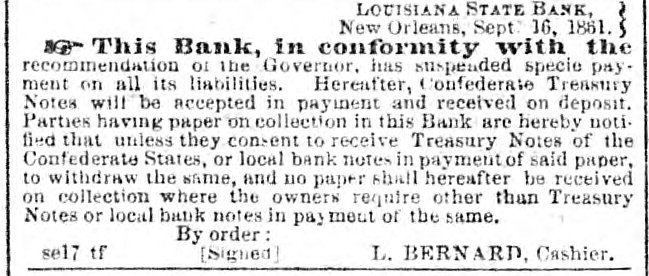
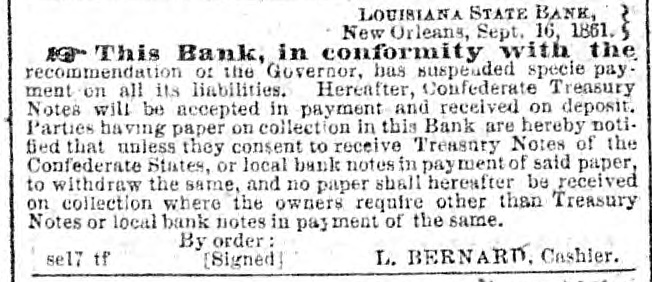
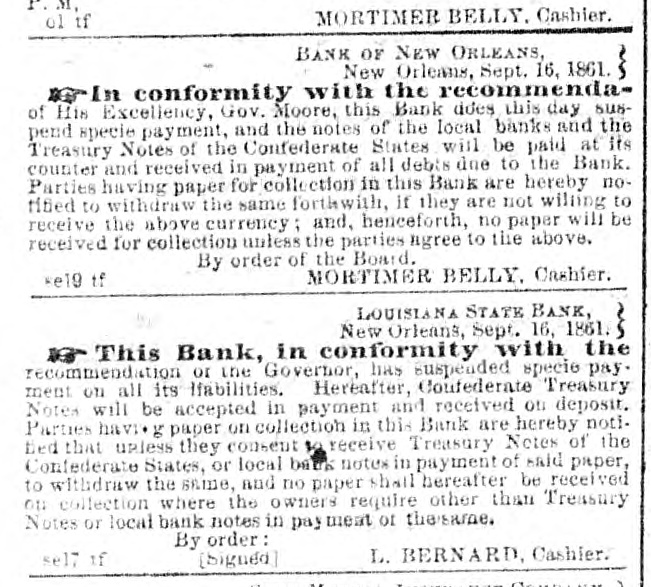
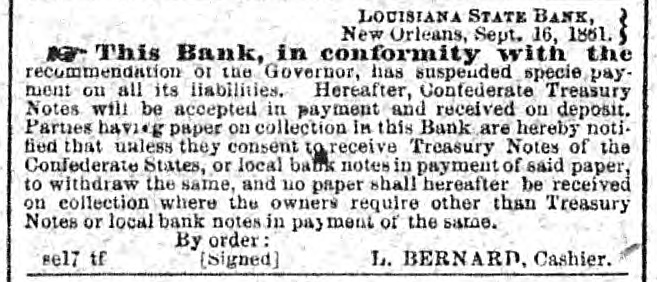
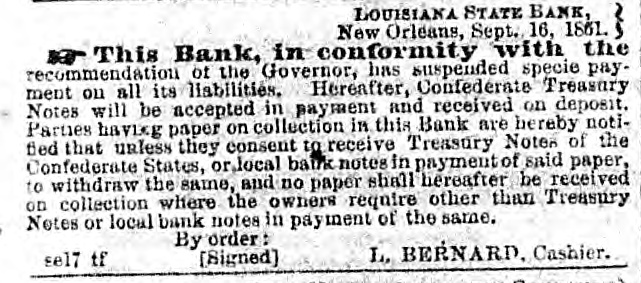
LOUISIANA STATE BANK, New Orleans, Sept 16, 1861. This Bank, in conformity with the recommendation of the Governor, has suspended specie payment on all its liabilities.
Source
newspapers
2. May 17, 1862 Other
Newspaper Excerpt
LOUISIANA STATE BANK, New ORLEANS. May 17,1862. Parties having deposited Confederate notes with this bank are requested to withdraw the same before the 27th inst ... All dealing in them thereafter is prohibited. By order. L. BERNARD Cashier.
Source
newspapers
3. June 17, 1863 Receivership
Newspaper Excerpt
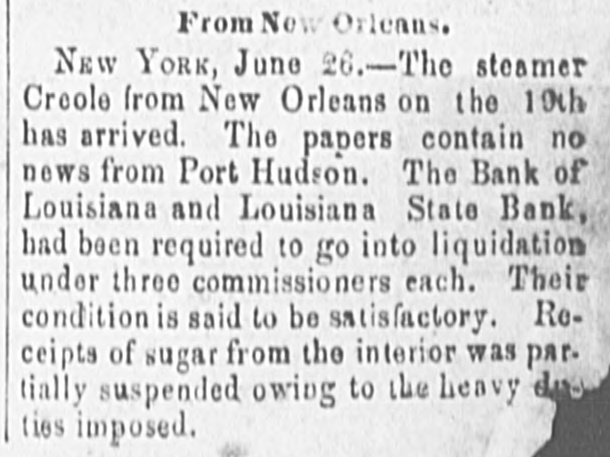
The Bank of Louisiana and Louisiana State Bank had been required to go into liquidation under three commissioners each. Their condition is said to be satisfactory.
Source
newspapers

Newspaper Articles (20)

Article from New Orleans Daily Crescent, September 17, 1861

Click image to open full size in new tab

Article Text

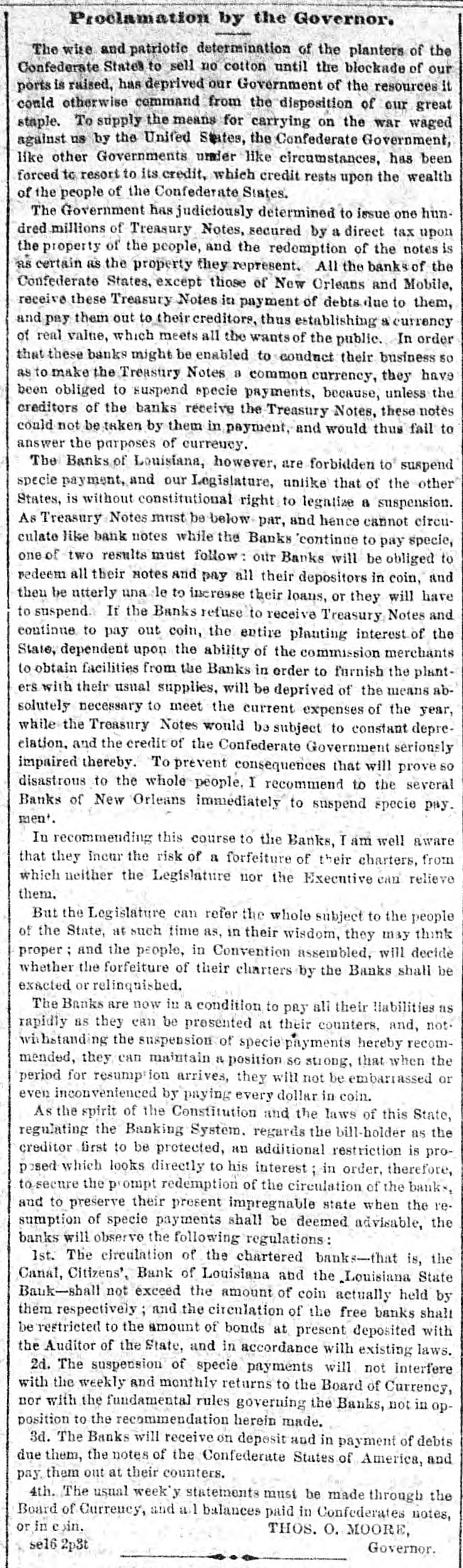
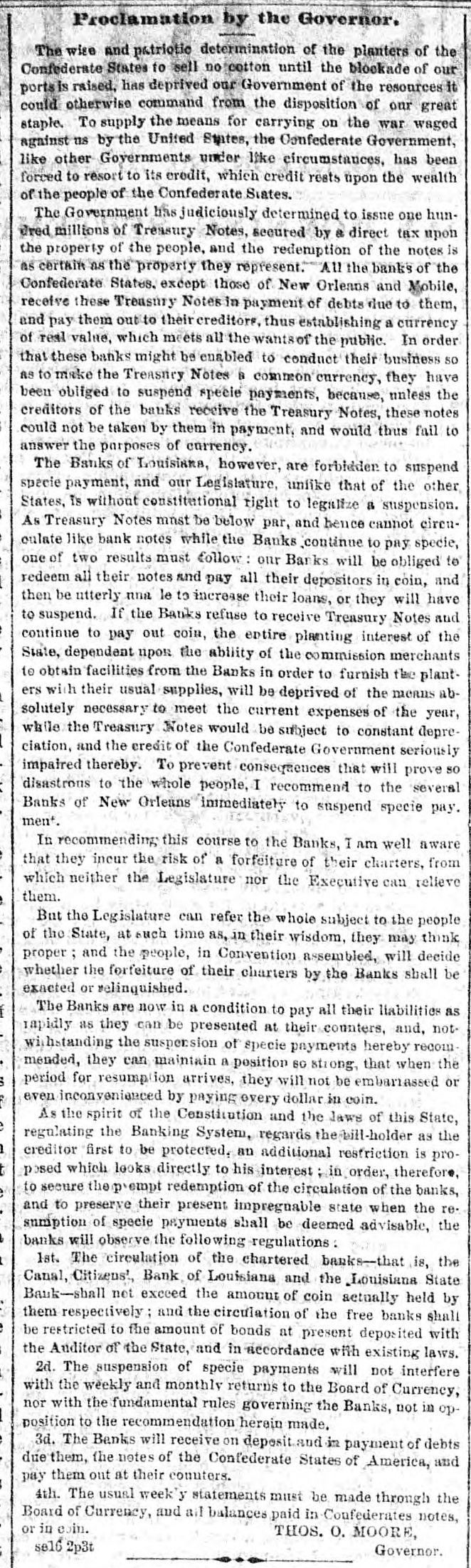
Proclamation by the Governor. The wise and patriotic determination of the planters of the Confederate States to sell no cotton until the blockade of our ports is raised, has deprived our Government of the resources it could otherwise command from the disposition of our great staple. To supply the means for carrying on the war waged against us by the Unifed States, the Confederate Government, like other Governments under like circumstances, has been forced to resort to its credit, which credit rests upon the wealth of the people of the Confederate States. The Government has judiciously determined to issue one hundred millions of Treasury Notes, secured by a direct tax upon the property of the people, and the redemption of the notes is as certain as the property they represent. All the banks of the Confederate States, except those of New Orleans and Mobile, receive these Treasury Notes in payment of debts due to them, and pay them out to their creditors, thus establishing a currency of real value, which meets all the wants of the public. In order that these banks might be enabled to conduct their business so as to make the Treasury Notes 8 common currency, they have been obliged to suspend specie payments, because, unless the creditors of the banks receive the Treasury Notes, these notes could not be taken by them in payment. and would thus fail to answer the parposes of currency. The Banks of Louisiana, however, are forbidden to suspend specie payment, and our Legislature, unlike that of the other States, is without constitutional right to legalize a suspension. As Treasury Notes must be below par, and hence cannot circuculate like bank notes while the Banks continue to pay specie, one of two results must follow: our Banks will be obliged to redeem all their notes and pay all their depositors in coin, and theu be utterly una le to increase their loans, or they will have to suspend. If the Banks refuse to receive Treasury Notes and continue to pay out coin, the entire planting interest of the State, dependent upon the ability of the commission merchants to obtain facilities from the Banks in order to furnish the planters with their usual supplies, will be deprived of the means absolutely necessary to meet the current expenses of the year, while the Treasury Notes would be subject to constant depreelation, and the credit of the Confederate Government seriously impaired thereby. To prevent consequences that will prove so disastrous to the whole people, I recommend to the several Banks of New Orleans immédiately to suspend specie pay. men't In recommending this course to the Banks, T am well aware that they incur the risk of a forfeiture of their charters, from which neither the Legislature nor the Executive can relieve them. But the Legislature can refer the whole subject to the people of the State, at such time as, in their wisdom, they may think proper; and the people, in Convention assembled, will decide whether the forfeiture of their charters by the Banks shall be exacted or relinquished, The Banks are now in a condition to pay all their liabilities as rapidly as they ean be presented at their counters, and, not withstanding the suspension of specie payments hereby recommended, they can maintain a position SO strong, that when the period for resumption arrives, they will not be embarrassed or even inconvenienced by paying every dollar in coin. As the spirit of the Constitution and the laws of this State, regulating the Banking System. regards the bill-holder as the creditor first to be protected, an additional restriction is proposed which looks directly to his interest in order, therefore, secure the prompt redemption of the circulation of the banks, and to preserve their present impregnable state when the resumption of specie payments shall be deemed advisable, the banks will observe the following regulations: 1st. The circulation of the chartered banks-that is, the Canal, Citizens', Bank of Louisiana and the Louisiana State Bauk-shall not exceed the amount of coin actually held by them respectively; and the circulation of the free banks shalt be restricted to the amount of bonds at present deposited with the Auditor of the State, and in accordance wilh existing laws. 2d. The suspension of specie payments will not interfere with the weekly and monthly returns to the Board of Currency, nor with the fundamental rules governing the Banks, not in opposition to the recommendation herein made. 3d. The Banks will receive on deposit and in payment of debts due them, the notes of the Confederate States of America, and pay them out at their counters. 4th. The usual week'y statements must be made through the Board of Currency, and all balances paid in Confederates notes, or in coin. THOS, O. MOORE, sel6 2p3t Governor.
Article from New Orleans Daily Crescent, September 18, 1861

Click image to open full size in new tab

Article Text

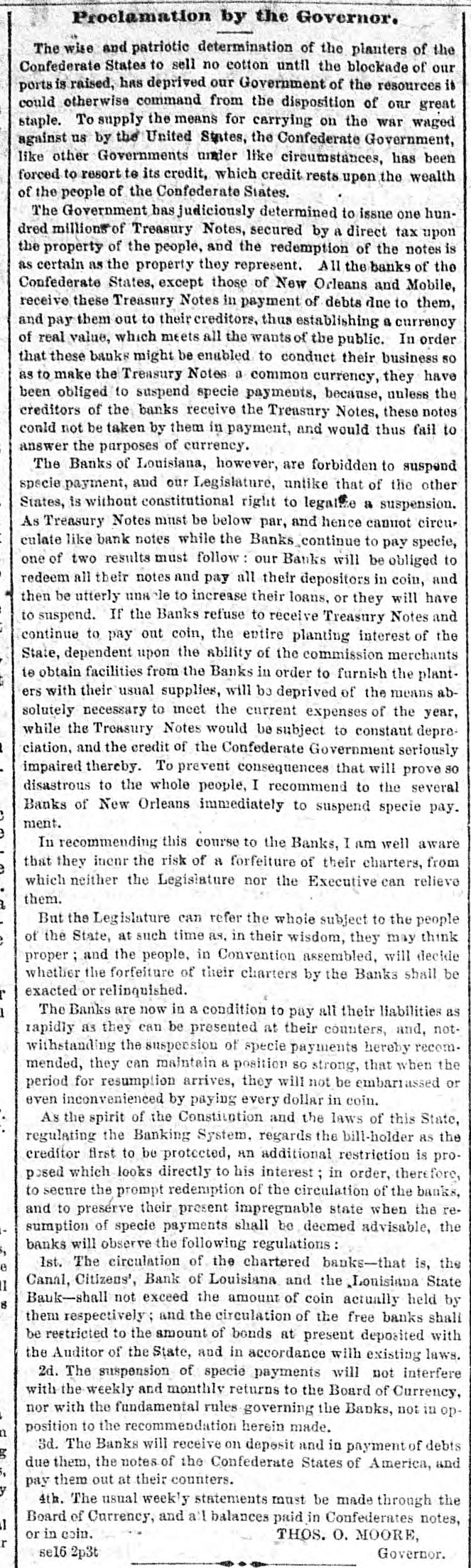
Proclamation by the Governor. The wise and patriotic determination of the planters of the Confederate States to sell no cotton until the blookade of our portsis raised, has deprived our Government of the resources it could otherwise command from the disposition of our great staple. To supply the means for carrying on the war waged against us by the United States, the Confederate Government, like other Governments under like circumstances, has been forced to resort to its credit, which credit rests upon the wealth of the people of the Confederate States. The Government has judiciously determined to issue one hundred millions of Treasury Notes, secured by a direct tax upon the property of the people, and the redemption of the notes is as certain as the property they represent. All the banks of the Confederate States. except those of New Orleans and Mobile, receive these Treasury Notes in payment of debts due to them, and pay them out to their creditors, thus establishing a currency of real value, which meets all the wants of the public. In order that these banks might be enabled to conduct their business so AS to make the Treasney Notes B common currency, they have been obliged to suspend specie payments, because, unless the creditors of the banks receive the Treasury Notes, these notes could not be taken by them in payment. and would thus fail to answer the purposes of currency. The Banks of Louisiana, however, are forbidder to suspend specie payment, and our Legislature, unlike that of the other States, is without constitutional right to legalize a suspension. As Treasury Notes mnst be below par, and hence cannot circuculate like bank notes while the Banks (continue to pay specie, one of two results must follow: our Banks will be obliged to redeem all their notes and pay all their depositors in coin, and then be utterly nna le to increase their loans, or they will have to suspend. If the Banks refuse to receive Treasury Notes and continue to pay out coin, the entire planting interest of the State, dependent upon the ability of the commission merchants to obtain facilities from the Banks in order to furnish the planters with their usual supplies, will be deprived of the morns absolutely necessary to meet the current expenses of the year, while the Treasury Notes would be subject to constant depreI ciation, and the credit of the Confederate Government seriously impaired thereby. To prevent consequences that will prove so : disastrous to the whole people, I recommend to the several Banks of New Orleans immediately to suspend specie pay. men't In recommending this course to the Banks, I am well aware that they incur the risk of a forfeiture of their charters, from which neither the Legislature nor the Executive can relieve them. ) But the Legislature can refer the whole subject to the people of the State, at such time as, in their wisdom, they may think proper ; and the people, in Convention assembled, will decide whether the forfeiture of their charters by the Banks shall be exacted or relinquished. f The Banks are now in a condition to pay all their liabilities as rapidly as they can be presented at their counters, and, notwithstanding the suspension of specie payments hereby recom mended, they can maintain a position 60 strong, that when the $ period for resumption arrives, they will not be embariassed or F even inconvenienced by paying every dollar in coin. As the spirit of the Constitution and the Jaws of this State, ) regulating the Banking System, regards the bill-holder as the 1 creditor first to be protected. an additional restriction is prot posed which looks directly to his interest in order, therefore, e to secure the prempt redemption of the circulation of the banks, and to preserve their present impregnable state when the resumption of specie payments shall be deemed advisable, the / banks will observe the following regulations : 1st. The circulation of the chartered banks-that is, the Canal, Citizens!, Bank of Louisiana and the Louisiana State Bauk-shall net exceed the amount of coin actually held by : them respectively ; and the circulation of the free banks shall e be restricted to the amount of bonds at present deposited with the Auditor of the State, and in accordance with existing laws. 2d. The suspension of specie payments will not interfere 1 with the weekly and monthly returns to the Board of Currency, nor with the fundamental rules governing the Banks, not in opposition to the recommendation herein made. : 3d. The Banks will receive on deposit and in payment of debts due them, the notes of the Confederate States of America, and pay them out at their counters. : 4th. The usual week'y statements must be made through the Board of Currency, and all balances paid in Confederates notes, or in coin. THOS. O. MOORE, self 2p3t Governor.


Article from New Orleans Daily Crescent, September 19, 1861

Click image to open full size in new tab

Article Text

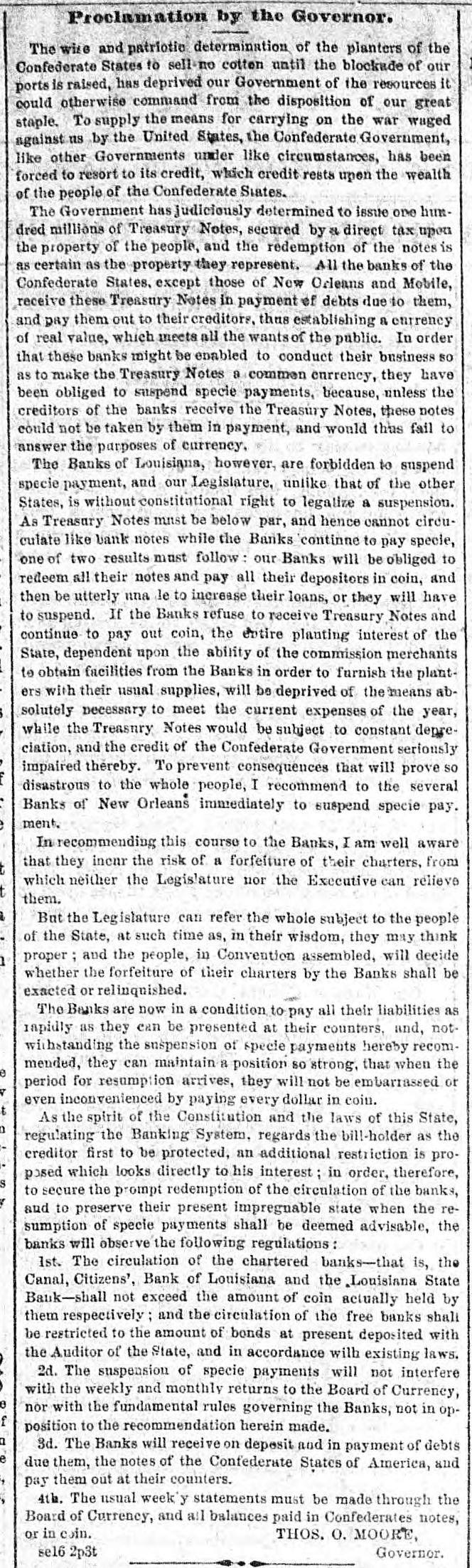
Proclamation by the Governor. The wise and patriotic determination of the planters of the Confederate States to sell no cotton until the blockade of our ports is raised, has deprived our Government of the resources it could otherwise command from the disposition of our great staple. To supply the means for carrying on the war waged against us by the United States, the Confederate Government, like other Governments under like circumstances, has been forced to resort to its credit, which credit rests upon the wealth of the people of the Confederate States. The Government has judiciously determined to issue one hundred millions of Treasury Notes, secured by a direct tax upon the property of the people, and the redemption of the notes is as certain as the property they represent. All the banks of the Confederate States, except those of New Orleans and Mobile, receive these Treasury Notes in payment of debts due to them, and pay them out to their creditors, thus establishing a currency of real value, which meets all the wants of the public. In order that these banks might be enabled to conduct their business so as to make the Treasury Notes a common currency, they have been obliged to suspend specie payments, because, unless the creditors of the banks receive the Treasury Notes, these notes could not be taken by them in payment, and would thus fail to answer the purposes of currency. The Banks of Louisiana, however, are forbidden to suspend spscie payment, and our Legislature, unlike that of the other States, is without constitutional right to legalize a suspension. As Treasury Notes must be below par, and hence cannot circuculate like bank notes while the Banks continue to pay specie, one of two results must follow our Banks will be obliged to redeem all their notes and pay all their depositors in coin, and then be utterly unacl to increase their loans, or they will have to suspend. If the Banks refuse to receive Treasury Notes and continue to pay out coin, the entire planting interest of the State, dependent upon the ability of the commission merchants to obtain facilities from the Banks in order to furnish the planters with their usual supplies, will be deprived of the means absolutely necessary to meet the current expenses of the year, while the Treasury Notes would be subject to constant depre1 ciation, and the credit of the Confederate Government seriously impaired thereby. To prevent consequences that will prove so disastrous to the whole people, I recommend to the several Banks of New Orleans immediately to suspend specie pay. ment. In recommending this course to the Banks, I am well aware that they inenr the risk of 8 forfeiture of their charters, from which neither the Legislature nor the Executive can relieve them. But the Legislature can refer the whole subject to the people of the State, at such time as. in their wisdom, they may think proper ; and the people, in Convention assembled, will decide whether the forfeiture of their charters by the Banks shall be exacted or relinquished. The Banks are now in a condition to pay all their liabilities as rapidly as they can be presented at their counters, and, notwithstanding the suspersion of specie payments hereby recommended, they can maintain 8 position SO strong, that when the period for resumption arrives, they will not be embarrassed or even inconvenienced by paying every dollar in coin. As the spirit of the Constitution and the laws of this State, regulating the Banking System. regards the bill-holder as the creditor first to be protected, an additional restriction is proposed which looks directly to his interest; in order, therefore, to secure the prompt redemption of the circulation of the banks, and to preserve their present impregnable state when the resumption of specie payments shall be deemed advisable, the banks will observe the following regulations: , 1st. The circulation of the chartered banks-that is, the e Canal, Citizens', Bank of Louisiana and the Louisiana State 11 Bauk-shall not exceed the amount of coin actually held by 8 them respectively and the circulation of the free banks shall be restricted to the amount of bonds at present deposited with the Auditor of the State, and in accordance wilh existing laws. 2d. The suspension of specie payments will not interfere with the weekly and monthly returns to the Board of Currency, nor with the fundamental rules governing the Banks, not in opposition to the recommendation herein made. n 3d. The Banks will receive on deposit and in payment of debts g due them, the notes of the Confederate States of America, and pay them out at their counters. y 4th. The usual weekly statements must be made through the Board of Currency, and all balances paid in Confederates notes, I or in coin. THOS. O. MOORE, r Governor. se16 2p3t


Article from New Orleans Daily Crescent, September 20, 1861

Click image to open full size in new tab

Article Text

Proclamation by the Governor. The wite and patriotic determination of the planters of the Confederate States to sell-no cotten until the blockade of our ports is raised, has deprived our Government of the resources it could otherwise command from the disposition of our great staple. To supply the means for carrying on the war waged against us by the United States, the Confederate Government, like other Governments under like circumstances, has been forced to resort to its credit, which credit rests upon the wealth of the people of the Confederate States. The Government has judiciously determined to issue one humdred millions of Treasury Notes, secured by a direct tax upon the property of the people, and the redemption of the notes is as certain as the property they represent. All the banks of the Confederate States, except those of New Orleans and Mobile, receive these Treasury Notes in payment of debts due to them, and pay them out to their creditors, thus establishing a currency of real value, which meets all the wants of the public. In order that these banks might be enabled to conduct their business so as to make the Treasury Notes a commen currency, they have been obliged to suspend specie payments, because, unless the creditors of the banks receive the Treasury Notes, these notes could not be taken by them in payment, and would thus fail to answer the purposes of currency, The Banks of Louisiana, however, are forbidden to suspend specie payment, and our Legislature, unlike that of the other States, is without constitutional right to legalize a suspension. As Treasury Notes must be below par, and hence cannot circuculate like bank notes while the Banks continue to pay specie, one of two results must follow: our Banks will be obliged to redeem all their notes and pay all their depositors in coin, and then be utterly una le to increase their loans, or they will have to suspend. If the Banks refuse to receive Treasury Notes and continue to pay out coin, the entire planting interest of the State, dependent upon the ability of the commission merchants to obtain facilities from the Banks in order to furnish the planters with their usual supplies, will be deprived of the means absolutely necessary to meet the current expenses of the year, while the Treasury Notes would be subject to constant depreciation, and the credit of the Confederate Government seriously impaired thereby. To prevent consequences that will prove SO disastrous to the whole people, I recommend to the several Banks of New Orleans immediately to suspend specie pay. ment. In recommending this course to the Banks, I am well aware that they incur the risk of a forfeiture of their charters, from which neither the Legislature nor the Executive can relieve them. But the Legislature can refer the whole subject to the people of the State, at such time as, in their wisdom, they may think proper; and the people, in Convention assembled, will decide 1 whether the forfeiture of their charters by the Banks shall be exacted or relinquished. The Banks are now in a condition to pay all their liabilities as rapidly as they can be presented at their counters, and, notwithstanding the suspension of specie payments hereby recommended, they can maintain a position so strong, that when the e period for resumption arrives, they will not be embarrassed or even inconvenienced by paying every dollar in coin. t As the spirit of the Constitution and the laws of this State, b regulating the Banking System. regards the bill-holder as the creditor first to be protected, an additional restriction is proposed which looks directly to his interest; in order, therefore, S to secure the prompt redemption of the circulation of the banks, and to preserve their present impregnable state when the resumption of specie payments shall be deemed advisable, the banks will observe the following regulations 1st. The circulation of the chartered banks-that is, the Canal, Citizens', Bank of Louisiana and the Louisiana State Bank-shall not exceed the amount of coin actually held by them respectively ; and the circulation of the free banks shall be restricted to the amount of bonds at present deposited with the Auditor of the State, and in accordance wilh existing laws. 2d. The suspension of specie payments will not interfere with the weekly and monthly returns to the Board of Currency, nor with the fundamental rules governing the Banks, not in opf position to the recommendation herein made. a 3d. The Banks will receive on deposit and in payment of debts e due them, the notes of the Confederate States of America, and pay them out at their counters. 4th. The usual weekly statements must be made through the Board of Currency, and all balances paid in Confederates notes, or in coin. THOS, O. MOORE, Governor. se16 2p3t


Article from New Orleans Daily Crescent, September 24, 1861

Click image to open full size in new tab

Article Text

LOUISIANA STATE BANK, New Orleans, Sept 16, 1861. This Bank, in conformity with the recommendation 01 the Governor. has suspended specio payment on all its liabilities. Hereafter, Confederate Treasury Notes will be accepted in payment and received on deposit. Parties having paper on collection in this Bank are hereby notified that unless they consent to receive Treasury Notes of the Confederate States, or local bank notes in payment of said paper, to withdraw the same, and no paper shall hereafter be received on collection where the owners require other than Treasury Notes or local bank notes in pay meat of the same. By order : se17 tf L. BERNARD Cashier. [Signed]


Article from New Orleans Daily Crescent, September 26, 1861

Click image to open full size in new tab

Article Text

LOUISIANA STATE BANK, New Orleans, Sept. 16, 1861. This Bank, in conformity with the recommendation of the Governor, has suspended specie payment on all its liabilities. Hereafter, Confederate Treasury Notes will be accepted in payment and received on deposit. Parties having paper on collection in this Bank are hereby notified that unless they consent to receive Treasury Notes of the Confederate States, or local bank notes in payment of said paper, to withdraw the same, and no paper shall hereafter be received on collection where the owners require other than Treasury Notes or local bank notes in pay ment of the same. By order L. BERNARD, Cashier. se17 tf (Signed


Article from New Orleans Daily Crescent, November 21, 1861

Click image to open full size in new tab

Article Text

MORTIMER BELLY. Cashier. 01 if BANK OF NEW ORLEANS, } New Orleans. Sept. 16, 1861. In conformity with the recommendaof His Excellency, Gov. Moore, this Bank ddes this day suspend specie payment, and the notes of the local banks and the Treasury Notes of the Confederate States will be paid at its counter and received in payment of all debts due to the Bank. Parties having paper for collection in this Bank are hereby notified to withdraw the same forthwith, if they are not willing to receive the above currency: and, henceforth, no paper will be received for collection unless the parties agree to the above. By order of the Board. MORTIMER BELLY. Cashier. se19 LOUISIANA STATE BANK, New Orleans, Sept. 16, 1861. This Bank, in conformity with the recommendation or the Governor, has suspended specie pay. ment on all its liabilities. Hereafter, Confederate Treasury Notes will be accepted in payment and received on deposit. Parties having paper on collection in this Bank are hereby notiBed that unless they consent receive Treasury Notes of the Confederate States, or local bath notes in payment of said paper, to withdraw the same, and no paper shall hereafter be received ou collection where the owners require other than Treasury Notes or local bank notes in pay meat of therearne. By order L. BERNARD, Cashier. sel7 if (Signed


Article from New Orleans Daily Crescent, December 16, 1861

Click image to open full size in new tab

Article Text

LOUISIANA STATE BANK, New Orleans, Sept. 16, 1861. This Bank, in conformity with the recummendation or the Governor, has suspended specie payment on all its liabilities. Hereafter, Confederate Treasury Notes will be accepted in payment and received on deposit. Parties having paper on collection in this Bank are hereby notified that unless they consent to receive Treasury Notes of the Confederate States, or local bank notes in payment of said paper, to withdraw the same, and no paper shall hereafter be received on collection where the owners require other than Treasury Notes or local bank notes in pay ment of the same. By order: sel7 if L. BERNARD, Cashier. (Signed]


Article from New Orleans Daily Crescent, February 1, 1862

Click image to open full size in new tab

Article Text

LOUISIANA STATE BANK, New Orleans, Sept. 16, 1861. This Bank, in conformity with the recommendation of the Governor, has suspended specie payment on all its liabilities. Hereafter, Confederate Treasury Notes will be accepted in payment and received on deposit. Parties having paper on collection in this Bank are hereby notified that unless they consent to receive Treasury Noten of the Confederate States, or local bank notes in payment of said paper, to withdraw the same, and no paper shall hereafter he received 0D collection where the owners require other than Treasury Notes or local bank notes in payment of the same. By order: L. BERNARD, Cashier. sel7 tf [Signed]


Article from The New York Herald, May 30, 1862

Click image to open full size in new tab

Article Text

If we sell our andize to the federals and receive payment in specie, or approved currency, whatever ad vantage they derive from the trade, we receive ponding one in return If we decline to deal with them, they seize our goods and enjoy the whole benefit without any equivalent to us. In the one case it is not only no injury, but substant tial benefit to us. and but little ad. vantage to them. In the other they enjoy the whole benefit and we suffer total loss Whatever may be pugnance to any intercourse or dealings with them, we do not see that either judicious expedient thus to reject their money in payment of goods. which we presame they will seize and take off without compensation, if we refuse to receive it. The State of Finances in New Orleans. LATEST MONETARY REPORT. OFFICE NEW ORLE TRUE DELTA NEW ORLEANS May 17 1862 The past week has been arked by increasing activity in the stock market. and by the promulgation of an im portant order by the Com handing General of the fed forces for this military department, touching the bank misce and the Sales of of rency city stocks transpired daily fabulous figures, and opera tions this class of securities were restricted only by the limited character ot the supply but particulars of as heretorore, most negotiations were, scrupuprivate lously suppressed for the time. though transactions to public auction were on a safficientl extensive scale indicate the ruling prices of the market There was nothing done in bonds from the opening to the close of the week, and there were no offerings of any class upon the market, so far as we have thus far been able to ascertain. General Butler's order on the currency question prohibits the city of New Orleans and the banks thereof from exchanging their notes. bills or obligations for Confederate notes. bills or bonds, and from issuing any bills, notes or obligations payable in Confederate notos. And it further ordains that on the 27th inst. all circulation of or trade in Confederate notes and bills will cease within this military department and all sales or transfers of property made on or after that date, in consideration of such notes or bills, will be void, and the property confiscated to the United States. The order which the above is the substance was first published this morning, and it has already caused almost a panic among the holders of Confederate securities Treasury notes have been sold to-day at heavy sacrifice, and those possessed of no other currency will doubtles be npelled accept for At them just whatev speculators may wish to offer the same time it is wholly unknown what currency Gen Butler designs substituting for them. though freely conjectured that it will be United States Treasury notes. Should this opinion prove correct. much suffering must arise from the absence of small change, as the numero mouths shinplasters several have been which for past freely used to meet all the requirements of trade for fractional parts of dollar sums under five dollars. have been almost exclusively based upon Confederate latter and the necesthe must of suppression currency sarily rendor the former valueless and therefore useless to the public. We presume only necessary to re spectfully invite General Butler's attention to the calamities likely to arise from the transition in the cy and that he will be able to devise some plan to shield the thousands of deserving poor in our city from the inevitable losses which would arise from suspension of the small note circulation till substitute be in readiness to meet the demands for provisions and other indispen sable necessaries Operations of every kind have continued at stand in the outside money market since the date of last weekly review and the bank movement has been re stricted as heretofore, to the payment of depositors checks and the liquidation or renewal of maturing obli gations. Transac tions in specie progressed as for some for for rates but in exchange weeks past, Confederate notes and for bank and city bills have studily ge of advanced. exchar have been limited to Offerings small amount of sterling bills. but no sales have been of to the week. close Receipts up the uncurreported of rent bank notes have been, if anything still lighter than heretofore, and negotiations were of too restricted a character throughout to establish reliable quotations. [From the True Delta of May 19.1 THE CURRENCY PROCLAMATION We have not had the requisite leisure to reflect fully over the proclamation of Major General Butler in rela tion to the currency, but so far as the bauks are con cerned we can perce ve no objection to their substit of their own paper in payment of deposites in every case, up to the present time. The presidents and directors of those titutions are too honorable and patriotic to dishonor the currency they were so anxious to intro duce to the public. and we are sure they will cheerfully aid in facilitating change of currency which cannot be otherwise than distressing to many members of the community We are not among those who doubt the patriotism or disinterestedness of banking institutions. THE "SOLID" MEN OF THE CRESCENT CITY PROVIDING CURRENCY. A [From the New Orleans Bulletin, May 20.] TO NOTICE PUBLIC. THE The undersigned parti complied with the re solution of the Common Council 6,027, and placed their securities in the hands of the Treasurer. the public are that the informed of issue small hereby notes said of parties will be redeemed at the City Treasurer's office, commencing on Wednesday . 21st inst. The Treasurer would respectfully request parties having considerable and sums notes, these small of means the of holding them for a few days, to do so: under the assurance that redeemed as will be they as carly possible. and by this means give chance to the poor people who have them in small amounts, and require for their daily sustenance, to be relieved first He also assures merchants and others that they may take them for their merchandise in safety as the parties have lodgdd abund ant security for their redemption and bound themselves to make no further issue:- Thos Payan & Co. D. H Holmes, Joseph Santini. B. Miller & Co., William Wil liams, Dan. Edwards & Son Adam Wagner G W Lehde Beals & Miller. Holtzel & Zoelly Cresan & McMil Ian,J.&J C. Davidson. C. W Cammack Metz & E. Hacker. Haggerty Brothers. James Cosgrove H. E. Law. rence on P Cazenave, Henderson & Gaines. Goo. W Gre gor & Co ADAM GIFFEN, City Treasurer. THE EFFECT OF GENERAL BUTLER'S ORDER NO. 29 ON THE CITY TREASURY AND THE BANKING INSTI TUTIONS. [From the New Orleans Bulletin of May 20.) NOTICE TREASURER'S DEP ARTMENT. NEW ORLEANS May 19 1862 To all collecting agents for the city, such as the City Attorney, Assistant City Attorney Rego ders, Pound Keepers Jail. Prison. orkhouse Insane Asylum and Houses of Refuge Keepers you are hereby notified to settle up your accounts with the city by Monday, the 26th, after that time no confederate money can be received from them ADAM GRIFFEN. City Treasurer. BANKING HOUSE OF JUDSON & Co. NEW ORLEANS May 19. 1862. All parties having deposits of Confederate notes with us are hereby notified to withdraw them prior to he inst. Such balances as may not be withdrawn will be considered at the risk of the owners and held subject to their order. JUDSON CO., & Corner of Camp and Canal streets. BANKING HOUSE OF SAM' SMITH & Co., NEW ORLE EANS, May 19 1862. All persons havin: deposited Confoderate notes in this banking house are notified to ithdraw them before the 27th inst. Such balances as may not then be withdrawn will be considered at the risk of the owners. SAM'L SMITH & CO. New ORLRANS CANAL AND BANKING COMPANY. NEW ORLEANS, May 20 1862. Parties having deposits of Confederate notes in this bank are hereby notified to withdraw the same previo to the 27th inst. A! balances resulting from such deposits as shall not then have been ithdrawn will be at risk of said parties. By order of the Board A. H. KERNION. Cashier. BANK OF AMERICA. NEW ORLEANS May 19 1862. All persons having deposits of Confederate notes in this bank are notified to withdraw them by the 25th inst. Such balances as may not be then withdrawn will be con. sidered as the risk of the owners C. CAVAROC. Cashier pro tem. LOUISIANA STATE BANK, New ORLEANS. May 17,1862. Parties having oposited Confederate notes with this bank are requested to withdraw the same before the 27th inst all dealing in them thereafter is prohibited. All balance of said deposit not withdrawn will be the risk of the depositors. By order. L. BERNARD Cashier. MERCHANTS BANK, NEW ORLEANS. May 19, 1862. This bank is prepared to pay balance in Confederate notes, which must be drawn flefore the 27th inst, WM. S. MOUNT. Cashier. UNION BANK OK LOUTHIANA New ORLEANS, May 17,1862.


Article from The New York Herald, June 14, 1862

Click image to open full size in new tab

Article Text

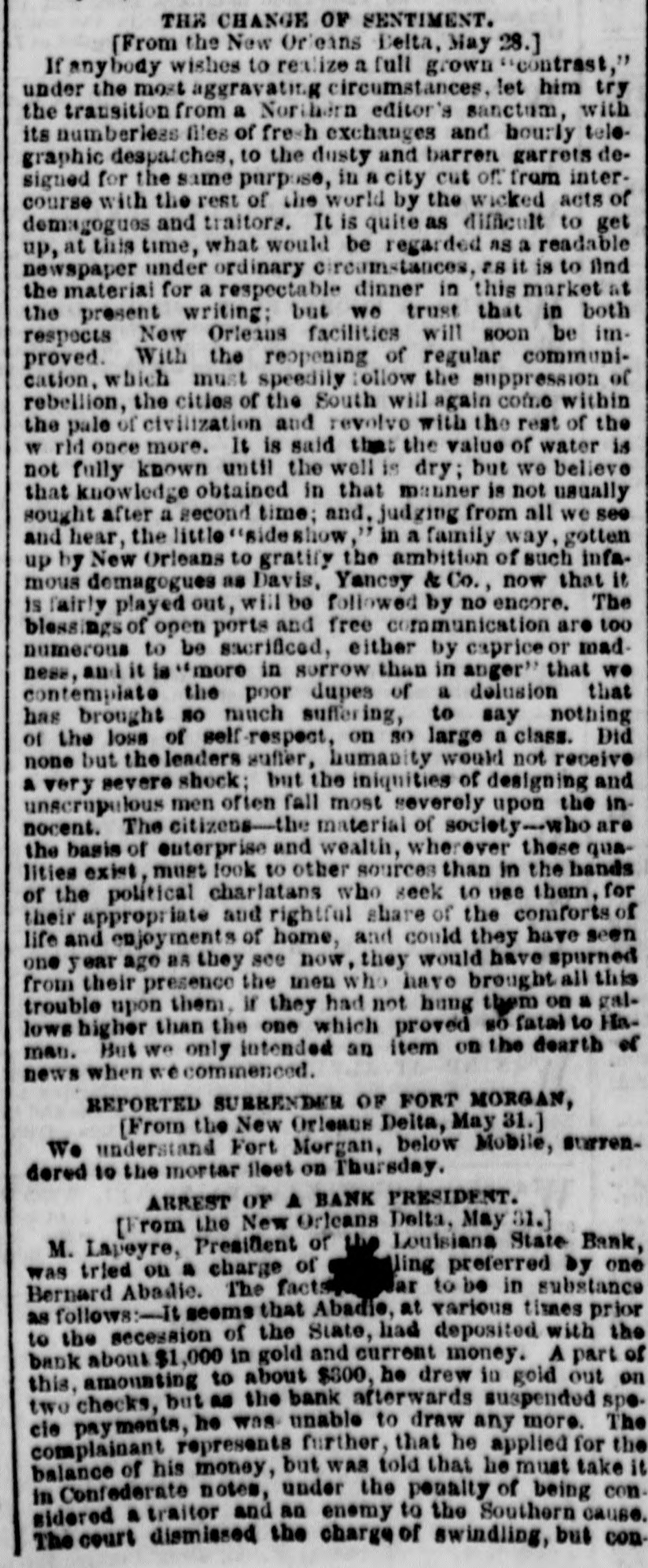
THE CHANGE OF SENTIMENT. (From the New Orleans Delta, May 28.] If anybody wishes to rex: ize a full grown "contrast," under the most aggravating circumstances. let him try the transition from a Northern editor's sanctum, with its numberless files of fresh exchanges and bourly telegraphic despatches, to the dusty and barren garrets designed for the same purpose, in a city cut off from intercourse with the rest of the world by the wicked acts of demagogues and traitors. It is quite as difficult to get up, at this time, what would be regarded as a readable newspaper under ordinary circumstances, 28 it is to find the material for a respectable dinner in this market at the present writing: but we trust that in both respects New Orleans facilities will soon be improved. With the reopening of regular communication, which must speedily follow the suppression of rebellion, the cities of the South will again cofne within the pale of civilization and revolve with the rest of the W rid once more. It is said that the value of water is not fully known until the well is dry; but we believe that knowledge obtained in that manner is not usually sought after a second time; and, judging from all we see and hear, the little "Bideshow, in a family way, gotten up by New Orleans to gratify the ambition of such infa. mous demagogues as Davis, Yancey & Co., now that it is fairly played out, will be followed by no encore. The blessings of open ports and free communication are too numerous to be sacrificed, either by caprice or mad. ness, and it is "more in sorrow than in anger" that we contemplate the poor dupes of a dolusion that has brought so much suffering, to say nothing of the loss of self-respect, on so large a class. Did none but the leaders suffer, humanity would not receive a very severe sheck; but the iniquities of designing and unscrupulous men often fall most severely upon the innocent. The citizens-the material of society-who are the basis of enterprise and wealth, wherever these qualities exist, must look to other sources than in the hands of the political charlatans who seek to use them, for their appropriate and rightful share of the comforts of life and enjoyments of home, and could they have seen one year age as they see now, they would have spurned from their presence the men who have brought all this trouble upon them, if they had not hung them on a gallows higher than the one which proved so fatal to Haman. But we only intended an item on the dearth of news when we commenced. REPORTED SUBRENDER OF FORT MORGAN, [From the New Orleans Delta, May 31.] We understand Fort Morgan, below Mobile, surrendered 10 the mortar fleet on Thursday. ARREST OF A BANK PRESIDENT. From the New Oricans Delta, May 31.] M. Lapoyre, President or the Louisiana State Bank, was tried on a charge of ling preferred by one Bernard Abadie. The facts Jar to be in substance as follows:-It seems that Abadie, at various times prior to the secession of the State, had deposited with the bank about $1,000 in gold and current money. A part of this, amounting to about $300, he drew in gold out on two checks, but as the bank afterwards suspended spocie payments, he was unable to draw any more. The complainant represents further, that he applied for the balance of his money, but was told that he must take it in Confederate notes, under the penalty of being con sidered a traitor and an enomy to the Southern cause. The court dismissed the charge of swindling, but con


Article from New-York Daily Tribune, June 27, 1863

Click image to open full size in new tab

Article Text

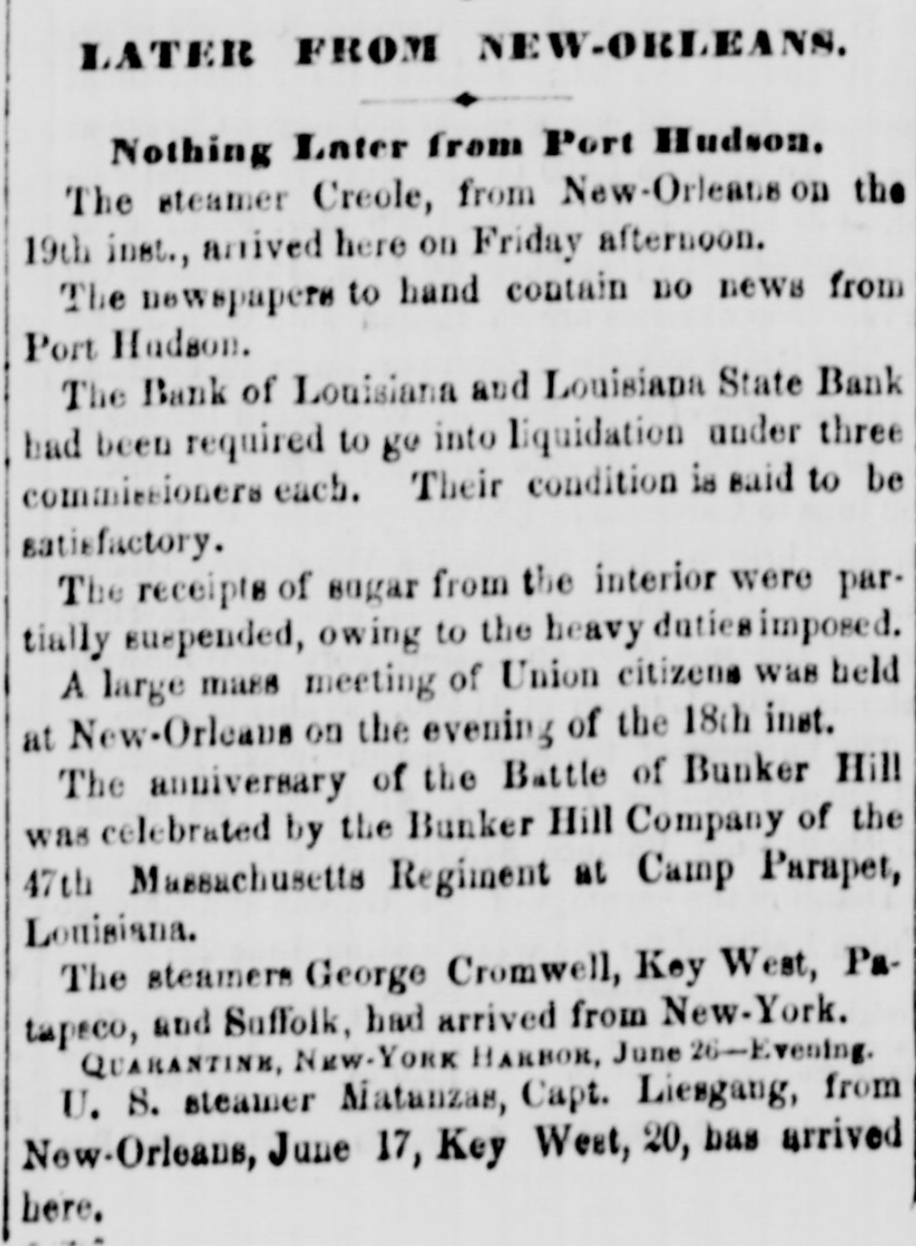
LATER FROM NEW-ORLEANS. Nothing Later from Port Hudson. The steamer Creole, from New-Orleans on the 19th inst., arrived here on Friday afternoon. The newspapers to hand contain no news from Port Hudson. The Bank of Louisiana and Louisiana State Bank had been required to go into liquidation under three commissioners each. Their condition is said to be satisfactory. The receipts of sugar from the interior were partially suspended, owing to the heavy dutiesimposed. A large mass meeting of Union citizens was held at New-Orleans on the evening of the 18th inst. The anniversary of the Battle of Bunker Hill was celebrated by the Bunker Hill Company of the 47th Massachusetts Regiment at Camp Parapet, Louisiana. The steamers George Cromwell, Key West, Patapsco, and Suffolk, had arrived from New-York. QUARANTINE, New-York HARBOR, June 26-Evening. U. S. steamer Matanzas, Capt. Liesgang, from New-Orleans, June 17, Key West, 20, has arrived here.


Article from Evening Star, June 27, 1863

Click image to open full size in new tab

Article Text

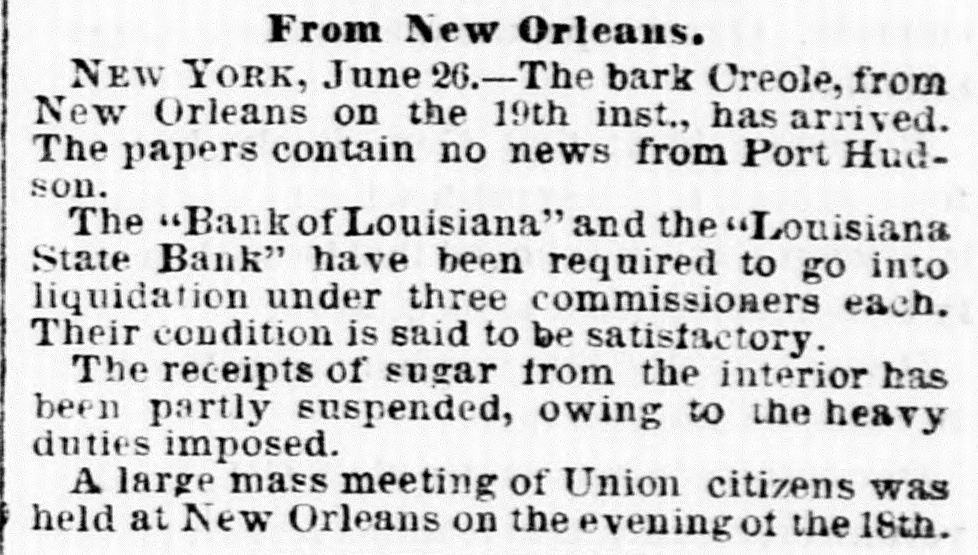
From New Orleans. NEW YORK, June 26.-The bark Creole, from New Orleans on the 19th inst., has arrived. The papers contain no news from Port Hudson. The "Bank of Louisiana" and the "Louisiana State Bank" have been required to go into liquidation under three commissioners each. Their condition is said to be satisfactory. The receipts of sugar from the interior has been partly suspended, owing to the heavy duties imposed. A large mass meeting of Union citizens was held at New Orleans on the evening of the 18th.


Article from Alexandria Gazette, June 27, 1863

Click image to open full size in new tab

Article Text

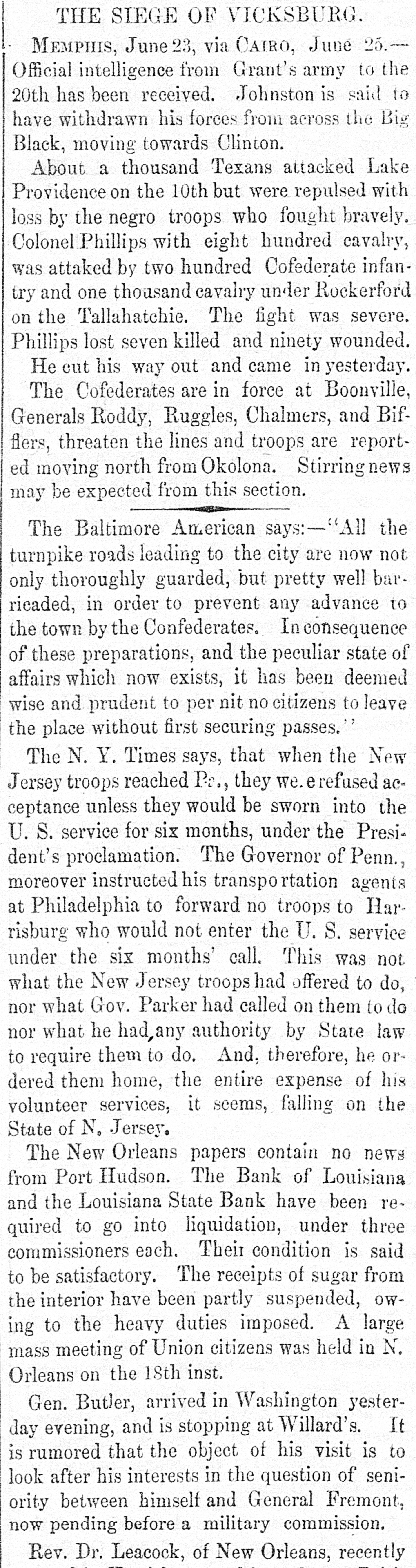
THE SIEGE OF VICKSBURG. MEMPHIS, June 23, via CAIRO, June 25.---Official intelligence from Grant's army to the 20th has been received. Johnston is said to have withdrawn his forces from across the Big Black, moving towards Clinton. About a thousand Texans attacked Lake Providence on the 10th but were repulsed with loss by the negro troops who fought bravely. Colonel Phillips with eight hundred cavalry, was attaked by two hundred Cofederate infantry and one thousand cavalry under Rockerford on the Tallahatchie. The fight was severe. Phillips lost seven killed and ninety wounded. He cut his way out and came in yesterday. The Cofederates are in force at Boonville, Generals Roddy, Ruggles, Chalmers, and Biffiers, threaten the lines and troops are reported moving north from Okolona. Stirring news may be expected from this section. The Baltimore American says:-"All the turnpike roads leading to the city are now not only thoroughly guarded, but pretty well barricaded, in order to prevent any advance to the town by the Confederates. Inconsequence of these preparations, and the peculiar state of affairs which now exists, it has been deemed wise and prudent to per nit no citizens to leave the place without first securing passes." The N. Y. Times says, that when the New Jersey troops reached Po., they we. refused acceptance unless they would be sworn into the U. S. service for six months, under the President's proclamation. The Governor of Penn., moreover instructed his transportation agents at Philadelphia to forward no troops to Harrisburg who would not enter the U. S. service under the six months' call. This was not what the New Jersey troops had offered to do, nor what Gov. Parker had called on them to do nor what he had, any authority by State law to require them to do. And, therefore, he ordered them home, the entire expense of his volunteer services, it seems, falling on the State of N. Jersey. The New Orleans papers contain no news from Port Hudson. The Bank of Louisiana and the Louisiana State Bank have been required to go into liquidation, under three commissioners each. Their condition is said to be satisfactory. The receipts of sugar from the interior have been partly suspended, owing to the heavy duties imposed. A large mass meeting of Union citizens was held in N. Orleans on the 18th inst. Gen. Butler, arrived in Washington yesterday evening, and is stopping at Willard's. It is rumored that the object of his visit is to look after his interests in the question of seniority between himself and General Fremont, now pending before a military commission. Rev. Dr. Leacock, of New Orleans, recently


Article from Cleveland Morning Leader, June 27, 1863

Click image to open full size in new tab

Article Text

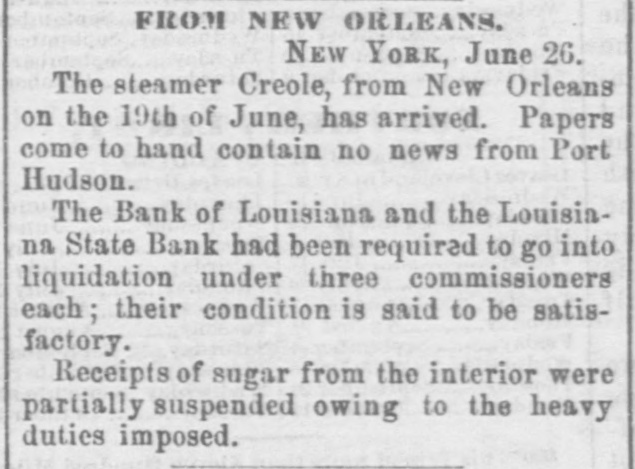
FROM NEW ORLEANS. NEW YORK, June 26. The steamer Creole, from New Orleans on the 19th of June, has arrived. Papers come to hand contain no news from Port Hudson. The Bank of Louisiana and the Louisiana State Bank had been required to go into liquidation under three commissioners each; their condition is said to be satisfactory. Receipts of sugar from the interior were partially suspended owing to the heavy duties imposed.


Article from Chicago Daily Tribune, June 27, 1863

Click image to open full size in new tab

Article Text

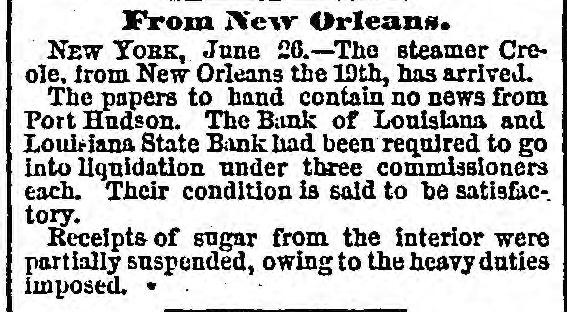
From New Orleans. NEW York, June 26.-The steamer Creole, from New Orleans the 19th, has arrived. The papers to hand contain no news from Port Hudson. The Bank of Louislana and Louisiana State Bank had been required to go into liquidation under three commissioners each. Their condition is said to be satisfactory. Receipts of sugar from the interior were partially suspended, owing to the heavy duties imposed.


Article from The Weekly Register, July 2, 1863

Click image to open full size in new tab

Article Text

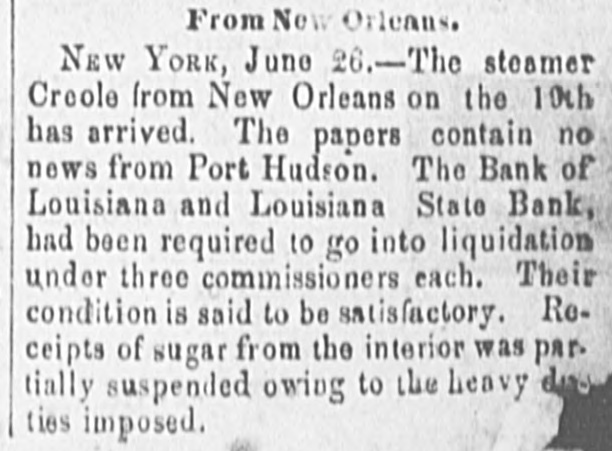
From New Orleans. NEW YORK, June 26.-The steamer Creole from New Orleans on the 10th has arrived. The papers contain no news from Port Hudson. The Bank of Louisiana and Louisiana State Bank, had been required to go into liquidation under three commissioners each. Their condition is said to be satisfactory. Receipts of sugar from the interior was partially suspended owing to the heavy ties imposed.


Article from The Weekly Register, July 2, 1863

Click image to open full size in new tab

Article Text

From New Orleans. NEW YORK, June 26.-The steamer Creole from New Orleans on the 19th has arrived. The papers contain no news from Port Hudson. The Bank of Louisiana and Louisiana State Bank, had been required to go into liquidation under three commissioners each. Their condition is said to be satisfactory. Receipts of sugar from the interior was partially suspended owing to the heavy due ties imposed.


Article from The Daily Dispatch, February 11, 1867

Click image to open full size in new tab

Article Text

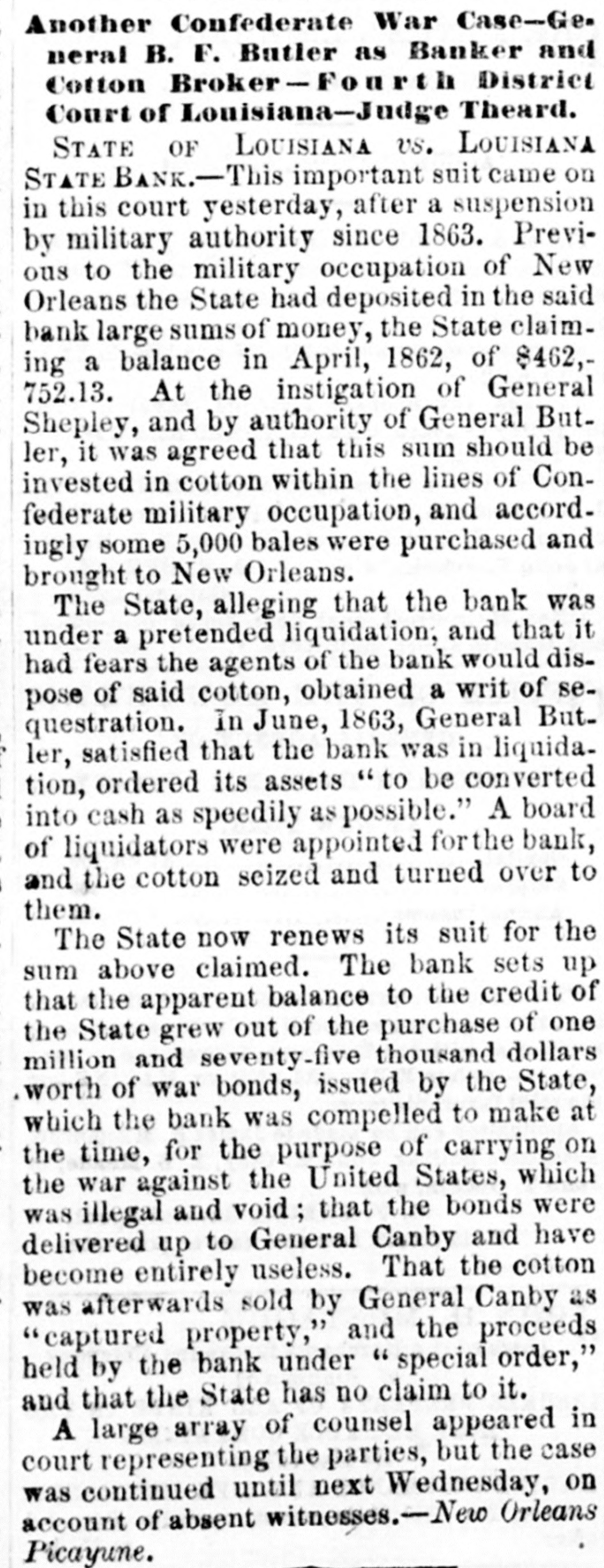
Another Confederate War Case-Ge. neral B. F. Batler as Banker and Cotton Broker-Fourth District Court of Louisiana-Judge Theard. STATE OF LOUISIANA vs. LOUISIANA STATE BANK.-This important suit came on in this court yesterday, after a suspension by military authority since 1863. Previous to the military occupation of New Orleans the State had deposited in the said bank large sums of money, the State claiming a balance in April, 1862, of $462,752.13. At the instigation of General Shepley, and by authority of General Butler, it was agreed that this sum should be invested in cotton within the lines of Confederate military occupation, and accordingly some 5,000 bales were purchased and brought to New Orleans. The State, alleging that the bank was under a pretended liquidation; and that it had fears the agents of the bank would dispose of said cotton, obtained a writ of sequestration. In June, 1863, General Butler, satisfied that the bank was in liquidation, ordered its assets "to be converted into cash as speedily as possible." A board of liquidators were appointed forthe bank, and the cotton seized and turned over to them. The State now renews its suit for the sum above claimed. The bank sets up that the apparent balance to the credit of the State grew out of the purchase of one million and seventy-five thousand dollars worth of war bonds, issued by the State, which the bank was compelled to make at the time, for the purpose of carrying on the war against the United States, which was illegal and void ; that the bonds were delivered up to General Canby and have become entirely useless. That the cotton was afterwards sold by General Canby as "captured property," and the proceeds held by the bank under "special order," and that the State has no claim to it. A large array of counsel appeared in court representing the parties, but the case was continued until next Wednesday, on account of absent witnesses.-New Orleans Picayune.


Article from The Daily Phoenix, February 13, 1867

Click image to open full size in new tab

Article Text

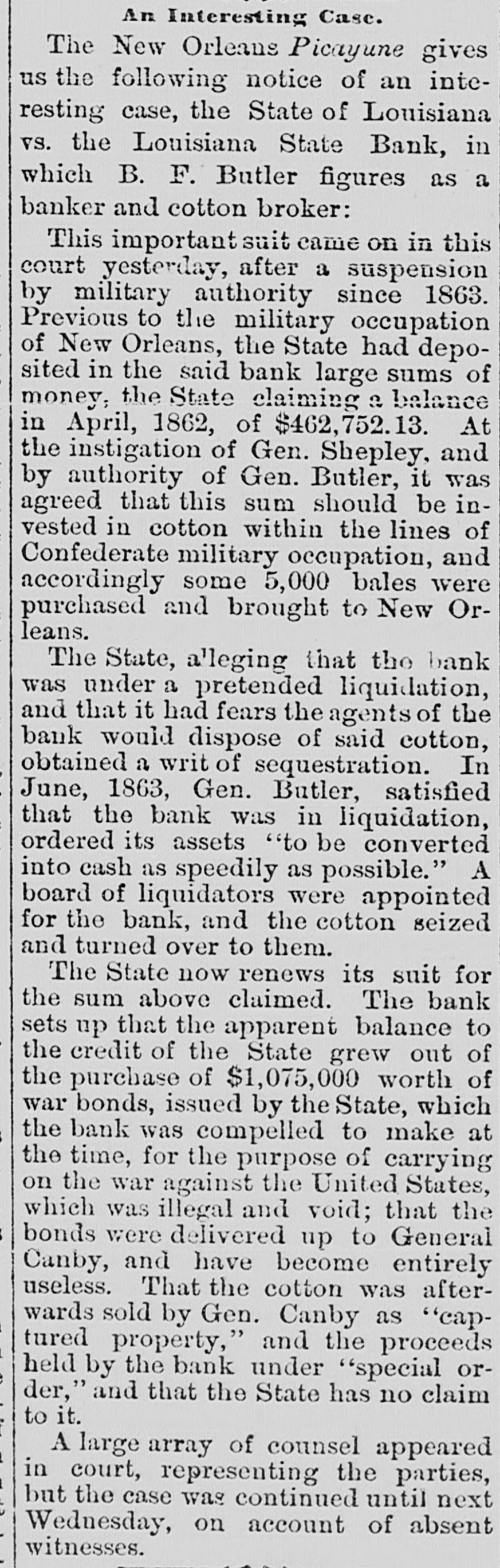
An Interesting Case. The New Orleans Picayune gives us the following notice of an interesting case, the State of Louisiana vs. the Louisiana State Bank, in which B. F. Butler figures as a banker and cotton broker: This important suit came on in this court yesterday, after a suspension by military authority since 1863. Previous to the military occupation of New Orleans, the State had deposited in the said bank large sums of money, the State claiming a balance in April, 1862, of $462,752.13. At the instigation of Gen. Shepley, and by authority of Gen. Butler, it was agreed that this sum should be invested in cotton within the lines of Confederate military occupation, and accordingly some 5,000 bales were purchased and brought to New Orleans. The State, alleging that the bank was under a pretended liquidation, and that it had fears the agents of the bank would dispose of said cotton, obtained a writ of sequestration. In June, 1863, Gen. Butler, satisfied that the bank was in liquidation, ordered its assets "to be converted into cash as speedily as possible." A board of liquidators were appointed for the bank, and the cotton seized and turned over to them. The State now renews its suit for the sum above claimed. The bank sets up that the apparent balance to the credit of the State grew out of the purchase of $1,075,000 worth of war bonds, issued by the State, which the bank was compelled to make at the time, for the purpose of carrying on the war against the United States, which was illegal and void; that the bonds were delivered up to General Canby, and have become entirely useless. That the cotton was afterwards sold by Gen. Canby as "captured property," and the proceeds held by the bank under "special order," and that the State has no claim to it. A large array of counsel appeared in court, representing the parties, but the case was continued until next Wednesday, on account of absent witnesses.