7633. Exchange Bank (New Orleans, LA)

Bank Information

Episode Type
Run → Suspension → Closure
Bank Type
state
Start Date
February 21, 1842
Location
New Orleans, Louisiana (29.955, -90.075)

Metadata

Model
gpt-5-mini
Short Digest
c89b6267

Response Measures

Full suspension

Other: Bank was placed into liquidation / sequestration by Attorney General; charter later adjudged forfeited.

Description

Newspapers report a run on Feb 21–22, 1842 after other New Orleans banks refused the paper of four banks (including the Exchange). The Exchange refused redemption, was discredited, and by March–April 1842 was placed in liquidation/sequestration by court/Attorney General; charter later adjudged forfeited. I infer state-chartered status from references to charter, legislature, and state actions (articles note charter forfeiture and legislative acts).

Events (4)

1. February 21, 1842 Run
Cause
Local Banks
Cause Details
Other New Orleans banks (the other twelve) refused to receive the notes of Exchange and three other banks, causing discredit and heavy withdrawals on Feb 21–22, 1842.
Measures
Exchange Bank refused to give anything in exchange for its notes; heavy redemptions refused and notes traded at deep discount.
Newspaper Excerpt
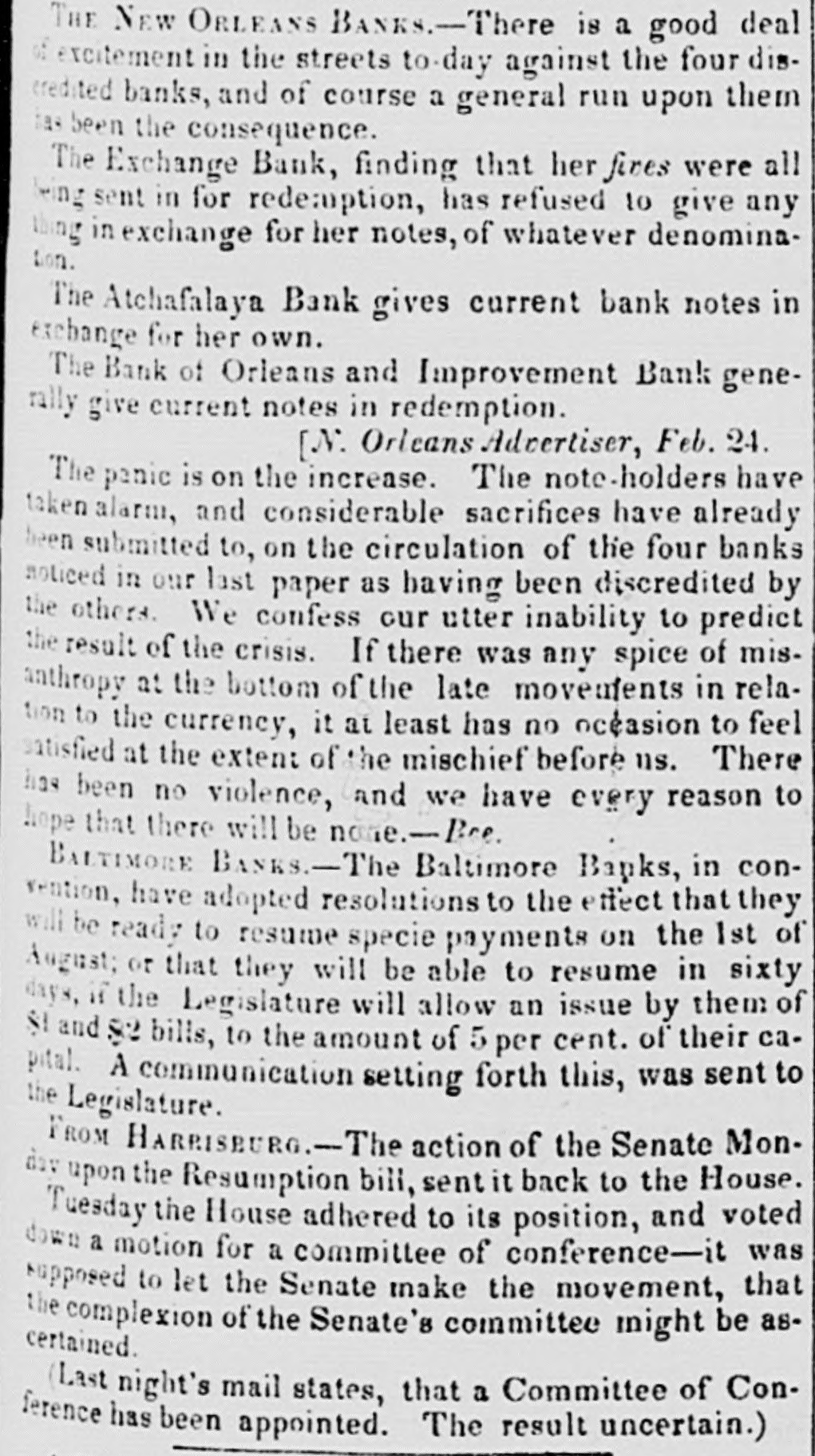
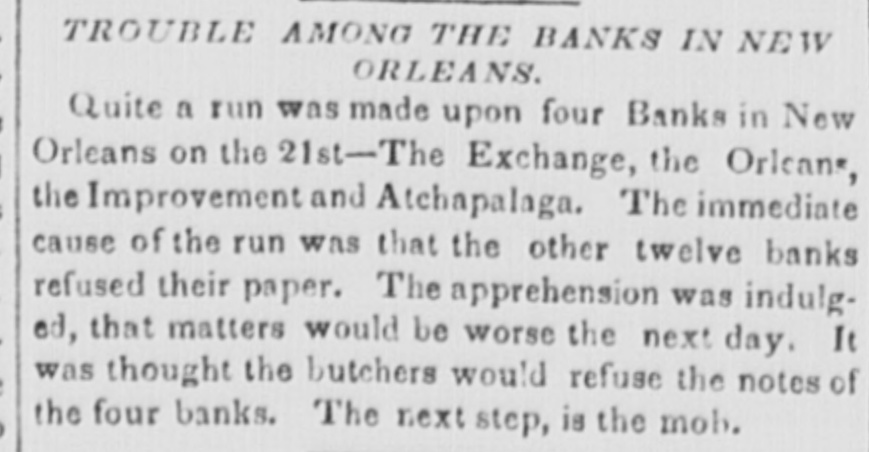
Quite a run was made upon four Banks in New Orleans on the 21st—The Exchange, the Orleans, the Improvement and Atchapalaga.
Source
newspapers
2. March 15, 1842 Receivership
Newspaper Excerpt
The Exchange Bank ... was placed in liquidation; commissioners for liquidating the affairs of the Exchange Bank of New Orleans intend applying to the Legislature ... The charter of the Exchange and Banking Co. was adjudged to be forfeited by a judgement ... on the 15th March, 1842.
Source
newspapers
3. March 15, 1842 Suspension
Cause
Government Action
Cause Details
Writs of sequestration/closure issued by the District Court on application of the Attorney General; bank put into liquidation and assets placed in hands of Board of Currency/commissioners.
Newspaper Excerpt
The charter of the Exchange and Banking Co. was adjudged to be forfeited by a judgement... on the 15th March, 1842. The Exchange Bank continued us banking business until March 1842, when ceased to redeem its notes.
Source
newspapers
4. April 1, 1842* Other
Newspaper Excerpt
The Exchange, Orleans and Atchafalaya Banks have been closed by writs of sequestration, issued by the District Court on application of the Attorney General. The Improvement and Merchants' Banks are to go into liquidation immediately . . . The Exchange, Atchafaya and Orleans Banks have been closed by the Attorney General and their assets are now in the hands of the Board of Currency.
Source
newspapers

Newspaper Articles (13)

Article from Baton-Rouge Gazette, December 25, 1841

Click image to open full size in new tab

Article Text

EXECUTIVE DEPARTMENT. New Orleans, 18th December 1841. Sta-1 have the honor to acknowledge the receipt of the letter which has been addressed to me yesterday, in the name of the Board of Directors over which you preside, to express their regret that, in my late annual mesange to the general assembly, "the Carrollton Bank has been classed an one of the institutotal which has encreased its liabilities during the last two years." No one could have experienced more uncasinces than I would, if through any error contained in the communication to which you allude, the Carrollton Bank, or any other, had been made undeservedly to suffer. I therefore feel happy in being able to stato and to prove that this has not been the case. In the discharge of what I considered a dutv. I have informed the legielature that the Board of Presidents have postponed the resumption of specie payments until November 1842, in order to enable the weak banks to change their position. It is not through any act of mine that your institution has been classed as a weak bank. It has been done by a resolution adopted by the Board of Presidenta in the following words: "Resolved, that the aid which may be necessary to enable the improvement, the Exchange, the Atchafalaya, the Orleans and the Carrollton Banks to resame payment in specie with the other banks, be furnished to said banks immediately, &c." Wishing to prove, by what had already taken place, that those weak banks could not expect to be benefited by a continuation of the suspension, I have given the position of each of them in October last, and in November, 1839, immediately after the second suspension; and I have shown that during the last two years, their collective cash liabilities have increased more than $780,000, and their collective cash assets have decreased $300,000. The statements on which my calculations were based, have been extracted from a document submitted officially by the Citizens' Bank to the Board of Presidents of the banks of this city, which has since been laid by that institution before the general assembly.These were the only data on which I could safely act, because the information on the situation of our monetary institutions which had requested officially from the Secretary of the Board of Presidents, could not be communicated to me, notwithstanding the willingness of that gentleman to do so, before the inceting of the legislature. In neither of the statements quoted in my message, can you find a cause of complaint, for in both of there your liabilities are smaller than those now given by yourself. Your classification with the institutions that have augmented their liabilities could not be avoided, for having undertaken to show the effect of srspension on all the banks which the Board of Presidents intended to relieve. I could not help classing you with them, without making a distinction which might appear invidious between the banks which they had thought proper to connect. I learn with much pleasure that the Carrollton Bank is preparing to resume specie payments, "at as early a period as a majority of the banks of this city may do so." I hope that the time is not far distant when the country shall be relieved from the calamities which necessarily follow the circulation of an irredeemable paper currency. Respectfully, Your obedient servant. A. B. ROMAN. (Signed) G.C. DUNCAN, President of the Carrollton Bank.
Article from Richmond Enquirer, March 3, 1842

Click image to open full size in new tab

Article Text

holding the dignity of the States TROUBLE.-There was a great deal of excitement on the 21st in New Orleans, in consequence of the refusal on the part of the Banks to receive each other's notes The "Commercial" article of the Bulletin (Whig) of that morning says, "The panic and distress which have hitherto distinguished the times, seem to have been but the precursors of the confusion, dismay and ruin which now threaten and appeal to the community.Under the crushing operation of the Bank Bill these institutions have been forced into measures of self-defence, and simultaneous with every movement of protection which they have adopted, is the aggravated pressure upon the mass of the people. To-day upon the opening of the banks, it was ascertained that the notes of four of these corporations-generally known as the weak banks, viz.-the Orleans, Exchange, At. chafalaya and Improvement, were absolutely refused either on deposit, or when offered for the payment of notes by all the other institutions. The immediate consequence of this discredit was a decline in the value of those notes. Many persons under the influence of the panic disposed of their funds at a discount, varying from 5 4 15 per cent. Others found it impracticable to get them off, and the evening closed upon a scene of disheartening uncertainty, gloom and ruinous forebod. ing, to which the morrow promises to bring but small alleviation. The N. Orleans Courier (Dem.) says, Feb. 21, half past 2 o'clock: "We learn that the refusal of the notes of four of the banks, by the other institutions of this city, has caused sufficient public agitation to induce the au thorities to resort to immediate measures to prevent the injury which might otherwise accrue. We cannotagain understand the W. "Independent. Citizen Poins has no doubt called upon it for an expla. nation of the paragraph which we published in our last. The last Independent now says, "The allusions, in our last, to the rumors prevailing here as to the relations between Governor Poindexter and the President, were not meant in any manner to countenance such reports. We have all along had reason to know that Governor Poindexter is pushing the investigation in question with all the zeal and pertinacity, which form so marked a part of his public character, and that, if he had desired an office of Mr. Tyler, an important one was long ago intimated to be at his disposal.' -That is to say, the In. dependent first insinuates that the President and Mr. Poindexter are sometimes quarrelling, then billing and cooing-First, that he (Mr. P.) is vexed at the Mexican Mission being taken from his grasp; but that the de. feat of Mr. Comptroller Barker opens a new door to Mr. P.'s aspirations ; and now it comes forward to say, that it by no means countenances any such rumors, and that "if he had desired an office, why an important one was long ago intimated to be at his disposal.""If!" ago`--first hinting a IIImor, and then declaring that it did not "mean in any t manner to countenance any such reports - why what sort of character is the Independent affecting Is it studying the diplomatic language of Washington The Republicans of Petersburg have had a meeting. Mr. N. M. Martin in the Chair, and Mr. Charles Campbell Secretary-and appointed Delegates to attend the Senatorial Convention at Goode's Tavern-and


Article from Daily Richmond Whig, March 3, 1842

Click image to open full size in new tab

Article Text

TROUBLE AMONG THE BANKS IN NEW ORLEANS. Quite a run was made upon four Banks in New Orleans on the 21st-The Exchange, the Orlcans, the Improvement and Atchapalaga. The immediate cause of the run was that the other twelve banks refused their paper. The apprehension was indulged, that matters would be worse the next day. It was thought the butchers would refuse the notes of the four banks. The next step, is the moh.


Article from The New York Herald, March 5, 1842

Click image to open full size in new tab

Article Text

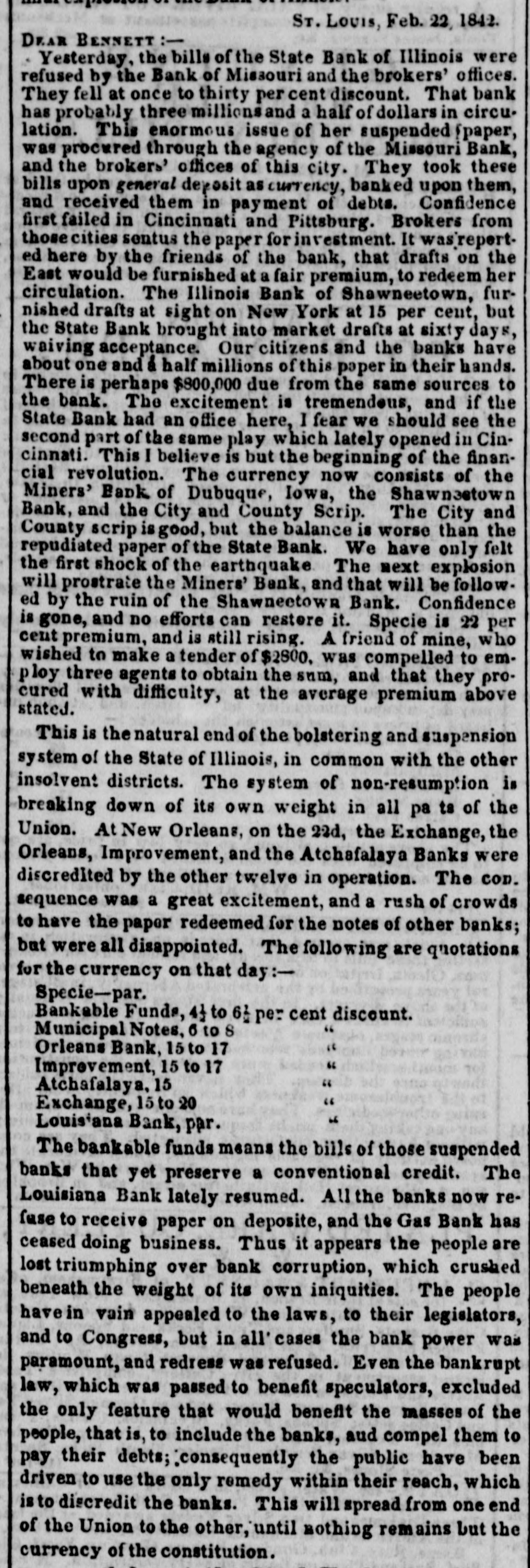
ST. Louis, Feb. 22 1842. DEAR BENNETT:Yesterday, the bills of the State Bank of Illinois were refused by the Bank of Missouri and the brokers' offices. They fell at once to thirty per cent discount. That bank has probably three millions and a half of dollars in circu. lation. This enormous issue of her suspended paper, was procured through the agency of the Missouri Bank, and the brokers' offices of this City. They took these bills upon general deposit as currency, banked upon them, and received them in payment of debts. Confidence first failed in Cincinnati and Pittsburg. Brokers from those cities sentus the paper for investment. It was'reperted here by the friends of the bank, that drafts on the East would be furnished at a fair premium, to redeem her circulation. The Illinois Bank of Shawneetown, furnished drafts at sight on New York at 15 per cent, but the State Bank brought into market drafts at sixty days, waiving acceptance. Our citizens and the banks have about one and & half millions of this paper in their hands. There is perhaps $800,000 due from the same sources to the bank. The excitement is tremendous, and if the State Bank had an office here, I fear we should see the second part of the same play which lately opened in Cincinnati. This I believe is but the beginning of the financial revolution. The currency now consists of the Miners' Bank of Dubuque, Iowa, the Shawn3stown Bank, and the City and County Scrip. The City and County scrip is good, but the balance is worse than the repudiated paper of the State Bank. We have only felt the first shock of the earthquake The next explosion will prostrate the Miners' Bank, and that will be follow. ed by the ruin of the Shawneetown Bank. Confidence is gone, and no efforts can restore it. Specie is 22 per cent premium, and is still rising. A friend of mine, who wished to make a tender of $2800, was compelled to employ three agents to obtain the sum, and that they procured with difficulty, at the average premium above stated. This is the natural end of the bolstering and suspension system of the State of Illinois, in common with the other insolvent districts. The system of non-resumption is breaking down of its own weight in all pa ts of the Union. At New Orleans, on the 22d, the Exchange, the Orleans, Improvement, and the Atchafalaya Banks were discredited by the other twelve in operation. The COD. sequence was a great excitement, and a rush of crowds to have the paper redeemed for the notes of other banks; but were all disappointed. The following are quotations for the currency on that day:Specie-par. Bankable Funds, 4} to 61 per cent discount. " Municipal Notes, 6 to 8 " Orleans Bank, 15 to 17 " Improvement, 15 to 17 " Atchafalaya 15 " Exchange, 15 to 20 66 Louisiana Bank, par. The bankable funds means the bills of those suspended banks that yet preserve a conventional credit. The Louisiana Bank lately resumed. All the banks now refuse to receive paper on deposite, and the Gas Bank has ceased doing business. Thus it appears the people are lost triumphing over bank corruption, which crushed beneath the weight of its own iniquities. The people have in vain appealed to the laws, to their legislators, and to Congress, but in all' cases the bank power was paramount, and redress was refused. Even the bankrupt law, which was passed to benefit speculators, excluded the only feature that would benefit the masses of the people, that is, to include the banks, aud compel them to pay their debts; (consequently the public have been driven to use the only remedy within their reach, which is to discredit the banks. This will spread from one end of the Union to the other, until nothing remains but the currency of the constitution.


Article from Richmond Enquirer, March 5, 1842

Click image to open full size in new tab

Article Text

THE NEW ORLEANS BANKS.-There - is a good deal %'excitement in the streets to-day against the four discredited banks, and of course a general run upon them been the consequence. The Exchange Bank, finding that her fires were all -ing sent in for redemption, has refused to give any thing in exchange for her notes, of whatever denominaLon. The Atchafalaya Bank gives current bank notes in exchange for her own. The Bank of Orleans and Improvement Bank generally give current notes in redemption. [N: Orieans Advertiser, Feb. 24. The panic is on the increase. The note-holders have taken alarm, and considerable sacrifices have already been submitted to, on the circulation of the four banks noticed in our last paper as having been discredited by the others. We confess our utter inability to predict the result of the crisis. If there was any spice of misanthropy at the bottom of the late movements in relation to the currency, it at least has no oceasion to feel satisfied at the extent of the mischief before us. There has been no violence, and we have every reason to hope that there will be none.-Bre. BALTIMORE BANKS.-The Baltimore Bapks, in conreation, have adopted resolutions to the effect that they will be ready to resume specie payments on the 1st of August; or that they will be able to resume in sixty days, if the Legislature will allow an issue by them of SI and 82 bills, to the amount of 5 per cent. of their capital. A communication setting forth this, was sent to the Legislature. FROM HARRISBURG.-The action of the Senate Monday upon the Resumption bill, sent it back to the House. Tuesday the House adhered to its position, and voted down a motion for a committee of conference-it was supposed to let the Senate make the movement, that the complexion of the Senate's committee might be ascertained (Last night's mail states, that a Committee of Conference has been appointed. The result uncertain.)


Article from New-York Tribune, March 8, 1842

Click image to open full size in new tab

Article Text

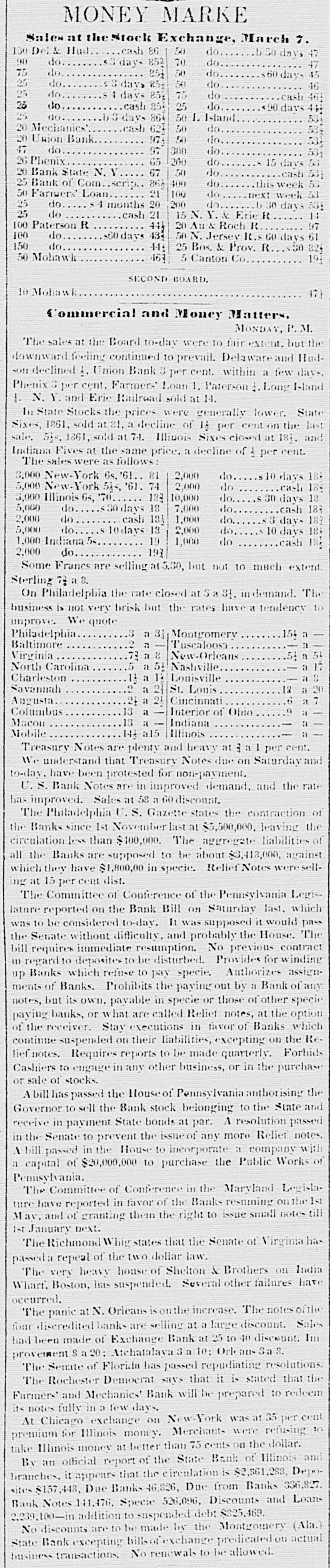
# MONEY MARKE Sales at the Stock Exchange, March 7. 130 Del & Hud.cash 86 50 do..b So0 days 47 90 do...$$ days 852 70 do... 47 75 do 251 50 do.... 60 days 45 25 do. 53 days 85 50 do 46 95 do.. ..s 4 days 851 75 do cash 461 25 do .cash 25 25 do.. ..≤90 days 4 25 do.... ..b 3 days 864 50 L Island. 534 20 Mechanics'.. .cash 624 50 do.. 20 Union Bank... 974 50 do.. 47 47 do.. 97 300 do.. 531 26 Phenix. 65 200 do.. 15 days 53 20 Bank State N. Y. 67 50 do ...cash 53 25 Bank of Com..scrip.. 86 400 do this week 53 50 Farmers' Loan.... 21 100 do.. next week 53 25 do s 4 months 20 200 do..b 30 days 531 25 do ...cash 21 15 N. Y. & Erie R 14 100 Paterson R 44 20 Au & Roch R. 97 100 do... 560 days 433 50 N. Jersey R.s 60 days 61 150 do.. 441 25 Bos. & Prov. R...s30 824 50 Mohawk 463 5 Canton Co 19 SECOND BOARD. 10 Mobawk.. 17 # Commercial and Money Matters. MONDAY, P. M. The sales at the Board to-day were to fair extent, but the downward feeling continued to prevail. Delaware and Hud- son declined, Union Bank 3 per cent. within a few days, Phenix 3 per cent, Farmers' Loan 1. Paterson, Long Island 4. N. Y. and Eric Railroad sold at 14. Tu State Stocks the prices were generally lower. State Sixes, 1861, sold at 21, a decline of 1 per cent on the last sale. 51s, 1861, sold at 74. Illinois Sixes closed at 184, and Indiana Fives at the same price, a decline of per cent. The sales were as follows: 3,000 New-York 6s, '61..81 2,000 dos 10 days 184 5,000 New-York 5s, 61. 74 2,000 do ...cash 184 5,000 Illinois 6s, '70. 183 10,000 dos 30 days 18 2,000 dos 30 days 18 7,000 do... .cash 183 2,000 do cash 13 1,000 do.s 3 days 182 5,000 dos 10 days 13 5,000 dos 10 days 184 2,000 dos 10 days 184 1,000 Indiana 5s.. 19 1,000 do ....cash 18 2,000 do. 193 Some Francs are selling at 5.30, but not to much extent. Sterling 7 a 8. On Philadelphia the rate closed at 5 a 31, in demand. The business is not very brisk but the rates have a tendency to improve. We quote Philadelphia.. 3 a 3 Montgomery 154 a Baltimore 2 Tuscaloosa a Virginia .73 a 2 New-Orleans 54 n 54 North Carolina .5 a 51 Nashville.. a 17 Charleston 14 a 12 Louisville as Savannal 2 a 2 St. Louis. 12 a 20 Augusta.. 24 a 2 Cincinnati 6a7 Columbus 13 a Interior of Ohio.9 a Macon 13 a Indiana a Mobile ..14 a15 Illinois a Treasury Notes are plenty and heavy at al per cent. We understand that Treasury Notes due on Saturday and to-day, have been protested for non-payment. U. S. Bank Notes are in improved demand, and the rate has improved. Sales at 58 a 60 discount. The Philadelphia U. S. Gazette states the contraction of the Banks since 1st November last at $5,500,000, leaving the circulation less than $100,000. The aggregate liabilities of all the Banks are supposed to be about $3,418,000, against which they have $1,800,00 in specie. Relief Notes were sell- ing at 15 per cent dist. The Committee of Conference of the Pennsylvania Legis- lature reported on the Bank Bill on Saturday last, which was to be considered to-day. It was supposed it would pass the Senate without difficulty, and probably the House. The bill requires immediate resumption. No previous contract in regard to deposites to be disturbed. Provides for winding up Banks which refuse to pay specie. Authorizes assign- ments of Banks. Prohibits the paying out by a Bank of any notes, but its own, payable in specie or those of other specie paying banks, or what are called Relief notes, at the option of the receiver. Stay executions in favor of Banks which continue suspended on their liabilities, excepting on the Re- lief notes. Requires reports to be made quarterly. Forbids Cashiers to engage in any other business, or in the purchase or sale of stocks. A bill has passed the House of Pennsylvania anthorising the Governor to sell the Bank stock belonging to the State and receive in payment State bonds at par. A resolution passed in the Senate to prevent the issue of any more Relief notes. A bill passed in the House to incorporate a company with a capital of $20,000,000 to purchase the Public Works of Pennsylvania. The Committee of Conference in the Maryland Legisla- ture have reported in favor of the Banks resuming on the 1st May, and of granting them the right to issue small notes till Ist January next. The Richmond Wing states that the Senate of Virginia has passed a repeal of the two dollar law. The very heavy house of Shelton & Brothers on India Whart, Boston, has suspended. Several other failures have occurred. The panic at N. Orieaus is on the increase. The notes of the four discredited banks are selling at a large discount. Sales had been made of Exchange Bank at 25 to 40 discount. Im- provement S a 20: Atchatalaya 3 a 10; Orleans Sa S. The Senate of Florida has passed repudiating resolutions. The Rochester Democrat says that it is stated that the Farmers' and Mechanics' Bank will be prepared to redeem its notes fully in a few days, At Chicago exchange on New-York was at 35 per cent premium for Illinois money. Merchants were refusing to take Ilinois money at better than 75 cents on the dollar. By an official report of the State Bank of Illinois and branches, it appears that the circulation is $2,361,288, Depo- sites $157,448, Due Banks 46,826, Due from Banks 336,827. Bank Notes 141,476, Specie 526,096, Discounts and Loans 2,239,100-in addition to suspended debt $825,469. No discounts are to be made by the Montgomery (Ala.) State Bank excepting bills of exchange predicated on actual business transactions. No renewals to be allowed.


Article from New-York Tribune, March 22, 1842

Click image to open full size in new tab

Article Text

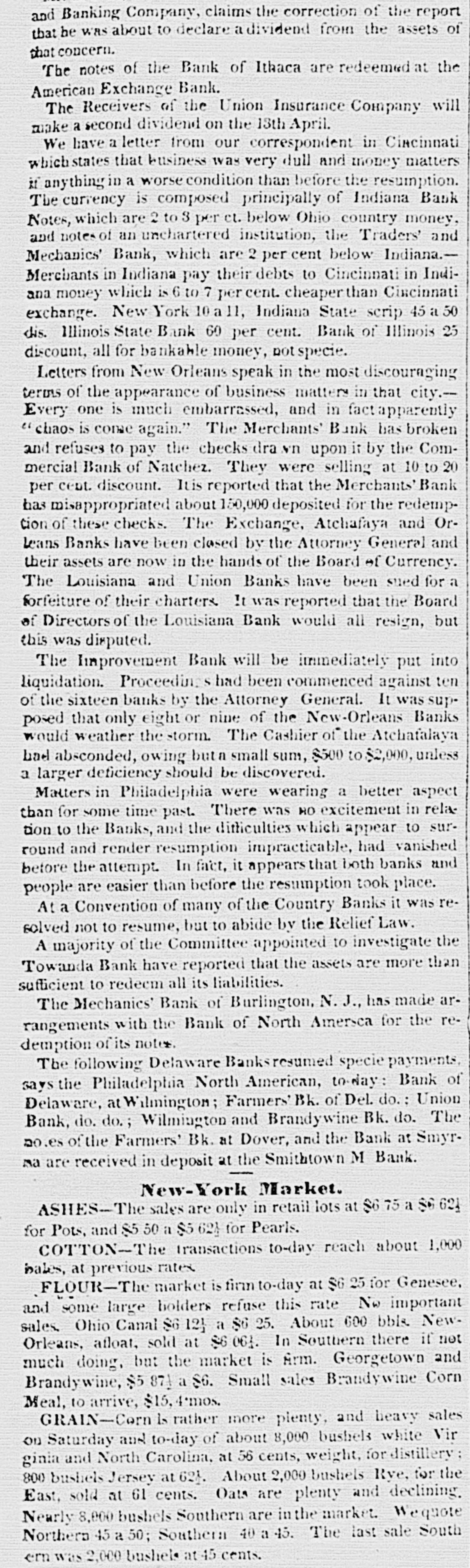
and Banking Company, claims the correction of the report that be was about to declare a dividend from the assets of that concern. The notes of the Bank of Ithaca are redeemed at the American Exchange Bank. The Receivers of the Union Insurance Company will make a second dividend on the 13th April. We have a letter from our correspondent in Cincinnati which states that business was very dull and money matters anything in a worse condition than before the resumption. The currency is composed principally of Indiana Bank Notes, which are 2 to 3 per ct. below Ohio country money, and notes of an unchartered institution, the Traders' and Mechanics' Bank, which are 2 per cent below Indiana.Merchants in Indiana pay their debts to Cincinnati in Indiana money which is 6 to 7 per cent. cheaper than Cincinnati exchange. New York 10 a 11, Indiana State scrip 45 a 50 dis. Illinois State Bank 60 per cent. Bank of Illinois 25 discount, all for bankable money, not specie. Letters from New Orleans speak in the most discouraging terms of the appearance of business matters in that city.Every one is much embarrassed, and in fact apparently "chaos is conse again." The Merchants' Bank has broken and refuses to pay the checks dra vn upon it by the Commercial Bank of Natchez. They were selling at 10 to 20 per cent. discount. Itis reported that the Merchants' Bank has misappropriated about 150,000 deposited for the redemption of these checks. The Exchange, Atchafaya and OrLeans Banks have been closed by the Attorney General and their assets are now in the hands of the Board of Currency. The Louisiana and Union Banks have been sued for a forfeiture of their charters. It was reported that the Board of Directors of the Louisiana Bank would all resign, but this was disputed. The Improvement Bank will be immediately put into liquidation. Proceedings had been commenced against ten of the sixteen banks by the Attorney General. It was supposed that only eight or nine of the New-Orleans Banks would weather the storm. The Cashier of the Atchafalaya had absconded, owing butn small sum, $500 to $2,000, unless a larger deficiency should be discovered. Matters in Philadelphia were wearing a better aspect than for some time past. There was HO excitement in relation to the Banks, and the difficulties which appear to surround and render resumption impracticable, had vanished before the attempt. In fact, it appears that both banks and people are easier than before the resumption took place. At a Convention of many of the Country Banks it was resolved not to resume, but to abide by the Relief Law. A majority of the Committee appointed to investigate the Towanda Bank have reported that the assets are more than sufficient to redeem all its liabilities. The Mechanics' Bank of Burlington, N. J., has made arrangements with the Bank of North Amersca for the redemption of its notes. The following Delaware Banksresumed specie payments, says the Philadelphia North American, to-day: Bank of Delaware, at Wilmington; Farmers' Bk. of Del. do.: Union Bank, do. do.; Wilmington and Brandywine Bk. do. The 20.08 of the Farmers' Bk. at Dover, and the Bank at Smyrna are received in deposit at the Smithtown M Bank. New-York Market. ASHES-The sales are only in retail lots at $6 75 a $6 621 for Pots, and $5.50 a $5.62 for Pearls. COTTON-The transactions to-day reach about 1,000 hales, at previous rates FLOUR-The market is firm to-day at SG 25 for Genesee. and some large holders refuse this rate No important sales. Ohio Canal $6 12} a $6 25. About 600 bbls. New. Orleans, afloat, sold at $6.061. In Southern there if not much doing. but the market is Arm. Georgetown and Brandywine, 5 871 a $6. Small sales Brandywine Corn Meal, to arrive, $15,4*mos. GRAIN-Corn is rather more plenty, and heavy sales on Saturday and to-day of about 8,000 bushels white Vir ginia and North Carolina, at 56 cents, weight, for distillery 800 bushels Jersey at 62k About 2,000 bushels Rye, for the East, sold at 61 cents. Oats are plenty and declining Nearly 8,000 bushels Southern are in the market. Wequate Northern 45 a 50; Southern 40 a 45. The last sale South ern 2,000 bushels at 45 cents.


Article from The New York Herald, April 6, 1842

Click image to open full size in new tab

Article Text

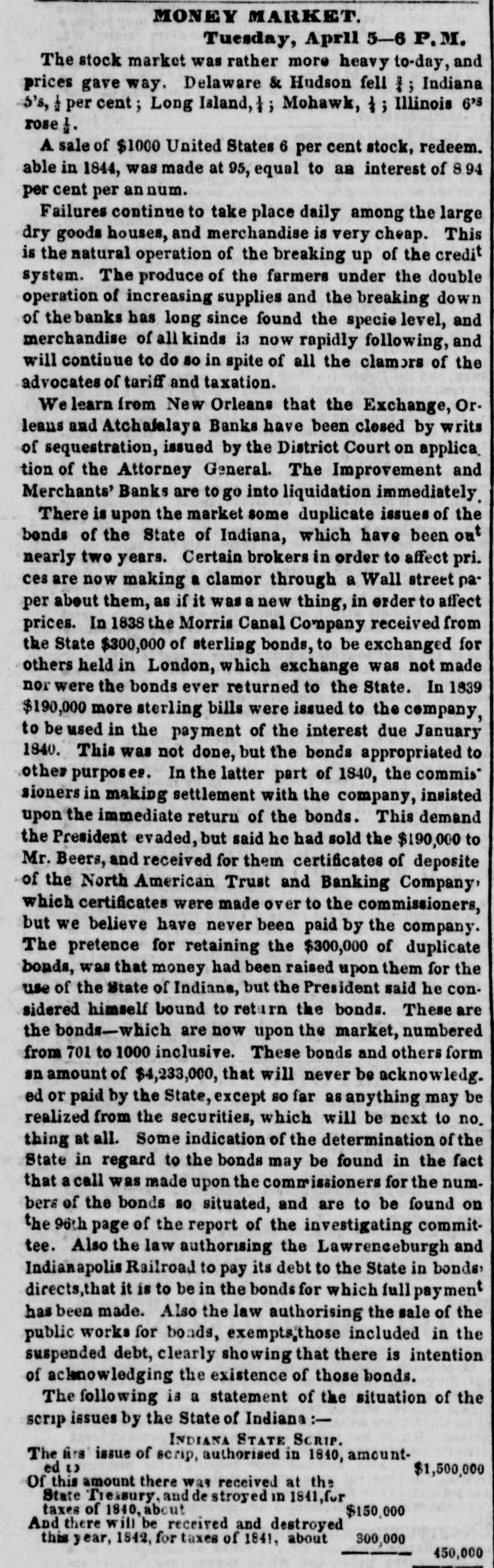
MONEY MARKET. Tuesday, April 5-6 P. M. The stock market was rather more heavy to-day, and prices gave way. Delaware & Hudson fell 1; Indiana 5's, 1 per cent; Long Island, Mohawk, 1; Illinois 6's rose 1. A sale of $1000 United States 6 per cent stock, redeem. able in 1844, was made at 95, equal to an interest of 8.94 per cent per an num. Failures continue to take place daily among the large dry goods houses, and merchandise is very cheap. This is the natural operation of the breaking up of the credit system. The produce of the farmers under the double operation of increasing supplies and the breaking down of the banks has long since found the specie level, and merchandise of all kinds i3 now rapidly following, and will continue to do so in spite of all the clamors of the advocates of tariff and taxation. We learn from New Orleans that the Exchange, Orleans and Atchafalaya Banks have been closed by writs of sequestration, issued by the District Court on applica tion of the Attorney General. The Improvement and Merchants' Banks are to go into liquidation immediately There is upon the market some duplicate issues of the bonds of the State of Indiana, which have been out nearly two years. Certain brokers in order to affect pri. ces are now making a clamor through a Wall street paper about them, as if it was a new thing, in order to affect prices. In 1838 the Morris Canal Company received from the State $300,000 of sterling bonds, to be exchanged for others held in London, which exchange was not made nor were the bonds ever returned to the State. In 1839 $190,000 more sterling bills were issued to the company, to be used in the payment of the interest due January 1840. This was not done, but the bonds appropriated to other purposes. In the latter part of 1840, the commis" sioners in making settlement with the company, insisted upon the immediate return of the bonds. This demand the President evaded, but said he had sold the $190,000 to Mr. Beers, and received for them certificates of deposite of the North American Trust and Banking Company, which certificates were made over to the commissioners, but we believe have never been paid by the company. The pretence for retaining the $300,000 of duplicate bonds, was that money had been raised upon them for the use of the State of Indiana, but the President said he considered himself bound to return the bonds. These are the bonds-which are now upon the market, numbered from 701 to 1000 inclusive. These bonds and others form sn amount of $4,233,000, that will never be acknowledg. ed or paid by the State, except so far asanything may be realized from the securities, which will be next to no. thing at all. Some indication of the determination of the State in regard to the bonds may be found in the fact that a call was made upon the commissioners for the numbers of the bonds so situated, and are to be found on the 96th page of the report of the investigating committee. Also the law authorising the Lawrenceburgh and Indianapolis Railroad to pay its debt to the State in bonds, directs,t it is to be in the bonds for which full pay ment has been made. Also the law authorising the sale of the public works for bonds, exemptsthose included in the suspended debt, clearly showing that there is intention of acknowledging the existence of those bonds. The following is a statement of the situation of the scrip issues by the State of Indiana:INDIANA STATE SCRIP. The first issue of scrip, authorised in 1840, amounted 1) $1,500,000 Of this amount there was received at the State Treasury. and de stroyed in 1841,fun taxes of 1840, about $150,000 And there will be received and destroyed this year, 1842, for taxes of 1841, about 300,000 450,000


Article from Richmond Enquirer, July 1, 1842

Click image to open full size in new tab

Article Text

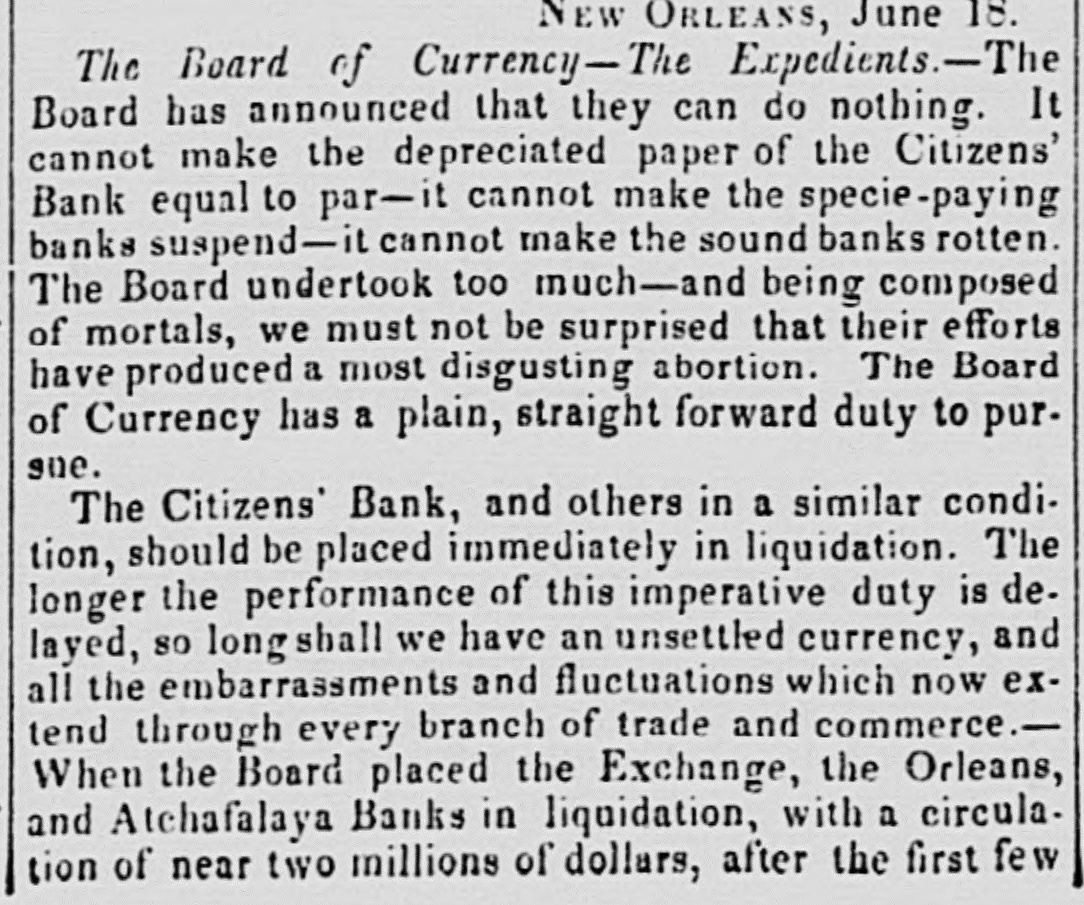
NEW ORLEANS, June 18. The Board of Currency- The Expedients.-The Board has announced that they can do nothing. It cannot make the depreciated paper of the Citizens' Bank equal to par- it cannot make the specie-paying banks suspend- it cannot make the sound banks rotten. The Board undertook too much-and being composed of mortals, we must not be surprised that their efforts have produced a most disgusting abortion. The Board of Currency has a plain, straight forward duty to pursue. The Citizens' Bank, and others in a similar condition, should be placed immediately in liquidation. The longer the performance of this imperative duty is delayed, 80 long shall we have an unsettled currency, and all the embarrassments and fluctuations which now extend through every branch of trade and commerce.When the Board placed the Exchange, the Orleans, and Atchafalaya Banks in liquidation, with a circula. tion of near two millions of dollars, after the first fev


Article from New-York Daily Tribune, August 19, 1842

Click image to open full size in new tab

Article Text

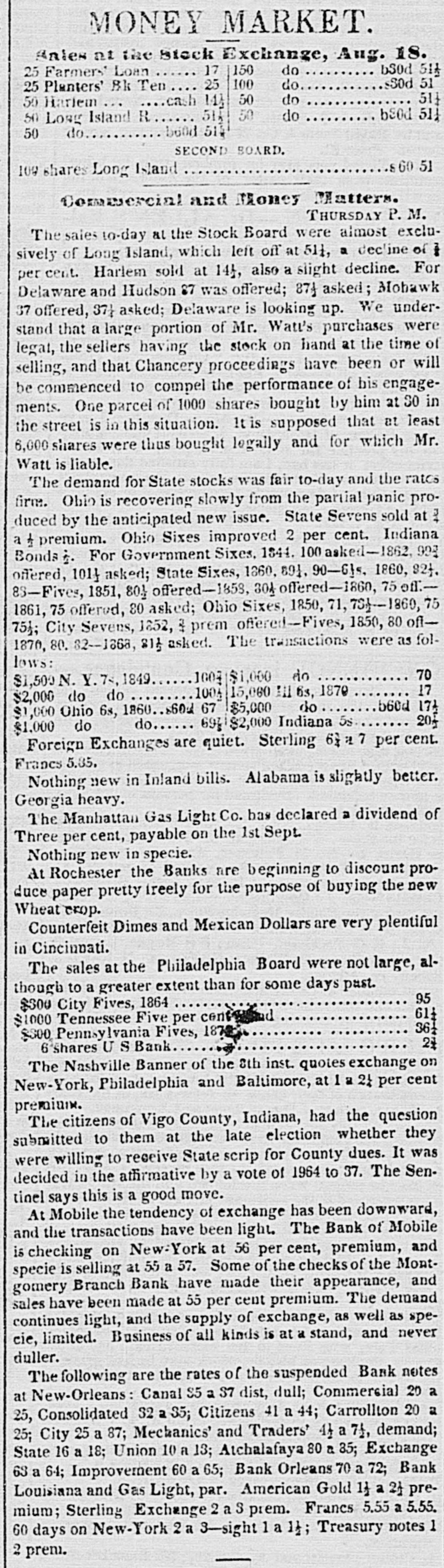
MONEY MARKET. sales at the stock Exchange, Aug. 18. 17 150 do bS0d 51A 25 Farmers' Loan $30d 51 100 25 do 25 Planters' Bk Ten 511 50 do cash 11 50 Harlem 514 50 do b80d 511 50 Long Island R bood 514 50 do SECOND BOARD. $60.51 109 shares Long Island Commercial and Money Matters. THURSDAY M. The sales to-day at the Stock Board were almost exclusively of Long Island, which left off at 511, a decline of i per cent. Harlem sold at 141, also a slight decline. For Delaware and Hudson 87 was offered; 87} asked; Mobawk 37 offered, 371 asked; Delaware is looking up. We understand that a large portion of Mr. Watt's purchases were legal, the sellers having the stock on hand at the time of selling, and that Chancery proceedings have been or will be commenced to compel the performance of his engagements. One parcel of 1000 shares bought by him at 30 in the street is in this situation. It is supposed that at least 6,000 shares were thus bought legally and for which Mr. Watt is liable. The demand for State stocks was fair to-day and the rates firm. Ohio is recovering slowly from the partial panic produced by the anticipated new issue. State Sevens sold at mt a 1/2 premium. Ohio Sixes improved 2 per cent. Indiana Bonds For Government Sixes. 1844. 100 asked-1862 992 offered, 101} asked; State Sixes, 1860, 891, 90-61s. 1860, 821. 83-Fives, 1851, 801 offered-1858, 304 offered-1860, 75 off:1861, 75 offered, 80 asked; Ohio Sixes, 1850, 71, 751-1860, 75 75}; City Sevens, 1852, 3 prem offered-Fives, 1850, 80 ofl1870, 80. 82-1868, 81 asked. The transactions were as follows: 70 $1,000 do 1003 $1,500 N. Y.7-,1849 17 100A 15,060 III 6s, 1870 $2,000 do do 560d 174 $5,000 do $1,000 Ohio 6s, 1860 600 67 20 69 do $2,000 Indiana 5s $1,000 do Foreign Exchanges are quiet. Sterling 6127 per cent. Francs 5.35. Nothing new in Inland bills. Alabama is slightly better. Georgia heavy. The Manhattan Gas Light Co. has declared a dividend of Three per cent, payable on the 1st Sept. Nothing new in specie. At Rochester the Banks are beginning to discount produce paper pretty treely for the purpose of buying the new Wheat erop. Counterfeit Dimes and Mexican Dollars are very plentiful in Cincinnati. The sales at the Philadelphia Board were not large, although to a greater extent than for some days past. 95 $300 City Fives, 1864 614 $1000 Tennessee Five per cent 361 $300 Pennsylvania Fives, 187 21 6'shares U S Bank The Nashville Banner of the 8th inst. quotes exchange on New-York, Pbiladelphia and Baltimore, at 1 a 21 per cent premium. The citizens of Vigo County, Indiana, had the question submitted to them at the late election whether they were willing to receive State scrip for County dues. It was decided in the affirmative by a vote of 1964 to 37. The Sentinel says this is a good move. At Mobile the tendency of exchange has been downward, and the transactions have been light. The Bank of Mobile is checking on New-York at 56 per cent, premium, and specie is selling at 55 a 57. Some of the checks of the Montgomery Branch Bank have made their appearance, and sales have been made at 55 per cent premium. The demand continues light, and the supply of exchange, as well as specie, limited. Business of all kinds is at a stand, and never duller. The following are the rates of the suspended Bank notes at New-Orleans: Canal S5 a S7 dist, dull; Commercial 20 a 25, Consolidated 32 a 35; Citizens 41 a 44; Carrollton 20 a 25; City 25 a 87; Mechanics' and Traders' 41 a 71, demand; State 16 a 18; Union 10 a 13; Atchalafaya 80 a 35; Exchange 63 a 64; Improvement 60 a 65; Bank Orleans 70 a 72; Bank Louisiana and Gas Light, par. American Gold 11 a 21 premium; Sterling Exchange 2 a S prem. Francs 5.55 a 5.55. 60 days on New-York 2 a 3-sight 1 a 11; Treasury notes 1 2 prem.


Article from The New York Herald, August 24, 1842

Click image to open full size in new tab

Article Text

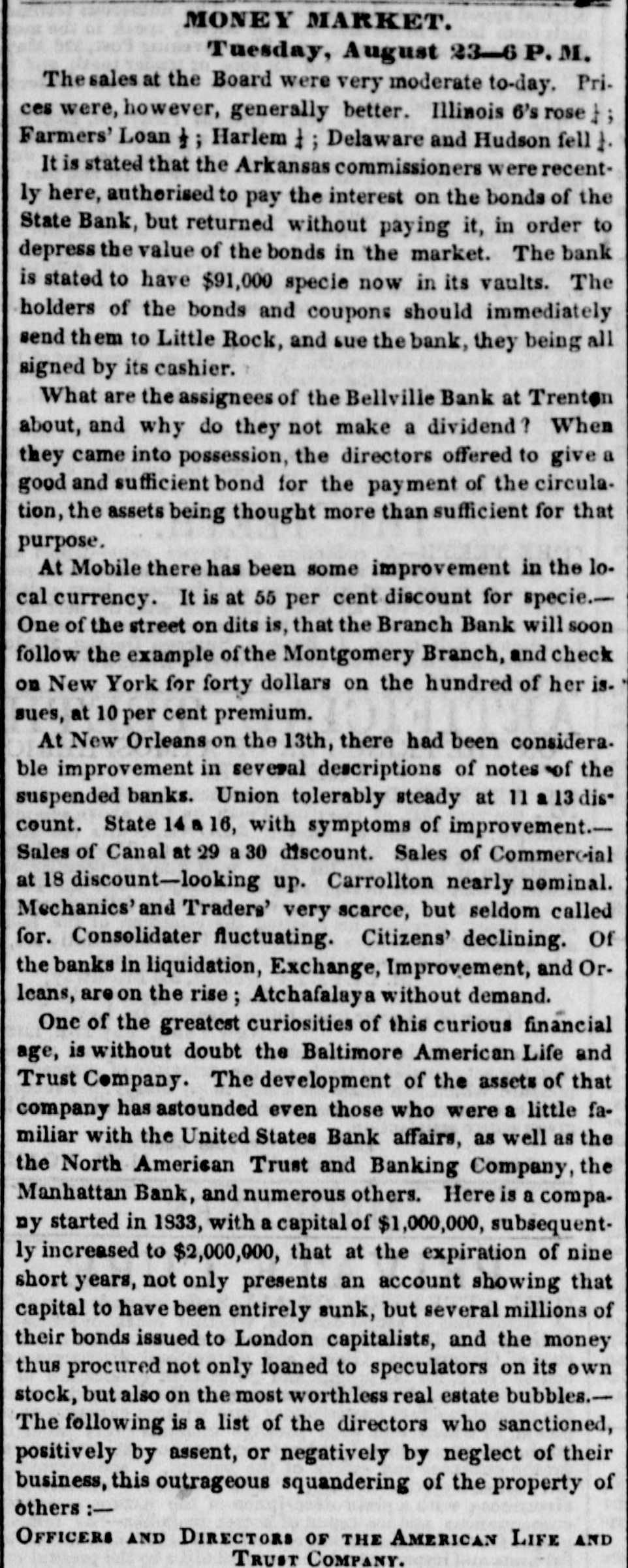
MONEY MARKET. Tuesday, August 23-6 P. Thesales at the Board were very moderate to-day. Pri. ces were, however, generally better. Illinois 6's rose Farmers' Loan 1; Harlem Delaware and Hudson fell It is stated that the Arkansas commissioners were recently here, authorised to pay the interest on the bonds of the State Bank, but returned without paying it, in order to depress the value of the bonds in the market. The bank is stated to have $91,000 specie now in its vaults. The holders of the bonds and coupons should immediately send them to Little Rock, and sue the bank, they being all signed by its cashier. What are the assignees of the Bellville Bank at Trenton about, and why do they not make a dividend? When they came into possession, the directors offered to give a good and sufficient bond for the payment of the circula. tion, the assets being thought more than sufficient for that purpose. At Mobile there has been some improvement in the local currency. It is at 55 per cent discount for specie.One of the street on dits is, that the Branch Bank will soon follow the example of the Montgomery Branch, and check on New York for forty dollars on the hundred of her is. sues, at 10 per cent premium. At New Orleans on the 13th, there had been considera. ble improvement in several descriptions of notes of the suspended banks. Union tolerably steady at 11 a 13 discount. State 14 a 16, with symptoms of improvement.Sales of Canal at 29 a 30 discount. Sales of Commercial at 18 discount-looking up. Carrollton nearly nominal. Mechanics' and Traders' very scarce, but seldom called for. Consolidater fluctuating. Citizens' declining. Of the banks in liquidation, Exchange, Improvement, and Orleans, are on the rise; Atchafalaya without demand. One of the greatest curiosities of this curious financial age, is without doubt the Baltimore American Life and Trust Company. The development of the assets of that company has astounded even those who were a little familiar with the United States Bank affairs, as well as the the North American Trust and Banking Company, the Manhattan Bank, and numerous others. Here is a company started in 1833, with a capital of $1,000,000, subsequently increased to $2,000,000, that at the expiration of nine short years, not only presents an account showing that capital to have been entirely sunk, but several millions of their bonds issued to London capitalists, and the money thus procured not only loaned to speculators on its own stock, but also on the most worthless real estate bubbles.The following is a list of the directors who sanctioned, positively by assent, or negatively by neglect of their business, this outrageous squandering of the property of others:OFFICERS AND DIRECTORS OF THE AMERICAN LIFE AND TRUST COMPANY.


Article from The New York Herald, January 19, 1843

Click image to open full size in new tab

Article Text

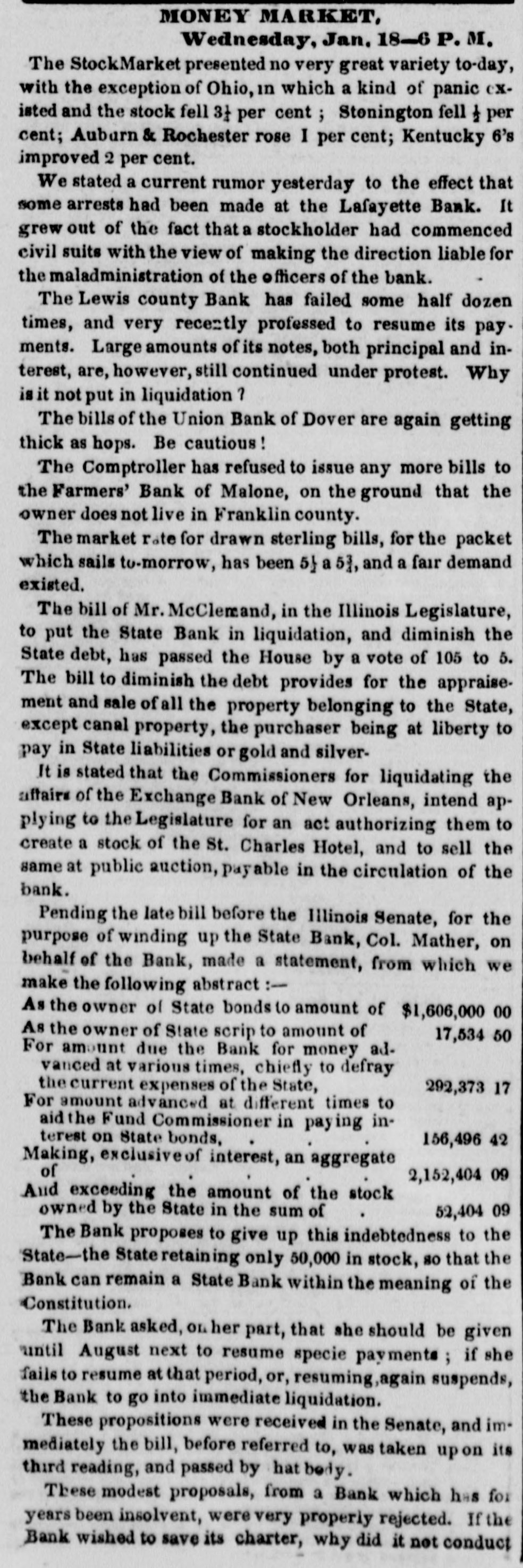
MONEY MARKET, Wednesday, Jan. 18-6 P. M. The StockMarket presented no very great variety to-day, with the exception of Ohio, in which a kind of panic CXisted and the stock fell 31 per cent Stonington fell 1/2 per cent; Auburn & Rochester rose I per cent; Kentucky 6's improved 2 per cent. We stated a current rumor yesterday to the effect that some arrests had been made at the Lafayette Bank. It grew out of the fact that a stockholder had commenced civil suits with the view of making the direction liable for the maladministration of the officers of the bank. The Lewis county Bank has failed some half dozen times, and very recently professed to resume its pay. ments. Large amounts of its notes, both principal and interest, are, however, still continued under protest. Why is it not put in liquidation ? The bills of the Union Bank of Dover are again getting thick as hops. Be cautious! The Comptroller has refused to issue any more bills to the Farmers' Bank of Malone, on the ground that the owner does not live in Franklin county. The market rate for drawn sterling bills, for the packet which sails to-morrow, has been 5} a 5}, and a fair demand existed. The bill of Mr.McClemand, in the Illinois Legislature, to put the State Bank in liquidation, and diminish the State debt, has passed the House by a vote of 105 to 5. The bill to diminish the debt provides for the appraisement and sale of all the property belonging to the State, except canal property, the purchaser being at liberty to pay in State liabilities or gold and silverIt is stated that the Commissioners for liquidating the affairs of the Exchange Bank of New Orleans, intend applying to the Legislature for an act authorizing them to create a stock of the St. Charles Hotel, and to sell the same at public auction, payable in the circulation of the bank. Pending the late bill before the Illinois Senate, for the purpose of winding up the State Bank, Col. Mather, on behalf of the Bank, made a statement, from which we make the following abstract :As the owner of State bonds to amount of $1,606,000 00 As the owner of State scrip to amount of 17,534 50 For amount due the Bank for money advanced at various times, chiefly to defray the current expenses of the State, 292,373 17 For amount advanced at different times to aid the Fund Commissioner in paying interest on State bonds, 156,496 42 Making, exclusive of interest, an aggregate of 2,152,404 09 And exceeding the amount of the stock owned by the State in the sum of 52,404 09 The Bank proposes to give up this indebtedness to the State-the State retaining only 50,000 in stock, so that the Bank can remain a State Bank within the meaning of the Constitution. The Bank asked, OL her part, that she should be given until August next to resume specie payments if she fails to resume at that period, or, resuming again suspends, the Bank to go into immediate liquidation. These propositions were received in the Senate, and immediately the bill, before referred to, was taken upon its third reading, and passed by hat body. These modest proposals, from a Bank which has for years been insolvent, were very properly rejected. If the Bank wished to save its charter, why did it not conduct


Article from The Daily Crescent, February 16, 1849

Click image to open full size in new tab

Article Text

Supreme Court of Louisiana, Condensed Decisions-New ORLEANS. Feb. 12. 1840. The liability of the sto kholde of a bank to its creditors under its original charter. cannot be im aired by of of the Legislature subsequently pass The date bank notes not evidence as he time when they came into party possession Bank notes are not curities or documents for debts they are to be treated money and cash in the ordinary course and transact. of business The Act of Ma ch 14. 1839, author. banks which had not apita ock then to suspend the until 1841. and declaring the that amount at that in should be deemed of saidbanks, th apital the stockholders who paid all the instalments in by the called all time directors, from that to bility to holders of bank notes sequently acqui.e Notes once paid into bank. after he reduction of its capital are extingnished and the ob non of the original all who -tockho their instalments, have paid cannot be revive by their rei sur. the bank with its re. duced capital being only bound by such reissue. HEPBURN & TURPIN vs. THE COMMISSIONERS OF THE NEW ORLEANS EXCHANGE AND BANKI G Co., et al peal from the Fifth District Court of New Orleans, (Bu chanan, J.)-No. 717 in the Supreme Court EUSTIS, J curiam n 1839 e legi-lature DRS ed an act to re. lieve the bank of the State which had incurred the forfeit. are of their charters by suspension of specie pay ment. from forfeiture, In the act it is provided that such of the banks as have not their capital s'ock paid in may suspend the payment of the stock until the first day of Feb. 1841, and that the amount actually paid in at that period shall be deemed the capital stock of said banks and th y are hereby restrained from doing business on any lurge amount of capiMarch tel der the rules prescrib d by their charter. et o' 1839, Sec. 2. The charter of the Exchange and Bank. ing Co. was adjudged to be forfeited by a judgement of the late Co rt of the F rst Judicial District on the 15th March, 1842. The plaintiff are holders of $34,710 of bank notes of this Company, which came In' their posse sion mbse. quently to June 1st, 1842. and the object of this suit is to make the or ginal stockho ders, several of whom are made defendants. liable for the bank notes on which his action ought. I IS admitted that the de fendants have paid all he instalments called in by the up to t me fixed bv act of 1839 to Feb 1st 41 Having thus capita to contribute were ributed bonn the to they reduced by the act of 1839. the question prese ted whe hat ond se be liable amount the in they by present ownership fing their of of from eason obligations thei The Distr Judge was of opin on that they were liable, and gave judgement for the defendan's. The laintiffs have appealed nt of the cause has been very els borately preargum pared We come to conclusion which under narrow comp District ascertained he rights as 10 prec of holders o' bank notes which they 842 charter March, in of 1839 accepte was by the Bank and far obvio legislation as the of the an mak that act bine and ohligaIt legal become was has in'ents so held by 'ourt the case of Millau The Car. Bank 3 Rob. 507 that the act of dimin of the original liabilities of the stockholders, and remained contineently liable for the of the subscriptions: but that for stood ital reduc of stock. the ca by banking wa not to be changed AI though we have not ble concur in this opinion of the upreme Court it decided far which principal the que-tion yet the principle tha the original liability WHB that creditors time kholders to to the continue But in we concur in wecaenou withont liability creditors, subsequent their to ng he power of the Legi-la ure to reduce the cap tal reduction thto The ting itself conser Bank Bank the on increased itations frequently their these lication and see no objection to its bei diminished limiting effect the a t o onsent of their Banks of he Pm T: e Car oilton Bank 8 An. 31. and se the therefore of 18 act dering Co decision gi the Bank the the the of of to capital amount the fixing amount paid in on the 1st February, 1841, AS the defendants they liable are that period as to up their hav paid quo en have where bts oreated of d Bank o th creditors the that period Supposing them to emain under their bok edi th as stock ponsibility of eis to origin Bank before the reduction o its capital re the plaintitis virtue of the note which they hold, invested with ? creditors? of the right large ortion of these notes hear date in the year of counse that confen origin by 1836, and there and that conciu date th ive, no debt the when ut erta the in no cir ning of mode other dates case the b As referring to except the themselve the of Folders AS the plaintiff befo evidence that of of date theonl Their the notes. that d iff conter notes consti he and plai the debt ntracted by the B nk in favor of the first hold. them in vested of banks 1839 of of New the act the thind section By the each due balance the and pay to set bound were Monday morning in gold nd silver and once circulation of their statement deposits, month &c. The Exchange B ank contin ed us banking business until M rch 1842. when cea ed to redeem its notes, and that time ceived daily and paid them o without being or of notice any date or amount, andum memo of the of the re-issue. In pursu nce of the act of 1889. to March. 1842. in weekl settlements up made banks the which the notes of each bank received bv the others were ascertained of issue. and balance the bank 10 the returned and ttled by the check of the settling clerk the Exchange Bank accord nglv receive its own DOTES and paid them out dates. alte ation of without an However true may be thatin ordinary written obligations to pay money theirdate is evidence of the time of thei orizin, which would shown justif has its been hority applino an ation to bank notes They constituted the principal part of the time the etment of en laws the at of the currency oncerning the nks of New Orleans These laws were enacted under an emergency of great public emb ra-sment which the Government of the S ate under ook to regula'e required the necessity of measure the by the as curr ney sion The very fact of the notes being currency excludes and date material of would deleat being their Insion con their currency No person wou'd d takea note as money of ob the and rules to were Pions. pecuniary subject our subject like them to the laws of pre-cription Indeed the from notes article bank ex empting has express Code operation of the cription applicable to no'es payable to Art. 3505 Where the notes of bank are issued in the course of its of the by is nb fixed the the bank igation busine daily face nece-sarily on becomes its date the notes the of issuing to of index the ffords the time and no no moment of of Legislature the and bank the noted of under banks the exclude just action of the of notes time bank of issue the It there follow that their date fore. from deduced being the plaintiffs having come in'o of the notes subsequen ly to the 1-t January 1843 there evidence to pre of the bank reduc. v'ous debts the being notes the of tion of its capital. under the law of 1839 That they were so originally the date imports but once paid in'o bank after the reduction of the capital they were and the ob. ligation of the original tock olde could not be revived their re issue, the bank with its reduced capital being only re-issue such by bound These views take to be in accordance with that in which the law considers bank notes according to the highest and authorities las approved Bank notes says Lord Mansfield in the case Miller vs. Rure. Rep. 452 are not goods. not securit es or documents bu+ treate meney as esteemed are they are nor debts, for 88 the ordinary course and action of busin by the general sense mank nd, w hich gives them the cred and currency of money to al intents and purposes. Heath Fines, 9th Johnson 120 Judah vs. Harris. 19th Johnson. 145 We therefore oncur with he District Judge in the opin. defendan's are who this case, th plain iffs and sue h being our ouinion. rised the points any in unnece becomes defence The judgment of the District ourt is there. affirmed with and Bonford, for plaintiff Ro ellus Micou. May bin and Livngston. for defendants and appellees THOS W JOHN STRATOR OF MR HON JEAN B BERNARD Arpeni from Court Parish. urche SLIDEL case the Sop eme Court held that due not being negotiable instrumen's subject of years but only of Whiting 12 Reb. 145 The judgement of the lower our was affirmed with costs. JOHN L LOBDELL vs. ROBERT CLARK. ET ROST meal from the Sixth Judicial District Court P 8. w The judgment below was affirmed. SLAVEDEPOT.