Commercial National Bank (Washington, DC)

Episode Information

Episode UID
744601303
Episode Type
Suspension โ†’ Closure
Bank Type
national
Bank ID
74460 national
Charter Number
7446
Start Date
July 10, 1908
Location
Washington, District of Columbia (38.895, -77.036)

Metadata

Model
gpt-5-mini (chosen from majority vote of a three-model LLM ensemble)
Short Digest
64237fd90dec8678

Response Measures

None

Receivership Details

Depositor recovery rate
70.0%
Date receivership started
1933-02-28
Share of assets assessed as good
42.6%
Share of assets assessed as doubtful
50.5%
Share of assets assessed as worthless
6.8%

Description

Articles show receivers ordering sales of the bank's building in 1914, indicating receivership/closure; earlier 1908 suit sought a receiver.

Events (5)

1. October 19, 1904 Chartered
Source
historical_nic
2. July 10, 1908 Other
Newspaper Excerpt
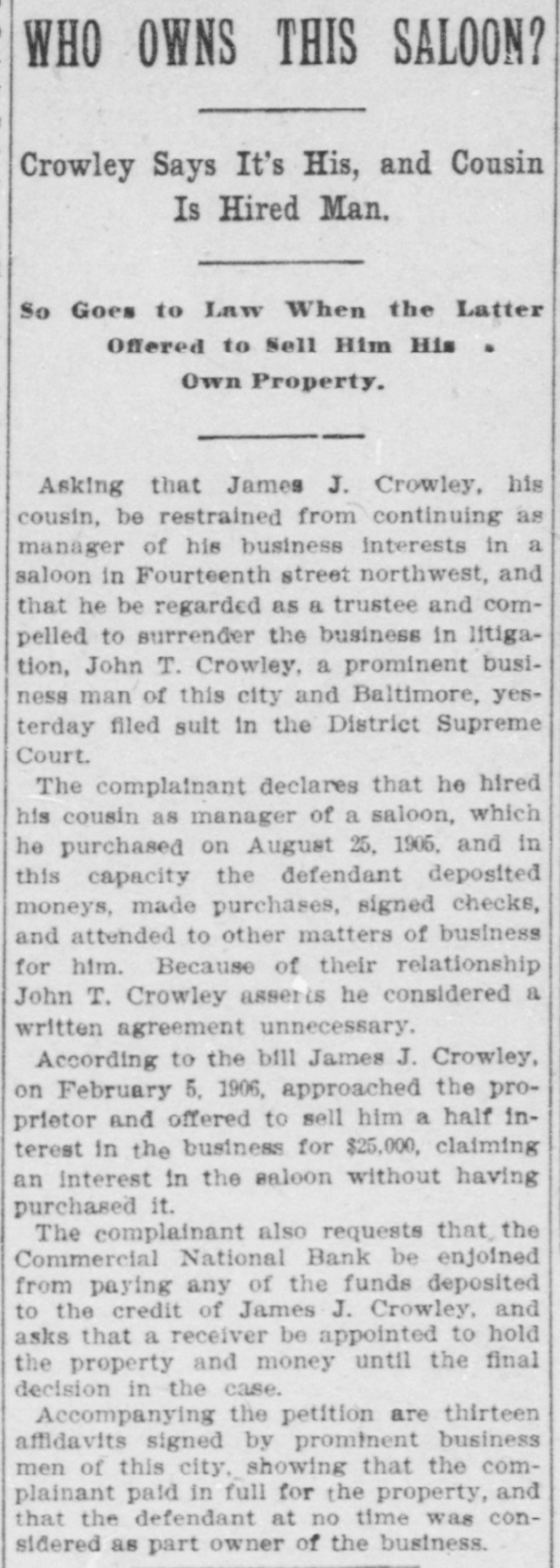
asks that the Commercial National Bank be enjoined from paying any of the funds deposited to the credit of James J. Crowley, and asks that a receiver be appointed to hold the property and money until the final decision in the case.
Source
newspapers
3. May 12, 1914 Receivership
Newspaper Excerpt
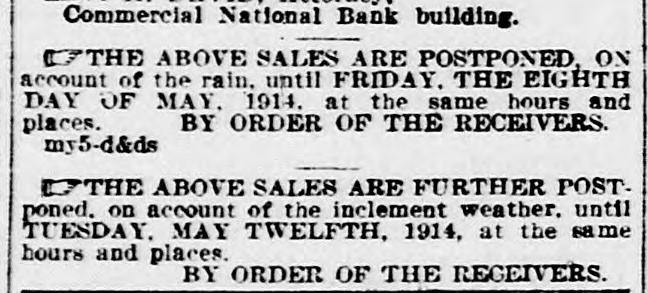
THE ABOVE SALES ARE FURTHER POSTponed. on account of the inclement weather. until TUESDAY. MAY TWELFTH, 1914... BY ORDER OF THE RECEIVERS.
Source
newspapers
4. July 24, 1921 Other
Newspaper Excerpt
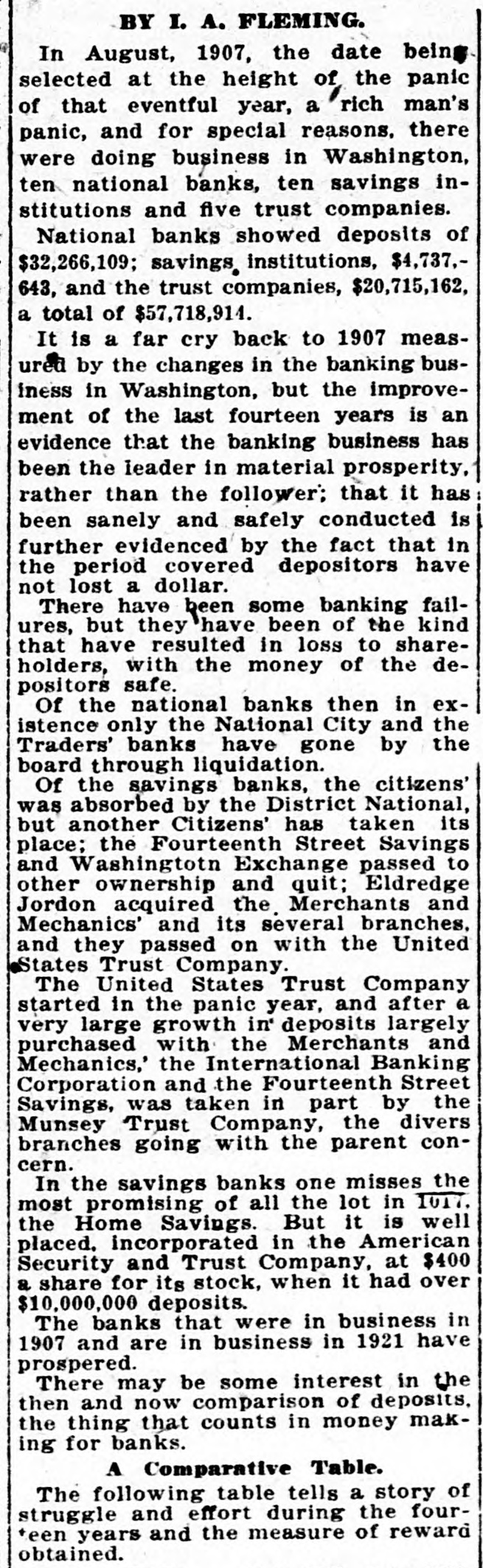
discussion of Washington banks since the panic of 1907; no specific new actions for Commercial National Bank in this article.
Source
newspapers
5. February 28, 1933 Receivership
Source
historical_nic

Newspaper Articles (3)

Article from The Washington Herald, July 10, 1908

Click image to open full size in new tab

Article Text

WHO OWNS THIS SALOON? Crowley Says It's His, and Cousin Is Hired Man. So Goes to Law When the Latter . Offered to Sell Him His Own Property. Asking that James J. Crowley, his cousin, be restrained from continuing as manager of his business interests in a saloon in Fourteenth street northwest, and that he be regarded as a trustee and compelled to surrender the business in litigation, John T. Crowley, a prominent business man of this city and Baltimore, yesterday filed sult in the District Supreme Court. The complainant declares that he hired his cousin as manager of a saloon, which he purchased on August 25, 1905. and in this capacity the defendant deposited moneys, made purchases, signed checks, and attended to other matters of business for him. Because of their relationship John T. Crowley asserts he considered a written agreement unnecessary. According to the bill James J. Crowley, on February 5. 1906, approached the proprietor and offered to sell him a half interest in the business for $25,000, claiming an interest in the saloon without having purchased it. The complainant also requests that the Commercial National Bank be enjoined from paying any of the funds deposited to the credit of James J. Crowley, and asks that a receiver be appointed to hold the property and money until the final decision in the case. Accompanying the petition are thirteen affidavits signed by prominent business men of this city, showing that the complainant paid in full for the property, and that the defendant at no time was considered as part owner of the business.
Article from Evening Star, May 11, 1914

Click image to open full size in new tab

Article Text

Commercial National Bank building. (7THE ABOVE SALES ARE POSTPONED, ON account of the rain. until FRIDAY. THE EIGHTH DAY OF MAY. 1914. at the same hours and BY ORDER OF THE RECEIVERS. places. my5-d&ds LATHE ABOVE SALES ARE FURTHER POSTponed. on account of the inclement weather. until TUESDAY. MAY TWELFTH, 1914, at the same hours and places. BY ORDER OF THE RECEIVERS.


Article from Evening Star, July 24, 1921

Click image to open full size in new tab

Article Text

BY I. A. FLEMING. In August, 1907, the date being selected at the height of the panic of that eventful year, a rich man's panic, and for special reasons, there were doing business in Washington, ten national banks, ten savings institutions and five trust companies. National banks showed deposits of $32,266,109; savings institutions, $4,737.643, and the trust companies, $20,715,162, a total of $57,718,914. It is a far cry back to 1907 measured by the changes in the banking business in Washington, but the improvement of the last fourteen years is an evidence that the banking business has been the leader in material prosperity, rather than the follower; that it has been sanely and safely conducted is further evidenced by the fact that in the period covered depositors have not lost a dollar. There have been some banking failures, but they have been of the kind that have resulted in loss to shareholders, with the money of the depositors safe. Of the national banks then in existence only the National City and the Traders' banks have gone by the board through liquidation. Of the savings banks, the citizens' was absorbed by the District National, but another Citizens' has taken its place; the Fourteenth Street Savings and Washingtotn Exchange passed to other ownership and quit; Eldredge Jordon acquired the Merchants and Mechanics' and its several branches. and they passed on with the United States Trust Company. The United States Trust Company started in the panic year, and after a very large growth in deposits largely purchased with the Merchants and Mechanics,' the International Banking Corporation and the Fourteenth Street Savings, was taken in part by the Munsey Trust Company, the divers branches going with the parent concern. In the savings banks one misses the most promising of all the lot in 1017. the Home Savings. But it is well placed. incorporated in the American Security and Trust Company, at $400 a share for its stock, when it had over $10,000,000 deposits. The banks that were in business in 1907 and are in business in 1921 have prospered. There may be some interest in the then and now comparison of deposits, the thing that counts in money making for banks. A Comparative Table. The following table tells a story of struggle and effort during the fourteen years and the measure of reward obtained.