Contemporary reports (June 7–8, 1903) state the City Trust & Banking Company closed and receivers were appointed after heavy withdrawals and inability to realize on securities. Articles describe a recent run on the institution and later investigations (Aug 1903, Mar 1904) attribute failure to large unauthorized loans by the treasurer, supporting a bank-specific adverse cause. The suspension led to receivership and permanent closure (receivers remained active and pursued suits).
Events (5)
1.June 7, 1903Run
Cause
Bank Specific Adverse Info
Cause Details
Heavy withdrawals (a run) combined with inability to realize on industrial/unlisted securities and later-discovered unauthorized loans by the treasurer
Newspaper Excerpt
the stringency of the money market, together with a recent run on the institution
Source
newspapers
2.June 8, 1903Receivership
Newspaper Excerpt
Judge Wickes yesterday appointed George Dobblin Penniman and Campbell Carrington receivers; the banking and trust features are brought to a standstill; about 2,800 depositors with deposits aggregating over $300,000 (June 8, 1903 reports).
Source
newspapers
3.June 8, 1903Suspension
Cause
Bank Specific Adverse Info
Cause Details
Suspension made necessary by withdrawal of deposits and failure to realize upon securities; admission of insolvency and creditors petitioned for receivers
Newspaper Excerpt
On the request of creditors and upon its own admission of insolvency, receivers have been appointed for the City Trust and Banking Company
Source
newspapers
4.August 15, 1903Other
Newspaper Excerpt
the troubles of the bank are due to loans made by Treasurer Frank J. Kohler to himself and personal friends. These unauthorized loans aggregated $154,000, of which $55,000 was loaned to Kohler himself.
Source
newspapers
5.March 19, 1904Other
Newspaper Excerpt
the receivers ... charge that the cause of the bank's failure was due 'to the unwarranted, unauthorized and fraudulent transactions of Frank J. Kohler, its former treasurer.'
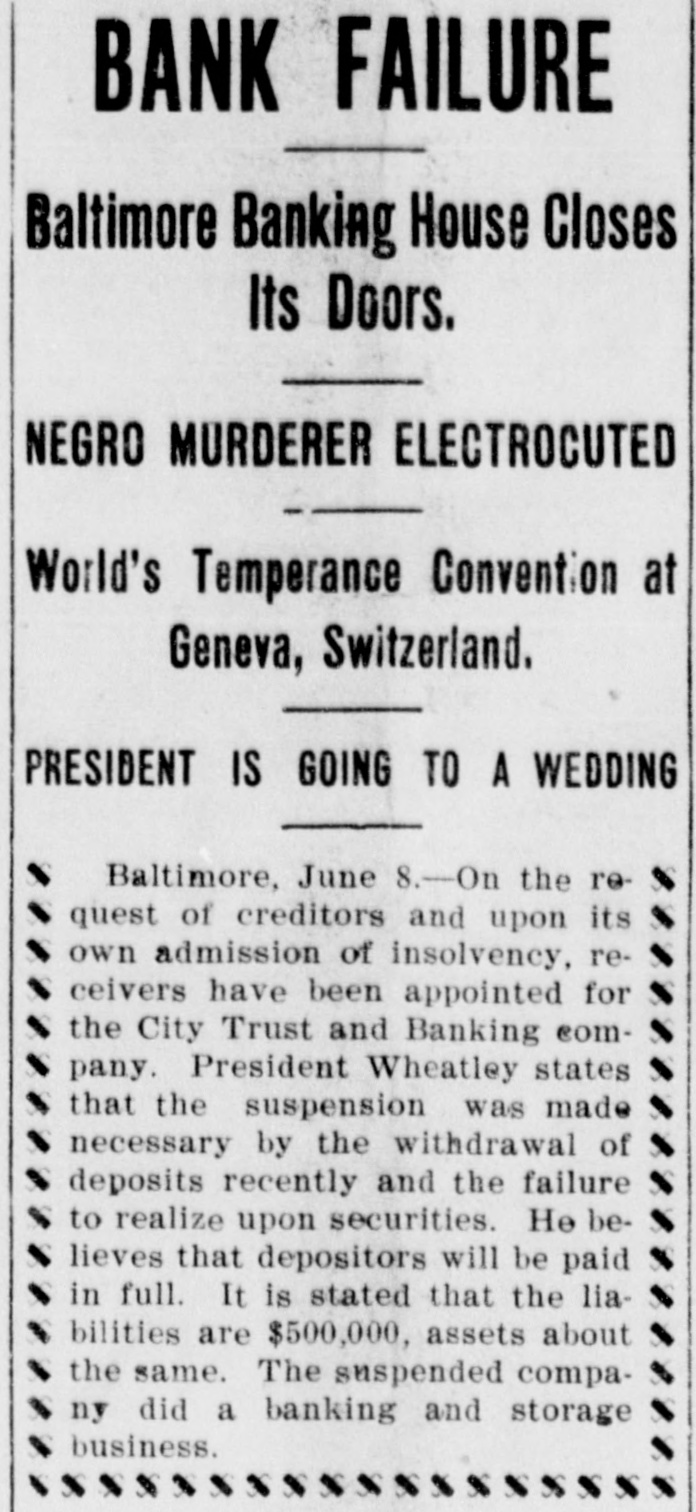
BANK FAILURE Baltimore Banking House Closes Its Doors. NEGRO MURDERER ELECTROCUTED World's Temperance Convention at Geneva, Switzerland. PRESIDENT IS GOING TO A WEDDING Baltimore, June 8.-On the request of creditors and upon its own admission of insolvency, receivers have been appointed for the City Trust and Banking company. President Wheatley states that the suspension was made necessary by the withdrawal of deposits recently and the failure to realize upon securities. He believes that depositors will be paid in full. It is stated that the liabilities are $500,000, assets about the same. The suspended company did a banking and storage business.
2.June 8, 1903New-York TribuneNew York, NY
Click image to open full size in new tab
Article Text
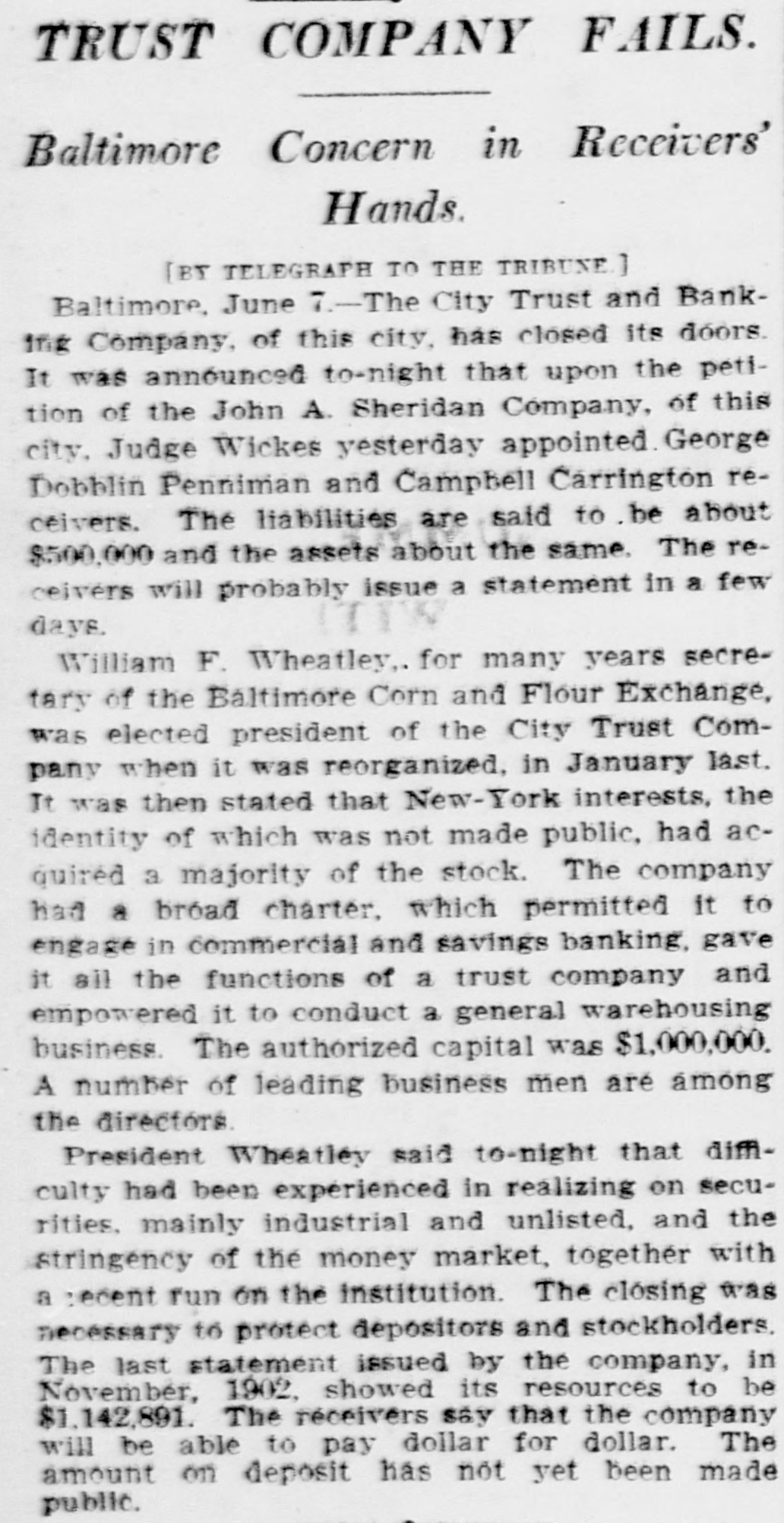
TRUST COMPANY FAILS. Baltimore Concern in Receivers' Hands. [BT TELEGRAPH TO THE TRIBUNE.] Baltimore, June 7.-The City Trust and Banktrig Company, of this city, has closed its doors. It was announced to-night that upon the petition of the John A. Sheridan Company, of this city, Judge Wickes yesterday appointed George Dobblin Penniman and Campbell Carrington receivers. The liabilities are said to be about $500,000 and the assets about the same. The receivers will probably issue a statement in a few TIM days. William F. Wheatley, for many years secretary of the Baltimore Corn and Flour Exchange, was elected president of the City Trust Company when it was reorganized, in January last. Tt was then stated that New-York interests, the identity of which was not made public, had acquired a majority of the stock. The company had a broad charter, which permitted it to engage in commercial and savings banking, gave it all the functions of a trust company and empowered it to conduct a general warehousing business The authorized capital was $1,000,000. A number of leading business men are among the directors. President Wheatley said to-night that diffculty had been experienced in realizing on securities, mainly industrial and unlisted, and the stringency of the money market, together with a recent fun on the institution. The closing was necessary to protect depositors and stockholders. The last statement issued by the company, in November, 1902, showed its resources to be $1,142,891. The receivers say that the company will be able to pay dollar for dollar. The amount on deposit has not yet been made public.
3.June 8, 1903Evening StarWashington, DC
Click image to open full size in new tab
Article Text
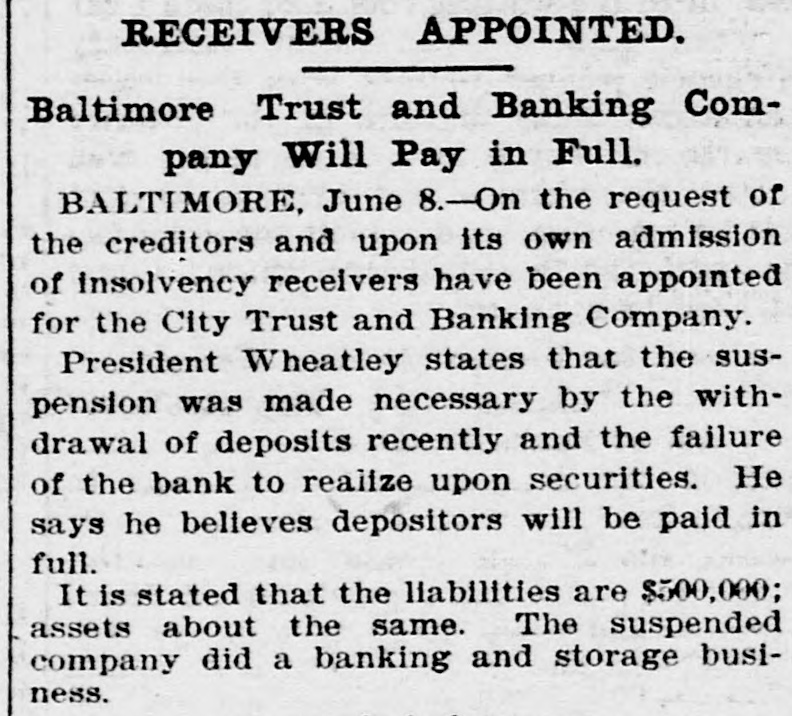
RECEIVERS APPOINTED. Baltimore Trust and Banking Company Will Pay in Full. BALTIMORE, June 8.-On the request of the creditors and upon its own admission of insolvency receivers have been appointed for the City Trust and Banking Company. President Wheatley states that the suspension was made necessary by the withdrawal of deposits recently and the failure of the bank to realize upon securities. He says he believes depositors will be paid in full. It is stated that the liabilities are $500,000; assets about the same. The suspended company did a banking and storage business.
4.June 8, 1903The Topeka State JournalTopeka, KS
Click image to open full size in new tab
Article Text
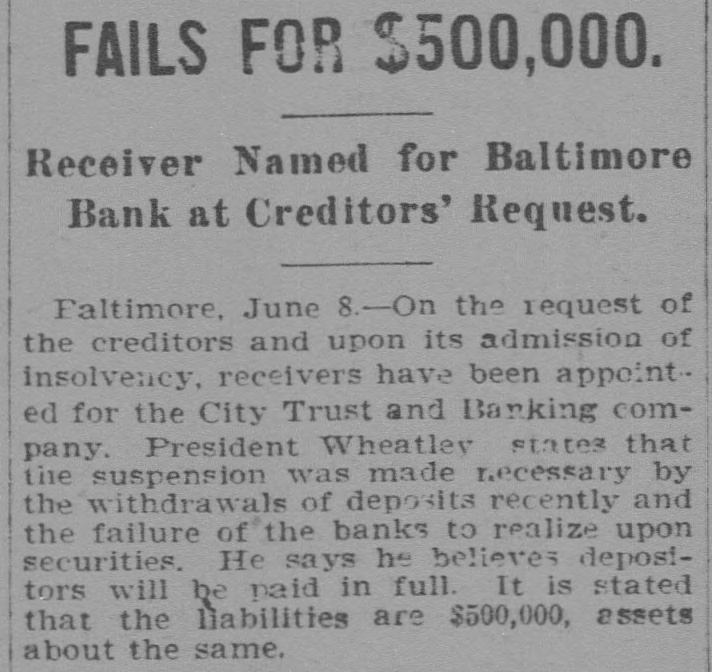
FAILS FOR $500,000. Receiver Named for Baltimore Bank at Creditors' Request. Faltimore, June 8.-On the request of the creditors and upon its admission of insolvency, receivers have been appoint.ed for the City Trust and Banking company. President Wheatley states that the suspension was made necessary by the withdrawals of deposits recently and the failure of the banks to realize upon securities. He says he believes depositors will be paid in full. It is stated that the liabilities are $500,000, assets about the same.
5.June 9, 1903The Montgomery AdvertiserMontgomery, AL
Click image to open full size in new tab
Article Text
RECEIVERS APPOINTED Baltimore, June 8.-On the request of the creditors and upon its own admission of insolvency, receivers have been appointed for the City Trust and Banking Company. President Wheatly states that the suspension was made necessary by the withdrawal of deposits recently and the failure of the bank to realize upon securities. He says he believes depositors will be paid in full. It Is stated that the liabilities are $500,000; assets about the same. The suspended company did a banking and storage business.
6.June 9, 1903Bismarck Daily TribuneBismarck, ND
Click image to open full size in new tab
Article Text
ADMISSION OF INSOLVENCY. Receivers Appointed for a Baltimore Trust Company. Baltimore, June 9.-On the request of the creditors and upon its own admission of insolvency receivers have been appointed for the City Trust and Banking company. President Wheatley states that the suspension was made necessary by the withdrawals of deposits recently and the failure of the bank to realize upon securities. He says he believes depositors will be paid in full. It is stated that the liabilities are about $500,000, assets about the same.
7.June 9, 1903The Wichita Daily EagleWichita, KS
Click image to open full size in new tab
Article Text
BANKING COMPANY INSOLVENT. President Wheatley Says Depositors Will Be Paid in Full. Baltimore, Md., June 8.-On the request of the creditors and upon its own admission of insolvency, receivers have been appointed for the City Trust and Banking company. President Wheatly states that the suspension was made necessary by the withdrawals of deposits recently and the failure of the bank to realize upon securities. He says he believes depositors will be paid in full. It is stated that the liabilities are $500,000; assets about the same.
8.June 9, 1903The St. Louis RepublicSaint Louis, MO
Click image to open full size in new tab
Article Text
BALTIMORE-On the request of creditors and upon its own admission of insolvency. receivers have been appointed for the City Trust and Banking Company. President Wheatley states that the suspension was made necessary by the withdrawals of deposits recently and the failure of the bank to realize upon securities. It is stated that the liabilities are $500.000.
9.June 9, 1903The SunNew York, NY
Click image to open full size in new tab
Article Text
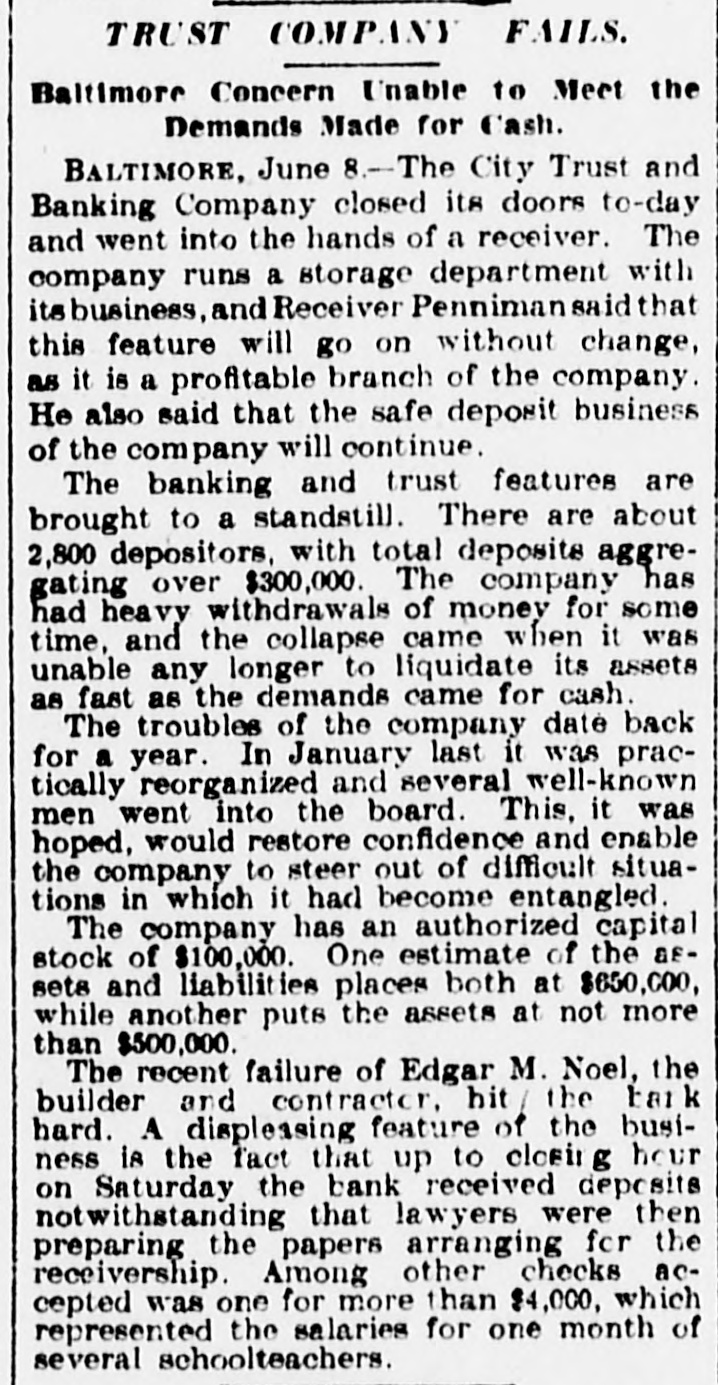
TRUST COMPANY FAILS. Baltimore Concern Unable to Meet the Demands Made for Cash. BALTIMORE, June 8.-The City Trust and Banking Company closed its doors to-day and went into the hands of a receiver. The company runs a storage department with itsbusiness, and Receiver Pennimansaidthat this feature will go on without change, as it is a profitable branch of the company. He also said that the safe deposit business of the company will continue. The banking and trust features are brought to a standstill. There are about 2,800 depositors, with total deposits aggregating over $300,000. The company has had heavy withdrawals of money for some time, and the collapse came when it was unable any longer to liquidate its assets as fast as the demands came for cash. The troubles of the company date back for a year. In January last it was practically reorganized and several well-known men went into the board. This, it was hoped, would restore confidence and enable the company to steer out of difficult situations in which it had become entangled. The company has an authorized capital stock of $100,000. One estimate of the assets and liabilities places both at $650,000, while another puts the assets at not more than $500,000. The recent failure of Edgar M. Noel, the builder and contractor. hit / the bar k hard. A displeasing feature of the business is the fact that up to closing hour on Saturday the bank received deposits notwithstanding that lawyers were then preparing the papers arranging for the receivership. Among other checks accepted was one for more than $4,000, which represented the salaries for one month of several schoolteachers.
10.June 12, 1903The Penn's Grove RecordPenns Grove, NJ
Click image to open full size in new tab
Article Text
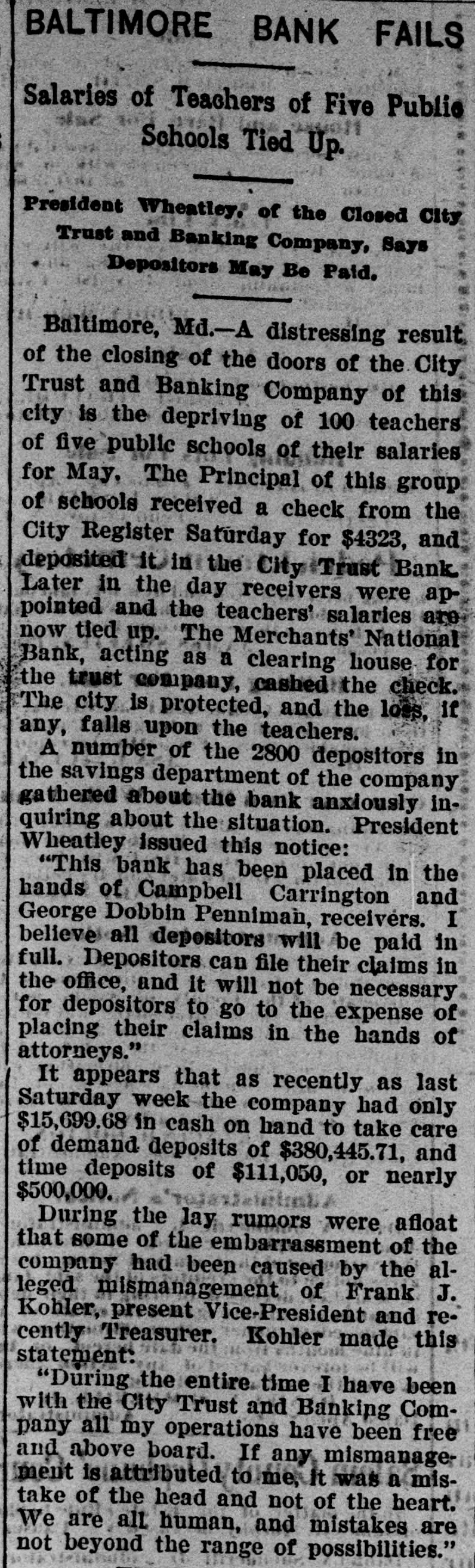
BALTIMORE BANK FAILS Salaries of Teachers of Five Public Schools Tied Up. President Wheatley, of the Closed City Trust and Banking Company, Says Depositors May Be Paid, Baltimore, Md.-A distressing result of the closing of the doors of the City Trust and Banking Company of this city is the depriving of 100 teachers of five public schools of their salaries for May. The Principal of this group of schools received a check from the City Register Saturday for $4323, and deposited it in the City Trust Bank. Later in the day receivers were appointed and the teachers' salaries are now tied up. The Merchants' National Bank, acting as a clearing house for the trust company, cashed the check. The city is protected, and the loss, if any, falls upon the teachers. A number of the 2800 depositors in the savings department of the company gathered about the bank anxiously inquiring about the situation. President Wheatley issued this notice: "This bank has been placed in the hands of Campbell Carrington and George Dobbin Penniman, receivers. I believe all depositors will be paid in full. Depositors can file their claims in the office, and it will not be necessary for depositors to go to the expense of placing their claims in the hands of attorneys." It appears that as recently as last Saturday week the company had only $15,699.68 in cash on hand to take care of demand deposits of $380,445.71, and time deposits of $111,050, or nearly $500,000. During the lay rumors were afloat that some of the embarrassment of the company had been caused by the alleged mismanagement of Frank J. Kohler, present Vice-President and recently Treasurer. Kohler made this statement: "During the entire time I have been with the City Trust and Banking Company all my operations have been free and above board. If any mismanagement is attributed to me, It was a mistake of the head and not of the heart. We are all human, and mistakes are not beyond the range of possibilities."
11.August 15, 1903The Birmingham Age-HeraldBirmingham, AL
Click image to open full size in new tab
Article Text
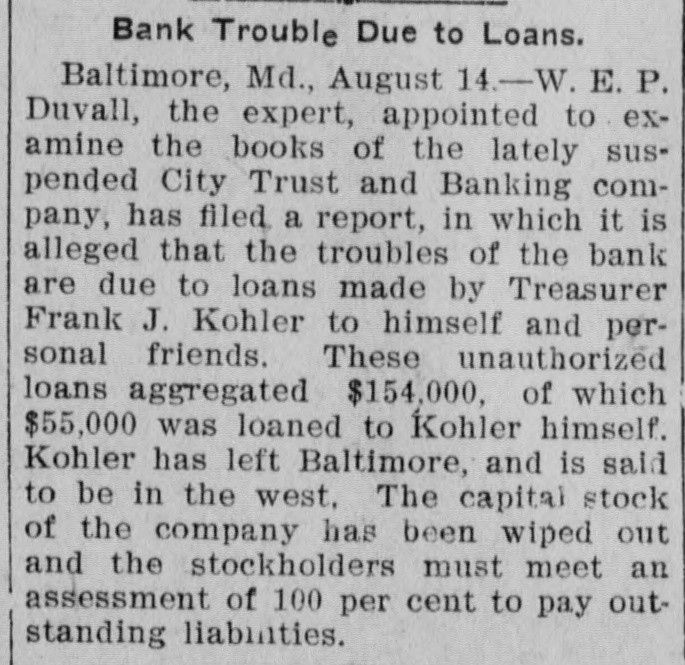
Bank Trouble Due to Loans. Baltimore, Md., August 14.-W. E. P. Duvall, the expert, appointed to examine the books of the lately suspended City Trust and Banking company, has filed a report, in which it is alleged that the troubles of the bank are due to loans made by Treasurer Frank J. Kohler to himself and personal friends. These unauthorized loans aggregated $154,000, of which $55,000 was loaned to Kohler himself. Kohler has left Baltimore, and is said to be in the west, The capital stock of the company has been wiped out and the stockholders must meet an assessment of 100 per cent to pay outstanding liabinties.
12.August 15, 1903The Washington TimesWashington, DC
Click image to open full size in new tab
Article Text
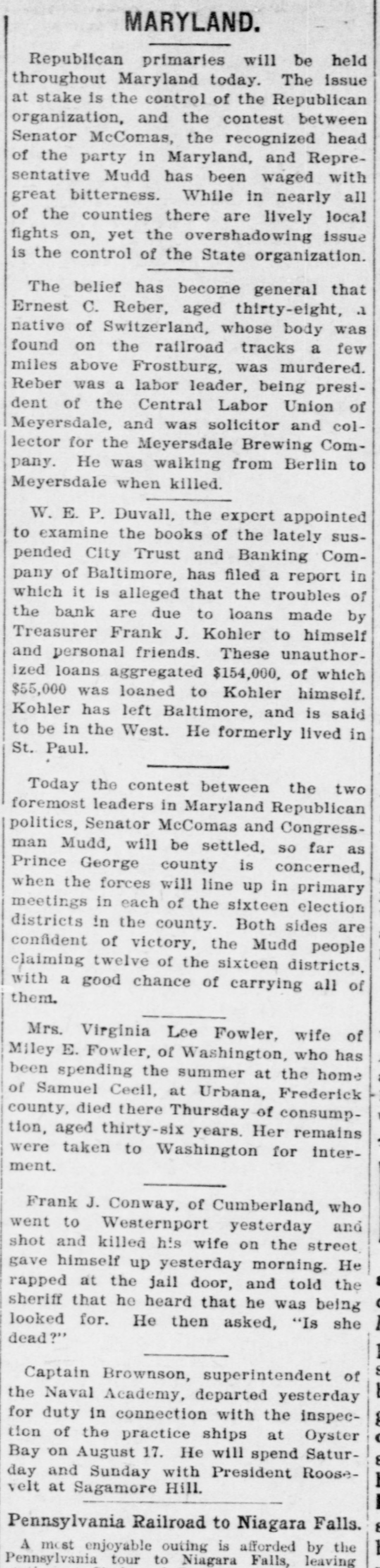
MARYLAND. Republican primaries will be held throughout Maryland today. The issue at stake is the control of the Republican organization, and the contest between Senator McComas, the recognized head of the party in Maryland, and Representative Mudd has been waged with great bitterness. While in nearly all of the counties there are lively local fights on, yet the overshadowing issue is the control of the State organization. The belief has become general that Ernest C. Reber, aged thirty-eight, a native of Switzerland, whose body was found on the railroad tracks a few miles above Frostburg, was murdered. Reber was a labor leader, being president of the Central Labor Union of Meyersdale, and was solicitor and collector for the Meyersdale Brewing Company. He was walking from Berlin to Meyersdale when killed. W. E. P. Duvall, the expert appointed to examine the books of the lately suspended City Trust and Banking Company of Baltimore, has filed a report in which it is alleged that the troubles of the bank are due to loans made by Treasurer Frank J. Kohler to himself and personal friends. These unauthorized loans aggregated $154,000, of which $55,000 was loaned to Kohler himself. Kohler has left Baltimore, and is said to be in the West. He formerly lived in St. Paul. Today the contest between the two foremost leaders in Maryland Republican politics, Senator McComas and Congressman Mudd, will be settled, so far as Prince George county is concerned, when the forces will line up in primary meetings in each of the sixteen election districts in the county. Both sides are confident of victory, the Mudd people claiming twelve of the sixteen districts. with a good chance of carrying all of them. Mrs. Virginia Lee Fowler, wife of Miley E. Fowler, of Washington, who has been spending the summer at the home of Samuel Cecil, at Urbana, Frederick county, died there Thursday of consumption, aged thirty-six years. Her remains were taken to Washington for interment. Frank J. Conway, of Cumberland, who went to Westernport yesterday and shot and killed his wife on the street gave himself up yesterday morning. He rapped at the jail door, and told the sheriff that he heard that he was being looked for. He then asked, "Is she dead?" Captain Brownson, superintendent of the Naval Academy, departed yesterday for duty in connection with the inspection of the practice ships at Oyster Bay on August 17. He will spend Saturday and Sunday with President Roosevelt at Sagamore Hill. Pennsylvania Railroad to Niagara Falls. A most enjoyable outing is afforded by the Pennsylvania tour to Niagara Falls, leaving
13.September 18, 1903The Washington TimesWashington, DC
Click image to open full size in new tab
Article Text
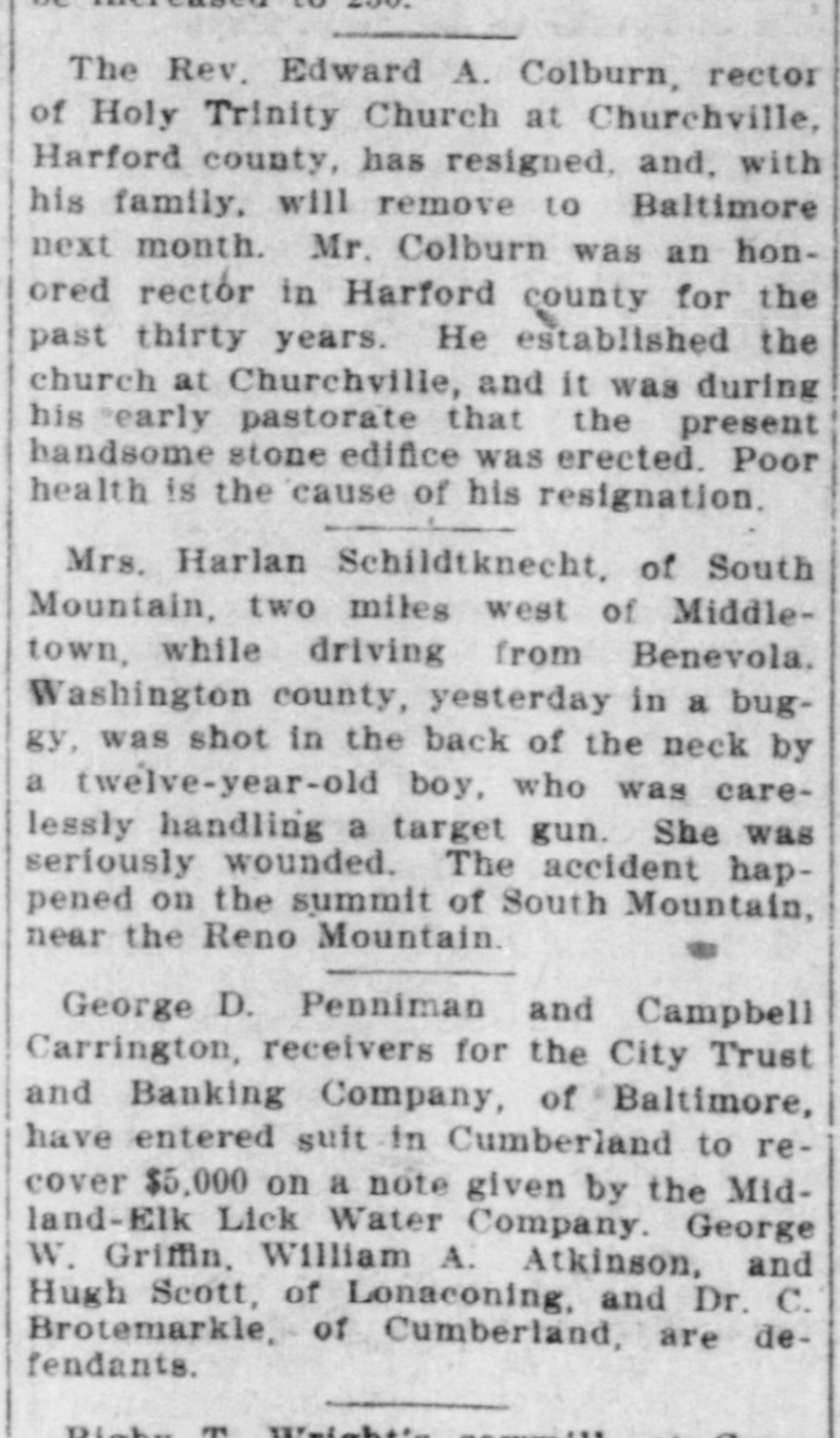
The Rev. Edward A. Colburn, rector of Holy Trinity Church at Churchville, Harford county, has resigned, and, with his family, will remove to Baltimore next month. Mr. Colburn was an honored rector in Harford county for the past thirty years. He established the church at Churchville, and it was during his early pastorate that the present handsome stone edifice was erected. Poor health is the cause of his resignation.
Mrs. Harlan Schildtknecht, of South Mountain, two miles west of Middletown, while driving from Benevola, Washington county, yesterday in a buggy, was shot in the back of the neck by a twelve-year-old boy, who was carelessly handling a target gun. She was seriously wounded. The accident happened on the summit of South Mountain, near the Reno Mountain.
George D. Penniman and Campbell Carrington, receivers for the City Trust and Banking Company, of Baltimore, have entered suit in Cumberland to recover $5,000 on a note given by the Midland-Elk Lick Water Company. George W. Griffin, William A. Atkinson, and Hugh Scott, of Lonaconing, and Dr. C. Brotemarkle, of Cumberland, are defendants.
14.October 20, 1903The Savannah Morning NewsSavannah, GA
Click image to open full size in new tab
Article Text
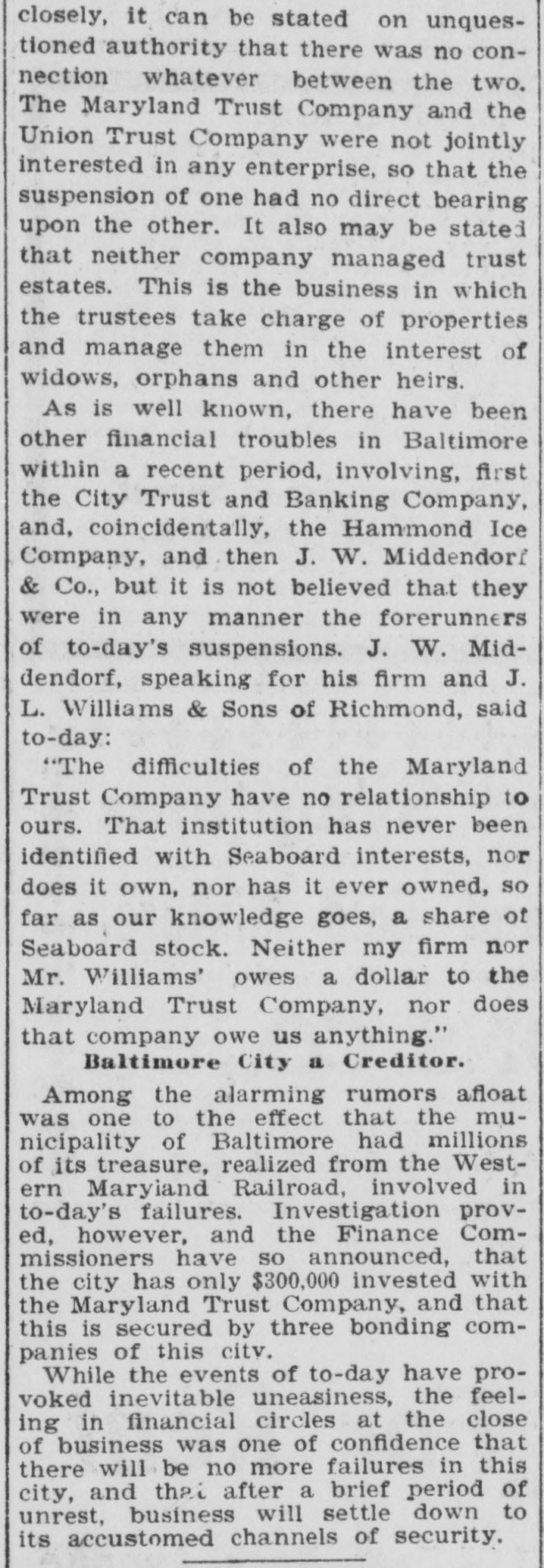
closely, it can be stated on unquestioned authority that there was no connection whatever between the two. The Maryland Trust Company and the Union Trust Company were not jointly interested in any enterprise, so that the suspension of one had no direct bearing upon the other. It also may be stated that neither company managed trust estates. This is the business in which the trustees take charge of properties and manage them in the interest of widows, orphans and other heirs. As is well known, there have been other financial troubles in Baltimore within a recent period, involving, first the City Trust and Banking Company, and, coincidentally, the Hammond Ice Company, and then J. W. Middendorf & Co., but it is not believed that they were in any manner the forerunners of to-day's suspensions. J. W. Middendorf, speaking for his firm and J. L. Williams & Sons of Richmond, said to-day: "The difficulties of the Maryland Trust Company have no relationship to ours. That institution has never been identified with Seaboard interests, nor does it own, nor has it ever owned, so far as our knowledge goes, a share of Seaboard stock. Neither my firm nor Mr. Williams' owes a dollar to the Maryland Trust Company, nor does that company owe us anything." Baltimore City a Creditor. Among the alarming rumors afloat was one to the effect that the municipality of Baltimore had millions of its treasure, realized from the Western Maryiand Railroad, involved in to-day's failures. Investigation proved, however, and the Finance Commissioners have so announced, that the city has only $300,000 invested with the Maryland Trust Company, and that this is secured by three bonding companies of this city. While the events of to-day have provoked inevitable uneasiness, the feeling in financial circles at the close of business was one of confidence that there will be no more failures in this city, and that after a brief period of unrest, business will settle down to its accustomed channels of security.
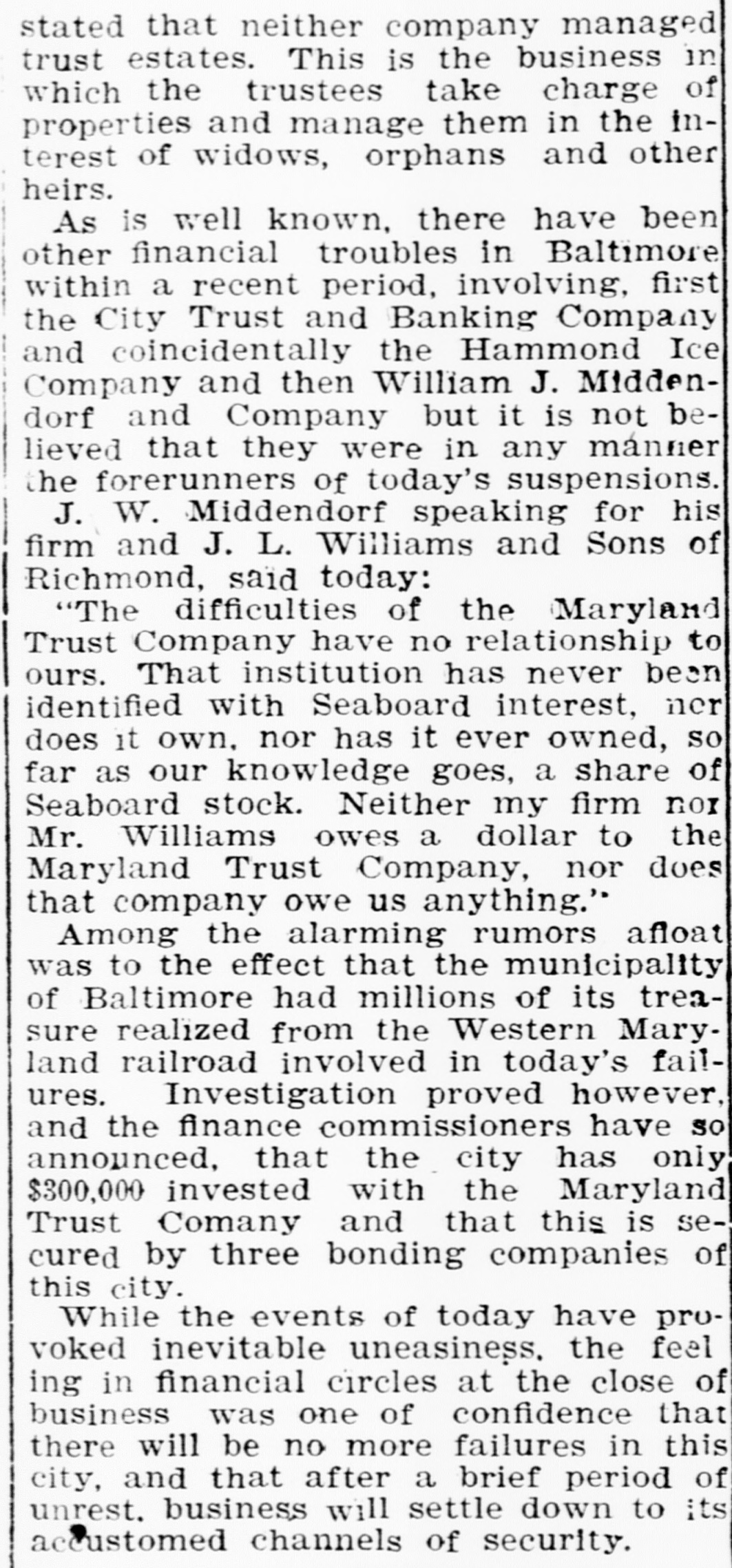
stated that neither company managed trust estates. This is the business in which the trustees take charge of properties and manage them in the interest of widows, orphans and other heirs. As is well known, there have been other financial troubles in Baltimore within a recent period, involving, first the City Trust and Banking Company and coincidentally the Hammond Ice Company and then William J. Middendorf and Company but it is not believed that they were in any mánner the forerunners of today's suspensions. J. W. Middendorf speaking for his firm and J. L. Williams and Sons of Richmond, said today: "The difficulties of the Maryland Trust Company have no relationship to ours. That institution has never bean identified with Seaboard interest, ner does it own. nor has it ever owned, so far as our knowledge goes, a share of Seaboard stock. Neither my firm nor Mr. Williams owes a dollar to the Maryland Trust Company, nor does that company owe us anything." Among the alarming rumors afloat was to the effect that the municipality of Baltimore had millions of its treasure realized from the Western Maryland railroad involved in today's failures. Investigation proved however, and the finance commissioners have SO announced, that the city has only $300,000 invested with the Maryland Trust Comany and that this is secured by three bonding companies of this city. While the events of today have provoked inevitable uneasiness. the feel ing in financial circles at the close of business was one of confidence that there will be no more failures in this city, and that after a brief period of unrest. business will settle down to its ac customed channels of security.
16.March 20, 1904The Salt Lake HeraldSalt Lake City, UT
Click image to open full size in new tab
Article Text
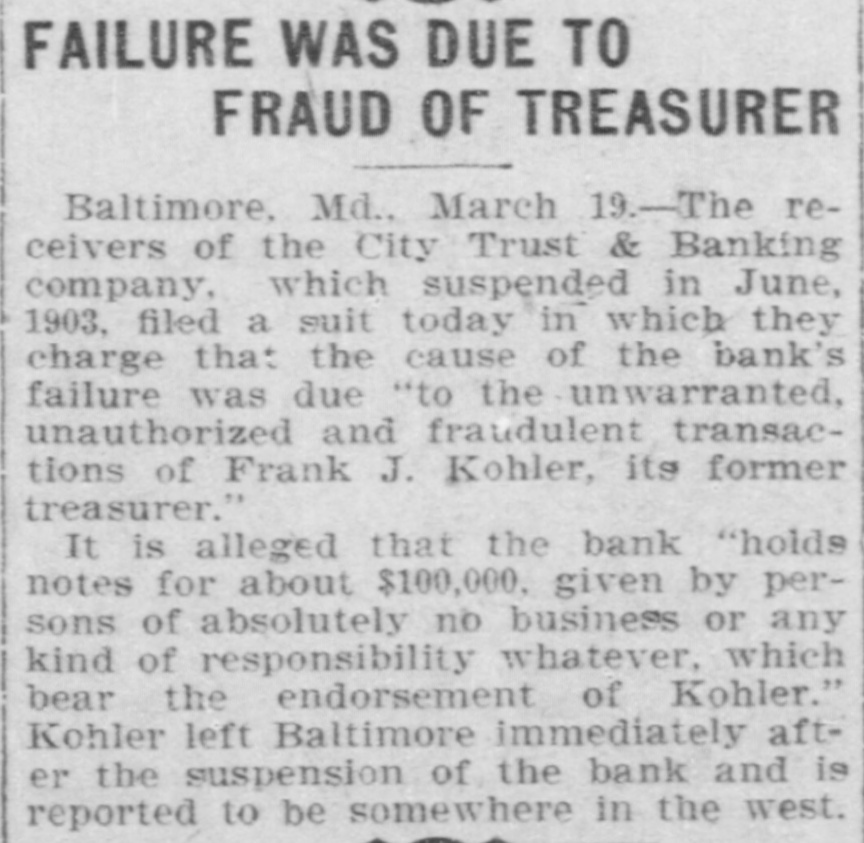
FAILURE WAS DUE TO FRAUD OF TREASURER Baltimore, Md., March 19.-The receivers of the City Trust & Banking company, which suspended in June, 1903, filed a suit today in which they charge that the cause of the bank's failure was due "to the unwarranted, unauthorized and fraudulent transactions of Frank J. Kohler, its former treasurer." It is alleged that the bank "holds notes for about $100,000, given by persons of absolutely no business or any kind of responsibility whatever, which bear the endorsement of Kohler." Kohler left Baltimore immediately after the suspension of the bank and is reported to be somewhere in the west.
17.March 22, 1904New-York TribuneNew York, NY
Click image to open full size in new tab
Article Text
MARYLAND BANK FAILS. Lonaconing Institution Carried Down by City Trust of Baltimore. Cumberland, Md., March 21.-Receivers were appointed to-day for the Miners and Merchants' Savings Bank, of Lonaconing, which has $300,000 on deposit. The failure was consequent on that of the City Trust and Banking Company, of Baltimore, which organized the Lonaconing institution.
18.March 22, 1904Arizona RepublicanPhoenix, AZ
Click image to open full size in new tab
Article Text
BANK RECEIVERS, Cumberland, March 21.-Receivers today were appointed for the Miners and Merchants' Savings Bank, at Lenaconing, which has $300,000 on deposit, its failure being consequent upon that of the City Trust and Banking Co., of Baltimore, which organized the institution.
19.March 23, 1904The News & ObserverRaleigh, NC
Click image to open full size in new tab
Article Text
Appointment of Receivers. Cumberland, Md., March 21.-Receivers were today appointed for the Miners and Merchants Savings Bank of Lonaconing, which had $300,000 on deposit, its failure being consequent upon that of the City Trust and Banking Company of Baltimore, which organized the Lonaconing institution.
20.March 29, 1904Twice-A-Week Plain DealerCresco, IA
Click image to open full size in new tab
Article Text
TELEGRAPHIC BREVITIES. Hobart S. Bird, who tried to run a reform newspaper in Porto Rico, deserted the field after 62 arrests on charges of libel. Report comes from a Paris source that Japan, China and Korea have signed a treaty forming a triple alliance against Russia. Henry Norman, London journalist and member of pariiament, in a magazine article declares the present war is the beginning of a struggle to control China. President Truesdale, of the Lackawanna railroad, says great combinations of labor and capital are socialistic, and tend to destroy American individuality. Charles H. Callahan, a ticket scalper convicted at Buffalo of forging transportation tickets, has been sentenced to not less than one and not more than three years in state prison. The Macon & Birmingham railroad has begun suit against E. R. Henderson, recently removed from the office of auditor, for $50,000, charging shortage and embezzlement. Henderson has been indicted. Receivers have been appointed for the Miners' and Merchants' savings bank of Lonaconing, Md., its failure being due to that of the City Trust and Banking company at Baltimore. The deposits are $300,000. An organization of employers, with headquarters in New York and offices in Chicago and other western cities, it is said, plans to shut out union workers from employment at the St. Louis exposition.
21.April 19, 1904Wausau PilotWausau, WI
Click image to open full size in new tab
Article Text
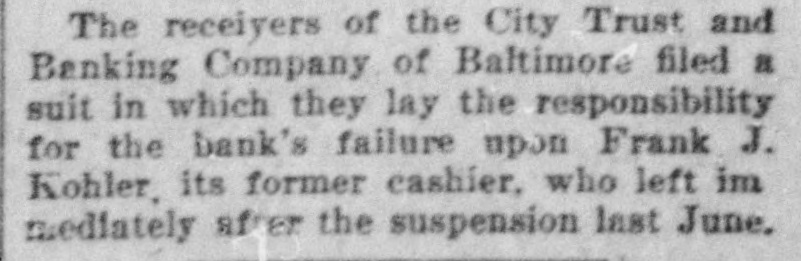
The receivers of the City Trust and Banking Company of Baltimore filed a suit in which they lay the responsibility for the bank's failure upon Frank J. Kohler, its former cashier, who left im mediately after the suspension last June.