7126. Lancaster National Bank (Lancaster, MA)

Bank Information

Episode Type
Suspension → Closure
Bank Type
national
Bank ID
583
Charter Number
583
Start Date
January 2, 1886
Location
Lancaster, Massachusetts (42.456, -71.673)

Metadata

Model
gpt-5-mini
Short Digest
15163eb4688eb2be

Response Measures

None

Receivership Details

Depositor recovery rate
100.0%
Date receivership started
1886-01-20
Date receivership terminated
1891-09-14
OCC cause of failure
Fraud
Share of assets assessed as good
49.7%
Share of assets assessed as doubtful
47.6%
Share of assets assessed as worthless
2.8%

Description

The bank suspended business after its president W. H. (McNeil/McNeill) absconded with funds (defalcation). Examiner/Comptroller actions placed the bank in receivership and the institution was wound up (receiver actions continue through 1890). No article describes a depositor run prior to suspension; the failure followed internal fraud/insolvency.

Events (4)

1. November 22, 1864 Chartered
Source
historical_nic
2. January 2, 1886 Suspension
Cause
Bank Specific Adverse Info
Cause Details
President W. H. McNeil absconded after taking bank funds (several thousand dollars and securities), prompting the bank to post suspension of business.
Newspaper Excerpt
A notice that the bank had suspended business was posted on the door this morning.
Source
newspapers
3. January 20, 1886 Receivership
Source
historical_nic
4. January 20, 1886 Receivership
Newspaper Excerpt
Bank Examiner Gatchell has turned the wrecked Lancaster National Bank over to the receiver. ... Receiver Corcoran (John W. Corcoran) declared dividends; receiver appointed to manage the wrecked bank's affairs was Corcoran or Ernest Harvier in some reports, and later John W. Corcoran is named as receiver in suits and dividend notices in subsequent years.
Source
newspapers

Newspaper Articles (10)

Article from St. Paul Daily Globe, January 3, 1886

Click image to open full size in new tab

Article Text

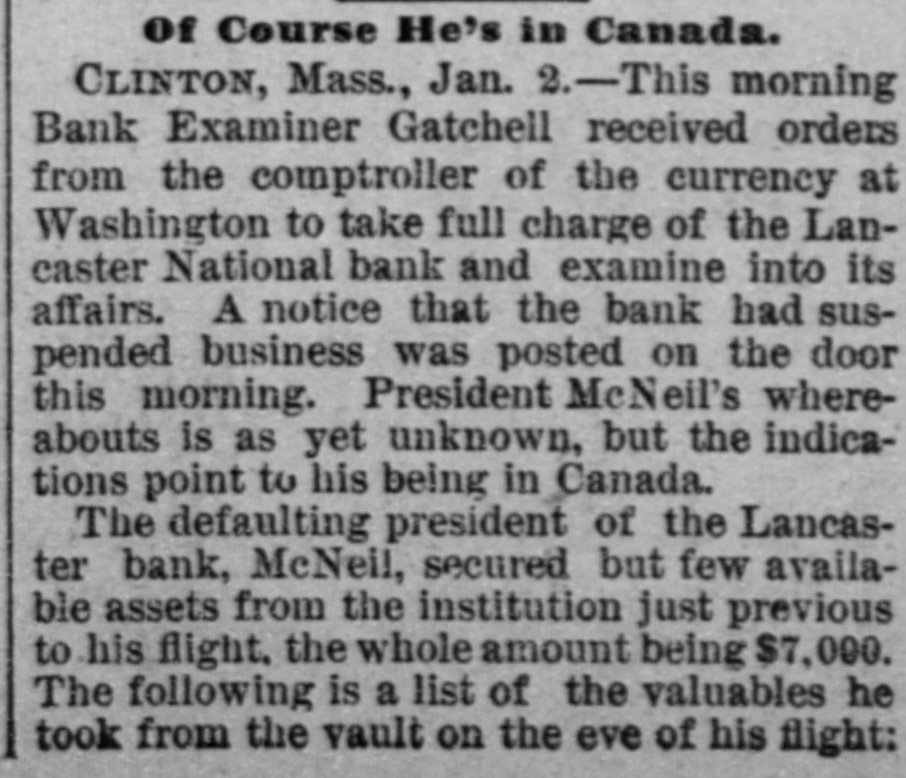
Of Course He's in Canada. CLINTON, Mass., Jan. 2.-This morning Bank Examiner Gatchell received orders from the comptroller of the currency at Washington to take full charge of the Lancaster National bank and examine into its affairs. A notice that the bank had suspended business was posted on the door this morning. President McNeil's whereabouts is as yet unknown, but the indications point to his being in Canada. The defaulting president of the Lancaster bank, McNeil, secured but few available assets from the institution just previous to his flight. the whole amount being $7,000. The following is a list of the valuables he took from the vault on the eve of his flight:


Article from Richmond Dispatch, January 3, 1886

Click image to open full size in new tab

Article Text

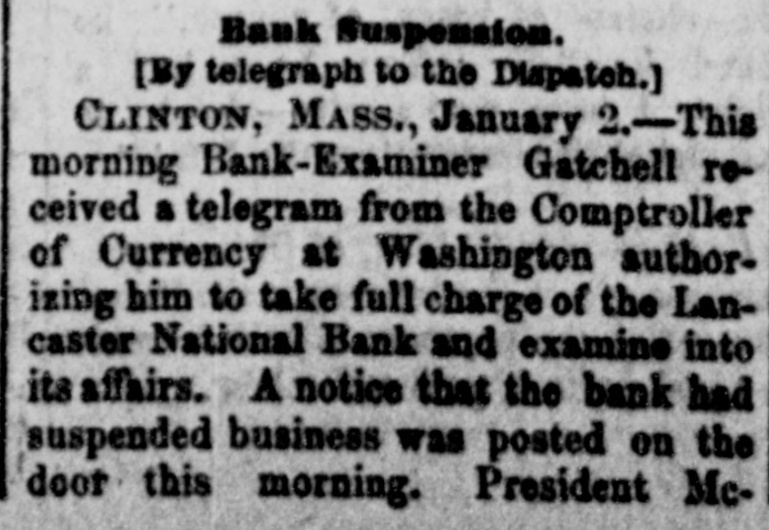
Bank Suspension. [By telegraph to the Dispatch.] CLINTON, Mass., January 2.-This morning Bank-Examiner Gatchell received a telegram from the Comptroller of Currency at Washington authorizing him to take full charge of the Lancaster National Bank and examine into its affairs. A notice that the bank had suspended business was posted on the door this morning. President Mc-


Article from The Austin Weekly Statesman, January 7, 1886

Click image to open full size in new tab

Article Text

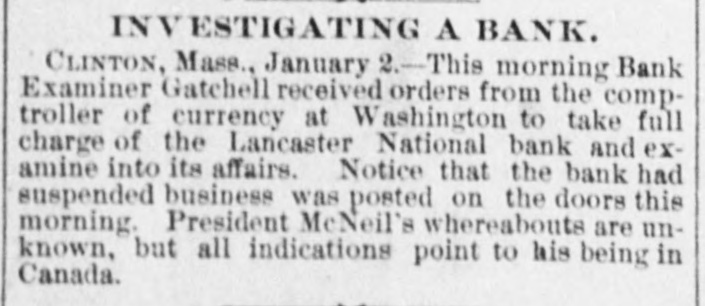
INVESTIGATING A BANK. CLINTON, Mass., January 2.-This morning Bank Examiner Gatchell received orders from the comptroller of currency at Washington to take full charge of the Lancaster National bank and examine into its affairs. Notice that the bank had suspended business was posted on the doors this morning. President McNeil's whereabouts are unknown, but all indications point to his being in Canada.


Article from Burlington Weekly Free Press, January 8, 1886

Click image to open full size in new tab

Article Text

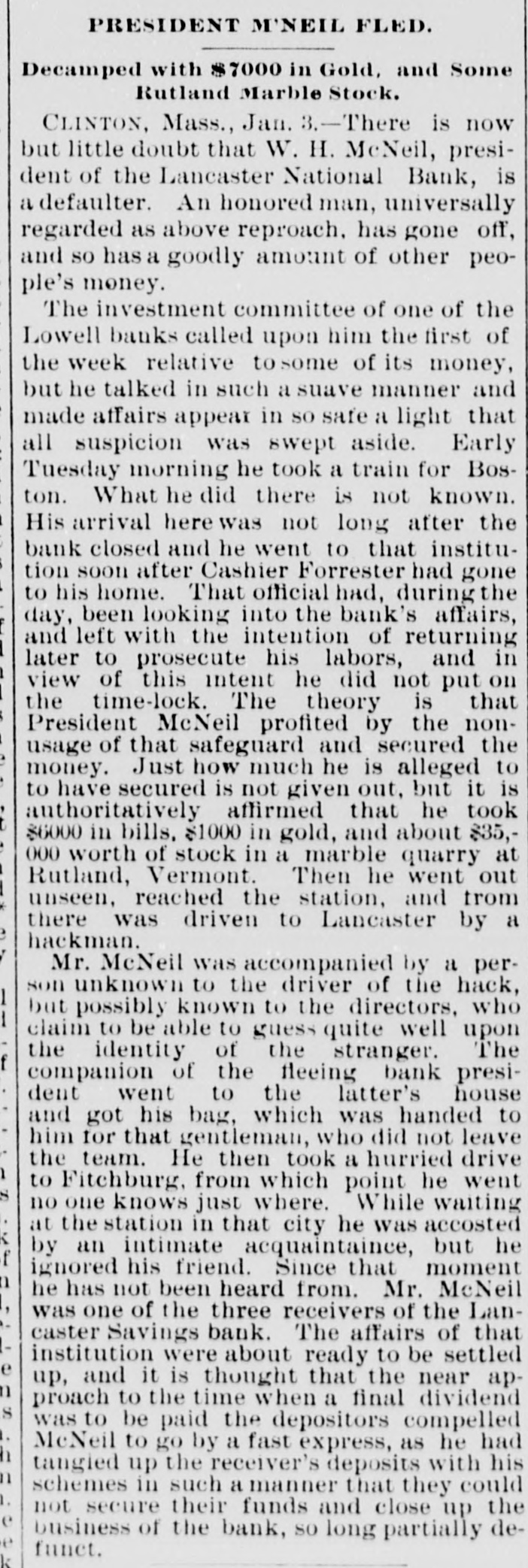
PRESIDENT M'NEIL FLED. Decamped with $7000 in Gold, and Some Rutland Marble Stock. CLINTON, Mass., Jan. 3.-There is now but little doubt that W. H. McNeil, president of the Lancaster National Bank, is a defaulter. An honored man, universally regarded as above reproach. has gone off, and so has a goodly amount of other people's money. The investment committee of one of the Lowell banks called upon him the first of the week relative to some of its money, but he talked in such a suave manner and made affairs appear in so safe a light that all suspicion was swept aside. Early Tuesday morning he took a train for Boston. What he did there is not known. His arrival here was not long after the bank closed and he went to that institution soon after Cashier Forrester had gone to his home. That official had, during the day, been looking into the bank's affairs, and left with the intention of returning later to prosecute his labors, and in view of this intent he did not put on the time-lock. The theory is that President McNeil profited by the nonusage of that safeguard and secured the money. Just how much he is alleged to to have secured is not given out, but it is authoritatively affirmed that he took $6000 in bills, $1000 in gold, and about $35,000 worth of stock in a marble quarry at Rutland, Vermont. Then he went out unseen, reached the station, and from there was driven to Lancaster by a hackman. Mr. McNeil was accompanied by a person unknown to the driver of the hack, but possibly known to the directors, who claim to be able to guess quite well upon the identity of the stranger. The companion of the fleeing bank president went to the latter's house and got his bag, which was handed to him for that gentleman, who did not leave the team. He then took a hurried drive to Fitchburg, from which point he went no one knows just where. While waiting at the station in that city he was accosted by an intimate acquaintaince, but he ignored his friend. Since that moment he has not been heard from. Mr. McNeil was one of the three receivers of the Lancaster Savings bank. The affairs of that institution were about ready to be settled up, and it is thought that the near approach to the time when a final dividend was to be paid the depositors compelled McNeil to go by a fast express, as he had tangled up the receiver's deposits with his schemes in such a manner that they could not secure their funds and close up the business of the bank, SO long partially defunct.


Article from National Republican, January 23, 1886

Click image to open full size in new tab

Article Text

The Worst Skinned Institution. BOSTON, MASS., Jan. - Bank Examiner Gatchell has turned the wrecked Lancaster National Bank over to the receiver. Mr. Gatchell says the bank is the worst skinned institution he has ever had anything to do with. He and the receiver both say that it is barely possible that the stockholders may escape an assessment. It will depend upon the amount realized from doubtful assets. Most of the notes to the bank have been rediscounted, and in one case a mortgage has been sold three or four times, the note being kept at the bank as a convenience in collecting the interest. Gen. Butler has been retained by the directors of the bank to go to Washington and secure the removal of Receiver Corcoran if possible.


Article from St. Paul Daily Globe, February 26, 1886

Click image to open full size in new tab

Article Text

TELEGRAPHIC SPARKS. The vestrymen of Trinity church, St. Louis, have unapimously requested Father Betts to withdraw his resignation. Sir William Jenner, the well-known physician, has ordered Lord Salisbury to go abroad to recruit his health. James Whitely, city clerk at Pekin, Ill., has defaulted and fled to parts unknown. He is believed to have taken a large amount. A. H. Stump & Sons, Baltimore, suspended Wednesday afternoon, with liabilities of $115.000. They hope to be able to pay in full. The total liabilities of the Lancaster. Mass., National bank are $246,240. An attempt is to be made to take it out of the receiver's hands. Ernest Harvier was yesterday appointed receiver of the property of Bartley Campbell, the playwright, under judgment for Bernard Brady. Canada expects a large immigration from England this year. Special pains are to be taken in England to send over only agricultural laborers. There was a large attendance at the funeral of John B. Gough, which took place Wednesday at his late home, "Hillside," in the town of Boyleston, Mass. The lower house of the Ohio legislature has passed a bill making the tax $200 on spirituous liquors and $100 on maltliquors. It is practically the old Scott law. The Loyal Patriotic union of Dublin has issued a circular inviting interested parties to furnish authentic particulars of instances of boycotting and outrages in general. Stockholm is suffering from commercial depression. The number of failures is steadily increasing. The gravity of the financial situation has not been paralleled since the panie of 1857. Dalton, Cincinnati's clerk of court, was arrested yesterday for failing to go to Columbus with the returns of precinct A, Fourth ward. He was released on his own recognizance in $500. The case will be heard on Wednesday. The English government has approved Lord Dufferin's request that a strong expedition be sent against the Shans. The troops forming the expedition will leave Mandalay on March 7th. British commissioners in Burmah are authorized to secure the submission of the chiefs either by bribing or fighting them. The saloon of T. R. Bryant at Norwich, Muskingum county, O., was shattered by an explosion of gun powder recently. The powder was exploded by unknown persons. There is great excitement in the town, but thus far no clue to the perpetrators has been found. In the New York senate yesterday a bill was introduced annulling the privileges and franchises of the Broadway Surface railroad, and providing for the appointment of a commissioner to take possession of all its property and sell the same, including its franchise, at public auction. A resolution was passed in the New York senate yesterday calling for full information as to the doings of the dock department of New York city. One senator said that if completely disclosed the proceedings of the dock commission would show corruption compared with which that of the Broadway surface road was nothing. In the St. Louis contested election case of ex-Mayor Ewing against the present mayor, D. R. Francis, which was brought before the circuit court last week under quo warranto proceedings to procure the opening of the ballot-boxes to prove alleged frauds, Judge Barclay gave his decision to the effect that such a result cannot be reached through quo warranto proceedings. The relator will probably take the case to the supreme court.


Article from New-York Tribune, November 18, 1887

Click image to open full size in new tab

Article Text

SUIT BY A BANK RECEIVER. FITCHBURG, Mass., Nov. 17.-AD interesting case was begun in the Supreme Court this afternoon before Judge Mason. The plaintiff is John W. Corceran, receiver of the Lancaster National Bank, and the defendant is Wesley R. Batchelder, of Lowell, General P. A. Collius is counsel for Mr. Corcoran, and General B. F. Butler and Frank L. Washburn, of Boston, for the defendant. The Built is to recover on three promissory notes amonting to $6,000. The defendant claims that he owed the bank about $15,000 and that he paid $9,000 and then refused to pay the remaining $6,000 until the receiver returned 173 shares of Erie Telegraph and Telephone stock deposited with the bank as collateral. The receiver dentes that he ev or saw or knew of any collateral. Batchelder showed a receipt for the collateral signed by W. H. McNeil, the abscouding president of the bank. General Butler read the statute stating that a bank could loan to a single firm not over one-tenth of its capital stock. The Lancaster Bank, however, with $100, 000 capital. loaned $15,000 to Bachelder, who was a director 11 the bank.


Article from New-York Tribune, November 24, 1887

Click image to open full size in new tab

Article Text

RECEIVER CORCORAN GETS A VERDIOT. FITCHBURG, Mass., Nov. 23.-The jury in the case of Receiver Corcoran, of the wrecked Lancaster National Bank, against Wesley R. Bateholder, a directorin that institution.to-day returned a verdict of $6,682 for the plaintiff. The suit was to recover on three promissory notes amounting to $6,000. Batchelder claimed that he was owing the bank $15,000, and paid $9,000, but refused to pay the remainder until the receiver returned 173 shares of Erie Telegraph and Telephone stock deposited with the bank as collateral. The case will ROW go to the Supreme Court on exceptions. General P. A. Collins is counsel for the plaintiff, and General Butler for the defendant.


Article from Pittsburg Dispatch, November 12, 1890

Click image to open full size in new tab

Article Text

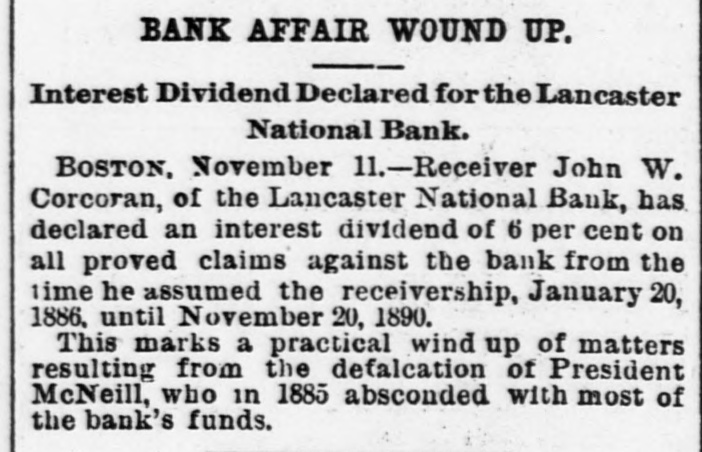
# BANK AFFAIR WOUND UP. Interest Dividend Declared for the Lancaster National Bank. BOSTON, November 11.-Receiver John W. Corcoran, of the Lancaster National Bank, has declared an interest dividend of 6 per cent on all proved claims against the bank from the time he assumed the receivership, January 20, 1886, until November 20, 1890. This marks a practical wind up of matters resulting from the defalcation of President McNeill, who in 1885 absconded with most of the bank's funds.


Article from The Windham County Reformer, October 16, 1891

Click image to open full size in new tab

Article Text

NOTINGS. Congressman George Fred Williams, who had been delayed by sickness, has this week taken the stump for the Massachusetts Democrats, speaking at Pittsford and North Adams yesterday and to-day. A tin-plate consumers' association has been formed to secure a repeal of the McKinley tax. Its members represent the canning and other large consuming interests. Senator Vest of Missouri, is a leader among the free coinage men, but he agrees with Mills that the tariff is the paramount issue and he thinks the Missouri Democracy is solid for Cleveland regardless of the coinage issue. Ex-Gov. Hobart B. Bigelow of Connecticut died Sunday at the age of 67. He was of good blood, the Massachusetts Bigelows and the Pierponts, learned the machinist's trade and was the head of the great business of the Bigelow boiler company. He was mayor of New Haven in 1878 and governor of the state in 1881-2. Dr. Madison C. Peters of the Bloomingdale Reformed church of New York preached a rousing sermon Sunday on the Dr. Briggs case. He likened it to that of Dr. Lyman Beecher, Albert Barnes and Prof David Swing, whose prosecution the Presbyterian church has occasion to remember with shame. "Such trials," he said, "should be placed side by side with the burning of witches in Massachusetts years ago, and thank God that a majority of the clergymen of New York are in sympathy with Dr. Briggs." Judge Paschal of a Texas court has refused to permit an alien to be naturalized who avowed himself a Socialist and admirer of Johann Most, because as the judge says, such ideas are "impracticable, un-American and dangerous to society." Senator Chandler did not appear before the interstate commission at the hearing it gave last week on his charges of the Boston & Maine railroads' wholesale bribery of New Hampshire with free passes. Perhaps he did not consider it necessary as the manager of the road has admitted practically all that he alleged about the abuse. A sentence was inflicted in Boston Saturday under the "habitual criminal" act. David Rea an, a burglar who has before served two terms for the same crime, was caught again attempting to break and enter and was sentenced to 25 years in states prison, which as he is 54 now, is practically a life sentence. That Admiral Stewart, who has become so conspicuous in print of late, owing to the Parnell tragedy, lived until 1869, when his 92 years proved more than he could bear. The grandfather of the late Irish leader, says a Buffalo man, once said in his hearing that he had dined with every president of the United States from the beginning down to Grant's regime, except Washington and Johnson. But he had sipped wine twice with the first president, if he had not actually dined with him. Stephen B. Elkins wants to get into the cabinet, in Noble's place if he can, otherwise in Proctor's. The government comptroller has complimented Gen. John. W. Corcoran of Clinton, Mass., upon his action as receiver of the National bank of Lancaster. It became involved through large loans to the insolvent West Rutland Marble company, whose money and papers Gen. Corcoran found in the woods on Tinmouth hills a few miles below West Rutland. The first judge to get at it knocks out the Texas statute forbidding aliens to hold land there. It is in controvention of the United States' treaties with foreign powers, says the judge, and if the state supreme court upholds this decision, as is probable, it will put one of the stiffest of the "state sovereignty" states of the south in line against Kansas, Illinois and several of the western states that have such laws. One hundred and eighty-eight students entered the Troy business college last week. This is, probably, the most successful private school in that part of the country. On account of the increased attendance they have enlarged their quarters by opening an office and reception room on the ground floor, and now have the most elegant and pleasant rooms that are used for a similar purpose. Ex-Senator Blair of New Hampshire has resigned his position as minister to China, since the Chinese government would not receive him. He says he wants no other office, that the president was willing to appoint him to one of equal dignity, but he would not take it and he proposes to retire to private life. Ruth is the name that ex-President and Mrs Cleveland have decided to give their little daughter, after Mrs. Cleveland's grandmother. President Harrison gracefully sent his congratulations to Mr and Mrs Cleveland over the happy event in their family last week. Mr. Ingalls of Kansas is "more of the opinion than ever that it will be Harrison against Cleveland the next time, and Cleveland has a comfortable reinforcement in his baby." Senator Sherman thinks that protection is growing in favor in the South, and that half a dozen states there are so strong for the policy now that they would go Republican if the race question could be eliminated. The directors of the New York league base ball team have been investigating the charge that the final games were thrown away to Boston and unanimously report that there is no ground for it. The latest Washington gossip is that an arrangement has been fixed up by which Gen. Raum shall quietly retire from the pension office after election and have a new place provided for him. Maj. W. H. Barker of New York, the chief of division who celebrated his rerating under Tanner by spending a part of $2300 arrears for a dinner pary, at which Tanner, in an after-dinner speech, got off the historic remark: "Boys, I'm with you. My legs may be a little shaky, but, if my good right arm holds out, God help the surplus," has been ejected from the pension office by order of Secretary Noble. His offense was borrowing money of his subordinates. Only six judges were present at the opening of the Supreme Court, at Washington, on Monday. The session lasted but six minutes. All the important cases which had been set for a hearing by the full court in advance of other cases on the docket—the lottery cases, the Sayward case, the case testing the validity of the McKinley tariff bill, etc—were postponed until the second Monday in November. Mexico has just passed a high tariff bill. Gov. Tuttle of New Hampshire, again nominated Wednesday Col. Thos. Cogswell for railroad commissioner, on the ground that his prominence as a Democrat and a former candidate for governor justifies giving him the place which the law requires to be filled by a Democrat, that his distinguished record as a soldier, his prominence in the Grand Army, his high rank as a lawyer, and his freedom from employment by any corporation, ali peculiarly adapt him, and the people of the state have decided that the council's previous rejection of his name was not justified. Gov. Russell will make ten speeches during the Massachusetts campaign. There is a report from Washington that the government has concluded a convention with Germany under which American grains and provisions will be admitted into that country either free or at greatly reduced duties after the first of January next. The consideration for this concession is said to be an assurance that the president will not reimpose a duty on German beet sugar, as he is empowered to do.