Click image to open full size in new tab
Article Text
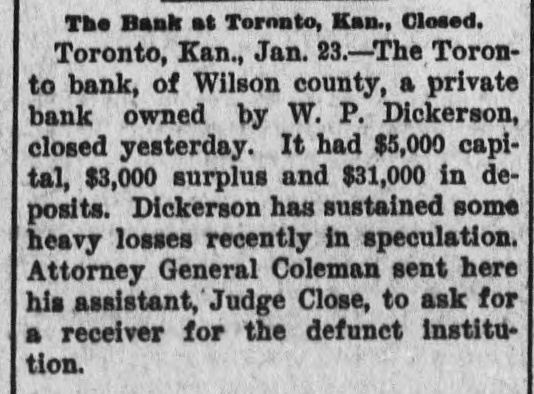
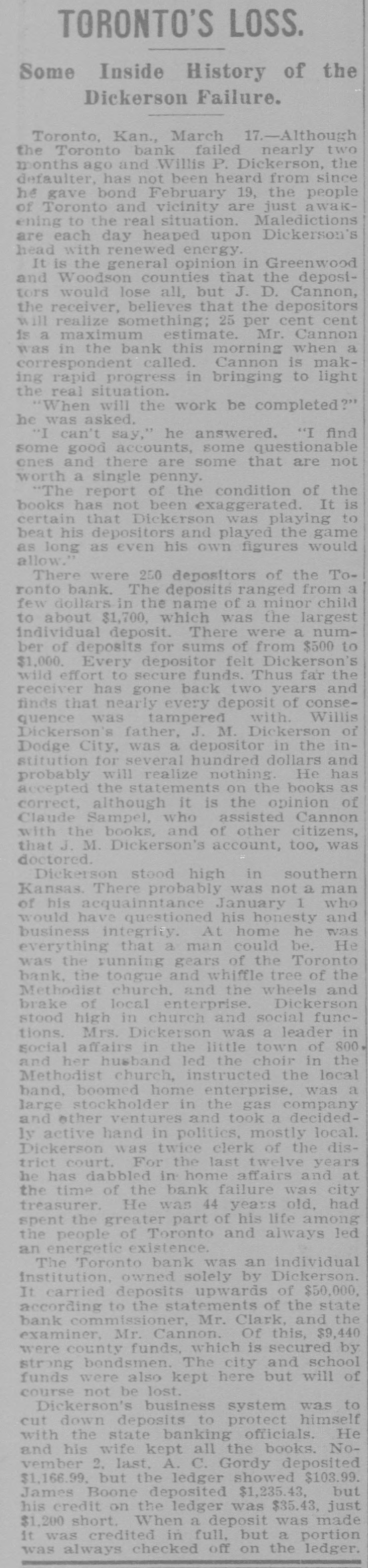
TORONTO'S LOSS. Some Inside History of the Dickerson Failure. Toronto, Kan., March 17.-Although the Toronto bank failed nearly two months ago and Willis P. Dickerson, the defaulter, has not been heard from since he gave bond February 19, the people of Toronto and vicinity are just awakening to the real situation. Maledictions are each day heaped upon Dickerson's head with renewed energy. It is the general opinion in Greenwood and Woodson counties that the depositors would lose all, but J. D. Cannon, the receiver, believes that the depositors will realize something; 25 per cent cent is a maximum estimate. Mr. Cannon was in the bank this morning when a correspondent called. Cannon is making rapid progress in bringing to light the real situation. "When will the work be completed?" he was asked. "I can't say," he answered. "I find some good accounts, some questionable ones and there are some that are not worth a single penny. "The report of the condition of the books has not been exaggerated. It is certain that Dickerson was playing to beat his depositors and played the game as long as even his own figures would allow." There were 250 depositors of the Toronto bank. The deposits ranged from a few dollars in the name of a minor child to about $1,700, which was the largest individual deposit. There were a number of deposits for sums of from $500 to $1,000. Every depositor felt Dickerson's wild effort to secure funds. Thus far the receiver has gone back two years and finds that nearly every deposit of consequence was tampered with. Willis Dickerson's father, J. M. Dickerson of Dodge City, was a depositor in the institution for several hundred dollars and probably will realize nothing. He has accepted the statements on the books as correct, although it is the opinion of Claude Sampel, who assisted Cannon with the books, and of other citizens, that J. M. Dickerson's account, too, was doctored. Dickerson stood high in southern Kansas. There probably was not a man of his acquainntance January 1 who would have questioned his honesty and business integrity. At home he was everything that a man could be. He was the running gears of the Toronto bank, the tongue and whiffle tree of the Methodist church, and the wheels and brake of local enterprise. Dickerson stood high in church and social functions. Mrs. Dickerson was a leader in social affairs in the little town of 800, and her husband led the choir in the Methodist church, instructed the local band, boomed home enterprise, was a large stockholder in the gas company and other ventures and took a decidedly active hand in politics, mostly local. Dickerson was twice clerk of the district court. For the last twelve years he has dabbled in home affairs and at the time of the bank failure was city treasurer. He was 44 years old, had spent the greater part of his life among the people of Toronto and always led an energetic existence. The Toronto bank was an individual Institution, owned solely by Dickerson. It carried deposits upwards of $50,000, according to the statements of the state bank commissioner, Mr. Clark, and the examiner, Mr. Cannon. Of this, $9,440 were county funds, which is secured by strong bondsmen. The city and school funds were also kept here but will of course not be lost. Dickerson's business system was to cut down deposits to protect himself with the state banking officials. He and his wife kept all the books. November 2. last, A. C. Gordy deposited $1,166.99. but the ledger showed $103.99. James Boone deposited $1,235.43, but his credit on the ledger was $35.43, just $1,200 short. When a deposit was made it was credited in full, but a portion was always checked off on the ledger.