Maverick Bank (Boston, MA)

Episode Information

Episode UID
6985026091103
Episode Type
Run β†’ Suspension β†’ Closure
Bank Type
state
Bank ID
698502609 hash
Start Date
November 2, 1891
Location
Boston, Massachusetts (42.358, -71.060)

Metadata

Model
gpt-5-mini (chosen from majority vote of a three-model LLM ensemble)
Short Digest
5f47f1cc720706a7

Response Measures

None

Description

Failure followed the suicide of Evans and suspension of I. A. Evans & Co., prompting withdrawals and receiver appointment.

Events (3)

1. November 2, 1891 Run
Cause
Bank Specific Adverse Info
Cause Details
Suicide of Evans and suspension of the firm I. A. Evans & Co. plus withdrawal of State deposits and trust funds triggered withdrawals.
Measures
Clearing House committee decided to close the bank; bank paid depositors as possible and trustee considered sixty-day clause (some payments continued).
Newspaper Excerpt
These events...caused a run of private depositors, and yesterday the Clearing House committee decided that it was necessary to close the bank.
Source
newspapers
2. November 2, 1891 Suspension
Cause
Bank Specific Adverse Info
Cause Details
Asset impairment and withdrawals following Evans-related scandal and loss of deposits led to suspension/closing by clearing house decision.
Newspaper Excerpt
The Maverick bank failare in Boston ... the Boston banks had decided to support the Maverick, and that that bank would resume business. ... the Clearing House committee decided that it was necessary to close the bank.
Source
newspapers
3. November 5, 1891 Receivership
Newspaper Excerpt
Beal, president of the National Bank of Boston, selected as receiver. ... Receiver Beal is preparing a statement to depositors which will be given to the press tomorrow.
Source
newspapers

Newspaper Articles (22)

Article from The Providence News, November 2, 1891

Click image to open full size in new tab

Article Text

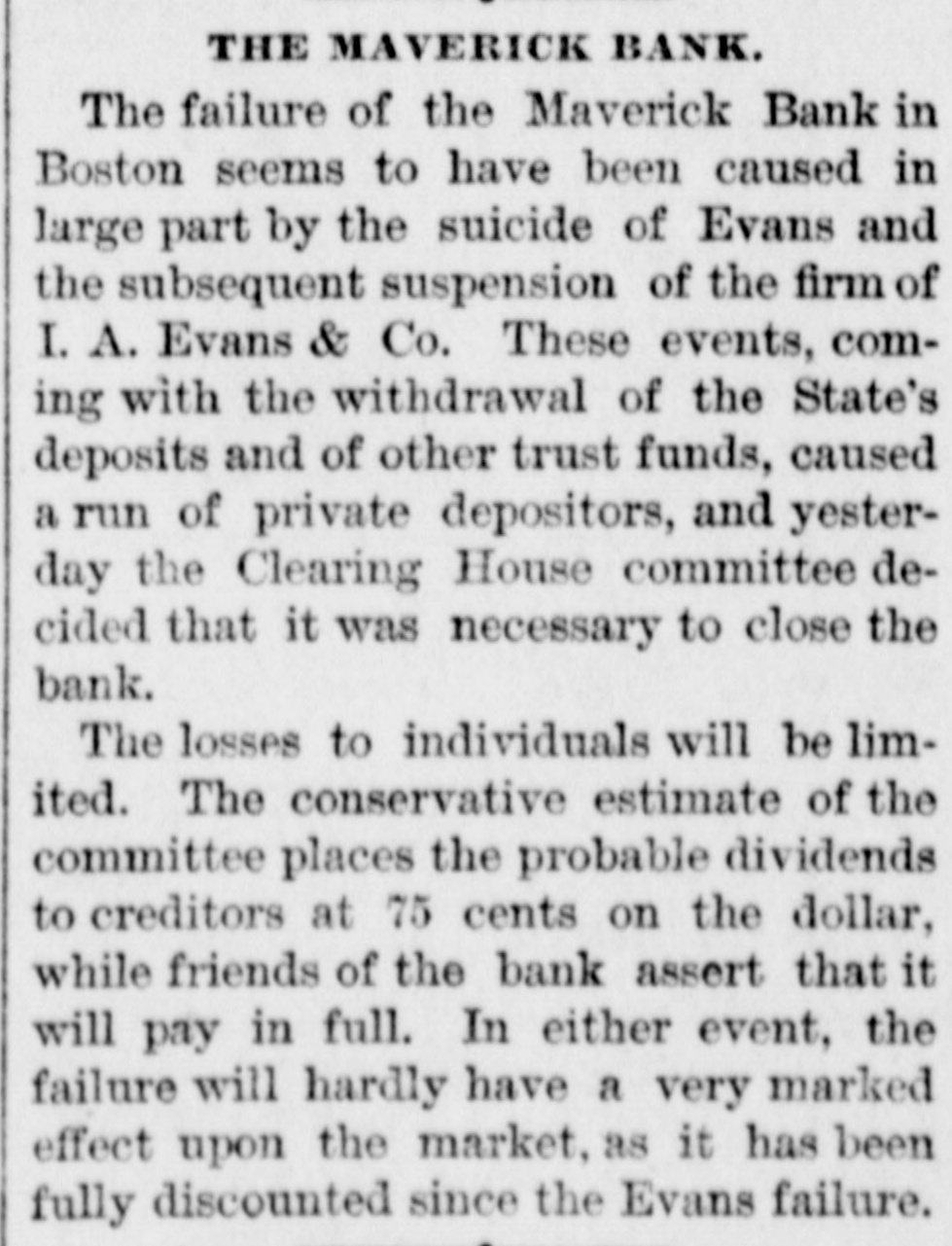
THE MAVERICK BANK. The failure of the Maverick Bank in Boston seems to have been caused in large part by the suicide of Evans and the subsequent suspension of the firm of I. A. Evans & Co. These events, coming with the withdrawal of the State's deposits and of other trust funds, caused a run of private depositors, and yesterday the Clearing House committee decided that it was necessary to close the bank. The losses to individuals will be limited. The conservative estimate of the committee places the probable dividends to creditors at 75 cents on the dollar, while friends of the bank assert that it will pay in full. In either event, the failure will hardly have a very marked effect upon the market, as it has been fully discounted since the Evans failure.


Article from The Portland Daily Press, November 3, 1891

Click image to open full size in new tab

Article Text

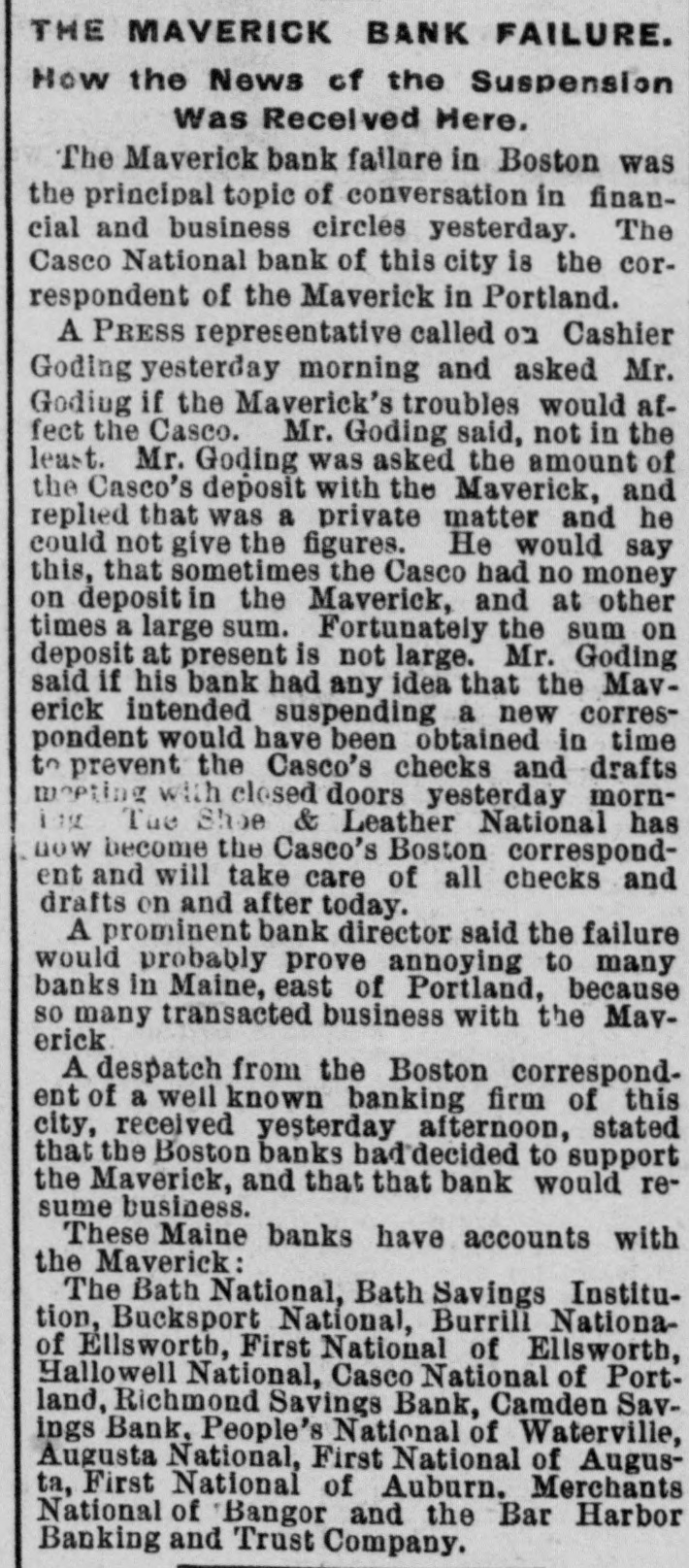
THE MAVERICK BANK FAILURE. How the News of the Suspension Was Received Here. The Maverick bank failare in Boston was the principal topic of conversation in financial and business circles yesterday. The Casco National bank of this city is the correspondent of the Maverick in Portland. A PRESS representative called on Cashier Goding yesterday morning and asked Mr. Goding if the Maverick's troubles would affect the Casco. Mr. Goding said, not in the least. Mr. Goding was asked the amount of the Casco's deposit with the Maverick, and replied that was a private matter and he could not give the figures. He would say this, that sometimes the Casco had no money on depositi in the Maverick, and at other times a large sum. Fortunately the sum on deposit at present is not large. Mr. Goding said if his bank had any idea that the Maverick intended suspending a new correspondent would have been obtained in time to prevent the Casco's checks and drafts meeting with closed doors yesterday mornin Tue Shoe & Leather National has now become the Casco's Boston correspondent and will take care of all checks and drafts on and after today. A prominent bank director said the failure would probably prove annoying to many banks in Maine, east of Portland, because so many transacted business with the Mayerick A despatch from the Boston correspondent of a well known banking firm of this city, received yesterday afternoon, stated that the Boston banks bad'decided to support the Maverick, and that that bank would resume business. These Maine banks have accounts with the Maverick: The Bath National, Bath Savings Institution, Bucksport National, Burrill Nationaof Ellsworth, First National of Ellsworth, Hallowell National, Casco National of Portland, Richmond Savings Bank, Camden Savings Bank. People's National of Waterville, Augusta National, First National of Augusta, First National of Auburn. Merchants National of Bangor and the Bar Harbor Banking and Trust Company.


Article from New-York Tribune, November 3, 1891

Click image to open full size in new tab

Article Text

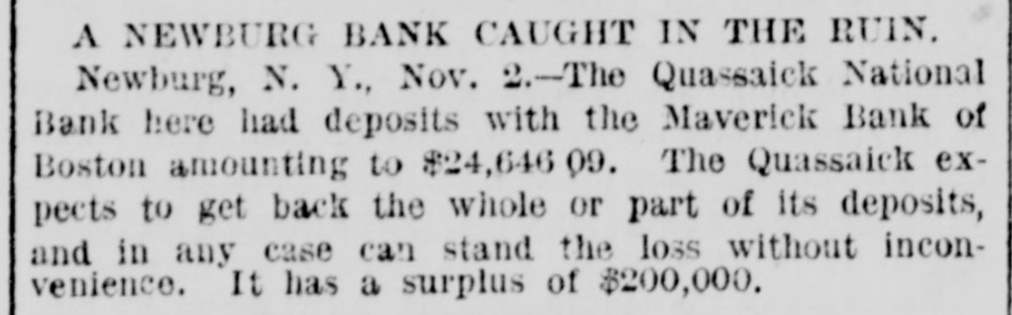
A NEWBURG BANK CAUGHT IN THE RUIN. Newburg, N. Y., Nov. 2.-The Quassaick National Bank here had deposits with the Maverick Bank of Boston amounting to $24,646 09. The Quassaick expects to get back the whole or part of its deposits, and in any case can stand the loss without inconvenience. It has a surplus of $200,000.


Article from Evening Star, November 3, 1891

Click image to open full size in new tab

Article Text

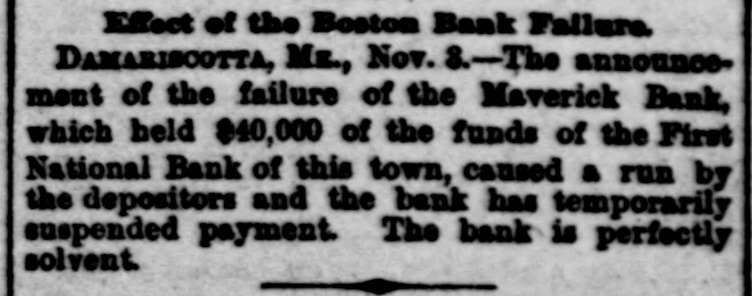
Effect of the Boston Bank Failure. DAMARISCOTTA, Mr., Nov. 8.-The announcement of the failure of the Maverick Bank, which held $40,000 of the funds of the First National Bank of this town, caused a run by the depositors and the bank has temporarily suspended payment. The bank is perfectly solvent.


Article from The Portland Daily Press, November 5, 1891

Click image to open full size in new tab

Article Text

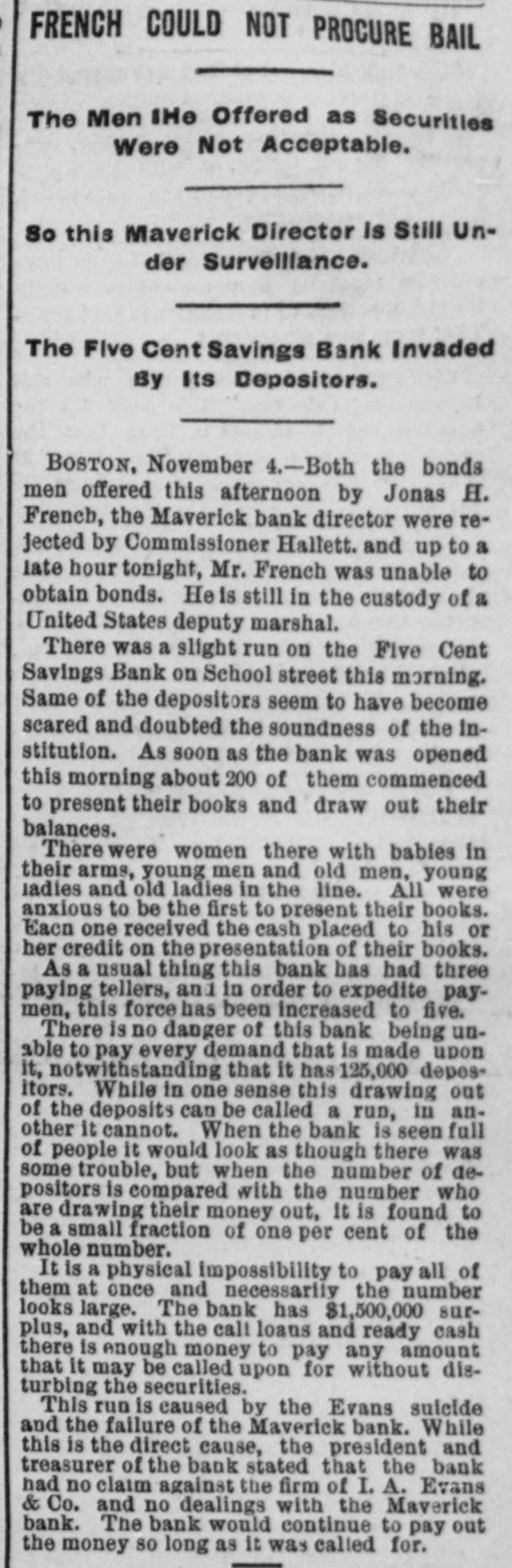
FRENCH COULD NOT PROCURE BAIL The Men THe Offered as Securities Were Not Acceptable. So this Maverick Director is Still Under Surveillance. The Five Cent Savings Bank Invaded By Its Depositors. BOSTON, November 4.-Both the bonds men offered this afternoon by Jonas H. French, the Maverick bank director were rejected by Commissioner Hallett. and up to a late hour tonight, Mr. French was unable to obtain bonds. He is still in the custody of a United States deputy marshal. There was a slight run on the Five Cent Savings Bank on School street this morning. Same of the depositors seem to have become scared and doubted the soundness of the institution. As soon as the bank was opened this morning about 200 of them commenced to present their books and draw out their balances. There were women there with babies in their arms, young men and old men, young ladies and old ladies in the line. All were anxious to be the first to present their books. Eacn one received the cash placed to his or her credit on the presentation of their books. As a usual thing this bank has had three paying tellers, and in order to expedite paymen, this force has been increased to five. There is no danger of this bank being unable to pay every demand that is made upon it, notwithstanding that it has 125,000 depositors. While in one sense this drawing out of the deposits can be called a run, in another it cannot. When the bank is seen full of people it would look as though there was some trouble, but when the number of depositors is compared with the number who are drawing their money out, it is found to be a small fraction of one per cent of the whole number. It is a physical impossibility to pay all of them at once and necessarily the number looks large. The bank has $1,500,000 surplus, and with the call loaus and ready cash there is enough money to pay any amount that it may be called upon for without disturbing the securities. This run is caused by the Evans suicide and the failure of the Maverick bank. While this is the direct cause, the president and treasurer of the bank stated that the bank had no claim against the firm of I. A. Evans & Co. and no dealings with the Maverick bank. The bank would continue to pay out the money so long as it was called for.


Article from The Dalles Daily Chronicle, November 5, 1891

Click image to open full size in new tab

Article Text

Condition of the Maverick Bank. BOSTON, Nov. 5.-A run on the five cent saving bank was continued this morning. Examiner Ewer reports $2,500,000 in cash in the Moverick bank vaults and collections still coming in. Much of the paper in assest will prove available and is marketable. Outside of the bank there is a crowd of people, mostly foreigners, waiting to get into the bank or selling their accounts to speculators at 95 cents on the dollar. President Evans says they will pay the depositors who desire their money, as fast as possible.


Article from News and Citizen, November 5, 1891

Click image to open full size in new tab

Article Text

and the receiver will have to whether the clearing house nittee have dealt too rigidly in ating the bank's assets or not. neaviest losses it is understood, on large loans to Mr. Evans, somewhere near $500,000, ollateral for which the clearing committee does not rate very Potter has made an assignto ex-Mayor Heart and H. D. T. P. Beal, president of the National Bank, of Boston, selected as receiver. There not a word been breathed the intergrity of the examinMr. Magruder has been a victim ight's disease for years, and for weeks has been almost totalHe was kept informed as facts of the Maverick's tround there is little doubt that the intensified his malady. effect of the suspension of the has been discounted by the banks, and it is unlikely that ollapse will result in anything temporary financial uneasiAs President Newman says: only is the surp[us ($80,000) but the undivided profits 0,000) and part of the capital. deposits in the bank ten days amounted to $10,000,000. last week more than $1,700,withdrawn. Maverick bank did considerVermont business, and was a correspondent of 21 banks in state. Some of its stock was in Vermont and the holders it was gilt edge investment. Maverick offered special induceto country customers, and its mmodations were so liberal that a good share of the country Many Vermont banks money on deposit at Maverick, is believed no one bank had on deposit there to cause any The Banker's Directory for gives the Maverick as a Boston spondent of these banks in VerBank of Barre, National bank of Barton. nington County National bank of BenNational bank of Bennington National bank of Brandon. ington Savings bank of Burlington. National bank of Chelsea. bank of Chester. National bank of Fair Haven. bank of Lyndon. National bank of Montpelier. National bank of North Bennington. thfield Savings bank of Northfield. Black R. ver bank of Proctorsville. National bank of Rutland


Article from St. Paul Daily Globe, November 6, 1891

Click image to open full size in new tab

Article Text

COL. FRENCH IN JAIL. His Wealthy Friends Will Not Come Forward. BOSTON, Nov. 5. - Col. Jonas H. French, in default of $75,000 bail, has been committed to Charles street jail. Since his arrest on Monday he has been in the custody of the United States marshal, and has been making strenuous efforts to obtain bail, but the man who a short time ago was surrounded by influential, financial, political and social friends found his closest associates SO far out of his reach when disaster came that not even the few thousand dollars needed to keep him out of jail could be found by himself or his counsel. But two men presented themselves to sign the bond of $75,000 required to secure him his liberty, and neither was nearly qualified to assume the responsibility. During the day John Stetson was applied to by a friend of Mr. French and he said be would furnish bail providing $75,000 in good securities were placed in his hands as an indemnity in case French forfeited his bonds, The friends of Col. French, who were willing to give an indemnity bond, have been engaged nearly all day in efforts to comply with Mr. Stetson's requirement but were unable to make the necessary arrangements and the commitment was made early this evening. The run on the Five Cent Savings bank is more apparent outside than inside the bank. About fifty people only are admitted to the bank at one time. Outside of the bank there IS a crowd of people, mostly foreigners, who are waiting to get into the bank or are selling their accounts to speculators at 95 cents on the dollar. President Eavns says that the trustee met last night and decided to take no action on the sixty-day clause, and they will pay depositors who desire their money as fast as possible. The bank is paying its depositors practically in gold. Examiner Ewer reports that there is now $2,500,000 in cash in the Maverick bank vaults, and collections still coming in. Much of the paper in the assets will prove available and marketable. The Washington National bank will not sign the agreement of the Boston banks to assess themselves 3 per cent of their loans, to relieve the depositors of the Maverick bank. The other banks will probably all sign. There is a diversity of opinion among bankers as to the practical working of the plan. The firm of Thomas Dana & Co., wholesale grocers, dissolved yesterday, owing to the Maverick bank complications. It is stated that of the $400,000 borrowings of Dana & Co. of the Maverick bank, Mr. Dana received only $100,000. The rest was received by the company, which will pay in full. Saving Bank Commissioners Chapin and Locke addressed the crowd that was gathered in and about the band today, assuring the depositors that they were only injuring themselves by withdrawing their money; that the bank was solid as a rock, and that the commissioners knew from personal investigation that if every depositor was paid in full the bank would have $1,500,000.


Article from Vermont PhΕ“nix, November 6, 1891

Click image to open full size in new tab

Article Text

Smith K. Randall has transferred the livery stable property at Springfield, occupied by Hart & Dodge to Isaac Dodge, who has deeded it to Adna Brown, in behalf of the hotel company, by whom it will be remodelled and run in connection with the hotel. The price was $2700. C. E. Richardson, president of the First national bank at Springfield, has gone to Boston to look after the interests of that institution, which had $10,000 deposited in the defunct Maverick bank. Thomas Dana, one of the directors who has been arrested, is the nephew of B. F. Dana of Springfield. J. Goux had his leg broken above the knee while cutting logs on the mountain at Bondville one day last week. Hiland Babbitt of the same town has recently been taken to the insane asylum at Brattleboro. It is estimated that 200 perch of stone will be used for the foundation of the new hotel at Springfield. A fine quarry has been opened on the old Johnson farm about two miles from the village, from whence the stone will be hauled. In opening this quarry it is said that fine flagging stone have been found about four inches in thickness and nearly as smooth as if hewn. It is now proposed that these stone be used for sidewalks, in preference to cement or concrete. The marriage of Carl Sidney Bishop, general secretary of the Fitchburg, Mass., Y. M. C. A., and Miss Jennie F. Maynard of Keene, N. H., took place in the First Congregational church at that place on Wednesday afternoon of last week. Mr. Bishop is the son of Capt. Bishop, a former station agent at South Vernon. The young man fitted himself for his present work by several years' study at Mt. Hermon. Charles Tuttle has sold his farm in the south part of Manchester and moved to Somerset, where he has a job drawing logs. C. M. Ward of Cavendish succeeds J. M. Whalen as station agent at Vergennes. Curtis Quimby, who has lived in Lyndon for 43 years, has recently moved to Springfield, where he is to work at his trade as blacksmith. J. M. Sheehan, a grocer at Proctorsville, is financially embarrassed, his liabilities being about $1200.


Article from The Seattle Post-Intelligencer, November 8, 1891

Click image to open full size in new tab

Article Text

# The S # K # BANK False R tion KANSAS Company this morning. F. Blanchard cally the business $53,000 capital organized tors: A. B. A. Hare B. Watts and the East side to be in ness among of the directors telegraph bezzlement whole case Clark charge of property own, delivered B. A. Hare of money Blanchard priating Lucock, that $10,000 the college money came COREY. here this Corey Nat and create was believed vealed the by the order charge. statement deposits and due almost bank has paper for and in the able to meet in Pittsburgh source of comptroller up, in accordance branch bank deprive the ness and was present condition a run there depositors. NEW YORK national bank correspondent Chicago, made this morning tion to announce the credit "The writing ishly made. I note that government liabilities that activity and punish extent of the of a financial bank of Chicago bank is as BOSTON morning. Washington tion obtained knows nothing tional bank The run has ended. Thomas 000 and both Examin ing-houses financial erick bank progress Maverick committee ST. JOSE


Article from Daily Kennebec Journal, November 10, 1891

Click image to open full size in new tab

Article Text

MAVERICK BANK Making Ready to Resume Business Preparing a Statement. BOSTON, Nov. 9 -Comptroller Lacey, Bank Examiner Ewer and Receiver Beal met at Maverick bank early this morning and had a long conference. Thirty-eight of sixty clerk formerly employed at the Maverick are in their places today. and the work of getting ready to open the bank for the transaction of business with the receiver will be pushed rapidiy. Receiver Beal is preparing a statement to depositors which will be given to the press tomorrow.


Article from The World, November 13, 1891

Click image to open full size in new tab

Article Text

# MAVERICK BANK CREDITORS. The Assets Are Impaired To The Extent Of $2,000,000. [Special to THE WORLD.] BOSTON, November 13.β€”The report of the bank examiner on the Maverick Bank to Controller Lacey shows that the bank's assets are impaired to the extent of $2,000,000. It is believed that the estates of the Directors and the bank's collateral will realize $15,000,000. By assessment on the stock-holders it is not expected that more than $100,000 can be collected. A rough calculation of the probable loss to unsecured creditors places the sum at about $100,000β€”not more than 75 cents each. The total amount received since the suspension and now in the United States Sub-Treasury is $1,1371,000. The bank had about two thousand accounts.


Article from The Sun, November 14, 1891

Click image to open full size in new tab

Article Text

# President Potter Beginning Life Anew in a Modest Way. BOSTON, Nov. 13.-Mr. Asa P. Potter has leased a $900 house in Brookline. He will withdraw his children from the private and send them to the public schools. He expects to engage in the brokerage business, for which his long experience with all kinds of commercial paper has admirably fitted him. A week from to-morrow all of Mr. Potter's stable outfit, horses, carriages, and harness, and even his setter dog, will be sold by auction. At the time of the suspension of the Maverick Bank Mr. Potter held 1,482 shares, of which he is said to have bought twenty during the week preceding the failure. Mr. French held 975, all of which were pledged as security for loans. Mr. Woods had sixty and Mr. Dana forty-two shares. With ten shares for Mr. Work, the minimum required for qualification as a director, there are accounted for 3,008 of the 4,000 shares. Of the remaining 902 shares 154 were held outside of Massachusetts and 748 by 100 small holders.


Article from The Abbeville Press and Banner, November 25, 1891

Click image to open full size in new tab

Article Text

LATER NEWS. FREEHOLDERS MULLEN and McGinnes, of the County Board, were struck by a fast Pennsylvania train while driving across the Market street crossing, in Newark, N. J. The carriage was smashed to flinders. Mullen was hurled a distance of thirty feet and instantly killed, and McGinnes had a leg taken off. He was removed to the hospital, where he died that night. DESTRUCTIVE forest fires raged in the Connecticut woods; extending from Wilton to New Canaan. Several hundred acres have been burned over, doing a great amount of damage. An extensive forest fire burned for two days in East Concord, Conn., doing much damage. THE failure of the Maverick Bank has caused a run on the Five Cents Savings Bank of Boston, Mass. CAPTAIN ARTHUR R. YATES, United States Navy, died of heart disease at the Portsmouth (N. H.) Navy Yard. Captain Yates was commandant of the Portsmouth yard, where he had been stationed a little more than a year. WILLIAM Cox and his son of Wapella, III., attempted to deepen an old well. Both were overcome by gas and died. SIX persons, including the captain, were drowned when the British ship Strathblane, from Honolulu, went ashore twenty-five miles north of Astoria, Oregon. Ex-Governor ALBERT S. MARKS, of Nashville, Tenn., died a few days ago. He was born in Daviess County, Ky., on October 16, 1836. THE Republicans won a sweeping municipal victory in Chicago, III. A STATEMENT prepared at the Treasury Department shows that there was a net in crease in circulation during October of $33,810,125, and a net increase of $9,182,403 in the money and bullion in the Treasury dur. ing the same period. NOTICES of intention to contest the right to the seats of six members-elect to the House of Representatives in the Fifty-second Congress have been filed with the clerk of the House. ADVICES from Yokohama, Japan, say that by the violent storm of September fifty-two lives were lost and thirty-seven hundred houses damaged. Seven hundred and eighty vessels were sunk. Great dam. age was done to crops. The loss to property is estimated at $1,000,000. A DISPATCH from Rio Janerio, the capital of Brazil, brings news of what seems to be little less than another revolution. Congress has been dissolved and martial law has been proclaimed at Rio Janeiro and throughout the provinces. The dispatch also announces that a dictatorship has been established in Brazil.


Article from The Morning Call, November 26, 1891

Click image to open full size in new tab

Article Text

Heavy Failure. BOSTON, Nov. 25.-Colonel J. H. French has assigned. A prominent banker says he owed the Maverick Bank $800,000 and held $258,000 of its stock, which is valueless. His liabilities will amount to at least $900,000. His assets are large, but not suf ficient.


Article from Huntsville Gazette, December 5, 1891

Click image to open full size in new tab

Article Text

CONDENSED TELEGRAMS. THE cash deposit of the receiver of the Maverick Bank with the United States subtreasurer at Boston now amounts to $2,119,000, and the estimates as to the first dividend are placed between 50 and 60 per cent. THE Kentucky railroad commissioners have recommended to the governor that separate cars be provided for whites and blacks. THE monthly debt statement shows a decrease in the Treasury cash of $545,002, the net cash balance being $36,126,917. The total of interest and noninterest-bearing debt, less the cash balance and the $100,000,000 gold reserve, is $838,613,069. PASSENGER train No. 3, on the St. Louis & San Francisco Railroad was held up and robbed by highwaymen near Glendale, Mo., on the 1st. The robbers secured about $20,000. THE low price of cotton has raised the cry of hard times in Alabama. The condition of affairs is largely charged to over production of cotton.) THE general revenue fund of the State of Arkansas is exhausted, and there will be no money to meet the current expenses of the State till the payment of liquor licenses on January 1st. LEE CHRISTMAN, an engineer on the Mississippi Valley Route, curled himself up for a nap when near La Place Station, La., on the 30th. The result was a collision, in which both engines and several cars were demolished and a number of persons barely escaped with their lives. IT is now estimated that 400 South Sea Islanders were lost in the wreck of the brig Tahiti off the coast of Mexico. G. B. RANDOLPH, an aged citizen of Woodstock, Ala., went to the station on the 30th with his son, who was leaving to make his home in another State. He was so overcome on bidding him good-by that he fell dead on the spot. THE issue of standard silver dollars from the mints and treasury offices for the week ended November 28th, was $454,980. The issue during the corresponding period of last year was $563,200. THE Court of Claims on the 30th gave judgment for $824,000 in favor of the "Old Settlers," or Western Cherokee Indians in their suit against the United States to recover money alleged to be due them under the treaty of 1846,


Article from The Enterprise, December 9, 1891

Click image to open full size in new tab

Article Text

into the rear end of a gravel train that was standing on the main track. THE southbound express on the East Tennessee, Virginia & Georgia railroad was held up on the 3d ard robbed by two masked men three miles east of Rome, Ga. The robbers secured $1,000 from the express car and escaped. FIRE started in a coal and lumber yard at Plainfield. N. J., on the 3d, and all the stock was destroyed, involving a loss of $100.000; insurance about $60,000. A dozen houses took fire and were more or less damaged by the flames. The total loss will probably foot up $150,000. LOUIS HARRIOr, the slayer of Mrs. Charles T. Leonard, who is now incarcerated in the county jail at Freehold, N. J., for the foul crime he committed near Atlantic Highlands a few days sgo, has at last confessed his guilt. Surr was entered against ex-Mayor Richard Pearson, of Allegheny, Pa., on the 3d for embezzlement. He is charged with retaining $794 of jail and workhouse commitments. THE 551 claims proved at the Maverick bank, Boston, aggregate about $1,800,000. The receiver has deposited with the United States sub-treasury $90,000, making a total of $2,300,000 now standing to the credit of the bank's creditors. JOHN T. STAPLER, a wealthy cracker manufacturer of Trenton, N. J suicided on the 3d by shooting himself, while making preparations to go on a pleasure trip to Bermuda with his wife. J. M. BENSON, treasurer of Bladen county, N. C., has absconded with $6,000 of the county's money and about $10,000 belonging to farmers in the county, which they had placed with him on deposit. BENSON C. HAZLETON, treasurer of the Order of the Royal Ark, which recently failed, and L. G. Powers, secretary of the same concern, were fined $200 and $400 respectively at Boston on the 3d for violating the insurance laws. Judge Sherman said he regretted that the law did not allow him to send them to prison. THE principal business block in Argyle, Mich., was destroyed by fire on the 4th. The loss was $100,000; insurance light. At St. Paul, Minn., on the 14th, the wall of a burned building fell upon fifteen workmen who were engaged in removing the debris from the scene. Seven of the laborers were killed and the remainder were terribly injured. THE strike among the miners at the Colorado Coal & Iron Company's mines at Crested Butte, Col., is still on, with no prospect of their going to work. Everything is shut down and the coke ovens are closed. Two hundred and fifty men are idle by the strike. EIGHT buildings were destroyed by fire at Blair, Neb., on the 4th, causing a loss of $100,000. AT Johnson, Neb., on the night of the 3d. a mob of masked men called at the office of Dr. P. H. Welfiey and after blindfolding and binding him, took him to an unused house and liberally laid on a coat of tar and feathers and gave him twenty-four hours to leave the town. He left. TWELVE barges loaded with brick, in tow of the tug Townsend, of the Cornell Towing Company, were upset when opposite Croton Point, N. Y., on the 4th and thirty persons are supposed to have been drowned. A TERRIFIC explosion occurred on the 4th in the Union Trust building in New York City. It was caused by a dynamite bomb exploding in the office of Russell Sage, the well-known financier. Mr. Sage was badly hurt, but will live. The man who threw the bomb, one of Mr. Sage's clerks, and two others were killed and many persons injured. The explosion was the work of a fiend who went to Russell Sage's office and demanded $1,300,000 from Sage and on being refused threw the bomb. THE business failures during the week ended December 3 number for the United States 304 and Canada 26, a total of 330, as compared with totals of 295 the previous week. For the corresponding week of last year the figures were 312. By an accident on the New England road near Boston on the 4th caused by a passenger train running into a freight train at a crossing, five persons were killed outright and another burned to death in the smoker, which took fire and was consumed. The passenger train on the Long Island road was passing on a track alongside at the time of the accident and it too crashed into the wreck, piling up three trains together. THE annual report of W. W. Farnam. treasurer of Yale university for the year ended July 31, 1891, shows that the university had received $343,734 in gifts during the past year. HARRY TAYLOR, a saloonkeeper, and Chris Yager, a farmer, were arrested at Port Huron, Mich, charged with counterfeiting. A quantity of the spurious coin, together with the metals used in its manufacture, were found on Taylor's premises. After the arrest Taylor confessed, implicating a number of others. MRS. CHARLES P. JOHNSON, of Wyandotte, Kan., has organized a band of adventists who have fixed Christmas day as the end of the world. She has about 800 followers already and has fitted up a residence magnificently, where she receives her friends and holds seances. An attempt was made on the 4th to

Article from The Sun, December 10, 1891

Click image to open full size in new tab

Article Text

# WHOLESALE INVESTIGATION. Boston and Maine Stockholders Want to Know About Some Leases. BOSTON, Dec. 9.-At the annual meeting of the Boston and Maine stockholders to-day. William C. Whitney and G. G. Havens of New York, Joseph H. White of Brookline, Mass., and Walter Hunnewell of Boston were elected directors in the place of Messrs. Sinclair, Sewall, and Potter. The other members of the Board were reΓ«lected. A committee was appointed to investigate the lease of the Nashua and Rochester and Manchester and Lawrence railroads, and ascertain in whose control the roads were prior to the lease, who were the principal beneficiaries, and whether the Boston and Maine paid more than the earning capacity of these roads. The committee will report at a special stockholders' meeting to be called in Boston prior to the next annual meeting. The same committee will investigate the lease of the Upper Coos and Knox and Lincoln railroads, which are leased to the Maine Central, to ascertain whether said leases will not reduce dividends paid by the Maine Central. The committee will further investigate the circumstances of the large deposit in the Maverick Bank at the time of the failure and ascertain if the directors, in the exercise of proper care, shouldn't have withdrawn the deposit before the failure. The agreement of June 22, 1887, between the Boston and Maine, Boston and Lowell, and Nashua and Lowell roads was approved.


Article from Bellows Falls Times, March 10, 1892

Click image to open full size in new tab

Article Text

MASSACHUSETTS. An accumulation of wood gas in one of the large brick charcoal kilns at the Richmond iron-works furnace at Cheshire caused an explosion and the kiln was entirely demolished. John Hayes and Michael Larkin of Worcester, who were excavating a cellar March 2, were completely buried by the caving in of an embankment. They wer rescued finally and will recover. Four burglars were arrested at Weston after breaking into the grain store of Keefe brothers. The men were taken to Waltham and were held in $3000. They gave names as follows: Henry Evans of Middletown, Conn., Frank Carter of Rochester. N. H., Fred Carter of Eno, O., Frank Warren of Newton. Corporation Counsel Babson of Boston appeared before Judge Colt in the United States circuit court on a motion to have the case of the city of Boston against Receiver Beals of the Maverick bank set down for a hearing. The court assigned the case for the 12th. The city seeks to recover $12,500 for taxes on the bank's capital for 1891. The North Amherst church is to be equipped with new furnaces, and half the cost will be borne by Mrs. Fisher, wife of Rev. G. E Fisher. It was only two years ago that Mrs. Fisher gave this church a beautiful new organ from Steere & Turner, and painted the church. Mr. Fisher also offers $500 for a new library building for the village.


Article from The Evening Herald, May 4, 1892

Click image to open full size in new tab

Article Text

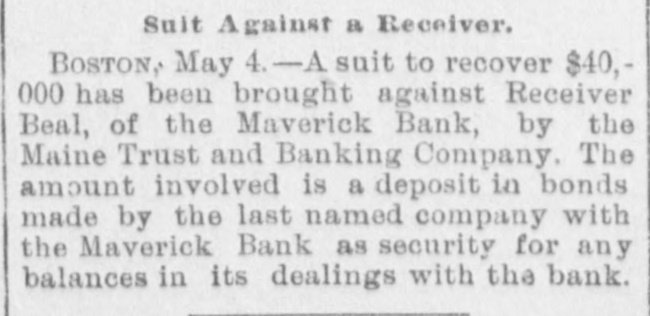
Suit Against a Receiver. BOSTON, May 4.-A suit to recover $40,000 has been brought against Receiver Beal, of the Maverick Bank, by the Maine Trust and Banking Company. The amount involved is a deposit in bonds made by the last named company with the Maverick Bank as security for any balances in its dealings with the bank.


Article from The Evening Herald, May 19, 1892

Click image to open full size in new tab

Article Text

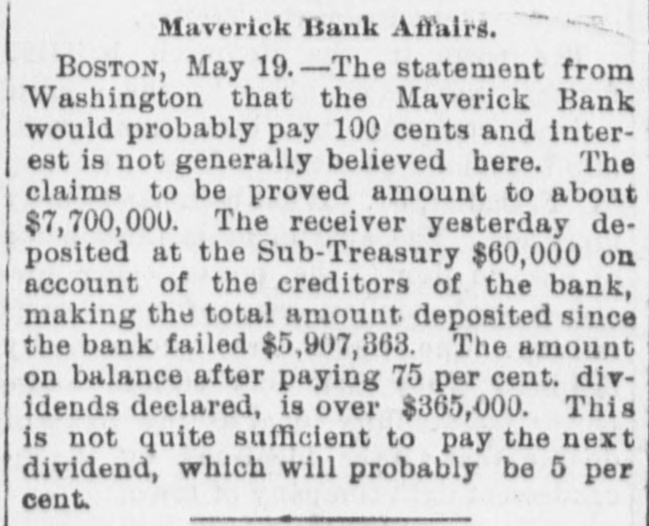
Maverick Bank Affairs. BOSTON, May 19. -The statement from Washington that the Maverick Bank would probably pay 100 cents and interest is not generally believed here. The claims to be proved amount to about $7,700,000. The receiver yesterday deposited at the Sub-Treasury $60,000 on account of the creditors of the bank, making the total amount deposited since the bank failed $5,907,363. The amount on balance after paying 75 per cent. dividends declared, is over $365,000. This is not quite sufficient to pay the next dividend, which will probably be 5 per cent.


Article from The Globe-Republican, August 5, 1892

Click image to open full size in new tab

Article Text

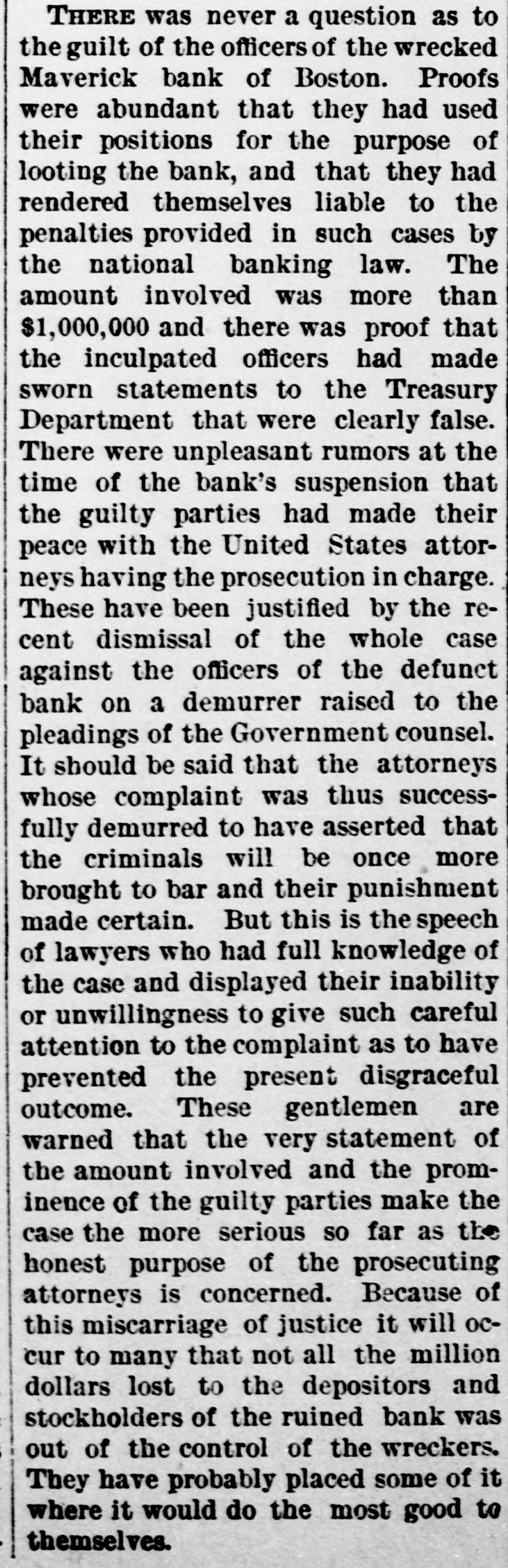
THERE was never a question as to the guilt of the officers of the wrecked Maverick bank of Boston. Proofs were abundant that they had used their positions for the purpose of looting the bank, and that they had rendered themselves liable to the penalties provided in such cases by the national banking law. The amount involved was more than $1,000,000 and there was proof that the inculpated officers had made sworn statements to the Treasury Department that were clearly false. There were unpleasant rumors at the time of the bank's suspension that the guilty parties had made their peace with the United States attorneys having the prosecution in charge. These have been justified by the recent dismissal of the whole case against the officers of the defunct bank on a demurrer raised to the pleadings of the Government counsel. It should be said that the attorneys whose complaint was thus successfully demurred to have asserted that the criminals will be once more brought to bar and their punishment made certain. But this is the speech of lawyers who had full knowledge of the case and displayed their inability or unwillingness to give such careful attention to the complaint as to have prevented the present disgraceful outcome. These gentlemen are warned that the very statement of the amount involved and the prominence of the guilty parties make the case the more serious so far as the honest purpose of the prosecuting attorneys is concerned. Because of this miscarriage of justice it will occur to many that not all the million dollars lost to the depositors and stockholders of the ruined bank was out of the control of the wreckers. They have probably placed some of it where it would do the most good to themselves.