Maverick National Bank (Boston, MA)

Episode Information

Episode UID
67701102
Episode Type
Run β†’ Suspension β†’ Closure
Bank Type
national
Bank ID
6770 national
Charter Number
677
Start Date
October 26, 1891
Location
Boston, Massachusetts (42.358, -71.060)

Metadata

Model
gemini-3-flash-preview (chosen from majority vote of a three-model LLM ensemble)
Short Digest
5e128a48f6c275c7

Response Measures

Full suspension, Books examined

Other: The Boston Clearing House Association voted to advance cash to the Maverick Bank's depositors (by taking assignments of their claims) to relieve their embarrassment after the bank was closed by the national examiner.

Clearinghouse involved: Yes (loan, examination, or other measures)

Receivership Details

Depositor recovery rate
90.2%
Date receivership started
1891-11-02
Date receivership terminated
1898-03-31
OCC cause of failure
Excessive lending
Share of assets assessed as good
43.0%
Share of assets assessed as doubtful
49.0%
Share of assets assessed as worthless
8.0%

Description

The bank experienced heavy withdrawals (a run) in the week preceding its suspension, which was ultimately triggered by the suicide of a major debtor and subsequent discovery of embezzlement by bank officers.

Events (6)

1. December 31, 1864 Chartered
Source
historical_nic
2. October 26, 1891 Run
Cause
Bank Specific Adverse Info
Cause Details
Rumors and talk following the suicide of broker Irving A. Evans, a major debtor to the bank.
Measures
The bank attempted to meet demands with its own resources until the pressure became too great.
Newspaper Excerpt
During the last week more than $1,700,000 was withdrawn. State Treasurer Marden withdrew some $90,000 of Commonwealth funds
Source
newspapers
3. November 2, 1891 Other
Newspaper Excerpt
President Asa Potter and Directors Jonas H. French and Thomas Dana, of the Maverick National Bank, were arrested tonight on a criminal charge.
Source
newspapers
4. November 2, 1891 Receivership
Source
historical_nic
5. November 2, 1891 Receivership
Newspaper Excerpt
Thomas P. Beal, president of the Second National Bank of this city, has been appointed receiver of the broken bank by the Controller of the Currency.
Source
newspapers
6. November 2, 1891 Suspension
Cause
Bank Specific Adverse Info
Cause Details
Insolvency and embezzlement by the president and directors, precipitated by the suicide of Irving Evans.
Newspaper Excerpt
The Maverick National Bank of Boston Has Suspended. ... The decision to close its doors was reached after a protracted conference of the clearing house committee
Source
newspapers

Newspaper Articles (23)

Article from The Portland Daily Press, November 2, 1891

Click image to open full size in new tab

Article Text

SUICIDE'S WORK. The Maverick National Bank of Boston Has Suspended. One Report Says Its Resources Are Nearly Wiped Out. A Result of the Suicide of Broker Irving A, Evans. BOSTON, November 1.-The Maverick Na. tional Bank will suspend payment tomorrow morning. The decision to close its doors was reached after a protracted conference of the clearing house committee of the Boston National banks at o'clock Sunday morning. It is stated positively that the failure will not entail any widespread financial evils. The official announcement of the suspension was made by the :clearing house committee this evening in the call for a meeting of the clearing house tomorrow morn ing to take action upon the proposition recommended by the committee that all banks composing the association junite. in making advances in cash to depositors in the Maverick Bank. The call states the object in makthese advances is to relieve the temporaing and that ry embarrassment of the depositors the bank is closed by the national examiner, acting under the instructions of the comptroller of the currency. The immediate cause of the bank's suspension was the suicide of Irving Evans and the talk which followed it. The loss caused the bank by its dealings with Evans was not large enough to seriously injure it, being not more than $200,000. But the talk of the street made the bank's loss far greater. The stories included ugly ones about Asa P. Potter, president of the bank and his relations with Evans. The facts in the matter are in no sense discreditable to Mr. Potter. More than a month ago, some of the principal depositors withdrew their accounts from the bank. The deposits in the bank ten days ago amounted to more than $10,000,000. During the last week more than $1,700,000 was withdrawn. State Treasurer Marden withdrew some $90,000 of Commonwealth funds which were on deposit there. Other trust moneys were also taken out. The situation was fully realized by Mr. Potter and his associates. They met it manfully, with all the resources at their command, but the pressure became too great. A Press representative talked with Mr. Potter today about the failure, but he would say very little. He said that he had no idea the bank would close until one o'clock this morning. He stated that no other institution would be in any way imperilled by the suspension. He admitted that he make a alconfident of his own should though personal assignment, solvency. Later in the day he decided to make Thomas N. Hart and Henry D. Hyde his assignees. Col. Jas. H. French, a director and Mr. Potter's associate in the management of the bank, will also make an assignment tomorrow. It is believed also that his affairs will prove to be sound. His assignees are not yet named. Col. French was seen this morning but would not say that the bank was solvent. It is stated that Bank Examiner John W. Magruder, who has been investigating the affairs of the bank, reported to the authorities at Washington last January that the bank was insolvent, By the last statement of the bank, September 3, it was shown that the assets included a capital of $400,000, surplus of $800,000, undivided profits of little more than $200,000. It is claimed that the clearing house committee ha thrown out all the assets considered worthless and reduced 20 per cent. from the rest of the securities and now declares the capital, surplus and undivided profits wiped our, and that Is left will what This fall-short of meeting dollar. the depositors liabilities. may expect 75 cents on the examiner Magruder Dead. BOSTON, November 1--John W. Magruder, United States bank examiner, died here today.

Article from New-York Tribune, November 2, 1891

Click image to open full size in new tab

Article Text

A THE GOES BOSTON BANK FAILS. UNDER. MAVERICK NATIONAL ITS BY THE RUMORS COLLAPSE PRECIPITATED OF THE EVANS. IRVING SUICIDE FOLLOWING (BY TELEGRAPH Bank National Maverick be not will Boston, Nov. has failed, -The and its Asa doors Potter inevitable has been and of Boston to-morrow. President to avert the over by friends load his difficulties as possible, and Saturday struggling opened for have weeks been bridged but the evening Mr. the Potter notified the could they end career, as became banks long too in the heavy, no association longer carry him, and and conwould servative or go later as that came bank has had a predicted showy that it kept crash. it This men long ago down financier with in able less under sooner Mr. Potter's it would ability have says gone that the the immediate suicide it. of afloat hands. when the The bank's Journal suspension the talk which was dealings followed with to ago cause of Evans and the bank enough by its seriously days injure Irving The loss caused not large said a few not lose more more Evans it. was The Journal of Mr. Evans true. would and it 'amount is also Bank. creater that the than creditors $500,000 than That $200.00 is But of that the talk The of true that not the Maverick bank's loss ugliest far description dead falls upon made the of the with the false Most are the street included ramers his relations entirely of present stories about Mr. Potter of these and stories in were the nossession Situation said Journal, their are in The not justify that they The broker The facts in the and matter while publication. the it can no be sense inevi ago month does unequivocally to Mr. Potter more than withdrew a their days of the deposits discreditable to be felt depositors bank ten Dureffect began principal in withSome The more than was some drawn. of the $90,000 accounts. amounted to more than Marden withdrew which on trust there. Other deposit ago ing last State week Treasurer funds money's were Yes, this afternoon toits doors that true But 1 clock except were also President taken out. Potter the bank said will 1 had not no open idea this that morning that morrow is be morning the case to until be said any now way That imperilled I know, would There is nothing will be Maverick in and you an Mr. Potter He other institution suspension of the it too strongly should make however personally Later solvent. by the cannot said put that he was confident, in the and N. Hart H. Jonas signment he was perfectly to make Thomas lonel as make associate sociate an that decided his and assigned Mr. Potter will yed also also that nees day he D. Hyde director, the ban is belie His assig Henry French, ement morrow of It be sound. number assistaria been alwayooks and the vilment will prove named to had and large the of bank this One deal ha his not Maxpositors everick vet HAS OD meet its the of dennering $400, there to-night that of build small The be unable will be to great that he Bank had is only the bank the in of hotel class clerk there capital said of the no May doubt businesstitution on a The There the is largest any reported similar disappe in has Health course, bank Mr. 000. done capital year of ago, it has now Potte held French owns precolonel country That, of the president Jonas These of two the nearly between years abotion The stock nds shares, Its and 900 shares lete control individualize very few 1.400 800 and held comp about 1,2 00 about keep to holds between for There are addition titutions years men. tution. have and in country four 0.000,000 instititors, mostly the callast from $10 deposit banks, there have Tranged toward $13, Journal of Balix taik eiven In Potter and following the man the The deposits 000.000. stration Mayle port saye instile nciers attitude hat borne the finance one been genti questing 111s the finan to that ing balls. the Mr. marters, most the course, puthout to the Evaus Goston's was, and ans death in the circles Thinking that deem don was Last Septem bank of even current from White of worse state that Mr result Lacey last the the the and work, their no took Lacey the the the is past finding National Maverics of the and than her's Mr. was Master Bank, them. 14 the of the French wars man No. the of doll upon guide as look Potterna righttions might to enter if these Mr. Potter reservery up to the potter tell the and top and banks Potter other for but aid, him they deat far, ears. thank the the that vasilors can Depand borrow the as is what that here is what Bank. must thing in there Monender stand imment the had The They the but were New that Had them betting would them it. with the not of John this traver Magnet the Bank for been in had ing and heart whichailure, him dering Mr. Magru Bankile was and died. land. Marsetown Depart Georbury time was a the of Treason from Magrue In was his life early der old, was kship in and was ago districular one years Eight years of this in the Army He ment time revenue printed he bank was a


Article from Evening Star, November 2, 1891

Click image to open full size in new tab

Article Text

THE BOSTON FAILURE Expelling the Maverick Bank From the Clearing*House. MORE TENNESSEE CONVICTS FREED. Quiet Has Been Restored to Briceville. RUSSIA'S GRAIN PROHIBITION. BOSTON'S BIG FAILURE Expulsion of the Maverick Bank by the Clearing House. BOSTON, Nov. 2-At a meeting of the Boston national banks at the clearing house this morning the following resolutions were unanimously adopted: "Vated-That it is the judgment of the clear ing house that all of the banks constituting the association should at once combine to relieve the necessities of the depositors of the Maver ick National Bank by making the written agree ment among themselves to advance money to such depositors upon the security of the assignment of their claims against said Maverick No. tional Bank. "Voted- That a committee of ten representatives of banks be appointed by the chair, who shall have full power to execute the fore going vote, to arrange. on behalf of the association, all terms and debts in the premises and to call upon the banks of the association for such sums of money as may be necessary. provided that the banks shall contribute in the proportion of their average loans as reported to the clearing house for the month of April, 1891." Every bank was represented at the clearing house this morning when the resolutions concerning the Maverick Bank were unanimously adopted The clearing house committee, consisting of Merats. '11 os. H. Beal, Franklin Haven, jr., A L Newman, Phineas Pierce and Moses Williams and the following named: 8. N. Aldrich, L T. Burr, John Carr. J. B. Case, C. A. Vialie and Geo. Ripley were appointed . committee to carry the resolutions into effect. It was voted that the Maverick National Bank be expelled from the association. The formal papers will be drafted and sent out for bank signatures immediately. The decision of the Maverick national bank today to close its doors reached after a protracted conference of the clearing house committee of Boston national banks yesterday morning It is stated positively that the failure will not entail any widespread financial loss. The immediate cause of the bank's suspension was the suicide of Irving Evans. The loss caused the bank by its dealings with Evane was not large enough to seriously injure it, being not more than €200,000, but the talk of the street made the bank's loss far more. By the last sworn statement of the bank is sued September 30 last, it was shown that the assets of the bank included the capital of €400,000, the surplus of $800,000 and undivided profits of a little more than e200,000. it is claimed that the clearing house committee threw out all assets which they considered worthless and deducted 20 per cent from the other securities and declared the capital. surplus and undivided profits wΓ¨re wiped out and that what was left will fall short of meeting the liabilities. This would indicate that the creditors might expect a dividend of 75 cents on the dollar. The bank will be put in the hands of a receiver. It is claimed that in good hands the depositors will receive dollar for dollar. The appointment of a receiver will come from Washington. President Cotter has made an assignment of his individual estate to Postmaster Thomas N. Hart and Henry D. Hyde.


Article from Deseret Evening News, November 2, 1891

Click image to open full size in new tab

Article Text

The Maveriek National Bank Nuspends Payment. BOSTON, Nov. The Maverick National bank will suspend payment tomorrow morning. The decision to close the doors was reached after a protracted conference of the clearing house committee of the Boston National banks Sunday morning. It is stated positively that the failure will not entall any widespread financial ovils. The official announcement of the suspension was made by the clearing house committee this evening in " call for a meeting of the clearing nouse tomorrow morning, to take action upon the proposition recommended by the committee that all banks composing the association unite in making advances in cash to the depositors in the Maverick bank. The call states that the object of making these advances is to relieve the temporary embarrassment of the depository, and that the bank is closed by the national bank examiner, acting under instructions of the comptroller of the currency. The immediate cause of the suspension was the suicide of Irving Evans and the talk which followed it. The loss caused the bank by its dealIngs with Evans was not large enough to seriously injure It, being not more than $200,000, but the title of the street made the loss far greater. The facts in the matter are in no sense discreditable to Mr. Potter. The deposits in the bank ten days ago amounted to more than $10,000,000. During the last week more than $1,700,000 was withdrawn. Friend's of the bank's management assert that it will pay the depositors dollar for dollar. A. receiver will be appointed.


Article from Los Angeles Herald, November 2, 1891

Click image to open full size in new tab

Article Text

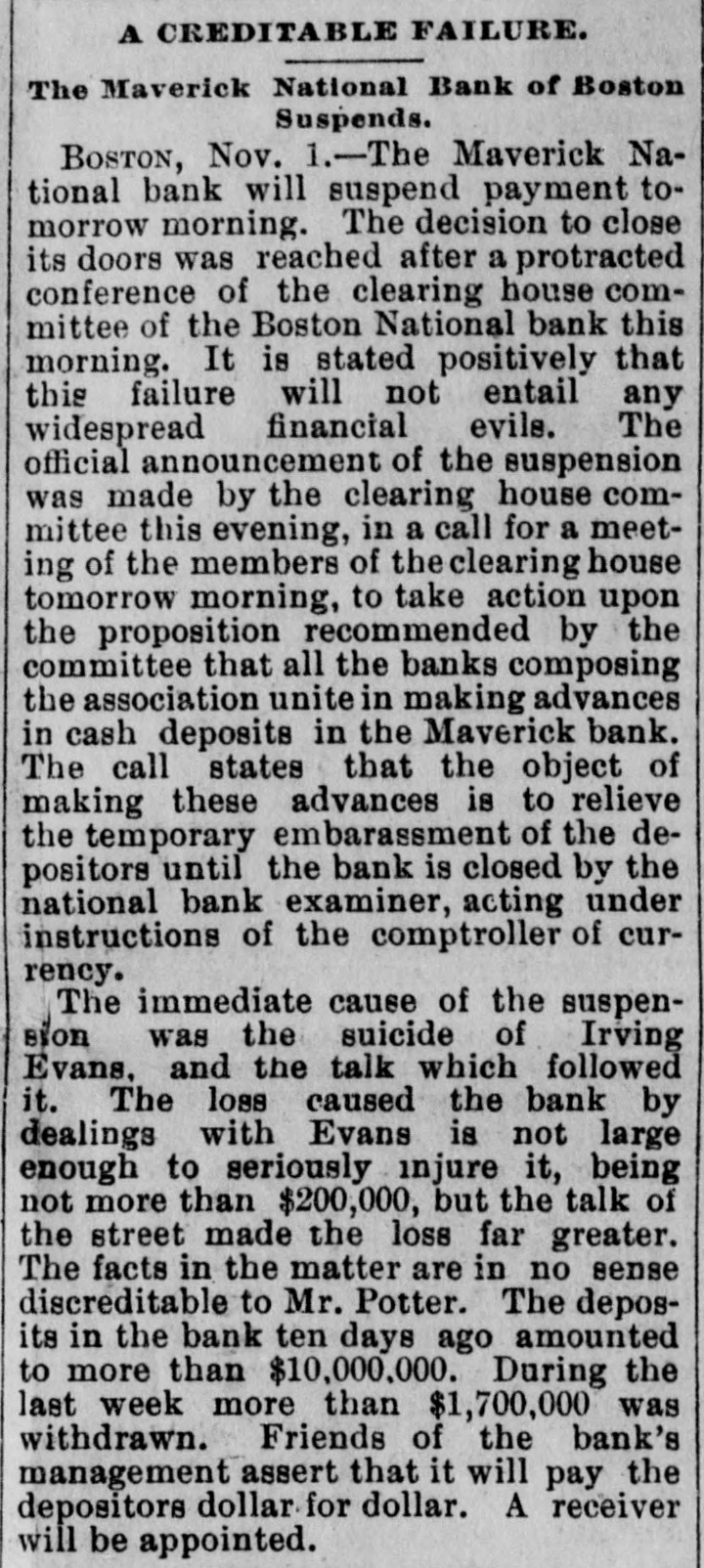
A CREDITABLE FAILURE. The Maverick National Bank of Boston Suspends. BOSTON, Nov. 1.-The Maverick National bank will suspend payment tomorrow morning. The decision to close its doors was reached after a protracted conference of the clearing house committee of the Boston National bank this morning. It is stated positively that this failure will not entail any widespread financial evils. The official announcement of the suspension was made by the clearing house committee this evening, in a call for a meeting of the members of the clearing house tomorrow morning, to take action upon the proposition recommended by the committee that all the banks composing the association unite in making advances in cash deposits in the Maverick bank. The call states that the object of making these advances is to relieve the temporary embarassment of the depositors until the bank is closed by the national bank examiner, acting under instructions of the comptroller of currency. The immediate cause of the suspension was the suicide of Irving Evans, and the talk which followed it. The loss caused the bank by dealings with Evans is not large enough to seriously injure it, being not more than $200,000, but the talk of the street made the loss far greater. The facts in the matter are in no sense discreditable to Mr. Potter. The deposits in the bank ten days ago amounted to more than $10,000,000. During the last week more than $1,700,000 was withdrawn. Friends of the bank's management assert that it will pay the depositors dollar.for dollar. A receiver will be appointed.


Article from New-York Tribune, November 3, 1891

Click image to open full size in new tab

Article Text

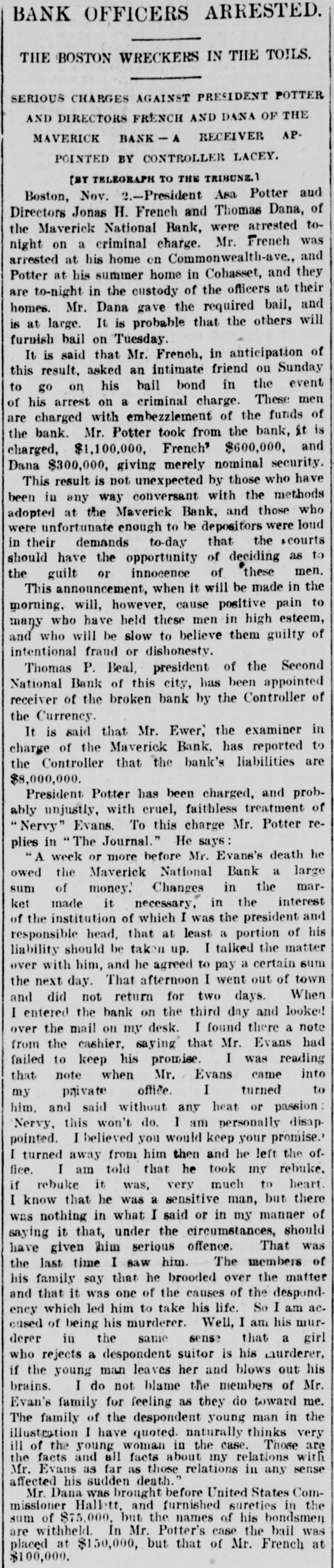
ARRESTED. BANK OFFICERS THE BOSTON WRECKERS IN THE TOILS. SERIOUS CHARGES AGAINST PRESIDENT POTTER AND DIRECTORS FRENCH AND DANA OF THE MAVERICK BANK - A RECEIVER APPOINTED BY CONTROLLER LACEY. (BY TELEGRAPH TO THE TRIBUNE.1 Boston, Nov. 2.-President Asa Potter and Directors Jonas H. French and Thomas Dana, of the Maverick National Bank, were arrested tonight on a criminal charge. Mr. French was arrested at his home on Commonwealth-ave., and Potter at his summer home in Cohasset, and they are to-night in the custody of the officers at their homes. Mr. Dana gave the required bail, and is at large. It is probable that the others will furnish bail on Tuesday. It is said that Mr. French, in anticipation of this result. asked an intimate friend on Sunday to go on his bail bond in the event of his arrest on a criminal charge. These men are charged with embezzlement of the funds of the bank. Mr. Potter took from the bank, it is charged, $1,100,000. French $600,000, and Dana $300,000, giving merely nominal security. This result is not unexpected by those who have been in any way conversant with the methods adopted at the Maverick Bank, and those who were unfortunate enough to be depositors were loud in their demands to-day that the &courts should have the opportunity of deciding as to the guilt or innocence of these men. This announcement, when it will be made in the morning. will, however, cause positive pain to many who have held these men in high esteem, and who will be slow to believe them guilty of intentional fraud or dishonesty. Thomas P. Beal, president of the Second National Bank of this city, has been appointed receiver of the broken bank by the Controller of the Currency. It is said that Mr. Ewer, the examiner in charge of the Maverick Bank, has reported to the Controller that the bank's liabilities are $8,000,000. President Potter has been charged, and probably unjustly, with cruel, faithless treatment of "Nervy" Evans. To this charge Mr. Potter replies in "The Journal." He says: A week or more before Mr. Evans's death he owed the Maverick National Bank a large sum of money." Changes in the market made it necessary, in the interest of the institution of which I was the president and responsible head, that at least a portion of his liability should be taken up. I talked the matter over with him, and he agreed to pay a certain sum the next day. That afternoon I went out of town and did not return for two days. When I entered the bank on the third day and looked over the mail on my desk. I found there a note from the cashier, saying that Mr. Evans had failed to keep his promise. I was reading that note when Mr. Evans came into my private office. I turned to him, and said without any heat or passion Nervy, this won't do. 1 am personally disap. pointed. I believed you would keep your promise. I turned away from him then and he left the office. I am told that he took my rebuke. if rebuke it was, very much to heart. I know that he was a sensitive man, but there was nothing in what I said or in my manner of saying it that, under the circumstances, should have given him serious offence. That was the last time I saw him. The members of his family say that he brooded over the matter and that it was one of the causes of the despondency which led him to take his life. So I am ac. cused of being his murderer. Well, I am his murderer in the same sense that a girl who rejects a despondent suitor is his Laurderer, if the young man leaves her and blows out his brains. I do not blame the members of Mr. Evan's family for feeling as they do toward me. The family of the despondent young man in the illustration I have quoted. naturally thinks very ill of the young woman in the case. Those are the facts and all facts about my relations with Mr. Evans as far as those relations in any sense affected his sudden death. Mr. Dana was brought before United States Commissioner Hallett. and furnished sureties in the sum of $75,000. but the names of his bondsmen are withheld. In Mr. Potter's case the bail was placed at $150,000, but that of Mr. French at $100,000.


Article from Evening Star, November 4, 1891

Click image to open full size in new tab

Article Text

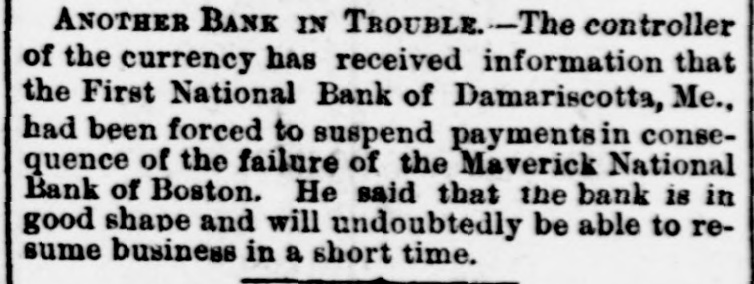
ANOTHER BANK IN TROUBLE. - The controller of the currency has received information that the First National Bank of Damariscotta, Me., had been forced to suspend payments in consequence of the failure of the Maverick National Bank of Boston. He said that the bank is in good shape and will undoubtedly be able to resume business in a short time.


Article from The Wheeling Daily Intelligencer, November 4, 1891

Click image to open full size in new tab

Article Text

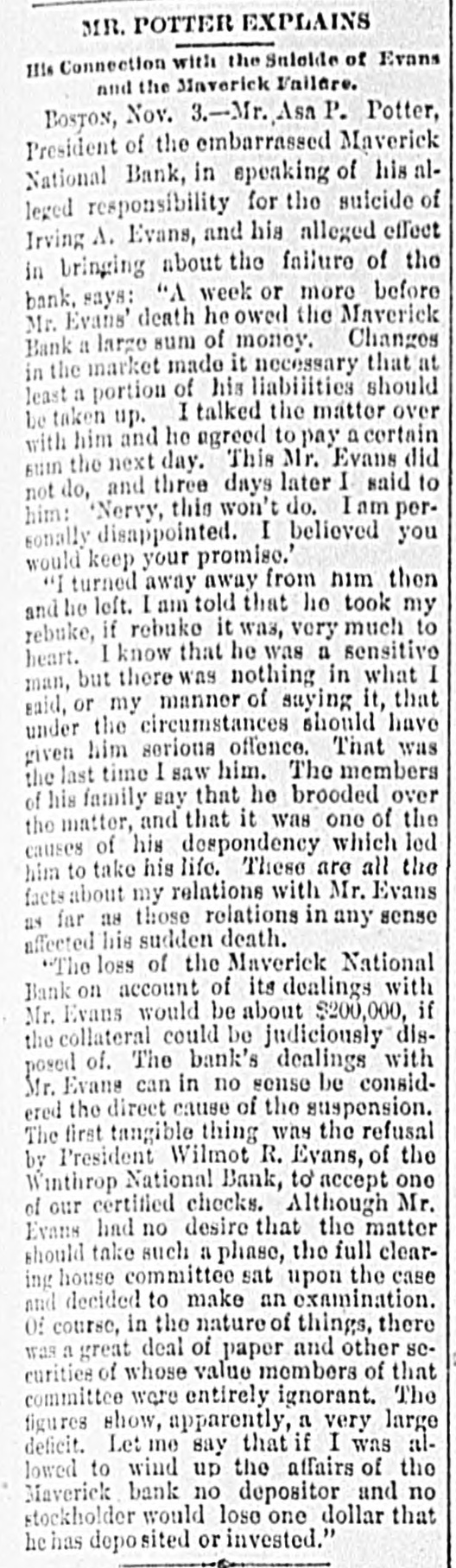
MR. POTTER EXPLAINS His Connection with the Suicide of Evans and the Maverick Failure. BOSTON, Nov. 3.-Mr. Asa P. Potter, President of the embarrassed Maverick National Bank, in speaking of his alleged responsibility for the suicide of Irving A. Evans, and his alleged effect in bringing about the failure of the bank. says: "A week or more before Mr. Evans' death he owed the Maverick Bank a large sum of money. Changes in the market made it necessary that at least a portion of his liabilities should be taken up. I talked the matter over with him and he agreed to pay a certain sum the next day. This Mr. Evans did not do, and three days later I said to him: 'Nervy, this won't do. I am personally disappointed. I believed you would keep your promise.' "I turned away away from him then and he left. I am told that he took my rebuke, if rebuke it was, very much to heart. I know that he was a sensitive man, but there was nothing in what I said, or my manner of saying it, that under the circumstances should have given him serious offence. That was the last time I saw him. The members of his family say that he brooded over the matter, and that it was one of the causes of his despondency which led him to take his life. These are all the facts about my relations with Mr. Evans as far as those relations in any sense affected his sudden death. "The loss of the Maverick National Bank on account of its dealings with Mr. Evans would be about $200,000, if the collateral could be judiciously disposed of. The bank's dealings with Mr. Evans can in no sense be considered the direct cause of the suspension. The first tangible thing was the refusal by President Wilmot R. Evans, of the Winthrop National Bank, to accept one of our certified checks. Although Mr. Evans had no desire that the matter should take such a phase, the full clearing house committee sat upon the case and decided to make an examination. Of course, in the nature of things, there was a great deal of paper and other securities of whose value members of that committee were entirely ignorant. The figures show, apparently, a very large deficit. Let me say that if I was allowed to wind up the affairs of the Maverick bank no depositor and no stockholder would lose one dollar that he has deposited or invested."


Article from Grant County Herald, November 5, 1891

Click image to open full size in new tab

Article Text

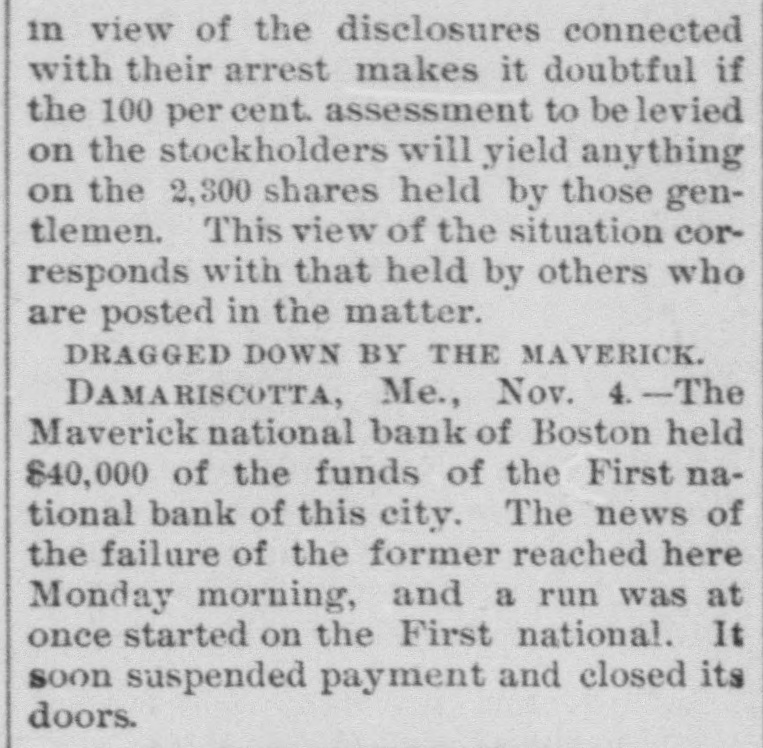
in view of the disclosures connected with their arrest makes it doubtful if the 100 per cent. assessment to be levied on the stockholders will yield anything on the 2,300 shares held by those gentlemen. This view of the situation corresponds with that held by others who are posted in the matter. DRAGGED DOWN BY THE MAVERICK. Damariscotta, Me., Nov. 4. -The Maverick national bank of Boston held $40,000 of the funds of the First national bank of this city. The news of the failure of the former reached here Monday morning, and a run was at once started on the First national. It soon suspended payment and closed its doors.


Article from Wheeling Register, November 5, 1891

Click image to open full size in new tab

Article Text

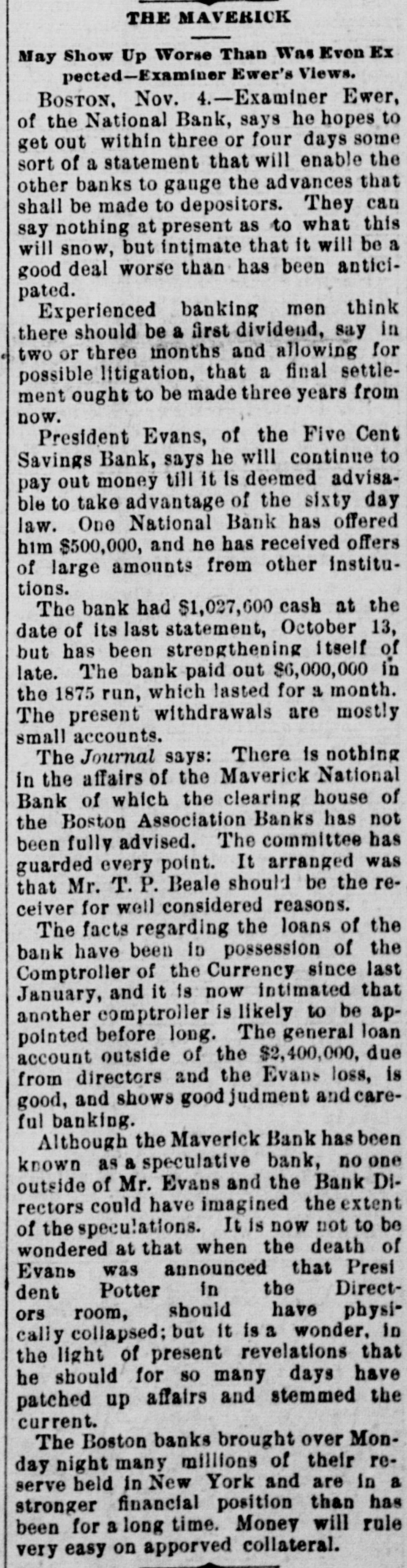
THE MAVERICK May Show Up Worse Than Was Even Ex pected-Examiner Ewer's Views. BOSTON. Nov. 4.-Examiner Ewer, of the National Bank, says he hopes to get out within three or four days some sort of a statement that will enable the other banks to gauge the advances that shall be made to depositors. They can say nothing at present as to what this will snow, but intimate that it will be a good deal worse than has been anticipated. Experienced banking men think there should be a first dividend, say in two or three months and allowing for possible litigation, that a final settlement ought to be made three years from now. President Evans, of the Five Cent Savings Bank, says he will continue to pay out money till it is deemed advisable to take advantage of the sixty day law. One National Bank has offered him $500,000, and he has received offers of large amounts from other institutions. The bank had $1,027,600 cash at the date of its last statement, October 13, but has been strengthening itself of late. The bank paid out $6,000,000 in the 1875 run, which lasted for a month. The present withdrawals are mostly small accounts. The Journal says: There is nothing in the affairs of the Maverick National Bank of which the clearing house of the Boston Association Banks has not been fully advised. The committee has guarded every point. It arranged was that Mr. T. P. Beale should be the receiver for well considered reasons. The facts regarding the loans of the bank have been in possession of the Comptroller of the Currency since last and it is now intimated that is apJanuary, another comptroller likely to be pointed before long. The general loan account outside of the $2,400,000, due from directors and the Evans loss, is good, and shows good judment and careful banking. Although the Maverick Bank has been known as a speculative bank, no one outside of Mr. Evans and the Bank Directors could have imagined the extent of the speculations. It is now not to be wondered at that when the death of Evans was announced that Presi dent Potter in the Directors room, should have physically collapsed; but it is a wonder. in the light of present revelations that he should for so many days have patched up affairs and stemmed the current. The Boston banks brought over Monday night many millions of their reserve held in New York and are in a stronger financial position than has been for a long time. Money will rule very easy on apporved collateral.


Article from The Austin Weekly Statesman, November 5, 1891

Click image to open full size in new tab

Article Text

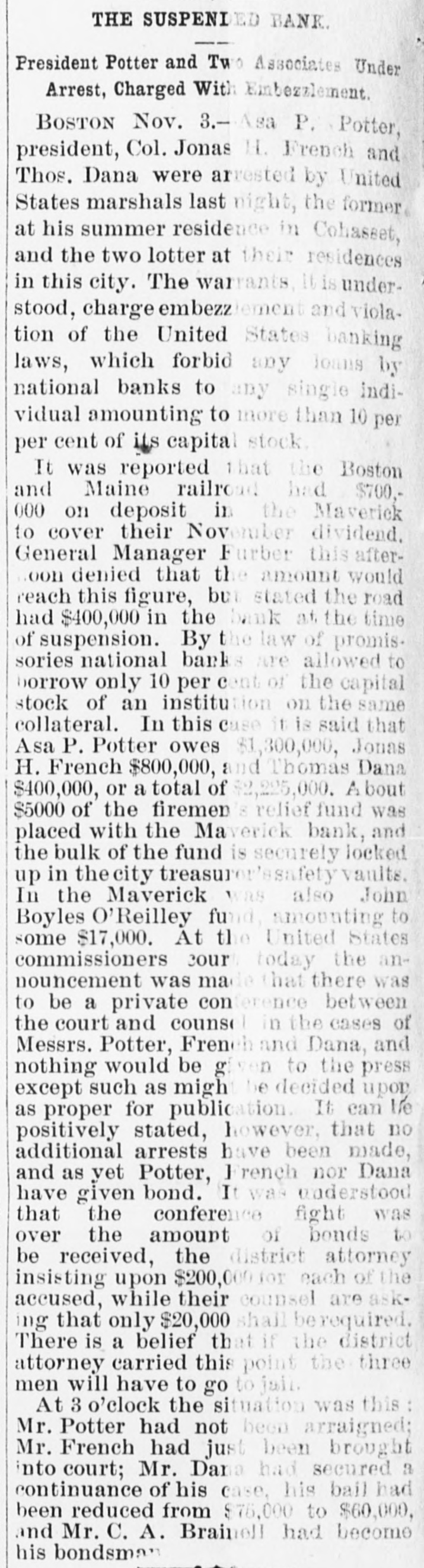
THE SUSPENDED BANK. President Potter and Two Associates Under Arrest, Charged With Embezzlement. BOSTON Nov. 3.- Asa P. Potter, president, Col. Jonas H. French and Thos. Dana were arrested by United States marshals last night, the former at his summer residence in Cohasset, and the two lotter at their residences in this city. The warrants, 11 is understood, charge embezz and violation of the United States banking laws, which forbid any loans by national banks to any single individual amounting to more than 10 per per cent of its capital stock. It was reported that the Boston and Maine railroad had $700,000 on deposit in the Maverick to cover their November dividend. General Manager Furber this after.oon denied that the amount would reach this figure, but stated the road had $400,000 in the bank at the time of suspension. By the law of promissories national banks are allowed to borrow only 10 per cent of the capital stock of an institution on the same collateral. In this case it is said that Asa P. Potter owes $1,300,000, Jonas H. French $800,000, and Thomas Dana $400,000, or a total of $2,225,000. About $5000 of the firemen relief fund was placed with the Maverick bank, and the bulk of the fund is securely locked up in thecity treasurer'ssafety: vaults. In the Maverick was also John Boyles O'Reilley fund, amounting to some $17,000. At the United States commissioners cour today the announcement was made that there was to be a private conference between the court and counse I in the cases of Messrs. Potter, Frenchand Dana, and nothing would be given to the press except such as might be decided upon as proper for publication. It can We positively stated, however, that no additional arrests have been made, and as yet Potter, French nor Dana have given bond. It was understood that the conference fight was over the amount of bonds to be received, the district attorney insisting upon $200,000 for each of the accused, while their counsel are asking that only $20,000 shall berequired. There is a belief that if the district attorney carried this point the three men will have to go to juli. At 3 o'clock the situation was this : Mr. Potter had not been arraigned; Mr. French had just been brought into court; Mr. Dana had secured a continuance of his case, his bail had been reduced from $75,000 to $60,000, and Mr. C. A. Brainell had become his bondsman


Article from New-York Tribune, November 6, 1891

Click image to open full size in new tab

Article Text

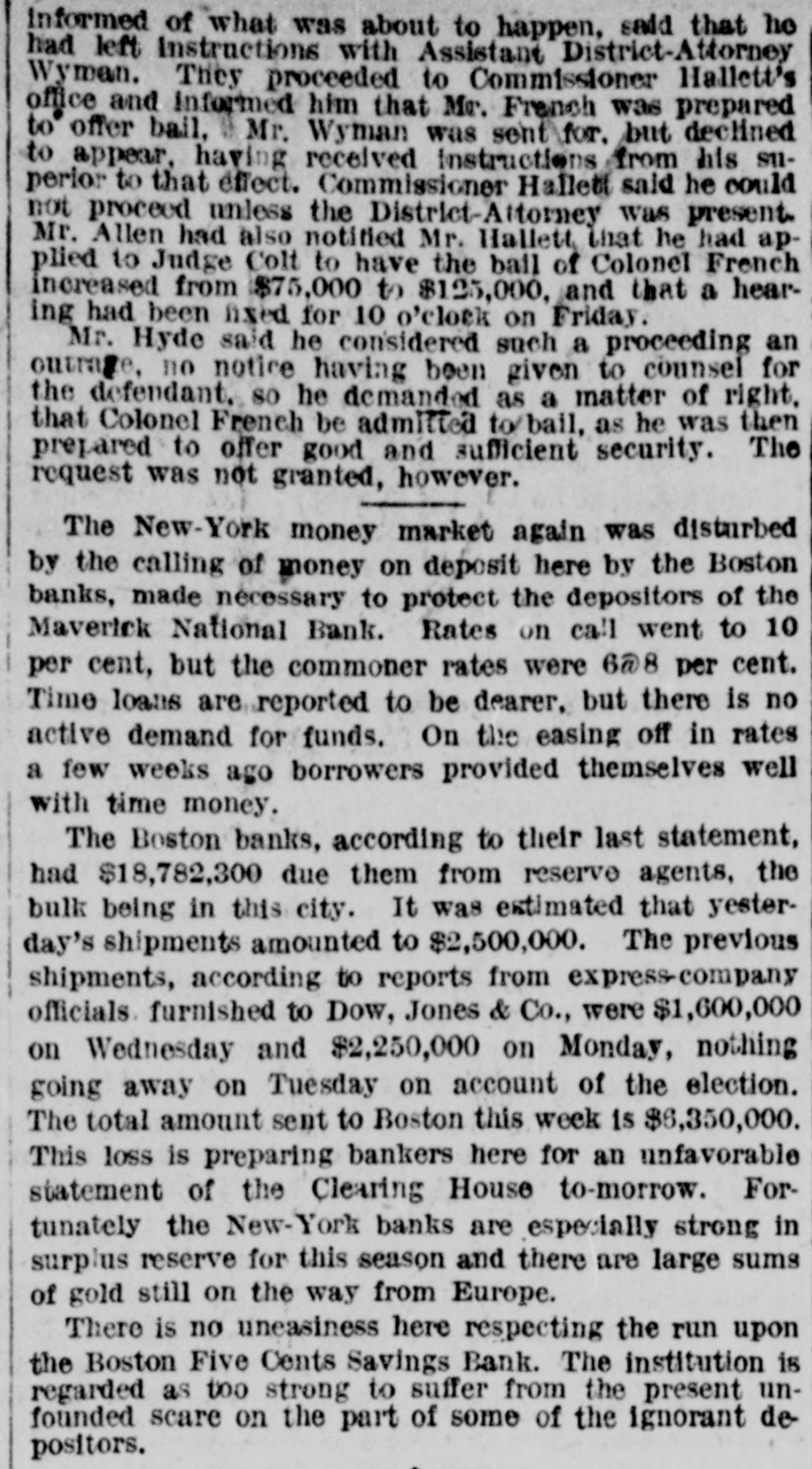
informed of what was about to happen, said that he had left Instructions with Assistant District-Attorney Wyman. They proceeded to Commissioner Hallett's office and informed him that Mr. French was prepared to offer bail, Mr. Wyman was sent for. but declined to appear. having received instructions from his superior to that effect. Commissioner Hallett said he could not proceed unless the District-Attorney was present. Mr. Allen had also notified Mr. Hallett that he had applied to Judge Colt to have the bail of Colonel French increased from $75,000 to $125,000, and that a hearing had been fixed for 10 o'clock on Friday. Mr. Hyde said he considered such a proceeding an outrage, no notice having been given to counsel for the defendant, so he demanded as a matter of right, that Colonel French be admitted to/ bail, as he was then prepared to offer good and sufficient security. The request was not granted, however. The New-York money market again was disturbed by the calling of money on deposit here by the Boston banks, made necessary to protect the depositors of the Maverick National Bank. Rates on call went to 10 per cent, but the commoner rates were 6@8 per cent. Time loans are reported to be dearer, but there is no active demand for funds. On the easing off in rates a few weeks ago borrowers provided themselves well with time money. The Boston banks, according to their last statement, had $18,782,300 due them from reserve agents, the bulk being in this city. It was estimated that yesterday's shipments amounted to $2,500,000. The previous shipments, according to reports from express-company officials. furnished to Dow, Jones & Co., were $1,600,000 on Wednesday and $2,250,000 on Monday, nothing going away on Tuesday on account of the election. The total amount sent to Boston this week is $6,350,000. This loss is preparing bankers here for an unfavorable statement of the Clearing House to-morrow. Fortunately the New-York banks are especially strong in surplus reserve for this season and there are large sums of gold still on the way from Europe. There is no uneasiness here respecting the run upon the Boston Five Cents Savings Bank. The institution is regarded as too strong to suffer from the present unfounded scare on the part of some of the ignorant depositors.


Article from The Forrest City Times, November 6, 1891

Click image to open full size in new tab

Article Text

GENERAL DOMESTIC. In the State elections Tuesday, November 3, the Democrats carried New York by a plurality estimated at 25,000. Ohio went Republican, McKinley's plurality being over 15,000, and the Legislature Republican. Iowa and Massachusetts are Democratic, Boies. and Russell being reelected. Pennsylvania gave a good Republican majority. Maryland is Democratic by 25,000, and Nebraska probably Republican by a small margin. Naturalga been struck near Monticello, III. Murderer Thomas A. Williamson was hanged at Sedalia, Mo. The first blizzard of the season is reported in North and South Dakota and Minnesota. Lee Hunn, president of the Fan-TanTong, the Chinese Gambling Association of New York is dead. Contractors on World's Fair buildings have been ordered to double their forces in order to expedite matters. Marshal Wise of Toledo, Tex., and a friend named Garcia were murdered by a smuggler they were trying to arrest. Pilot Thomas Welch of New York was convicted of manslaughter in causing the death of two people by running down ayacht. The Strowger Automatic Telephone Exchange Company has been incorporated in Illinois. The object is to do away with the need for operators at a central exchange. Senator Quay has telegraphed Comptroller Lacy asking by whose authority or permission the Bardsley certificate of deposit was delivered to the Democratic State Committee, it being one of the documents in the Keystone Bank, which is in the custody of the United States. Evansville's embezzler, John J. Morton, is in jail unable to get bail. Ex Mayor Carter Harrison now owns and conducts the Chicago Times. Charles Blish of Peekskill, N. Y., was shot and killed by H. Betts of Brooklyn. A new poem by Sir Edwin Arnold was read by him before the Lotus Club, New York. At Green Point, N. Y., Mrs. Francis Kiernan was fatally stabbed by her husband with a fork. Thomas Wilkins of Graves County, Kentucky, is a fugitive charged with arson and other crimes. During a recess in a trial at Boerne, Tex., Frank Bishop, one of the jurors, hanged himself. New York school children of foreign birth are being taught to salute the American flag and also the way to vote. A mob of 200 released 200 convicts at Oliver Springs, Tenn. Five hundred convicts are now roaming throughout that part of the State. President Harrison has granted a ninety-day respite to Charles Benson, who was to have been hanged at Leavenworth, Kas., upon Thursday. President Potter and Director French of the defunct Maverick National Bank of Boston were arrested, charged with embezzlement. It is alleged that Potter French, together with Director Dana, who is still at large, owe the bank $2,100,000. The bank has been considered shaky for years. Other banks of Boston have come to the relief of the depositors. The Texas State Fair closed after a very successful seaso , lasting sixteen days. Seventeen of the nineteen flint glass mould factories will be closed down, the remaining two doing all the work required. John J. Morton has embezzled $10,000 from two Evansville building associations. The reported earthquake in Texas County, Missouri seems to have been the genuine article. Several men claiming to represent the Chicago Purchasing Company are swindling farmers in Rice County, Minnesota. The World's Fair delegation were hos pitably entertained at Austin, Tex., but found little enthusiasm for the big show Robbers woke up Cashier Freeze of the State Bank at Homer, Neb., and compelled him to open the safe, from which itsy took $1,600.


Article from Pawtucket Tribune, November 10, 1891

Click image to open full size in new tab

Article Text

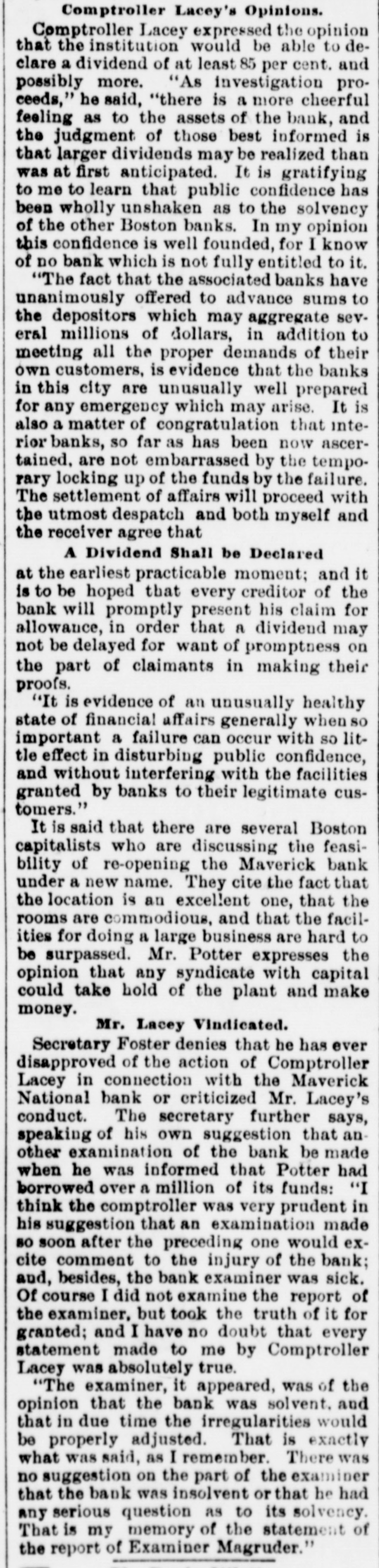
Comptroller Lacey's Opinions. Comptroller Lacey expressed the opinion that the institution would be able to declare a dividend of at least 85 per cent. and possibly more. "As investigation proceeds," he said, "there is a more cheerful feeling as to the assets of the bank, and the judgment of those best informed is that larger dividends may be realized than was at first anticipated. It is gratifying to me to learn that public confidence has been wholly unshaken as to the solvency of the other Boston banks. In my opinion this confidence is well founded, for I know of no bank which is not fully entitled to it. "The fact that the associated banks have unanimously offered to advance sums to the depositors which may aggregate several millions of dollars, in addition to meeting all the proper demands of their own customers, is evidence that the banks in this city are unusually well prepared for any emergency which may arise. It is also a matter of congratulation that interior banks, so far as has been now ascertained, are not embarrassed by the temporary locking up of the funds by the failure. The settlement of affairs will proceed with the utmost despatch and both myself and the receiver agree that A Dividend Shall be Declared at the earliest practicable moment; and it is to be hoped that every creditor of the bank will promptly present his claim for allowance, in order that a dividend may not be delayed for want of promptness on the part of claimants in making their proofs. "It is evidence of an unusually healthy state of financial affairs generally when so important a failure can occur with so little effect in disturbing public confidence, and without interfering with the facilities granted by banks to their legitimate customers." It is said that there are several Boston capitalists who are discussing the feasibility of re-opening the Maverick bank under a new name. They cite the fact that the location is an excellent one, that the rooms are commodious, and that the facilities for doing a large business are hard to be surpassed. Mr. Potter expresses the opinion that any syndicate with capital could take hold of the plant and make money. Mr. Lacey Vindicated. Secretary Foster denies that he has ever disapproved of the action of Comptroller Lacey in connection with the Maverick National bank or criticized Mr. Lacey's conduct. The secretary further says, speaking of his own suggestion that another examination of the bank be made when he was informed that Potter had borrowed over a million of its funds: "I think the comptroller was very prudent in his suggestion that an examination made so soon after the preceding one would excite comment to the injury of the bank; and, besides, the bank examiner was sick. Of course I did not examine the report of the examiner, but took the truth of it for granted; and I have no doubt that every statement made to me by Comptroller Lacey was absolutely true. "The examiner, it appeared, was of the opinion that the bank was solvent. and that in due time the irregularities would be properly adjusted. That is exactly what was said, as I remember. There was no suggestion on the part of the examiner that the bank was insolvent or that he had any serious question as to its solvency. That is my memory of the statement of the report of Examiner Magruder."


Article from New-York Tribune, November 10, 1891

Click image to open full size in new tab

Article Text

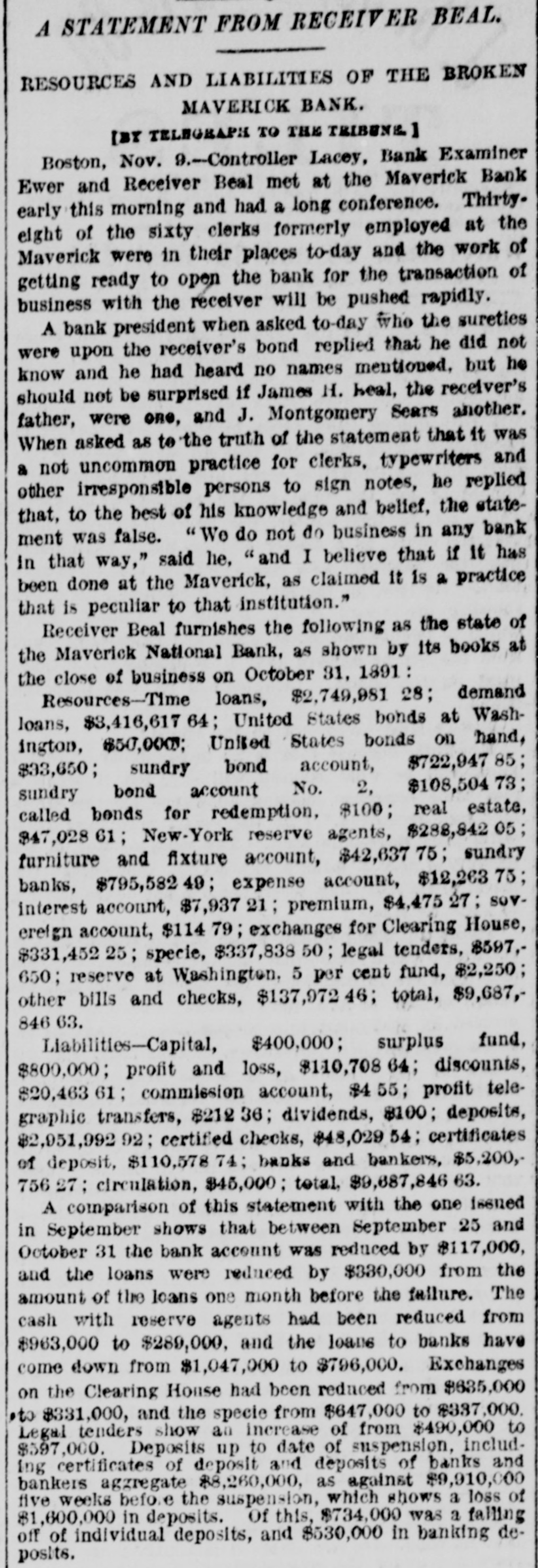
A STATEMENT FROM RECEIVER BEAL. RESOURCES AND LIABILITIES OF THE BROKEN MAVERICK BANK. [Br TELEGRAPH TO THE TRIBUNE] Boston, Nov. 9.-Controller Lacey, Bank Examiner Ewer and Receiver Beal met at the Maverick Bank early this morning and had a long conference. Thirtyeight of the sixty clerks formerly employed at the Maverick were in their places to-day and the work of getting ready to open the bank for the transaction of business with the receiver will be pushed rapidly. A bank president when asked to-day who the sureties were upon the receiver's bond replied that he did not know and he had heard no names mentioned. but he should not be surprised if James H. heal, the receiver's father, were one, and J. Montgomery Sears another. When asked as to the truth of the statement that it was a not uncommon practice for clerks. typewriters and other irresponsible persons to sign notes, he replied that, to the best of his knowledge and belief, the statement was false. "We do not do business in any bank in that way," said he, "and I believe that if it has been done at the Maverick, as claimed it is a practice that is peculiar to that institution." Receiver Beal furnishes the following as the state of the Maverick National Bank, as shown by its books at the close of business on October 31, 1891: Resources-Time loans, $2,749,981 28; demand loans, $3,416,617 United States bonds at Washington, $50,000); United States bonds on hand, $33,650; sundry bond account, $722,947 85; sundry bond account No. 2, $108,504 73; called bonds for redemption, $100; real estate, $47,028 61; New-York reserve agents, $288,842 05; furniture and fixture account, $42,637 75; sundry banks, $795,582 49; expense account, $12,263 75; interest account, $7,937 21; premium, $4,475 27; SOVereign account, $114 79; exchanges for Clearing House, $331,452 25; specie, $337,838 50; legal tenders, 8597,650; reserve at Washington, 5 per cent fund, $2,250; other bills and checks, $137,972 46; total, $9,687,846 63. Liabilities-Capital, $400,000; surplus fund, $800,000; profit and loss, $110,708 6 discounts, $20,463 61; commission account, 55; profit telegraphic transfers, $212 36; dividends, $100; deposits, $2,951,992 92; certified checks, $48,029 5 certificates of deposit, $110,578 74; banks and bankers, $5,200,756 27; circulation, $45,000; total, $9,687,846 A comparison of this statement with the one issued in September shows that between September 25 and October 31 the bank account was reduced by $117,000, and the loans were reduced by $330,000 from the amount of the loans one month before the failure. The cash with reserve agents had been reduced from $963,000 to $289,000, and the loans to banks have come down from $1,047,000 to $796,000. Exchanges on the Clearing House had been reduced from $635,000 ,to $331,000, and the specie from $647,000 to $337,000. Legal tenders show an increase of from $490,000 to $597,000. Deposits up to date of suspension, including certificates of deposit and deposits of banks and bankers aggregate $8,260,000, as against $9,910,000 five weeks before the suspension, which shows a loss of $1,600,000 in deposits. Of this, $734,000 was a falling off of individual deposits, and $530,000 in banking deposits.


Article from Evening Star, November 11, 1891

Click image to open full size in new tab

Article Text

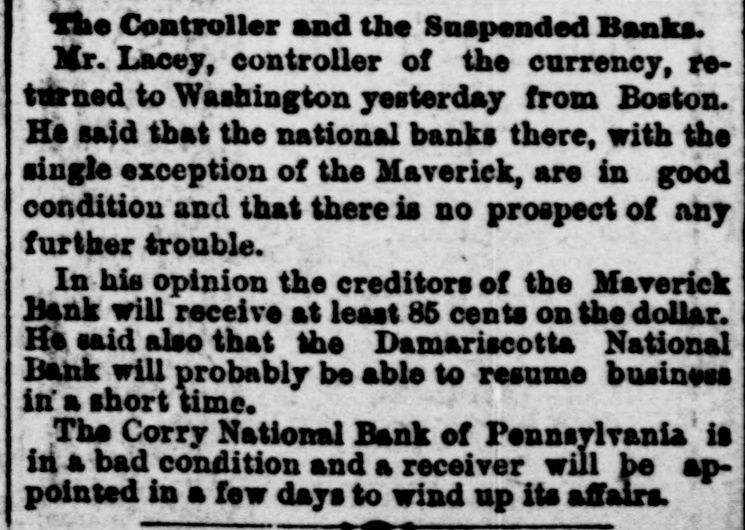
The Controller and the Suspended Banks. Mr. Lacey, controller of the currency, returned to Washington yesterday from Boston. He said that the national banks there, with the single exception of the Maverick, are in good condition and that there is no prospect of any further trouble. In his opinion the creditors of the Maverick Bank will receive at least 85 cents on the dollar. He said also that the Damariscotta National Bank will probably be able to resume business in a short time. The Corry National Bank of Pennsylvania is in a bad condition and a receiver will be appointed in a few days to wind up its affairs.


Article from The Sun, November 12, 1891

Click image to open full size in new tab

Article Text

MISCELLANEOUS, THE Endicotts buy the Aberdeen hotel, St. Paul. THE New York presbytery dismisses the charges of heresy against Dr. Briggs. SNOW completely blocks threshing operations in North Dakota. A NEWLY arrived German girl in New York marries her brother under very peculiar circumstances. THE question of the state boundary line between Ohio and Indiana is in litigation. THE Maverick National bank, Boston, fails, owing $8,000,000. Of the assets $2,000,000 are missing. The president and two directors are arrested. THE Executive committee of the National Educational association has decided to hold the next annual convention at Saratoga Springs, N. Y., July 12 to 15, 1892. JUDGMENT for $125,180 was entered against the Scranton Steel Company, of New York, in favor of John A. Nichols, on promissory notes for pig iron furnished by W. R. Hart & Co., of Philadelphia. ABRAHAM BACKER, the New York note broker who assigned on Aug, 3, allowed judgment to be entered against him for $102,471 in favor of George F. Baldwin and others. J. P. WITHEROW & Co., the extensive furnace builders of New Castle, Pa., will apply to the court for the appointment of a receiver. The assets are placed at $1,111,000, and the liabilities at $374,000. THE annual meeting of the American Shropshire Sheep Breeder's Association was held at Buffalo. The society accepted 11,512, and rejected 8,100 during the year. The election of officers resulted in the choice of Hon. John Dryden, of Brooklyn, Ont., as president; Prof. W. C. Latta, of Indiana, vice-president; Mortimer Levering, re-elected secretary, and the following elected on the executive committee; W. J. Garlock, Michigan; Richard Gibson, Ontario; R. R. Clough, Ohio: John T. Thompson, Indiana; Frank D. Ward, New York.


Article from The Progressive Farmer, December 8, 1891

Click image to open full size in new tab

Article Text

THE LATEST NEWS. parks from the Wires--Most Important Events Throughout the World for a Week. NEW YORK. Dec 1.-Phy sicians say yrus Field may not live through the ay. Three members of the Field re under arrest. TACOMAH. Wash., Nov. 30.-Distinct hocks of earthquake were felt in this ity yesterday afternoon. Port Townend and Olympia also report shocks. To damage done. BOSTON, Nov. 30.-The Maverick ational bank was opened this ng and the book keepers are deliverng receiver's certificates to depositors ho have proved their claims. GALENA, Ill., Nov. 30.-The mercury ast night fell to 15 degrees below zero. The Mississippi river, which was clear f ice Thursday, is now frozen from hore to shore. The weather is the oldest ever known here in November. RIO JANERIO, Dec. 1.-There is larming increase of yellow fever his port. The disease has assumed erious a form that the embarkation f government troops for Rio Grande o Sul and Santa Catalina has been emporarily suspended. Mrs. Duncan, of Washington, D. C., T S A., whose husband, an American, ttempted to murder her last May ear Bettwsy Boed, in Wales, and who as remained at Festinog since the age, has just been delivered of a oth mother and child are doing well JACKSON, Miss., Nov. 30.-Bill Nye, he famous humorist, who fell from he opera house gallery into a pile of umber at Yazoo City Saturday night, as considerably shaken up, but not eriously hurt. He passed through his city yesterday morning en or New Orleans, where he is billed to ecture. NEW ORLEANS, La., Nov. 30.-The hain building of a frame structure sed as a library, and several small uildings, belonging to Straight ersity for colored people, were troved by fire this morning. Theloss ; $30,000; insurance unknown. The uildings were owned by the American Issionary Association of New York. ODESSA, Russia. Nov. 30 ---- An outcry as been raised that Zemstvo agents re paying fancy prices for rye that 0 adulterated with sand and other aterials that it is unfit to eat. and lso that they are buying wheat rices above the market rate. It eared that the outery will put a ) the contributions of people charit bly inclined. Damage reaching $150,000 was inlicted last night by a fire in the ently constructed building of the Chicago Arc-Light and Power any at Washington street bridge, Chicago. The blaze was started wo electric light wires sagging ach other. The Excelsior Cork Cut ing Company was a considerable y the conflagration. RONCEVERTE. W. Va., Nov. ead end freight collision occurred he west end of town this morning o'clock, which resulted in thedestruc ion of two engines and several nd the death of Freman W. M. Carter, f Hinton, and the engineer of rain was pretty badly scalded. Sev ral brakemen were injured. perator's carelessness caused vreck. LEXINGTON, Va., Nov. 30.-A shoot ng affray occurred here Saturday ight in a disreputable house. nan unknown was shot in the 'he parties have been arrested,


Article from The Portland Daily Press, December 10, 1891

Click image to open full size in new tab

Article Text

# THE LAWRENCE MEETING. Detailed Account of the Proceedings of the Boston & Maine. LAWRENCE, Mass., December 9.-At the annual meeting of the stockholders of the Boston & Maine Railroad in City Hall today, Lawyer C. S. Hamlin of Boston, representing stock and security holders to the extent of 4000 shares, offered the following motion: "Moved, that a committee of three stockholders be appointed to investigate and inquire into the circumstances of the large deposit of our funds in the Maverick National Bank of Boston, and to seek to ascertain whether or not our directors, by the exercise of proper care and diligence, should have withdrawn said deposit from said bank prior to its failure, said committee to report at a special meeting of this company to be held on February 1, 1892 in Boston. Moved, that a committee of three stockholders be appointed to investigate the accounts of the company, and to examine into the matter of leases of the Nashua & Rochester and the Manchester & Lawrenee railroads to ascertain in whose control these railroads were at the time these leases were entered into, who were the principal owners of the stock in the said roads at said time, and who were the principal beneficiaries under said contracts, and to ascertain who, whether or not, paid for said leases more than their fair earning capacity, said committee to report at a special meeting of this company, to be called on February 1, 1892, at Boston. "Whereas, our road owns more than half the stock of the Maine Central Railroad, and is, therefore, responsible for its past and future management and chooses its directors, it is moved that a committee of three stockholders be appointed to investigate and examine into the leases of the Hereford, Upper Coos and Knox & Lincoln and other roads by said Maine Central railroad with a view to aseertaining whether or not said leases will reduce the net earnings of said Maine Central and thus impair the dividends on our stock which have hitherto added over one hundred thousand dollars annually to our income account, said committee to report at a special meeting of this company to be called on February 1, 1892, at Boston." These motions were subsequently amended to read so that the investigating committees shall report at the special meeting designated or at the next annual meeting. The motions were adopted. The balloting for directors resulted as follows:


Article from New-York Tribune, January 25, 1892

Click image to open full size in new tab

Article Text

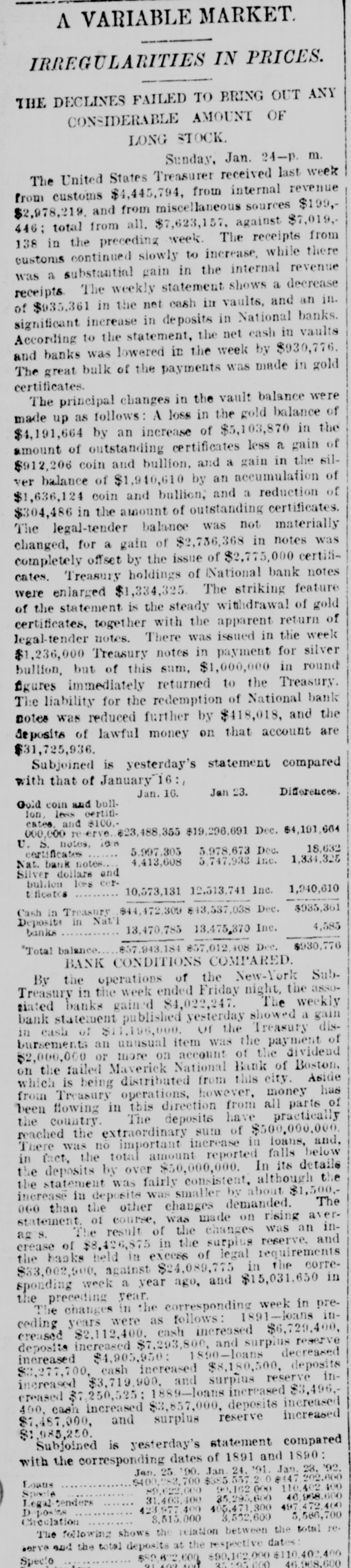
A VARIABLE MARKET. IRREGULARITIES IN PRICES. THE DECLINES FAILED TO BRING OUT ANY CONSIDERABLE AMOUNT OF LONG STOCK. Sunday, Jan. 24-p. m. The United States Treasurer received last week from customs $4,445,794, from internal revenue $2,978,219. and from miscellaneous sources $199,446; total from all. $7,623,157, against $7,019,138 in the preceding week. The receipts from customs continued slowly to increase, while there was a substantial gain in the internal revenue receipts. The weekly statement shows a decrease of $935,361 in the net cash in vaults, and an in. significant increase in deposits in National banks. According to the statement, the net cash in vaults and banks was lowered in the week by $930,776. The great bulk of the payments was made in gold certificates. The principal changes in the vault balance were made up as follows: A loss in the gold balance of $4,191,664 by an increase of $5,103,870 in the amount of outstanding certificates less a gain of $912,206 coin and bullion, and a gain in the silver balance of $1,940,610 by an accumulation of $1,636,124 coin and bullion, and a reduction of $304,486 in the amount of outstanding certificates. The legal-tender balance was not materially changed, for a gain of $2,736,368 in notes was completely offset by the issue of $2,775,000 certificates. Treasury holdings of National bank notes were enlarged $1,334,325 The striking feature of the statement is the steady withdrawal of gold certificates, together with the apparent return of legal-tender notes. There was issued in the week $1,236,000 Treasury notes in payment for silver bullion, but of this sum, $1,000,000 in round figures immediately returned to the Treasury. The liability for the redemption of National bank notes was reduced further by $418,018, and the deposits of lawful money on that account are $31,725,936. Subjoined is yesterday's statement compared with that of January Differences. Jan 23. Jan. 16. Gold coin and bullIon, less certificates and $100,Dec. $4,101,664 $19,296,691 erve. $23,488,355 re 000,000 U. S. notes, less 18,632 5,978,673 Dec. 5,997,305 certificates 1,334,325 Inc. 5,747,933 4,413,608 Nat. bank notes. Silver dollars and buldon less cer1,940,610 Inc. 12,513,741 10,573,131 tificates Cash in Treasury $44,472,309 $43,537,038 Dec. $935,361 Deposits in Nat'l 4,585 Inc. 13,475,370 13,470,785 banks Total balance $57,943.184 $57,012,408 Dec. $930,776 BANK CONDITIONS COMPARED. By the operations of the New-York SubTreasury in the week ended Friday night, the assosiated banks gained $4,022,247. The weekly bank statement published yesterday showed a gain in cash of $11,196,000. or the Treasury disbursements an unusual item was the payment of $2,000,000 or more on account of the dividend on the failed Maverick National Bank of Boston, which is being distributed from this city. Aside from Treasury operations, however, money has been flowing in this direction from all parts of the country. The deposits have practically reached the extraordinary sum of $500,000,000 There was no important increase in loans, and, in fact, the total amount reported falls below the deposits by over $50,000,000. In its details the statement was fairly consistent, although the increase in deposits was smaller by about $1,500,- The 000 than the other changes demanded. statement. of course, was made on rising averThe result of the changes was an increase ages. of $8,426,875 in the surplus reserve, and the backs held in excess of legal requirements $33,002,500, against $24,089,775 in the corresponding week a year ago, and $15,031,650 in the preceding year. The changes in the corresponding week in preceding years were as follows: 1891-loans increased $2,112,400. cash increased $6,729,400, deposits increased $7,293,800, and surplus reserve increased $4,905,950: 1890-loans decreased $3,277,700, cash increased $8,180,500, deposits inincreased $3,719,900. and surplus reserve creased $7,250,525; 1889-loans increased $3,496,400, cash increased $3,857,000, deposits increased $7,487,000, and surplus reserve increased $1,985,250. Subjoined is yesterday's statement compared with the corresponding dates of 1891 and 1890: Jan. 25 90. Jan 24. '91. Jan. 23. '92. $400,283,700 $447 202,600 Loans 89,622,000 90,162,000 110.402.400 Specie 31,403,400 35,295,600 46,968,600 Legal tenders Deposits 423,977,400 405,471,300 497,472,400 5,586,700 3,552,600 8,515,000 Choclation The following shows the relation between the total reserve and the total deposits at the respective dates $89,622,600 $90,162,000 $110,402,400 Specie 21 403 100 25 295 600 46.968.600


Article from The Providence News, February 24, 1892

Click image to open full size in new tab

Article Text

THE DECISION TO-MORROW. President Potter Fights Hard to Retain Possession. BOSTON, Feb. 24.-The contest between Mr. Asa P. Potter, ex-President of the Maverick National Bank, on the one hand through his counsel, and Receiver Beal and United States District Attorney Allen, on the other, for the possession of the trunk which Mr. Potter alleges contains only his private papers, and which Messrs. Beal and Allen assert contains documents which the Receiver should be allowed to take before the Grand Juryas a part of theevicence to be submitted to it in the Maverick Bank cases, was resumed in the United States Circuit Court yesterday before Judge Aldrich. After hearing the evidence and arguments Judge Aldrich said he would give a decision Thursday morning. The transactions between the late Irving A. Evans and Asa P. Potter are to be brought before the United States Circuit Court Grand Jury, now in session. On February 20 District Attorney Allen sent to Messrs. Paul H. Kendricken and Col. Albert A Pope a summons to appear before the Grand Jury and bring with them such papers and books which they, as assignees of Evans & Co., might have in their possession. These gentlemen did not respond to the summons, and yesterday afternoon they were ordered to appear before Judge Nelson. Mr. Kendricken came and General P. A. Collins represented Colonel Pope. District Attorney Allen stated that he desired to have the books of the late Mr. Evans brought before the. Grand Jury in connection with the Maverick Bank matter, and General Collins objected on the ground that the District Attorney should specify in detail what particular books and papers he wanted. Mr. Allen said that it would not be possible to specify in detail, but he stated what book he wanted, and Judge Nelson offered the assignees the alternative of producing the papers or going to jail. They concluded to produce the books, and yesterday afternoon they were delivered to District Attorney Allen.


Article from Pawtucket Tribune, July 27, 1892

Click image to open full size in new tab

Article Text

# MAVERICK BANK ASSETS. Court Decision Against the City of Boston's Right to a Share. BOSTON, July 27.-A tax of $12,096 levied by the city of Boston on Maverick National bank stock on May 1, 1891, and due Oct. 1 of that year, does not entitle the city to share in the assets of the bank in the hands of Receiver Beal. Justice Colt has given a decision in the United States circuit court dismissing the complainant's bill. The court, in an interesting opinion, says: It appears that as the time this suit was brought the assets of the bank were in the hands of a receiver, and that the property representing the capital stock had been swept away. This tax, therefore, if held to be valid, is not a tax upon the shareholders (such as the state is authorized to make) but a tax upon the assets of the bank, which belong to the creditors. If the tax is paid by the bank it can have no lien upon the shares of stock for repayment, as provided by section 10 of chapter 13 of the public statutes of Massachusetts, because the property representing such shares has ceased to exist. Under these circumstances I do not think that the receiver can be held liable for this tax, or that it is a provable claim against the assets in his hands. If the action against the bank under the statute makes the bank the agent of the city to collect the tax, or if the action is to be considered as a form of trustee process or attaching the funds of the shareholders in the hands of the bank, it is too late to bring suit after the funds are no longer in existence from which the bank can reimburse itself. Bill dismissed with costs.


Article from The Evening Herald, September 15, 1892

Click image to open full size in new tab

Article Text

# PRESIDENT POTTER'S TRUNK. Asked That it be Taken from Custody of the Clerk of the Court. BOSTON, Sep. 15. - Senator William E. Chandler, Chairman of the Senate Bank Investigating Committee, has written to Thomas P. Beale, Receiver of the Maverick National Bank, formally asking him to apply at once to the court for a revocation of its order placing President Asa P. Potter's trunk in the keeping of the clerk of the court. Testimony is cited in proof that a written engagement was entered into between Mr. Potter and his counsel by which Mr. Beale and Mr. Hutchins are to have at all times access to all the papers in the trunk. The committee do not understand that any agreement made in behalf of the United States by which the receiver and his counsel may examine this trunk and its contents while the Comptroller of the Currency and a committee of Congress are excluded therefrom. The Senator, therefore, asks Mr. Beale to procure access to the trunk, and allow an inspection of its contents by the committee.