6903. Central National Bank (Boston, MA)

Bank Information

Episode Type
Run → Suspension → Reopening
Bank Type
national
Bank ID
2103
Charter Number
2103
Start Date
November 19, 1881
Location
Boston, Massachusetts (42.358, -71.060)

Metadata

Model
gpt-5-mini
Short Digest
7d22ffb9fba4300e

Response Measures

Accommodated withdrawals, Capital injected, Full suspension, Books examined

Receivership Details

Depositor recovery rate
100.0%
Date receivership started
1902-11-13
Date receivership terminated
1906-10-20
OCC cause of failure
Excessive lending
Share of assets assessed as good
68.8%
Share of assets assessed as doubtful
24.6%
Share of assets assessed as worthless
6.6%

Description

The articles describe a heavy run on Central National Bank on Nov 19, 1881 that led the bank to stop paying checks for a short time (about two hours) while directors and the bank examiner consulted. The bank resumed payment the same day after receiving assistance and assessments; thus sequence is run → brief suspension → reopening. Many articles also discuss the separate failure/suspension of the Pacific National Bank (the trigger), but this episode entry focuses on Central National Bank as requested. OCR errors in some articles corrected (e.g., Beston -> Boston; Eliott -> Eliot).

Events (5)

1. April 30, 1873 Chartered
Source
historical_nic
2. November 19, 1881 Reopening
Newspaper Excerpt
The Central National Bank...resumed payment at 1:30 p.m. This has inspired a marked feeling of confidence.
Source
newspapers
3. November 19, 1881 Run
Cause
Local Banks
Cause Details
Run was triggered by the suspension/closing of the Pacific National Bank and fears about its connections (rediscounts/collateral), especially exposures to broker T. Weeks.
Measures
Paid out large sums (reported $450,000) to meet claims of other banks; clearing-house/other Boston banks provided assistance; stockholders later paid assessments to bolster the bank.
Newspaper Excerpt
A heavy run upon the Central National Bank was begun by depositors when the doors were opened to-day...the banking rooms were crowded all morning.
Source
newspapers
4. November 19, 1881 Suspension
Cause
Government Action
Cause Details
Temporary stoppage on advice of the Bank Examiner and directors to permit examination of accounts and consultation following run and concerns about paper received from the Pacific National Bank.
Newspaper Excerpt
At 11:30 a. m. the Central National Bank stopped paying checks...the directors went into consultation...the Bank Examiner thought best to suspend operations of this kind for the moment until a full opportunity for consultation revealed the resources of the Boston banks.
Source
newspapers
5. November 13, 1902 Receivership
Source
historical_nic

Newspaper Articles (20)

Article from The Rock Island Argus, November 18, 1881

Click image to open full size in new tab

Article Text

BOSTON BOTHER. NEW YORK, Nov. 18 -The Post's financial part of the depression in the market has been due to rumors that one or two Boston banks had failed or were in trouble. An inquiry of leading firms having private wires to Bosten brings the following: There is a well authenticated rumor of a difficulty in two Boston banks, the names of which have not yet transpired, one of which it is thought will go under. Others will be supported by the clearing house, No important mercantile failures are reproted. CLOSED. WASHINGTON, Nov. 18.-A private dispatch states. that the Pacific National Bank of Boston has closed its doors. The Central National Bank of Boston was in trouble, but overcame its embarrassment and continues business. IN TROUBLE. BOSTON, Nov. 18.-The Pacific Bank is in trouble, but claim to be all right before the close of business to-night.


Article from The Wheeling Daily Intelligencer, November 19, 1881

Click image to open full size in new tab

Article Text

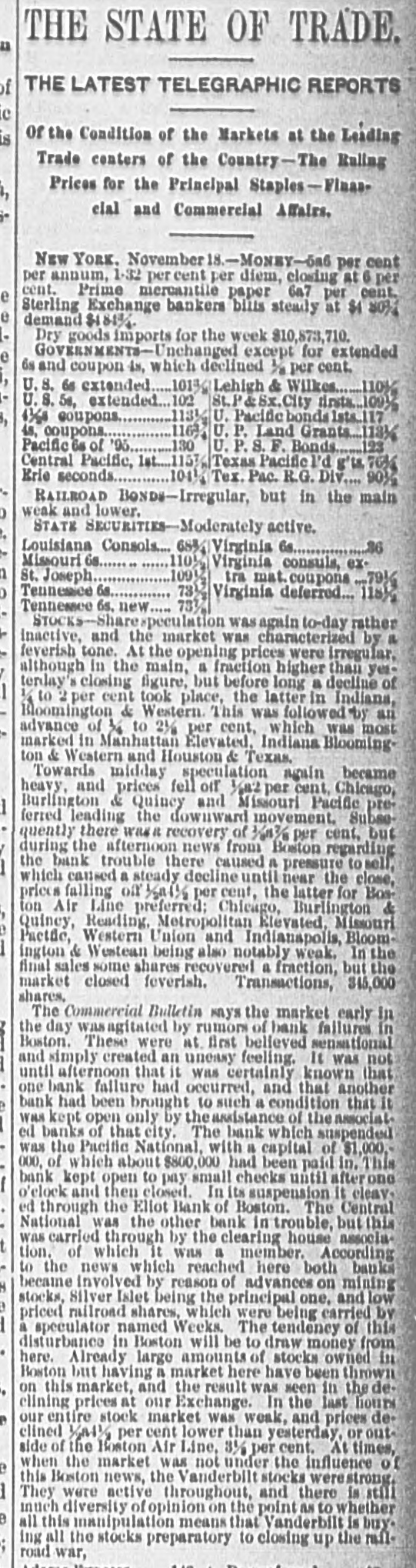
THE STATE OF TRADE. THE LATEST TELEGRAPHIC REPORTS of ic of the Condition of the Markets at the Leading is Trade centers of the Country-The Rullag Prices for the Principal Staples-Flandcial and Commercial Affairs. NEW YORK. November 18.-MONEY-686 per cent per annum, 1.32 per cent per diem, closing at 6 per cent. Prime mercantile paper 6a7 per cent. e Sterling Exchange bankers bills steady at $4 30% e demand $181% Dry goods imports for the week $10,573,710. GOVERNMENTS-Unchang except for extended e 6s and coupon is, which declined 1/4 per cent. , U.S. 65 extended 1013 Lehigh & Wilkes 110% U.S.5s, extended 102 Sx. City firsta 10916 113% U. Pacific bondaists 117 41/8 coupons, 8, is, coupons 116) U.P. Land Grants 11316 130 Pacific 6s of '95 U. P. 8. F. Bonds 123 115% Texas Pacific I'd Central Pacific, 1st Krie seconds 1011 Tex. Pac. R.G. Div 901/2 RAILROAD Bonds-Irregular, but in the main weak and lower. 0 STATE SECURITIES-Moderately active. 36 Louisiana Consols. 68% Virginia 6s Missouri 6s 110% Virginia consuls, ex 1 10912 St. Joseph tra mat. coupons ..7916 73% Tennesice 6s 0 Virginia deferred 118% Tennemee 6s. new 73% STOCKS peculation was again to-day rather inactive, and the market was characterized by a feverish tone. At the opening prices were Irregular, although in the main, a fraction higher than yetterlay's closing figure. but before long a decline of to 2 per cent took place, the latter in Indiana, Bloomington & Western This was followed by an advance of 1/4 to 21/6 per cent, which was most marked in Manhattan Elevated. Indiana Blooming ton & Western and Houston & Texas. Towards midday speculation again became heavy, and prices fell off 182 per cent, Chicago, Burlington & Quincy and Missouri Pacific preferred leading the downward movement. Subsequently there was recovery of 1/683/6 per cent. but during the afternoon news from Boston regarding the bank trouble there caused n pressure to sell, which caused a steady decline until near the close, prices falling off per cent, the latter for Bos ton Air Line preferred: Chicago, Burlington & Quincy, Reading, Metropolitan Elevated, Missuri Pactice, Western Union and Indianapolis, Bloom ington & Westean being also notably weak. In the final sales some shares recovered a fraction, but the market closed feverish. Transactions, 345,000 shares. The Commercial Bulletin says the market early in the day wasagitated by rumors of bank failures In Boston. These were ut. first believed sensational and simply created an uneasy feeling. It was not until afternoon that it was certainly known that one bank failure had occurred, and that another bank had been brought to such a condition that it askept open only by the assistance of the associate ed banks of that city. The bank which suspended was the Pacific National, with n capital of $1,000, 000, of which about $800,000 had been paid in. This bank kept open to pay small checks until after one o'clock and then closed. In its suspension it cleav ed through the Ellot Bank of Boston. The Central National was the other bank in trouble, but this was carried through by the clearing house association. of which it was a member. According to the news which reached here both banks became involved by reason of advances on mining stocks, Silver Islet being the principal one, and low priced nailroad shares, which were being carried by a speculator named Weeks. The tendency of this disturbance in Boston will be to draw money from here. Already large amounts of stocks owned in Boston but having n market here have been thrown on this market, and the result was seen in the declining prices at our Exchange. In the last hours our entire stock market was weak, and prices declined 1/m per cent lower than yesterday, or outside of the Boston Air Line, 3% per cent. At times, when the market was not under the influence of this Boston news, the Vanderbilt stocks werestrong, They were active throughout, and there is still inuch diversity of opinion on the point as to whether B all this manipulation means that Vanderbilt is buy. ing all the stocks preparatory to closing up the rail road war, -
Article from The Rock Island Argus, November 19, 1881

Click image to open full size in new tab

Article Text

MONEY MATTERS. NEW YORK, Nov. 19.-The suspended Boston bank was the Pacific National, capital $1,000.000. About $800,000 was paid in. This bank kept open to pay small checks until after 1 o'clock and then closed in suspension. It cleared through the Elliot Bank. The Boston Central National was the other bank in trouble but it was carried through by the Clearing House Association of which it was a member. It was involved by reason of advances on mining stock, the siver Islet being the principal one, and the low price of railroad shares which were being car ried by a speculator named Weeks The tendency of this disturbance in Boston will draw money from here. Already large amounts of stock owned in Boston, but having a market here, have been thrown on this market, and the result was seen in the declining prices in the last half hour. NEWARK, Nov. 19.-The depositors in the Mechanics' Bank are understood to have determined to prosecute the directors and employ Benj. F, Butler and Roger A. Pryor as counsel. BOSTON, Nov. 18.-There is the best authority for believing that the failure of the Pacific Bank to-day will effect no other city banks seriously, Should the mining stock collaterals or deposits with other banks depreciate in value, the banks will probably realize a sufficient sum to meet the major part of its obligations. There was a considerable run on the bank to-day, owing partially to the expressed opinions of prominent bankers and business men that it was shaky, and to the known facts about its worthless collaterals. The bank's capital stock has recently been increased from $500,000 to $1,000,000. Upon the announcement of the failure the eastern railroad stock dropped from 48 to 88. The directors of the Pacific National have been in consultation with Bank Examiner Needham through the evening and have come to no positive conclusion. Another meeting will be held in the morning. The bank will not go on to-morrow morning, but it is reasonable to suppose, as it is within the range of possibility and probability, that means may be furnished to enable the bank to start again. That will be determined to-morrow when the directors will decide whether to surrender the bank or raise the money necessary to carry it through its difficulty. From the present standpoint it would seem impossible for depositors to lose a cent. Week hopes to recoup, and if he does the bank may continue business.


Article from Lancaster Daily Intelligencer, November 19, 1881

Click image to open full size in new tab

Article Text

ANOTHER EMBARRASSED BANK. Suspension that is Claimed to be Only Temporary. BOSTON, Nov.18.-At 11:40 a. m. Central national bank stopped paying checks. They do not wish it to be understood as a permanent suspension, but a temporary stoppage for the purpose of consultation among the directors as to the proper course to pursne. At the clearing house to-day the Central bank was compelled to pay 8400,000.


Article from Alexandria Gazette, November 19, 1881

Click image to open full size in new tab

Article Text

The Boston Bank Trouble, BESTON, Mass., Nov. 19.-At 11 30 3. in. the Central National Bank stopped paying checks. They do not wish it to be understood 8; 8 permannet suspension, Lut is temporary stoppage, for the purpose of consultation among the directors BS to the proper course to Bureus At the clearing house today the Central Bank was competies to pay $100,000. [A later citpatch saye the bank has again resumed payment I


Article from The Salt Lake Herald, November 19, 1881

Click image to open full size in new tab

Article Text

The Troubled Bank. New York, 28.-The Boston bank which suspended to-day, was the Pacific National, with a capital of $1,000,000, of which about $800,000 had been paid in. This bank kept open to pay small checks until after 1, and then closed in suspension. It was cleared through the Eliott Bank of Boeton. The Central National was the other bank in trouble, but thie bank was carried through by the Clearing House Association of which it was a member. According to the news both banks became involved by reason of advances on mining stock, Silver Islet the principal one, and low priced railroad shares, which were being carried by a speculator named Wesks. The tendency of this dis turbance in Boston will be to draw money from here. Already large amounts of stocks are owned in Bos ton, but having a market here have been thrown on this market and the result was seen in the declining prices.


Article from The Dallas Daily Herald, November 20, 1881

Click image to open full size in new tab

Article Text

Bank Stoppage. BOSTON, November 19.-At 11:30 a. m. the Central National Bank stopped paying. At the bank they don't wish it understood as a permanent suspension, but a temporary stoppage for the purpose of consultation among the directors as to the proper course to pursue. At the clearing house to-day the Central Bank was compelled to pay $400.000, and there was great apprehension on State street this morning until after the Clearing-house meeting announcement that all loans between banks had been promptly paid, and that the rate had not materially advanced. greatly allaved the general anxiety. The Central Bank. which stopped payment at 11:30 this morning, at 1:30 resumed payment and the resumption of payment by the Central Bank has inspired a marked feeling of confidence. here and it is the generally expressed opinion that the worst is over.


Article from New-York Tribune, November 20, 1881

Click image to open full size in new tab

Article Text

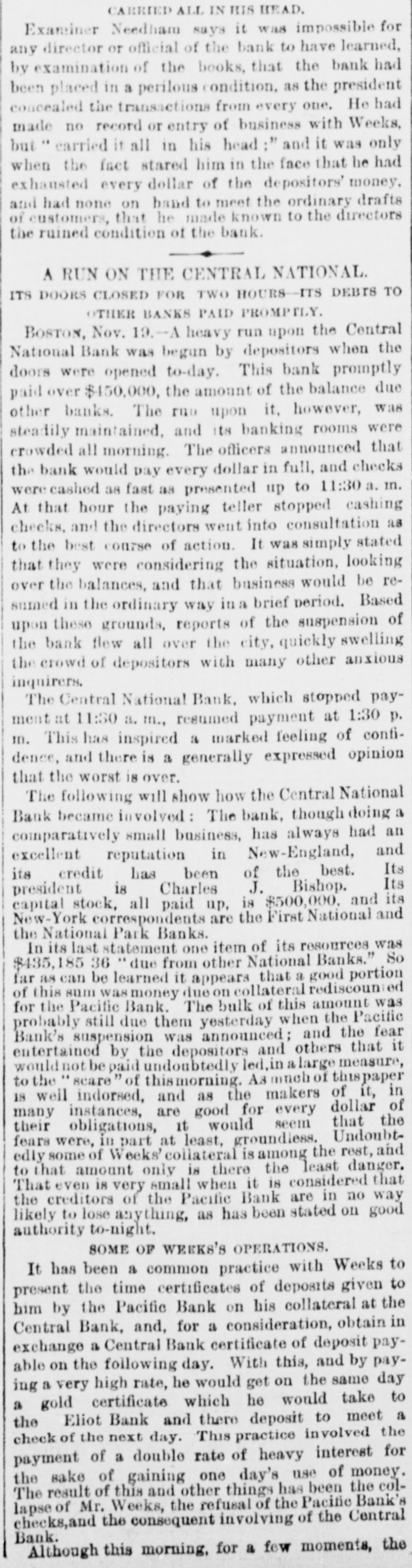
BOSTON BANK TROUBLES. LOOSE MANAGEMENT AT THE PACIFIC. WEEKS OWES $1,260,000 TO THE PACIFIC BANKTHE CENTRAL NATIONAL RESUMES BUSINESS AFTER A BRIEF SUSPENSION-CONFIDENCE RESTORED HERE. The affairs of the Pacific National Bank of Boston were placed yesterday in the hands of Colonel Needham, the Bank Examiner, and a committee of the directors. Weeks's indebtedness turns out to be $1,260,000. The president says he made no entry of Weeks's transactions, but "kept it all in his head." The Central Bank suspended for two hours yesterday. It paid out $450,000 to meet the claims of other banks. In this city there was some alarm, but confidence was subsequently restored.


Article from New-York Tribune, November 20, 1881

Click image to open full size in new tab

Article Text

CARRIED IN HIS HEAD. Examiner Needham says it was impossible for any director or official of the bank to have learned, by examination of the books, that the bank had been placed in a perilous condition. as the president concealed the transactions from every one. He had made no record or entry of business with Weeks, but 'carried it all in his head : and it was only when the fact stared him in the face that he had exhausted every dollar of the depositors' money. and had none on hand to meet the ordinary drafts of customers, that he made known to the directors the ruined condition of the bank. A RUN ON THE CENTRAL NATIONAL. ITS DOORS CLOSED FOR TWO HOURS-ITS DEBIS TO OTHER BANKS PAID PROMPTLY. BOSTON, Nov. 19.-A heavy run upon the Central National Bank was begun by depositors when the doors were opened to-day. This bank promptly paid over $450,000, the amount of the balance due other banks. The run upon it. however, was steadily maintained, and its banking rooms were crowded all morning. The officers announced that the bank would pay every dollar in full, and checks ere cashed as fast as presented up to 11:30 a. in. At that hour the paying teller stopped cashing checks. and the directors went into consultation as of action. It was simply stated were the to that the they best course considering situation, looking over the balances, and that business would be resumed in the ordinary way in a brief period. Based upon these grounds, reports of the suspension of the bank flew all over the city, quickly swelling the crowd of depositors with many other anxious inquirers. The Central National Bank, which stopped payment at 11:30 a. m., regumed payment at 1:30 p. m. This has inspired a marked feeling of confidence, and there is a generally expressed opinion that the worst is over. The following will show how the Central National Bank became involved The bank, though doing a comparatively small business, has always had an excellent reputation in New-England, and its credit has been of the best. Its Its president is Charles J. Bishop. capital stock, all paid up, is $500,000. and its New-York correspondents are the First National and the National Park Banks. In its last statement one item of its resources was $435,185 36 "due from other National Banks." So far as can be learned it appears that a good portion of this sum wasmoney due on collateral rediscounted for the Pacific Bank. The bulk of this amount was probably still due them yesterday when the Pacific Bank's suspension was announced; and the fear the and not be undoubtedly led, in a to the 'scare" of thismorning. As entertained would paid by depositors makers much others large of of thispaper measure, that it, in it 18 weil indorsed, and as the many instances, are good for every dollar of their obligations, it would seem that the fears were, in part at least, groundless. Undoubtedly some of Weeks' collateral is among the rest, and to that amount only is there the least danger. That even is very small when it is considered that the creditors of the Pacific Bank are in no way likely to lose anything, as has been stated on good authority to-night. SOME OF WEEKS'S OPERATIONS. It has been a common practice with Weeks to present the time certificates of deposits given to the Pacific Bank on his for a consideration, Central him by Bank, and, collateral obtain at the in exchange a Central Bank certificate of deposit payable on the following day. With this, and by paying a very high rate, he would get on the same day a gold certificate which he would take to the Eliot Bank and there deposit to meet a of the next day. This practice involved the of a double rate of heavy check payment interest of money. for the sake of gaining one day's use The result of this and other things has been the collapse of Mr. Weeks, the refusal of the Pacific Bank's checks,and the consequent involving of the Central Bank. Although this morning, for a few moments, the


Article from The Daily Dispatch, November 20, 1881

Click image to open full size in new tab

Article Text

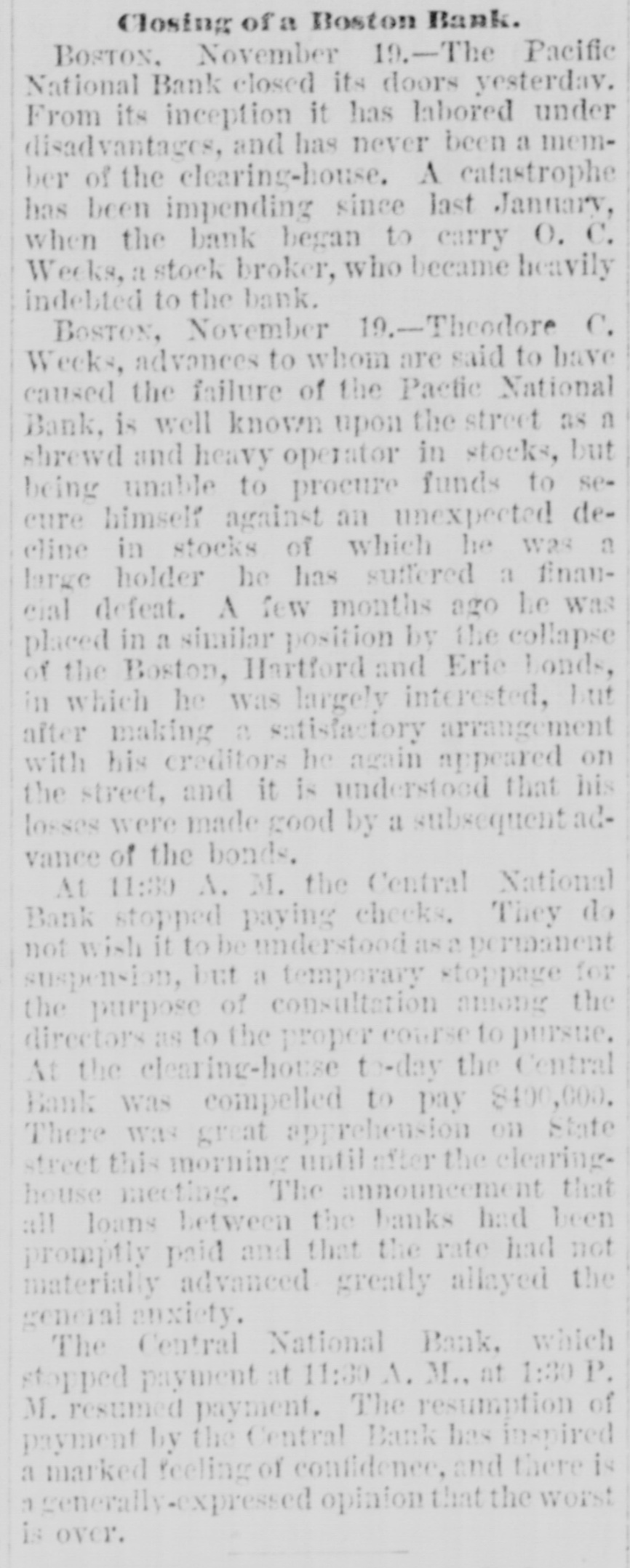
Closing of a Boston Bank. BOSTON, November 19.-The Pacific National Bank closed its doors yesterday. From its inception it has labored under disadvantages, and has never been a member of the clearing-house. A catastrophe has been impending since last January, when the bank began to carry O. C. Weeks, a stock broker, who became heavily indebted to the bank. BOSTON, November 19.-Theodore C. Weeks, advances to whom are said to have caused the failure of the Pactic National Bank, is well known upon the street as a shrewd and heavy operator in stocks, but being unable to procure funds to secure himself against an unexpected decline in stocks of which he was a large holder he has suffered a financial defeat. A few months ago he was placed in a shallar position by the collapse of the Boston, Hartford and Eric Londs, in which he was largely interested, but after making a satisfactory arrangement with his creditors he again appeared on the street, and it is understood that his losses were made good by a subsequentadvance of the bonds. At 11:30 A. M. the Central National Bank stopped paying checks. They do not wish it to be understood as 2 permanent suspension, but a temporary uppage for the purpose of consultation among the directors as to the proper course to pursue. At the clearing-house to-day the Central Bank was compelled to pay $400,000. There was great apprehension on State street this morning until of the clearinghouse meeting. The announcement that all loans between the banks had been promptly paid and that the rate had not materially advanced greatly allayed the general anxiety. The Central National Bank. which stopped payment at 11:30 A. M., at 1:30 P. M. resumed payment. The resumption of payment by the Central Bank has inspired a marked feeling of confidence, and there is 7 generally expressed opinion that the worst is over.


Article from Evening Star, November 21, 1881

Click image to open full size in new tab

Article Text

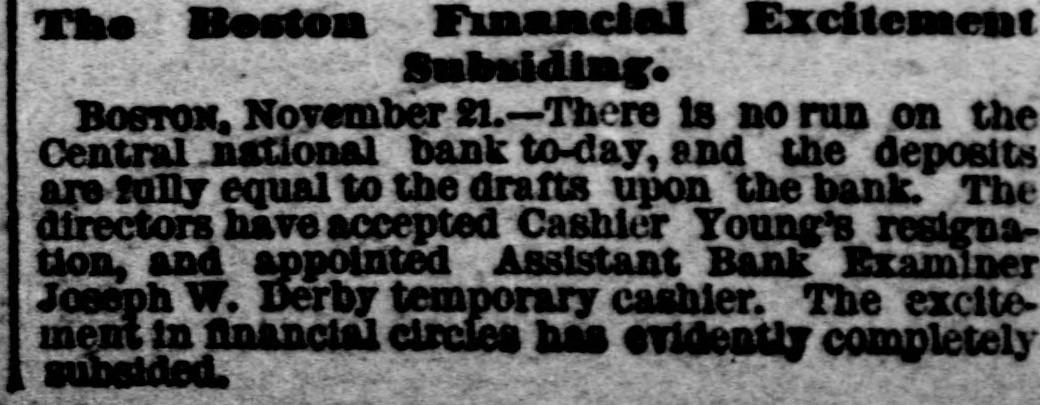
The Beston Financial Excitement Subsiding. BOSTON, November 21.-There is no run on the Central national bank to-day, and the deposits are fully equal to the drafts upon the bank. The directors have accepted Cashier Young's resignation, and appointed Assistant Bank Examiner Joseph W. Derby temporary cashier. The excitementin financial circles has evidently completely subsided.


Article from The Wheeling Daily Intelligencer, November 21, 1881

Click image to open full size in new tab

Article Text

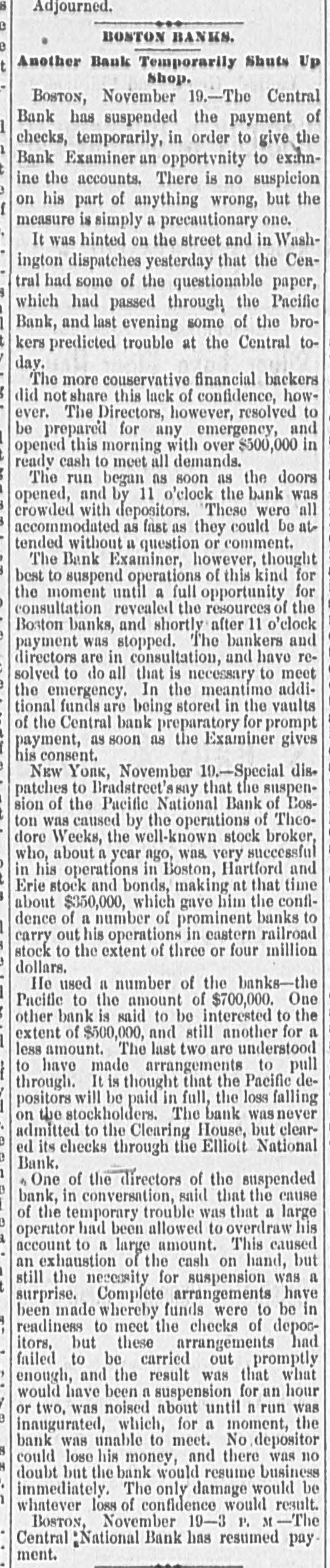
Adjourned. BOSTON BANKS. Another Bank Temporarily Shuts Up Shop. BOSTON, November 19.-The Central Bank has suspended the payment of checks, temporarily, in order to give the Bank Examiner an opportvnity to exanine the accounts. There is no suspicion on his part of anything wrong, but the measure is simply a precautionary one. It was hinted on the street and in Washington dispatches yesterday that the Central had some of the questionable paper, which had passed through the Pacific Bank, and last evening some of the brokers predicted trouble at the Central today. The more conservative financial backers did not share this lack of confidence, however. The Directors, however, resolved to be prepared for any emergency, and opened this morning with over $500,000 in ready cash to meet all demands. The run began as soon as the doors opened, and by 11 o'clock the bank was crowded with depositors. These were all accommodated as fast as they could be at tended without a question or comment. The Bank Examiner, however, thought best to suspend operations of this kind for the moment until a full opportunity for consultation revealed the resources of the Boston banks, and shortly after 11 o'clock payment was stopped. The bankers and directors are in consultation, and have resolved to do all that is necessary to meet the emergency. In the meantimo additional funds are being stored in the vaults of the Central bank preparatory for prompt payment, as soon as the Examiner gives his consent. NEW Yonk, November 10.-Special dis. patches to Bradstreet's any that the suspension of the Pacific National Bank of Boston was caused by the operations of Theodore Weeks, the well-known stock broker, who, about n year ago, was very successful in his operations in Boston, Hartford and Erie stock and bonds, making nt that time about $350,000, which gave him the confidence of a number of prominent banks to carry out his operations in eastern railroad stock to the extent of three or four million dollars. He used n number of the banks-the Pacific to the amount of $700,000. One other bank is said to be interested to the extent of $500,000, and still another for a less amount. The last two are understood to have made arrangements to pull through. It is thought that the Pacific depositors will be paid in full, the loss falling on the stockholders. The bank was never admitted to the Clearing House, but cleared its checks through the Elliott National Bank. One of the directors of the suspended bank, in conversation, said that the cause of the temporary trouble was that a large operator had been allowed to overdraw his account to a large amount. This caused an exhaustion of the cash on hand, but still the necessity for suspension was a surprise. Complete arrangements have been made whereby funds were to be in readiness to meet the checks of depositors, but these arrangements had failed to be carried out promptly enough, and the result was that what would have been a suspension for an hour or two, was noised about until n run was inaugurated, which, for a moment, the bank was unable to meet. No depositor could lose his money, and there was no doubt but the bank would resume business immediately. The only damage would be whatever loss of confidence would result. BOSTON, November 19-3 P. -The Central National Bank has resumed pay ment.


Article from Daily Kennebec Journal, November 21, 1881

Click image to open full size in new tab

Article Text

THE BANK TROUBLE IN BOSTON. A Run on the Central National. AFFAIRS MORE QUIET. Effect in Wall Street. Nov. 19. There was great appreon State street this after hours. The hension BOSTON, the clearing announcement morning until that all loans between had paid, and was been made promptly Nothing that the there banks had been no material advance. ne. V was made known in to the the and business moved way Pacific, regard in situation its usual at until 11 o'clock, when a run the National was When the doors opened positors. Central after begun heavy by this the upon bank deover $450,000 of due other promptly the balance paid banks. of the maintained, The amount run it, however, was steadily roo ns were crowded and upon its stoppage hour all the the bank morning. After the of an resumed payment. THE EXCITEMENT SUBSIDING. over the Pacific National Bank and the The suspension excitement reported practically embarof the Central Bank has The of no loss be entailed upon subsided. rassment will publicity depositors the fact the that of anxie- the Pacific Bank was sufficient to quell ty which prevailed on Friday, while the amtardy aid, extended to the Central its friends has its The among ple, by though patrons. restored accounts tranquility of by both banks are undergoing careful scrutiny the bank examiners, who will probably report on Monday. for a reorganization is still going and effort to The on, movement every will be the made presiLewis Coleman accept It is not definitely a rewill take nor be dency. have organization Mr. place, decided his that will work. it examiner has If matters as as is to that he a reason until he the finds hope will, completed favorable reorganization there It will take place and the bank will go on. is said that President Benyon favors the proposal to make Mr. Coleman president. THE EFFECT IN NEW YORK. The report of the failure of the Central Bank, right upon the announcement of the crash of the Pacific Bank, created considerable and methods as questionable anxiety include apprehension of banking the bolstering that prevail such in which of certain and large amounts of upon Boston, speculators, capital the mining lending stocks of and railroad stocks of uncertain market value, might not be confined to that city. There was considerable disturbance of loans by reason of the fright, and money on call rose to 1-64 and interest. The market was better during the last hour, and, by heavy of leading the excitement was purchases allayed. Mr. being operators, J. sustained A. Garland, the vice of National of this corressecond Bank president city, which National the is the First Bank pondent of the Central of Boston, said: The latest we have heard is that, by the advice of the bank examiner, the Central National has suspended temporarily until the bank accounts could be thoroughly examined. It looked this morning to us as if the to over would be but I suppose pressure became to great. successful, efforts The Central tide the National it Bank's balance in our bank is not yet exhausted, but, as soon as is. of course we shall out money on It not be for me would stop paying right hands." to its state account. Presi- the amount of its balance in our dent of the Gallatin he did the as a affair, not Tappen regard failure Bank serious said and that its effect would be transient. BOSTON, Nov. 20. It has been learned to day that the entire capital and also a heavy assessment upon the stockholders of the Pacific Bank will be necessary to cover the liabilities. It further appears that,the bank's dealings with Weeks are not by any means the extent of the transactions of the same nature. They have, for instance, been sustaining a large piano manufactursng company. The following is Weeks' method of transacting business: He would deposit to the Pacific his own or another broker's check and receive a certificate of deposit for the amount with the understanding that it should not be returned for payment until a certain numberof days. In this way President Benyon secured the free use of the money for a specified period, (usually from ten to thirty days.) A CARD FROM THE DIRECTORS. We, the directers of the Chntral National Bank, Boston, have causeda examination of its books to be an error found and sinhas and been assets therein, made, and with the not the gle exception of its claims against Pacific National Bank with collateral held to secure the same, will ultimately result in little if any loss to this bank. The bank will be open for business Monday morning, prepared to meet its obligations. Cashier Young's resignation has been demanded, and a new cashier will be on duty Monday morning.


Article from The Evening Critic, November 21, 1881

Click image to open full size in new tab

Article Text

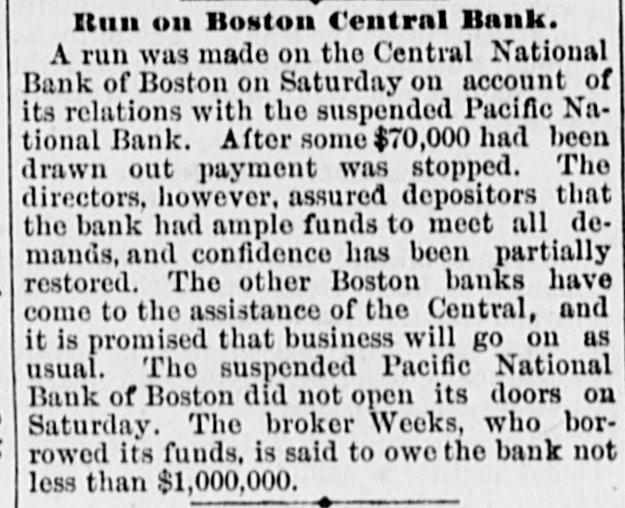
Run on Boston Central Bank. A run was made on the Central National Bank of Boston on Saturday on account of its relations with the suspended Pacific National Bank. After some $70,000 had been drawn out payment was stopped. The directors, however, assured depositors that the bank had ample funds to meet all demands, and confidence has been partially restored. The other Boston banks have come to the assistance of the Central, and it is promised that business will go on as usual. The suspended Pacific National Bank of Boston did not open its doors on Saturday. The broker Weeks, who borrowed its funds, is said to owe the bank not less than $1,000,000.


Article from The Daily Gazette, November 21, 1881

Click image to open full size in new tab

Article Text

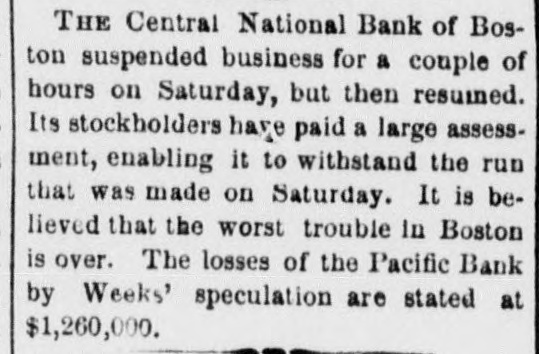
THE Central National Bank of Boston suspended business for a couple of hours on Saturday, but then resuined. Its stockholders have paid a large assessment, enabling it to withstand the run that was made on Saturday. It is believed that the worst trouble in Boston is over. The losses of the Pacific Bank by Weeks' speculation are stated at $1,260,000.


Article from New-York Tribune, November 21, 1881

Click image to open full size in new tab

Article Text

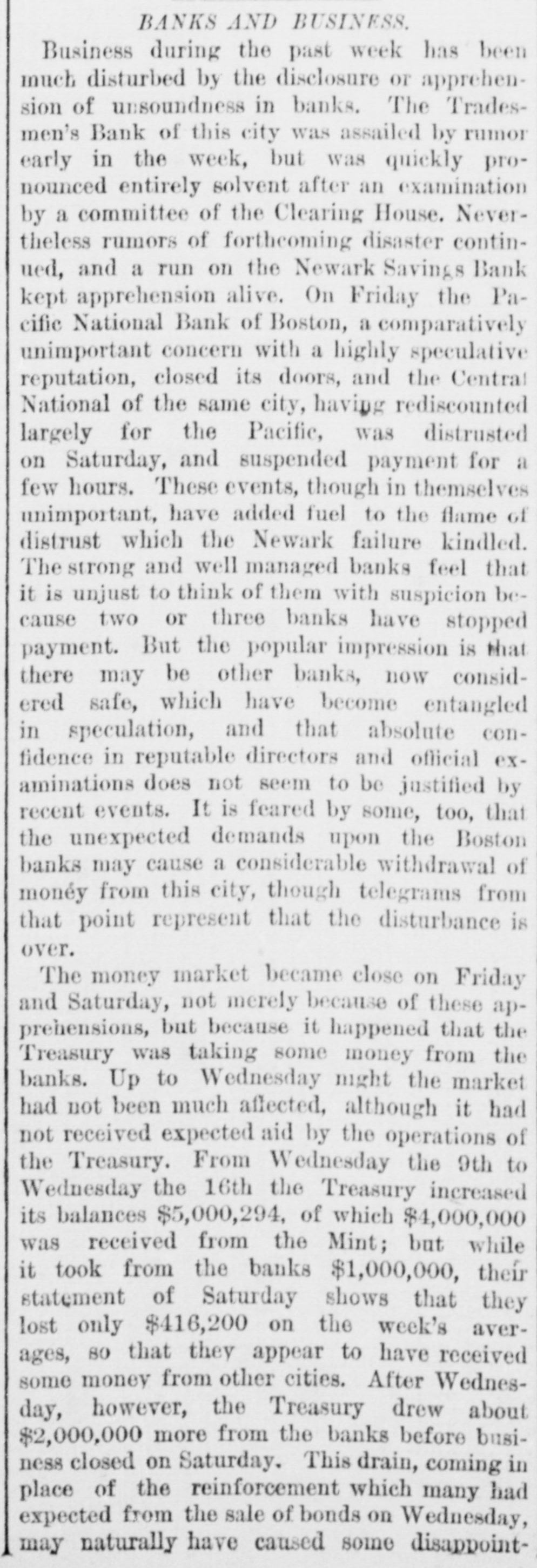
BANKS AND BUSINESS. Business during the past week has been much disturbed by the disclosure or apprehension of unsoundness in banks. The Tradesmen's Bank of this city was assailed by rumor early in the week, but was quickly pronounced entirely solvent after an examination by a committee of the Clearing House. Nevertheless rumors of forthcoming disaster continued, and a run on the Newark Savings Bank kept apprehension alive. On Friday the Pacific National Bank of Boston, a comparatively unimportant concern with a highly speculative reputation, closed its doors, and the Central National of the same city, having rediscounted largely for the Pacific, was distrusted on Saturday, and suspended payment for a few hours. These events, though in themselves unimportant, have added fuel to the flame of distrust which the Newark failure kindled. The strong and well managed banks feel that it is unjust to think of them with suspicion because two or three banks have stopped payment. But the popular impression is that there may be other banks, now considered safe, which have become entangled in speculation, and that absolute confidence in reputable directors and official examinations does not seem to be justified by recent events. It is feared by some, too, that the unexpected demands upon the Boston banks may cause a considerable withdrawal of money from this city, though telegrams from that point represent that the disturbance is over. The money market became close on Friday and Saturday, not merely because of these apprehensions, but because it happened that the Treasury was taking some money from the banks. Up to Wednesday night the market had not been much affected, although it had not received expected aid by the operations of the Treasury. From Wednesday the 9th to Wednesday the 16th the Treasury increased its balances $5,000,294, of which $4,000,000 was received from the Mint; but while it took from the banks $1,000,000, their statement of Saturday shows that they lost only $416,200 on the week's averages, 80 that they appear to have received some money from other cities. After Wednesday, however, the Treasury drew about $2,000,000 more from the banks before business closed on Saturday. This drain, coming in place of the reinforcement which many had expected from the sale of bonds on Wednesday, may naturally have caused some disappoint-


Article from The Cheyenne Daily Leader, November 22, 1881

Click image to open full size in new tab

Article Text

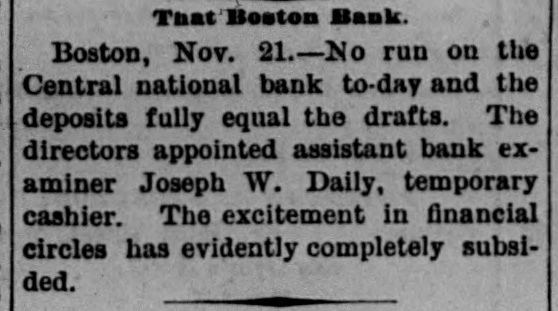
That Boston Bank. Boston, Nov. 21.-No run on the Central national bank to-day and the deposits fully equal the drafts. The directors appointed assistant bank examiner Joseph W. Daily, temporary cashier. The excitement in financial circles has evidently completely subsided.


Article from The Wheeling Daily Intelligencer, November 22, 1881

Click image to open full size in new tab

Article Text

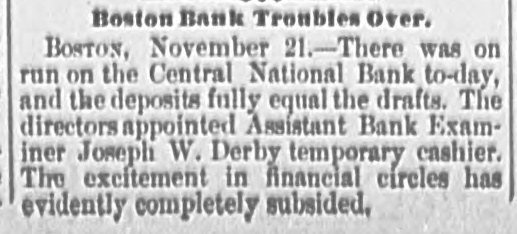
Boston Bank Tronbles Over. BOSTON, November 21.-There was on run on the Central National Bank to-day, and the deposits fully equal the drafts. The directorsappointed Assistant Bank Examiner Joseph W. Derby temporary cashier. The excitement in financial circles has evidently completely subsided,


Article from The Owosso Times, November 25, 1881

Click image to open full size in new tab

Article Text

MISCELLANEOUS. Another defalcation of $40,000 by Howgat is discovered. The hospitals of New York are full of small patients. Secretary Kirkwood recommends a dissolution of tribal relations of the Indians, the reduction of reservations in number and area the establishment of experimental farms and educational facilities. The workingmen's congress at Pittsburg vig orously denounces Chinese and convict labor and favors legal protection of trades unions. At Philadelphia the Academy of Music was crowded Wednesday night by an enthusiastic audience gathered to hear O'Connor, the Irish Land League ambassador. Senator Sherman addressed the Cincinnati Chamber of Commerce Wednesday. He commented on the era of good feeling now fairly inaugurated, and rejoiced that there were no issues to divide the people. The damage by floods at Oshkosh and Fond du Lac, Wis, is estimated at over $600,000. The inundation is caused chiefly by government dams at Appleton and Menasha. Dr. Agnew, consulting physician in the case of President Garfield, has been summoned as a witness in the Guiteau trial. Secretary of the treasury Folger has issued a circular intended to secure greater safety to passengers on inland and coast steam vessels. Inspectors must see that every requirement of equipment is provided and that the rules and regulations of the board of supervising inspectors are observed. Secretary Blaine was on the witness stand Thursday testifying as to the assassination of President Garfield. Keifer of Ohio is now mentioned as a strong candidate for the speakership. The Health Department, Chicago, has push. ed the corporations which use soft coal 80 hard that Justice Wallace has fined the Michigan Southern Railroad $50 for allowing its locomotives to persist in using the soft coal without a smoke consumer. The court declared he would enforce the law vigorously among the railroads until all the roads burn hard coal within the city limits. 600 inmates were rescued without loss of life although they were wet through by rain storm which prevailed. The origin of the fire is supposed to have been in the dust flues from contact with over heated pipes. Frederick P. Lilley, formerly an official, is under arrest for receiving $8,000 for favors rendered in awarding a mail contract in Louisiana. Postmaster General James has started on his southern tour of inspection, going directly to Florida and returning by Atlanta. The Central National bank of Boston has suspended. It is announced that the extension of the Wabash railway to Des Moines, Iowa, will be completed in a few weeks. Saturday was observed in Washington as the 50th anniversary of Garfield's birth by a local literary society of which he was a member.


Article from The Daily Gazette, November 29, 1881

Click image to open full size in new tab

Article Text

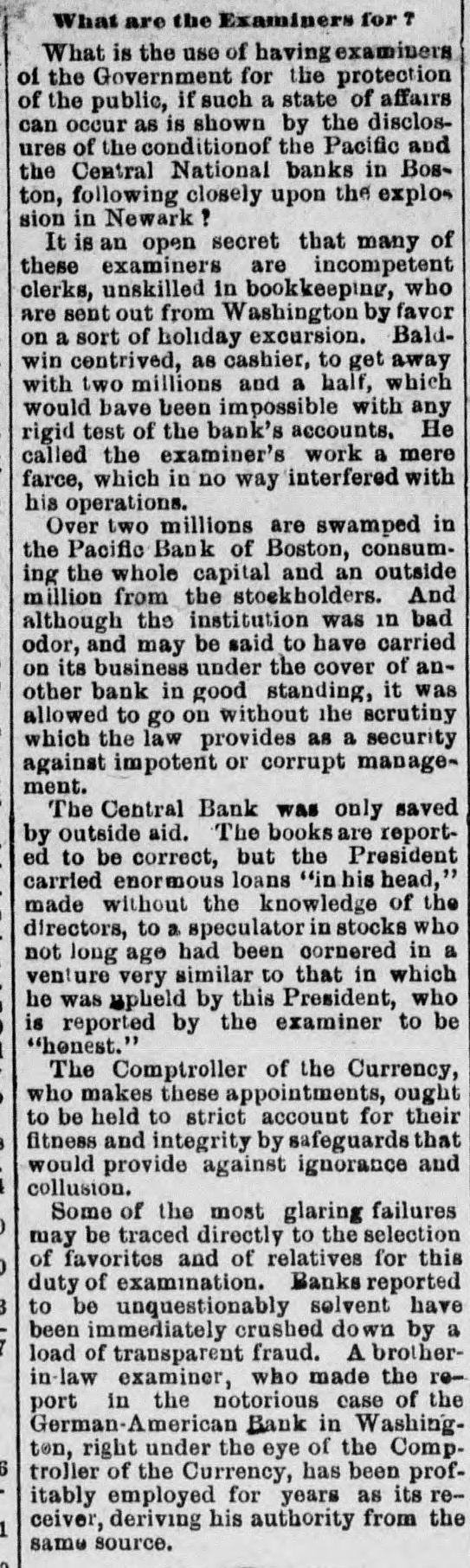
What are the Examiners for T What is the use of having examiners of the Government for the protection of the public, if such a state of affairs can occur as is shown by the disclosures of the condition of the Pacific and the Central National banks in Boston, following closely upon the explos sion in Newark ! It is an open secret that many of these examiners are incompetent clerks, unskilled in bookkeeping, who are sent out from Washington by favor on a sort of holiday excursion. Baldwin contrived, as cashier, to get away with two millions and a half, which would bave been impossible with any rigid test of the bank's accounts. He called the examiner's work a mere farce, which in no way interfered with his operations. Over two millions are swamped in the Pacific Bank of Boston, consuming the whole capital and an outside million from the stockholders. And the was in and odor, although may institution be said to have carried bad on its business under the cover of another bank in good standing, it was allowed to go on without the scrutiny which the law provides as a security against impotent or corrupt management. The Central Bank was only saved by outside aid. The books are reported to be correct, but the President carried enormous loans "in his head, made without the knowledge of the directors, to a speculator in stocks who not long age had been cornered in a venture very similar to that in which he was upheld by this President, who is reported by the examiner to be "honest." The Comptroller of the Currency, who makes these appointments, ought to be held to strict account for their fitness and integrity by safeguards that would provide against ignorance and collusion. Some of the most glaring failures may be traced directly to the selection of favorites and of relatives for this duty of examination. Banks reported to be unquestionably solvent have been immediately crushed down by a load of transparent fraud. A brotherin-law examiner, who made the report in the notorious case of the German-American Bank in Washington, right under the eye of the Comp6 troller of the Currency, has been profitably employed for years as its receiver, deriving his authority from the same source.