Click image to open full size in new tab
Article Text
# Proclamation by the Governor.
The wise and patriotic determination of the planters
of the Confederate States to sell no cotton until the
blockade of our ports is raised, has deprived our gov-
ernment of the resources it could otherwise command
from the disposition of our great staple. To supply the
means for carrying on the war waged against us by the
United States, the Confederate government, like other
governments under like circumstances, has been forced
to resort to its credit, which credit rests upon the wealth
of the people of the Confederate States.
The government has judiciously determined to issue
one hundred millions of treasury notes, secured by a
direct tax upon the property of the people, and the re-
demption of the notes is as certain as the property they
represent. All the banks of the Confederate States, ex-
cept those of New Orleans and Mobile, receive these
treasury notes in payment of debts due to them, and
pay them out to their creditors, thus establishing a cur-
rency of real value, which meets all the wants of the
public. In order that their banks might be enabled to
conduct their business so as to make the treasury notes
a common currency, they have been obliged to suspend
specie payments, because, unless the creditors of the
banks receive the treasury notes, these notes could not
be taken by them in payment, and would thus fail to
answer the purposes of currency.
The banks of Louisiana, however, are forbidden to
suspend specie payment, and our legislature, unlike that
of the other States, is without constitutional right to
legalise a suspension. As treasury notes must be below
par, and hence cannot circulate like bank notes while
the banks continue to pay specie, one of two results
must follow; Our banks will be obliged to redeem all
their notes and pay all their depositors in coin, and then
be utterly unable to increase their loans, or they will
have to suspend. If the banks refuse to receive treas-
ury notes and continue to pay out coin, the entire plant-
ing interest of the State, dependent upon the ability of
the commission merchants to obtain facilities from the
banks in order to furnish the planters with their usual
supplies, will be deprived of the means absolutely ne-
cessary to meet the current expenses of the year, while
the treasury notes would be subject to constant depri-
cation, and the credit of the Confederate government
seriously impaired thereby. To prevent consequences
that will prove so disastrous to the whole people, I re-
commend to the several banks of New Orleans to sus-
pend specie payment.
In recommending this course to the banks, I am well
aware that they incur the risk of a forfeiture of their
charters, from which neither the legislature nor the ex-
ecutive can relieve them.
But the legislature can refer the whole subject to the
people of the State, at such times as, in their wisdom,
they may think proper; and the people, in convention
assembled, will decide whether the forfeiture of their
charters by the banks shall be exacted or relinquished.
The banks are now in a condition to pay all of their
liabilities as rapidly as they can be presented at their
counters, and, notwithstanding the suspension of specie
payments hereby recommended, they can maintain a
position so strong, that when the period for resumption
arrives, they will not be embarrassed or even inconven-
ienced by paying every dollar in coin.
As the spirit of the constitution and the laws of this
State, regulating the banking system, regards the bill-
holder as the creditor first to be protected, an additional
restriction is proposed, which looks directly to his inter-
est; in order, therefore, to secure the prompt redemp-
tion of the circulation of the banks, and to preserve
their present impregnable state when the resumption of
specie payment shall be deemed advisable, the banks
will observe the following regulations:
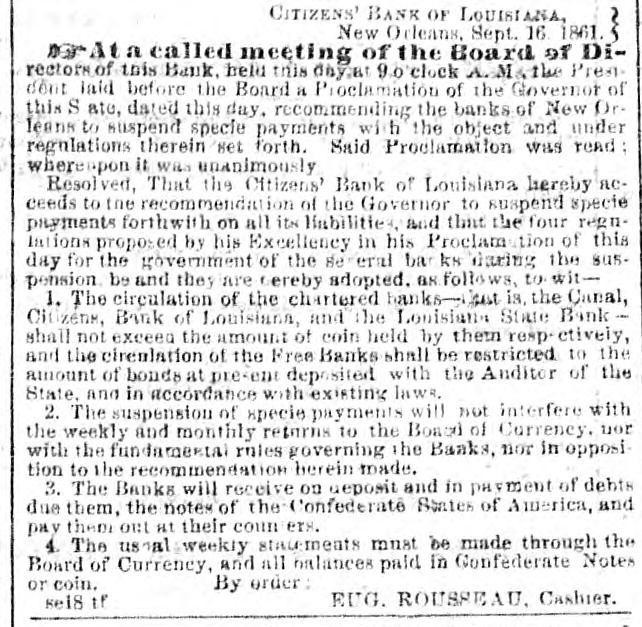
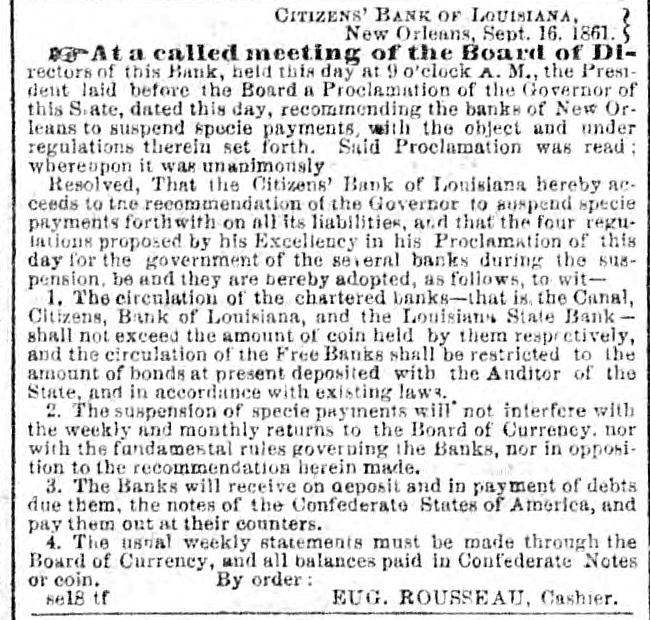
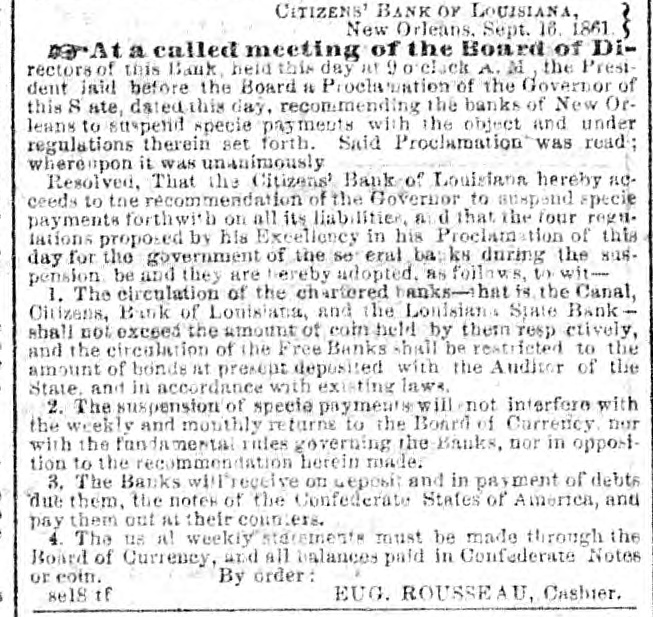
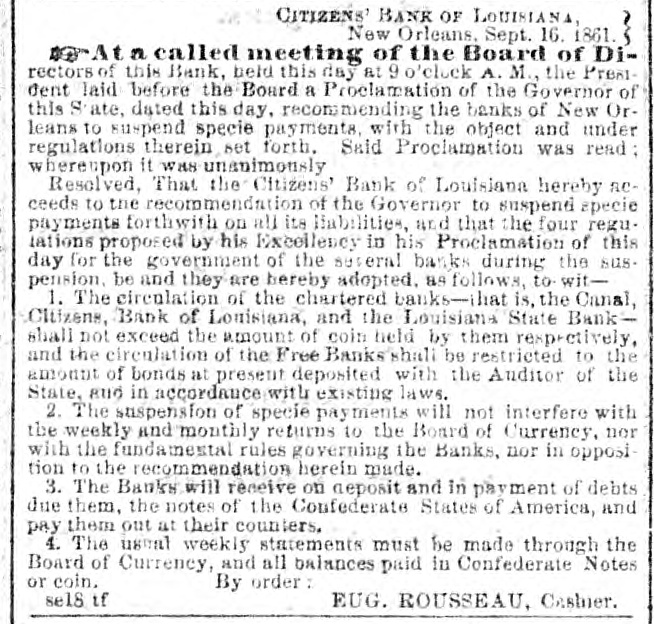
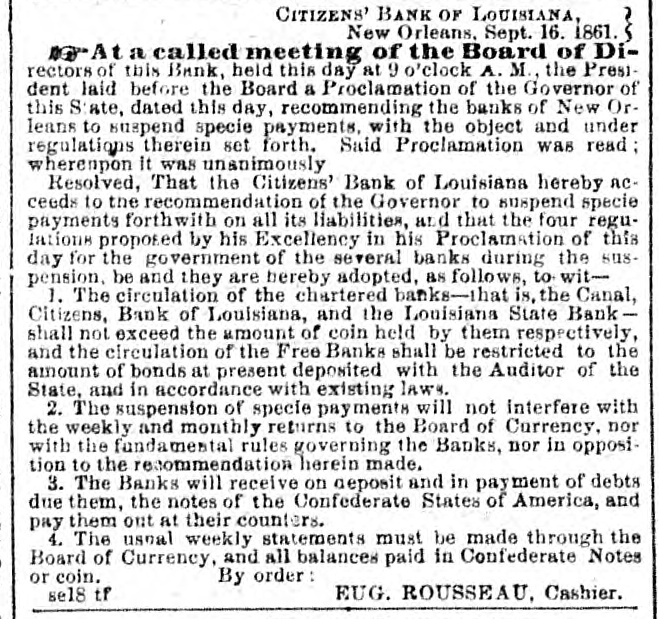
1. The circulation of the chartered banks that is,
the Canal, Citizens' Bank of Louisiana, and the Louisi-
ana State bank-shall not exceed the amount of coin
actually held by them respectively, and the circulation
of the free banks shall be restricted to the amount of
bonds at present deposited with the auditor of this
State, and in accordance with existing laws.
2. The suspension of specie payments will not inter-
fere with the weekly and monthly returns to the board
of currency, nor with the fundamental rules governing
the banks, not in opposition to the recommendation
herein made.
3. The banks will receive on deposit and in payment
of debts due them, the notes of the Confederate States
of America, and pay them out at their counters.
4. The usual weekly statements must be made through
the board of currency, and all balances paid in Confed-
erate notes or in coin.
THOS, O. MOORE, Governor.
# LINCOLN SPIES AMONG US.
Three men were arrested
a few days ago, by order of the governor, and detained
for examination on a most serious charge. Their names
are J. D. Walker, Nicholas Casper, and Roden-
baum, all three pilots. Being alleged to be spies, it was
deemed by the governor most fitting that they should
be turned over to the Confederate commander of this
military department, and accordingly they were sent to
Gen. Twiggs, who was preparing, in conjunction with
the governor, to have an investigation. The act in
which it is alleged these men were engaged is no less
than a treasonable correspondence, having for its object
the assisting in the organisation of Lincoln's flotilla for
a descent upon this city.
Notwithstanding the serious aspect which this case
has assumed, writs of habeas corpus were sued out yes-
terday by two of these men, before judge Howell, of
the sixth district court-Geo. L. Bright, Esq., appearing
as attorney for Walker, and J. B. Cotton, Esq., for
Casper. The writ was served upon mayor Monroe, who
denied having the prisoners in custody, his honor hav-
ing stated that under the orders of the governor and
major-general Twiggs, they had been committed to the
charge of the sheriff, who, we learn, will be summoned
to-day.
It is very possible that the evidence is yet incomplete
to warrant their detention, and if so, these men may be
turned loose to pursue their treasonable schemes, and
both the governor and Gen. Twiggs be thwarted in the
patriotic efforts to guard the welfare of the republic.
The following is a copy of a letter addressed to Capt.
J. D. Walker, one of the spies arrested, which was in-
tercepted. It shows clearly that we are surrounded by
spies, and that at the present time too much vigilance
and circumspection cannot be used by the police as
well as by our loyal citizens generally. This letter
would seem to convict the whole party beyond the
shadow of a doubt.
[Picayune.
"LOUISVILLE, June 30, 1861.
"Capt. J. D. Walker:
"DEAR SIR-I received your letter the other day, and
was happy to hear from you. You say that the rebels
suspected you, and tried to get up a report that you was
a Union man-but convinced them you were sound on
the southern goose. The river is so low that we cannot
make much headway. I am in hopes that we will have
a rise in a day or so, that will let us out to Cairo. I
saw Capt. N. McLelland the other day; he is just up
from New Orleans; he says that business is flat; there is
nothing doing, and the Union feeling is stronger than
any body could suppose. His opinion is that it would
not take a very large army to capture the city, as most
of the citizens are in favor of the Union. I expect to
have charge of one of the gunboats, and want you to
keep me posted about things Give all the informa-
tion about Red and Ouachita rivers, and how much
cotton there is from Alexandria to the mouth, and how
much will be made on black and Ouachita rivers, for it
will be our aim to take all the cotton on these rivers,
and send it up the Ohio. I want you to find out how
many pilots we can count on in Red River, and send us
the names. You have sent me two besides yourself
from Ouachita-Casper and Rodenbaum. Tell them
that they will have a share in all the prizes that are
taken. Tell R. to write to me. All the pilots that go
with us will make money enough to do them without
going on the rivers again. I will let you know in time
to meet me at Memphis. It will be a glorious thing to
clear the traitors out, and show them a lesson for rob-
bing mints and customhouses, and stealing steamboats.
You must send your letters by private hands to Cairo.
Do not trust the mails. I will send this to Memphis by
private hands, and have it mailed there. My respects
to Mrs. W. Yours,
[Signed]
JOHN SEBASTIAN."
The New York chamber of commerce have, in a re-
cent meeting aired their patriotism in a series of resolu-
tions, to which we give place, simply that the southern
people may clearly perceive where stand the men who
have thriven on southern patronage. At a meeting of
the chamber on the 5th the subjoined resolutions
were unanimously adopted:
Resolved, That this chamber, in view of the unex-