Union National Bank (Beloit, KS)

Episode Information

Episode UID
670101487
Episode Type
Run → Suspension → Closure
Bank Type
national
Bank ID
67010 national
Charter Number
6701
Start Date
November 3, 1923
Location
Beloit, Kansas (39.456, -98.106)

Metadata

Model
gpt-5-mini (chosen from majority vote of a three-model LLM ensemble)
Short Digest
902a472d8fb79d11

Response Measures

Accommodated withdrawals, Capital injected, Full suspension, Books examined

Receivership Details

Depositor recovery rate
40.6%
Date receivership started
1923-11-13
Date receivership terminated
1931-11-02
OCC cause of failure
Economic conditions
Share of assets assessed as good
44.4%
Share of assets assessed as doubtful
23.4%
Share of assets assessed as worthless
32.2%

Events (5)

1. March 30, 1903 Chartered
Source
historical_nic
2. November 3, 1923 Run
Cause
Bank Specific Adverse Info
Cause Details
Loss of confidence stemming from badly placed loans and connections to the Felix Broeker failures led deposit withdrawals.
Measures
Representatives of other Beloit banks canvassed situation; board considered reorganization or takeover.
Newspaper Excerpt
A heavy run was made Saturday and the bank was virtually without funds at the close of business that day.
Source
newspapers
3. November 5, 1923 Suspension
Cause
Bank Specific Adverse Info
Cause Details
Board closed the bank due to inability of borrowers to pay, large bad loans and practical depletion of funds after run.
Newspaper Excerpt
The Union National bank of Beloit failed to open its doors for business this morning. A notice posted on the door says the bank was closed by the board of directors and put in the hands of a special examiner.
Source
newspapers
4. November 13, 1923 Receivership
Source
historical_nic
5. November 24, 1923 Receivership
Newspaper Excerpt
D. L. Noon, a bank examiner, has been appointed receiver for the Union National bank at Beloit, which failed recently.
Source
newspapers

Newspaper Articles (13)

Article from The Emporia Gazette, November 5, 1923

Click image to open full size in new tab

Article Text

NATIONAL BANK AT BELOIT CLOSES DOORS Inability of Borrowers to Make Good Their Indebtedness Given as Cause HEAVY RUN SATURDAY Union National is First National Bank to Close in Kansas Since 1914 Beloit, Nov. 5.—The Union National bank of Beloit failed to open its doors for business this morning. Inability of borrowers to make good their indebtedness was given as the cause of the bank's closing. Frank Mergen is president, Tom P. Downs, vice-president and Leo A. Mergen, cashier and active manager. The latest statement shows the Union National had deposits of $750,000, loans $875,000, capital $50,000, surplus and undivided profits, $100,000. The Union National is said to be the first national bank to close in Kansas since 1914. A notice posted on the door today says the bank was closed by the board of directors and put in the hands of R. L. Noone, special examiner. A heavy run was made Saturday and the bank was virtually without funds at the close of business that day. Representatives of the three other banks canvassed the situation yesterday with the board of directors of the Union National with a view to re-organizing or taking over that institution, but it was decided this was impracticable. Cashier Mergen also was owner of the Scottsville State bank closed by the state bank's alleged bad loans are said by officials to have been traceable to transactions of Felix Broeker and F. J. Lefferdink who managed the defunct Kansas State bank of Salina. Lefferdink is fugitive.


Article from The St. Louis Star and Times, November 5, 1923

Click image to open full size in new tab

Article Text

$1,000,000 BANK CLOSES DOORS AT BELOIT, KAN. BELOIT, KAN., Nov. 5.—(By U. P.) — The Union National Bank here, a $1,000,000 institution, closed its doors today when directors voted to liquidate debts and turned the bank over to federal authorities. Outstanding notes to L. A. Mergen and G. E. Mergen of Albuquerque, N. M., sons of Frank Mergen, president of the bank, were said to have contributed to the bank's failure.


Article from The Iola Register, November 5, 1923

Click image to open full size in new tab

Article Text

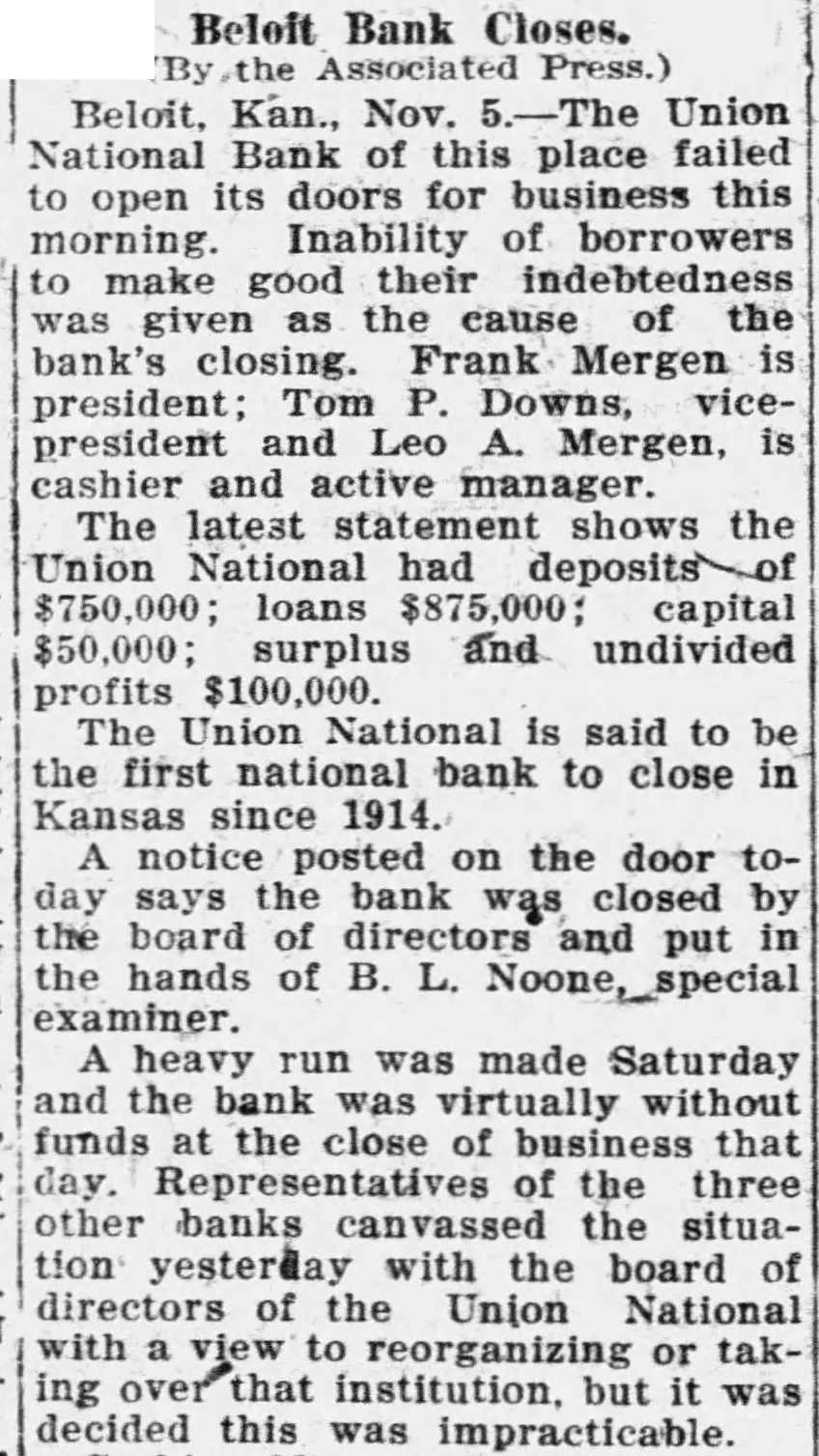
Beloit Bank Closes. (By the Associated Press.) Beloit, Kan., Nov. 5.—The Union National Bank of this place failed to open its doors for business this morning. Inability of borrowers to make good their indebtedness was given as the cause of the bank's closing. Frank Mergen is president; Tom P. Downs, vice-president and Leo A. Mergen, is cashier and active manager. The latest statement shows the Union National had deposits of $750,000; loans $875,000; capital $50,000; surplus and undivided profits $100,000. The Union National is said to be the first national bank to close in Kansas since 1914. A notice posted on the door today says the bank was closed by the board of directors and put in the hands of B. L. Noone, special examiner. A heavy run was made Saturday and the bank was virtually without funds at the close of business that day. Representatives of the three other banks canvassed the situation yesterday with the board of directors of the Union National with a view to reorganizing or taking over that institution, but it was decided this was impracticable.


Article from The Kansas City Star, November 5, 1923

Click image to open full size in new tab

Article Text

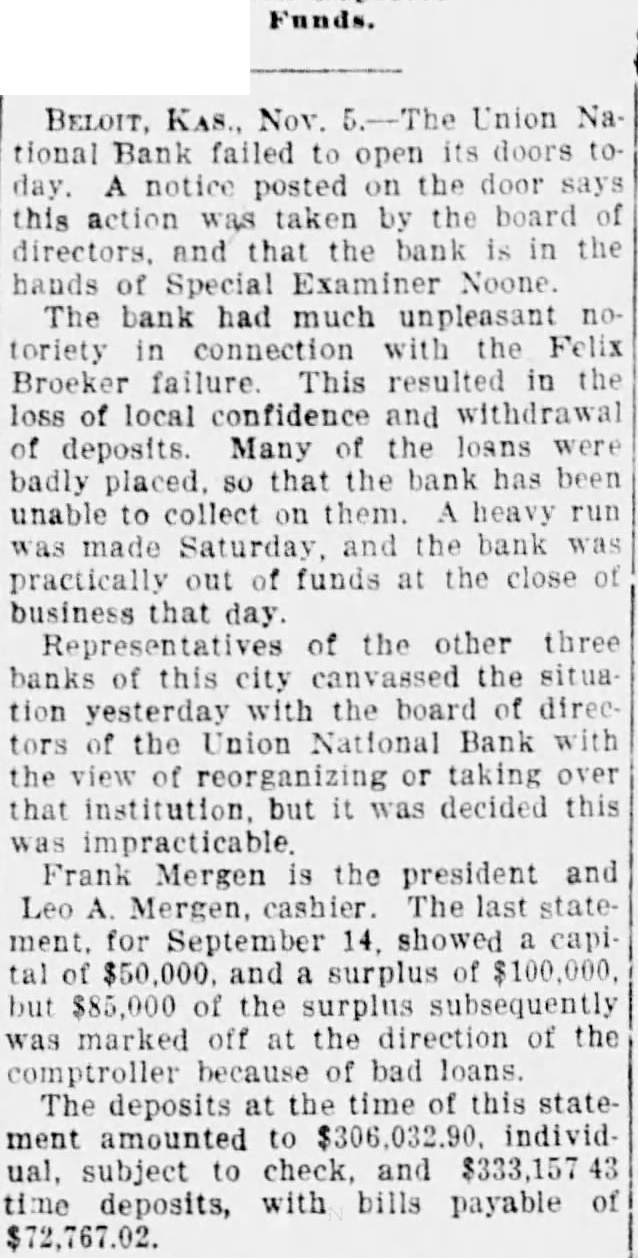
BELOIT, KAS., Nov. 5.—The Union National Bank failed to open its doors today. A notice posted on the door says this action was taken by the board of directors, and that the bank is in the hands of Special Examiner Noone. The bank had much unpleasant notoriety in connection with the Felix Broeker failure. This resulted in the loss of local confidence and withdrawal of deposits. Many of the loans were badly placed, so that the bank has been unable to collect on them. A heavy run was made Saturday, and the bank was practically out of funds at the close of business that day. Representatives of the other three banks of this city canvassed the situation yesterday with the board of directors of the Union National Bank with the view of reorganizing or taking over that institution, but it was decided this was impracticable. Frank Mergen is the president and Leo A. Mergen, cashier. The last statement, for September 14, showed a capital of $50,000, and a surplus of $100,000, but $85,000 of the surplus subsequently was marked off at the direction of the comptroller because of bad loans. The deposits at the time of this statement amounted to $306,032.90, individual, subject to check, and $333,157.43 time deposits, with bills payable of $72,767.02.


Article from The Kansas City Star, November 5, 1923

Click image to open full size in new tab

Article Text

BELOIT, KAS., Nov. 5.—The Union National Bank failed to open its doors today. A notice posted on the door says this action was taken by the board of directors, and that the bank is in the hands of Special Examiner Noone. The bank had much unpleasant notoriety in connection with the Felix Broeker failure. This resulted in the loss of local confidence and withdrawal of deposits. Many of the loans were badly placed, so that the bank has been unable to collect on them. A heavy run was made Saturday, and the bank was practically out of funds at the close of business that day.


Article from The Kansas City Star, November 5, 1923

Click image to open full size in new tab

Article Text

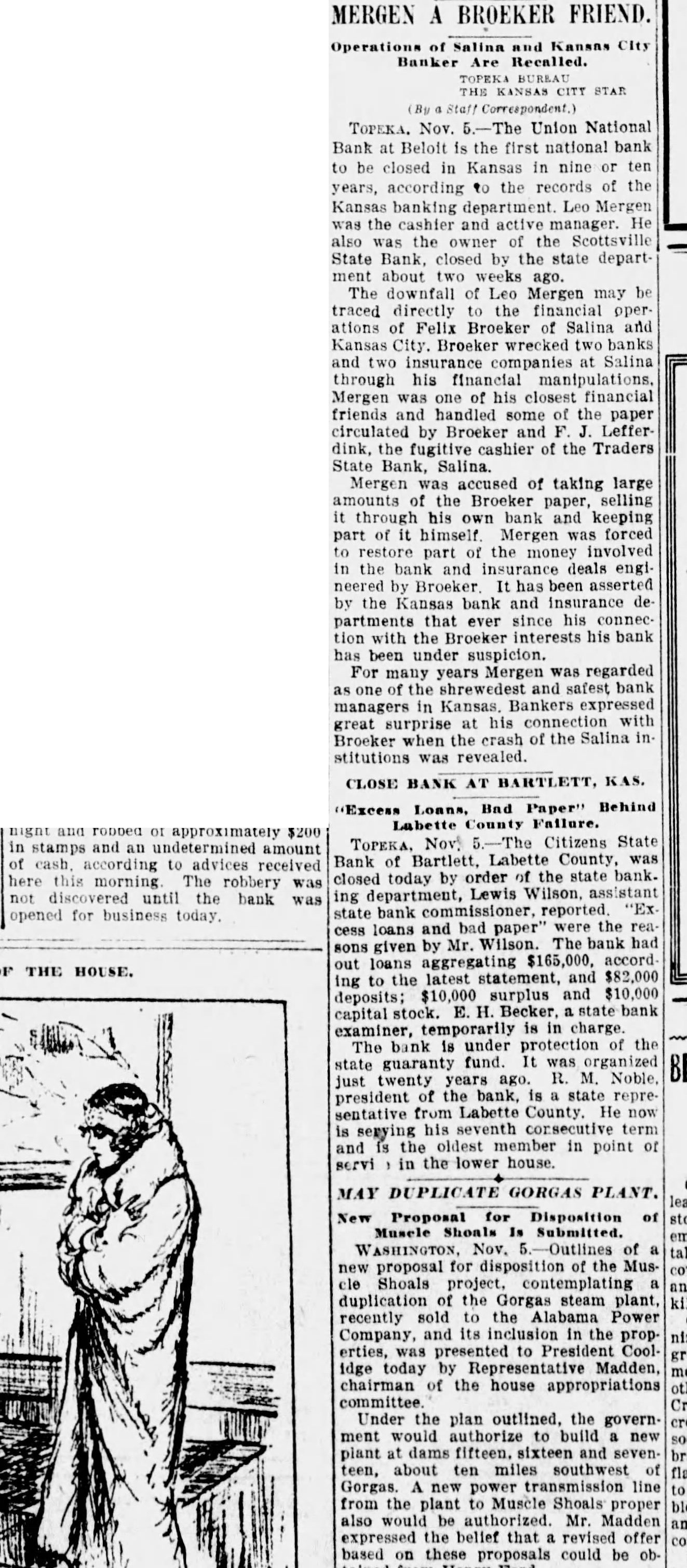
MERGEN A BROEKER FRIEND. Operations of Salina and Kansas City Banker Are Recalled. TOPEKA BUREAU THE KANSAS CITY STAR (By a Staff Correspondent.) TOPEKA, Nov. 5.—The Union National Bank at Beloit is the first national bank to be closed in Kansas in nine or ten years, according to the records of the Kansas banking department. Leo Mergen was the cashier and active manager. He also was the owner of the Scottsville State Bank, closed by the state department about two weeks ago. The downfall of Leo Mergen may be traced directly to the financial operations of Felix Broeker of Salina and Kansas City. Broeker wrecked two banks and two insurance companies at Salina through his financial manipulations. Mergen was one of his closest financial friends and handled some of the paper circulated by Broeker and F. J. Lefferdink, the fugitive cashier of the Traders State Bank, Salina. Mergen was accused of taking large amounts of the Broeker paper, selling it through his own bank and keeping part of it himself. Mergen was forced to restore part of the money involved in the bank and insurance deals engineered by Broeker. It has been asserted by the Kansas bank and insurance departments that ever since his connection with the Broeker interests his bank has been under suspicion. For many years Mergen was regarded as one of the shrewdest and safest bank managers in Kansas. Bankers expressed great surprise at his connection with Broeker when the crash of the Salina institutions was revealed. CLOSE BANK AT BARTLETT, KAS. "Excess Loans, Bad Paper" Behind Labette County Failure. TOPEKA, Nov. 5.—The Citizens State Bank of Bartlett, Labette County, was closed today by order of the state banking department, Lewis Wilson, assistant state bank commissioner, reported. "Excess loans and bad paper" were the reasons given by Mr. Wilson. The bank had out loans aggregating $165,000, according to the latest statement, and $82,000 deposits; $10,000 surplus and $10,000 capital stock. E. H. Becker, a state bank examiner, temporarily is in charge. The bank is under protection of the state guaranty fund. It was organized just twenty years ago. R. M. Noble, president of the bank, is a state representative from Labette County. He now is serving his seventh consecutive term and is the oldest member in point of service in the lower house. MAY DUPLICATE GORGAS PLANT. New Proposal for Disposition of Muscle Shoals Is Submitted. WASHINGTON, Nov. 5.—Outlines of a new proposal for disposition of the Muscle Shoals project, contemplating a duplication of the Gorgas steam plant, recently sold to the Alabama Power Company, and its inclusion in the properties, was presented to President Coolidge today by Representative Madden, chairman of the house appropriations committee. Under the plan outlined, the government would authorize to build a new plant at dams fifteen, sixteen and seventeen, about ten miles southwest of Gorgas. A new power transmission line from the plant to Muscle Shoals proper also would be authorized. Mr. Madden expressed the belief that a revised offer based on these proposals could be obtained from Henry Ford.


Article from The Atchison Daily Globe, November 7, 1923

Click image to open full size in new tab

Article Text

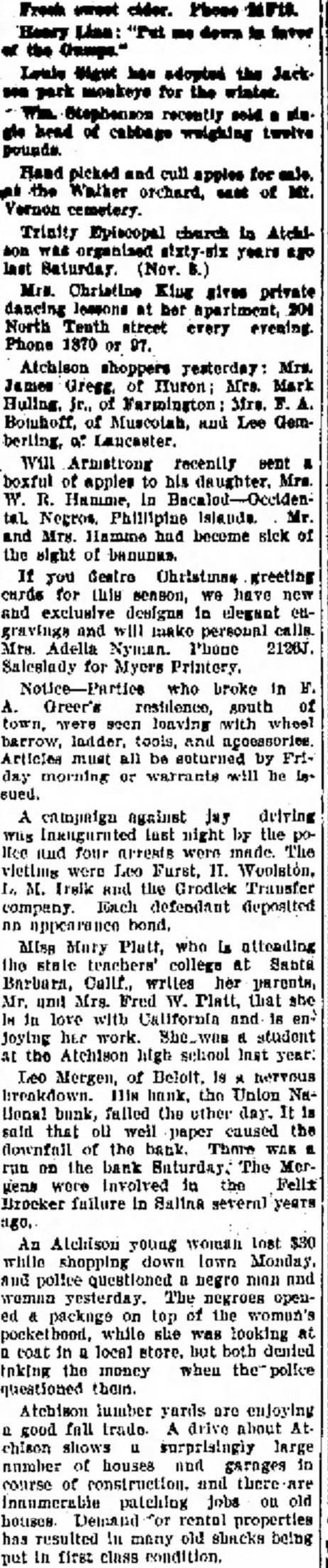
Fresh sweet cider. Phone 21F13. Henry Linn: "Put me down in favor of the Gramps." Louis Bigut has adopted the Jackson park monkeys for the winter. Wm. Stephenson recently sold a single head of cabbage weighing twelve pounds. Hand picked and cull apples for sale at the Walker orchard, east of Mt. Vernon cemetery. Trinity Episcopal church in Atchison was organized sixty-six years ago last Saturday. (Nov. 5.) Mrs. Christine King gives private dancing lessons at her apartment, 204 North Tenth street every evening. Phone 1370 or 97. Atchison shoppers yesterday: Mrs. James Gregg, of Huron; Mrs. Mark Huling, jr., of Farmington; Mrs. E. A. Bomhoff, of Muscotah, and Lee Gemberling, of Lancaster. Will Armstrong recently sent a boxful of apples to his daughter, Mrs. W. R. Hamme, in Bacalod-Occidental Negros, Philippine Islands. Mr. and Mrs. Hamme had become sick of the sight of bananas. If you desire Christmas greeting cards for this season, we have new and exclusive designs in elegant engravings and will make personal calls. Mrs. Adella Nyman. Phone 2126J. Saleslady for Myers Printery. Notice—Parties who broke in E. A. Greer's residence, south of town, were seen leaving with wheelbarrow, ladder, tools, and accessories. Articles must all be returned by Friday morning or warrants will be issued. A campaign against jay driving was inaugurated last night by the police and four arrests were made. The victims were Leo Furst, H. Woolston, L. M. Irsik and the Grodick Transfer company. Each defendant deposited an appearance bond. Miss Mary Platt, who is attending the state teachers' college at Santa Barbara, Calif., writes her parents, Mr. and Mrs. Fred W. Platt, that she is in love with California and is enjoying her work. She was a student at the Atchison high school last year. Leo Mergen, of Beloit, is a nervous breakdown. His bank, the Union National bank, failed the other day. It is said that oil well paper caused the downfall of the bank. There was a run on the bank Saturday. The Mergens were involved in the Felix Brocker failure in Salina several years ago. An Atchison young woman lost $30 while shopping down town Monday, and police questioned a negro man and woman yesterday. The negroes opened a package on top of the woman's pocketbook, while she was looking at a coat in a local store, but both denied taking the money when the police questioned them. Atchison lumber yards are enjoying a good fall trade. A drive about Atchison shows a surprisingly large number of houses and garages in course of construction, and there are innumerable patching jobs on old houses. Demand for rental properties has resulted in many old shacks being put in first class condition.


Article from The Beloit Gazette, November 7, 1923

Click image to open full size in new tab

Article Text

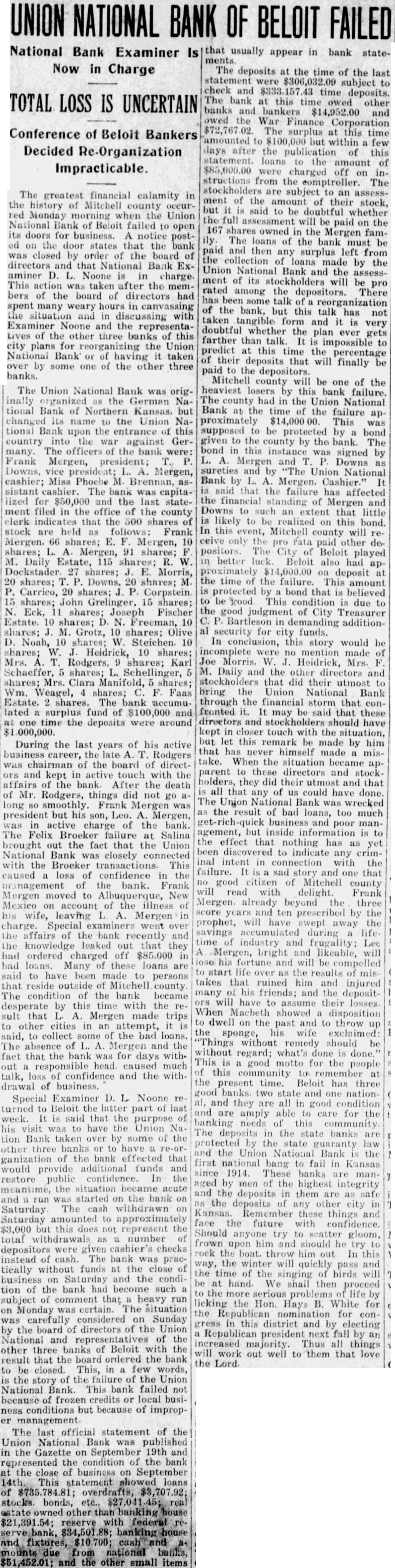
UNION NATIONAL BANK OF BELOIT FAILED National Bank Examiner Is Now in Charge TOTAL LOSS IS UNCERTAIN Conference of Beloit Bankers Decided Re-Organization Impracticable. The greatest financial calamity in the history of Mitchell county occurred Monday morning when the Union National Bank of Beloit failed to open its doors for business. A notice posted on the door states that the bank was closed by order of the board of directors and that National Bank Examiner D. L. Noone is in charge. This action was taken after the members of the board of directors had spent many weary hours in canvassing the situation and in discussing with Examiner Noone and the representatives of the other three banks of this city plans for reorganizing the Union National Bank or of having it taken over by some one of the other three banks. The Union National Bank was originally organized as the German National Bank of Northern Kansas, but changed its name to the Union National Bank upon the entrance of this country into the war against Germany. The officers of the bank were: Frank Mergen, president; T. P. Downs, vice president; L. A. Mergen, cashier; Miss Phoebe M. Brennan, assistant cashier. The bank was capitalized for $50,000 and the last statement filed in the office of the county clerk indicates that the 500 shares of stock are held as follows: Frank Mergen, 66 shares; E. F. Mergen, 10 shares; L. A. Mergen, 91 shares; F. M. Daily Estate, 115 shares; R. W. Dockstader, 27 shares; J. E. Morris, 20 shares; T. P. Downs, 20 shares; M. P. Carrico, 20 shares; J. P. Corpstein, 15 shares; John Grelinger, 15 shares; N. Eck, 11 shares; Joseph Fischer Estate, 10 shares; D. N. Freeman, 10 shares; J. M. Grotz, 10 shares; Olive D. Noah, 10 shares; W. Steichen, 10 shares; W. J. Heidrick, 10 shares; Mrs. A. T. Rodgers, 9 shares; Karl Schaeffer, 5 shares; L. Schellinger, 5 shares; Mrs. Clara Manifold, 5 shares; Wm. Weagel, 4 shares; C. F. Faas Estate, 2 shares. The bank accumulated a surplus fund of $100,000 and at one time the deposits were around $1,000,000. During the last years of his active business career, the late A. T. Rodgers was chairman of the board of directors and kept in active touch with the affairs of the bank. After the death of Mr. Rodgers, things did not go along so smoothly. Frank Mergen was president but his son, Leo. A. Mergen, was in active charge of the bank. The Felix Broeker failure at Salina brought out the fact that the Union National Bank was closely connected with the Broeker transactions. This caused a loss of confidence in the management of the bank. Frank Mergen moved to Albuquerque, New Mexico on account of the illness of his wife, leaving L. A. Mergen in charge. Special examiners went over the affairs of the bank recently and the knowledge leaked out that they had ordered charged off $85,000 in bad loans. Many of these loans are said to have been made to persons that reside outside of Mitchell county. The condition of the bank became desperate by this time with the result that L. A. Mergen made trips to other cities in an attempt, it is said, to collect some of the bad loans. The absence of L. A. Mergen and the fact that the bank was for days without a responsible head, caused much talk, loss of confidence and the withdrawal of business. Special Examiner D. L. Noone returned to Beloit the latter part of last week. It is said that the purpose of his visit was to have the Union National Bank taken over by some of the other three banks or to have a re-organization of the bank effected that would provide additional funds and restore public confidence. In the meantime, the situation became acute and a run was started on the bank on Saturday. The cash withdrawn on Saturday amounted to approximately $3,000 but this does not represent the total withdrawals, as a number of depositors were given cashier's checks instead of cash. The bank was practically without funds at the close of business on Saturday and the condition of the bank had become such a subject of comment that a heavy run on Monday was certain. The situation was carefully considered on Sunday by the board of directors of the Union National and representatives of the other three banks of Beloit with the result that the board ordered the bank to be closed. This, in a few words, is the story of the failure of the Union National Bank. This bank failed not because of frozen credits or local business conditions but because of improper management. The last official statement of the Union National Bank was published in the Gazette on September 19th and represented the condition of the bank at the close of business on September 14th. This statement showed loans of $735,784.81; overdrafts, $3,707.92; stocks, bonds, etc., $27,041.45; real estate owned other than banking house $21,391.54; reserve with federal reserve bank, $34,501.88; banking house and fixtures, $10,700; cash and amounts due from national banks, $51,452.01; and the other small items that usually appear in bank statements. The deposits at the time of the last statement were $306,032.09 subject to check and $333,157.43 time deposits. The bank at this time owed other banks and bankers $14,952.00 and owed the War Finance Corporation $72,767.02. The surplus at this time amounted to $100,000 but within a few days after the publication of this statement, loans to the amount of $85,000.00 were charged off on instructions from the comptroller. The stockholders are subject to an assessment of the amount of their stock, but it is said to be doubtful whether the full assessment will be paid on the 167 shares owned in the Mergen family. The loans of the bank must be paid and then any surplus left from the collection of loans made by the Union National Bank and the assessment of its stockholders will be pro rated among the depositors. There has been some talk of a reorganization of the bank, but this talk has not taken tangible form and it is very doubtful whether the plan ever gets farther than talk. It is impossible to predict at this time the percentage of their deposits that will finally be paid to the depositors. Mitchell county will be one of the heaviest losers by this bank failure. The county had in the Union National Bank at the time of the failure approximately $14,000.00. This was supposed to be protected by a bond given to the county by the bank. The bond in this instance was signed by L. A. Mergen and T. P. Downs as sureties and by "The Union National Bank by L. A. Mergen, Cashier." It is said that the failure has affected the financial standing of Mergen and Downs to such an extent that little is likely to be realized on this bond. In this event, Mitchell county will receive only the pro rata paid other depositors. The City of Beloit played in better luck. Beloit also had approximately $14,000.00 on deposit at the time of the failure. This amount is protected by a bond that is believed to be good. This condition is due to the good judgment of City Treasurer C. P. Bartleson in demanding additional security for city funds. In conclusion, this story would be incomplete were no mention made of Joe Morris, W. J. Heidrick, Mrs. F. M. Daily and the other directors and stockholders that did their utmost to bring the Union National Bank through the financial storm that confronted it. It may be said that these directors and stockholders should have kept in closer touch with the situation, but let this remark be made by him that has never himself made a mistake. When the situation became apparent to these directors and stockholders, they did their utmost and that is all that any of us could have done. The Union National Bank was wrecked as the result of bad loans, too much get-rich-quick business and poor management, but inside information is to the effect that nothing has as yet been discovered to indicate any criminal intent in connection with the failure. It is a sad story and one that no good citizen of Mitchell county will read with delight. Frank Mergen, already beyond the three score years and ten prescribed by the prophet, will have swept away the savings accumulated during a lifetime of industry and frugality; Leo A. Mergen, bright and likeable, will lose his fortune and will be compelled to start life over as the results of mistakes that ruined him and injured many of his friends; and the depositors will have to assume their losses. When Macbeth showed a disposition to dwell on the past and to throw up the sponge, his wife exclaimed: "Things without remedy should be without regard; what's done is done." This is a good motto for the people of this community to remember at the present time. Beloit has three good banks, two state and one national, and they are all in good condition and are amply able to care for the banking needs of this community. The deposits in the state banks are protected by the state guaranty law and the Union National Bank is the first national bank to fail in Kansas since 1914. These banks are managed by men of the highest integrity and the deposits in them are as safe as the deposits of any other city in Kansas. Remember these things and face the future with confidence. Should anyone try to scatter gloom, frown upon him and should he try to rock the boat, throw him out. In this way, the winter will quickly pass and the time of the singing of birds will be at hand. We shall then proceed to the more serious problems of life by licking the Hon. Hays B. White for the Republican nomination for congress in this district and by electing a Republican president next fall by an increased majority. Thus all things will work out well to them that love the Lord."
Article from The Stockton Review and Rooks County Record, November 8, 1923

Click image to open full size in new tab

Article Text

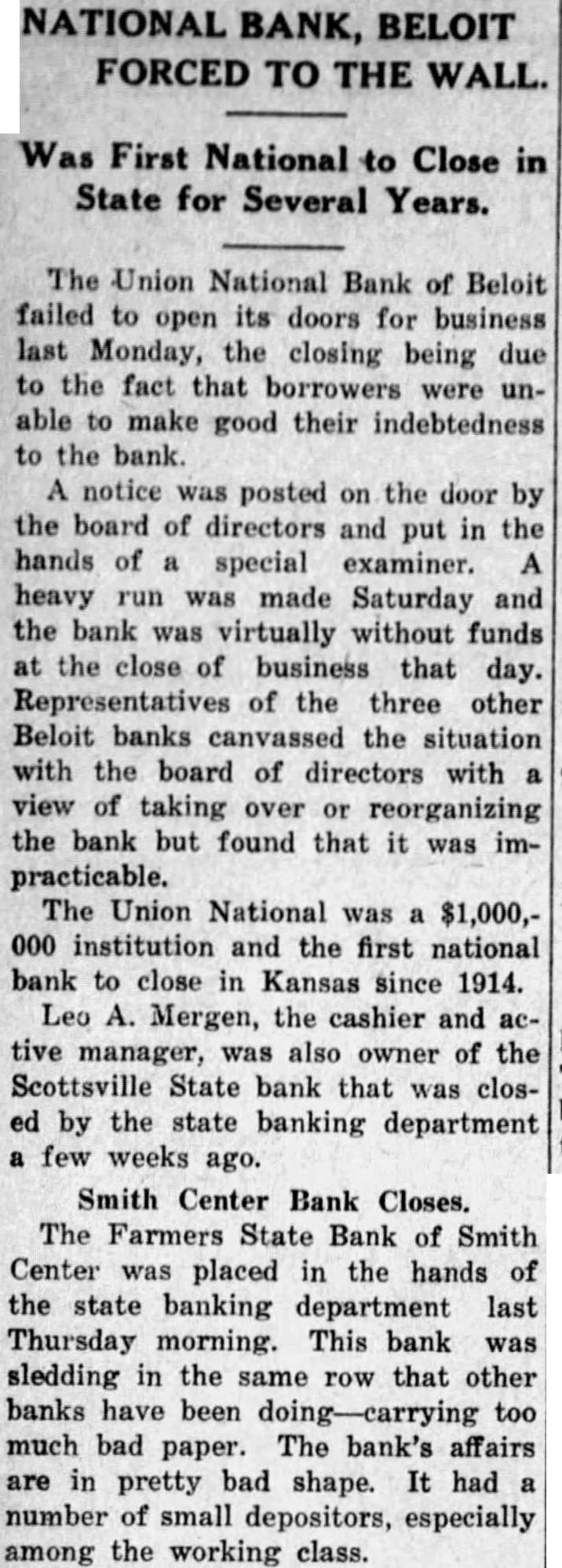
NATIONAL BANK, BELOIT FORCED TO THE WALL. Was First National to Close in State for Several Years. The Union National Bank of Beloit failed to open its doors for business last Monday, the closing being due to the fact that borrowers were unable to make good their indebtedness to the bank. A notice was posted on the door by the board of directors and put in the hands of a special examiner. A heavy run was made Saturday and the bank was virtually without funds at the close of business that day. Representatives of the three other Beloit banks canvassed the situation with the board of directors with a view of taking over or reorganizing the bank but found that it was impracticable. The Union National was a $1,000,000 institution and the first national bank to close in Kansas since 1914. Leo A. Mergen, the cashier and active manager, was also owner of the Scottsville State bank that was closed by the state banking department a few weeks ago. Smith Center Bank Closes. The Farmers State Bank of Smith Center was placed in the hands of the state banking department last Thursday morning. This bank was sledding in the same row that other banks have been doing—carrying too much bad paper. The bank's affairs are in pretty bad shape. It had a number of small depositors, especially among the working class.


Article from Smith County Journal, November 8, 1923

Click image to open full size in new tab

Article Text

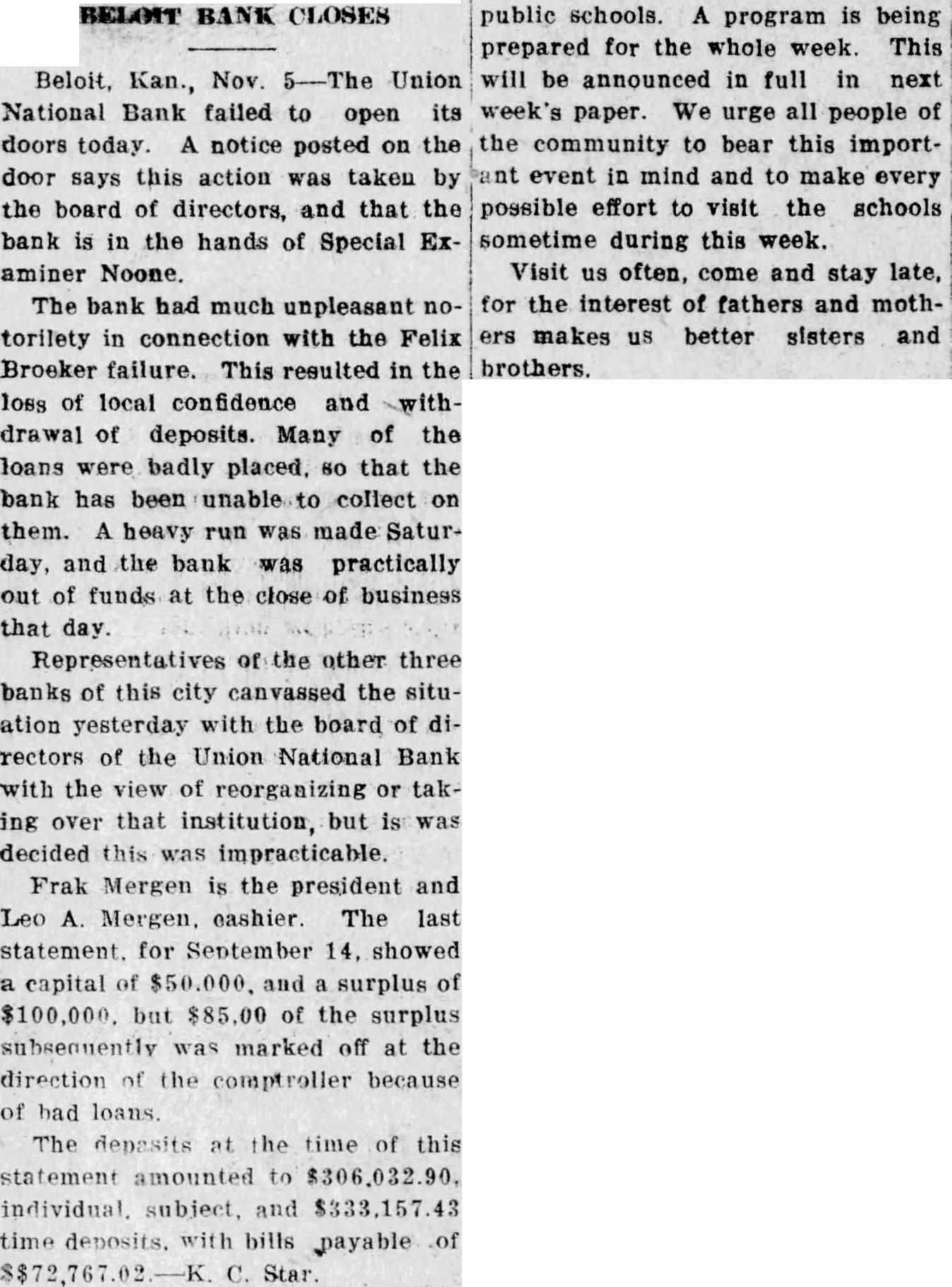
BELOIT BANK CLOSES Beloit, Kan., Nov. 5—The Union National Bank failed to open its doors today. A notice posted on the door says this action was taken by the board of directors, and that the bank is in the hands of Special Examiner Noone. The bank had much unpleasant notoriety in connection with the Felix Broeker failure. This resulted in the loss of local confidence and withdrawal of deposits. Many of the loans were badly placed, so that the bank has been unable to collect on them. A heavy run was made Saturday, and the bank was practically out of funds at the close of business that day. Representatives of the other three banks of this city canvassed the situation yesterday with the board of directors of the Union National Bank with the view of reorganizing or taking over that institution, but it was decided this was impracticable. Frank Mergen is the president and Leo A. Mergen, cashier. The last statement, for September 14, showed a capital of $50,000, and a surplus of $100,000, but $85,000 of the surplus subsequently was marked off at the direction of the comptroller because of bad loans. The deposits at the time of this statement amounted to $306,032.90, individual, subject, and $333,157.43 time deposits, with bills payable of $72,767.02.—K. C. Star.


Article from The Beloit Gazette, November 21, 1923

Click image to open full size in new tab

Article Text

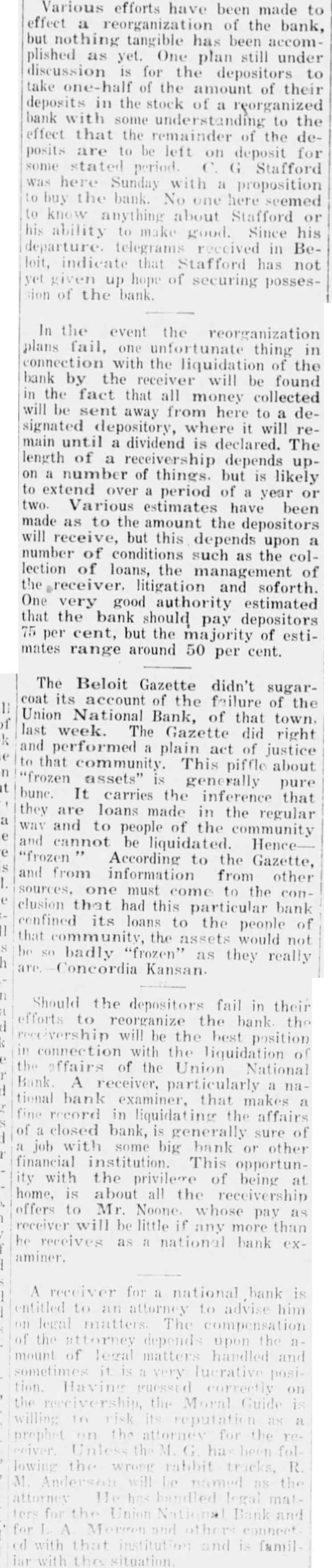
Various efforts have been made to effect a reorganization of the bank, but nothing tangible has been accomplished as yet. One plan still under discussion is for the depositors to take one-half of the amount of their deposits in the stock of a reorganized bank with some understanding to the effect that the remainder of the deposits are to be left on deposit for some stated period. C. G. Stafford was here Sunday with a proposition to buy the bank. No one here seemed to know anything about Stafford or his ability to make good. Since his departure, telegrams received in Beloit, indicate that Stafford has not yet given up hope of securing possession of the bank. In the event the reorganization plans fail, one unfortunate thing in connection with the liquidation of the bank by the receiver will be found in the fact that all money collected will be sent away from here to a designated depository, where it will remain until a dividend is declared. The length of a receivership depends upon a number of things, but is likely to extend over a period of a year or two. Various estimates have been made as to the amount the depositors will receive, but this depends upon a number of conditions such as the collection of loans, the management of the receiver, litigation and soforth. One very good authority estimated that the bank should pay depositors 75 per cent, but the majority of estimates range around 50 per cent. The Beloit Gazette didn't sugarcoat its account of the failure of the Union National Bank, of that town, last week. The Gazette did right and performed a plain act of justice to that community. This piffle about "frozen assets" is generally pure bunc. It carries the inference that they are loans made in the regular way and to people of the community and cannot be liquidated. Hence—"frozen" According to the Gazette, and from information from other sources, one must come to the conclusion that had this particular bank confined its loans to the people of that community, the assets would not be so badly "frozen" as they really are.—Concordia Kansan. Should the depositors fail in their efforts to reorganize the bank, the receivership will be the best position in connection with the liquidation of the affairs of the Union National Bank. A receiver, particularly a national bank examiner, that makes a fine record in liquidating the affairs of a closed bank, is generally sure of a job with some big bank or other financial institution. This opportunity with the privilege of being at home, is about all the receivership offers to Mr. Noone, whose pay as receiver will be little if any more than he receives as a national bank examiner. A receiver for a national bank is entitled to an attorney to advise him on legal matters. The compensation of the attorney depends upon the amount of legal matters handled and sometimes it is a very lucrative position. Having guessed correctly on the receivership, the Moral Guide is willing to risk its reputation as a prophet on the attorney for the receiver. Unless the M. G. has been following the wrong rabbit tracks, R. M. Anderson will be named as the attorney. He has handled legal matters for the Union National Bank and for L. A. Mergen and others connected with that institution and is familiar with the situation.


Article from The Kansan, November 29, 1923

Click image to open full size in new tab

Article Text

BELOIT BANK RECEIVER NAMED Washington, Nov. 24.—D. L. Noon, a bank examiner, has been appointed receiver for the Union National bank at Beloit, which failed recently. Quite an effort was made by certain Beloit citizens and Salina and Concordia banking interests, to have Ray Green of Concordia appointed to the place; but so many protests were received by the comptroller of the currency that his application was rejected and Mr. Noon, who is said to have no connection with the various financial interests involved, was appointed instead. The foregoing news dispatch appeared in the Topeka Capital and in a Kansas City paper, on Sunday last. The first publicity given to the desire of Commodore Green and of his application for the position mentioned was printed in the Kansan. Some people thought our article was merely another gesture in a "newspaper dow." Some people said: "The thing's absurd. Why should Green be appointed to such a position? He never had any experience in a bank, except on the front side of the counter. What does he know about a bank—running or busted?" Well, it's very likely the reason why his services as receiver were in demand by certain interests that possibly might profit thereby. They came very nearly putting it over, too, before the people most interested in having an intelligent, reliable man in the position to safeguard the interests of depositors and stockholders alike, knew such a move was on foot. All say that Mr. Noon is such a man.


Article from The Beloit Gazette, February 27, 1924

Click image to open full size in new tab

Article Text

BANK RECEIVER NOONE ENTERED SUITS MONDAY. D. L. Noone, receiver of the Union National Bank of Beloit, filed three suits in the federal court yesterday to collect promissory notes. All the defendants are residents of Beloit. The amounts which he is trying to collect are: C. L. Kagey, $14,823.11; Matt Stover, $5,747; and F. H. Wessling $4,000.—Tuesday's Topeka Capital.