6690. Bank of Louisiana (New Orleans, LA)

Bank Information

Episode Type
Suspension β†’ Closure
Bank Type
state
Start Date
September 16, 1861
Location
New Orleans, Louisiana (29.955, -90.075)

Metadata

Model
gpt-5-mini
Short Digest
843a433475572d64

Response Measures

None

Description

Contemporary papers report the banks of New Orleans (including the Bank of Louisiana) suspended specie payments beginning 16 Sept 1861 (Governor's proclamation, articles). No discrete depositor 'run' is described in these items. Later (June 1863) multiple papers state the Bank of Louisiana was required to go into liquidation under commissioners β€” a permanent closure. I infer 'state' bank from name and references to state charters. OCR errors in some articles corrected (e.g., 'specie pay' -> 'specie payment').

Events (3)

1. September 16, 1861 Suspension
Cause
Government Action
Cause Details
Governor's proclamation and the adoption of Confederate Treasury notes made it impracticable for New Orleans banks to continue specie payments; the governor recommended immediate suspension and banks adopted suspension of coin payments on/after Sept 16, 1861.
Newspaper Excerpt
To prevent consequences... I recommend to the several Banks of New Orleans immediately to suspend specie payment.
Source
newspapers
2. June 9, 1862 Other
Newspaper Excerpt
Case against the Bank of Louisiana... On the 16th of September, 1861... the banks not only suspended specie payments, but also ceased to pay out their own notes... The court held ... the deposits since Sept 16 had been in Confederate notes ... Judgment for complainant. The case will probably be taken up before Gen. Butler. Judge Bell... granted a delay ... to obtain a revision of the judgment. (Provost Court, June 9, 1862).
Source
newspapers
3. June 26, 1863 Receivership
Newspaper Excerpt
The Bank of Louisiana and Louisiana State Bank had been required to go into liquidation under three commissioners each. Their condition is said to be satisfactory.
Source
newspapers

Newspaper Articles (21)

Article from New Orleans Daily Crescent, September 17, 1861

Click image to open full size in new tab

Article Text

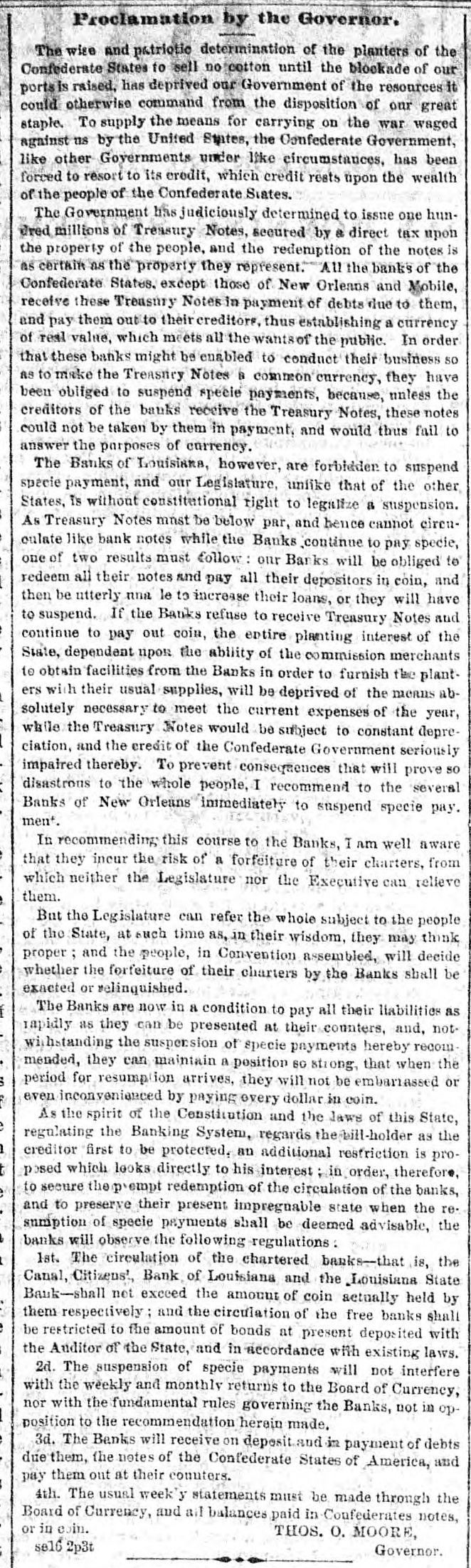
Proclamation by the Governor. The wise and patriotic determination of the planters of the Confederate States to sell no cotton until the blockade of our ports is raised, has deprived our Government of the resources it could otherwise command from the disposition of our great staple. To supply the means for carrying on the war waged against us by the Unifed States, the Confederate Government, like other Governments under like circumstances, has been forced to resort to its credit, which credit rests upon the wealth of the people of the Confederate States. The Government has judiciously determined to issue one hundred millions of Treasury Notes, secured by a direct tax upon the property of the people, and the redemption of the notes is as certain as the property they represent. All the banks of the Confederate States, except those of New Orleans and Mobile, receive these Treasury Notes in payment of debts due to them, and pay them out to their creditors, thus establishing a currency of real value, which meets all the wants of the public. In order that these banks might be enabled to conduct their business so as to make the Treasury Notes 8 common currency, they have been obliged to suspend specie payments, because, unless the creditors of the banks receive the Treasury Notes, these notes could not be taken by them in payment. and would thus fail to answer the parposes of currency. The Banks of Louisiana, however, are forbidden to suspend specie payment, and our Legislature, unlike that of the other States, is without constitutional right to legalize a suspension. As Treasury Notes must be below par, and hence cannot circuculate like bank notes while the Banks continue to pay specie, one of two results must follow: our Banks will be obliged to redeem all their notes and pay all their depositors in coin, and theu be utterly una le to increase their loans, or they will have to suspend. If the Banks refuse to receive Treasury Notes and continue to pay out coin, the entire planting interest of the State, dependent upon the ability of the commission merchants to obtain facilities from the Banks in order to furnish the planters with their usual supplies, will be deprived of the means absolutely necessary to meet the current expenses of the year, while the Treasury Notes would be subject to constant depreelation, and the credit of the Confederate Government seriously impaired thereby. To prevent consequences that will prove so disastrous to the whole people, I recommend to the several Banks of New Orleans immΓ©diately to suspend specie pay. men't In recommending this course to the Banks, T am well aware that they incur the risk of a forfeiture of their charters, from which neither the Legislature nor the Executive can relieve them. But the Legislature can refer the whole subject to the people of the State, at such time as, in their wisdom, they may think proper; and the people, in Convention assembled, will decide whether the forfeiture of their charters by the Banks shall be exacted or relinquished, The Banks are now in a condition to pay all their liabilities as rapidly as they ean be presented at their counters, and, not withstanding the suspension of specie payments hereby recommended, they can maintain a position SO strong, that when the period for resumption arrives, they will not be embarrassed or even inconvenienced by paying every dollar in coin. As the spirit of the Constitution and the laws of this State, regulating the Banking System. regards the bill-holder as the creditor first to be protected, an additional restriction is proposed which looks directly to his interest in order, therefore, secure the prompt redemption of the circulation of the banks, and to preserve their present impregnable state when the resumption of specie payments shall be deemed advisable, the banks will observe the following regulations: 1st. The circulation of the chartered banks-that is, the Canal, Citizens', Bank of Louisiana and the Louisiana State Bauk-shall not exceed the amount of coin actually held by them respectively; and the circulation of the free banks shalt be restricted to the amount of bonds at present deposited with the Auditor of the State, and in accordance wilh existing laws. 2d. The suspension of specie payments will not interfere with the weekly and monthly returns to the Board of Currency, nor with the fundamental rules governing the Banks, not in opposition to the recommendation herein made. 3d. The Banks will receive on deposit and in payment of debts due them, the notes of the Confederate States of America, and pay them out at their counters. 4th. The usual week'y statements must be made through the Board of Currency, and all balances paid in Confederates notes, or in coin. THOS, O. MOORE, sel6 2p3t Governor.
Article from New Orleans Daily Crescent, September 18, 1861

Click image to open full size in new tab

Article Text

Proclamation by the Governor. The wise and patriotic determination of the planters of the Confederate States to sell no cotton until the blookade of our portsis raised, has deprived our Government of the resources it could otherwise command from the disposition of our great staple. To supply the means for carrying on the war waged against us by the United States, the Confederate Government, like other Governments under like circumstances, has been forced to resort to its credit, which credit rests upon the wealth of the people of the Confederate States. The Government has judiciously determined to issue one hundred millions of Treasury Notes, secured by a direct tax upon the property of the people, and the redemption of the notes is as certain as the property they represent. All the banks of the Confederate States. except those of New Orleans and Mobile, receive these Treasury Notes in payment of debts due to them, and pay them out to their creditors, thus establishing a currency of real value, which meets all the wants of the public. In order that these banks might be enabled to conduct their business so AS to make the Treasney Notes B common currency, they have been obliged to suspend specie payments, because, unless the creditors of the banks receive the Treasury Notes, these notes could not be taken by them in payment. and would thus fail to answer the purposes of currency. The Banks of Louisiana, however, are forbidder to suspend specie payment, and our Legislature, unlike that of the other States, is without constitutional right to legalize a suspension. As Treasury Notes mnst be below par, and hence cannot circuculate like bank notes while the Banks (continue to pay specie, one of two results must follow: our Banks will be obliged to redeem all their notes and pay all their depositors in coin, and then be utterly nna le to increase their loans, or they will have to suspend. If the Banks refuse to receive Treasury Notes and continue to pay out coin, the entire planting interest of the State, dependent upon the ability of the commission merchants to obtain facilities from the Banks in order to furnish the planters with their usual supplies, will be deprived of the morns absolutely necessary to meet the current expenses of the year, while the Treasury Notes would be subject to constant depreI ciation, and the credit of the Confederate Government seriously impaired thereby. To prevent consequences that will prove so : disastrous to the whole people, I recommend to the several Banks of New Orleans immediately to suspend specie pay. men't In recommending this course to the Banks, I am well aware that they incur the risk of a forfeiture of their charters, from which neither the Legislature nor the Executive can relieve them. ) But the Legislature can refer the whole subject to the people of the State, at such time as, in their wisdom, they may think proper ; and the people, in Convention assembled, will decide whether the forfeiture of their charters by the Banks shall be exacted or relinquished. f The Banks are now in a condition to pay all their liabilities as rapidly as they can be presented at their counters, and, notwithstanding the suspension of specie payments hereby recom mended, they can maintain a position 60 strong, that when the $ period for resumption arrives, they will not be embariassed or F even inconvenienced by paying every dollar in coin. As the spirit of the Constitution and the Jaws of this State, ) regulating the Banking System, regards the bill-holder as the 1 creditor first to be protected. an additional restriction is prot posed which looks directly to his interest in order, therefore, e to secure the prempt redemption of the circulation of the banks, and to preserve their present impregnable state when the resumption of specie payments shall be deemed advisable, the / banks will observe the following regulations : 1st. The circulation of the chartered banks-that is, the Canal, Citizens!, Bank of Louisiana and the Louisiana State Bauk-shall net exceed the amount of coin actually held by : them respectively ; and the circulation of the free banks shall e be restricted to the amount of bonds at present deposited with the Auditor of the State, and in accordance with existing laws. 2d. The suspension of specie payments will not interfere 1 with the weekly and monthly returns to the Board of Currency, nor with the fundamental rules governing the Banks, not in opposition to the recommendation herein made. : 3d. The Banks will receive on deposit and in payment of debts due them, the notes of the Confederate States of America, and pay them out at their counters. : 4th. The usual week'y statements must be made through the Board of Currency, and all balances paid in Confederates notes, or in coin. THOS. O. MOORE, self 2p3t Governor.


Article from New Orleans Daily Crescent, September 19, 1861

Click image to open full size in new tab

Article Text

Proclamation by the Governor. The wise and patriotic determination of the planters of the Confederate States to sell no cotton until the blockade of our ports is raised, has deprived our Government of the resources it could otherwise command from the disposition of our great staple. To supply the means for carrying on the war waged against us by the United States, the Confederate Government, like other Governments under like circumstances, has been forced to resort to its credit, which credit rests upon the wealth of the people of the Confederate States. The Government has judiciously determined to issue one hundred millions of Treasury Notes, secured by a direct tax upon the property of the people, and the redemption of the notes is as certain as the property they represent. All the banks of the Confederate States, except those of New Orleans and Mobile, receive these Treasury Notes in payment of debts due to them, and pay them out to their creditors, thus establishing a currency of real value, which meets all the wants of the public. In order that these banks might be enabled to conduct their business so as to make the Treasury Notes a common currency, they have been obliged to suspend specie payments, because, unless the creditors of the banks receive the Treasury Notes, these notes could not be taken by them in payment, and would thus fail to answer the purposes of currency. The Banks of Louisiana, however, are forbidden to suspend spscie payment, and our Legislature, unlike that of the other States, is without constitutional right to legalize a suspension. As Treasury Notes must be below par, and hence cannot circuculate like bank notes while the Banks continue to pay specie, one of two results must follow our Banks will be obliged to redeem all their notes and pay all their depositors in coin, and then be utterly unacl to increase their loans, or they will have to suspend. If the Banks refuse to receive Treasury Notes and continue to pay out coin, the entire planting interest of the State, dependent upon the ability of the commission merchants to obtain facilities from the Banks in order to furnish the planters with their usual supplies, will be deprived of the means absolutely necessary to meet the current expenses of the year, while the Treasury Notes would be subject to constant depre1 ciation, and the credit of the Confederate Government seriously impaired thereby. To prevent consequences that will prove so disastrous to the whole people, I recommend to the several Banks of New Orleans immediately to suspend specie pay. ment. In recommending this course to the Banks, I am well aware that they inenr the risk of 8 forfeiture of their charters, from which neither the Legislature nor the Executive can relieve them. But the Legislature can refer the whole subject to the people of the State, at such time as. in their wisdom, they may think proper ; and the people, in Convention assembled, will decide whether the forfeiture of their charters by the Banks shall be exacted or relinquished. The Banks are now in a condition to pay all their liabilities as rapidly as they can be presented at their counters, and, notwithstanding the suspersion of specie payments hereby recommended, they can maintain 8 position SO strong, that when the period for resumption arrives, they will not be embarrassed or even inconvenienced by paying every dollar in coin. As the spirit of the Constitution and the laws of this State, regulating the Banking System. regards the bill-holder as the creditor first to be protected, an additional restriction is proposed which looks directly to his interest; in order, therefore, to secure the prompt redemption of the circulation of the banks, and to preserve their present impregnable state when the resumption of specie payments shall be deemed advisable, the banks will observe the following regulations: , 1st. The circulation of the chartered banks-that is, the e Canal, Citizens', Bank of Louisiana and the Louisiana State 11 Bauk-shall not exceed the amount of coin actually held by 8 them respectively and the circulation of the free banks shall be restricted to the amount of bonds at present deposited with the Auditor of the State, and in accordance wilh existing laws. 2d. The suspension of specie payments will not interfere with the weekly and monthly returns to the Board of Currency, nor with the fundamental rules governing the Banks, not in opposition to the recommendation herein made. n 3d. The Banks will receive on deposit and in payment of debts g due them, the notes of the Confederate States of America, and pay them out at their counters. y 4th. The usual weekly statements must be made through the Board of Currency, and all balances paid in Confederates notes, I or in coin. THOS. O. MOORE, r Governor. se16 2p3t


Article from New Orleans Daily Crescent, September 20, 1861

Click image to open full size in new tab

Article Text

Proclamation by the Governor. The wite and patriotic determination of the planters of the Confederate States to sell-no cotten until the blockade of our ports is raised, has deprived our Government of the resources it could otherwise command from the disposition of our great staple. To supply the means for carrying on the war waged against us by the United States, the Confederate Government, like other Governments under like circumstances, has been forced to resort to its credit, which credit rests upon the wealth of the people of the Confederate States. The Government has judiciously determined to issue one humdred millions of Treasury Notes, secured by a direct tax upon the property of the people, and the redemption of the notes is as certain as the property they represent. All the banks of the Confederate States, except those of New Orleans and Mobile, receive these Treasury Notes in payment of debts due to them, and pay them out to their creditors, thus establishing a currency of real value, which meets all the wants of the public. In order that these banks might be enabled to conduct their business so as to make the Treasury Notes a commen currency, they have been obliged to suspend specie payments, because, unless the creditors of the banks receive the Treasury Notes, these notes could not be taken by them in payment, and would thus fail to answer the purposes of currency, The Banks of Louisiana, however, are forbidden to suspend specie payment, and our Legislature, unlike that of the other States, is without constitutional right to legalize a suspension. As Treasury Notes must be below par, and hence cannot circuculate like bank notes while the Banks continue to pay specie, one of two results must follow: our Banks will be obliged to redeem all their notes and pay all their depositors in coin, and then be utterly una le to increase their loans, or they will have to suspend. If the Banks refuse to receive Treasury Notes and continue to pay out coin, the entire planting interest of the State, dependent upon the ability of the commission merchants to obtain facilities from the Banks in order to furnish the planters with their usual supplies, will be deprived of the means absolutely necessary to meet the current expenses of the year, while the Treasury Notes would be subject to constant depreciation, and the credit of the Confederate Government seriously impaired thereby. To prevent consequences that will prove SO disastrous to the whole people, I recommend to the several Banks of New Orleans immediately to suspend specie pay. ment. In recommending this course to the Banks, I am well aware that they incur the risk of a forfeiture of their charters, from which neither the Legislature nor the Executive can relieve them. But the Legislature can refer the whole subject to the people of the State, at such time as, in their wisdom, they may think proper; and the people, in Convention assembled, will decide 1 whether the forfeiture of their charters by the Banks shall be exacted or relinquished. The Banks are now in a condition to pay all their liabilities as rapidly as they can be presented at their counters, and, notwithstanding the suspension of specie payments hereby recommended, they can maintain a position so strong, that when the e period for resumption arrives, they will not be embarrassed or even inconvenienced by paying every dollar in coin. t As the spirit of the Constitution and the laws of this State, b regulating the Banking System. regards the bill-holder as the creditor first to be protected, an additional restriction is proposed which looks directly to his interest; in order, therefore, S to secure the prompt redemption of the circulation of the banks, and to preserve their present impregnable state when the resumption of specie payments shall be deemed advisable, the banks will observe the following regulations 1st. The circulation of the chartered banks-that is, the Canal, Citizens', Bank of Louisiana and the Louisiana State Bank-shall not exceed the amount of coin actually held by them respectively ; and the circulation of the free banks shall be restricted to the amount of bonds at present deposited with the Auditor of the State, and in accordance wilh existing laws. 2d. The suspension of specie payments will not interfere with the weekly and monthly returns to the Board of Currency, nor with the fundamental rules governing the Banks, not in opf position to the recommendation herein made. a 3d. The Banks will receive on deposit and in payment of debts e due them, the notes of the Confederate States of America, and pay them out at their counters. 4th. The usual weekly statements must be made through the Board of Currency, and all balances paid in Confederates notes, or in coin. THOS, O. MOORE, Governor. se16 2p3t


Article from New Orleans Daily Crescent, September 21, 1861

Click image to open full size in new tab

Article Text

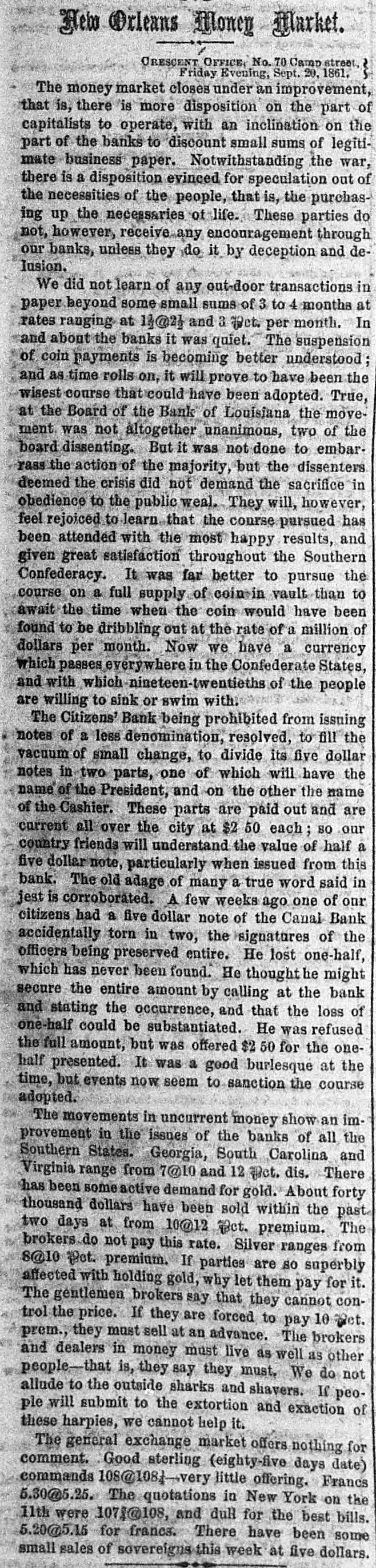
Hebo Orleans Money Market. CRESCENT OFFICE No. 70 Camp street, Friday Evening, Sept. 20, 1861. The money market closes under an improvement, that is, there is more disposition on the part of capitalists to operate, with an inclination on the part of the banks to discount small sums of legitimate business paper. Notwithstanding the war, there is a disposition evinced for speculation out of the necessities of the people, that is, the purchasing up the necessaries of life. These parties do not, however, receive any encouragement through our banks, unless they do it by deception and delusion. We did not learn of any out-door transactions in paper beyond some small sums of 3 to 4 months at rates ranging at 1122 and 3 Pet. per month. In and about the banks it was quiet. The suspension of coin payments is becoming better understood and as time rolls on, it will prove to have been the wisest course that could have been adopted. True, at the Board of the Bank of Louisiana the movement. was not altogether unanimous, two of the board dissenting. But it was not done to embarrass the action of the majority, but the dissenters deemed the erisis did not demand the sacrifice in obedience to the public weal. They will, ho wever, feel rejoiced to learn that the course pursued has been attended with the most happy results, and given great satisfaction throughout the Southern Confederacy. It was far better to pursue the course on a full supply of coin in vault than to await the time when the coin would have been found to be dribbling out at the rate of a million of dollars per month. Now we have a currency which passes everywhere in the Confederate States, and with which-nineteen-twentieths of the people are willing to sink or swim with. The Citizens' Bank being prohibited from issuing notes of a less denomination, resolved, to fill the vacuum of small change, to divide its five dollar notes in two parts, one of which will have the name of the President, and on the other the name of the Cashier. These parts are paid out and are current all over the city at $2 50 each SO our country friends will understand the value of half a five dollar note, particularly when issued from this bank. The old adage of many a true word said in jest is corroborated. A few weeks ago one of our citizens had a five dollar note of the Canal Bank accidentally torn in two, the signatures of the officers being preserved entire. He lost one-half, which has never been found. He thought he might secure the entire amount by calling at the bank and stating the occurrence, and that the loss of one-half could be substantiated. He was refused the full amount, but was offered $2 50 for the onehalf presented. It was a good burlesque at the time, but events now seem to sanction the course adopted. The movements in uncurrent money show an improvement in the issues of the banks of all the Southern States. Georgia, South Carolina and Virginia range from 7@10 and 12 Oct. dis. There has been some active demand for gold. About forty thousand dollars have been sold within the past two days at from 10@12 Pct. premium. The brokers do not pay this rate. Silver ranges from 8@10 Pot. premium. If parties are so superbly affected with holding gold, why let them pay for it. The gentlemen brokers say that they cannot control the price. If they are forced to pay 10 Pet. prem., they must sell at an advance. The brokers and dealers in money must live as well as other people-that is, they say they must. We do not allude to the outside sharks and shavers. If people will submit to the extortion and exaction of these harpies, we cannot help it. The general exchange market offers nothing for comment. Good sterling (eighty-five days date) commands 108@108.-very little offering. Francs 5.30@5.25. The quotations in New York on the 11th were 107 @ 108, and dull for the best bills. 5.20@5.16 for francs. There have been some small sales of sovereigns this week at five dollars.


Article from Memphis Daily Appeal, September 24, 1861

Click image to open full size in new tab

Article Text

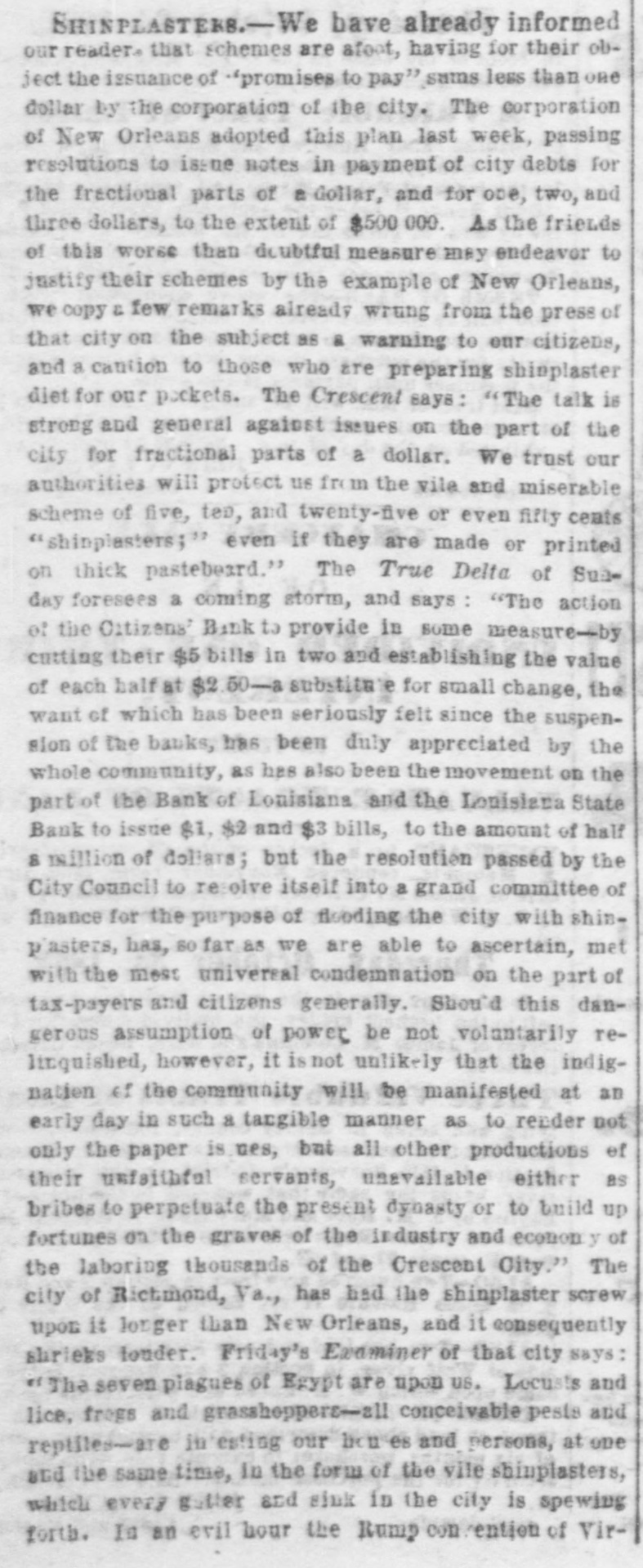
# SHINPLASTERS. - We have already informed our readers that schemes are afoot, having for their object the issuance of "promises to pay" sums less than one dollar by the corporation of the city. The corporation of New Orleans adopted this plan last week, passing resolutions to issue notes in payment of city debts for the fractional parts of a dollar, and for one, two, and three dollars, to the extent of $500 000. As the friends of this worse than doubtful measure may endeavor to justify their schemes by the example of New Orleans, we copy a few remarks already wrung from the press of that city on the subject as a warning to our citizens, and a caution to those who are preparing shinplaster diet for our pockets. The Crescent says: "The talk is strong and general against issues on the part of the city for fractional parts of a dollar. We trust our authorities will protect us from the vile and miserable scheme of five, ten, and twenty-five or even fifty cents "shinplasters;" even if they are made or printed on thick pastebeard." The True Delta of Sunday foresees a coming storm, and says: "The action of the Citizens' Bank to provide in some measure-by cutting their $5 bills in two and establishing the value of each half at $2.50-a substitute for small change, the want of which has been seriously felt since the suspension of the banks, has been duly appreciated by the whole community, as has also been the movement on the part of the Bank of Louisiana and the Louisiana State Bank to issue $1, $2 and $3 bills, to the amount of half a million of dollars; but the resolution passed by the City Council to resolve itself into a grand committee of finance for the purpose of flooding the city with shinp'asters, has, so far as we are able to ascertain, met with the mest universal condemnation on the part of tax-payers and citizens generally. Shou'd this dangerous assumption of power be not voluntarily relinquished, however, it is not unlikely that the indignation of the community will be manifested at an early day in such a tangible manner as to render not only the paper is ues, but all other productions of their unfaithful servants, unavailable either as bribes to perpetuate the present dynasty or to build up fortunes on the graves of the industry and economy of the laboring thousands of the Crescent City." The city of Richmond, Va., has had the shinplaster screw upon it longer than New Orleans, and it consequently shrieks louder. Friday's Examiner of that city says: "The seven plagues of Egypt are upon us. Locusts and lice, frogs and grasshoppers-all conceivable pests and reptiles-are intesting our houses and persons, at one and the same time, in the form of the vile shinplasters, which every gutter and sink in the city is spewing forth. In an evil hour the Rump convention of Vir-


Article from New Orleans Daily Crescent, September 26, 1861

Click image to open full size in new tab

Article Text

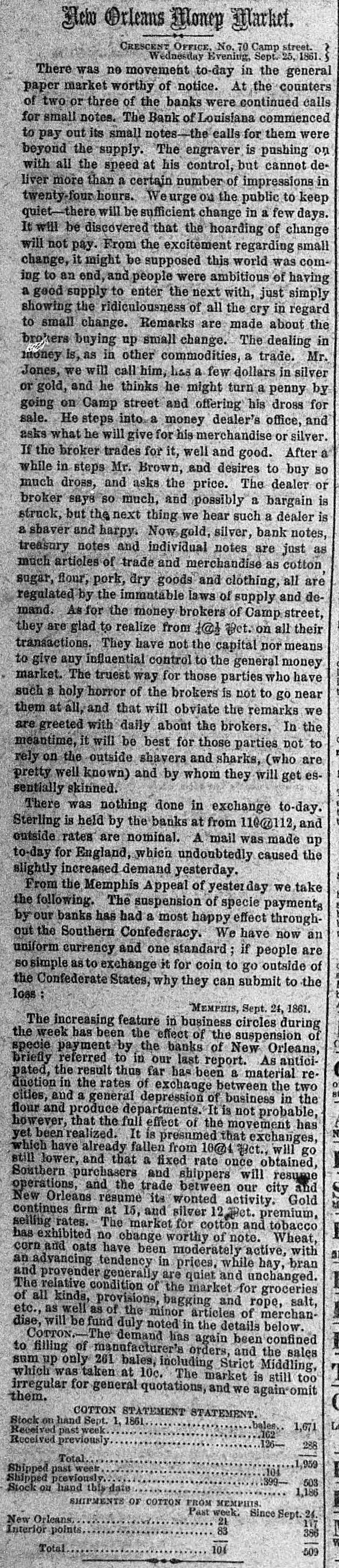
Hew Orleans Money Market. CRESCENT OFFICE. No. 70 Camp street. Wednesday Evening, Sept. 25, 1861. There was no movement to-day in the general paper market worthy of notice. At the counters of two or three of the banks were continued calls for small notes. The Bank of Louisiana commenced to pay out its small notes-the calls for them were beyond the supply. The engraver is pushing on with all the speed at his control, but cannot deliver more than a certain number of impressions in twenty-1 hours. eurge on the public to keep quiet-there will be sufficient change in a few days. It will be discovered that the hoarding of change will not pay. From the excitement regarding small change, it might be supposed this world was coming to an end, and people were ambitious of having a good supply to enter the next with, just simply showing the ridiculousness of all the cry in regard to small change. Remarks are made about the brokers buying up small change. The dealing in money is, as in other commodities, a trade. Mr. Jones, we will call him, has a few dollars in silver or gold, and he thinks he might turn a penny by going on Camp street and offering his dross for sale. He steps into a money dealer's office, and asks what he will give for his merchandise or silver. If the broker trades for it, well and good. After a while in steps Mr. Brown, and desires to buy so much dross, and asks the price. The dealer or broker says so much, and possibly a bargain is struck, but the next thing we hear such a dealer is a shaver and harpy. Now gold, silver, bank notes, treasury notes and individual notes are just as much articles of trade and merchandise as cotton sugar, flour, pork, dry goods and clothing, all are regulated by the immutable laws of supply and demand. As for the money brokers of Camp street, they are glad to realize from @ Oct. on all their transactions. They have not the capital nor means to give any influential control to the general money market. The truest way for those parties who have such a holy horror of the brokers is not to go near them at all, and that will obviate the remarks we are greeted with daily about the brokers. In the meantime, it will be best for those parties not to rely on the outside shavers and sharks, (who are pretty well known) and by whom they will get essentially skinned. There was nothing done in exchange to-day. Sterling is held by the banks at from 110@112, and outside rates are nominal. A mail was made up to-day for England, which undoubtedly caused the slightly increased demand yesterday. From the Memphis Appeal of yester day we take the following. The suspension of specie payment by our banks has had a most happy effect throughout the Southern Confederacy. We have now an uniform currency and one standard; if people are simple as to exchange it for coin to go outside of the Confederate States, why they can submit to the loss MEMPHIS, Sept. 24, 1861. The increasing feature in business circles during the week has been the effect of the suspension of specie payment by the banks of New Orleans, briefly referred to in our last report. As anticipated, the result thus far has been a material reduetion in the rates of exchange between the two cities, and a general depression of business in the flour and produce departments. It is not probable, however, that the full effect of the movement has yet been realized. It is presnmed that exchanges, which have already fallen from 10@4 Oct., will go still lower, and that a fixed rate once obtained, Southern purchasers and shippers will resume operations, and the trade between our city and New Orleans resume its wonted activity. Gold continues firm at 15, and silver 12 Pet. premium, selling rates. The market for cotton and tobacco has exhibited no change worthy of note. Wheat, corn and oats have been moderately active, with an advancing tendency in prices, while hay, bran and provender generally are quiet and unchanged. The relative condition of the market for groceries of all kinda, provisions, bagging and rope, salt, etc., as well as of the minor articles of merchandise, will be fund duly noted in the details below. Corron.-The demand has again been confined to filling of manufacturer's orders, and the sales sum up only 261 bales, including Strict Middling, which was taken at 10c. The market is still too irregular for general quotations, and we again omit them. COTTON STATEMENT STATEMENT. Stock on hand Sept. 1, 1861 bales L 1,671 Received past week 762 Received previously 126288 Total 1,959 Shipped past week I 104 Shipped previously 399 503 Stock on hand this date 1,186 SHIPMENTS OF COTTON FROM MEMPHIS. Past week. Since Sept. 24 New Orleans 21 117 I 83 Interior points 386 W Total 104 509


Article from New Orleans Daily Crescent, October 3, 1861

Click image to open full size in new tab

Article Text

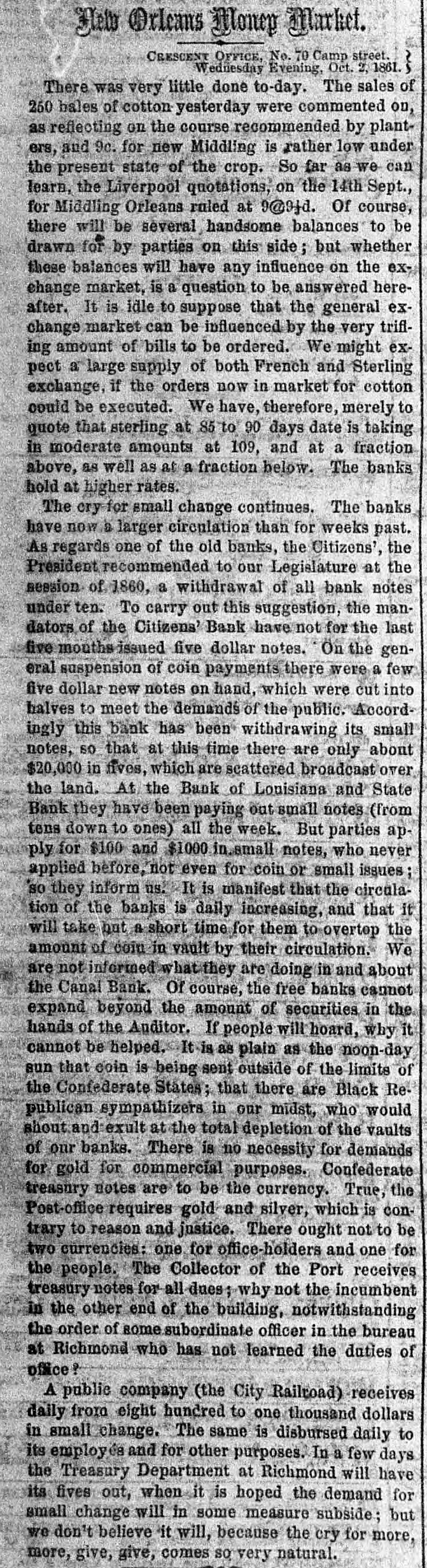
# New Orleans Money Market. CRESCENT OFFICE, No. 70 Camp street. Wednesday Evening, Oct. 2, 1861. There was very little done to-day. The sales of 250 bales of cotton yesterday were commented on, as reflecting on the course recommended by planters, and 9c. for new Middling is rather low under the present state of the crop. So far as we can learn, the Liverpool quotations, on the 14th Sept., for Middling Orleans ruled at 9@9fd. Of course, there will be several handsome balances to be drawn for by parties on this side; but whether these balances will have any influence on the exchange market, is a question to be answered hereafter. It is idle to suppose that the general exchange market can be influenced by the very trifling amount of bills to be ordered. We might expect a large supply of both French and Sterling exchange, if the orders now in market for cotton could be executed. We have, therefore, merely to quote that sterling at 85 to 90 days date is taking in moderate amounts at 109, and at a fraction above, as well as at a fraction below. The banks hold at higher rates. The cry for small change continues. The banks have now a larger circulation than for weeks past. As regards one of the old banks, the Citizens', the President recommended to our Legislature at the session of 1860, a withdrawal of all bank notes under ten. To carry out this suggestion, the mandators of the Citizens' Bank have not for the last five mouths issued five dollar notes. On the general suspension of coin payments there were a few five dollar new notes on hand, which were cut into halves to meet the demands of the public. Accordingly this bank has been withdrawing its small notes, so that at this time there are only about $20,000 in fives, which are scattered broadcast over the land. At the Bank of Louisiana and State Bank they have been paying out small notes (from tens down to ones) all the week. But parties apply for $100 and $1000 in small notes, who never applied before, not even for coin or small issues; so they inform us. It is manifest that the circulation of the banks is daily increasing, and that it will take but a short time for them to overtop the amount of coin in vault by their circulation. We are not informed what they are doing in and about the Canal Bank. Of course, the free banks cannot expand beyond the amount of securities in the hands of the Auditor. If people will hoard, why it cannot be helped. It is as plain as the noon-day sun that coin is being sent outside of the limits of the Confederate States; that there are Black Republican sympathizers in our midst, who would shout and exult at the total depletion of the vaults of our banks. There is no necessity for demands for gold for commercial purposes. Confederate treasury notes are to be the currency. True, the Post-office requires gold and silver, which is contrary to reason and justice. There ought not to be two currencies: one for office-holders and one for the people. The Collector of the Port receives treasury notes for all dues; why not the incumbent in the other end of the building, notwithstanding the order of some subordinate officer in the bureau at Richmond who has not learned the duties of office? A public company (the City Railroad) receives daily from eight hundred to one thousand dollars in small change. The same is disbursed daily to its employΓ©s and for other purposes. In a few days the Treasury Department at Richmond will have its fives out, when it is hoped the demand for small change will in some measure subside; but we don't believe it will, because the cry for more, more, give, give, comes so very natural.


Article from New Orleans Daily Crescent, March 28, 1862

Click image to open full size in new tab

Article Text

Orleans Dallp Crescent. DEP ARTMENT COLUMNS Helo Orleans Money Market. CRESCENT OFFICE. No. Camp street, Evening, March 27, 1962 movements were, we The to-day Thursday general might.say, and money just nothing at all in the paper an attempt to of but it abortive market. stocks, There was proved remarkably sell In quiet-about some and about kinds the banks it was quiet, day of the season. Possibly we be the There were some some may the most respects approaching quiet' culminating little point offerings in of exchange but holders were asking the usual birthrates. There were no movements in domestic funds: In fact, the total annibilation of all means of transportation thither suspends all sales or transactions in sugar and molasses. Currency plays considerable of a part in the transactions of the day, as limited as they may be, but change is called for hourly. In fact, it is change, change. The Confederate Government ought to take the place of our banks in regard to the furnishi=g of five and ten dollar notes. If the parties in the Treasury Department at Richmond and it too laborious to work over four or five hours daily in signing notes, they should abdicate and allow others who will work ten hours per day to take their places. Six months have expired'since Mr. Memminger commenced to furnish the Confeder: acy, particularly this community, which is the metropolis of the South, with a circulation of paper. We learn that the one hundred millions of dollars in Confederate notes, authorized to be issued, have not yet been placed in circulation. The great public, or the members of it, here and there, are much to blame for the apparent scarcity. All the small notes of the banks have been placed away in iron safes, old secretaries and in old stock togs. Immediately after the banks acceded to the request of the authorities, that is, in closing their vaults, the Bank of Louisiana and Louisiana State Bank commenced the issuance of notes under the denomination of fives, and have been issuing for six months just as fast as the notes could be signed. Strange to say that of these issues, now amounting. from the two banks to about $400,000, none of them are ever returned to the banks in the way of deposits, nor presented for coin, showing conolusively that these small notes are stowed away, hoarded; possibly under the expectation that they are expressly redeemable in specie when the banks should resume coin payments. It may be well enough that the minda of the hoarders should be relieved from this delusion. These small notes are not expressly redeemable in coin. They have been issued since the suspension of coin payments, merely for the accommodation of the great public. Therefore, we again repeat, holders of these small notes need not clasp to their bosom the fond anticipations that these notes are expressly redeemable in coin, and they might as well throw them into general circulation. True, they look SO very nice that it is rather disagreeable to part with them; but what is the use of hoarding day after day? These notes are paid out, bnt none come back, either to the counters of the banks issuing, nor.l the other banks, either in the way of deposit or in the payment of debts. Hoarding and holding on appear to be systematically carried out.


Article from New Orleans Daily Crescent, April 4, 1862

Click image to open full size in new tab

Article Text

Hely Orients Money Market. CRESCENT OFFICE No. 70 Camp street, Tb Tursday Evening, April 3, 1862. The money and paper market to-day was something of a real nonentity. There were some negotiations astir for first-class mortgage securities at the rate of I, 2 and 3 Pet. per annum, that is, one year at the rate of I Act., two years 2 Po and three years 3 Oct. In other respects we did not learn of a negotiation. Bat what is the theory of money? What is the use of it; some parties of sense inquire? It is nothing more than the garb or form, the representative of commodite which the course of commerce and trade sumes. We cast never learned of any individual, whatever or standing in society, carrying any more money out of the worid than he b ,Jught into it. Money is supposed to be somethi of a.representative of values, which we, of urse, do not call into ques and at this moment, during the tion, money crisis now imp ding, is a valueless commodity. titutions have an abundance over, Our public and know not how to use it for the want of sound and good borrowers. what we intimated in our last issue, of two of ar banks stamping their issues redeemable in Confederate notes, was carried out to-day. It is carrying out suggestions to place our currency on an equality, and through the action of the ProvostMarshain, to equalize the issues of our banks with Confederate notes. It has been suggested that the issues of the city corporation and the Treasury notes of the State under the $1,000,000 and $2,000, 000 issues might be stamped in the same way. The city authorities are allowed to issue $1,000,000, which are to be received at all times for taxes and dues to the city, but not to be reissued. As the issue has been granted, or otherwise protected impliedly by legislative enactments, it follows these notes can be reissued, paid out, brought into cir culation the same as Confederate notes. Why not These notes are boarded the same as gold; how to keep them in circulation is the question asked. No other way is presented than that they should be stamped, redeemable in Confederate currency. The State Treasury notes are redeemable and payabletwelve months after a treaty of peace with our enemy. We do not discover anything to be gained by putting these notes in old stockings or in side drawers to await the good time hoped for. In fact, when the good time returns, all our currency, by the laws of trade, will be on an equality. Since the suspension of coin payments by the banks, the Bank of Louisiana and State Bank have issued about $400,000 of notes under the denomination of fives. The city authorities have issued about $650,000; fives and tens of several banks have been divided, and yet none of them are returned to the banks, either in the way of deposit or pay ment of does. It may be well enough to understand that the small notes of the two banks, issued since the 16th of September last, are not redeemable in specie. It is useless to stow them away under that impression, There were no sales of bank shares, bonds or anything else reported to-day. As for exchange, the transactions were too limited to command any notice. We append below an extract from a Liverpool circular of the tobacco trade in England for the year 1861. The stocks on hand for five years past are also annexed. We have before given the an anal statement of the cotton trade: The Liverpool market has been very inactive during the past month, but there is no abatement of confidence in the maintenance of prices, AB shown by our quotations. With reference to the stock on sale, it may be observed that if Virginia continues compelled to deny us her final supplies, our stock must be coming very near to exhaustion. The aggregat stock is almost identical with that of last year, a reduction in the supply of hometrade qualities bein counterbalaced by an excess in Kentucky leaf and Maryland a good deal of both of which would probably not have come to the market at all but for the peculiar circumstances of the times, and the same will have to wait for eventual distribution e where. e From the statistics accompanying the circular we derive the following B The estimated stock on sale in Liverpool, in e cluded 418 Virginia Leaf against 610 on the 31st of December, 1860 and 716 do. Stem'd against 2024 in 1860. The stock of Virginia Leaf and Stem'd on the 31st of December, in London, was 1813 hhds. against 4371 for the same period in 1860. The quotations in London for Virginia were 4β‚«@ 76 for Leaf, and 71@10 for Stem'd in Liverpool, @10 for Leaf. and 10@14 for stem'd, against 4@ 7 for Leaf, and 8@101 for Stem'd, on the 31st of December, 1860. Stock of Tobacco in Europe, Dec. 31. 1661 1860. 1859. 1858 f 200 200 000 250 North of Europe 10 600 6.500 Bremen and Hamburg. 7.600 6.916 Amsterdam, Rotterdam, 3.888 9.786 5.400 etc. 5.500 Spain, Portigal and GI. 200 200 300 200 brattan 49.450 Great Britain 37.889 43.792 33.427 i 69.547 71.189 61.134 46.127


Article from Memphis Daily Appeal, April 26, 1862

Click image to open full size in new tab

Article Text

On Phaage-Business News. We have nothing new to report of doings on 'Change. The receipts were: 23 sacks bran, 6 kegs but ter, 10 easks bacon, 736 sacks corn, 6 head cattle, sacks dried fruit, 95 sacks flour, 50 bales hay, 2 kegs and 1 bar rel lard, 103 sacks oats, 11 casks pork, 14 sacks potatoes, 91 sacks wheat The New Orleans banks, after a meeting at which no agreement was come to, have been paying out more or less gold. This act created much consternation, as it was believed to be done from an expectation that the enemay would be victorious in his attempts against the city. The New Orleans Crescent of Wednesday says: The press at the counter of the M. chanica' and Traders' Bank was largely beyond that of any other bank, yet the cails or presensation of notes were very small, ranging from five and ten dollars up to one hundred dollars, which were paid. At the Bank of Louisiana there were some calls, but all in small amma; and some parties, on being offered silver, refused, wanting gold only. These parties who are 80 very tenacious and desire gold because it is more susceptible for placing in out-of the way nooks, may be somewhat surprised if within a few days, or a few hours, an order may be received from the highest authority, commanding the banks to retain all coin in vaults, and decline at once the paying out, either in circulation or deposits. The greatest press to-day was in and around the Me. chanies' and Traders' Bank. Its circulation is only $245,000 against $663,000 in coin. It will not be many days before our banks will be asked by those who were most clamorous for coin to receive bags of silver and tin boxes containing gold on special deposits. We at once urge on our bank mandators to decline all special de posits of this character The same paper of Thursday states: The most important feature in financial circles to-day was the reception of a decree by some of the banks from the highest authority forbidding the paying out of specie or CO n. It was received early in the day by some of the banks, but up to 12 o'clock it had not been received by other banks. The Mechanics and Traders' Bank was paying out silver up to I bleck, but in very small sums. In fact, the holders of circulation of the banks have run out, completely prostrated; they have no more promises to pay or circulation of the banks. At an early hour in the day the State Bank received notice to suspend the payment of coin. The State has a heavy interest in this bank, and the mandate was promptly obeyed; so at the Citizens' Bank, it had to follow the instructions. It was, however, very late in the day before all the banks received the order. In obedienee to the mandate from the authorities the paying out of coin was generally suspended before 2 o'clock.


Article from Memphis Daily Appeal, June 14, 1862

Click image to open full size in new tab

Article Text

Important Decision in New Orleans. From the Delta, June 10 PROVOST COURT - Major Joseph M. Bill, Judge - Monday, June 9 -Case against the Bank of Louisiana-Amcdee - Durand, Complainant.-On the 16th of September, 1861, the city of New Orleans enjoyed a financial system second to none in the country. The banks were all in a sound condition. On that day they not only suspended specie payments, but also ceased to pay out their own notes. Instead they substituted notes of the Confederate States, and all transactions were conducted in that currency. After the 15th of September, 1861, the claimant made a deposit in the bank of Confederate notes. He now demands that the amount of his deposit shall be paid him in current funds. The court held that the Constitution of the Southern Confederacy made coin the only legal tender, and no law exists compelling the receipt of Confederate notes in the payment of debts. The banks, by their action in withdrawing their own notes from circulation, and advertising their willingness to receive Confederate notes, reduce the currency of the public to such Contederate notes. The complainant had for a long time been a depositor in the Bank of Louisiana. It is admitted that all of his deposits since September 16.h have been in Confederate notes, or paper which he knew was to be paid in Confederate notes. He nas not deposited a dollar of money. But the bank is estoped to deny that these de posits are money. It, with others, aided to make them the only currency for the people. It would pay out nothing but Confederate notes: it received them as money, without objection; there was no element of compulsion, physical or meral, in their reception by the bank. It would be to allow them to take advantage on their own wrong to permit them now to say that these notes are not money. It would work a Laud upon their customers who are at the mercy of the banks. The deposits of the complainaut can in no legal sense be called "special deposits. Such deposits are too well understood to need exposition. This case has nothing in common with the cases previously decided, where the parties were compelled to receive Confederate notes as money. Judgment for complainant. The counsel for the bank, J Ad. Rosier. Esq, was permitted to have & copy of the complaint properly filed, and filed his answer and objection thereto. He was also permitted to file an exception to the jurisdiction of the court. The case will probably be taken up before Gen. Batler. Judge Bell, however, refused to grant a : uspension appeal, but insisted on the execution of the judgment. Col. A. P. Field appeared and made a strong argument against the bank. Since the above was written, we learn that the bank, through J. Ad. R sier, attorney, made ape plication for a stay of proceedings, in order to of obtain a revision of the judgment. Gen Butler e granted a delay, in order to have time to examine the application.


Article from The New York Herald, June 17, 1862

Click image to open full size in new tab

Article Text

INTERESTING FROM NEW ORLEANS. THE UNION SENTIMENT INCREASING. A Loyal Citizen Police in Power. The Ladies Presenting Flags to the Union Soldiers. LIFE AND PROPERTY FULLY PROTECTED QUIET AND ORDER REIGN. ARREST OF PIERRE SOULE CONFIRMED. THE CHARGES AGAINST HIM. THE BELGIAN CONSUL IN TROUBLE. Large Quantities of Cotton and Sugar Being Shipped North. SOUND CURRENCY P POLICY, &c. &c. &c., Our New O leans Corres ondence. NEW ORLEANS. La. May 23,1862. General Buller's Order Relative to Specie Payments, d.e. The Ciange for the Better in Public Opinion-Studbora ness of The Bank if Louisiana- Corre presidence Belween Its Directors and General But er-The Bank Complies with the Order-Brigudier General Shepley Acts a May -Union Citizens Placed on the Police. and the Thus Policemen Discha ged- -Killing of the Union Candida's for Recorder by Thug'--The Case to be Investigated The Way Police and Criminal Trials are Now Carried On-Liless of Major Strong, Assistant Adjutant Gene ril-Affairs about Vicksburg and Red Rio - Demoraiitation of Beauregard's Army Appointment of an As sis'ant Military Commandant- Presentation of Bann to the Thirteenth Connecticut Volunteers- Finding a R.d. Sulmarine Ram. dec Since my last letter General Butler has made stroke that has already been productive of . vast amount of d in restoring the old spirit of attachment to the Chinn. The action to which allude will be found om died in Order No.30, compelling the banks to pay their itors and creditore "the bills of the bank United tates Treasury notes, gold or silver. !This order was published in the HERALD of May 31.-ED.} This order has been well received by ali classes, ex" cepting those who, by is provisions, will be made to soller justly for having created the present wretched curre. cy and brought misery and want upon the thou. sands of worthy people constituting the middle and poorer portions of this community. As a merchant yesterday That order is of more value the cause of the Union than twenty thousand soldiers could The improvement in the feelings or the citizens become palpable thing within the last few daws: it in the people as they pass through the and feel its influence ervading the atm sphere of public opinion. the citizens are no longer afraid seen near headquarters, or speaking with naon officers and soldiers, who now walk singly and uharmed throughout the city as safely they could any Northern city. The change for the in the demeanor of the Indies is improving to personal appearance and their manuers iilying to our forces. The stores now opeu appear to be doing some little business. The discusses the order temporately and approvingly Delia, especially sus mins General Butler boldness and manliues which have always charac rized that newspa er. effect of this order on the ba: ks has been salutary. caption they all subu bitted gracefully and the General edict. The xception of which I speak is the Bank Louisiana. The Board or Directors this bank hold meeting on the 21st and passed resolution, which they to General Butler, in. tending to vade the order if possible. The General's answer to this resolution. and letter from the President pro cm impanying it, brought the reluctant bank up with short turn. The annexed cor respondence will explain the position of the Bank of Louisiana General Butler is satisfied that the specio removed by the banks beyond their control, and be has information of General Lovell having contiscated his hauds No. 148 CANAL STREET May 21, 1862 SIR-The Board Director the Bank special meeting this order to take Order No. 30. The with the exceptive of single number for with the gravity of the question about tu be submitted. The result of their deliberation was the adoption of cer tain resolutions, which have now the honor to submit you. same time was instructed to make ow ob plunation or their course and especially disclaim and disavow the any imputation affecting their rectitude, integrity or nor. their they their invite most searching of all their books, cluding the minutes their and of every their even private their with the bank, by any person whom you may for that purpo se: and they are willing to the either incharge is their difficult aud delicate duties, anu feeling that their tentions were have confidence of abiding and their they upright, excusption from the intiuence all sordid or soiliab motives. required will wait on you and afford every expla. &c., nation my MERCER. NEWION Pr pro stuent item. Major General BUTLER, IT S. NOTE-O. the capital stock the bank-28,000 shares-th directors own about one tenth. To the back they owe nothing. OF THE DIRECTORS. LOUISIANA, BANK May OF 21,1862 As this bank is anable comply with the the restrict upon by Order issued by General Butler, and have been cast upon the conduct and characters of its directors, Therefore, Reaol ed imously That General Batler invited to appo int some competent person, in whom confidence, examine thoroughly the couditio since its suspension of specie the action of His directors since the 1st day of optember last. That the cashier be instructed togive to General Butler's agent if one be appointed. every facility for such examination of all its books, paper vaults desks and afford him every information touchin or this during the period ready mentioned, together with an inspection of the director the accounts of Thac, the meantime, Bill General Butler's final do ascer the operations tained be bank termination the must rily besuspended. is has its none of its own issue and only very small amount of cuia. I certify that the action above men tioned was held this of Louisians Bauk the by morning NEWTON MERCER, President pro tem. New ORLEANS, May 21, 1862. To this letter and the resolution General Butler an swered follows: HEADQUAR DEPARTMENT OF THE GOLF, New ORLEANS May 22. 1862. W NEWTON MERCER, Esq. President of the Bank of Louistana Sit-1 have received your comm covering the unanimous action of the directors or the Hank of Loui. NIADA. their request that would appoint commis the affairs the bank accede the contrary of the bank With have do, except so far as either affects the in United Status terest The igued reason for the call for this examination. faith good the or and directors have the integrity that beer Impugned, not move me you refer Order No. so, which speake or acts and facts, not motives. Your says that the directors own but one-teath of stock the bank. it hout consulting e other three nearly took this Immense wealth from country deposit, company ace of the among property masses fugitive eating and starving army is more than likely never return. Again: the time would take make an in estigation, which would show


Article from Alexandria Gazette, February 28, 1863

Click image to open full size in new tab

Article Text

private, charged tish subject from Richmond; G. T. Tansill has been in the Confederate service, and stated he would be there again but for his wounds received in the service. Cassius M. Clay, who is about to return to Russia, as the U. S. Minister, has published a brief letter, in which he explains why he did not enter the field as an officer of the army.He says:-"I told President Lincoln that I could not, and would not, enter the field unless the policy of liberating the slaves of Confederates was adopted. As soon as the President issued his proclamation of the 22d September, I offered my. services at once to Gen. Halleck. I was received in such manner that Secretary Chase, who was present, and had urged me by the most pressing arguments to take a command, was satisfied, as well as myself, that I could not serve the country or my own reputation by entering the service. Justice to the country and to my own character for frankness, demands of me to say that I regard Gen Halleck as too pro slavery to do justice to any man of my views of the great political issues pending. I have done what I could, and [ shall do what I can, to induce the President to put Gen. Benj. F. Butler in his place." A letter from New Orleans in the N. Y. World says, "The Bank of Louisiana (burnt out last week) has resumed business in the Crescent City Bank building. Business is dull. Thirty-six bales of cotton were sold yesterday, good ordinary to low middling, at sixtyfour cents per pound. There are daily transactions in sugar and molasses to a limited extent. Gold is lower here than it is in New York. Greenbacks are not SO popular as city currency." A fire originated yesterday at 207 Fulton street, N. Y., in a coffee establishment, and before it was put out, three buildings were burnt. The loss was six thousand dollars, which is covered by insurance. The celebrated racing stock of Messrs. Kenner and Minor, consisting of the stallions Panic Ben West, Viceroy, Whale and Bob Cheathem and thirteen blooded mares and fillies, were to have been sold at New Orleans on Monday last, for the benefit of the U. S. Government, by order of Gen. Banks.


Article from New-York Daily Tribune, June 27, 1863

Click image to open full size in new tab

Article Text

LATER FROM NEW-ORLEANS. Nothing Later from Port Hudson. The steamer Creole, from New-Orleans on the 19th inst., arrived here on Friday afternoon. The newspapers to hand contain no news from Port Hudson. The Bank of Louisiana and Louisiana State Bank had been required to go into liquidation under three commissioners each. Their condition is said to be satisfactory. The receipts of sugar from the interior were partially suspended, owing to the heavy dutiesimposed. A large mass meeting of Union citizens was held at New-Orleans on the evening of the 18th inst. The anniversary of the Battle of Bunker Hill was celebrated by the Bunker Hill Company of the 47th Massachusetts Regiment at Camp Parapet, Louisiana. The steamers George Cromwell, Key West, Patapsco, and Suffolk, had arrived from New-York. QUARANTINE, New-York HARBOR, June 26-Evening. U. S. steamer Matanzas, Capt. Liesgang, from New-Orleans, June 17, Key West, 20, has arrived here.


Article from Evening Star, June 27, 1863

Click image to open full size in new tab

Article Text

From New Orleans. NEW YORK, June 26.-The bark Creole, from New Orleans on the 19th inst., has arrived. The papers contain no news from Port Hudson. The "Bank of Louisiana" and the "Louisiana State Bank" have been required to go into liquidation under three commissioners each. Their condition is said to be satisfactory. The receipts of sugar from the interior has been partly suspended, owing to the heavy duties imposed. A large mass meeting of Union citizens was held at New Orleans on the evening of the 18th.


Article from Alexandria Gazette, June 27, 1863

Click image to open full size in new tab

Article Text

THE SIEGE OF VICKSBURG. MEMPHIS, June 23, via CAIRO, June 25.---Official intelligence from Grant's army to the 20th has been received. Johnston is said to have withdrawn his forces from across the Big Black, moving towards Clinton. About a thousand Texans attacked Lake Providence on the 10th but were repulsed with loss by the negro troops who fought bravely. Colonel Phillips with eight hundred cavalry, was attaked by two hundred Cofederate infantry and one thousand cavalry under Rockerford on the Tallahatchie. The fight was severe. Phillips lost seven killed and ninety wounded. He cut his way out and came in yesterday. The Cofederates are in force at Boonville, Generals Roddy, Ruggles, Chalmers, and Biffiers, threaten the lines and troops are reported moving north from Okolona. Stirring news may be expected from this section. The Baltimore American says:-"All the turnpike roads leading to the city are now not only thoroughly guarded, but pretty well barricaded, in order to prevent any advance to the town by the Confederates. Inconsequence of these preparations, and the peculiar state of affairs which now exists, it has been deemed wise and prudent to per nit no citizens to leave the place without first securing passes." The N. Y. Times says, that when the New Jersey troops reached Po., they we. refused acceptance unless they would be sworn into the U. S. service for six months, under the President's proclamation. The Governor of Penn., moreover instructed his transportation agents at Philadelphia to forward no troops to Harrisburg who would not enter the U. S. service under the six months' call. This was not what the New Jersey troops had offered to do, nor what Gov. Parker had called on them to do nor what he had, any authority by State law to require them to do. And, therefore, he ordered them home, the entire expense of his volunteer services, it seems, falling on the State of N. Jersey. The New Orleans papers contain no news from Port Hudson. The Bank of Louisiana and the Louisiana State Bank have been required to go into liquidation, under three commissioners each. Their condition is said to be satisfactory. The receipts of sugar from the interior have been partly suspended, owing to the heavy duties imposed. A large mass meeting of Union citizens was held in N. Orleans on the 18th inst. Gen. Butler, arrived in Washington yesterday evening, and is stopping at Willard's. It is rumored that the object of his visit is to look after his interests in the question of seniority between himself and General Fremont, now pending before a military commission. Rev. Dr. Leacock, of New Orleans, recently


Article from Cleveland Morning Leader, June 27, 1863

Click image to open full size in new tab

Article Text

FROM NEW ORLEANS. NEW YORK, June 26. The steamer Creole, from New Orleans on the 19th of June, has arrived. Papers come to hand contain no news from Port Hudson. The Bank of Louisiana and the Louisiana State Bank had been required to go into liquidation under three commissioners each; their condition is said to be satisfactory. Receipts of sugar from the interior were partially suspended owing to the heavy duties imposed.


Article from The Weekly Register, July 2, 1863

Click image to open full size in new tab

Article Text

From New Orleans. NEW YORK, June 26.-The steamer Creole from New Orleans on the 10th has arrived. The papers contain no news from Port Hudson. The Bank of Louisiana and Louisiana State Bank, had been required to go into liquidation under three commissioners each. Their condition is said to be satisfactory. Receipts of sugar from the interior was partially suspended owing to the heavy ties imposed.


Article from The Weekly Register, July 2, 1863

Click image to open full size in new tab

Article Text

From New Orleans. NEW YORK, June 26.-The steamer Creole from New Orleans on the 19th has arrived. The papers contain no news from Port Hudson. The Bank of Louisiana and Louisiana State Bank, had been required to go into liquidation under three commissioners each. Their condition is said to be satisfactory. Receipts of sugar from the interior was partially suspended owing to the heavy due ties imposed.


Article from The New Orleans Crescent, March 16, 1869

Click image to open full size in new tab

Article Text

# SIXTH DISTRICT COURT. Important Decision Relative to Bank of Louisiana Notes-The Bank Compelled to Receive its own Notes in Payment of all Dues, In the Sixth District Court, Judge W. H. Cooley, the following decision was rendered yesterday: It appears that in 1861, M. A. Becnel and L. Becnel subscribed a promissory note to their own order and indorsed it, for the sum of twenty thousand three hundred and forty-five dollars eighty cents. That said note was the property of the Bank of Louisiana at the time the forfeiture of its charter was judicially declared, and is now in possession of the commissioners appointed to liquidate the affairs of the insolvent bank. M. A. Becnel having applied to the commissioners to pay said note, tendered them bills of the Bank of Louisiana, which they refused to receive in payment of the note due by him. Hence the present proceeding on the part of Becnel to compel the commissioners to receive the bills tendered by him in payment of his note and the delivery to him of the note. The commissioners thus brought into court, before urging any defense to the merits, have thought proper to take exception to the form of the proceeding. I cannot conceive what interest these commissioners, who are presumed to be acting for the benefit of the creditors and not for themselves, can have in contesting the mere form of the proceeding. It is the interest of the creditors, and the holders of the bills of the bank are preferred ones, that if there be any doubt on the point raised by the rule, it should be decided promptly and without any unecessary delay. Those who hold the notes of the Bank of Louisiana are entitled to know at once whether the bills they have can be used as effects against the debts due to the bank, and this appears to be a matter of vital importance to them, as the law under which the commissioners act, makes the bill holders creditors by preference. It does seem to me that skirmishing on the outside, when it can accomplish no other purpose than that of delaying the decision of the main and only important question involved, is in conflict with the best interests of the bill holders. The question raised by the rule is whether the commissioners are obliged to receive the bills of the Bank of Louisiana in payment of the notes due to it, and the question can be met and satisfactorily argued and decided on a rule as well as in any other form of proceeding. But the technical plea besides being in fact to some extent prejudicial to those whose interests it is the first duty of the commissioners to protect, is in law totally untenable. It is predicated upon the idea that debtors of the Bank of Louisiana are third persons to the insolvent proceedings. Considering for the sake of argument that they are third parties, they have none the less interests involved in the matter, and whenever it becomes necessary for their protection, like all others, they may make themselves parties to the suit. But without any act of theirs they are parties and necessary parties to the proceedings for the liquidation of the bank; which are nothing but insolvent proceedings after all. In the letter and spirit of the act of 1842 all the creditors and debtors of the bank become parties in the proceedings instituted with the view of its liquidation. So much for the technical objection. The denial of the commissioners that they are bound to receive the notes of the Bank of Louisiana in payment of notes due to the bank, and the corresponding assertion that they have the power to compel the payment of such debts due the bank in legal currency of the United States, is not only unfounded in law, but considering how plain the law is to the contrary, the claim put forth by them is strange in the extreme. The whole contest finds a ready and easy solution by the following words contained in the act of 26th March, 1842, amendatory of another act of the same year: "Provided. That nothing contained in the act to provide for the liquidation of banks or other laws of the State, shall be so construed as to deny to persons having notes to pay in banks in liquidation, the right of paying said notes in the bank notes of saidliquidating banks, except when said notes may have been transferred to the other banks as security for receiving the circulation of the said liquidating banka." See Bess, acts of 1842, page 454. It is not pretended that the note due by Becnel is in the possession of the other banks as security for receiving the circulation of the Bank of Lou-isiana. I cannot conceive what language the Legislature of 1842 could have employed to make the obligation of a liquidating bank to receive its own notes, more clear, plain and emphatic. But if this law be not explicit enough the act of the 5th April, 1843, certainly is. The proviso in the second section of this act says: "* And that it shall be the duty of each of the banks of the State at all times to receive in offset or part offset of debts due to it, its own debts when liquidated and past due, whether for circulation, deposits, or arising from any other source whatever, and whether such banks be or not in liquidation, and without reference to the date at which the debtor offering such tender may have acquired the claim offered by him in offset. *" The object of the Legislature was to insure the payment of the bill holders, and the lawgiver was so solicitous to accomplish this object that in the act of 1842 reviving the charters of the several banks which had suspended specie payment, one of the conditions imposed upon the several banks as a consideration for the revival granted was that they should receive each others' circulation. The language is plain and full of meaning: "And it shall be the duty of the banks not in liquidation under the provisions of this act, and as a condition for the restoration of their charters to receive at par at their respective counters in payment of all debts and obligations due and owing them respectively the circulation of the bank or banks that may enter into liquidation voluntarily or otherwise under the provisions of this act." See 8th section of the article of 5th Feb. 1842, Sess. acts page 48. This act was subsequently amended, but only to limit the amount of the circulation of a liquid-ating bank which the others were bound to receive, and to fix the terms of their reception. The extent of the first obligation was limited, but the obligation pro tanto still exists. Thus, when it is very plain that even the other banks may, for a certain amount and upon certain conditions, be compelled to receive at their counters at par the circulation of the liquidating bank, it is contended that the liquidating bank itself is not bound to receive its own notes. The language is not only plain, but has received the sanction of judicial interpretation by the Supreme Court in several cases. The first is that of "The Commissioners of the Exchange and Banking Company of New Orleans vs. Mudge et al.," reported in 6 Robinson's reports, page 397. In that case it was urged that the intent of the Legislature was that the bank should be liquidated in the same manner an insolvent estate was administered; that the rules governing the last were applicable to the first; and that if the commissioners were compelled to receive of the liquidating bank in payment, that the bill holders would be the only creditors paid, as the bank was notoriously insolvent. These objections were met and refuted in a very able manner. I quote one of the concluding paragraphs of the very able opinion delivered by Judge Bullard, as the organ of the court: "It appears to us, therefore, clear that the Legislature intended to make special provision for the bill-holders, and to make the circulation of the bank always a good offset to debts due to the liquida-ting banks. The justice or policy of particular laws does not concern the judicial department; but it would appear but just that those who received the bank notes as money, under the sanction of the Legislature, should be particularly favored." The obligation to receive its own notes in payment on the part of the liquidating banks, so decided in the case already quoted, has been uniformly adhered to by our Supreme Court. See cases of Citizens' Bank of New Orleans vs. the Levee Steam Cotton Press Company, 11 Rob., 286.; Saunders et als., commissioners, vs. Smith, administratrix, 4 A. R., 232; J. R. Marshall vs.