Dime Savings Bank (Chicago, IL)

Episode Information

Episode Type
Run → Suspension → Closure
Start Date
December 28, 1896
Location
Chicago, Illinois (41.850, -87.650)
Bank Type
savings

Metadata

Notes

Bank temporarily relaxed 90-day rule and paid needy depositors before a receiver was appointed.

Events (4)

1. December 28, 1896 Run
Cause
Local Banks
Cause Details
Withdrawals and runs triggered by the retirement/closure of the Atlas National Bank and related local bank failures.
Measures
Issuing of ninety-day withdrawal notices to limit immediate payouts; directors called meeting of creditors.
Newspaper Excerpt
There was a steady stream of depositors today during banking hours.
Source
newspapers
2. December 28, 1896 Suspension
Cause
Local Banks
Cause Details
Suspended payments under the 90-day statutory clause as a direct result of the retirement of the Atlas National Bank.
Newspaper Excerpt
payments are suspended under the ninety-day withdrawal notice clause
Source
newspapers
3. January 5, 1897 Reopening
Newspaper Excerpt
The rules requiring ninety days' notice for the withdrawal of deposits is being relaxed...and considerable money was paid out yesterday for the first time since the suspension of the National Bank of Illinois.
Source
newspapers
4. January 30, 1897 Receivership
Newspaper Excerpt
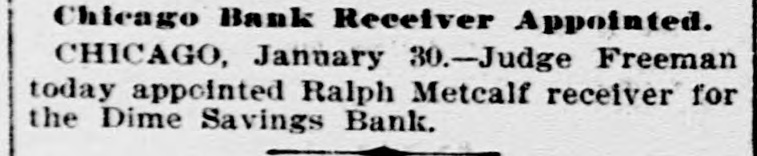
Judge Freeman today appointed Ralph Metcalf receiver for the Dime Savings Bank.
Source
newspapers

Newspaper Articles (25)

Article from Evening Star, December 28, 1896

Click image to open full size in new tab

Article Text

NINETY-DAY NOTICE DEMANDED. Steady Stream of Depositors at a Chieago Savings Bank. CHICAGO, December 28.-In pursuance of an agreement among directors of the Dime Savings Bank, who held a secret session this morning, a general meeting of the creditors was called for this afternoon at 3 o'clock. Treasurer Geo. W. Reed's window is barricaded and payments are suspended under the ninety-day withdrawal notice clause, granted in the statutes to savings banks. The majority of the Dime Savings Bank depositors have already filed their withdrawal notices. There was a steady stream of depositors today during banking hours. They were assured that the issuing of the notices was in no way an indication of the bank's inability to meet all demands for money, but simply a means of self-protection against violent durries. Nearly all of the depositors are laboring people.


Article from The Seattle Post-Intelligencer, December 29, 1896

Click image to open full size in new tab

Article Text

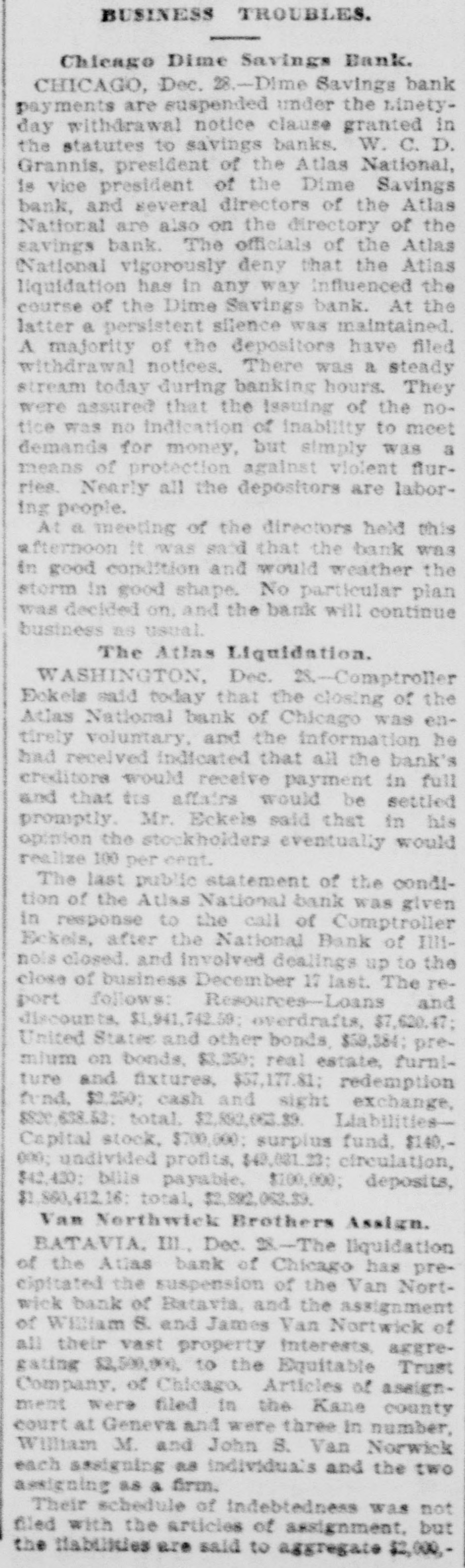
BUSINESS TROUBLES. I Chicago Dime Savings Bank. CHICAGO, Dec. 28.-Dime Savings bank payments are suspended under the ninetyday withdrawal notice clause granted in the statutes to savings banks. W. C. D. Grannis, president of the Atlas National, is vice president of the Dime Savings bank, and several directors of the Atlas National are also on the directory of the savings bank. The officials of the Atlas National vigorously deny that the Atlas liquidation has in any way influenced the course of the Dime Savings bank. At the latter a persistent silence was maintained. A majority of the depositors have filed withdrawal notices. There was a steady stream today during banking hours. They were assured that the Issuing of the notice was no indication of inability to meet demands for money, but simply was a means of protection against violent flurries. Nearly all the depositors are laboring people. At a meeting of the directors held this afternoon It was said that the bank was in good condition and would weather the storm in good shape. No particular plan was decided on. and the bank will continue business as usual. The Atlas Liquidation. WASHINGTON, Dec. 28.-Comptroller Dokels said today that the closing of the Atlas National bank of Chicago was entirely voluntary, and the information he had received indicated that all the bank's creditore would receive payment in full and that tis affairs would be settled promptly. Mr. Eckels said that in his opinion the stockholders eventually would realize 100 per cent. The last public statement of the condition of the Atlas National bank was given in response to the call of Comptroller Eckels, after the National Bank of IIIInois closed. and involved dealings up to the close of business December 17 last. The report follows: Resources-Loans and discounts, $1,941,742.59; overdrafts, $7,620.47; United States and other bonds, $59,384; premium on bonds, $3,350: real estate, furniture and fixtures, $57,177.81: redemption fund. $2,250; cash and sight exchange, $820,638.63 total. $2,892,063.39. LiabilitiesCapital stock, $700,000; surplus fund. $140,000; undivided profits, $49,081.23: circulation, $42,430: bills payable, $100,000; deposits, $1,860,412.16: total, $2,892,063.39. Van Northwick Brothers Assign. BATAVIA. III., Dec. 28-The liquidation of the Atlas bank of Chicago has precipitated the suspension of the Van Nortwick bank of Batavia, and the assignment of William 8. and James Van Nortwick of all their vast property Interests, aggregating $2,500,000. to the Equitable Trust Company. of Chicago. Articles of assignment were filed in the Kane county court at Geneva and were three in number, William M. and John 8. Van Norwick each assigning 0.8 individuals and the two assigning as & firm. Their schedule of indebtedness was not filed with the articles of assignment, but the liabilities are said to aggregate $2,000,-


Article from The Madison Daily Leader, December 29, 1896

Click image to open full size in new tab

Article Text

Dime Savings Bank Closed. CHICAGO, Dec. 29.-As a direct result of the retirement of the Atlas National bank, the Dime Saving bank temporarily suspended payments, taking advantage of the 90-day clause. A meeting of the directors will be held during the afternoon to decide upon the bank's future course. The directors of the Dime Savings bank are practically the same as those of the Atias National.


Article from The Wheeling Daily Intelligencer, December 29, 1896

Click image to open full size in new tab

Article Text

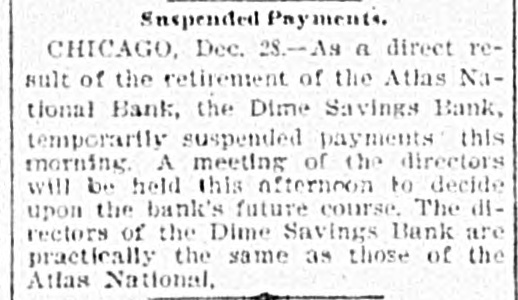
Suspended Payments. CHICAGO, Dec. 28.-As a direct result of the retirement of the Atlas National Bank, the Dime Savings Bank, temporarily suspended payments this morning. A meeting of the directors will be held this afternoon to decide upon the bank's future course. The directors of the Dime Savings Bank are practically the same as those of the Atlas National,


Article from Abilene Weekly Reflector, December 31, 1896

Click image to open full size in new tab

Article Text

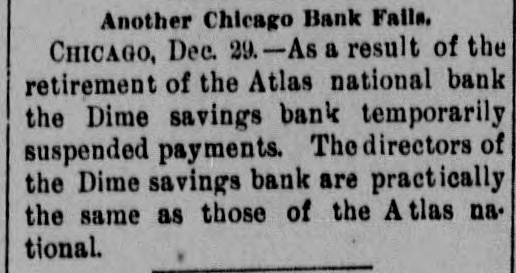
Another Chicago Bank Fails. CHICAGO, Dec. 29.-As a result of the retirement of the Atlas national bank the Dime savings bank temporarily suspended payments. The directors of the Dime savings bank are practically the same as those of the A tlas national.


Article from Jamestown Weekly Alert, December 31, 1896

Click image to open full size in new tab

Article Text

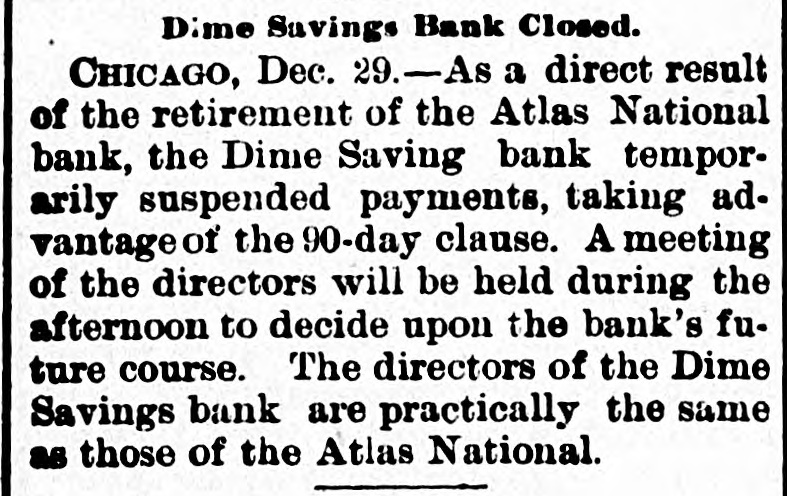
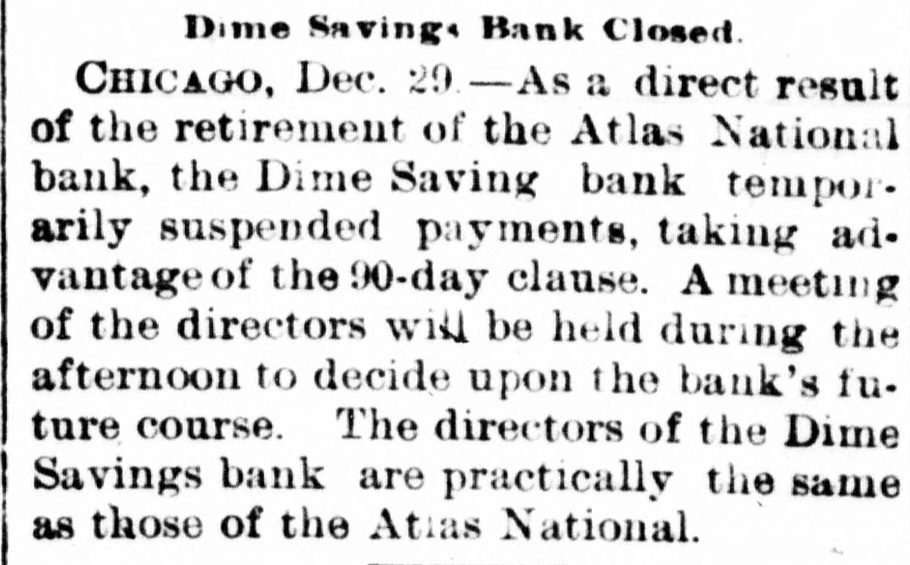
Dime Savings Bank Closed. CHICAGO, Dec. 29.-As a direct result of the retirement of the Atlas National bank, the Dime Saving bank temporarily suspended payments, taking advantage of the 90-day clause. A meeting of the directors will be held during the afternoon to decide upon the bank's future course. The directors of the Dime Savings bank are practically the same as those of the Atlas National.


Article from The Providence News, January 1, 1897

Click image to open full size in new tab

Article Text

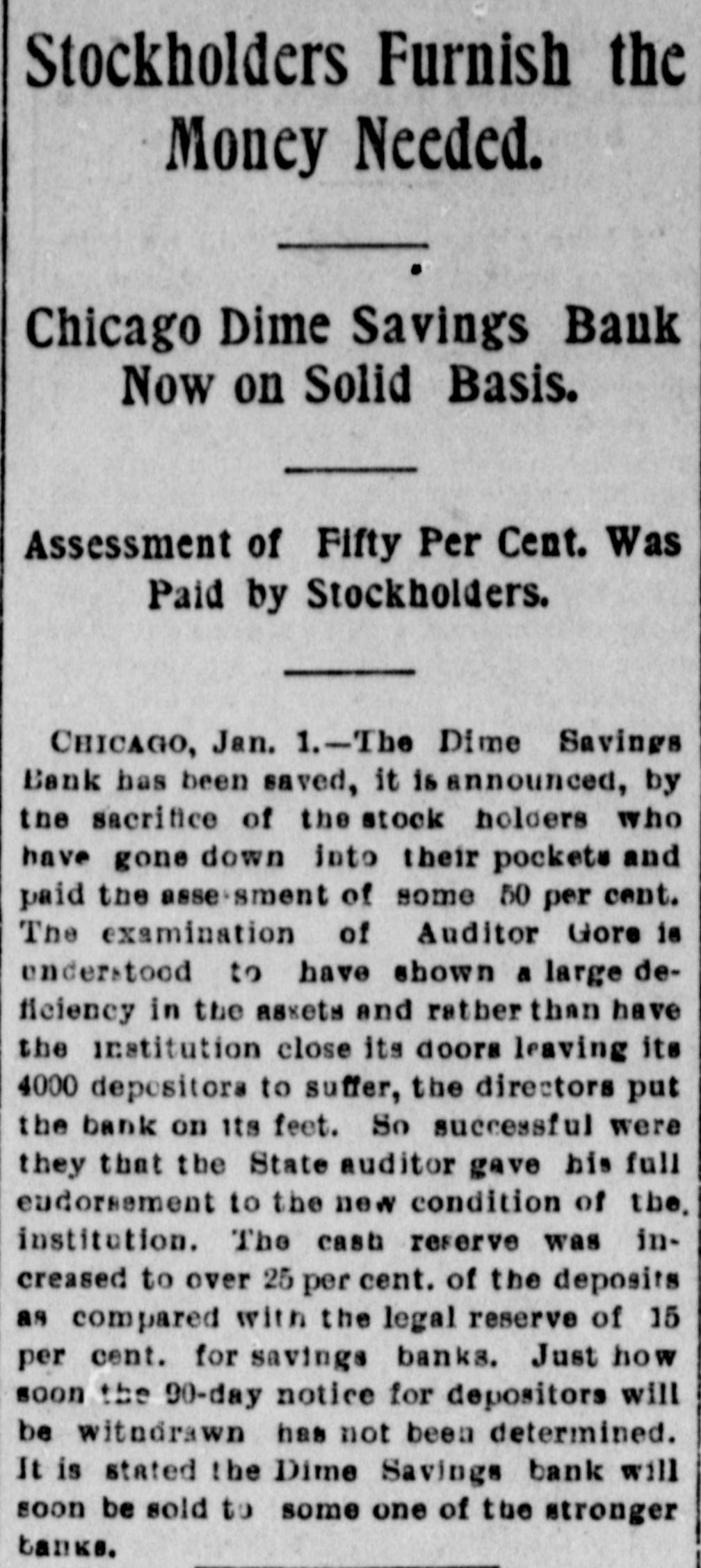
Stockholders Furnish the Money Needed. Chicago Dime Savings Bank Now on Solid Basis. Assessment of Fifty Per Cent. Was Paid by Stockholders. CHICAGO, Jan. 1.-The Dime Savings Bank has been saved, it is announced, by the sacrifice of the stock holders who have gone down into their pockets and paid the assessment of some 50 per cent. The examination of Auditor Gore is understood to have shown a large deficiency in the assets and rather than have the institution close its doors leaving its 4000 depositors to suffer, the directors put the bank on its feet. So successful were they that the State auditor gave his full endorsement to the new condition of the, institution. The cash reserve was increased to over 25 per cent. of the deposits as compared with the legal reserve of 15 per cent. for savings banks. Just how soon the 90-day notice for depositors will be witndrawn has not been determined. It is stated the Dime Savings bank will soon be sold to some one of the stronger banks.


Article from Alexandria Gazette, January 5, 1897

Click image to open full size in new tab

Article Text

The rules requiring ninety days no. tice for the withdrawal of deposits is being relaxed at the Dime Savings Bank, of Chicago, for needy depositors, and considerable money was paid out yesterday for the first time since the suspension of the National Bank of Illinois.


Article from The Norfolk Virginian, January 6, 1897

Click image to open full size in new tab

Article Text

CONDITIONS ARE EASIER. The Dime Savings Bank. of Chicago, is Making Demands. Chicago, Jan. 5.--The rules requiring ninety days' notice for the withdrawal of deposits is being relaxed at the Dime Savings Bank for needy depositors, and considerable money was paid out yesterday for the first time since the suspension of the Bank of Illinois, This action was the result of the recent strengthening of the institution by the assessment of 50 per cent on the stockholders. Negotiations for the sale of the Dime Savings Bank are said to be at an end for the time at least.


Article from The Times, January 6, 1897

Click image to open full size in new tab

Article Text

Time Limit Removed. CHICAGO, Jan. 5.-The rules requiring ninety days for the notice for the withdrawal of deposits is being relaxed at the Dime Savings Banks for needy depositors, and considerable money was paid out yesterday for the first time since the suspension of the National Bank of Illinois, This action was the result of the recent strengthening of the institution by the assessment of 50 per cent. on the stockholders. Negotiations for the sale of the Dime Savings Bank are said to be at an end for the time being.


Article from The Morning News, January 6, 1897

Click image to open full size in new tab

Article Text

NINETY DAY'S RULE RELAXED. Needy Depositors Allowed to Draw Out Their Money. Chicago, Jan. 5.-The rules requiring ninety days' notice for the withdrawal of deposits it being relaxed at the Dime Savings Bank for needy depositors, and considerable money was paid out yesterday, for the first time since the suspension of the National Bank of Illinois. This action was the result of the recent strengthening of the institution by the assessment of 50 per cent. on the stockholders. Negotiations for the sale of the Dime Savings Bank are said to be at an end for the time being.


Article from Richmond Dispatch, January 6, 1897

Click image to open full size in new tab

Article Text

CHICAGO DIME SAVINGS BANK. Ninety-Day-Notice Rule RelaxedSale Negotiations Ended. CHICAGO, ILL, January 5.-The rule requiring ninety days' notice for the withdrawal of deposits is being relaxed at the Dime Savings Bank for needy depositors, and considerable money was paid out yesterday, for the first time since the suspension of the National Bank of Illinois. This action was the result of the recent strengthening of the institution by the assessment of 50 per cent. on the stockholders. The negotiations for the sale of the Dime Savings Bank are said to be at an end, for the time being.


Article from The Yale Expositor, January 8, 1897

Click image to open full size in new tab

Article Text

NEWSY CONDENSATIONS. The complete offic al canvass of the vote at the recent election gives MeKinley 7,101,401 votes; Bryan 6,470,656. Fifty-four families were driven out of their homes during zero weather and at night by the burning of two large apartment houses on West Fifteenth street, New York City. Carnegie is to have strong opposition in the manufacture of armor plate in an immense new plant to be erected at Pittsburg by the Firth-Sterling Steel Co., composed of eastern and English capitalists. An impenetrable fog settled upon New York for a whole day preventing the operation of the ferries and causing an almost total suspension of traffic in the harbor, and on the streets the situation was not much better. Senator Wolcott, of Colorado, is taking a trip to Europe and it is asserted that he goes with President-elect McKinley's approval to confer with leading statesmen and diplomats upon the subject of an international bimetallic conference. A Washington dispatch says Li Hung Chang's visit to England and the United States has already borne fruit in a decision of the Chinese government to establish schools for the teaching of the English language and western sciences in all of the principal cities of the country. It is said that the intention eventually is to substitute English for Chinese. While Mrs. Daniel Myron, of Kalamazoo, was away from home, some one entered her house and completely demolished every piece of furniture, bedding, pictures, carpets, etc., doing damage to the amount of $700. The intruders cut in the wall with a knife in large letters, the word "Revenge." There is no clue to the hoodlums and Mrs. Myron has not an enemy so far as known. The prospects of the 1,000 people in burned-out town of Ontonagon are very blue. No manufactory seems inclined to locate there, notwithstanding it is one of the finest harbors on Lake Superior. Many of the burnedout families are still dependent upon the relief committee. The 12 business houses which have rebuilt are doing but little business, but the 13 saloons appear to be thriving. Secretary of State Gardner reports that there are 506,779 families in Michigan, and the average number of persons belonging to each is 4.42. There are 23,094 more families than dwellings. The numbers of families increased 118,031 from 1890 to 1896. There are 182,409 families in incorporated cities. The average number to a family there is 4.50; in the country, 4.38. There are an average of 4.63 persons in each dwelling in Michigan. The St. Joseph Valley railroad has had much trouble trying to fill up sink holes near Benton Harbor. Hundreds of carloads of dirt have quickly disappeared. Dozens of piles have been driven, one above the other. yet no bottom found. It is said that several piles, which were marked, were found floating in Lake Michigan soon afterwards, having evidently passed through a subterranean river. The recent heavy failures of the Illinois National and the Atlas National banks, at Chicago, have caused several other disasters. Otto Wasmansdorff, a well-known banker, grew despondent over his losses and suicided by shooting. The Dime Savings bank was reported to be heavily involved in the failures and experienced a very severe run. Wm. M. and J. S. Van Nortwick. of Batavia, 111., have been forced to make an assignment owing to their Josses.


Article from The Salt Lake Herald, January 10, 1897

Click image to open full size in new tab

Article Text

DIME SAVINGS BANK. Will Doubtless Go Out of Existence Ver Soon. Chicago, Jan. 9.-According to a morning paper the Dime Savings bank, the oldest exclusive savings bank in Chicago, will go out of existence before the expiration of the 90 day notice, which has been required on depositors since the suspension of the Atlas National bank. Edwin Walker, the attorney representing the stockholders and directors,


Article from The Madison Daily Leader, January 11, 1897

Click image to open full size in new tab

Article Text

Going Out of Business. CHICAGO, Jan. 11.-The Dime Savings bank, with its 4,000 depositors, one of the oldest exclusive savings banks in Chicago, will go out of existence before the expiration of the 90day notice which has been required of depositors since the suspension of the National Bank of Illinois.


Article from The Leader, January 13, 1897

Click image to open full size in new tab

Article Text

Dime Savings Bank to Quis CHICAGO, Jan. 9.--The Dime savings bank, with its 40,000 depositors, one of the oldest exclusive banks in Chicago, will go out of existence before tbl expiration of the 90-day notice, when has been required of depositors she the suspension of the National Bankot Illinois Depositors will be paid in ful.


Article from The Abbeville Press and Banner, January 13, 1897

Click image to open full size in new tab

Article Text

Domestic. The long threatened split in Tammany Hall, New York City, came when Henry D. Purroy, with several district leaders, openly bolted the organization and announced that he would form a new Tammany. Isaac Zuker was sentenced to thirty-six years' imprisonment for arson by Judge Fursman, in the Criminal Branch of the Supreme Court, New York City. Burglars entered the branch office of the Metropolitan Insurance Company, in West Forty-second street, New York City, and after blowing open a big safe in front of an open window stole $1500 in cash and valuable jewelry. Mrs. James Abercrombie Burden, wife of a millionaire iron founder. was attacked on Fifth avenue, in New York City, in broad daylight, by a highwayman, who flourished a knife, threw her down and ran off with her pocketbook. He was captured by Policeman Young after a hot chase. The Columbia National and Washington Banks of Minneapolis. the Commercial National Bank of Roanoke, Va., and the Van Nortwick Bank at Batavia, III, closed. Fire destroyed the electric light plant in Newark, N.J., and the city and'several nearby towns were left in darkness for a right. Isnac Zuker was convicted of arson in the first degree in having planned the burning of his building in New York City in January, 1892. The Atlas National Bank, of Chicago, Ill., began liquidating its affairs, and the Dime Savings Bank, of the same city, required depositors to give ninety days' notice of withdrawals. Three masked men, armed with revolvers, entered the saloon of Mrs. Mary Bernhardt, In Chicago, at 11 o'clock p. m., and robbed the place of $450. Mrs. Bernhardt was bebind the bar when the men came in, and two patrons of the place were sitting at a table playing dominoes. Two men were killed and another was fatally shot in a general fight six miles north of Mount Vernon. Ky. The dead are A. Rowland and Jack Rigsby. The wounded man is Greeley Lear. The fight began at a merrymaking. and was fought out on the highway in Kentucky feudal fashion between opposing factions. At Superior, Wis.. anticipating a run, the Bank of Superior did not open for business. Henry S. Butler is assignee. and has assumed charge of the bank's affairs. The failure is due to poor business and heavy withdrawals since recent failures in St. Paul and Chicago. The capital of the bank was $25,000, with a surplus of $6000. The deposits were nearly $100,000, including $13,210 of city funds. More than $1,500.000 was voted to hospitals, asylums and other charitable institutions for 1897 by the Board of Estimate, of New York City. The Lehigh Mills, in South Easton, Penn., manufacturers of cotton goods, have shut down for four months. and there is said to be but little prospect of a resumption at the end of that period. Depression in business is given as the cause of the shut-down, and one hundred employes are affected. The plant was started nearly one hundred years ago, and this is the first shut-down it has experienced. City Treasurer Turner. of Boston. Mass., opened bids for $1,890,000 3½ per cent. and four per cent. ten, twenty, and thirty year loans. The contract was awarded to Blake Brothers and R. L. Day. whose bid was $1,944,286 for the entire loan. The Scandia Bank, of Minneapolis, Minn., closed its doors. It was organized fifteen years ago by M. Grinager, a prominent Scandinavian politician. who died in 1893. Its President is R. Sunde, who came to Minneapolis ten years ago from Wilmar. Minn., where he had made a fortune as a money lender. Thomas J. O'Malley, a Chicago Alderman, has been indicted for the murder of "Gus" Colliander, in an election booth in 1894. A mail train from the West was robbed at one of the New York City stations and a large sum of money taken from letters addressed to New York firms. The letters, without in. closures, were found in the lower bay. Mrs. Agnes Antoinette Halpin, wife of ex. Assemblyman William Halpin, died in New York City of nervous exhaustion, collapse and gastritis, caused by the excessive use of Jamaica ginger. This habit is said to be prevalent in many places. The West End Street Railway Company of Boston, on which a strike occurred recently, discharged 700 union men, including the members of the Conference Committee and officers of the union. The Board of Directors of the Security Mortgage and Trust Company, Dallas, Texas, made application for the appointment of a receiver. The liabilitieso the company are, approximately, $2,000,000. Georgia's alleged titled convict, "Lord Beresford, as Sidney Lascelles called himself, was madea freeman by act of Governor Atkinson, who took pity upon him and pardoned him for his model conduct while in prison. The Atlas National Bank, Chicago, decided not to open its doors again, and the Clearing House will advance $600,000 tc help it pay all claims on demand. The bank has a capital of $700,000. W. C. D. Grannis is President. Thesecurities were examined and found to be ample to pay all claims in full.
Article from Courier Democrat, January 14, 1897

Click image to open full size in new tab

Article Text

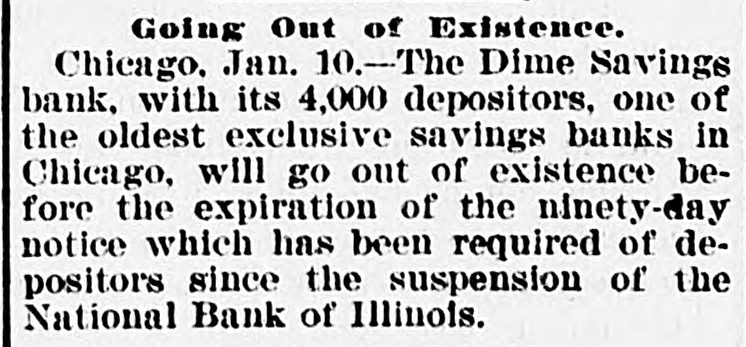
Going Out of Existence. Chicago, Jan. 10.-The Dime Savings bank, with its 4,000 depositors, one of the oldest exclusive savings banks in Chicago, will go out of existence before the expiration of the ninety-day notice which has been required of depositors since the suspension of the National Bank of Illinois.


Article from Evening Star, January 30, 1897

Click image to open full size in new tab

Article Text

Chicago Bank Receiver Appointed. CHICAGO, January 30.-Judge Freeman today appointed Ralph Metcalf receiver for the Dime Savings Bank. -


Article from Deseret Evening News, January 30, 1897

Click image to open full size in new tab

Article Text

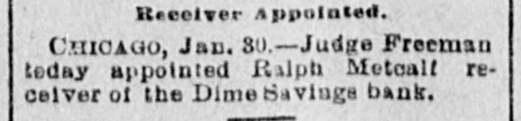
Receiver Appointed. CHICAGO, Jan. 80.-Judge Freeman today appointed Ralph Metcall recelver of the Dime Savings bank.


Article from River Falls Journal, February 4, 1897

Click image to open full size in new tab

Article Text

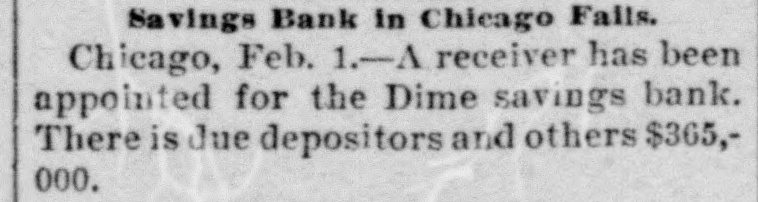
Savings Bank in Chicago Fails. Chicago, Feb. 1.—A receiver has been appointed for the Dime savings bank. There is due depositors and others $365,000.


Article from The Topeka State Journal, February 5, 1897

Click image to open full size in new tab

Article Text

A BANK IS IN DANGER. Depositors In the Burst Dime Savings Bank, Chicago, Worked Up to a High State of Anger. TO HOLD A MEETING Next Sunday to Denounce the Owners of the Bank. Depositors Were Mainly People of Small Means. Chicago, Feb. 5.-One thousand depositors in the lamented Dime Savings bank will gather in mass meeting on Sunday, exchange indignant views regarding the directors of the shattered institution and take definite action. This meeting was called at a preliminary conference last night at the Sherman house, during which the directors were denounced as scoundrels, theives and liars. Fifty persons who had never met one another before constituted last night's meeting and arranged for the larger one. When they reached the clubroom at the Sherman house they sat around for an hour to order. Every one wanted to do something, waiting for somebody to call the meeting, to get his money back, but did not know how. At last a lawyer present, who said he was not a depositor started the ball. Before the meeting adjourned this backward gathering was applauding the denuciatory speeches with all vigor. "It is enough to make Anarchists of poor people,' James R. Conrad, No. 673 East Sixty-third street, exclaimed. and the depositors cheered. We must do up a few of these rascals and show the whole country that the poor people cannot be robbed in this way while the big 'stiffs' who do it strut around town." Every few minutes. some one wanted to institute criminal proceedings against the directors, but the lawyers present, who came to represent clients, they said, were strongly opposed to such a course, as it was a sure means of losing what there was left in the bank. The failure of the criminal proceedings in the Kean crash in 1890, in the Schaffner failure of 1893, and the pardoning of the Meadowcrofts after depositors had spent over $5,000 in securing their conviction, were urged as examples of what might be expected. Others wanted Receiver Metcalf removed. but again the lawyers pointed out that such an attempt would be wasting money, and that it did not make much difference, as the receiver was under bonds. One depositor asked if he lost any of his legal rights if he took the 30 per cent dividend. He was told to get what he could when he could, for the bank might never pay another cent. The saving of deposits since December 21. when the ninety-day notice was posted, was denounced as a scheme to head off criminal proceedings after the failure for receiving deposits within thirty days after insolvency. To get the interests of the 4,000 depositors in the failed bank into better shape, a committee was appointed to see the receiver and the directors and to report at a meeting to be held in Aldine hall, No. 77 Randolph street, on next Sunday afternoon at 2:30 o'clock. The following were named as this committee: J. M. Etlinger, George B. Smith, H. M. Seliman, J. G. Harris and L. P. Biller. For chairman of the meeting J. G. Harris was selected. The Dime Savings bank began paying a 30 per cent dividend to depositors yesterday. When the bank doors were opened in the morning a crowd of anxious men, women and boys gathered at the steps. There was a rush and crush in the effort to get into the lobby, and the jam at the door continued all day. Two policemen stood inside with positive instructions to let in only a few people at a time. When 3 o'clock came the doors were promptly barred. Some women who had stood on the cold, wet stones since morning were turned away without having received the meager portion of their savings which had been promised them. The process of giving out the cash was SO slow that comparatively few depositors were able to take advantage of the order of the court instructing the payment. Many feeble women were compelled to leave in order to avoid the crush of the crowd that surged around the door. The gathering of depositors presented a picture which emphasized the fact that the shutting down of the bank was a terrrible hardship to thousands. Scarcely a well-dressed man or woman appeared in a score of depositors. Calloused hands hoarded the little savings which were locked away from them in the iron vaults of the bank. Some of the creditors of the institution were compelled to walk down town yesterday morning from Lake View, from Woodlawn and from distances far on the west side because they had not money enough to pay car fare. Working women who shivered and waited in the crowd outside the bank door for hours told stories of painful deprivations caused by the result of "impairment of the bank's capital. Rents were foreclosed, insurance payments were lapsing, credit had been exhausted at the grocer's and baker's and at the coal dealer's. Medical bills had taken away what other money they had, and in some cases needed medical attention was denied by reason of previous overconfidence in the Dime Savings bank.


Article from Perrysburg Journal, February 6, 1897

Click image to open full size in new tab

Article Text

Savings Bank in Chicago Fails. Chicago, Feb. 1.—A receiver has been appointed for the Dime savings bank. There is due depositors and others $365,000.


Article from The Diamond Drill, February 6, 1897

Click image to open full size in new tab

Article Text

Savings Bank in Chicago Fails. Chicago, Feb. 1.—A receiver has been appointed for the Dime savings bank. There is due depositors and others $365,000.


Article from The Representative, June 23, 1897

Click image to open full size in new tab

Article Text

FROM OUR EXCHANGES. A final word to you, comrade: Stand to your colors. Be a Populist as you have bravely been since the terrible days of 1891. Dont drag your creed into the mire. Don't become a Republican to spite the Democrats. You'll hurt nobody but yourself by such a mistake. You are no Republican. You oppose their principles and their class laws. You know that the Republican party . legislates for the money power of the East and North against the people of the West and South. If the People's party must die (which God forbid), what would you look like in the Republican party? What does it advocate that you approve? When has it been the friend of the South? What can you hope that it will do for the masses? Let us recognize Populism and meet the enemy once more! Don't give up the ship. The stars in their courses henor the brave, and nowhere under the sun is the time-server respected. On the platform of our convention at St. Louis sat men representing the greatest fortunes of this nation: The Sharon estate, the Hearst estate, the Huntingtons and all the Pacific California millionaires. We were not without our bonanza. The leaders of the Democratic party were there doing their secret work. The honest rank and file of the Democracy must be educated. They must be shown that no reform will ever come from the Democratic party. It has betrayed every promise. No old party ever achieved a real reform. The masses of all parties are honest. We must seek their votos, and we cannot get them by lauding the virtues of a political hariot like their party. The Republican party will not give relief. It cannot unless it accepts our policy. It dare not do that. The appointment of Gage and Sherman throws down the glove to every true patrio: They will fail. We must ally all forces and whip the Democrats in the South, and separate them from the West. Run straight tickets everywhere. No fusion. A straight fight. "He who dallies is a dastard." The battle is on and the separation of the sheep from the goats should commence.-Paul Van Dervoort. --Sentincl. That one Populist principle is beginring to impress itself on Republican minds is shown by the following from the Abilene Reflector (Rep.): "Priful tales of suffering entailed among the Chicago poor is shown by the failure of the Dime Savings bank. Thousands of needy ones had their entire savings in it and can get nothing out. One of these days Uncle Sam will develop sense enough to establish postal savings banks, operated in connection with the postoffices, and making an absolutely safe depository for the saving of the poor. Why it has been delayed so long, in view of the history of broken banks, is by no means clear."