Bank of the State of Missouri (St Louis, MO)

Episode Information

Episode Type
Suspension โ†’ Closure
Start Date
June 19, 1877
Location
St Louis, Missouri (38.627, -90.198)
Registered Place
St. Louis
Bank Type
state

Metadata

Events (3)

1. June 19, 1877 Suspension
Cause
Bank Specific Adverse Info
Cause Details
Hopeless insolvency due to fraudulent management, excessive loans to officers/directors, heavy 'dead paper' and depreciation of securities.
Newspaper Excerpt
A ten-day examination ... The board of directors met June 19, 1877, and after an all day session, admitted insolvency and asked for a receivership.
Source
newspapers
2. June 23, 1877 Other
Newspaper Excerpt
Old Bank Suspended. ... the Bank of the State of Missouri at St. Louis placed in the hands of a receiver of the United States Treasury on June 23, 1877.
Source
newspapers
3. June 16, 1887 Receivership
Newspaper Excerpt
The affairs of the bank were finally closed on June 16, 1887, creditors being paid 100% with interest through Edgar T. Welles, who succeeded Johnston as receiver in 1885.
Source
newspapers

Newspaper Articles (9)

Article from Daily Globe, October 5, 1878

Click image to open full size in new tab

Article Text

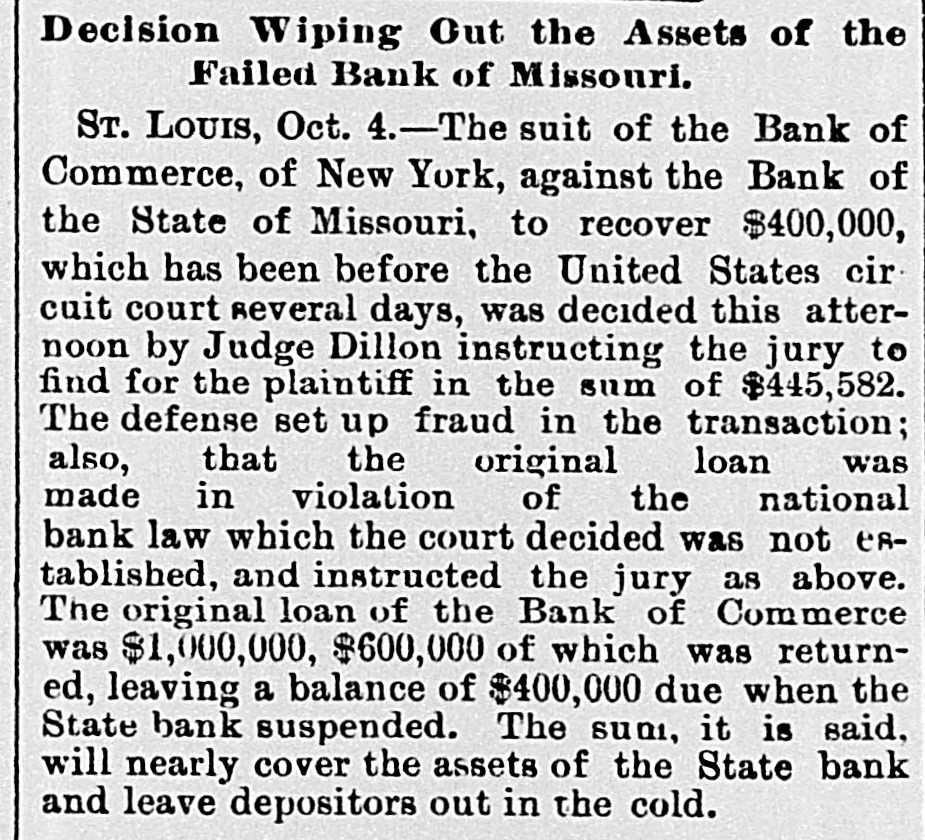
Decision Wiping Out the Assets of the Failed Bank of Missouri.

ST. LOUIS, Oct. 4. -The suit of the Bank of Commerce, of New York, against the Bank of the State of Missouri, to recover $400,000, which has been before the United States circuit court several days, was decided this afternoon by Judge Dillon instructing the jury to find for the plaintiff in the sum of $445,582. The defense set up fraud in the transaction; also, that the original loan was made in violation of the national bank law which the court decided was not established, and instructed the jury as above. The original loan of the Bank of Commerce was $1,000,000, $600,000 of which was returned, leaving a balance of $400,000 due when the State bank suspended. The sum, it is said, will nearly cover the assets of the State bank and leave depositors out in the cold.


Article from The Rock Island Argus, January 4, 1879

Click image to open full size in new tab

Article Text

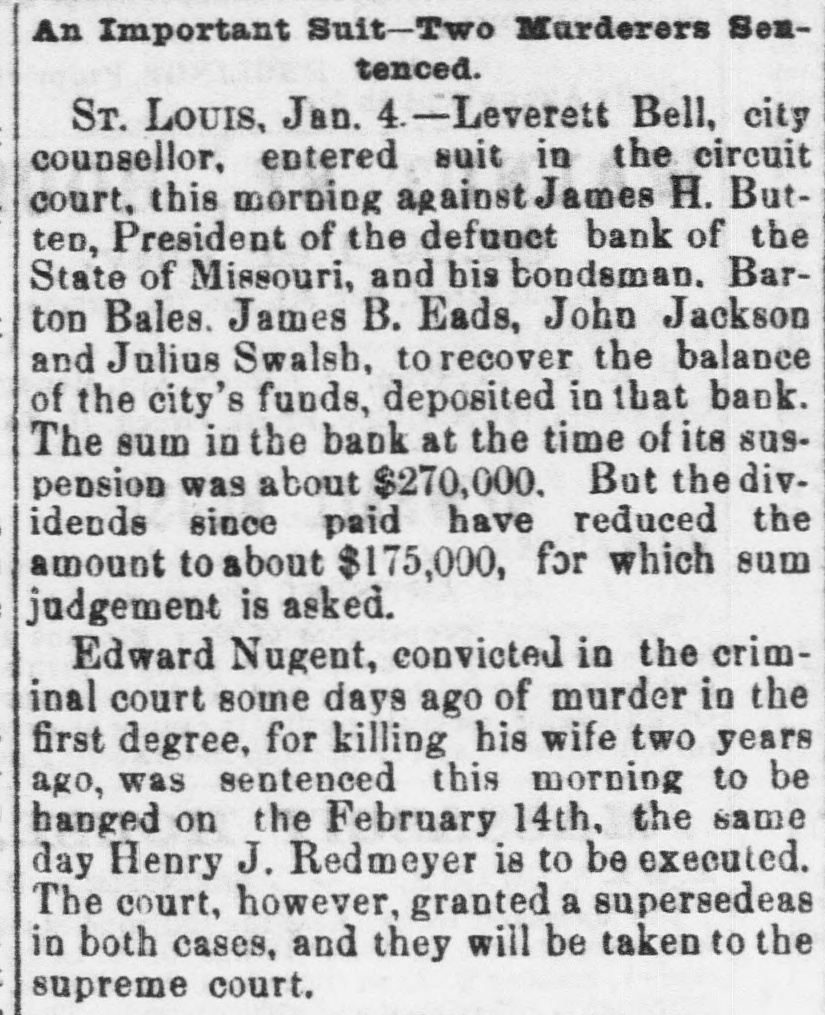
An Important Suit -Two Marderers Sentenced. Sr. LOUIS, Jan. 4.-Leverett Bell, city counsellor, entered suit in the circuit court, this morning against James H. Butten, President of the defunct bank of the State of Missouri, and bis bondsman. Bartop Bales. James B. Eads, John Jackson and Julius Swalsh, to recover the balance of the city's funds, deposited in that bank. The sum in the bank at the time of its suspension was about $270,000. But the dividends since paid have reduced the amount to about $175,000, for which sum judgement is asked. Edward Nugent, convicted in the criminal court some days ago of murder in the first degree, for killing his wife two years ago, was sentenced this morning to be hanged on the February 14th, the same day Henry J. Redmeyer is to be executed. The court, however, granted a supersedeas in both cases, and they will be taken to the supreme court.


Article from Daily Globe, January 6, 1879

Click image to open full size in new tab

Article Text

Suit for Recovery of City Funds.

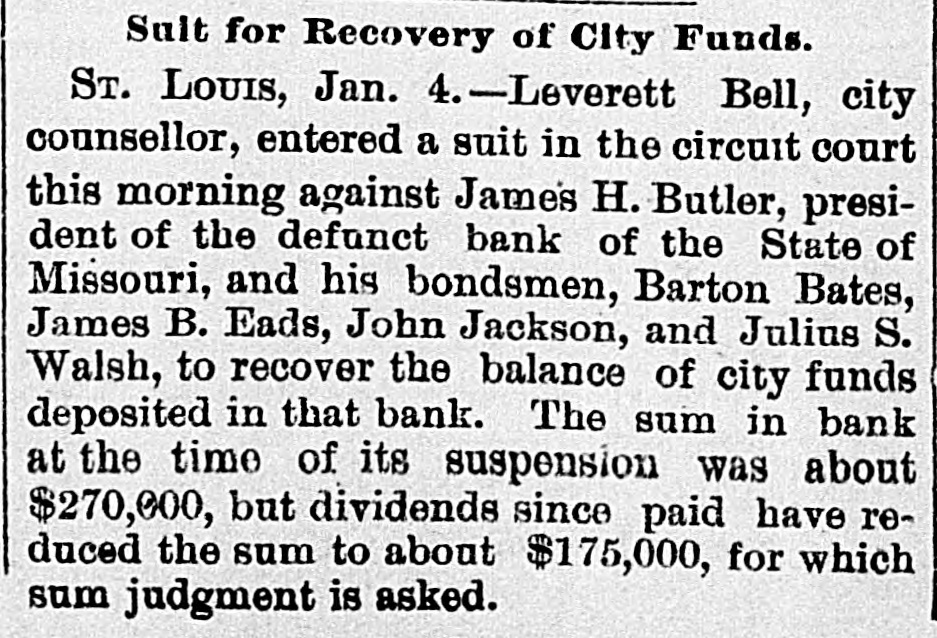
ST. LOUIS, Jan. 4. -Leverett Bell, city counsellor, entered a suit in the circuit court this morning against James H. Butler, president of the defunct bank of the State of Missouri, and his bondsmen, Barton Bates, James B. Eads, John Jackson, and Julius S. Walsh, to recover the balance of city funds deposited in that bank. The sum in bank at the time of its suspension was about $270,000, but dividends since paid have reduced the sum to about $175,000, for which sum judgment is asked.


Article from Daily Globe, January 6, 1879

Click image to open full size in new tab

Article Text

Suit for Recovery of City Funds.

St. Louis, Jan. 4. - Leverett Bell, city counsellor, entered a suit in the circuit court this morning against James H. Butler, president of the defunct bank of the State of Missouri, and his bondsmen, Barton Bates, James B. Eads, John Jackson, and Julius S. Walsh, to recover the balance of city funds deposited in that bank. The sum in bank at the time of its suspension was about $270,000, but dividends since paid have reduced the sum to about $175,000, for which sum judgment is asked.


Article Text

Old Bank Suspended. June 1877 significant Missouri banking circles the day which National Bank the State of Missouri Louis placed in the hands receiver the comptroller United States Treasury. Although when finally failed this bank was fundamentally changed from its organization at its beginning its failure marked the end of of Amerigreat banks. its early days known the Bank the finance and has played great role in the of all Missouri the Mississippi Valley. The State remained in the banksyndicate of Louis headed by James Eads, and the bank was This firm continued to do busiuntil the bank placed the hands received 1877. bank, having authorized known to banking circles "plunger", and dealer in spec-

Examined found that the bank much dead paper and about per cent the bank's capital gone. The bank not dered closed, but another and fullinvestigation was planned. Cable. his book, Bank of the State of Missouri", attributes the bad condition of the bank part to the apathy the stockholders. For three years before the Treasury investigation, meetings had been called but quorum never appeared, there was of officers. Dividends had been paid and the stockholders did not take trouble inquire into the status of the bank. ten-day examination of the bank committee showed the bank hopelessly insolvent. The board of directors met June 1877, and after an all day admitted insolvency and for There was little immediate fect in Louis following the closing the bank. The failure surprise to the people, but unexpected to bankers. Howwithin months, fourteen banks in Louis had closed and total of twenty-five banks in the whole state were closed during same period. By 1879, Walter Johnston, ceiver, reported that 70 cent dividends approved claims had been paid. The affairs the bank finally closed on June 1887. creditors being paid 100 per with interest, through Edgar who succeeded Johnston receiver 1885. and Mrs. Croy plan establish undertakparlor


Article Text

Week's Events In Missouri's History

Compiled by the State Historical Society, Columbia, Missouri, Floyd C. Shoemaker, Secretary.

Capture of Jefferson City. Preceding the first Civil war battle in Missouri by only two days, General Nathaniel Lyon, commander of the Department of the West for the Federal government, and his troops, entered Jefferson City and took charge of the State capitol without resistance on June 15, 1861, the anniversary of which date occurs this week. General Lyon's campaign into central Missouri, leading to Battle of Boonville on June 17, 1861, and resulting in the rout of troops under Governor Claiborne F. Jackson and General Sterling Price, was the answer to Jackson's proclamation calling for 50,000 State troops to repel the Federal soldiers within the boundaries of Missouri. On June 11, State and Federal representatives met in St. Louis in an effort to reach an agreement sought by the State, whereby Federal troops would be withdrawn from the State and both sides be disarmed. There had previously been passed by the State legislature a Military Bill, organizing the State for repelling invasion. This meeting, held June 11 at the Planter's Hotel at St. Louis, followed after Lyon had granted the Governor and Price safe conduct to and from St. Louis. The State government was represented by Governor Jackson, General Price, and the governor's secretary, Thomas L. Snead; and the Federal forces by General Lyons, Col. F. P. Blair, Jr., and MaFor four hours these men conferred. Jackson and Price declared they wanted no troops in the State, and that they would disband the State troops if the Federal troops were removed from Missouri.. Lyon, on the other hand, recognized the recently passed Military Bill as antagonistic to the United States, and would not consent to any agreement that would hamper the free movement of Federal troops. The meeting broke up and Jackson and Price left at m. over the Pacific Railroad for Jefferson City, later ordering the Gasconade and Osage river bridges burned after them. There followed Jackson's famous proclamation, calling for 50,000 men to repel the Federal troops from Missouri. This proclamation was regarded as declaration of war by the State executive against the United States. On June 13, General Lyon loaded troops estimated at between 2000 and 3000 men on steamers, and proceeded up the Missouri river to Jefferson City. Governor Jackson and his officers on the same day had abandoned Jefferson City, leaving there by the steamer White Cloud for Boonville, where mobilization of State troops was being effected. The Missouri Statesman (Columbia) of June 21, 1861, tells the story of the quiet capture of Jefferson City:

"About 3 o'clock last Saturday evening (June 15, 1861) the Federal troops under the command of Gen. Lyon disembarked from boats at Jefferson City and took possession of the town. No resistance was offered. The number of troops engaged in the expedition was between two and three thousand, but those who entered the city were five companles of Col. Blair's regiment, one company of regulars, and one company of artillery. The regulars landed first and immediately took possession of the heights near the penitentiary, and part of Col. Blair's regiment marched to the Capitol, took possession of the building, and hoisted the national flag. The balance of the troops remained on the boats with the artillery. On the evening of the same day, Col. Boernstein's regiment also arrived." Col. Henry Boernstein, placed in command at Jefferson City, held the capitol while General Lyon and the main body of his force continued in pursuit of Jackson's followers. Leaving Jefferson City at 2 p. m., June 16, by boat, Lyon and his force proceeding up the river at Boonville the next day fought and won the first Civil war battle in Missouri. end of "one of America's great banks." In its early days, then known as the Bank of the State of Missouri, the official State bank, this bank had set standards of sound and conservative finance and had played great role in the development of all Missouri and the Mississippi valley. The State remained in the banking business through this banking house from 1837 until 1866, but in that year it sold its stock to a syndicate of St. Louis headed by James B. Eads, and the bank was nationalized. This firm continued to do business until the bank was placed in the hands of a receiver in 1877. The Comptroller's report on the bank states that the cause of its failure was fraudulent management ,excessive loans to officers and directors, and depreciation of securities. Although it was the undisputed leader of Missouri banking affairs in 1866, and larger than any Western bank, having an authorized captal of fice million dollars, of which $3,410,000 was paid up, the policy of the bank was changed by its new own-

The National Bank of the State of Missouri, though considered by the public as still conservative, was known to banking circles as plunger,' and a dealer in speculative investments. Among the projects financed by the bank were included the North Missouri Railroads, the Eads Tunnel and Bridge, the Eads Jetties, the Merchant's Exchange, and numerous real estate transactions.

The panic of 1873 was met by the National Bank of Missouri by reducing its capital, and cutting down its circulation by retiring United States Bonds. Failure was avoided by this drastic method, but the bank had received a blow from which it never recovered. In April, 1877, after publication of statement which showed a condition that was none too strong, the bank was investigated by the Treasury Department. The Treasury examiner found that the bank held much dead paper and about 40% of the bank's capital was gone. The bank was not ordered closed, but another and fuller investigation was planned.

Cable, in his book, "The Bank of the State of Missouri," attributes the bad condition of the bank in part to the apathy of the stockholders. For three years before the Treasury investigation, meetings had been called, but as a quorum never appeared, there was no election of officers. dividends had been paid regularly, and the stockholders did not take trouble to inquire into the status of the bank.

A ten-day examination of the bank by a committee showed the bank was hopelessly insolvent. The board of directors met June 19, 1877, and after an all day session, admitted insolvency and asked for a receivership.

There was little immediate effect in St. Louis following the closing of the bank, The failure was a surprise the people, but not unexpected to bankers. However, within 16 months, fourteen banks in St. Louis had closed and a total of twenty-five banks in the whole state were closed during the same period. By 1879, Walter S. Johnson, receiver, reported that 70% dividends on approved claims had been paid. The affairs of the bank were finally closed on June 16, 1887, creditors being paid 100% with interest thru Edgar T. Welles, who succeeded Johnston as receiver in 1885.
Article Text

Notice Of Grant Of Letters

Estate of Wm. A. Price, deceased. Notice is hereby given, that letters Administration on the Estate of Wm. A Price, deceased, were granted to the undersigned, on the 1st day of June 1931, by the Probate Court of Dade County, Missouri. All persons having claims said Estate are requirednel Court within six months after theions. from benefit be precluded any such estate: and if such claims be not exhibited and presented as aforesaid within one year from date of this publication, they shall be forever barred.

ROY PRICE, Administrator.

I hereby certify that the above and foregoing is true and correct, as shown by the records in my office. Witness my hand and seal.

Horace Howard Probate Judge. (Seal) This 1st day of June 1931. 1st insertion June 4.th, 1931. which $3,410,000 was paid up, the policy of the bank was changed by its new owners. The National Bank of the State of Missouri, though considered by the public as still conservative was known to banking circles as a "plunger," and a lealer in speculative investments Among the projects financed by the bank were included the North Missouri Railroad, the Eads Tunand Bridge, the Eads jetties, of the National Bank of Missouri by reducing its capital, and cutting down its circulation by retiring United States Bonds. Failure was avoided by this drastic method, but the bank had received a blow from which it never recovered. In April, 1877, after publication of a statement which showed a condition that was none too strong, the bank was investigated by the Treasury Department. The Treasury examiner found that the bank held much dead paper and about 40 per cent of the bank's capital was gone. The bank was not ordered closed, but another and fuller investigation was planued. Cable, in his book "The Bank of the State of Missouri, attributes the bad condition of the bank in part to the apathy of the stock holders For threeyears before the Tresury investigation meetings had been called but as a quarm never appeared, there was no election of officers. Dividends had been paid regularly, and the stockholders did not take trouble to inquire into the status of the bank.

A ten-day examination of the bank by a committee showed the bank was hopelessly finsolvent. The board of directors met June 19. 1877. and after an all day ses. sion admited Insolvency and askThere was little immediate effeet in St. Louis following the closing of the bank. The failure was a surprise to the people, but not unexpected to the bankers. However, within 16 months four teen banks in St. Louis had closed and a total of twenty-five banks in the whole state were closed during the same period By 1879: Walter S. Johnston, receiver creported that 70% div. idends on aproved claims had been paid. The affairs of the bank were finally closed on June 16. 1887. creditors being paid 100% with interest through Fd. gar T. Welles, who succeeded Johnston as receiver in 1885


Article Text

Bringing In More Residents HOME TOWN THOUGHTS

Our people all have an interest in seeing more residents come in to make their homes in our community. If within few years our population should increase 25 per cent, there would be 25 per cent more jobs, and the profits of business, the amounts paid in wages, the sums available for public enterprises, would be increased in proportion. The possibility of securing new residents, then, is something that is worth while for every one to bear in mind. Let us all talk up our home town when people ask about it. If we do business with them, let us serve them so enthusiastically that they will like the trade spirit of the place. If we meet them socially, let us be so cordial that they say Campbell is good, friendly place to live in.

St. Mills. wheat flouring mills, will resume operations.

Branson- Election held here to vote on $20,000 boid issue for construetoin of new high school building.

Excelsior Springs- Swallow, new sandwich shop, opened for business in Beyer Theatre building. bank's capital was gone. The bank was not ordered closed, but another and fuller investigation was planned. Cable, in his book, "The Bank of the State of Missouri," attributes the bad condition of the bank in part to the apathy of the sockholders. For three years before the Treasury investigation, meetings had been called, but as quorum never appeared, there was no election of officers. Dividends had been paid regularly, and the stockholders did not take trouble to inquire into the status of the bank A ten-day examination of the bank by a committee showed the bank was hopelessly insolvent. The board of directors met June 19, 1877. and after an all day session, admitted insolvency and asked for a receivership. There was little immediate effect in St. Louis following the closing of the bank. The failure was surprise to the people, but not unexpected to bankers. However, within 16 months, fourteen banks in St. Louis had closed and total of twenty-five banks in the whole state were closed in the same period. By 1879, Walter S. Johnston, receiver, reported that 70 per cent dividends on approved claims had been paid. The affairs of the bank were finally closed on June 16, 1887, creditors being paid 100 per cent with interest through Edgar T. Welles, who succeeded Johnston as receiver in

Question is asked, as to how more trade can be drown into Campbell. The thing that draws trade, is the pulling power of enterprise, initiative and service.

One defect of vision is far-sighted ness. Good many people seem to be able to see a store bargain in some distant city, when they can't see an equally good or better one in their home town.

You can't get people out to an entertainment, unless it is in some way publicly announced. And similarly, you can't get people out to see your bargains in store, unless you announce them through advertising.


Article Text

Week

Compiled FLOYD Secretary State Historical Society of Missouri Columbia,

OLD BANK SUSPENDED

June 23, 1877 significant Missouri banking circles the which the Bank of the State of Missouri at St. Louis in the hands of receiver of the United States Treasury. when finally failed Although this bank fundamentally changed from its at its beginnin 1877, its failure marked the of of America's great In its early days, then known the bank of the state of Missourt, the official State bank, this bank standards of and conservative finance and had played great in the development of all Missand the Mississippi valley. The State remained the banking business through this banking house 1837 until 1866, but that from sold its stock to syndicate Louis headed by James Eads, and the bank nationalized. This continued to busiuntil the bank was placed the hands of receiver 1877. The Comptroller's report on the states cause of its failure was fraudulent management, excessive loans officers and directors, and depreciation of securities Although the undisputed leader Missouri affairs in 1866, and larger than any western bank, having an authorized capital of which was paid the policy of the bank was up, changed by new owners. The National Bank of the State Missouri, though considered by the public still was known banking circles and dealer speculative vestments. Among the projects anced by the bank were the North Missouri Railroad, Eods Tunnel Bridge, the Eods Jetties, the Exchange, numerreal estate transactions. The of 1873 met by the panic was National Bank of Missouri by reducing its capital and cutting down its circulation by retiring United States Bonds. Failure was avoided by this drastic method, but the bank had received blow from which never recovered. In April, 1877, after publication of which showed condition that was none too strong, the bank the Treasury partment. The Treasury examiner found that the bank held much dead paper and about 40 per cent of the bank's capital gone. The bank was not ordered closed, but another fuller investigation was planed. Cable, in his book, Bank of State of attributes the bad of the bank in part the apathy of the For three years before the Treasury investigation, meeting had been called, but aquor never appeared, there no election of officers. Dividends been paid regularly, and the stockholders did not take trouble to inquire into the status of the bank. ten day examination of the bank showed the bank was hopelessly insolvent. The board of directors June 19, after an all day session, admitted insolvency and asked for receivership. By 1879, Walter Johnston, ceiver, reported that 70 cent per viden approved claims had been The affairs the were finally closed on 16, 1887, ditors being paid 100 cent with per interest through Edgar Welles, who succeeded Johnston as receiver in 1885.
INFANTILE PARALYSIS

Jefferson City, August, and September are the of the year parents should constantly on the watch against the dread disease and when every precaution should taken to tect children from other people who may coming may be "carriers. The State Board of Health or the Missouri Society for crippeld children will with facts conthe disease, its treatment, and recovery. However, few facts that every parent should know. slight illness in your child should be watched with suspicespecially during an epidemic, and the family doctor should be callonce. positive diagnosis can obtained paralysis occurs, valescent of other serums can be ministered with excellent chance recovery without paralysis. Some those serums can obtained through the cooperation children's specialorthopedic surgeons, hospitals, laboratories in Kansas City and St. Louis. has already occur of its effetcs can overproper measures are undertaken once while the child still bed. Practically all disabling deformities can prevented plete both well muscles insured immediately proper handling, by braces or splints that rest, and carefully guided "passive and exercise. child cannot be taken to orthopedic (bone specialsoon the quarantine the Missouri Society for Crippled Children will cooperate with family doctor in furnishing list muscle training exercises upon Remember: Disabling deformity, even the majority of cases of fantile paralysis, thing. prevent prevent