6379. Farmers Bank & Trust Company (Hardinsburg, KY)

Bank Information

Episode Type
Suspension โ†’ Reopening
Bank Type
trust
Start Date
June 7, 1933
Location
Hardinsburg, Kentucky (37.780, -86.461)

Metadata

Model
gpt-5-mini
Short Digest
c0818f1b58ba8db7

Response Measures

None

Description

Articles (June 7โ€“8, 1933) describe a closed Farmers Bank & Trust Co. of Hardinsburg whose depositors submitted a reorganization plan; the Court of Appeals upheld the 1932 reopening law and directed the Banking Commissioner to approve plans, permitting reopening. No run is described; the bank was in liquidation/closed by banking authorities and is being reorganized and reopened.

Events (3)

1. June 7, 1933 Other
Newspaper Excerpt
Court of Appeals ... directed James R. Dorman, Commissioner of Banking and Securities, to approve reorganization plans for the reopening of the Farmers Bank & Trust Company, of Hardinsburg.
Source
newspapers
2. * Reopening
Newspaper Excerpt
The decision of the court upheld a ruling ... directing James R. Dorman ... to approve reorganization plans for the reopening of the Farmers Bank & Trust Company, of Hardinsburg.
Source
newspapers
3. * Suspension
Cause
Government Action
Cause Details
Bank had been closed and placed in liquidation by banking authorities; liquidation was suspended while depositors pursued a reorganization plan under the 1932 statute.
Newspaper Excerpt
reopening of the Farmers Bank & Trust company, Hardinsburg. During the period of reorganization liquidation of a closed bank is suspended.
Source
newspapers

Newspaper Articles (3)

Article from The State Journal, June 7, 1933

Click image to open full size in new tab

Article Text

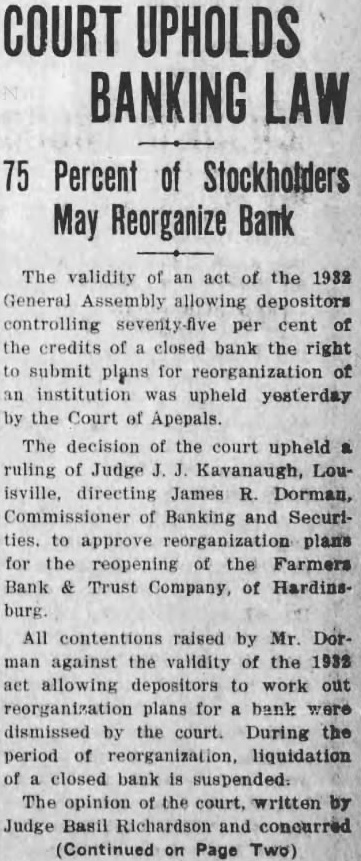
COURT UPHOLDS BANKING LAW 75 Percent of Stockholders May Reorganize Bank The validity of an act of the 1982 General Assembly allowing depositors controlling seventy-five per cent of the credits of a closed bank the right to submit plans for reorganization of an institution was upheld yesterday by the Court of Apepals. The decision of the court upheld a ruling of Judge J. J. Kavanaugh, Louisville, directing James R. Dorman, Commissioner of Banking and Securities. to approve reorganization plans for the reopening of the Farmers Bank & Trust Company, of Hardinsburg. All contentions raised by Mr. Dorman against the validity of the 1932 act allowing depositors to work out reorganization plans for a bank were dismissed by the court. During the period of reorganization, liquidation of a closed bank is suspended: The opinion of the court, written by Judge Basil Richardson and concurred (Continued on Page Two)


Article from The Owensboro Messenger, June 8, 1933

Click image to open full size in new tab

Article Text

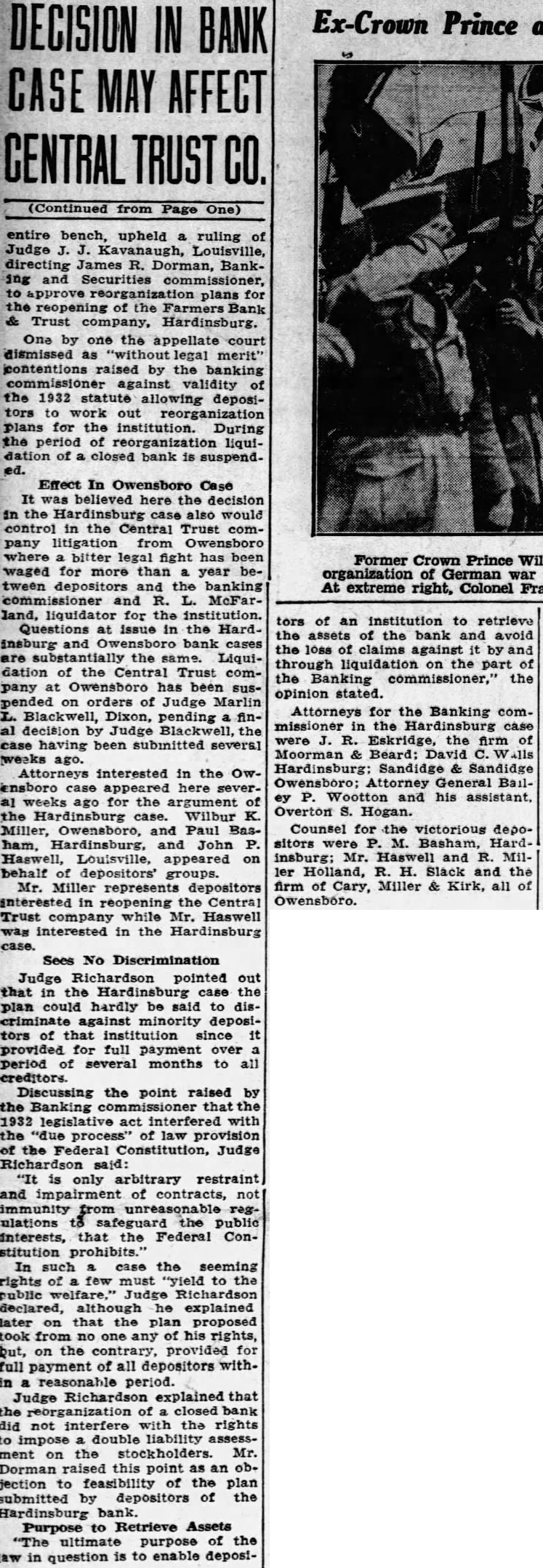
DECISION IN BANK CASE MAY AFFECT CENTRAL TRUST CO. (Continued from Page One) entire bench, upheld a ruling of Judge J. J. Louisville, directing James R. Dorman, Banking and Securities commissioner, to approve reorganization plans for the reopening of the Farmers Bank & Trust company, Hardinsburg. One by one the appellate court dismissed as "without legal merit" contentions raised by the banking commissioner against validity of the 1932 statute allowing depositors to work out reorganization plans for the institution. During the period of reorganization liquidation of a closed bank is suspended. Effect In Owensboro Case It was believed here the decision in the Hardinsburg case also would control in the Central Trust company litigation from Owensboro where a bitter legal fight has been waged for more than year between depositors and the banking commissioner and R. L. McFarland, liquidator for the institution. Questions at issue in the Hardinsburg and bank cases are substantially the same. Liquidation of the Central Trust company at Owensboro has been suspended on orders of Judge Marlin L. Blackwell, Dixon, pending a final decision by Judge Blackwell, the case having been submitted several weeks ago. Attorneys interested in the Owensboro case appeared here severa] weeks ago for the argument of the Hardinsburg case. Wilbur K. Miller, Owensboro, and Paul Basham, Hardinsburg, and John P. Haswell, Louisville, appeared on behalf of depositors' groups. Mr. Miller represents depositors interested in reopening the Central Trust company while Mr. Haswell was interested in the Hardinsburg case. Sees No Discrimination Judge Richardson pointed out that in the Hardinsburg case the plan could hardly be said to discriminate against minority depositors of that institution since it provided for full payment over period of several months to all creditors. Discussing the point raised by the Banking that the 1932 legislative act interfered with the "due process" of law provision of the Federal Constitution, Judge Richardson said: "It is only arbitrary restraint and impairment of contracts, not immunity from unreasonable regulations to safeguard the public interests, that the Federal Constitution prohibits.' In such a case the seeming rights of a few must "yield to the public welfare," Judge Richardson declared, although he explained later on that the plan proposed took from no one any of his rights, but, on the contrary, provided for full payment of all depositors within a reasonable period. Judge Richardson explained that the reorganization of a closed bank did not interfere with the rights to impose a double liability assessment on the stockholders. Mr. Dorman raised this point as an ob. jection to feasibility of the plan submitted by depositors of the Hardinsburg bank. Purpose to Retrieve Assets "The ultimate purpose of the law in question is to enable deposi- tors of an institution to retrieve the assets of the bank and avoid the 1088 of claims against it by and through liquidation on the part of the Banking commissioner," the opinion stated. Attorneys for the Banking commissioner in the Hardinsburg case were J. R. Eskridge, the firm of Moorman & Beard: David C. Walls Hardinsburg: Sandidge & Sandidge Owensboro; Attorney General Bailey P. Wootton and his assistant. Overton S. Hogan. Counsel for the victorious depositors were P. M. Basham, Hardinsburg; Mr. Haswell and R. Miller Holland, R. H. Slack and the firm of Cary, Miller & Kirk, all of Owensboro.
Article from The Owensboro Messenger, June 8, 1933

Click image to open full size in new tab

Article Text

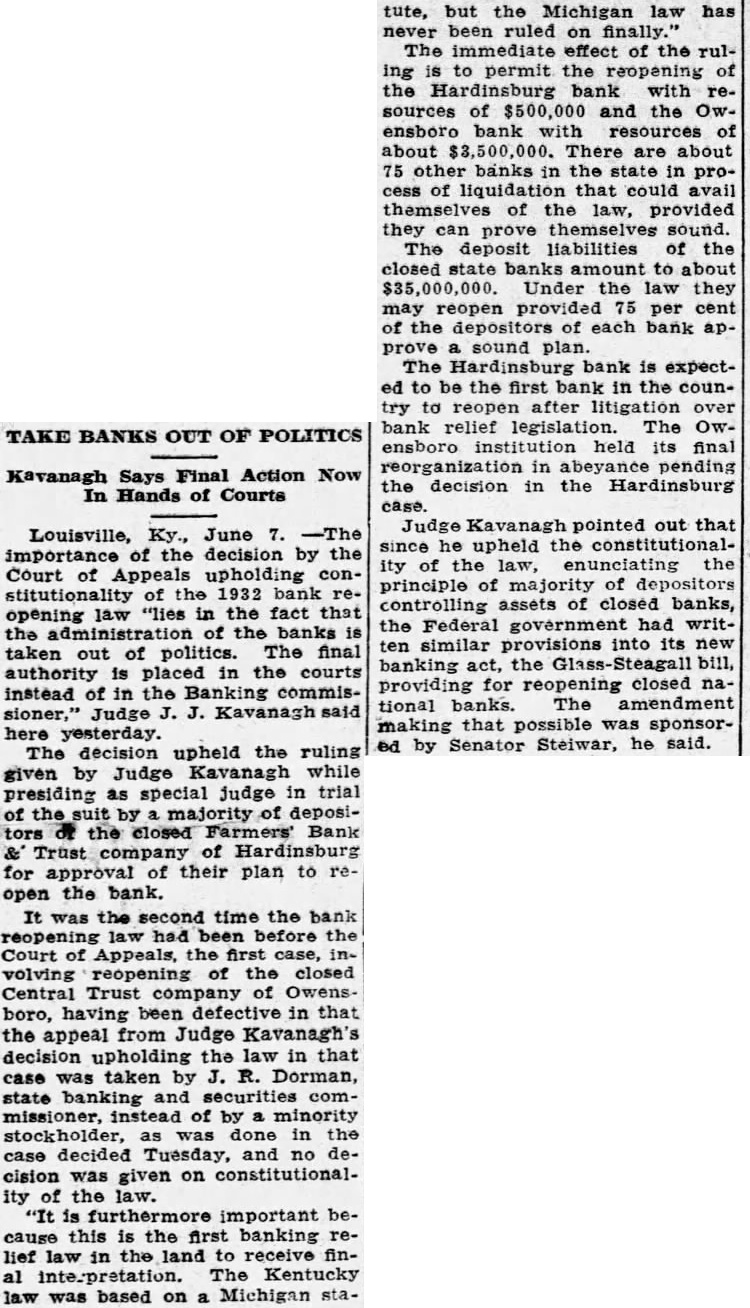
TAKE BANKS OUT OF POLITICS Kavanagh Says Final Action Now In Hands of Courts Louisville, Ky., June 7. -The importance of the decision by the Court of Appeals upholding constitutionality of the 1932 bank reopening law "lies in the fact that the of the banks is taken out of politics. The final authority is placed in the courts instead of in the Banking commissioner," Judge J. J. Kavanagh said here yesterday. The decision upheld the ruling given by Judge Kavanagh while presiding as special judge in trial of the suit by majority of depositors of the closed Farmers' Bank & Trust company of Hardinsburg for approval of their plan to reopen the bank. It was the second time the bank reopening law had been before the Court of Appeals, the first case, involving reopening of the closed Central Trust company of Owensboro, having been defective in that the appeal from Judge Kavanagh decision upholding the law in that case was taken by J. R. Dorman, state banking and securities commissioner, instead of by minority stockholder, as was done in the case decided Tuesday, and no decision was given on constitutionality of the law. "It is furthermore important because this is the first banking relief law in the land to receive final interpretation. The Kentucky law was based on a Michigan sta- tute, but the Michigan law has never been ruled on finally." The immediate effect of the ruling is to permit the reopening of the Hardinsburg bank with resources of $500,000 and the Owensboro bank with resources of about $3,500,000. There are about 75 other banks in the state in process of liquidation that could avail themselves of the law, provided they can prove themselves sound. The deposit liabilities of the closed state banks amount to about $35,000,000. Under the law they may reopen provided 75 per cent of the depositors of each bank approve sound plan The Hardinsburg bank is expected to be the first bank in the country to reopen after litigation over bank relief legislation. The Owensboro institution held its final reorganization in pending the decision in the Hardinsburg case. Judge Kavanagh pointed out that since he upheld the constitutional ity of the law, enunciating the principle of majority of depositors controlling assets of closed banks, the Federal government had written similar provisions into its new banking act, the Glass-Steagall bill, providing for reopening closed national banks. The amendment making that possible was sponsored by Senator Steiwar, he said.