Click image to open full size in new tab
Article Text
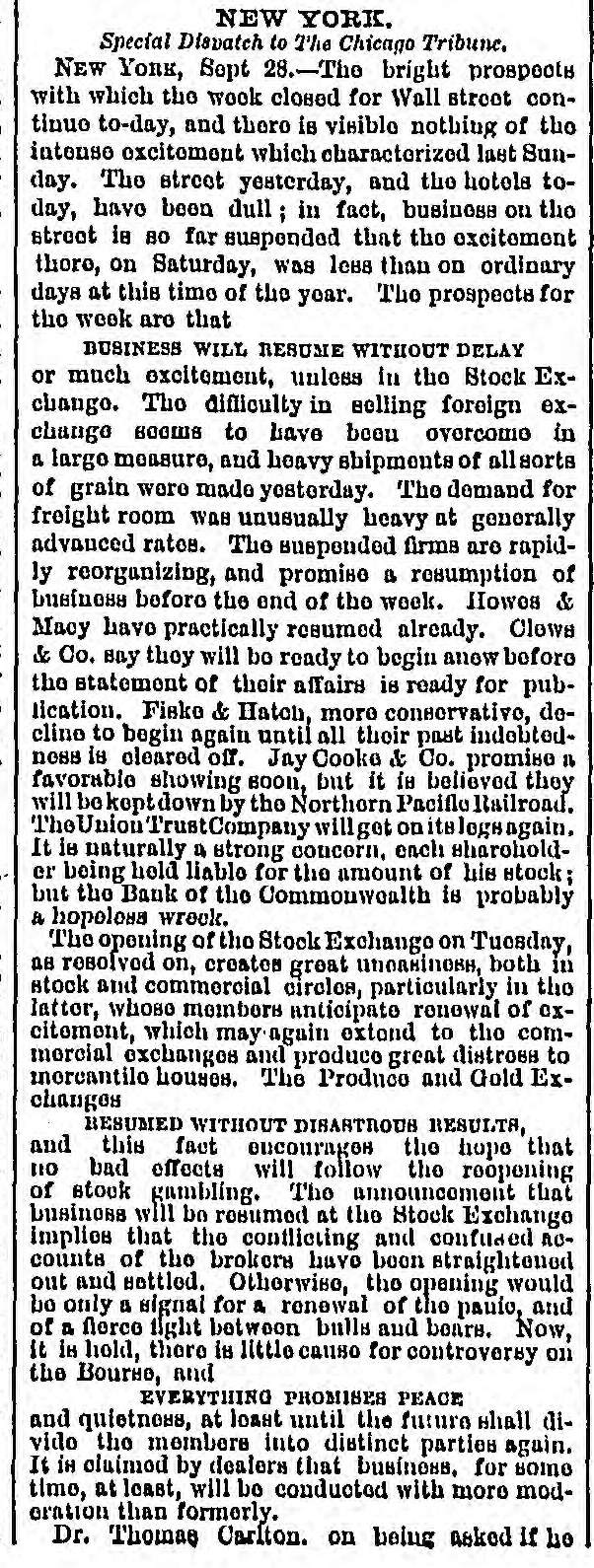
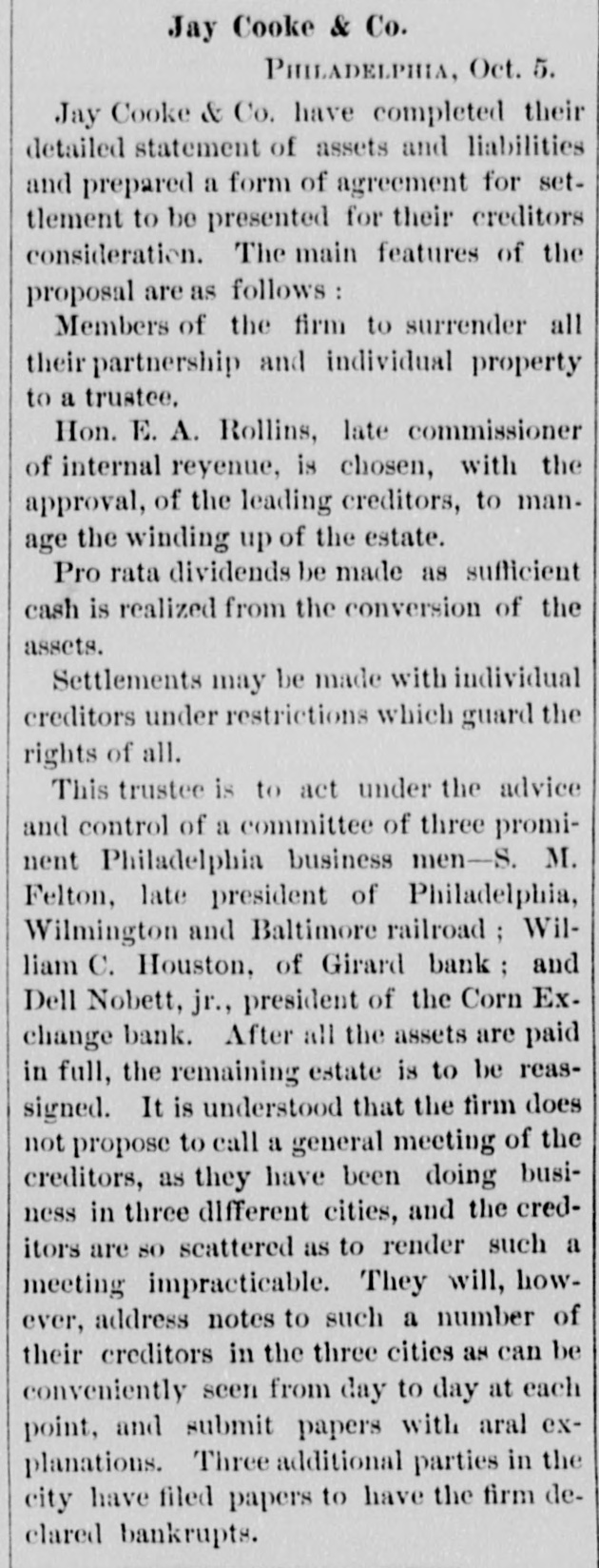
HOWES & MACY. It is not the intention of this firm to make any public detailed statement of their affairs. They consider it unnecessary in view of the fact that they are adjusting matters as rapidly as possible, with the purpose of continuing business at as early a date as practicable. They are in daily receipt of letters from their customers, acceding to the proposition contained in their circular, and with the many satisfactory assu* rances thus received they are determined to resume operations on the plan proposed, in the hope that the experiment will eventually prove successful. Mr. Macy says the whole financial difficulty assumes a very peculiar phase. If a person has "money any where else than town in his own control he cannot get it. People out of who make collections for his house write that such and such an amount is deposited to their credit in such and such a bank. But that does not do them any good; that is not what they need; all the exchanges are so bad that certified checks are next to useless if one cannot get the money on them. Mr. Macy had been visited by a country correspondent who had come to New-York to draw a large amount of money which had been deposited in his bank in small amounts, and which the country banker had sent to the city for investment. But be could not procure the funds in) available shape, and remarked that unless he could get his deposits in bills of staall denominations, they were of no more use to him than 80 much brown paper. Mr Macy would have been glad if the Government relief had been proffered through another channel, whereby it would have brought money into the country and distributed it among the people. He thought $10,000,000 in the hands of the merchants at this time would do more good than if distributed among the banks. The present outlook was not very clear, yet they were cheerful and hopeful. Biugham Bros. & Brace of Mount Morris, N. Y., and E. B. Hale & Co. of Cleveland, Ohio, deny that they are correspondents of Howes & Macy. HENRY CLEWS & CO. This firm is still engaged in the preparation of its statement, but the time of completion is uncertain. It will be exclusively for the information of the creditors of the house, publicity probably being given to nothing beyond a report of assets and liabilities. Mr. Clews believes the effect of the panic will be felt for years. He says everybody in the street has virtually suspended that is,they cannot pay their loans or meet their obligations, and if they were applied to for the money they would be obliged to suspend, the same as the rest of us." He thought the outlook was horrible-frightful. With 6 per cent for greenbacks as against certified checks, who could stand I" JAY COOKE & CO. These gentlemen believe the prospect is brighter and that the good or iil of the future is dependent largely on the exercise or lack of caution and a spirit of accommo dation on the part of creditors as against their debtors. They are rather afraid, however, of the effect of the reopening of the Stock Exchange this morning. The fact is, they say, our banks are poor. They hold large quantities of stocks as security for loans. If they press their claims for the money upon which these collaterals are held the result will be disastrous, and will be felt all over the country. But if the banks are inclined to be lenient toward their customers the trouble will be tided over, and we may before long discern the tokens of better times. Messrs. Jay Cooke & Co. have presented, in their report of assets and liabilities, all they intend to make public. They will, however, issue a statement of their condition and accounts for the information of their customers, together with a circular containing plan of resumption, which will be submitted to their patrons, and to the propositions in which the latter will be asked to accede or dissent therefrom. FISK & HATCH. The members of this firm, while not shrinking from reasonable publicity, feel that a detailed statement of their accounts is a matter strictly between themselves and their creditors. The public is entitled to understand their general condition and prospects, and to cover this obligation it is stated that Fisk & Hatch have an abundance of assets and a surplus sufficient to pay everybody and resume business with a large margin. They are now working with a definite object in view, of which, if accomplished, the public will DO fully informed.; THE UNION TRUST COMPANY. Mr. Wesley, the receiver of the Union Trust Company, yesterday morning denied the report that Commodore Vanderbilt had returned to the Company their loan to the Lake Shore Railroad. FAILURE OF THE GLENHAM MANUFACTURING COMPANY The Glenham Manufacturing Company, a corporation in existence for more than fifty years, having extensive woolen mills at Glenham, N.Y., and its office at No. 293 Broadway, suspended yesterday morning. The President, Russel Dart, said that to give in detail the causes of the suspension would involve a long statement, which he was not disposed and had not the time to make. In general terms, it was due to the depression of business, and resulted directly from the financial panic, which had prevented merchants from going on as they otherwise would. Previous to the disturbance in Wall-st., the outlook for business was good. He was not prepared to make even an approximate estimate of the assets liabilities, and could not tell whetner the suspension would be final or only temporary before learning the disposition of the creditors. He was also unable to say whether the creditors where chiefly individuals or corporations. as it is impossible at present to tell where the paper of the Company 18 placed. The Company was organized in 1820 by Peter H. Schenck, the grandfather of President Dart. James Dart, a brother of the latter, is Treasurer, and the organization is wholly a family affair. The original capital was $140,000, and it has always been maintained at that figure, but Mr. Dart said that at least $1,000,000 had been expended on the Company's property, which could not be replaced for that sum. The Company owns 200 acres of land at Glenham. with large factories for the manufacture of woolen goods, and dwelling-houses for all of the 500 operatives. Mr. Dart was unable to say whether the suspension would result in throwing all these operatives out of work, as this would largely depend upon the action of the creditors. Up to the present time the Company had never been involved in any difficulty. A dispatch from Philadelphia announces the suspension of Benjamin Bullock's Sons. extensive wool dealers, in consequence of the suspension of the Glenham Company, which Company owes the firm about $600,000. FINANCIAL PECULIARTIES.