First National Bank (Philadelphia, PA)

Episode Information

Episode UID
100885
Episode Type
Run β†’ Suspension β†’ Closure
Bank Type
national
Bank ID
10 national
Charter Number
1
Start Date
September 18, 1873
Location
Philadelphia, Pennsylvania (39.952, -75.164)

Metadata

Model
gpt-5-mini (chosen from majority vote of a three-model LLM ensemble)
Short Digest
b27e2d84703797c0

Response Measures

Accommodated withdrawals, Partial suspension, Full suspension, Books examined

Description

Contemporary reports describe a run in Sept. 1873 followed by the bank's suspension/failure (committee report cites failure on Sept. 18).

Events (4)

1. June 20, 1863 Chartered
Source
historical_nic
2. September 18, 1873 Suspension
Cause
Bank Specific Adverse Info
Cause Details
Overexposure to Jay Cooke & Co. and large indebtedness; committee later found mismanagement and heavy advances to Cooke leading to failure.
Newspaper Excerpt
the suspension of the First National Bank of that city.
Source
newspapers
3. September 19, 1873 Run
Cause
Macro News
Cause Details
Run was part of the broader panic following the failure of Jay Cooke & Co. and collapsing New York houses.
Measures
Bank continued to meet demands during the day (paid out sums); kept open to reassure depositors.
Newspaper Excerpt
There was a run on the First National Bank, but it did not amount to much.
Source
newspapers
4. June 14, 1882 Chartered
Source
historical_nic

Newspaper Articles (15)

Article from The New York Herald, September 20, 1873

Click image to open full size in new tab

Article Text

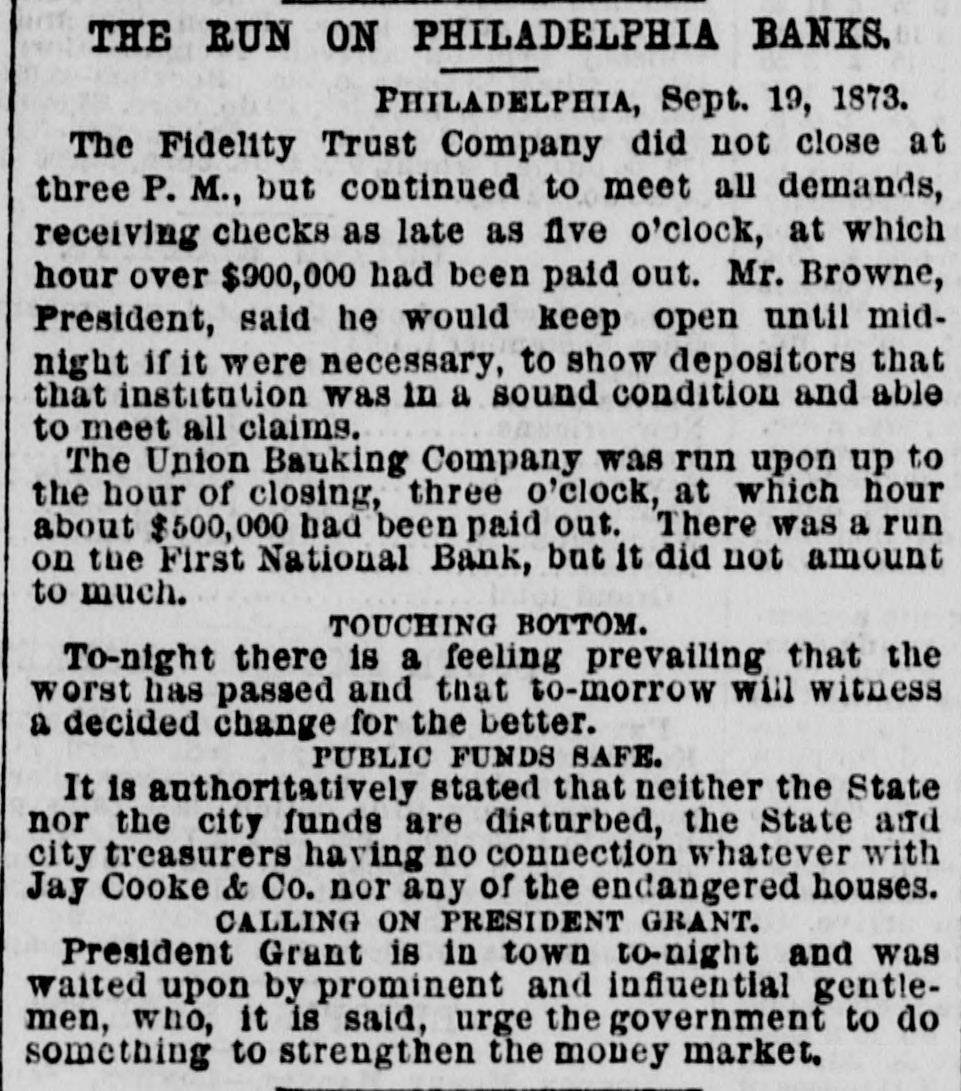
THE RUN ON PHILADELPHIA BANKS. PHILADELPHIA, Sept. 19, 1873. The Fidelity Trust Company did not close at three P. M., but continued to meet all demands, receiving checks as late as five o'clock, at which hour over $900,000 had been paid out. Mr. Browne, President, said he would keep open until midnight if it were necessary, to show depositors that that institution was in a sound condition and able to meet all claims. The Union Bauking Company was run upon up to the hour of closing, three o'clock, at which hour about $500,000 had been paid out. There was a run on the First National Bank, but it did not amount to much. TOUCHING BOTTOM. To-night there is a feeling prevailing that the worst has passed and that to-morrow will witness a decided change for the better. PUBLIC FUNDS SAFE. It is authoritatively stated that neither the State nor the city funds are disturbed, the State and city treasurers having no connection whatever with Jay Cooke & Co. nor any of the endangered houses. CALLING ON PRESIDENT GRANT. President Grant is in town to-night and was waited upon by prominent and influential gentlemen, who, it is said, urge the government to do something to strengthen the money market.


Article from New Orleans Republican, September 20, 1873

Click image to open full size in new tab

Article Text

WHOLE NUMBER 1981. weather the storm. The president of the physician, was attacked with the dis to-day company asserts that it can pay two dollars for every one of its indebtedness. The Fever in Key West. A Washington dispatch says: Henry D. WASHINGTON, September -The in Cooke says their house will soon resume department has advices from Key W and depositors lose nothing. He also says that the cases of yel'ow fever on the P the suspension of the Washington house nee are improving. No fever at Key W was a matter of expediency, and that time or aboard the Sanguis (Shawmut?). will show them to be in a sound condition. Secretary Richardson. who is advised as to the cause of the suspension of Jay Cooke WASHINGTON. & Co. expressed the opinion that the susCrew of the Polaris. pension will be temporary, and that their assets will be found in excess of their lia S WASHINGTON. September 19.-The bilities. Department has ordered the consul I Excitement at Washington. dee to pay the Polaris crew's expenses, send them home. WASHINGTON, September 9.-Dispatches from all cities report long lines of depositors The Charges Against R. T. Merrick crowding the bank doors. This city is no vestigated. exception. The committee of the bar association There is quite a rush on the Washington the District of Columbia, appointed at City Savings Bank, and a slight demonstrarequest of R. T. Merrick, Esq., to inv tion on the Freedmen's Bank. Both give gate certain charges made against him assurances of their ability to meet all deI Benjamin E. Green, son of General mands. The Freedmen's Savings Bank reGreen, and formerly of this city, made port that they had this morning $80,000, of report to-day. which only $20,000 had been drawn. f The report contains copious extracts There are about seventy-five persons in a the evidence. It sets forth that the char line at this bank. have been shown to be without the sli There is no excitement about the other est foundation, and that Green knew th banks. to be false when he published them, Action of the Authorities at the Capitol. that the committee is forced to this con sion by Green's own testimony, taken Various rumors have been in circulation der oath before the committee. The throughout the day as to the action the troversy arose out of some transact Secretary of the Treasury would take in that took place while Mr. Merrick was order to relieve the financial pressure in ing as counsel for Green in prosecut New York and elsewhere, and telegrams suits to recover property for Green in were sent hence by private parties professdistrict, and of which he had been depri ing to give the programme adopted by during the war. The suit was prosect him. after. it was alleged, a conto success by Mr. Merrick, and since ference with Grant, who was reported for $75,000. to be in Washington. The President was Return of the Juniata. not in Washington, but at 10:30 A. M. General Babcock called at the Treasury The Juniata has returned to St. Jo Department and had a private interview from her search for the Polaris, where with the Secretary. Subsequently numerwill wait for the Tigress and return her. ous inquiries were made of the Secretary, Ten Millions of Bonds. to which he uniformly replied he had not determined what he should do in the premThe Secretary of the Treasury, at a ises, as he saw no reason as yet why he hour to-night, telegraphed the assis should interfere. and at eleven o'clock to treasurer at New York to purchase night. being interrogated on the same sub000,000 of bonds on Saturday. jeet. he remarked that there was no authority for the various statements and rumors concerning his acts or intentions on finanTHE POLARIS. cial subjects. as he had determined on nothing. The Polaris Party at Dundee. During the afternoon and evening he was LONDON, September 19. -The stea in telegraphic correspondence with the Arctic brought to Dundee ten member treasury officers in New York and also the Polaris expedition, whose names are with the President, He said at the latest follows: Buddington, sailing master; interview that if he should to-night detersels, chief of scientific corps; Chester, mine upon any measure he would furnish mate; Morton, second mate; Schun the information to the press. chief engineer; O'Dell, second engin At half-past eleven o'clock the Secretary, Campbell, freman; Simous, Hobby in company with General Babcock and Mr. Hays, seamen. All are in excellent liea Conant, the chief of the loan division, were Three others were transferred by at the telegraph office together. when he Ravenscraig to the whaler Intrepid, W telegraphed to the assistant Treasurer at t is expected at Dundee in two or New York to purchase on Saturday $10,weeks. Their names are: Bryan, astr 000,000 of bonds. This is a special sale in J mer and chaplain; Mauch, seaman; addition to the regular sale next week. Booth, fireman. The Effect in Philadelphia. What They Say. PHILADELPEIA, September -The folThe reseued of the Polaris party re that after separation from Tyson and Iowing have suspended: H. H. Douglass a companions, the Polaris was finally Bayard, J.H. Yerkes, John L. Lloyd, Gildoned in a sinking condition by Cap baugh & Co. all small firms except Gilbaugh. Buddington and the remainder of the.e 1 The feeling here is that the worst is past, dition. The party wintered in Life and that to-morrow will witness a decided Cave, where they built a timber h change for the better. which they covered with sails. The wi It is authoritatively stated that neither passed without event, except the breal u the State nor city funds are disturbed. out of seurvy, which, however, was tended by severe symptoms. Plentiful s Run on the Philidelphia Banks. plies of walrus' liver for food were obta The Fidelity Trust Company did not from the natives, and to this diet is at close at 3P. M. but continued to meet all uted the mildness of the disease. demands. receiving checks as late as five In the spring two boats were built of o'clock. at which hour over $900,000 had boards taken from the cabin of the Pol been paid out. Mr. Brown, the president, In these the whole party embarked as said he would keep open until midnight, if as the ice opened, and sailed soutHw it was necessary, to show depositors that On the third of June they sighted the institution was in sound condition and York, and on the twenty second were pi able to meet all claims. up by the Ravenscraig. The Union Banking Company was run as Mr. Chester, first mate, is regarded upon up to the hour of closing. three one who did most to save the party o'clock, at which hour about $500,000 had the rescued men speak in the highest tΓ© been paid out. There something of a of his exertions. They also say that run on the First National also, but it did tain Hall enjoyed the confidence of e not amount to much. one, and his death, which was unexped The Matter is Circinnati was deplored by all on board. CISCINNATI. September News con Dr. Bessel's Statement. eerning the New York failures has been GOTHA, September --Dr. Petermani sought to-day with a great deal of interest, received a private dispatch from Dr. but has produced no excitement. There is Bessel, chief of the scientific corps of a feeling of general security with reference Polaris, announcing the safe arrival to our banks here, and no apprehensions the remainder of the Polaris expeditio are felt concerning our dealers in stocks. Dundee. The dispatch briefly states The transactions in stocks during the last the party experienced great hardships one or two months are said to have been had narrow escapes before they were unusually small. The impression appears cued by the Ravenscraig. general in our financial circles that the reg. ular business interests of the country will How They Were Rescued. not be seriously affected. DUNDEE, Scotland, September 19 crew of the Polaris were making their No Excitement in Sit. Louis. south in boats, made from the ship, ST. LOUIS, September 19.-There was they were seen by the whaler Ravens no excitement here today from the and taken aboard that vessel. They panic in New York Business on all well. 'Change was very quiet, and outside of a Civil War in Morocco. small decline in wheat and bacon, from A civil war has broken out in Mor local causes. nothing unusual is noticeable between a son and brother of the dece In monetary circles and among banks and Sultan, and the trade of the count brokers everything is calm and confident. paralyzed. None of our banks have large balances in New York; what they have are in old corNEW YORK. porated institutions, therefore no fears are entertained of losses. There has actually been no effect here m any department of Board of Steam Navigation. trade other than a slight pause, which will NEW YORK, September 19.-The Nat be too temporary to produce serious results. Board of Steam Navigation elected Ca Dick Woolfolk, of Louisville. vice presi The London House All Right. The board passed resolutions against LOXDON, September 19. -Jay Cooke, Mcrenewal of patents and in favor of the Culloch & Co., of this city, have paid over ernment controlling the Louisville can the counter all day the run on the house. Declines. P.P. firm of Jay Cooke, McCulVice President Wilson declines the loch & Co., of this city, paid cash over dency of the Cuban League. its counter all day. notwithstanding the run on the house. Marine. Arrived New York Angela

Article from Middletown Transcript, September 20, 1873

Click image to open full size in new tab

Article Text

The great banking house of Jay Cooko & Co. has suspended. Their liabilities are not yet known. Greatexcitement prevailed in financial circles when the announcement of their inability to meet their payments was made. In New York a financial panic ensued, and operators in gold and stocks became very nervous. The firms of Richard Shell & Co., and Robinson & Suydam suspend. ed, and a dispatch from Philadelphia announced the suspension of E. W. Clark & Co. Then came the news of the closing of the Warbington house of Jay Cooke & Co., and the suspension of the First National Bank of that city. At last reports other failures were looked for.


Article from The Wheeling Daily Register, September 22, 1873

Click image to open full size in new tab

Article Text

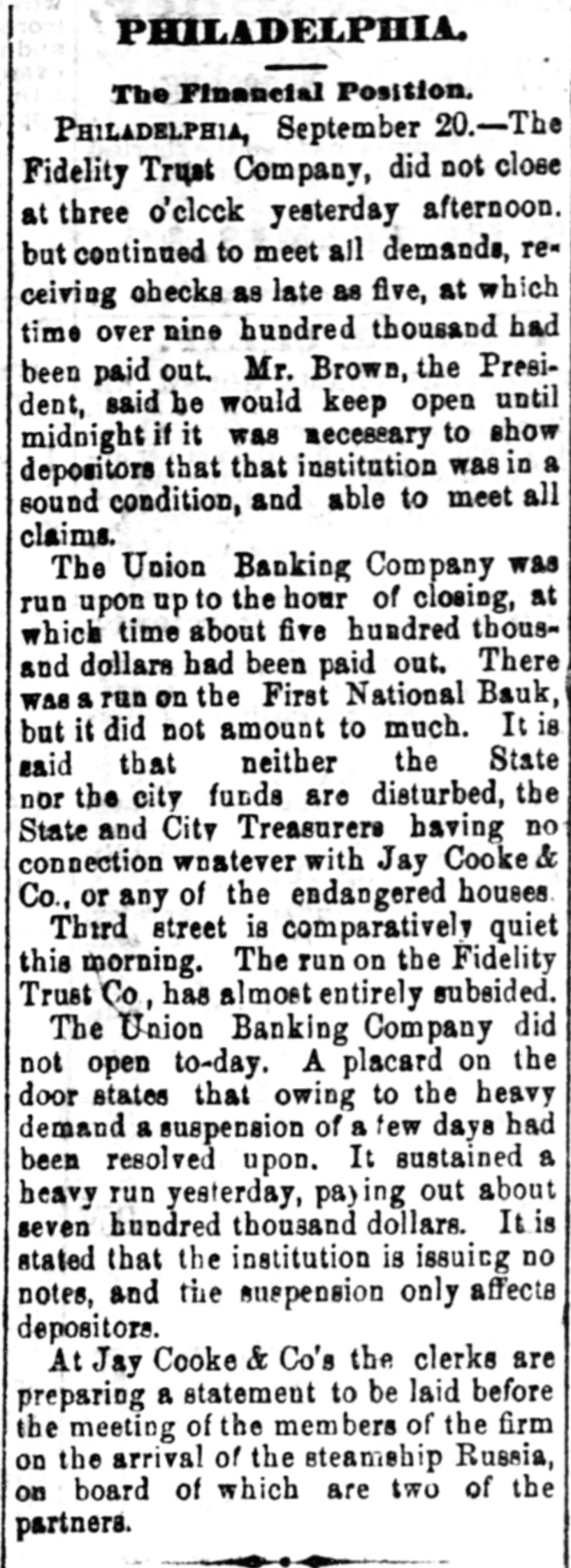
PHILADELPHIA. The Financial Position. PHILADELPHIA, September 20. .-The Fidelity Trust Company, did not close at three o'clock yesterday afternoon. but continued to meet all demands, re= ceiving ohecks as late as five, at which time over nine hundred thousand had been paid out. Mr. Brown, the President, said be would keep open until midnight if it was necessary to show depositors that that institution was in a sound condition, and able to meet all claims. The Union Banking Company was run upon up to the hour of closing, at which time about five hundred thousand dollars had been paid out. There was a run on the First National Bauk, but it did not amount to much. It is said that neither the State nor the city funds are disturbed, the State and City Treasurers having no connection weatever with Jay Cooke & Co., or any of the endangered houses Thurd street is comparatively quiet this morning. The run on the Fidelity Trust Co, has almost entirely subsided. The Union Banking Company did not open to-day. A placard on the door states that owing to the heavy demand a suspension of a few days had been resolved upon. It sustained a heavy run yesterday, paying out about seven hundred thousand dollars. It is stated that the institution is issuing no notes, and the suspension only affects depositors. At Jay Cooke & Co's the clerks are preparing a statement to be laid before the meeting of the members of the firm on the arrival of the steamship Russia, on board of which are two of the partners.


Article from The Wheeling Daily Intelligencer, September 22, 1873

Click image to open full size in new tab

Article Text

ADDITIONAL TELEGR APH. for with great interest and has been freely discussed. No paper has gone to protest, and the banks generally have been caring s for their customers. Though the past few days have been spent in preparing for every possible emergency, the merchants P and monied men of the city almost uniformly believe that Cincinnati will not be seriously affected by the storm which is raging in the East. The Run on Banks at Washington. WASHINGTON, Sep. 30 -The run on the Freedmen's and Washington City Sav. ings Banks continues to-day, but is much leas than yesterday. The former has paid out $65,000. There are about seventy. five persons, the majority being colored, awaiting their turn at the counter, and the actuary says it is about the usual Baturday afternoon crowd. WASHINGTON, Sep. though much interest was to day manifested in the exciting news from New York and Philadelphia, it had no apparent effect on the benking institutions in this city, The run on the Freedmen's and ashington City Savings Banks continued, but not to the extent of yesterday. No Disturbance of Business at Boston Bosron, Bep. 20.-The financial alarm to New York in the principal subject of discussion, but 80 far does not interfere with business. Only Serves to Induce Cantion at Montreal. MONTHEAL, Sept. 20.-The only effect here of the panic in New York has been to make #: bankers more cantious and leas willing to let out their tunds, which are ample for all their legitimate commercial demands. The discount rates vary from 7 to per cent, according to the standing of the names. A Suspension at Toronto. TORONTO, Sept. 20.-H. J. Morse & Co. bankers and brokers in this city, have suspended, owing to the failure of Cooke & Co., and other prominent houses. A Temporary Suspension at Albany. ALBANY, Sept. 20.-T. Squire & Co.' bankers, announce their temporary sus. pension until further orders from New York. Suspension or a Branch of Taussig & Co. in St. Louis. Sr. Louis, Sept. 20 -Taussig, Gemp & Co., this city, closed doors this afternoon, after the failure of their New York house, Tauseig, Fischer & Co. They confldent or being able to resume in a few days, and state that no one will lose a dollar by them. This house dealt pretty ex tensively in railroad securities on their own account. Suspension of a Private Bank in Chicago--No Excitement in Financial or Commercial Circles There. CHICAGO, Sept. 20.-The Franklin Bank, a private banking institution on the corner of Madison and Dearborn streets, closed its doors to-day, being unable to settle at the clearing house. The amount short was only $9,000. Fernando Jones is President of the concern and S. A. Briggs, Vice President. The latter states that their embarrassment is merely temporary and as it is not known to have been in any way connected with any of the suspended New York houses there would appear to be no reason why it should not resume soon. It is stated that a majority of the teachers of the public schools of the city are depositors in the bank. Its early resumption is, therefore, the more to be hoped for. The suspension creates no excitement or feeling whatever in t financial or commercial circles. Matters in Philadelphia Better Feeling in the Evening. PHILADELPHIA, Sept. 20.-The Fidelity Trust Company did not close at 3 o'clock 8 this afternoon, but continued to meet all demands, receiving checks as late as 5 o'clock, at which hour over over $900,000 had been paid out. Mr. Brown, the President, said be would keep open until midnight it it was neccessary, to show the depositors that the institution was in sound condition and able to meet all claims against it. The Union Banking Company was run upon up to the hour of closing, at which time about $500,000 had been paid out. There was a run on the First National Bank, but it did not amount to much. It is authoritatively stated that neither the State nor city funds are disturbed, the State and city Treasuries having no connection with Jay Cooke & Co. or any u of the endangered houses. p PHILADELPHIA, Sept. 20.-Third street is comparatively quiet this morning. The run on the Fidelity Trust Company has almost entirely subsided. The Union Banking Company did not open to-day. tl A placard on the door states that owing to the heavy demands n suspension of alow days had been resolved on. It sustaineda heavy run yesterday, paying out about $700,000. It is a Stateinstitution, issuing no notes, and the suspension only affects the depositors. At Jay Cooke's the clerks are preparing a statement to be laid be fore a meeting of the members of the firm, on the arrival ot the steamship Russis, on board of which are two of the n partners. Priladelphia, Sept. 20 -Evening.Tuo excitement over the failures has abated and matters are beginning to as. sume a right shape, although the stock market was somewhat feverish to day; yet the affairs on the street were more settled, owing, no doubt. to the promise of the Secretary of the Treasury to make use of $44 000,000 of the reserve fund If desired. The failure of the Union Banking Company, of this city, had but little effect on the public mind, as it was a small conoern and its failure cannot possibly affect other institutions. The Fidelity Trust and Safe Company met all its obligations to day. The run was not as heavy as yesterday, only about $400,000 being paid out. Prudential Step Taken by Chicago Savings Banks. CHICAGO, Sept 31 meeting of the officers of the different Savings Banks in this city was held to-day, at which all the Savings Bank institutions in the city


Article from Wilmington Daily Commercial, September 30, 1873

Click image to open full size in new tab

Article Text

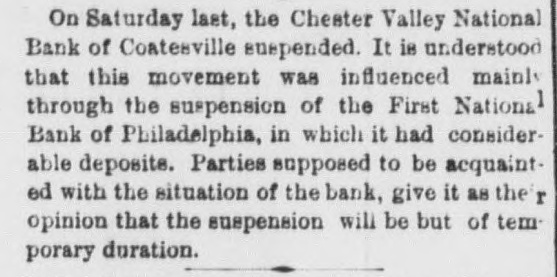
On Saturday last, the Chester Valley National Bank of Coatesville suspended. It is understood that this movement was influenced mainly through the suspension of the First National Bank of Philadelphia, in which it had considerable deposits. Parties supposed to be acquainted with the situation of the bank, give it as the'r opinion that the suspension will be but of tem porary duration.


Article from National Republican, March 21, 1874

Click image to open full size in new tab

Article Text

es NKING AND CURRENCY. HOW THE BANK was MAN AGED-NEGLE OF THE -THE OFFICERS-THE BANK'S INDESTEDNESS TO THE COOKE & CO.'S RELATIONS WITH ITM THE -PROPOSED TO AMENDMENT THE CURRENCY ACT. Mr. J. Macfarland, correspondent f the Phile delphia Press, telegraphed the following to area shop I $ I $ age: paper tiem by the House late the affairs o the First National Bank of this city. Asubof the on Banking and CurMerriam Parwell, Measrs. of remoy, I Darbam, appointed to make the examination. meeting the committee yester. I 1 day 1 Che or and regort sented and adopted, and is understood a reported to the House Momday next. prtscipal stoek- a that report of the holders of at the i I members of the firm of Jay Cooke & Co. During its exist existence the bank has been a. depository blie meneys, and largely employed at the time to faspeial a A : I % 1 of I de 1 I a thirty notes, and in funding various Government I system. with As Government agent its transactions have been of great magnitude, and large profits have boon derived from them and from dealing overament securities or all kinds. Another branch. to and a a I 1 I 1 version of matilated the time of its to the failure persissions currency fund amounted $750,000 of indebtedness to other becks, The commiller and that there was was GREAT AND NEGLECT by the officers of the bank to establish and out proper system for the management of its details. No adequate checks shed to Insure correctness and accuracy. No record is found of any cash settlement having been made in this department of the bank. It did not into the general cash account, but was kept separately. The books of this account were simply wpwerouse At the time of the failure the accumulation of not entered on the general books of the bank amounted to nearly $340,000. This entered and comes in Its proper place in the balance sheet. There difference between the balance sheet prepared by the committee and the statement actually shown by the books on the 18th of September last in this mutilated curr ency account $46,398. A thorough examination shows that this deficit cannot be accounted for. THE LARGE INDESTEDNESS of the bank to the Government exceeding the amount securities deposited has speciall inquired into, and arose as follows: As desig. na nated de depository this bank issued its certif in favor vor the United States rer for fractional currency, to forwarded the banks who made their orders through it. In the natural course of business said certificates would not be large, and the balances in bank would be kept down to proper amount by transfer orders made soon as the reports of the bank when received at the Treasury could be exam ined. August 23, 1873, the balance to the credit of the Treasurer on the books of the bank, and reported to him, was $133,108.45. 45. During the fol. lowing week were issue by the bank and cashed (by the Treasurer amounting to @118 ,750, @118,750, runnin the balance on the 30th August $251,858.45. During the following week certifi cates were issued to amount of $40,524, 534, making a total of $292,382.45. Transfer orders were paid the amount of $145,000, leaving the balance September 6at at 8147 $147,382.45. From the 8th tothe 17th of September, inclusive, certificates were issued to the amount of 400. $185,400. making total of $332,782; and on the 13th of September transfer order was paid for $45, 000, leaving lance on the 13th $287,782.45 or the certific stes issued during the last week $125,000 were for ractional currency to be shipped Jay Cooke & Uo., Phils Hadelphia. At the that these large sums were forwarded on the strength of the certificates of the First National Bank that bank was already indebted to the United States Treasurer for & sum larger than the amount of its securities on deposit with the Treasurer. HOW JAY COOKE AND co. OBTA OBTAINED ED GOVERNMENT AID. The committee find that the manner through which Cooke were permitted to thus obtain from the Government what might be called temporary loan of large amount of money on the simple indo indorsement of the First National bank was due to & laxity in former Treasury regulations, of which they took advanto forbolster in their : attempt failing du tage tunes. Immediately after the failure of the bank the present Secretary of the Treasury took effective steps, through which he has been enabled to obtain full and ampleg narantees and security by which the Gove would be saved red from loss. The committee have examined Ined the charac racter of the guarantee and security, and feel confident that any deficiency will fully met from another source than the assets of the bank. The commit. tee give the Secretary credit -for his promptness in this matter. In speaking of the management and CAUSE OF FAILURE OF THE BANK the committee find that on September 18 there were $83,383.46 of due past-due paper, mostly owed, and $72,838.93 demand notes- notes-making total of $156,222.39. These demand notes dational loans of long standing, which should be been a have for of them Some called past-due. years in one shape or anot another. The bank is carestate # real indebt000'988 emos rying edness, which has also been carried for years. The commit tee further find that during its OXistence sum amounting to over $180,000 has been charged to profit and loss account for bad debts. The statement of these few facts the committee deems sufficient to show that the management rement of the bank has been, to say the least, unfortunate. From the of its business to the present time the bank seems to have paid no attention to the law limiting loans one tenth capital. The provisions of the 29th section of the our rency act has been repeatedly transg transgressed, both letter and spirit, and to this failure of the bank is is dir directly traccable. Technically, it might be said that the large amount due from Jay Cooke Co. was the nature deposit, the facts such an assertion is preposterous. I 00.18 COOKE YYP On the 18th of September, and the date of its failure, Jay Cooke were indebted to the bank in the of sum of $765,960.69 960.69 in current account. They further . debt - indorsers on paper of the Northern Pacific railroad $100,000, and Henry D. Cooks, president bank and mem Indelecad a the the : I Date (on note carried by the bank fn some shape or other since January 1888, of $49,978 42; making total . The Northern Pacific railroad indebtedness edness has carried by the bank since the 17th of July, 1872. From August Ito Septemb 18 the current account of Jay Cooke & Co. was increased from 8238, $238,682 to 8748 $748,980, without security. Nearly $300, 000 of this amount was after September 6240,000 fthat was - the 15th and 10th of September. These facts are sufficient evidence, in view of the events which vents which thereafter, that these large transfers of moneys were really loans made to bolster up and streng then strengthen s firm and were not deposits. difficulties, legitimate lites, Thus were the whole capital of the bank. its whole surplus, and . part of its used by one firm, and that firm composed of the principal I 8 & I terms I 8 above of a 1 parts 2 you = public and private funds intrusted tos national bank for safe-heeping and legitimate uses. The refer to the fact that the Comptroller of the Currency has able to pay 30 per 1 per R 3 I 1 pay Repredent a 1 an divided of and ! ACT. The committee closed by submitting amendto the twenty r-atath and fifty fifty-third third sections of the tonal currency act. The twenty minth section the mittee propose amend to: as follows: That no rganised under this act shall deposit with, loan to in any manner or purchase any obligation of any person, Imp to or = . I peny, For one tenth of its unimpaired capital and sap. greater be smply # collaterals 3 valuable of 5 I or under the perfect control of such salable in the - mari market for an amount at one teath greater than the - secured thereby: Provided, That this shall not applyto of bone Ade bills of values. askally ally I il to made with deposits sociations organized under Titlons of the national currency It is proposed to amend the fifty-third section by imposing penalties for the forfeiture of the charter, and the fine and risonment of I 1 an # I a I I [ 1 collected -


Article from The Sun, July 29, 1878

Click image to open full size in new tab

Article Text

itor" says. The Times gives the "printing and stationery" as "$3,972." There are $6,283.40 of printing bills alone, but a large portion of this is for legal printing, which is doubtless included by the Times in the item "costs of litigation, additional fees for professional services and other legal expenses, $38.673." The trustee is highly and deservedly respected in this community. The committee consists of Isaac Norris, a gentleman of great wealth and high standing; John Clayton, a leading lawyer, whose wife is one of the heirs of the Baldwin estate; Robert Shoemaker, a well-known wholesale druggist, all of this city; Charles P. Helfenstein, who represents claims amounting to $120,000, a coal merchant of Shamokin, Pa., and Joseph Brown, a Wilkes-barre banker, whose recent suspension has been caused by this failure and that of Henry Clews & Co. They want the estate wound up. Their paltry salary of $1,000, and the niggardly allowance of $15 per meeting for travelling expenses given to the two country members, does not pay for their trouble and responsibility. "The fat," one of them said, "all goes to pay expenses." From the Hartford Times, The meeting of the so-called creditors of Jay Cooke & Co., in Philadelphia, several days since, was as clean a fraud as ever was imposed upon a swindled people. The whole meeting was arranged by Lewis, the trustee, and was in the interest of Jay Cooke. When Jay Cooke's branch and the First National Bank here, which was also owned and run by the Cookes and others, went up, they held over $17,000 belonging to Mr. Alexander. As soon as he learned that the bank had closed its doors, he attached the building, determined that he would get his money back. This did not succeed, as other creditors had as much right to the bank building as he had. He thereupon began to fight the Cookes in the courts, here and in Philadelphia. He attended one or two of these so-called creditors' meetings in Philadelphia, and seeing clearly that they were shams, he then and there denounced the whole party, and said outright that he intended to prosecute the Cookes criminally as swindlers. Knowing that he was a famous fighter, and being thoroughly acquainted with Alexander's fight with the District Ring here, Cooke was frightened, and, through his attorneys, made approaches toward Alexander, looking to a compromise. Alexander would not listen to any compromise. He said he was in no particular hurry for his money; that he "wanted 100 cents for every dollar, and interest for the time they hold it that nothing less would do, and that he intended to have every cent or nothing. Alexander made a demand every week for his money.and refused to accept the five per cent. dividend. About two weeks ago a firm of lawyers who are in the employ of the Cookes, and who are buying up claims for them all of the time, called upon Mr. Alexander and made offers to settle. They did that because they ascertained that Alexander had got it down fine that John Sherman was a large stockholder in Cooke's national bank, at the same time being Chairman of the Finance Committee of the Senate. It also became known that Mr. Alexander intends to make this the subject of a Congressional investigation at the next session of Congress, all of which had a tendency to make Mr. Sherman uneasy, as no one will for a moment attempt to defend Sherman for buying bank stock and holding it while he also held the most important financial position in the Government. The connection between the two is too plain, and needs no explanation. Alexander told the attorneys that he intended to have his money. and that whether he got it or not he intended to let all the creditors see that Sherman was a party with the Cookes in swindling them. Various propositions were then made, property of various kinds being offered as payment. Alexander looked at some pieces of property, among them one of Grant's houses here, which, it seems, has in some way got into the hands of the Cookes, but he informed the attorneys that nothing would please him but the money, which was paid him on Friday last. The reason for paying him that day was so that he could not gain admittance by right to the creditors' meeting held in Philadelphia on Monday. It was thought that if Alexander was there he would knock the bottom out of the little game the Cookes are playing. It will be difficult for the trustee, or the Cookes, to explain why Mr. Alexander was satisfied in full, while the other creditors, who should have equal rights, have only been paid a five per cent. dividend.


Article from The Sun, August 17, 1893

Click image to open full size in new tab

Article Text

Suspended Banks Reopen Their Doors. KANSAS CITY. Aug. 16. - The Armourdale Bank at Armourdale. which suspended business in the financial crash in the two Kansas cities one month ago yesterday. has reopened its doors and resumed business. FORT SCOTT, Kan., Aug. 16-The First National Bank of this city. which suspended on July 18, resumed business this morning. Bank Examiner Latimer of Sedalia. who has been in charge since it closed. has issued a notice to depositors saying that the institution is in good financial condition. WASHINGTON. Aug. 16.-The First National Bank of Rico, Col., which suspended payment June 30. 1893. having complied with the conditions imposed by the Comptroller of the Currency. and its capital stock being unimpaired. has been permitted to-day to reopen its doors for business. CLEVELAND. Aug. 16.-The Cardington Banking Company. at Cardington. O., closed its doors this afternoon. Theassets approximate $100. 000 and are said to be sufficient to meet the demands of the creditors. The President of the bank. Major W. G. Beatty. was obliged to make an assignment. and the bank could not weather the trouble brought on by his embarrassment. CARROLLTON. Pa.. Aug. 16.-The banks of Johnston. Bucks county. at Ebensburg. Carrollton. and Hastings. which suspended payments until they could get more money. will open again on Monday morning.


Article from Phillipsburg Herald, August 24, 1893

Click image to open full size in new tab

Article Text

make the fight for gold monometallism Knowing that Cleveland was heartily with them, they desired to create such public sentiment as would make his triumph with congress easy. First they were to press the west for a settlement of indebtedness, and next they were to start the scare over the export of gold. The movement of gold abroad began early in the year. It was undoubtedly accelerated by New York financiers, and every effort made to magnify its importance. The telegraph wires were daily loaded, not merely with the various amounts that were going abroad, but with interviews with New York men as to what was the cause, etc. There was apparently a systematic effort to press upon the people of the whole country that other nations were frightened on account of our silver legislation, and were determined to secure all their indebtedness at once in gold. The strongest influences were brought to bear on President Harrison and Secretary of the Treasury Foster to get them to issue bonds for the purpose of calling gold back. It is said that the treasurer, Foster, succumbed to their influence and was willing to issue the bonds, which SO greatly encouraged the New Yorkers that they formed a syndΔ±cate for the purpose of handling them. A gentleman of this city assures the Inter Ocean that he knows some of the members of said syndicate. President Harrison's firmness, however, thwarted their efforts, and when President Cleveland was inaugurated he refused to do what his predecessor had so firmly and positively declined. When it was found that President Cleveland would neither issue the bonds nor call an immediate session of congress to wipe out silver legislation the export of gold continued to increase rather than decrease, and the wise financiers of the east began to see that the movement they had started was one they could not control. The fuliillment of their prophecies of evil began to look them full in the face they became worse frightened than those whom in the beginning they had intended to frighten. They could not conΓ§eal their apprehension, and though they were much more demure than they were when they were trying to frighten the rest of the nation, their influence was 80 chilling to enterprise and prosperity that the panic spread all over the country. A general distrust of banks and financial institutions siezed the whole people and an unexampled hoarding of currency began in all parts of the country. The result is that the nation is now undergoing a financial stringency such as was never seen here before and, like retributive justice, the severest sufferers of all are the financiers of the Atlantic who inaugurated and created the panic. The great banks of New York, Boston and Philadelphia have practically suspended and the work of furnishing currency to those who have workman to pay is relegated to brokers, who sell at premium, The New York city banks have now some $37,000,000 of clearing house certificates, which is a species of currency|that is good between the banks themselves. Checks and drafts on Boston, New York and Philade'phia, are selling in Chicago at from $15 to $30 per $1,000 discount and go begging at that. Over $25,000,000 of gold have been imported since July 1, but still these great banks are not able to resume their old relation with the banks of the country. They undertook to teach the west a lesson and require them to pay up, but they have found that the west is the great source of the wealth of the country, and that from the west come the exports to foreign countries, and that the money of foreign countries must come west in order to secure these exports. Ther have found that


Article from The Ketchum Keystone, September 2, 1893

Click image to open full size in new tab

Article Text

ity that the panic spread all over the country. WALL STREET CHEATED THE PANIC. A general distrust of bank and financial institutions seized the whole people and an unexampled hoarding of currency began in all parts of the country. The result is that the nation is now undergoing a financial stringency such as was never seen here before, and like retributive justice, the severest sufferers of all are the financiers of the Atlantic cities who inaugurated and created the panic. The great banks of New York, Boston and Philadelphia have practically suspended. and the work of furnishing currency to those who have workmen to pay is relegated to brokers, who sell at premium. NEW YORK BANKS SOLVENT. The New York City banks have now some $37,000,000 of Clearing House certificates, which is a species of currency that is good between the banks themselves. Checks and drafts on Boston, New York and Philadelphia are selling in Chicago at from $15 to $30 per $1,000 discount, and go begging at that. Over $25,000,000 of gold has been imported since July 1st, but still these great banks are not able to resume their old relations with the banks of the country. They undertook to teach the West a lesson and require them to pay up, but they found that the West is the great source of the wealth of the country, and that from the West come the exports of foreign countries, and that the money of foreign countries must come West in order to secure those exports. They have found, too, that the West is full of able and independent business men, S who do not find it necessary to 1 simply imitate their brothers of the East. EASTERN BANKERS' CRIMINALITY. These great financiers of the East undertook to teach the nation a lesson, showing the folly of bimetallism+ and have simply demonstrated their own inefficiency as business men and worked irrepara ble injury to the whole country The gold that they aided to get away to Europe is returning, but it f comes to pay for the exports of the West. The same men and their allies undertook to make things easy for Mr. Cleveland, but have only succeeded in rousing animosities that will make the success of his administration more difficult and 7 S make monometallism more hated h than ever. Whatever the actual result of present contentions, there is a lesson in the present situation to all those who would have the whole t country pay them tribute.-Chicago Inter-Ocean, August 20th.


Article from The Great West, September 8, 1893

Click image to open full size in new tab

Article Text

of the nation, their influence was so depressing to enterprise and prosperity that the panic spread all over the country. A general distrust of banks and financial institutions seized the whole people, and an unexampled hoarding of currency of all kinds began in all parts of the country. The result is that the nation is now undergoing a financial stringency such as was never seen here before, and, as if ordered by retributive justice, the severest sufferers of all are the financiers of the Atlantic cities who inaugurated and created the panic. The great banks of New York, Boston and Philadelphia have practically suspended, and the work of furnishing currency to those who have workmen to pay relegated to brokers who sell it at a premium. Chicago is the only great city of the nation where the banks honor all checks, and pay every depositor currency as asked for. The New York city banks have now some $38,000,000 of clearing house certificates, which are a species of currency, unknown to the law, that is good between the banks themselves. Checks and drafts on Boston, New York, and Philadelphia are selling in Chicago at from $15 to $30 per $1,000 discount, and go begging at that. Over $25,000,000 of gold has been imported since the first of July, but still these great banks are not able to resume their old relation with the banks of the country. They undertook to teach the west Γ  lesson and require them to pay up, but they have found that the west is the great source of wealth of the country, and that from the west come the exports to foreign countries and that the money of the foreign countries must come west in order to secure these exports. They have found, too, that the west is full of able and independent business men, who do not find it necessary simply to imitate their brothers of the east. These great financiers of the east undertook to teach the nation a lesson, showing the folly of bimetallism, and have simply demonstrated their own inefficiency as business men, and worked irreparable injury to the whole country. The gold that they aided, to get away to Europe is returning, but it comes to pay for the exports of the west. The same men and their allies undertook to make things easy for Mr. Cleveland, but have only succeeded in rousing animosities that will make the success of his administration more difficult and make mono-metalism more hated than ever. Whatever the actual result of present contentions, there is a lesson in the present situation to all those who would have the whole country pay them tribute."


Article from Idaho Semi-Weekly World, September 12, 1893

Click image to open full size in new tab

Article Text

of Congress to wipe out silver legis. lation, the export of gold began to increase rather than decrease, and the wise financiers of the East began to see that the movement they had started was one they could not control. The fulfillment of their prophesy of evil began to look them full in the face, and they became worse frightened than those whom, in the beginning, they had intended to frighten. They could not conceal their apprehension, and though they were much more demure than they were when they were trying to frighten the rest of the nation, their influence was so chilling to enterprise and prosperity that the panic spread all over the country. WALL STREET CREATED THE PANIC. A general distrust of bank and financial institutions seized the whole people, and an unexampled boarding of currency began in all parts of the country. The result is that the nation is undergoing a financial stringency such as was never seen here before, and, like retributive justice, the severest sufferers of all are the financiers of the Atlantic cities who inaugurated and created the panic. The great banks of New York, Boston and Pbiladelphia have practically suspended, and the work of furnishing currency to those who have workmen to pay is relegated to brokers, who sell at a premium. NEW YORK BANKS INSOLVENT. The New York city banks have now some $37,000,000 of Clearing House certificates, which is a species of currency that is good between the banks themselves. Checks and drafts on Boston are selling in Chicago at from $15 to $30 per $1,000 discount, and go begging at that. Over $25,000,000 of gold has been imported since July 1st, but still these great banks are not able to rosume their old relations with the banks of the country. They undertook to teach the West a lessen and require them to pay up, but they found that the West is the great source of wealth of the country, and that from the West come the exports to foreign countries, and that the money of foreigh countries must come West in order to secure those exports. They t have found, too, that the West is full of independent business men, who do s not find it necessary to simply imin tate their brothers of the East. EASTERN BANKERS' CRIMINALITY. , These great financiers of the East undertook to teach the nation, showe ing the folly of bimetallism, and have simply demonstrated their own ineffi3, ciency as business men and worked y irreparable injury to the whole country. The gold that they aided to get d away to Europe is returning, but d comes to pay for the exports of the West. The same men and their alis lies undertook to make things easy for Mr. Cleveland, but have only succeeded in rousing animosities that st will make the success of his administration more difficult and make moncd metallism more hated than ever. r Whatever the actual result of present t contentions, there is a lesson in the le present situation to all those who would have the country pay them tribute. d


Article from Evening Star, March 4, 1933

Click image to open full size in new tab

Article Text

# EARLY U. S. ACTION # PLANNED ON BANKS New York and Illinois Declare Holidays-Only Four States Unrestricted. (Continued From First Page.) Connecticut took similar action, bring- ing to 43 the list of States in which restrictions on withdrawals are opera- tive in some form or another. Only Montana, Colorado, North Da- kota and South Carolina remained without restrictions at noon today. Delaware's banks were open, but the State Legislature has already taken emergency action. These developments had brought from Representative Rainey, the next Speaker of the House, the prediction that "an extra session of Congress will be called at the earliest possible time." He said he felt that early next week, possibly Tuesday, would not be too soon. Pre- viously Rainey had told House mem- bers-elect to remain in Washington. Others at the Capitol said the session probably would begin Wednesday. The Federal Reserve Bank of New York was closed with all other bank- ing institutions of that State. The Federal Reserve Bank at Philadelphia also closed, under a holiday declared throughout Pennsylvania by Gov. Pin- chot. Later in the day the Minne- apolis Federal Reserve Bank suspended business. The closing of the New York Federal Reserve Bank meant the tying up of its huge gold reserve for the period of the holiday against withdrawal by either domestic or foreign agencies. In discussing the banking relief pro- gram, Senator Robinson said: "We do not know just when it will be completed, but it will be expedited all possible. The details can not be announced right now but you may be assured there will be no delay." Wagner Plans Action, Previously Senator Wagner, Demo- crat, of New York, had told newspaper men he would carry immediately to Democratic leaders an appeal for imme- diate emergency banking moves. In- formed at his hotel here of banking moratoria in New York and Illinois. Wagner said he would appeal this morn- ing to Democratic leaders to begin working out a program and some time this afternoon would call on Mr. Roose- velt with the same objective. A bank holiday, he said, "is the only thing to do" to meet the emergency of the banks themselves, but he added quick steps are necessary to enable them to reopen and continue opera- tions. Harvey Couch, Democratic member of the Reconstruction Finance CorpoΠ³Π°- tion, was the first White House caller this morning. He said after a brief conference with President Hoover he had discussed "matters incident to the banking situation," but declined to give details. Couch conferred last night with President-elect Roosevelt. Officials in Conferences. High officials both of the outgoing Republican and incoming Democratic administrations were in conference most of the night. Secretary of the Treasury Mills said afterward the Hoover administration would have no statement, but that governors of the Federal Reserve banks in Chicago and New York would have announcements. Demands Impossible. The hours between midnight and dawn saw banking officials in many States struggling with the problem, made acute by the flurrying of nervous- ness on the part of depositors. As a statement by the New York Clearing House Committee put it: "The unthinking attempt of the pub- lic to convert over $40,000,000,000 of deposits into currency at one time is, on its face, impossible." The statement added that the condi- tion clearing house banks is such that "they could, through the facilities of the Federal Reserve Bank, pay on de- mand every dollar of their deposits," but that withdrawals throughout the country as a whole have increased so that a "halt" is necessary "to enable the proper authorities to consider and adopt remedies to meet this situation, not for New York primarily, but for the Nation as a whole." Only a few States remained today in which restrictions on withdrawals had not been invoked. No Holiday in Virginla. In Virginia, Gov. Pollard said no general banking holidays would be de- clared because the State's laws already protect the banks and their depositors. In Maryland, the General Assembly early today approved the emergency banking legislation without a dissenting vote in either House. Gov. Ritchie signed it this morning, but said that the banking institutions of the State will not reopen Monday. The resources of the Reconstruction Finance Corporation earlier had been made available to hard-pressed, but solvent banks in States that have imposed moratoria on withdrawals. This was one of a number of de- velopments yesterday that included introduction of legislation to allow postal savings checking accounts and to confer upon the incoming admin- istration sweeping authority to main- tain the security of deposits. Reconstruction Corporation officials said their policy called for lending in- stitutions if the loans were well secured enough money to pay the percentage of deposits that could be withdrawn, provided the banks did not have the funds immediately available. It was emphasized this was not a new departure, but was simply the ap- plication of regulations decided upon for individual instances in the past to a situation spread into a number of States. Pinchot's Statement. Gov. Pinchot of Pennsylvania here for the inauguration issued the follow- ing statement: "Because of the declaration of a bank holiday in New York, Illinois and most of the other States, similar action in Pennsylvania has become unavoidable. "Were our banks to remain open, the demands upon them would impose an impossible burden. "Therefore, upon specific recom- mendation of Gov. Norris of the Phila- delphia Federal Reserve Bank, I hereby declare a bank holiday throughout Pennsylvania on Saturady, March 4, 1933, and Monday, March 6, 1933." Exchange Statement. A statement issued by the Govern- ing Committee of the New York Stock Exchange said: "The Governing Committee at a meeting held this morning in order to give full effect to the banking holiday declared by the Governor of the State of New York directed: "First, that the exchange be closed during such holiday: "Second, that members and firms registered on the exchange be pro- hibited from making any contracts for the purchase or sale or the borrowing or lending of any securities, and also from permitting their offices or facili- ties to be used for the purpose of mak- ing or carrying out any such contracts; "Third, that all deliveries be suspend- ed on all member contracts, except on such contracts as may be cleared by or settled through the Stock Clearing Corporation, and that in such cases deliveries shall be made as the Stock Clearing Corporation shall direct


Article from The Daily Courier, March 4, 1933

Click image to open full size in new tab

Article Text

GOVERNOR ORDERS TWO-DAY HOLIDAY FOR STATE BANKS By International Nows Service. PHILADELPHIA, March 4.-Governor Gifford Pinchot. from his temporary residence at Washington, D. C., today proclaimed mandatory twoday hollday for all Pennsylvania banks. The proclamation issued at 8:30 this morning through Dr. William D. Gordon, State Secretary of Banking, directs all banks in the Commonwealth to remain closed Saturday and Monday. George W. Norris, governor of the Federal Reserve Bank in Philadelphia at whose behest leading Philadelphia financiers assembled in the early Lours the morning to consider decisive action, said the step was made necessary by the growing list state bank holidays. Although it was believed Penneylvania banks could have remained open under the emergency legislation passed by the Legislature last Monday, of holidays by the governors of New York and Illinois and several other states early today precipitated the crisis, Norris explained. "Because of the declaration of bank holiday in New York, Illinois and other states similar action in Pennsylvania has become unavoidable," the Governor declared in his "Were our banks to remain open the demands on them would impose an impossible burden." "Therefore, on the specific recommendation of Governor George W. Norris of the Philadelphia Reserve Bank, hereby declare bank hollday throughout for Saturday, March 5, and Monday, March 6," the proclamation concluded.