Article Text
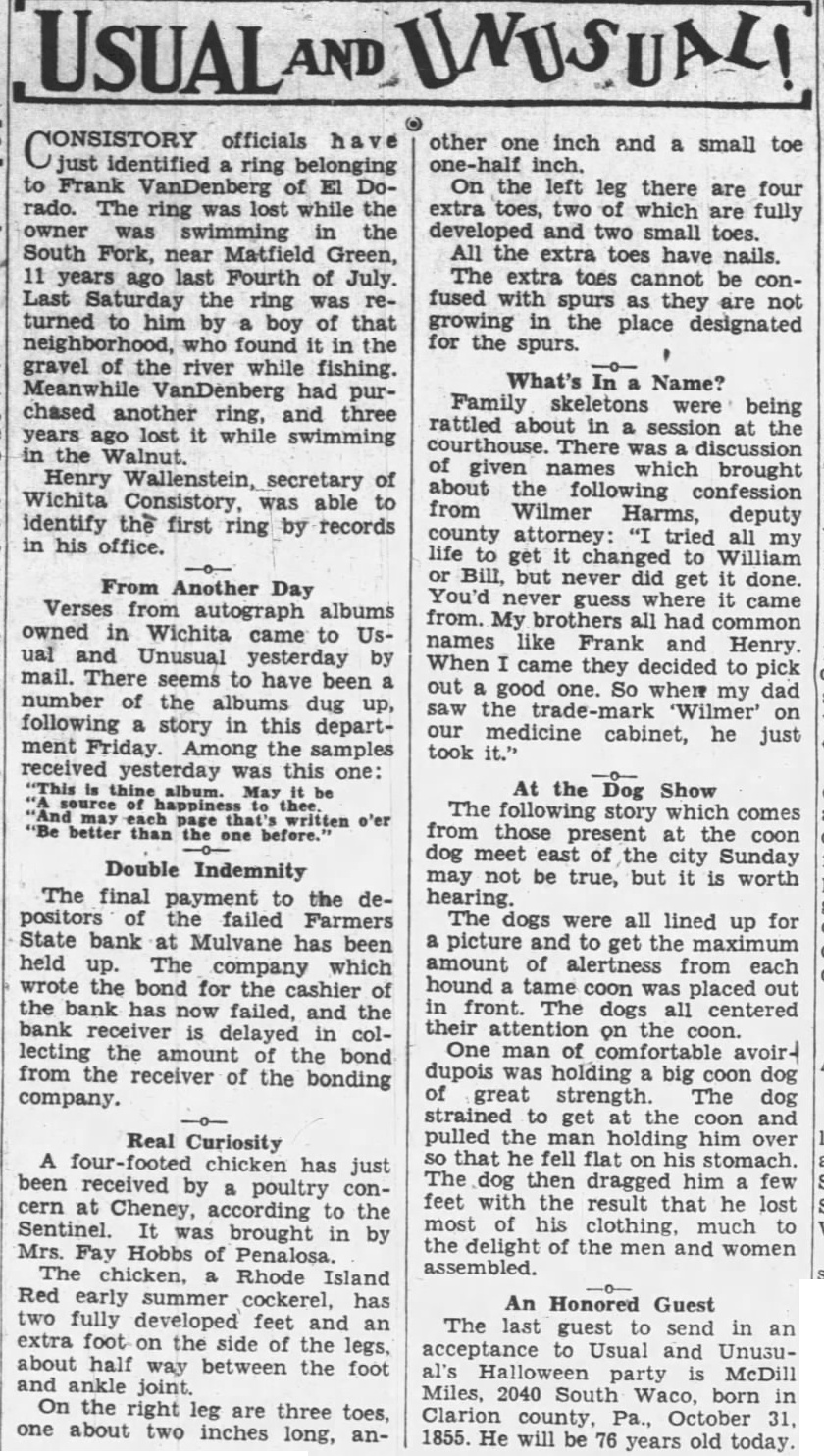
CONSISTORY officials identified ring belonging to Frank VanDenberg of El Dorado. The ring was lost while the owner was swimming in the South Fork, near Matfield Green, 11 years ago last Fourth of July. Last Saturday the ring was returned to him by boy of that neighborhood, who found it in the gravel of the river while fishing. Meanwhile VanDenberg had purchased another ring, and three years ago lost it while swimming Henry Wallenstein, secretary of Wichita Consistory, was able to identify the first ring by records in his office. From Another Day Verses from autograph albums owned in Wichita came to Usual and Unusual yesterday by mail. There to have been number of the dug up, following story in this department Friday. the samples received yesterday was this one: o'er Double Indemnity The final payment to the depositors the failed Farmers State bank at Mulvane has been held up. The company which wrote the bond for the cashier of the bank has now failed, and the bank delayed in collecting the of the bond from the receiver of the bonding company. Real Curiosity A chicken has just been received by poultry concern at Cheney, according to the Sentinel. was brought in by Mrs. Fay Hobbs of Penalosa. The chicken, Rhode Island Red early summer cockerel, has two fully developed feet and an extra foot on the side the legs, about half way between the foot and ankle joint. On the right leg three toes, one about two inches long, other one inch and small toe one-half inch. On the left leg there are four extra toes, two which are fully developed and two small toes. All the extra toes have nails. The extra toes cannot be confused with spurs as they are not growing in the place designated for the spurs. What's Name? Family skeletons were being rattled in session at the courthouse. There of given names which brought about the following confession from Wilmer Harms, deputy county attorney: tried all my life get changed William Bill, but never did get it done. You'd never guess where came from. My brothers all had common names like Frank and Henry. When came they decided to pick out good one. So when my dad saw the trade-mark "Wilmer" on our medicine cabinet, he just took the Dog Show The following story which comes from those present the coon dog meet east of the city Sunday may not be true, but it worth hearing. The dogs were all lined up for picture to get the maximum amount of alertness from each hound coon was placed out in front. The dogs all centered their attention on the One man of avoirdupois was holding big coon dog of great strength. The strained to get the coon and pulled the holding him that fell flat on his stomach. The dog then dragged him few feet with the result that he lost most his much to the delight of the men and women assembled. An Honored Guest The last guest send in an acceptance to Usual and Unusual's Halloween party McDill Miles, 2040 South born Clarion county, October 31, 1855. He will be 76 years old today.