58. Bessemer Savings Bank (Bessemer, AL)

Bank Information

Episode Type
Suspension → Closure
Bank Type
savings bank
Start Date
June 11, 1903
Location
Bessemer, Alabama (33.402, -86.954)

Metadata

Model
gpt-5-mini
Short Digest
13b5f5db

Response Measures

None

Description

President T. J. Cornwell absconded after a large shortage/embezzlement was discovered. The bank's doors failed to open and a receiver was appointed (June 11–12, 1903). The institution remained in receivership and paid dividends later, indicating permanent closure rather than a temporary suspension and reopening.

Events (2)

1. June 11, 1903 Suspension
Cause
Bank Specific Adverse Info
Cause Details
Large shortage/embezzlement by President T. J. Cornwell (missing/absconding) revealed, causing bank to stop payments and close its doors.
Newspaper Excerpt
With President T. J. Cornwall in parts unknown and short nearly $280,000, the Bessemer Savings Bank ... will close its doors and ask for a receiver to-morrow morning.
Source
newspapers
2. June 12, 1903 Receivership
Newspaper Excerpt
Judge Senn, of the City Court, on petition of the depositors of the savings bank, named George H. Stevenson as receiver for that bank.
Source
newspapers

Newspaper Articles (24)

Article from The Montgomery Advertiser, June 11, 1903

Click image to open full size in new tab

Article Text

Admits That He is Solely to Blame. THEINSTITUTION WRECKED President Chooses Flight to Work in Mines. Says That He Lost the Money Endeavoring to Make Back $42,000 Which He Lost in a Legitimate Transaction. Birmingham, June 10.-With President Thomas J. Cornwell in parts unknown and short nearly $280,000, the Bessemer Savings Bank. one of the strongest institutions in the district, will close its doors and ask for a receiver tomorrow morning. President Cornwell, who was a member of the late Constitutional Convention, and one of the most prominent men in the State. left behind him three notes explaining the shortage. In one, addressed to the public, he Bays that he lost the money trying to make back $42,000 he lost in in a legitimate business transaction. He further exonerates all the officers of the bank and takes the whole blame on himself. In a letter to his wife, which she was Instructed to open this morning, he stated that he would not commit suicide, but would let her know if he did. In a third letter, addressed to Cashier Cockrill, he states that he had nothing left for him to do but "wander on the face of the earth, or become a convict in the State mines." Barr Failed to Get Money. The shortage was not discovered until this morning, when President Barr of National the First for Bank $800 of Birmingham, the window presented checks at of the Bessemer bank and later stated that the bank had refused payment on them. The officers were surprised, and an investigation followed, showing the shortage. President Cornwell left Sunday and stated that he was going to Walker County to dispose of some land and get not seen not banks. The some mingham The money. shortage He will has Bank been affect of Commerce the since. Bir- to of Bessemer has made arrangements borrow all the money it needs in case of B run tomorrow morning when it opens' their doors, so no further trouble is expeeted in any of the banks. It is understood that a great part of the money was the deposits of the merchants and miners, together with employes of the rolling mills, furnaces and Industrial plants of Bessemer. The city of Bessemer loses $17,000. The bank will probably not be able to make a payment of more than a very small percentage on its deposits. The bank was organized in 1891 with a capital stock of $100,000 and had deposits of about $260,000.
Article from The Birmingham Age-Herald, June 11, 1903

Click image to open full size in new tab

Article Text

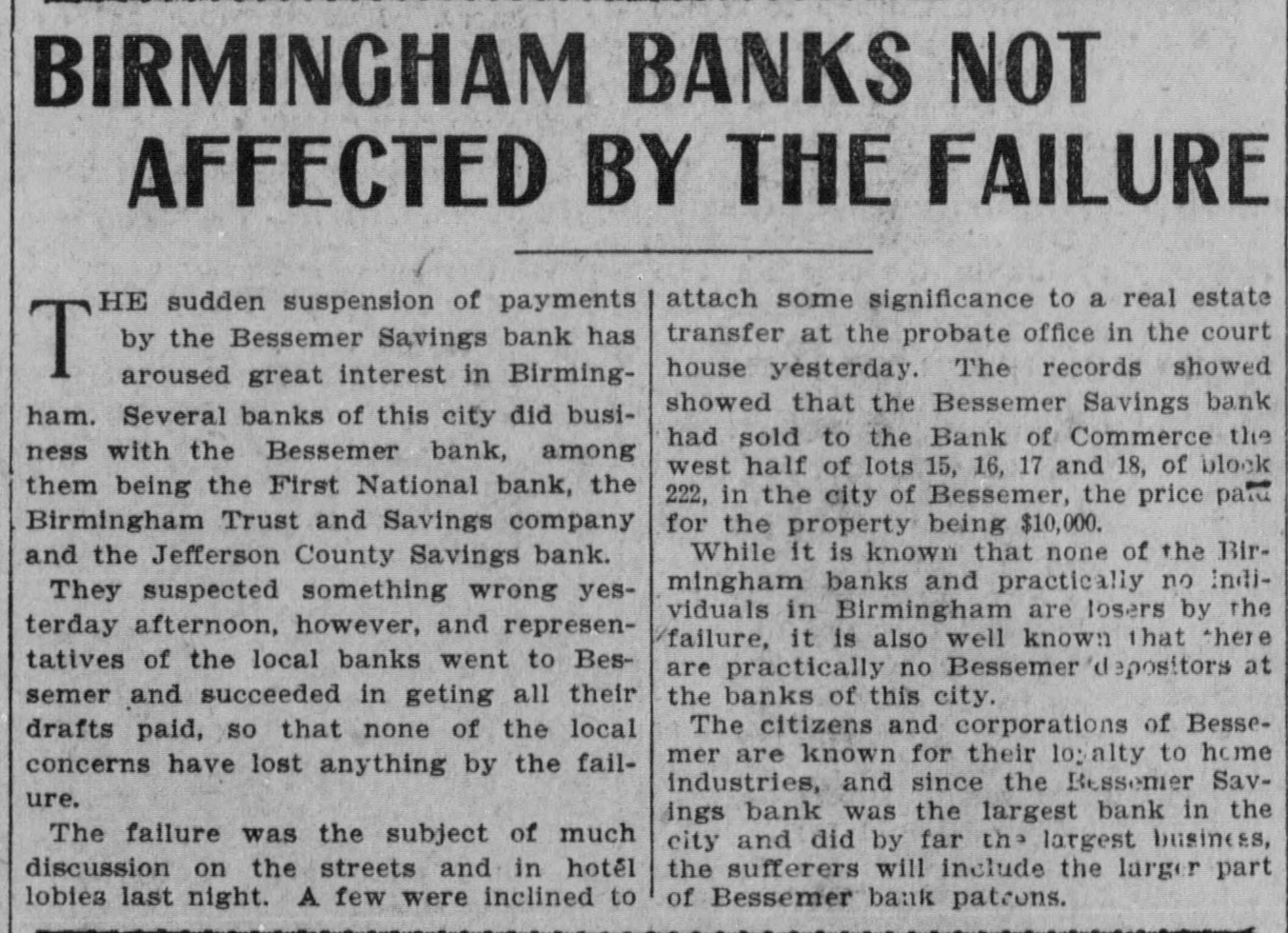
BIRMINGHAM BANKS NOT AFFECTED BY THE FAILURE attach some significance to a real estate HE sudden suspension of payments transfer at the probate office in the court by the Bessemer Savings bank has T house yesterday. The records showed aroused great interest in Birmingshowed that the Bessemer Savings bank ham. Several banks of this city did busihad sold to the Bank of Commerce the ness with the Bessemer bank, among west half of lots 15, 16, 17 and 18, of block them being the First National bank, the 222, in the city of Bessemer, the price patu Birmingham Trust and Savings company for the property being $10,000. While it is known that none of the Birand the Jefferson County Savings bank. mingham banks and practically no IndiThey suspected something wrong yesviduals in Birmingham are losers by the terday afternoon, however, and represenfailure, it is also well known that here tatives of the local banks went to Besare practically no Bessemer depositors at semer and succeeded in geting all their the banks of this city, The citizens and corporations of Bessedrafts paid, so that none of the local mer are known for their loyalty to home concerns have lost anything by the failindustries, and since the Bessemer Savure. ings bank was the largest bank in the The failure was the subject of much city and did by far the largest business, discussion on the streets and in hotel the sufferers will include the larger part of Bessemer bank patrons. lobies last night. A few were inclined to


Article from The Savannah Morning News, June 11, 1903

Click image to open full size in new tab

Article Text

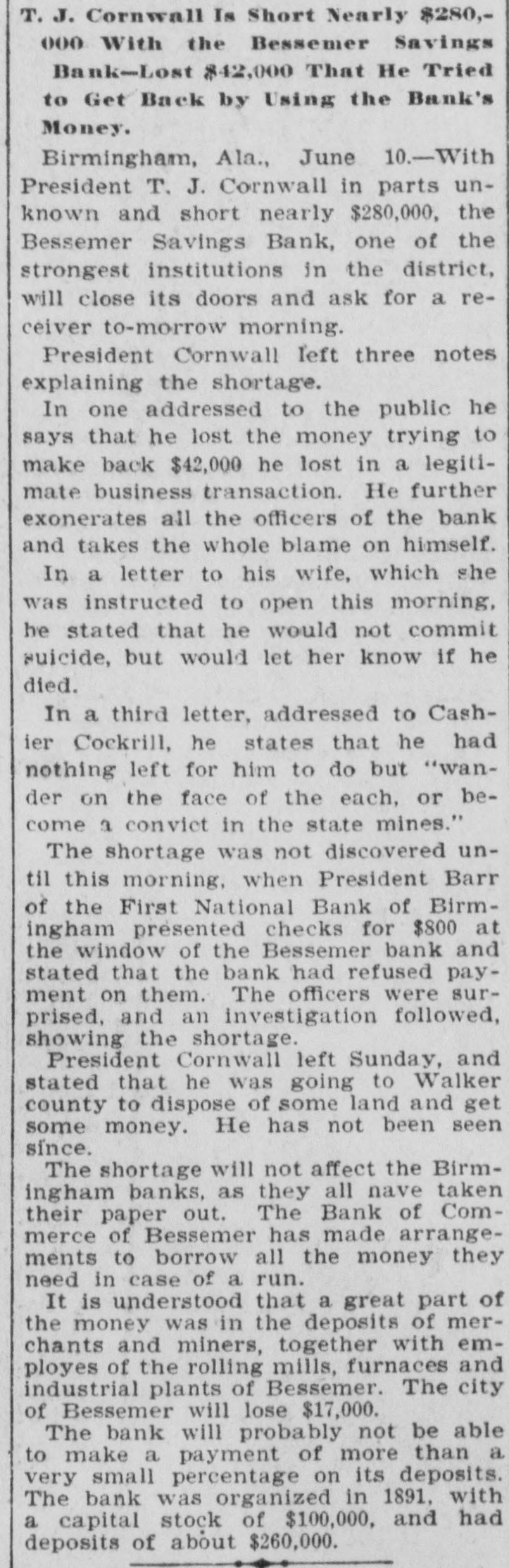
T. J. Cornwall Is Short Nearly $280,000 With the Bessemer Savings Bank-Lost $42,000 That He Tried to Get Back by Using the Bank's Money. Birmingham, Ala., June 10.-With President T. J. Cornwall in parts unknown and short nearly $280,000, the Bessemer Savings Bank, one of the strongest institutions in the district, will close its doors and ask for a receiver to-morrow morning. President Cornwall left three notes explaining the shortage. In one addressed to the public he says that he lost the money trying to make back $42,000 he lost in a legitimate business transaction. He further exonerates all the officers of the bank and takes the whole blame on himself. In a letter to his wife, which she was instructed to open this morning, be stated that he would not commit suicide, but would let her know if he died. In a third letter, addressed to Cashier Cockrill, he states that he had nothing left for him to do but "wander on the face of the each, or become a convict in the state mines." The shortage was not discovered until this morning, when President Barr of the First National Bank of Birmingham presented checks for $800 at the window of the Bessemer bank and stated that the bank had refused payment on them. The officers were surprised, and an investigation followed, showing the shortage. President Cornwall left Sunday, and stated that he was going to Walker county to dispose of some land and get some money. He has not been seen since. The shortage will not affect the Birmingham banks, as they all nave taken their paper out. The Bank of Commerce of Bessemer has made arrangements to borrow all the money they need in case of a run. It is understood that a great part of the money was in the deposits of merchants and miners, together with employes of the rolling mills, furnaces and industrial plants of Bessemer. The city of Bessemer will lose $17,000. The bank will probably not be able to make a payment of more than a very small percentage on its deposits. The bank was organized in 1891, with a capital stock of $100,000, and had deposits of about $260,000.

Article from The Billings Gazette, June 12, 1903

Click image to open full size in new tab

Article Text

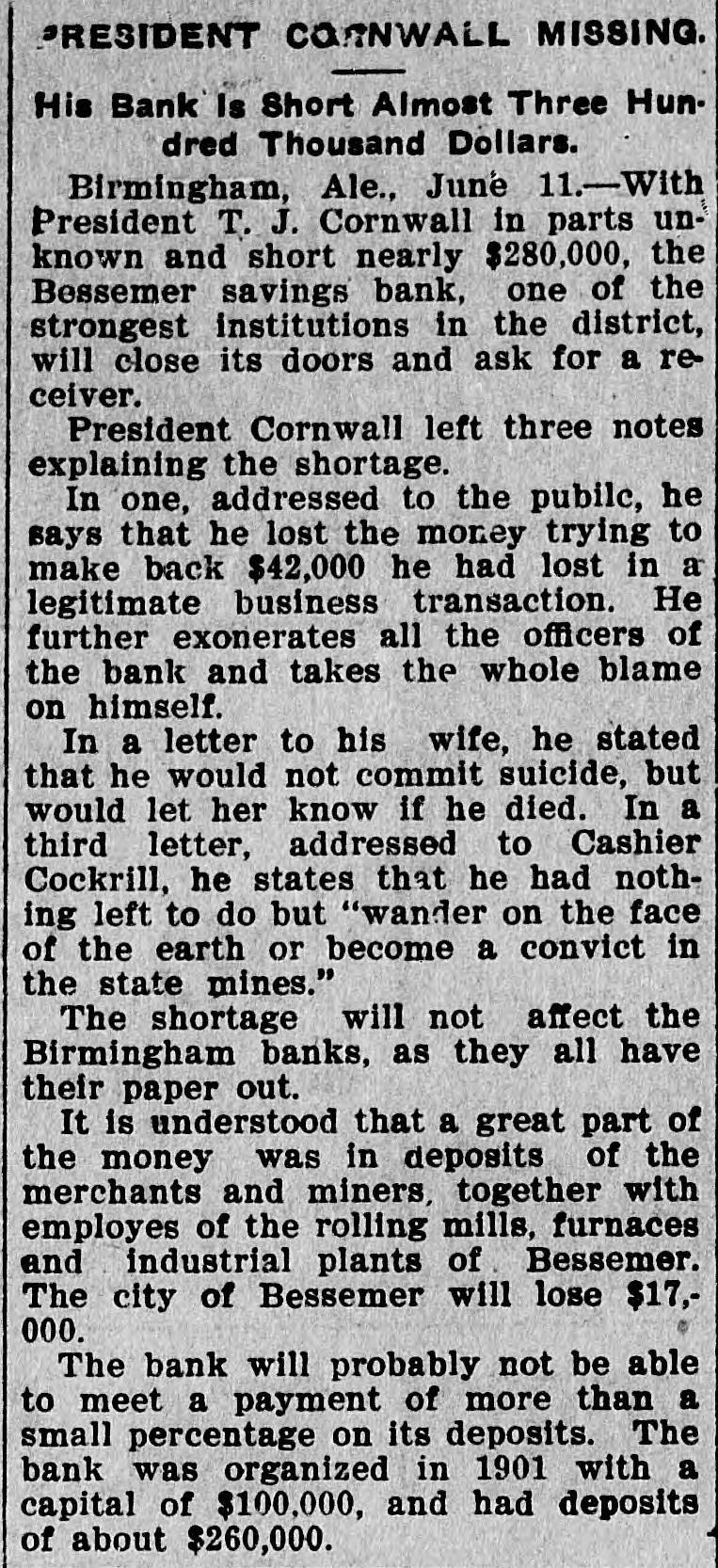
RESIDENT CORNWALL MISSING. His Bank Is Short Almost Three Hundred Thousand Dollars. Birmingham, Ale., June 11.-With President T. J. Cornwall in parts unknown and short nearly $280,000, the Bessemer savings bank, one of the strongest institutions in the district, will close its doors and ask for a receiver. President Cornwall left three notes explaining the shortage. In one, addressed to the pubilc, he says that he lost the money trying to make back $42,000 he had lost in a legitimate business transaction. He further exonerates all the officers of the bank and takes the whole blame on himself. In a letter to his wife, he stated that he would not commit suicide, but would let her know if he died. In a third letter, addressed to Cashier Cockrill, he states that he had nothing left to do but "wander on the face of the earth or become a convict in the state mines." The shortage will not affect the Birmingham banks, as they all have their paper out. It is understood that a great part of the money was in deposits of the merchants and miners, together with employes of the rolling mills, furnaces and industrial plants of Bessemer. The city of Bessemer will lose $17,000. The bank will probably not be able to meet a payment of more than a small percentage on its deposits. The bank was organized in 1901 with a capital of $100,000, and had deposits of about $260,000.

Article from Alexandria Gazette, June 12, 1903

Click image to open full size in new tab

Article Text

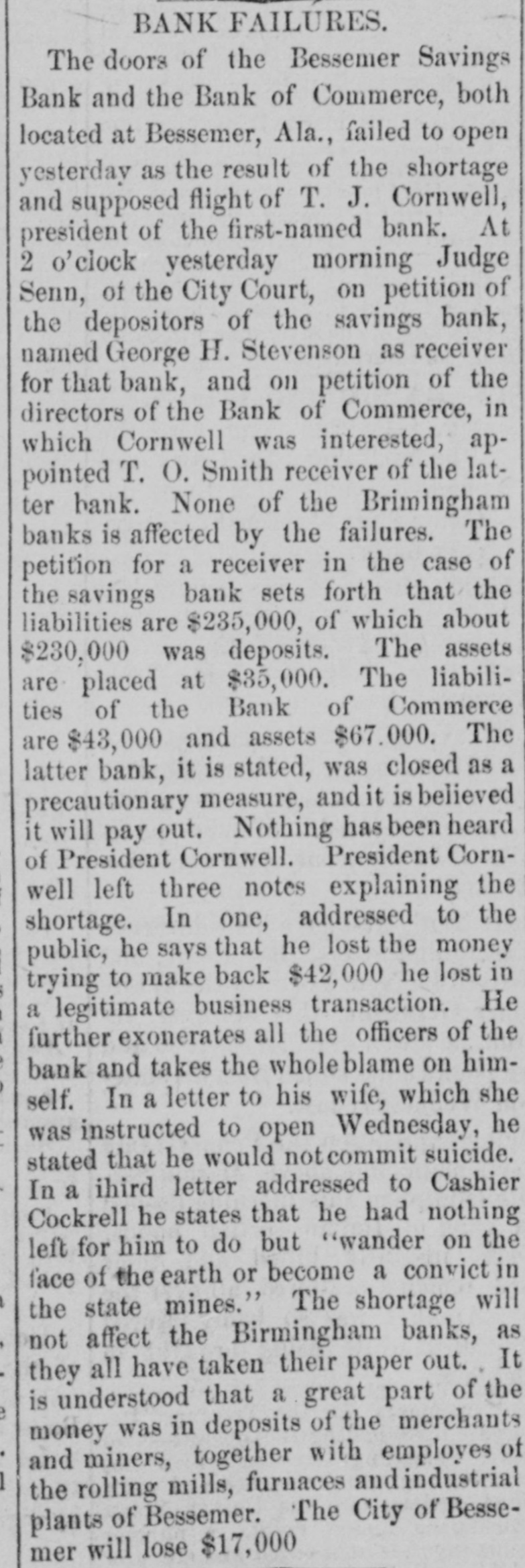
BANK FAILURES. The doors of the Bessemer Savings Bank and the Bank of Commerce, both located at Bessemer, Ala., failed to open yesterday as the result of the shortage and supposed flight of T. J. Cornwell, president of the first-named bank. At 2 o'clock yesterday morning Judge Senn, of the City Court, on petition of the depositors of the savings bank, named George H. Stevenson as receiver for that bank, and on petition of the directors of the Bank of Commerce, in which Cornwell was interested, appointed T. O. Smith receiver of the latter bank. None of the Brimingham banks is affected by the failures. The petition for a receiver in the case of the savings bank sets forth that the liabilities are $235,000, of which about $230,000 was deposits. The assets are placed at $35,000. The liabilities of the Bank of Commerce are $43,000 and assets $67.000. The latter bank, it is stated, was closed as a precautionary measure, and it is believed it will pay out. Nothing has been heard of President Cornwell. President Cornwell left three notes explaining the shortage. In one, addressed to the public, he says that he lost the money trying to make back $42,000 he lost in a legitimate business transaction. He further exonerates all the officers of the bank and takes the whole blame on himself. In a letter to his wife, which she was instructed to open Wednesday, he stated that he would not commit suicide. In a ihird letter addressed to Cashier Cockrell he states that he had nothing left for him to do but "wander on the face of the earth or become a convict in the state mines." The shortage will not affect the Birmingham banks, as they all have taken their paper out. It is understood that a great part of the was in deposits of the merchants money of and miners, together with employes the rolling mills, furnaces and industrial plants of Bessemer. The City of Bessemer will lose $17,000


Article from Rock Island Argus, June 12, 1903

Click image to open full size in new tab

Article Text

PRESIDENT GONE: BANKS ARE CLOSED And Institutions Face a Big Shortage in the Cash Balance. Girmingham, Ala., June 12.-The doors of the Bessemer Savings bank and the Bank of Commerce, both Iocated at Bessemer, Ala., failed to open as the result of the shortage and supposed flight of T. J. Cornwell, president of the first-named bank. At 2 a. m. this morning Judge Senn, of the city court, on petition of the depositors of the savings bank, named George H. Stevenson as receiver for that bank, and on petition of the directors of the Bank of Commerce, in which Cornwell was interested, appointed Tom O. Smith receiver of the latter bank. None of the Birmingham banks are affected by the failures. The petition for a receiver in the case of the savings bank sets forth that the liabilities are $235,000, of which about $230,000 was deposits. The assets are placed at $35,000. The liabilities of the Bank of Commerce are $43,000 and assets $67,000.


Article from Evening Star, June 12, 1903

Click image to open full size in new tab

Article Text

ALABAMA BANKS CLOSE. Shortage and Supposed Flight of President is Explanation. BIRMINGHAM, Ala., June 12.-The doors of the Bessemer Savings Bank and the Bank of Commerce, both located at Bessemer, Ala., are closed as the result of shortage and supposed flight of T. J. Cornwell, president of the first-named bank. Judge Senn of the city court, on petition of the depositors of the savings bank, named George H. Stevenson as receiver for that bank, and on petition of the directors of the Bank of Commerce, in which Cornwell was interested, appointed Tom O. Smith receiver of the latter bank. None of the Birmingham banks is affected by the failure. The petition for a receiver in the case of the savings bank sets forth that the liabilities are $235,000. of which about $230,000 was deposits. The assets are placed at $35,000.


Article from The Times Dispatch, June 12, 1903

Click image to open full size in new tab

Article Text

PRESIDENT GONE; TWO BANKS CLOSE T. J. Cornwell. of Bessemer. Ala.. is Supposed to Have Flown-A Receiver. (By Associated Press.) BIRMINGHAM, ALA., June 11.-The doors of the Bessemer Savings Bank and the Bank of Commerce, both located at Bessemer, Ala., failed to open to-day as the result of shortage and supposed flight of T. J. Cornwell, president of the first named bank. At 2 o'clock this morning Judge Senn, of the City Court, on petition of the depositors of the Savings Bank, named George H. Stevenson as rereceiver for that bank, and on petition of the directors or the Bank of Commerce, in which Cornwell was interested. appointed Tom O, Smith, receiver of the latter bank. None of the Birmingham banks is affacted by the failures. The petition for a receiver in the case of the Savings Bank sets forth that the liabilities are $235,000, of which about $230,000 was deposits. The assets are placed at $35,000. The liabilities of the Bank 01 Commerce are $43,000, and assets $67,000. The latter bank, It is stated, was closed as a, precautionary measure, and it is believed It will pay out. Nothing has been heard of President Cornwell


Article from The Mankato Free Press, June 12, 1903

Click image to open full size in new tab

Article Text

PRESIDENT CORNWALL MISSING. His Bank Is Short Almost Three Hundred Thousand Dollars. Birmingham, Ale., June 11.-With President T. J. Cornwall in parts unknown and short nearly $280,000, the Bessemer savings bank, one of the strongest institutions in the district, will close its doors and ask for a receiver. President Cornwall left three notes explaining the shortage. In one, addressed to the pubilc, he says that he lost the money trying to make back $42,000 he had lost in a legitimate business transaction. He further exonerates all the officers of the bank and takes the whole blame on himself. In a letter to his wife, he stated that he would not commit suicide, but would let her know if he died. In a third letter, addressed to Cashier Cockrill, he states that he had nothing left to do but "wander on the face of the earth or become a convict in the state mines." The shortage will not affect the Birmingham banks, as they all have their paper out. It is understood that a great part of the money was in deposits of the merchants and miners, together with employes of the rolling mills, furnaces and industrial plants of Bessemer. The city of Bessemer will lose $17,000. The bank will probably not be able to meet a payment of more than a small percentage on its deposits. The bank was organized in 1901 with a capital of $100,000, and had deposits of about $260,000.

Article from The News & Observer, June 13, 1903

Click image to open full size in new tab

Article Text

Two Banks Close Their Doors. (By the Associated Press.) Birmingham, Ala., June 11.-The doors of the Bessemer Savings Bank and the Bank of Commerce, both located at Bessemer, Ala., failed to open today as the result of shortage and supposed flight of J. T. Cornwell president of the firstnamed bank. At 2 o'clock this morning Judge Senn of the city court, on petition of the depositors of the savings bank named George H. Stevenson as rereceiver for that bank and on petition of the directors of the Bank of Commerce in which Cornwell was interested, appointed Tom O. Smith receiver of the latter bank. None of the Birmingham people is affected by the failure. The petition for a receiver in the case of the savings bank sets forth that the liabilities are $235,000, of which about $230,000 was deposits. The assets are placed at $35,000. The liabilities of the Bank of Commerce are $43,000 and assets $67,000. The latter bank, it is stated, was closed as a precautionary measure, and it is believed it will pay out. Nothing has been heard of President Cornwell.


Article from The Montgomery Advertiser, June 13, 1903

Click image to open full size in new tab

Article Text

REWARD IS OFFERED STATE WILL GIVE $300 FOR CAPTURE OF CORNWELL. Citizens of Bessemer Appealed to Governor for Aid in Apprehending the Absconding Presi-dent of Savings Bank. Governor Jelks yesterday offered a reward of $300 for the arrest and return to Jefferson County of T. J. Cornwell. the absconding President of the wrecked Bessemer Savings Bank. The reward was offered at the urgent request of the Mayor, Board of Aldermen and many prominent citizens of Bessemer. The city of Bessemer is deeply stirred over the enormous defalcation of Cornwell, The citizens are determined to have him arrested and brought to trial if it can be accomplished. To this end they have invoked the aid o fthe State, and the Governor has extended It. Cornwell is alleged to have embezzled $235,000 of the bank's funds. In fact, it is said he almost wiped out the entire assets of the bank. The wrongdoing of Cornwell has brought financial panic to a great part of the business community and to many laboring people of Bessemer. Cornwell was one of the leading citizens of Bessemer, having been one of the representatives of Jefferson County in the Constitutional Convention. Beyond the fact that Cornwell had dealt more or less extensively in futures and stocks, it is not known how he made way with the large sum he is said to have embezzled. When he left Bessemer Friday, Cornwell said that he was going to Walker County to look after the sale of some lands. He is said to have bought a ticket Friday night for Washington. Every effort will be made to catch the absconding bank President before he gets out of the country. Mayor T. T. Huey of Bessemer, who joined in the request to the Governor for the issuance of the offer of reward, was an officer of the wrecked bank.


Article from The Montgomery Advertiser, June 14, 1903

Click image to open full size in new tab

Article Text

The News of Birmingham need and a collection was taken up and Birmingham, June 18.-(Special.) the sum of $100 was contributed for the nited States Senator John T. Morgan purpose of supplying them with the neis offered to assist the people of Bircessities of life. ingnam and this section in securing A very gratifying feature developed toI abundance of water by running the day when it was discovered that the actarior River water from Locust Fork ual cash assets of the Bessemer Savings wn through the valley to the Warrior Bank were $13,000 larger than was hitherver again near Tuscaloosa. The letto thought. This amount, with certain r from Senator Morgan is in reply to property which it is expected the rek invitation to attend a meeting for the ceiver will be able to recover for the stallation of officers of the Birmingbank, makes the outlook very much m Board of Trade and is as follows: brighter. Those connected with the BesWarm Springs, Va., June 11, 1903. semer Savings Bank will not state where Your invitation to be present at the or in what shape the $13,000 was found, stallation of the officers of the Board but it is reliably known that such disTrade, to take piace today. only covery has been made. ached me this morning. I thank you George Stevenson, who was named by r the compliment and regret that the Judge Senn as receiver for the savings tter of invitation did not reach me bank. is in charge and actively at work. oner. Lee Moody, who was afterward appointed by Judge Coleman, has made no efI think it is true that a more importfort to interfere with Mr. Stevenson. t period or turning point in the hisIt is still confidently expected that the ry of Birmingham will never exist than Bank of Commerce will pay off dollar the present time. for dollar. J. H. Bernis, cashier of that Nature has done all there could be debank, said today that even if the Bank red in furnishing material for making of Commerce should lose the $40,000 innes Valley a central and supreme 10volved in the transfer made to it several tion for great industries. but much has days ago by the Bessemer Savings Bank on left to skill, enterprise and labor that still the bank would be able to pay make these gifts profitable and useoff its depositors in full. No clues as to 1 to the world. You have developed the whereabouts of Cornwell have devellese resources to a certain point, which oped here today. The impression is growonly a good beginning, and must rest ing that he has fled to South or Central here you are unless your faith in the America with the probabilities in favor ture of Birmingham is equal to its real of British Honduras. stiny, which is far greater than anyJake Stein, the 14-year-old son of Saming that Is yet seen ond known. uel Stein, a prominent business man The only material thing to be supplied here, was arrested yesterday for making an abundant flow of water through a search through the pile of messages is great valley. If that is not obtainreceived by the Postal Telegraph ComI, it may be truly said that Birmingpany's office. It is supposed he was induced to make this search by some man m has nearly attained to its full who was interested in the bank failure, owth as the commercial center of these as the boy stated when he was caught lendid industries. It is for your peoby the manager that he was looking for le to say whether you will stop with a message about the bank. There was ur present achievements or will cona rumor that a message had been sent by nue to progress. Water, in abundance, Captain Cornwell to some friend here, to be drawn from the Locust Fork and it is thought some one persuaded the Warrior River, for all purposes, the boy to try to get this information. ith a reasonable expenditure of labor Later the boy was released on account d money. It is there and can be conof his father, but he would not say anyolled. This fact justifies almost any thing. tpenditure to obtain results that are


Article from The Birmingham Age-Herald, June 19, 1903

Click image to open full size in new tab

Article Text

BESSEMER. Depositors Still Have Hopes of Recovering Their Money. Bessemer, June 18.-(Special.)-As the investigation of the affairs of the Bessemer Savings bank continues the prospects of the depositors grow brighter. It is now belleved by many that the depositors will get at least 50 per cent of their money back, and this is about 40 per cent better than at first was thought. The whereabouts of President T. J. Cornwell, whose flight created the monumental sensation of Bessemer's history, remains a profound mystery. The board of mayor and aldermen will hold a special meeting tomorrow night. The nature of the business to come up is not fully known, but it is believed that the loss by the city of 17,000 through the failure of the Bessemer Savings bank and the suspension of work on the city sewerage system, one of the results of this loss, will be given consideration. The proposition to borrow $10,000 to tide the city through the emergency will also come up, in all probability. The graduating class of the Bessemer high school was entertained tonight by Miss Bessie Spencer. Miss Otis Shipman entertained yesterday at progressive anagrams, the affair being in honor of her sister, Mrs. Rogers. The many guests were entertained in the most enjoyable manner. The first prize, a handsome chocolate pot, was won by Miss Henrietta Morgan; the second, a hand-painted handkerchief, by Mrs. M. I. Boots. Miss Julia Houston drew the consolation. Elaborate refreshments were served.


Article from The Montgomery Advertiser, July 1, 1903

Click image to open full size in new tab

Article Text

Total $50,292.30 The report contains an itemized list of all the real and personal property, notes and other assets owned by the bank. Also a list of the accounts. Receiver Smith has also filed a bill in the City Court against the Bank of Commerce, T. R. Fulton and J. S. Winters. in which he prays that the court may take jurisdiction of the trust made by the deed of assignment and will direct and decree the management and administration of the execution thereof. and that an order may be made requiring all creditors of the defendant corporation to file their claims in the City Court within a time fixed by the court. Also that an order be granted authorizing the receiver to convert all the property of the defendant corporation into cash and that the rights, equities and preferences of all creditors of the defendant corporation, shall be settled by decree of the court, and distribution made of the assets of the defendant corporation. This bill was the result of the various claims of priority which have been made by different individuals and corporations who are creditors of the Bank of Commerce. The Bank of Commerce of Bessemer went into the hands of a receiver immediately after the flight of Captain T. J. Cornwell, president of the Bessemer Savings Bank, and the collapse of that institution. From the report of the receiver it would appear that the condition of the bank is such that all claims can be paid off in full, as the assets exceed the liabilities $33,305.39.


Article from The Birmingham Age-Herald, July 7, 1903

Click image to open full size in new tab

Article Text

Real Estate Not Included. This report does not include the real estate, including the Bank of Commerce building and several stores adjoining, the two Sharp stores, and four or five lots on Fifth avenue, the property which is claimed as among the assets of the Bank of Commerce. It was with the hope of securing this property without litigation that the report of the Bessemer Savings bank has been so long delayed. The courts will have to decide to which bank this property belongs. It is valued at from $20,000 to $40,000. Neither do the assets include certain stock in the Warrior River Coal and Land company, which is in the name of Captain Cornwell's children, and which cannot at this time be claimed as among the assets. Other Sources of Revenue. There are other sources from which it is hoped to secure money. The report is a very conservative one, the receiver having endeavored to underestimate rather than over-estimate the assets. Mr. Stevenson states that a dividend might be paid within thirty days if an order from the court authorizing same could be secured. It seems unlikely now to secure such an order until October, owing to adjournment. Other reports will be made from time to time.


Article from The Birmingham Age-Herald, February 21, 1904

Click image to open full size in new tab

Article Text

BESSEMER PEOPLE ARE INTERESTED Discussing Bond Issue for New High School CORNWELL MAY RETURN Reported That His Friends Are Ready to Go on His Bond and That He Will Come Back for Trial. Bessemer, February 20.-(Special.)-The people of Bessemer are already interested at in the on the issue of of present proposed coming $35,000 election worth buildbonds to build a new high school ing, which comes off on Monday, February 29. The plan submitted for the new structure, which will probably be adopted by the council is a three-story brick building. On the first floor will be six recitation rooms and a hall; on the second floor will be six recitation rooms and an auditorium; on the third floor will be a gymnasium. The proposed building will be modern and first-class in every respect. This action was deemed expedient by the board of education, owing to the congested condition of the schools. The board recommended the erection of the building to the mayor and aldermen, who in turn called an election so that people might express their opinion in the matter. It is not anticipated that there will develop much opposition at the polls to the plan suggested by the council. Working Hard for College. The committee that was appointed by the citizens' mass meeting two weeks ago to canvass in behalf of the proposed synodical college for men, will renew its labors next week with zeaious determination. The chances for Bessemer's securing the institution are indeed bright. The citizens all want the college and every one is doing his share in having it located in the Marvel City. Bessemer proposes to grant the conditions laid down by the committee of the Alabama synod. and it is hoped by April 5. the day on which all the bids will be opened, to present the town's claims in such manner as to convince the members that the Marvel City is the logical site for the location of the college. Chances for Railroad Bright. The central committee and the subcommittees are working strenuously getting matters in shape preparatory to breaking dirt for the trolley car line that the citizens of Bessemer propose to build from this city into the Blue Creek district. It is proposed also to build a line from this city to Blocton. It is reported that the people along the proposed routes a are delighted with the project and number have expressed their willingness not only to give rights of way, but to put up a bonus for the lines. Case Taken Under Advisement. After hearing the arguments in the mandamus proceeding against the mayor and aldermen. taken out at the instance of the of Twentieth and an cows at B aldermen street, the running wholesale seeking to pass of to merchants force ordinance large, the mayor to Judge prohibit court case were Clay took titioners the Jones of under represented the Bessemer advisement. by city Attorney The peW. S. Welch and the city by City Attorney L. D. Godfrey. It will probably be several days before Judge Jones renders his decision. To Pay Divedends. The receivers of the defunct Bessemer Savings bank are getting matters in shape to pay the first dividends to the creditors of the bank, which will probably be some date between now and the first of March. At the first payment the receivers think that they will be able to wipe out 30 per cent of the late bank's indebtedness. They have in hand now, counting the proceeds from yesterday's sales, $65,000. From this amount, however, will have to be deducted $4760. the amount of a mortgage held by Mr. Frutell of Mississippi. Captain Cornwell May Return. mer Bessemer Capt. last to T. June, this Savings J. Cornwell, it is bank, in stated, the president who will left probably of Besse- the return city next few days. Following hard after Captain Cornwell's departure from the Marvel City the Bessemer Savings bank and the Bank of Commerce closed their doors. Governor Jelks has called in the reward for the arrest of Captain Cornwell, and a number of his friends in Bessemer, it is stated, have arranged to furnish bonds on the indictments returned against him by the grand jury. Captain Cornwell has been in Honduras a for cablegram number the past stating of several Bessemer that months. all friends arrangements On yesterday sent a had been perfected for his return. Ca


Article from The Montgomery Advertiser, March 27, 1904

Click image to open full size in new tab

Article Text

# Contests Sale of Property. In the second division of the City Court George H. Stevenson, receiver of the Bessemer Savings Bank, is contesting the sale of several hundred acres of Walker County coal property which took place about a month ago by order of the court. The land was sold to Murray Cannon at $7 per acre and Mr. Stevenson contends that it was worth $9 an acre.


Article from The Birmingham Age-Herald, December 23, 1904

Click image to open full size in new tab

Article Text

Ohristmas Coming. "We should move along. I think," said Captain White, "for Christmas is coming." Attorney Scott then offered in evidence the minute book of the bank from page 1 to 96, inclusive. An objection to the introduction of the bank book was overruled by the court. "I will ask the witness to take the trial balance book and see if that is the balance you made on June 10, 1903." "It is." "Was that the last you made?" "Yes." "We offer this book in evidence," said Attorney Scott. "The witness tells you that he made the balance; that he identifies his handwriting." "We object," said Captain White. "The court will recall that neither the certificate of deposit book, the general ledger, the cash book and the individual ledger have been introduced, and still they attempt to introduce a conclusion from these books. Let us have these books." "Overrule the objection," said the court. "After the bank had gone into the hands of a receiver, were the balances placed on the books?" "No, sir." "Did you assist in getting up the figures contained in the report?" "Yes, sir. The figures were gotten up here and carried to Birmingham where the report was made up." "State what figures you assisted Mr. Osborne in getting up." "We object," said Captain White. "Sustained." Excused for the Present. "We will excuse Mr. Cockrell for the present," said Attorney Scott. "We would like to examine the witness," said Captain White. "We would like first to have the cash book." "This book is in the hands of the receiver, but can be secured," said Attorney Scott. "All right." "The ballff will bring into court all of the books," said Judge Jackson. Bank Methods. Mr. Cockrell, was it usual in the Bessemer Savings bank not to enter demand paper on the discount register?" "I do not know." "Your duties were to keep the general books, I believe." "Yes, sir." "The notes, I believe you said, were not in your custody?" "Yes, sir." "If a man wanted to pay his note you could go get it, could you not?" "Yes." "Where were the notes?" "In the safe." "Could notes be in the safe without your knowledge?" "Yes." "You only went to the vault to secure notes in the absence of Cornwell from the bank, as I understand it?" "Yes." "Where was the proper place for demand notes to be entered under the system of the Bessemer Savings bank?" "We object," said Attorney Scott. "Overruled," said Judge Jackson. "On the cash book," replied the witness after the ruling of the court on the objection of the state. About Cornwell's Return. "You said the defendant came back last spring of his own accord and gave himself up?" "Yes." "He was not forced back?" "No." "We desire to introduce," said Captain White, "the cash book showing entries of October 1, 1901; page 525." "Did you make the entry of October 1, 1901, for $9984.56, Mr. Cockrell." "I did." "Did that item come from the blotter of the bank?" "It did." Did you make the entry of May 14, 1902, for $20,000, loans and discounts?" "I did." "W. S. Winters was with the bank, was he not?" "Yes." "When Winters was out of the bank Cornwell made entries, did he not?" "Yes." "This entry of July 30, 1901, $450 loans and discounts, was made by Mr. Winters, was it not?" "Yes, sir." "He is dead?" "Yes." "Does the entry appear on the blotter?" "Yes." "The entry of $5400 on October 31, 1902, loans and discounts, is in your handwriting?" "Yes." "Where did you get the item from?" "The blotter." "Entry of March 30, 1903 for $5065.71?" "My handwriting." "Where did you get it from?" "Blotter." At 12 o'clock Judge Jackson announced an adjaurnment for dinner would be taken until 1 o'clock. Cockrell Again. At the beginning of the afternoon session the examination of Witness Cockrell by the defense was resumed. "In whose handwriting was entry of March 16, 1903 for $5736.43. loans and discounts?" asked Attorney Smith. "Mine." "Of March 17, 1903, for $4173.30, loans and discounts?" "Mine." "Of March 30, 1903, for $5065.21, loans and discounts?" "Mine." "Of July 30, for $25,252.50, loans and discounts?" "Cornwell's handwriting... "Where else do these items appear?" "On the bank's blotter." "Was it always the custom to return cancelled checks to the depositors?" "Depositors frequently failed to call for cancelled checks." "Are you an expert bookkeeper?" "No sir." "If a customer should go to the bank and make a note for $50, less the discount


Article from The Birmingham Age-Herald, December 24, 1904

Click image to open full size in new tab

Article Text

# Witness Batson. "Call John Batson, then." "Where do you live?" "Five miles west," said Batson. "Were you a depositor of the Bessemer Savings bank?" "Yes sir." "How much." "Can't tell." "Did you deposit in the bank while Mr. Cornwell was president?" "Yes sir." "How much?" "About $400." "Did you ever draw it out?" "No." "That's all," announced the state. There was no cross-examination. William George was called again and he responded. "Was you a depositor in the Bessemer Savings bank?" "I was." "How much money did you have there when it failed?" "$1300." No cross-examination. M. M. Given was next called. "Where do you live?" "Fourteen miles west of here." "Did you have any transactions with the bank?" "Yes, sir." "Did you have any money in the bank at this time of its failure?" "Myself?" "Yes." "About $2500." "Did you ever get any of that back?" "Yes, sir." "How much?" "About $230." "Did your relatives have any money deposited there?" "Yes, sir." # Randall Called. A. A. Randle, a retired Bessemer merchant and a stockholder of the bank, was called. "Did you have any dealing with the bank?" "Yes, sir." "Any deposits?" "Yes, sir." "How much?" "About $3000." "Any of it back?" "Yes." "How much?" "Twenty-five per cent from the receiver." "You were a director?" "Yes." I. A. Lewis was called. "Was you acquainted with Bessemer Savings Bank?" "Yes." "Did you have money then?" "Yes." "How much?" "About $1720." "Get any back?" "Not a cent." "What was it?" "A deposit. "Drawing interest?" "Yes, sir." "How much?" "Four per cent." # Cockrell Recalled. H. D. Cockrell was recalled by the defense on cross examination, the state taking a rest at 2:30 o'clock. "Was a check on the First National Bank of Birmingham for $2500 drawn on June 6, 1903?" asked Captain White. "We object," said the state. "Sustained," said Judge Jackson. "We except," said Captain White. "That is all. The witness can stand aside." # Define Marked Motive. "We would like for the jury to retire


Article from The Birmingham Age-Herald, January 10, 1905

Click image to open full size in new tab

Article Text

# Suits Filed. A number of suits were called yesterday in the city court of Birmingham in the matter of George H. Stevenson, receiver of the Bessemer Savings bank vs. certain creditors of the bank. In each instance Judge Charles A. Senn entered a judgment for the plaintiff. The amounts sued for, which were on notes, will aggregate something over $1000.


Article from The Birmingham Age-Herald, February 3, 1905

Click image to open full size in new tab

Article Text

Ask for a Hearing. The attorneys for the receiver of the Bessemer Savings bank have filed a petition in the Birmingham city court asking for a re-hearing in the case of the receiver of the Bessemer Savings bank vs. the receiver of the Bank of Commerce. This is the case which Judge Senn recently disallowed the claims of the receiver of the Savings bank, who was seeking to recover about $22,000. If the petition to reopen the case is denied by the city court, it is understood that the matter will then be appealed to the supreme court. The contention of the receiver of the Savings bank is that the money in the Bank of Commerce at the time of its suspension was transferred from the Savings bank and that this amount is by


Article from The Birmingham Age-Herald, April 8, 1905

Click image to open full size in new tab

Article Text

Three Fifty SUFFERERS ARE GIVEN MORE AID SEMI-MONTHLY ALLOWANCES ARE PAID TO THE WIDOWS AND ORPHANS OF LATE MINERS. OTHER NEWS. Bessemer, April 7.-(Special.)-The Virginia mines relief committee, through Jerry Fountain. distributed the second regular semi-monthly payment to the Virginia mines' sufferers today. Over $1000 was divided among the widows and orphans left by the disaster, which occurred on February 20. The committee has an accurate list of the sufferers, and the money is being judiciously distributed. Something like 200 people are on the list of the committee. The fund is being increased every day. All the donations are small, and are coming in much slower than they did at first. May Pay Dividend Soon. The probabilities are that a twentyfive per cent dividend will be paid to the depositors of the defunct Bessemer Savings bank at an early date. The recelved has managed the affairs of the bank in an excellent manner, and will, from all indications, be able to pay the depositors the greater portion of the amount that they had on deposit at the time the bank closed its doors. Several months ago the receiver paid a twenty-five per cent dividend, and the recent compromise offer of the original stockholders of the bank may enable the payment of another dividend. Elect Officers. The Ladies' Aid society of the First Presbyterian church met at the manse yesterday afternoon, and selected the following officers for the ensuing year: Mrs. J. M. Boots, president; Mrs. C. M Lovejoy, vice-president; Mrs. George H Stevenson, secretary and treasurer; Mr J. S. Winters, Mrs. D. Macrery, Mrs. 4 W. Berglund, Mrs. J. C. Houston an Mrs. Rudolph Wegelin, board of dire tors. May Build Church. The congregation of the First Presbyterian church has under consideration a plan to erect a new church ediuce. The new building. it is understood, will be one of the handsomest and most modern houses of worship in the city.


Article from The Birmingham Age-Herald, April 19, 1905

Click image to open full size in new tab

Article Text

BESSEMER COUNCIL MET LAST NIGHT THE NEW SEWER SYSTEM IS TO BE COMPLETED AT AN AD-, VANCED PRICE-NEW FIRE STATION PROPOSED. Bessemer, April 18.-(Special.)-The regular session of the city council met tonight, with Mayor Huey in the chair. Councilmen Moore, Randle, Dennis, Simmons, Hurd and Mundes were present. The session was a short one, but several items of small importance were disposed of. Ordinance No. 11, providing for sidewalk extensions and improvements, was taken up and after a sn 014 cussion was repealed. W. J. Long was present and stated that after the failure of the Bessemer Savings bank and the suspension of work on the Bessemer sewerage system he had found it impossible to continue the work under the old contract on account of the great advance in the cost of labor. He stated that he was willing to carry out the contract and finish the work if the price was increased. The council agreed to pay Mr. Long for the work, and the construction of the system will be resumed at once. Under the head of petitions and complaints the council was called upon to consider a petition from the citizens of East Bessemer asking for a fire station in that section of the town. The matter was referred to the fire department committee. Ordinance No. 19, providing for the changing of the names of Seventeenth, Eighteenth and Nineteenth streets, was introduced and passed on its first reading. Also, ordinance No. 14, providing for the changing of the names of Nineteenth and Twentieth streets to Second and Third avenues, was introduced and passed on its first reading. There being no further business, the council adjourned.


Article from The Birmingham Age-Herald, October 12, 1905

Click image to open full size in new tab

Article Text

cross-examination he stated that he was a brother-in-law to T. J. Cornwell, the defendant. Attorney W. K. Smith took the stand and said: "I assisted Captain White in defending Mr. Cornwell in the former trial and have a distinct recollection that Captain White asked the solicitor three different times to elect sum on which he asked conviction. The solicitor did not elect. One time his associate, Mr. Scott, said they would take the three items in the $8000 indictment, but the solicitor refused to agree. The state's attorneys never did elect particular charge or sum and were sustained by the court.' Being cross-examined, Mr. Smith said: "I don't think that Solicitor Godfrey limited his argument to the particular indictment on trial. The $8000 indictment was on trial, but we could not keep the argument and taking of testimony confined to that particular charge." J. T. Johnson. a juryman in the former trial, gave testimony which was practically the same as that given by the other witness. A number of refused charges were here introdumed, and read before the jury. These were charges written by the defendant's attorneys with the request that they be given to the jury in the former trial. They had been refused and were so endorsed by Judge William Jackson, who presided in the former trial. The defense rested here, and George A. Stevenson was put on the stand by the state. He testified as to the identity of Certain books and papers that had been introduced as evidence in the former trial, and also as to a blotter that did not appear in court at this time. Mr. Stevenson was appointed receiver for the Bessemer Savings bank at the time it failed and has had the books of the bank in charge since that time. J. E. Osborne, expert accountant who checked the books of the bank, testifled in the former trial and especially as to certain items appearing on the bank books on March 6, 1902. These items are suppose to be the three items mentioned in the $8000 indictment on which Cornwell was tried and acquitted last December. Judge Jackson on Stand. Judge William Jackson was put on the stand by the state. Judge Jackson said: "I presided as judge in the trial of T. J. Cornwell last December, when he was acquitted of the charge of embezzlement. The state called for the trial of case No. 1007, but the defense objected to the trial of this case and insisted upon the trial of case No. 993, which was the first appearing on the docket. Case No. 993 was designated as the one to be tried and the indictment in this case was read and no other. There was never any motion presented in writing to exclude testimony of other charges in the remaining indictments. When called upon the state elected the three items named in