New Amsterdam National Bank (New York, NY)

Episode Information

Episode UID
578301294
Episode Type
Run β†’ Suspension β†’ Closure
Bank Type
national
Bank ID
57830 national
Charter Number
5783
Start Date
October 21, 1907
Location
New York, New York (40.714, -74.006)

Metadata

Model
gemini-3-flash-preview (chosen from majority vote of a three-model LLM ensemble)
Short Digest
c753b72efcc9dd97

Response Measures

Borrowed from banks or large institutions, Clearinghouse loan, Full suspension, Books examined

Clearinghouse involved: Yes (loan, examination, or other measures)

Receivership Details

Depositor recovery rate
100.0%
Date receivership started
1908-01-30
Date receivership terminated
1909-04-14
OCC cause of failure
Losses
Share of assets assessed as good
54.9%
Share of assets assessed as doubtful
40.6%
Share of assets assessed as worthless
4.5%

Description

The bank initially survived the October 1907 panic with Clearing House aid but ultimately failed in January 1908 due to a renewed run and the withdrawal of that support.

Events (7)

1. April 18, 1901 Chartered
Source
historical_nic
2. October 21, 1907 Run
Cause
Bank Specific Adverse Info
Cause Details
Association with the Morse-Heinze-Thomas interests and their speculative activities.
Measures
Received assistance from the Clearing House committee to meet debit balances.
Newspaper Excerpt
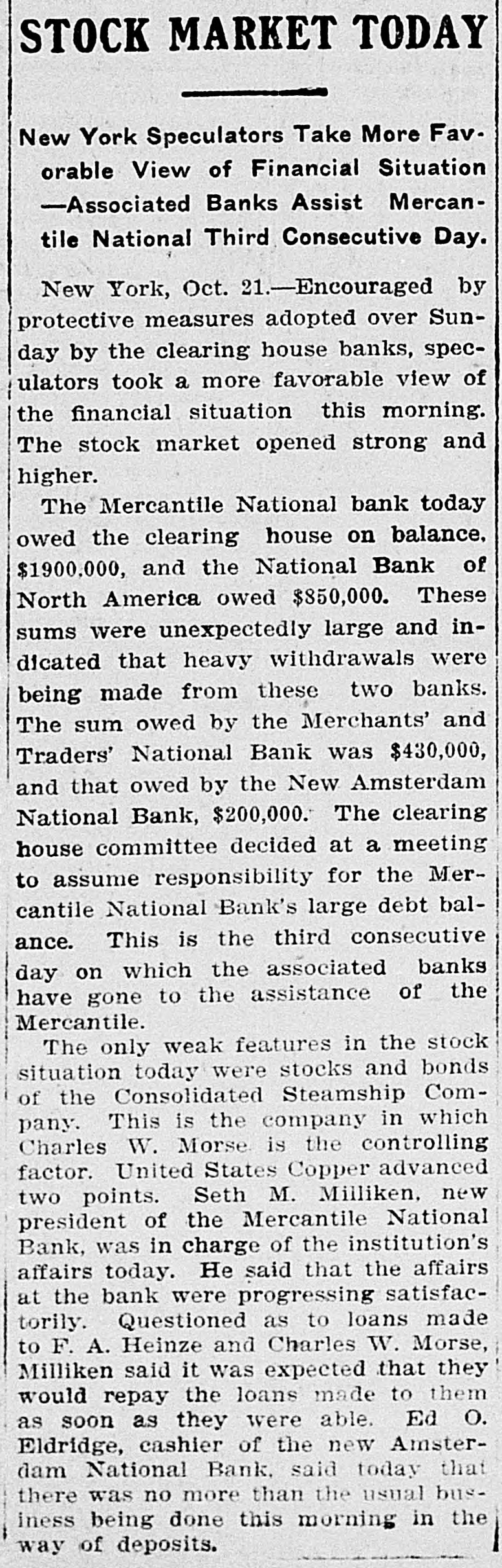
The sum owed by the Merchants' and Traders' National Bank was $430,000, and that owed by the New Amsterdam National Bank, $200,000.
Source
newspapers
3. January 29, 1908 Run
Cause
Local Banks
Cause Details
The failure of the National Bank of North America (another Morse bank) triggered a renewed run.
Measures
The Clearing House declined further credit, leading to closure.
Newspaper Excerpt
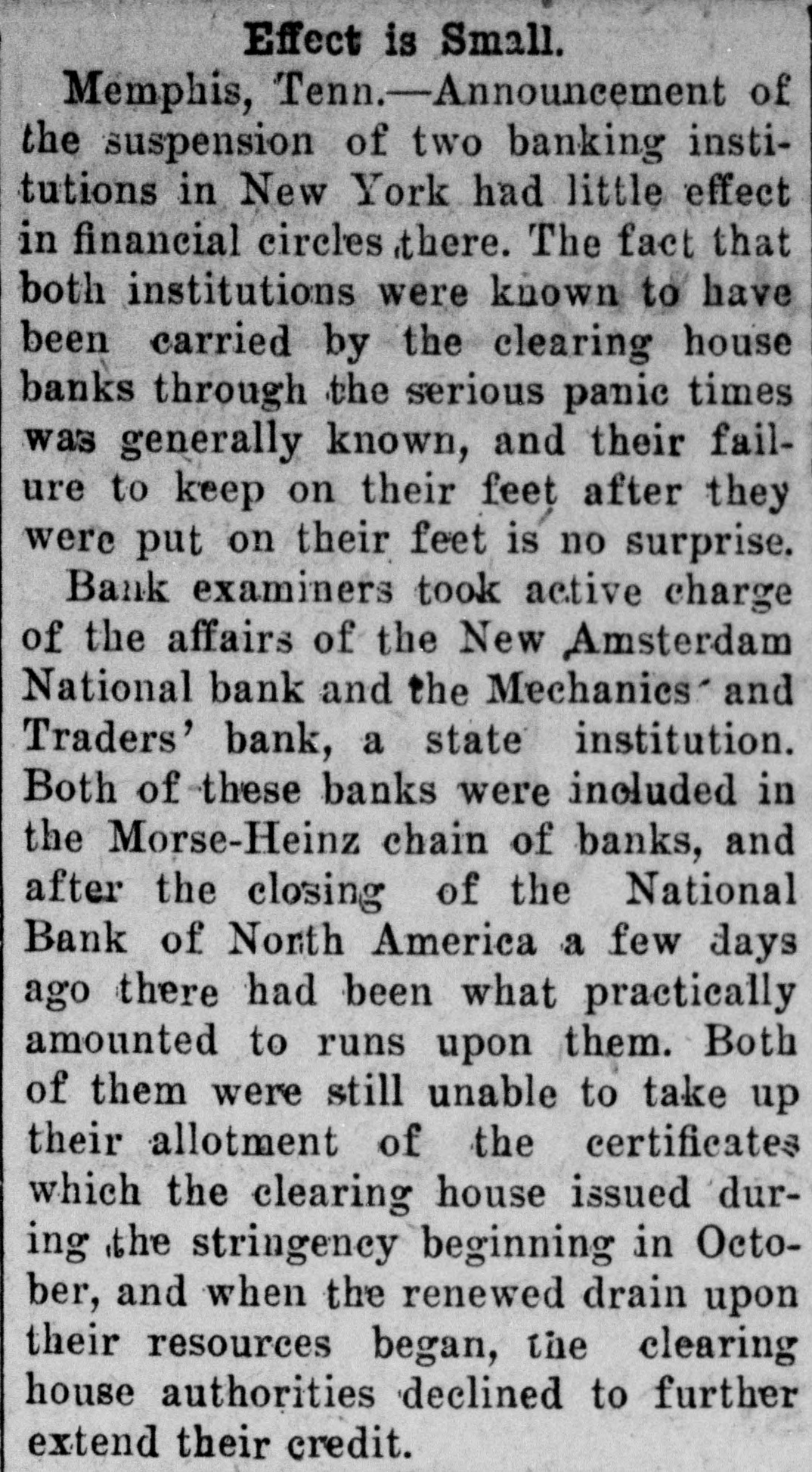
after the closing of the National Bank of North America a few days ago, there had been what practically amounted to a run upon them.
Source
newspapers
4. January 29, 1908 Suspension
Cause
Government Action
Cause Details
Taken in charge by the Comptroller of the Currency after the Clearing House refused further aid during a run.
Newspaper Excerpt
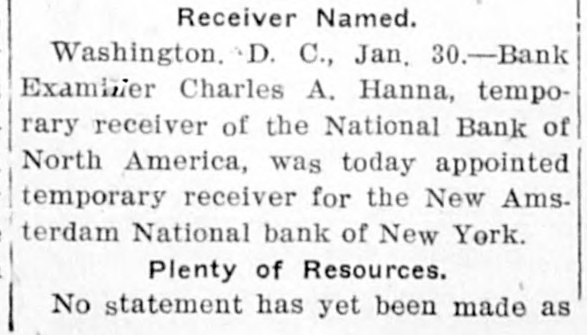
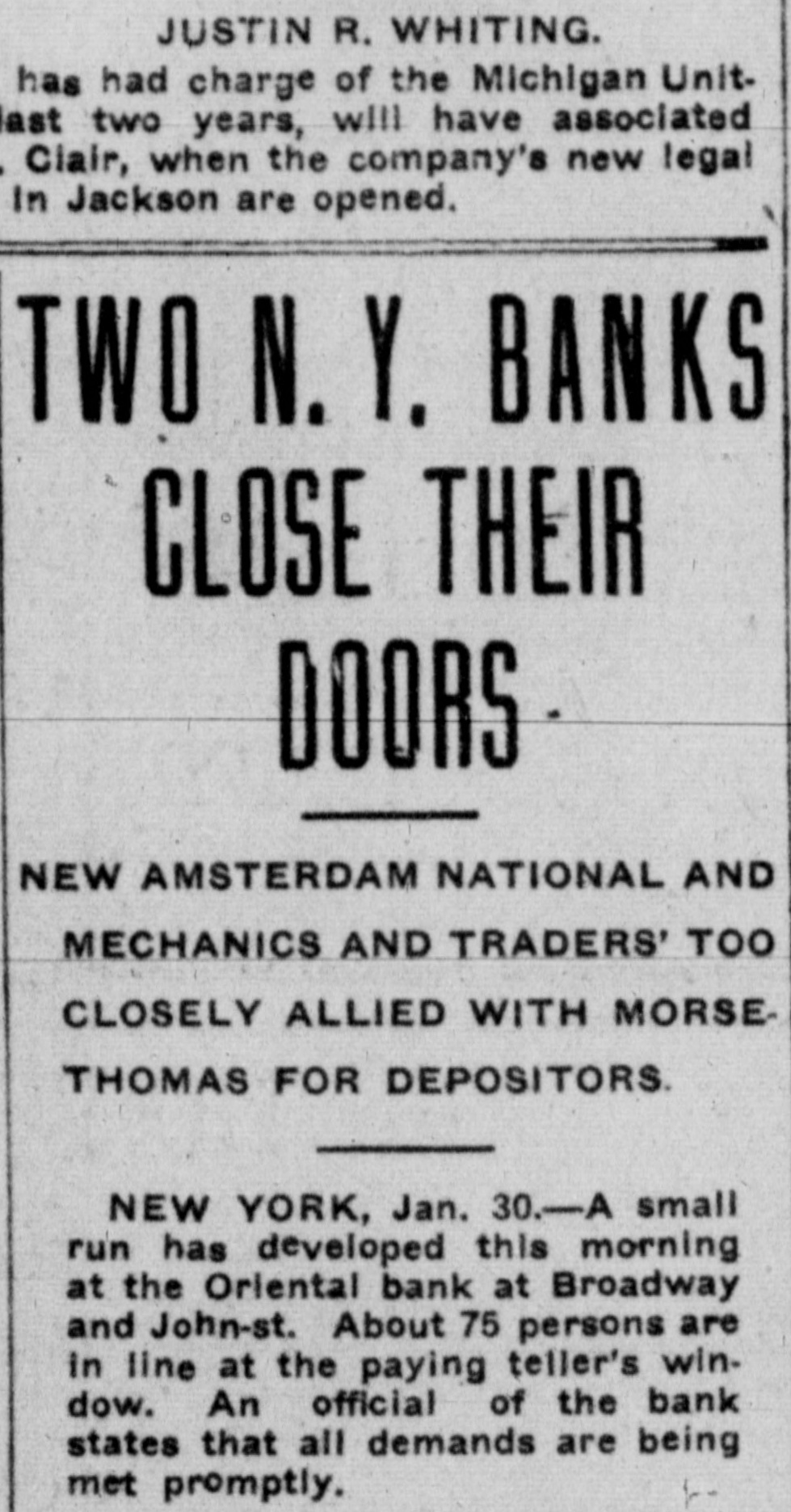
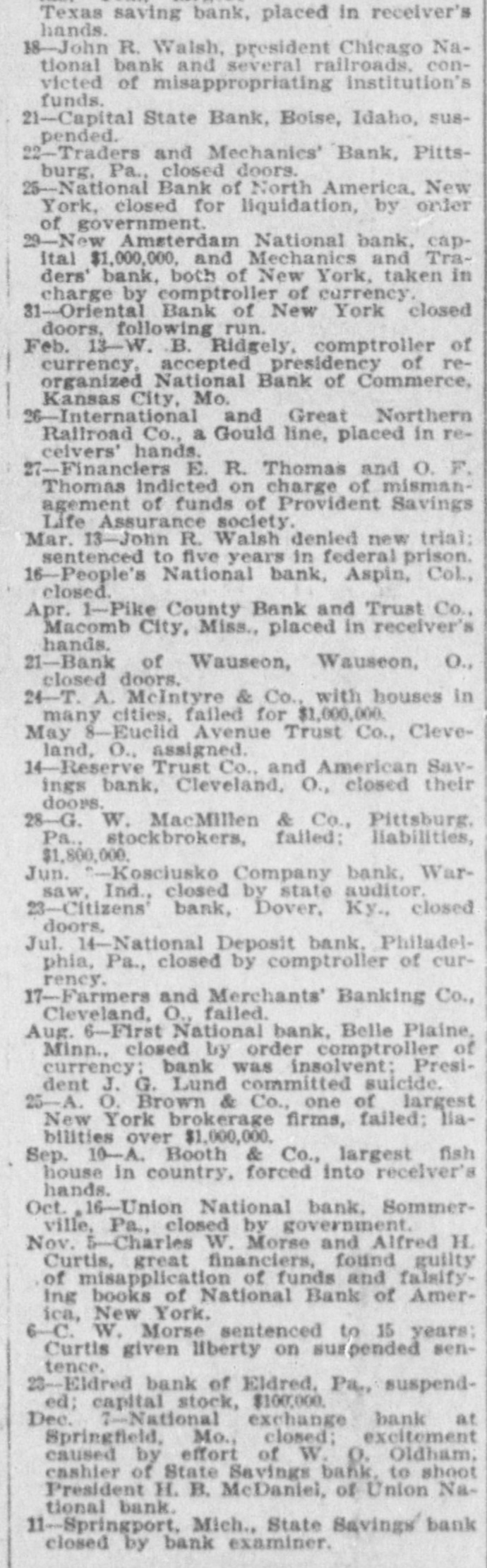
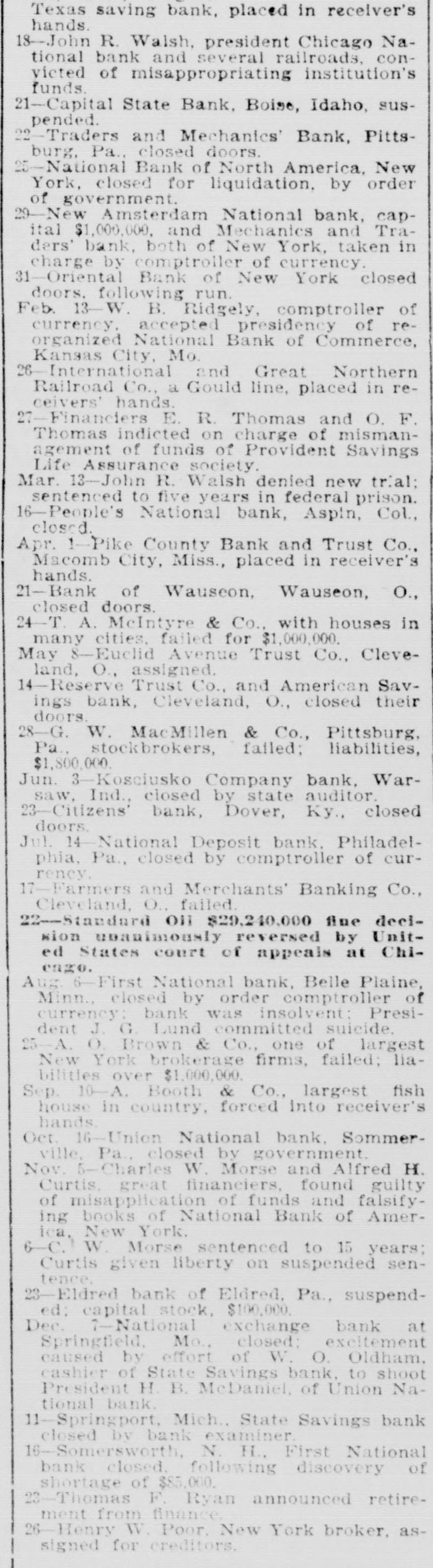
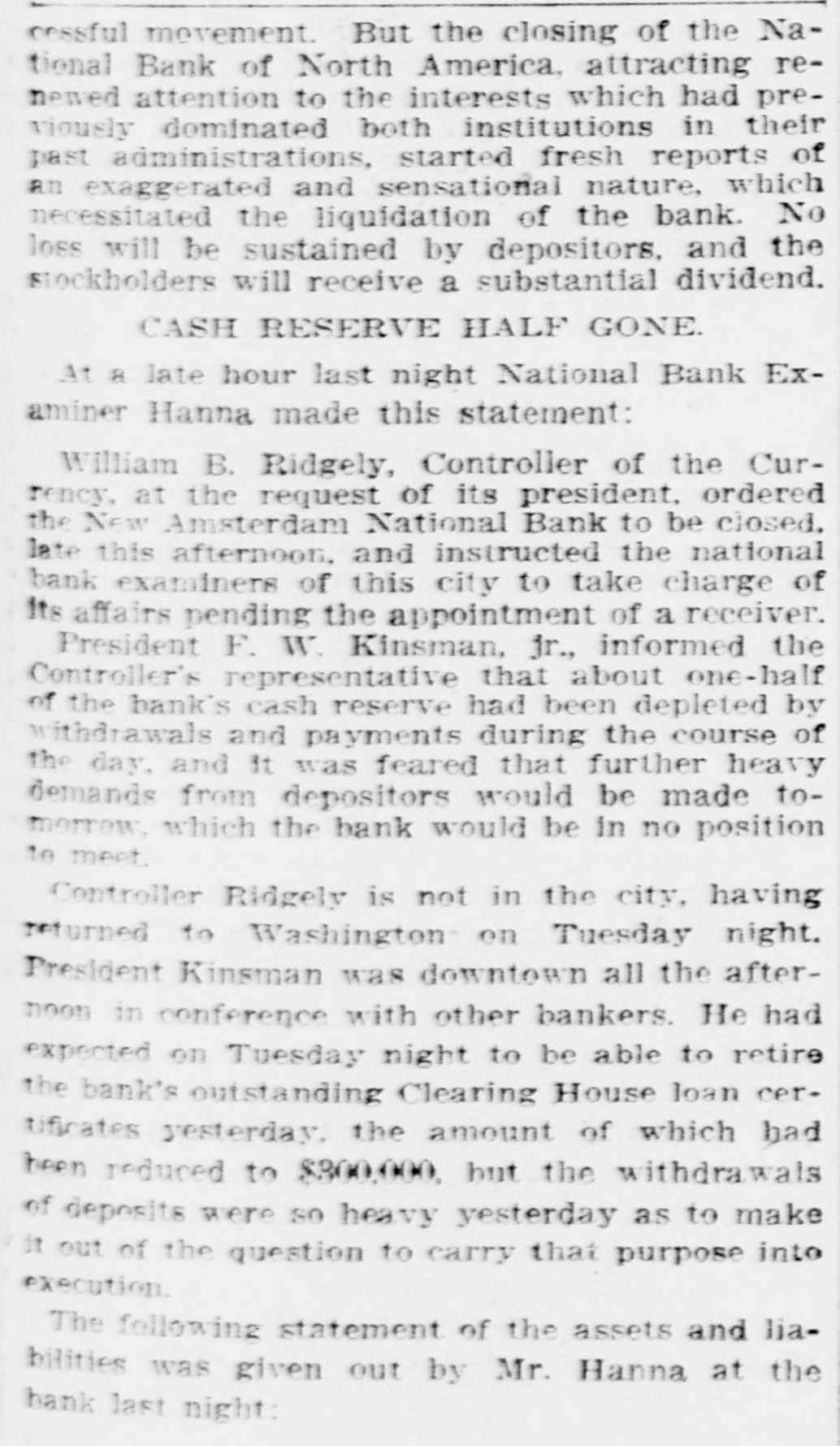
New Amsterdam National bank, capital $1,000,000, and Mechanics and Traders' bank, both of New York, taken in charge by comptroller of currency.
Source
newspapers
5. January 30, 1908 Receivership
Source
historical_nic
6. March 16, 1908 Receivership
Newspaper Excerpt
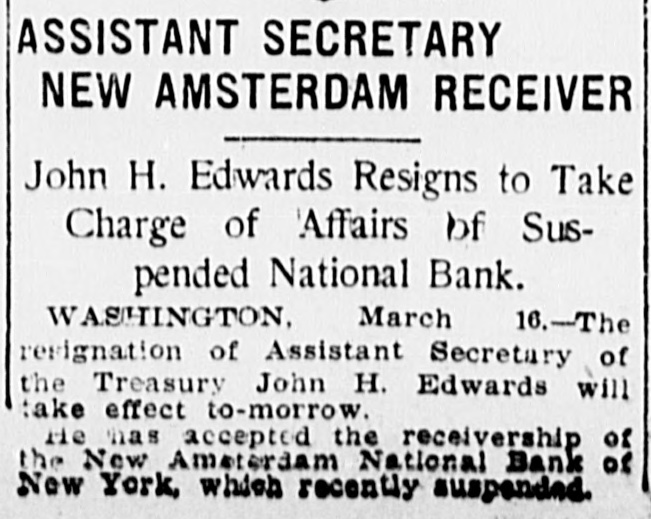
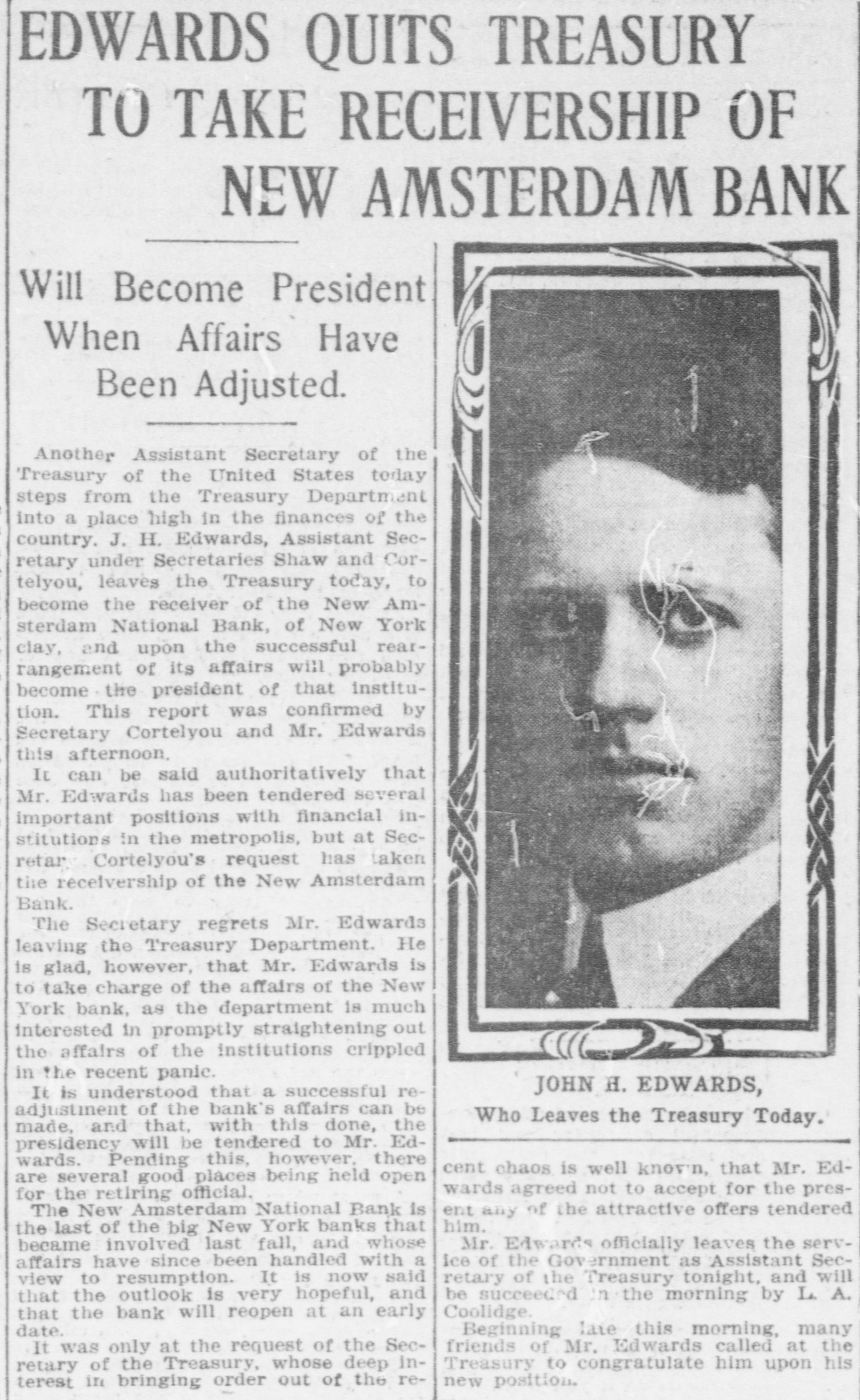
J. H. Edwards, Assistant Secretary under Secretaries Shaw and Cortelyou, leaves the Treasury today, to become the receiver of the New Amsterdam National Bank
Source
newspapers
7. June 2, 1908 Other
Newspaper Excerpt
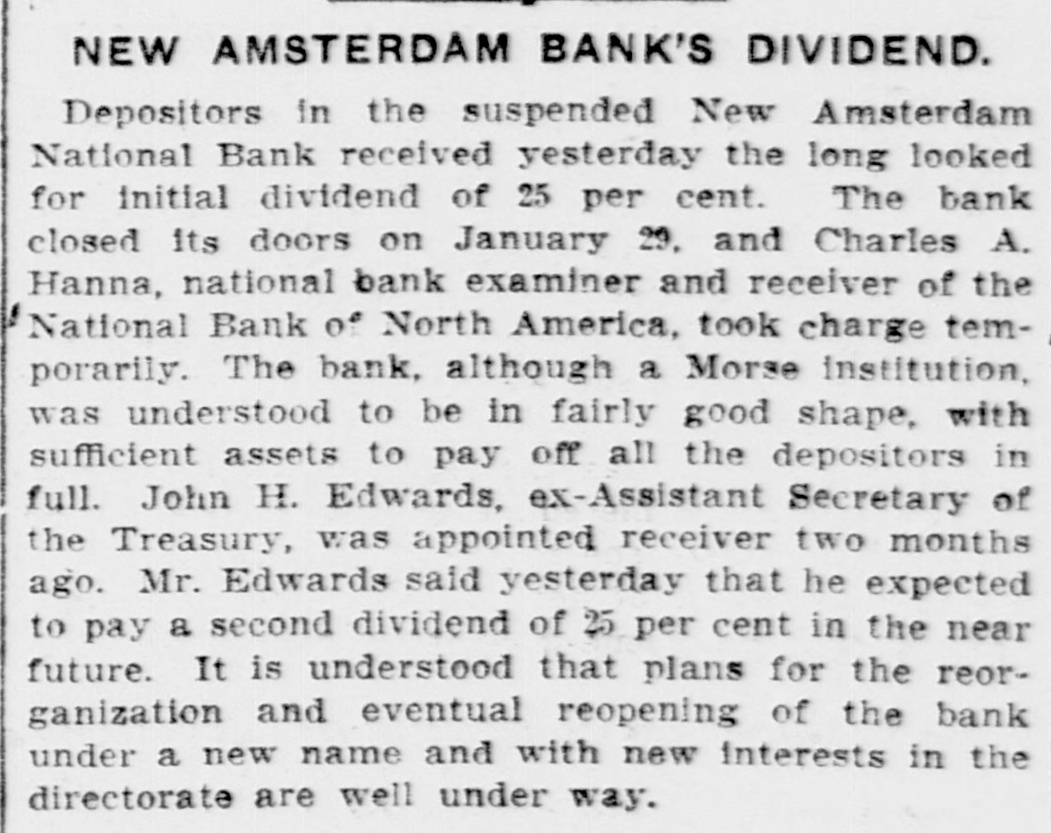
Depositors in the suspended New Amsterdam National Bank received yesterday the long looked for initial dividend of 25 per cent.
Source
newspapers

Newspaper Articles (25)

Article from Evening Times-Republican, October 21, 1907

Click image to open full size in new tab

Article Text

STOCK MARKET TODAY New York Speculators Take More Favorable View of Financial Situation -Associated Banks Assist Mercantile National Third Consecutive Day. New York, Oct. -Encouraged by protective measures adopted over Sunday by the clearing house banks, speculators took a more favorable view of the financial situation this morning. The stock market opened strong and higher. The Mercantile National bank today owed the clearing house on balance, $1900.000, and the National Bank of North America owed $850,000. These sums were unexpectedly large and indicated that heavy withdrawals were being made from these two banks. The sum owed by the Merchants' and Traders' National Bank was $430,000, and that owed by the New Amsterdam National Bank, $200,000. The clearing house committee decided at a meeting to assume responsibility for the Mercantile National Bank's large debt balance. This is the third consecutive day on which the associated banks have gone to the assistance of the Mercantile. The only weak features in the stock situation today were stocks and bonds of the Consolidated Steamship Company. This is the company in which Charles W. Morse is the controlling factor. United States Copper advanced two points. Seth M. Milliken, new president of the Mercantile National Bank, was in charge of the institution's affairs today. He said that the affairs at the bank were progressing satisfactorily. Questioned as to loans made to F. A. Heinze and Charles W. Morse, Milliken said it was expected that they would repay the loans made to them as soon as they were able. Ed O. Eldridge, cashier of the new Amsterdam National Bank, said today that there was no more than the usual business being done this morning in the way of deposits.
Article from Daily Kennebec Journal, October 22, 1907

Click image to open full size in new tab

Article Text

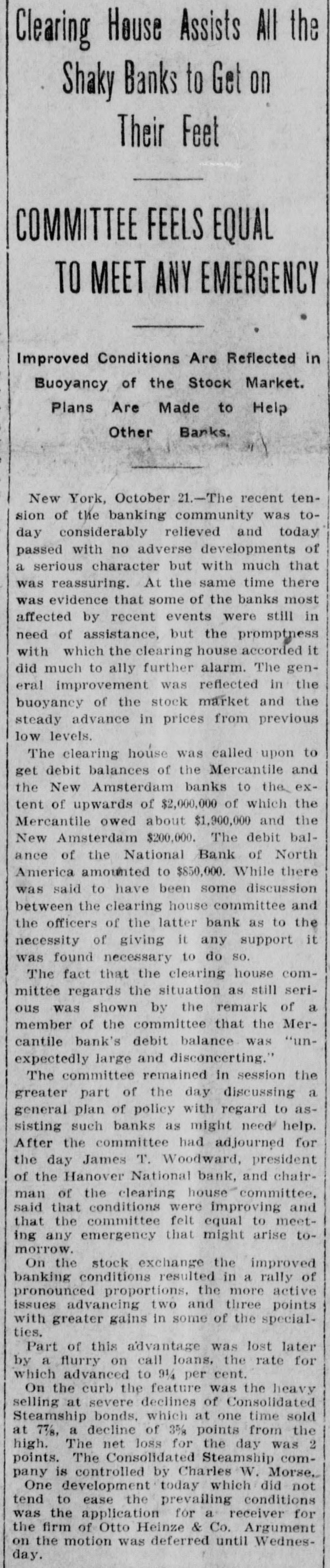
IMPROVING. New York Bank Situation Looks Much Better. Action of Clearing House Serves to Prevent Alarm. Many Banks Affected, Though, Still Need Assistance. New York, Oct. 21.-The recent tension of the banking community was todayconsiderably relieved and the day passed with no adverse developments of a serious character but with much reassuring. At the same time there was evidence that some of the banks most affected by recent events were still in need of assistance. but the promptness with which the Clearing House accorded it did much to allay further alarm. The general improvement was reflected in the buoyancy of the stock market and the steady advance in prices from previous low levels. On the other hand, the conservative element deferred a too optimistic view until the relief given by the Clearing House had continued for several days and had permanently re-established the stability of some of the weaker institutions, notably the Mercantile National Bank and the New Ainsterdam National Bank. The Clearing House was called upon today to meet debit balances of the Mercantile and the New Amsterdam Banks to the extent of upwards of $2,000,000. of which the Mercantile owed about $1,900,000 and the New Amsterdam $200,000. The debit balance of the National Bank of North America amounted to $850,000. While there was said to have been some discussion between the Clearing House committee and the officers of the latter bank a3 to the necessity of giving it any support, it was not found necessary to do SO and William M. Havemeyer, the president of the institution, declared that the Bank of North America had not and would not ask one dollar's aid from the Clearing House. "The situation," Mr. Havemeyer said, "is really far better than we expected. So far only about $150,000 has been withdrawn. When the bank opened this morning we had a million dollars on hand to pay all comers, but only a small portion was used." The fact that the Clearing House committee regards the situation as still serious was shown by the remark of a member of the committee that the Mercantile Bank's debit balance was "unexpectedly large and disconcerting." The committee remained in session the greater part of the day discussing a general plan of policy with regard to assisting such banks as might need help. After the committee had adjourned for the day. James T. Woodward. president of the Hanover National Bank and chairman of the committee. said the conditions were improving and that the committee felt equal to meeting any emergency that might arise tomorrow. William Sharer, manager of the Clearing House, said the situation was under control that some of the more awkard features had been eliminated. and that


Article from Evening Star, October 23, 1907

Click image to open full size in new tab

Article Text

WILD DAY ON 'CHANGE NATIONAL BANKS WEATHER FINANCIAL STORM. NEW YORK, October 23.-In the financial district yesterday there was a tendency to put the blame for the present trouble among the trust companies upon the republican party. After the life insurance investigation there was a demand on the legislature for an investigation of trust companies. The late Gov. Higgins and republican powers in the legislature stopped the movement partially to protect ex-Superintendent Kilburn of the banking department. In place of an investigation, which would have straightened out the tangle, the legislature passed a law providing for a 15 per cent reserve fund. That this reserve does not protect has just been demonstrated. Wall street was alive with rumors that other trust companies were in such condition that they could not afford to rescue the Knickerbocker: that Thomas Ryan had come under the ban of the clearing house committee and was to be forced out of banking, as was Morse, Heinze, the Thomases and Barney. This rumor finally took definite form in a report that Mr. Ryan had been asked to withdraw from the Morton Trust Company. There followed a run of slight dimensions on that institution shortly before the closing hour. It was handled without trouble. Morton Speaks for Ryan. Levi P. Morton, the venerable president of the Morton Trust Company, who spent a full day in the financial district for the first time in months, was sufficiently worried by disquieting reports to issue this formal statement: "The story in circulation that Mr. Ryan has resigned or intends to resign as vice president of the Morton Trust Company is pure invention. Mr. Ryan has not resigned and has no intention of doing so. It has never been discussed or even suggested." Mr. Ryan made many trips yesterday from his office, in the Morton Trust Company, to the office of Valentine P. Snyder, president of the National Bank of Commerce. He made one trip without his hat, waving off interviewers as he hurried along. "I've heard nothing of it," he said when asked if he was going to quit his banking directorates. George B. Cortelyou, Secretary of the Treasury, came from Washington in the early evening. He had a conference with Hamilton Fish, assistant treasurer here, over the disposition of the $6,000,000 which Washington is sending to relieve the situation. They also discussed the need of more money. At the Manhattan Hotel he received J. Pierpont Morgan, who was accompanied by several of his banking associates. He had other conferences over the telephone and had promised a statement before going to bed. National Banks Weather the Storm. The national banks were able to weather Monday's storm without assistance from the clearing house, with the single exception of the New Amsterdam National Bank, which needed help with a debit balance of $341,000. This is one of the banks from which Charles W. Morse was forced Saturday. The array of debit balances at the clearing house was somewhat startling. The National Bank of Commerce, which has been clearing for the Knickerbocker Trust, headed the list with a debit balance of $7,000,000. It was met promptly and without clearing house assistance. The Mercantile National Bank, from which F. Augustus Heinze was forced, showed improvement under the management of Seth M. Milliken. Its debit was $454,000, the lowest since Thursday, and its own funds were available. Other debits were the National Bank of North America, $543,000; the Mechanics and Traders', $335,000; and the Oriental Bank, $147,000. Members of the clearing house committee held several conferences and were ex-


Article from The Barre Daily Times, October 23, 1907

Click image to open full size in new tab

Article Text

Trust Company of America Besieged Today CLAIMS IT IS COMPETENT The Knickerbocker Trust Company, Which Suspended Payment Yesterday Is Now in the Hands of the State Banking Department, New York, Oct. 23.-The state bank ing department has taken charge of the Knickerboeker Trust company, and it was officially stated that the bank would not open for business this morning. In spite of it, hundreds of people congregated about the doors, and the police reserves have been called out to control them. The Trust company of America opened with its counters stacked with enormous piles of money, prepared for a run. Before nine o'clock a double line of depositors was waiting for the open ing. The company claims it has money enough on hand to meet all demands There was the same condition at the Colonial branch of the company. The Knickerbocker Trust company, the storm center yesterday, paid out cash to depositors at the rate of $44,444 a minute for three hours and then closed its doors. At a meeting of the directors of the Hudson Trust company held yesterday, the resignation of Orlando F. Thomas as president was formally accepted, and E. R. Chapman was selected as head of the institution in his place. Other Banks Wouldn't Help. President Higgins, the new president of the Knickerbocker. when asked if the other trust company presidents were reluctant to help out his bank, replied: Reluctant is no name for it. They seemed to feel that they ought to hold on to all the money they had. One of them said to me: We might have help ed you out. but here you have closed your doors. You mean that you don't want to ride a dead horse, I said, 'but I wish you to distinctly understand that the Knickerbocker is not a dead horse, and what are you going to do about it Mr. Higgins would not say what was answered Bauks That Were Helped. The clearing house committee went into session shortly after ten o'clock yesterday and announced the following debit balances of bank: Mercantile National bank, $454,000; National Bank of North America, $543. 000: National Bank of New Amsterdam. $340,000; the Mechanics' and Traders' National bank, $335,000; the National Bank of Commerce, $7,000,000. It was sofficially announced that the clearing house committee had rendered assistance yesterday to the Mercantile National bank, the National Bank of North America and the National Bank of New Am sterdam. It was stated that the large debit balance of the National Bank of o Commerce represented the clearances of the Knickerbocker Trust company. Cortelyou's Coming Gave Strength. V Secretary of the Treasury Cortelyou o teached New York from Washington at e 9:30 last night. He was met at Jerby Hamilton Fish, assistant il United States treaurer, and the two the u were in earnest conversation during ferry trip to New York. Upon reaching A this city they went at once to the Hotel Manhattan, where several bankers later k presented to the secretary the various phases of local financial conditions. h Secretary Cortelyou is here to thor oughly look into the financial situation, for si which he has had under observation R ,several weeks. He has come with no of ideas of how much money to relieve the h P and will preconceived be required relief situation the matter of treasury meas he will be determined by what to ures learns. He will do all that he can relieve the present stress. Secretary of the Treasury George B. made the before one o'clock this shortly Cortelyou following morning: statement leaving "I repeat what I stated before for no P this afternoon if at other Washington reason than to emphasize the It titude of the treasury department in every will use its facilities to assist interests way legitimate business and thor and proper its action will be prompt at tr ough national banks of New York condition City in 'The in an exceptionally strong to be te are general situation here looked seems after U The in hand, and is being men, fil well many strong and influential in the ed by those whose recent action public it such as house received emphatic similar ha clearing The movement for trust com ne approval. of action among the and far of concert should have a helpful the day panies effect. I shall spend at the B con reaching tomorrow sub-treasury. made from a th statement was situation el This on the local banking between Γ©e ference the Hotel Manhattan Geo al held at Cortelyou, J. P. Morgan, Frank A th Secretary Perkins, George F. Baker, and J. G. fr W Vanderlip, James Stillman Cannon. ha pa and TND GREAT DEPIL


Article from The Roswell Daily Record, December 3, 1907

Click image to open full size in new tab

Article Text

"The current number of Harper's Weekly contains an editorial 'roast' of the clearing house certificates issued in Las Vegas, New Mexico. In view of the fact that the financial difficulties of the West were wholly due to the suspension of payment by the New York banks, and the issue by these banks of clearing house certificates and other forms of 'Johnsmith' currencyβ€”as it is now calledβ€”it would seem that the Weekly might have found a target for its ammunition nearer home.β€”Socorro Chieftain.


Article from Deseret Evening News, December 3, 1907

Click image to open full size in new tab

Article Text

# RESUMPTION. Horace Greely was wont to say that "the way to resume is to resume." The New York banks have been announcing for some time that specie payments are about to be resumed. It appears that the bankers elsewhere are ready to pay cash as soon as New York decides to keep its promises. It is noted as one peculiar feature of the present panic that some of the New York bankers will become rich because of it. And we doubt not that the most immediate cause of the suspension of cash payment by the banks all over the country was the stoppage of such payments by the banks in New York. As long as the banks of that city continue to withhold payment of their obligations, there seems to be no reason why they might not be purchasing the government bonds and so making a profit out of withholding cash payments to the rest of the country. Such a suggestion is made in many quarters, and the way to negative any such suspicion is for the New York banks to pay their obligations inland in the current money of the realm.


Article from New-York Tribune, January 30, 1908

Click image to open full size in new tab

Article Text

ually reduced until yesterday it was down to $1,900,000. The Clearing House announcement that no further aid would be extended, he said, was the final obstacle in the bank's fight for life that it could not surmount. Edward R. Thomas was formerly a vice-president of the bank and among the directors were F. Augustus Heinze, Orlando F. Thomas, Edward R. Thomas and Elverton R. Chapman. Last fall, however, the Thomas-Heinze interests retired from the directorate and the election of ex-Controller Grout and his brother to the board, with numerous other Brooklyn business men, was thought to have strengthened the position of the bank greatly. The president of the third bank which it had been rumored within the last few days would be obliged to go into voluntary liquidation and which has been unable to retire its Clearing House loan certificates, said last night: "The bank cleared within the regular time today, meeting all its outstanding obligations. The bank will open at the usual time to-morrow morning." WILL CLARIFY SITUATION. An officer in one of the largest banks in the city said last night that the downfall of these banks would go far toward clearing up the banking situation in New York and placing it on a stronger basis than it has ever occupied before. "Their overthrow was not unexpected," he said, "and there was nothing extraordinary in it. It simply emphasizes the fact that banks that are not managed along orderly lines must be eliminated. It is well known that certain officials connected with these institutions have departed from recognized banking methods, and that knowledge in the case of the New Amsterdam has led to a dropping of deposits from $6,000,000 to $2,000,000. This fact in itself showed that the days of usefulness of the bank were ended. With the falling off of the deposits has come a consequent difficulty in obtaining money to meet the demands made upon the institution. Efforts to raise this money by calling upon other banks have been fruitless. The fact that the Clearing House Association had ordered that the members begin to issue individual statements again after February 8 made it necessary that the banks in question obtain the money to take up their Clearing House loan certificates if they were not to appear in the statements. "Other banks were none too anxious to come to the rellef of those institutions where affairs had been improperly conducted. In times of financial panic one bank is willing to come to the aid of another in order to keep up the general standing, but at this time, when affairs are almost normal, I see no reason why a supposedly sound institution should have any particular aid. "The officials of the New Amsterdam were making efforts among various banks yesterday to get money to tide them over their difficulties. At one time it looked as though this money might be obtained, but I think that the banks where appeals for assistance were made were not satisfied with the collateral that the New Amsterdam had to offer. This collateral was made up largely of small notes and bills receivable. In the case of the notes of a large corporation it is easy for a committee to decide what they are worth, but in the case of collateral such as the New Amsterdam had it is difficult for any one not perfectly familiar with the signers of the notes to know what their real value is. Consequently the bank was unable to get the aid that it needed. I think its condition is not due to any decided run that has been made on it recently, as the debit balance which it had at the Clearing House to-day was less than $100,000. "The liquidation of these banks ought to have a wholesome effect upon banking in New York With the exception of possibly one other institution, every other bank in the city is as sound as a dollar. They have more money than they need, and their condition is constantly improving. With these banks eliminated, the banking situation was never as strong as it is to-day." [By Telegraph to The Tribune. Albany, Jan. 29.-Clark Williams, State Super-


Article from Los Angeles Herald, January 31, 1908

Click image to open full size in new tab

Article Text

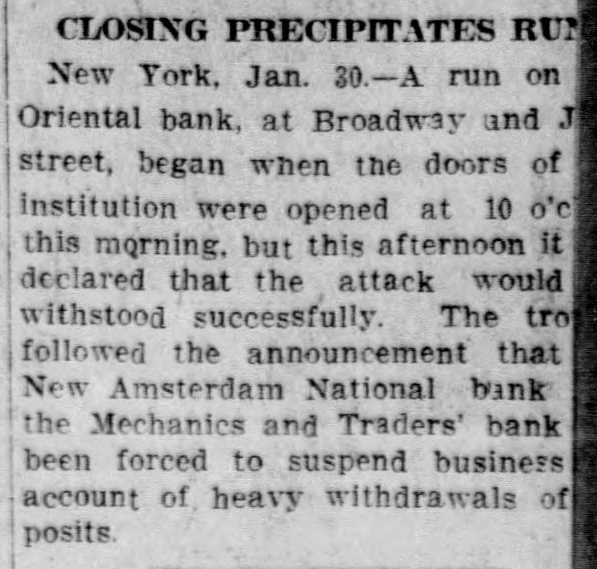
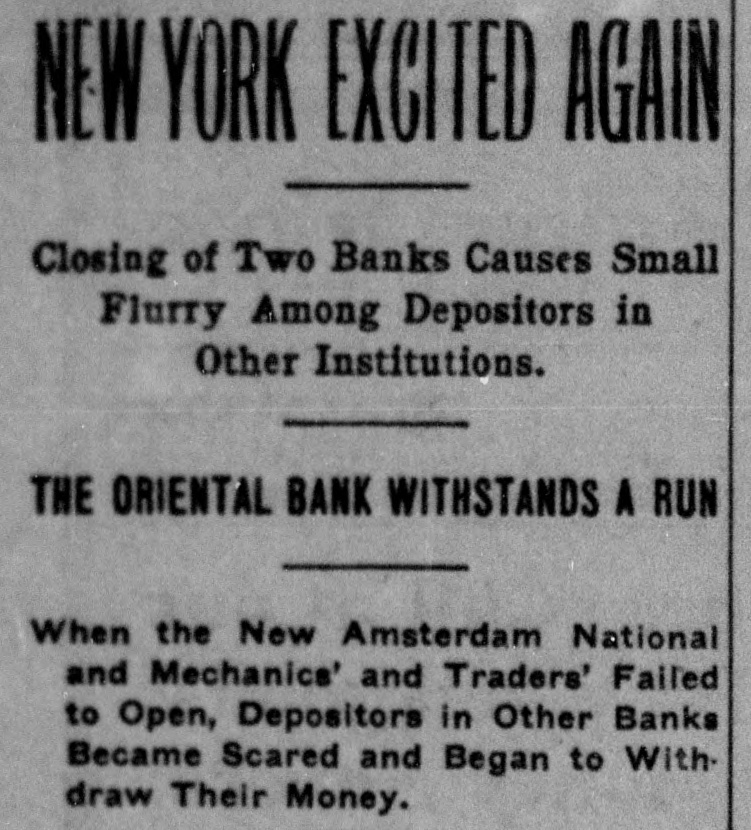
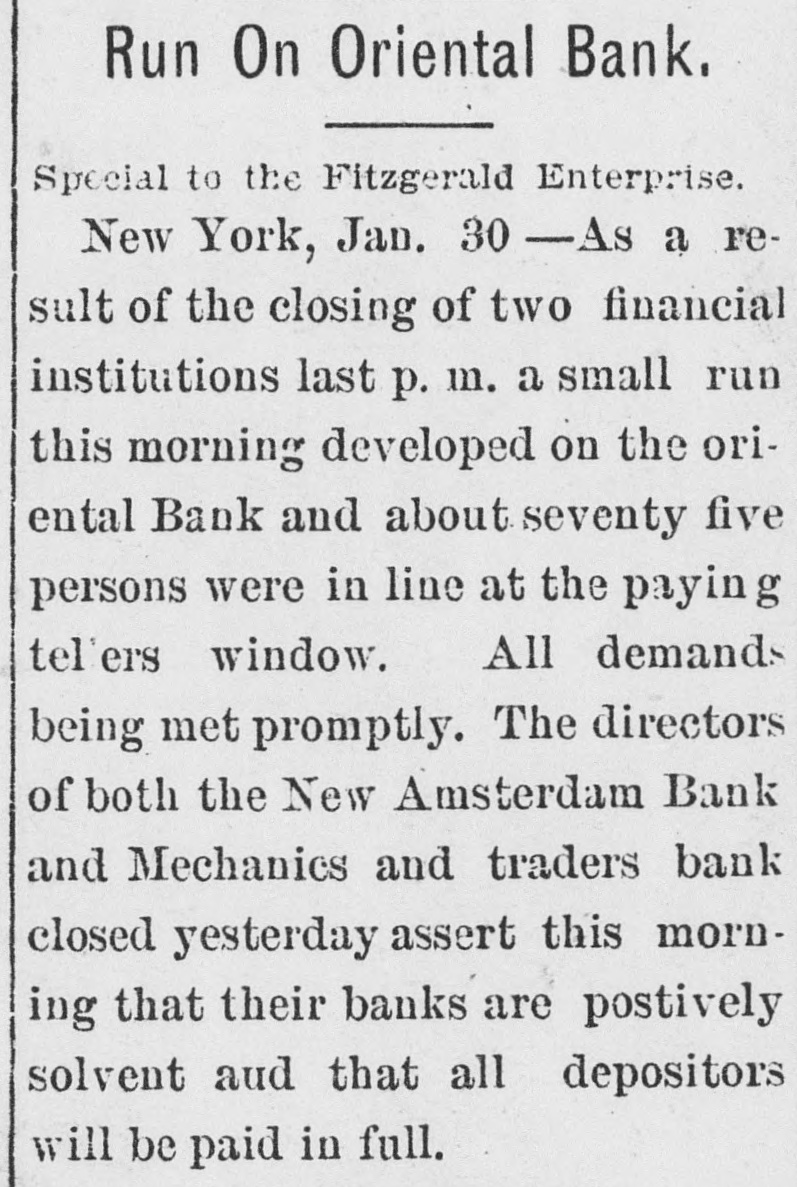
BANK STANDS EXTREME RUN NEW YORK HOUSE PUTS IN A DAY OF DRAINS GREAT CROWDS SWARM BUILD. ING FOR MONEY Desperate Effort to Ward Off Insolvency Proves Sucessful and Officials Expect to Resume Business Today By Associated Press. NEW YORK, Jan. 30.-The Oriental bank, a state institution, withstood a severe run today, and President Kelly gave out a statement about midnight tonight that he believed the bank would open tomorrow morning for business, although there is some doubt of it. A meeting of the directors will be held at 9 o'clock tomorrow morning, he added, at which the question of opening will be definitely determined. The announcement was made after a meeting of the president and several of the directors of the Oriental bank at the former's home. Following the closing last night of the New Amsterdam National and the Mechanics and Traders bank, a state institution, there was a run on the Oriental during today, which it successfully withstood. All depositors were paid promptly during the day and it was given out at the close that the bank would be able to secure all the assistance necessary to tide it over the run, as it was understood that friends of President Kelly had come to his aid with $1,000,000, and that he would be able to secure further assistance, if needed, from the clearing house. Loans Are Protected 'Of course these banks," said President Kelley, "while offering to advance us $1,000,000, sought to protect themselves, and as a provision of their offer they asked our directors to individually guarantee a proportionate share of the sum agreed upon. "When this offer came to us over the telephone our directors were in session, and I insisted that under no other conditions would the kindly offer be accepted. The propostion was then put to the directors, and seven or eight acquiesced in the plan, but we found that two or three of the directors were hampered by partnership agreements which prevented them from immediately acquiescing in the plan. 'These directors were not pressed upon the point during the day, but will declare their position at the meeting tomorrow morning. "I am unable to state tonight other than my personal belief, which is that I think the bank will open tomorrow morning for business as usual, but the meeting of the directors before banking hours will decide the matter one way or another. Much will depend upon the bank's clearing house debit tomorrow. "If the debit is comparatively small it will be favorable to the institution, but if on the other hand the debit proves large-well, that's another matter. The clearing house phase of the situation is of prime importance at this juncture of the bank's existence." Several depositors who had not been paid off at the close of banking hours had representatives waiting in line outside the bank's doors throughout the night tonight to keep their places for them. The temperature hovered around 5 degrees above zero, and the walters suffered severely from the cold. The Oriental bank is capitalized at $750,000 and previous to the panic last fall carried individual deposits of $7,519,000, but this has been largely reduced since the panic. Bank examiners took active charge today of the affairs of the New Amsterdam National bank and the Mechanics and Traders' bank, which closed their doors yesterday. Both of these banks were included in the Morse-Henize-Thomas chain of banks, and after the closing of the National Bank of North America a few days ago, there had been what practically amounted to a run upon them.


Article from The Sun, January 31, 1908

Click image to open full size in new tab

Article Text

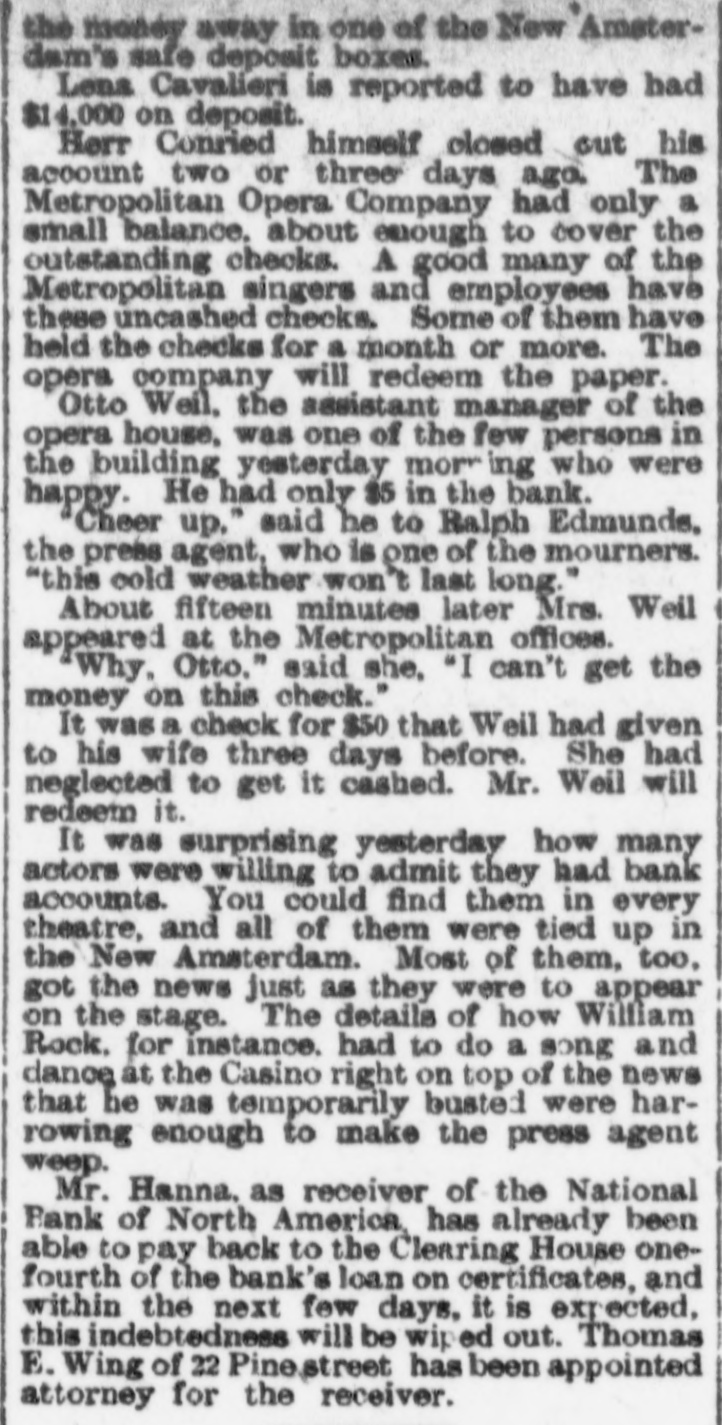
the money away in one of the New Amsterdam's safe deposit boxes. Lena Cavalieri is reported to have had $14,000 on deposit. Herr Conried himself closed cut his account two or three days ago. The Metropolitan Opera Company had only a small balance. about enough to cover the outstanding checks. A good many of the Metropolitan singers and employees have these uncashed checks. Some of them have held the checks for a month or more. The opera company will redeem the paper. Otto Weil, the assistant manager of the opera house, was one of the few persons in the building yesterday morn ing who were happy. He had only $5 in the bank. Cheer up." said he to Ralph Edmunds, the press agent, who is one of the mourners. "this cold weather won't last long." About fifteen minutes later Mrs. Weil appeared at the Metropolitan offices. "Why, Otto." said she, "I can't get the money on this check." It was a check for $50 that Weil had given to his wife three days before. She had neglected to get it cashed. Mr. Weil will redeem it. It was surprising yesterday how many actors were willing to admit they had bank accounts. You could find them in every theatre, and all of them were tied up in the New Amsterdam. Most of them, too, got the news just as they were to appear on the stage. The details of how William Rock. for instance. had to do a song and dance at the Casino right on top of the news that he was temporarily busted were harrowing enough to make the press agent weep. Mr. Hanna. as receiver of the National Bank of North America. has already been able to pay back to the Clearing House onefourth of the bank's loan on certificates, and within the next few days, it is expected, this indebtedness will be wiped out. Thomas E. Wing of 22 Pinestreet has been appointed attorney for the receiver.


Article from The Brandon News, February 6, 1908

Click image to open full size in new tab

Article Text

Effect is Small. Memphis, Tenn.-Announcement of the suspension of two banking institutions in New York had little effect in financial circles there. The fact that both institutions were known to have been carried by the clearing house banks through the serious panic times was generally known, and their failure to keep on their feet after they were put on their feet is no surprise. Bank examiners took active charge of the affairs of the New Amsterdam National bank and the Mechanics and Traders' bank, a state institution. Both of these banks were included in the Morse-Heinz chain of banks, and after the closing of the National Bank of North America a few days ago there had been what practically amounted to runs upon them. Both of them were still unable to take up their allotment of the certificates which the clearing house issued during the stringency beginning in October, and when the renewed drain upon their resources began, the clearing house authorities declined to further extend their credit.


Article from Twice-A-Week Plain Dealer, February 7, 1908

Click image to open full size in new tab

Article Text

America, the New Amsterdam bank and the Mechanics and Traders'. The Morse-Heinze-Thomas connection with these banks had weakened public confidence, and it was feared that runs would be made which the institutions could not meet. Therefore as a safeguard they were placed in the hands of the federal banking authorities. All are said to be solvent, and it was expected that depositors would be paid in full and that the banks would be able to resume business in a short time. After withstanding a run on the previous day and fearing a continuance, the directors of the Oriental bank decided to close its doors and turn the bank over to the state banking officials. The reason for this action was the disclosure at the clearing house of a debit balance of $939,000. # Steel Trust's Big Earnings. Despite the unfavorable showing of the last quarter of the year, the records of the steel trust show that its profits for 1907 were $160,984,477, which is over $6,000,000 in excess of the previous high water mark, reached in 1906. The October earnings, immediately preceding the financial and industrial disturbance, were the largest in the history of the corporation. The directors have declared dividends for the last quarter of the year of 1ΒΌ per cent on the preferred and one-half of 1 per cent on the common stock. The first five years of the profit sharing plan of the trust have nearly closed, and it is reported in Wall street that those of its employees who have continuously held the preferred stock purchased when the plan was first announced in 1903 will receive an extra dividend of 65.4 per cent. # McCurdy Laughs at Suits. Richard A. McCurdy, former president of the Mutual Life Insurance company, who has spent two years in Europe, recently returned to his home in Morristown, N. J. When asked about the suits for the restitution of several million dollars which the management of his old company had brought against him he laughed and said: "I have lawyers, and they will take care of the suits. They are not worth talking about. I am seventy-three years old. The real question is, Which will last the longer, the suits or myself?" # Pittsburg Exchange Opens. The Pittsburg Stock Exchange, closed since Oct. 23 last, opened for business Jan. 27. There was a tendency on the part of the brokers to withhold sales, and only 271Β½ shares changed hands. The reopening of the exchange has already restored confidence to a notable degree. # Morse Lines Ask Receivership. In order to prevent various creditors from applying for a receivership on their own account the controlling interests and the bondholders' committee of the Consolidated Steamship lines, the Charles W. Morse $120,000,000 combine, have applied for a receiver for the Consolidated and the two weakest of its subsidiary lines, the Metropolitan and Eastern Steamship companies. These proceedings do not affect the Mallory, Clyde, New York and Porto Rico and New York and Cuba lines, which are also subsidiaries of the Consolidated. # Morgan Takes More Bonds. The New York city officials have decided to sell $50,000,000 in bonds, having arranged with J. Pierpont Morgan for the underwriting of the issue. It is expected that these bonds will be put on the market in a few days. Their proceeds will be used in carrying out needed public improvements.


Article from Wausau Pilot, February 11, 1908

Click image to open full size in new tab

Article Text

NEW YORK BANKS FAIL. New Amsterdam National and the Mechanics and Traders Are Kit. Bank examiners have taken charge of the affairs of the New Amsterdam National and the Mechanics and Traders'. a State, institution, both of which closed their doors in New York the day before. These banks were in the Morse-HeinzeThomas chain, and after the closing of the National of North America a few days ago, there had been runs upon them. Both were unable to take up their allotment of the certificates which the clearing house issued during the stringency beginning in October, and when the renewed drain upon their resources began the clearing house authorities declined to extend their credit. Although the closing was expected among the bankers and wellinformed men in the financial world it found many of the depositors unprepared and caused them inconvenience. As a result several other banks not in the important class met with heavy withdrawals of deposits. One of these was the Oriental, where a rush began as soon as the office was opened for business. Depositors were paid promptly.


Article from The White Pine News, March 4, 1908

Click image to open full size in new tab

Article Text

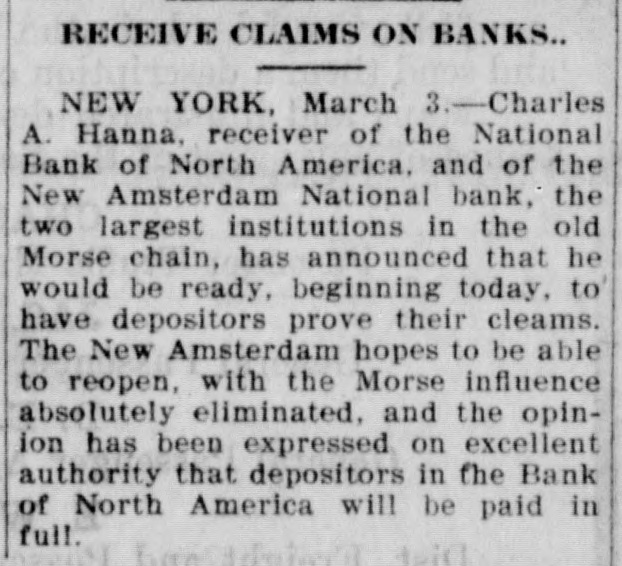
RECEIVE CLAIMS ON BANKS. NEW YORK, March 3.-Charles A. Hanna, receiver of the National Bank of North America, and of the New Amsterdam National bank, the two largest institutions in the old Morse chain, has announced that he would be ready, beginning today, to have depositors prove their cleams. The New Amsterdam hopes to be able to reopen, with the Morse influence absolutely eliminated, and the opinion has been expressed on excellent authority that depositors in the Bank of North America will be paid in full.


Article from The Washington Times, March 16, 1908

Click image to open full size in new tab

Article Text

EDWARDS QUITS TREASURY TO TAKE RECEIVERSHIP OF NEW AMSTERDAM BANK Will Become President When Affairs Have Been Adjusted. Another Assistant Secretary of the Treasury of the United States today steps from the Treasury Department into a place high in the finances of the country. J. H. Edwards, Assistant Secretary under Secretaries Shaw and Cortelyou, leaves the Treasury today, to become the receiver of the New Amsterdam National Bank, of New York clay, and upon the successful rearrangement of its affairs will probably become the president of that institution. This report was confirmed by Secretary Cortelyou and Mr. Edwards this afternoon. It can be said authoritatively that Mr. Edwards has been tendered several important positions with financial institutions in the metropolis, but at Secretar Cortelyou's request has taken the receivership of the New Amsterdam Bank. The Secretary regrets Mr. Edwards leaving the Treasury Department. He is glad, however, that Mr. Edwards is to take charge of the affairs of the New York bank, as the department is much interested in promptly straightening out the affairs of the institutions crippled in the recent panic. JOHN H. EDWARDS, It is understood that a successful readjustment of the bank's affairs can be Who Leaves the Treasury Today. made, and that, with this done, the presidency will be tendered to Mr. Edwards. Pending this, however. there cent chaos is well known, that Mr. Edare several good places being held open wards agreed not to accept for the presfor the retiring official. The New Amsterdam National Bank is ent any of the attractive offers tendered him. the last of the big New York banks that became involved last fall, and whose Mr. Edwards officially leaves the servIce of the Government as Assistant Secaffairs have since been handled with a view to resumption. It is now said retary of the Treasury tonight, and will that the outlook is very hopeful, and be succeeded in the morning by L. A. Coolidge. that the bank will reopen at an early date. Beginning late this morning, many friends of Mr. Edwards called at the It was only at the request of the SecTreasury to congratulate him upon his retary of the Treasury, whose deep innew position. terest in bringing order out of the re-


Article from The Washington Herald, March 17, 1908

Click image to open full size in new tab

Article Text

as Assistant Secretary of that department, made himself deservedly popular by his efficient services with those who were associated with him. A man of exceptional ability. he merited the esteem of his superiors, and it was with regret that Secretary Cortelyou sanctioned his departure. The retiring Assistant Secretary will be succeeded by Louis Coolidge, who will take the oath of office to-day. Mr. Edwards, the retiring Assistant secretary, came to Washington from Ohio, and has administered the affairs of the office in a particularly able manner. He has enjoyed the confidence of bla superiors to a marked degree and has been deservedly popular with those who frequent the second floor of the Treasury Building. Secretary Cortelyou said yesterday that Mr. Edwards had received three attractivo offers from financial institutions in New York, but that he prevailed upon Mr. Edwards to suspend consideration of them for a time. He did so, he said, because he felt that he needed Mr. Edwards' services in the receivership of the New Amsterdam Bank. He added that he regarded his assistant as especially qualified for this work. Mr. Cortelyou said he regretted exceedingly that Mr. Edwards was leaving the Assistant Sec. retaryship, as he had discharged the duties of that office with excep ional ability. It was stated yesterday that the New Amsterdam Bank will eventually resume business. and that other institutions in the same vicinity will be consolidated with it to form a banking house of large capital. Mr. Edwards will, as receiver, take an active part in the reorganization of the New Amsterdam and the other banks which are to be consolidated with that institution, and it is supposed that his appointment is preliminary to his election as president of the consolidated concern. Mr. Edwards was private secretary to Leslie M. Shaw when Mr. Shaw was Secretary of the Treasury, and was appointed Assistant Secretary when Robert M. Armstrong retired from the department to become president of a banking institution in New York. Business on the Washington Stock Exchange yesterday was small in volume, chiefly because there was little stock to be had. It was clear to the observer that there was a good demand for stocks. Prices were in most instances bid up, brokers standing ready to take shares at prices better than the closing bid. Indeed, there was a good deal of sparring in the way of bids, in the hope of uncovering stock; and the impression left by the day's business was that much more stock could have been soid than was offered. The chief business was the utility shares, Capital Traction leading. It sold somewhat under the highest of last week, at 118 1-2 and 119. Washington Railway and Electric preferred went at 70 1-8, and 24 1-2 was bid for the common. Gas was sold in fractional lots above 62, and Washington Railway and Electric 4s brought L321-2.


Article from New-York Tribune, June 3, 1908

Click image to open full size in new tab

Article Text

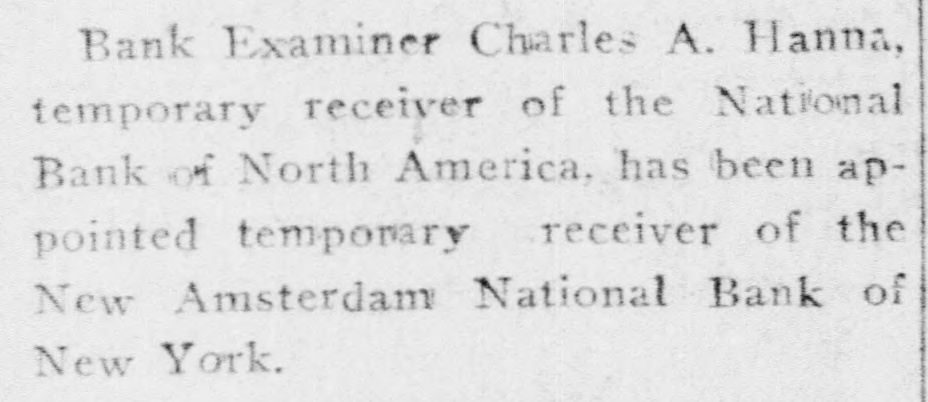
NEW AMSTERDAM BANK'S DIVIDEND. Depositors in the suspended New Amsterdam National Bank received yesterday the long looked for initial dividend of 25 per cent. The bank closed its doors on January 29. and Charles A. Hanna, national bank examiner and receiver of the National Bank of North America, took charge temporarily. The bank. although a Morse institution, was understood to be in fairly good shape, with sufficient assets to pay off all the depositors in full. John H. Edwards, ex-Assistant Secretary of the Treasury, was appointed receiver two months ago. Mr. Edwards said yesterday that he expected to pay a second dividend of 25 per cent in the near future. It is understood that plans for the reorganization and eventual reopening of the bank under a new name and with new interests in the directorate are well under way.


Article from New-York Tribune, July 26, 1908

Click image to open full size in new tab

Article Text

MR. MORSE OPTIMISTIC. Financier Says He'll Soon Take the Public Into His Confidence. Charles W. Morse, when seen yesterday in the National Bank of North America, where he had been in consultation with Charles A. Hanna, the receiver, said that his plan to pay off all the bank's depositors and then have the bank's assets turned over to the stockholders was making excellent headway. Mr. Morse said that depositors representing hundreds of thousands of dollars had already availed themselves of his offer to pay the full amount of all claims. In regard to his plans for paying off the depositors of the New Amsterdam National Bank, and then taking over the assets of that institution, Mr. Morse said that he was not quite ready as yet to take the public into his confidence, but added that he expected to have some important announcements to make along that line in the near future. Asked concerning the activities of the Morse Securities Company, which was incorporated in Bath, Me., some time ago, to buy and sell stocks. bonds and other securities, Mr. Morse said he had nothing new to divulge just at present. Mr. Morse expressed himself as optimistic on the general financial situation. Asked how much further he thought the present rise in the stock and bond market was likely to go. he said: "The pendulum always swings too far, you know. Last fall it swung much too low. Now it may swing too far the other way." Mr. Morse seemed to be in better health and spirits than at any time since last October, when he resigned from all the banking institutions with which he was connected.


Article from Daily Kennebec Journal, July 27, 1908

Click image to open full size in new tab

Article Text

To Take Public Into His Confidence, Morse Says. Will Soon Give Out Plans For Bank of North America. Optimistic as to Financial Situation -Health Is Good. New York, July 26.-Charles W. Morse, when seen yesterday in the National Bank of North America, where he had been in consultation with Charles A. Hanna, the receiver, said that his plan to pay off all the bank's depositors and then have the bank's assets turned over to the stockholders was making excellent headway. Mr. Morse said that depositors representing hundreds of thousands of dollars had already availed themselves of his offer to pay the full amount of all claims. In regard to his plans for paying off the depositors of the New Amsterdam National Bank. and then taking over the assets of that institution, Mr. Morse said that he was not quite ready as yet to take the public into his confidence, but added that he expected to have some important arnouncements to make along that line in the near future. Asked concerning the activities of the Morse Securities Co., which was incorporated in Bath, Me., some time ago, to buy and sell stocks, bonds and other securities, Mr. Morse said he had nothing new to divulge just at present. Mr. Morse expressed himself as optimistic on the general financial situation. Asked how much further he thought the present rise in the stock and bond market was likely to go, he said: "The pen.


Article from Alexandria Gazette, September 11, 1908

Click image to open full size in new tab

Article Text

were, $184,606.01; expenditures, $183,220.70; balance in the treasury, $129,395.33. During the last year, 216 charters were granted by the federation to new labor bodies in various parts of the country. As showing the tremendous amount of correspondence conducted by the headquarters office, he stated that an average of 1416 letters a day was being sent out. In his annual report, made public today, Brig. Ger. Frederick Funston, commanding the department of Oalifornia, expresses great gratification over the benificient results of the army pay legislation. "Company commanders," he says, report that a much larger proportion of desirable men are re-enlisting than was formerly the case, and many former soldiers are returning to the service. Orville Wright is preparing this afternoon to make a speed test of his aeroplane. Heretofore he has limited his motor to three-fourths of its power. When he flies, probably about sun-set this evening, he will try letting it out to its full capacity. Inventor A. M. Herring, who has contracted to deliver an aeroplane at Fort Myer by Monday next, wired the War Department today requesting an additional month in which to make improvements in his machine. The Signal Office has received a telegram from Capt. Olifford, in charge of the Seat:le station, with information of further success in forging the chain of wireless stations through Alaska. An additional dividend of forty per cent. to the creditors of the New Amsterdam National Bank of New York city, was ordered today. Receiver Edwards informed the comptroller of the currency, in a personal conference, that the assets are amply sufficient to pay the r. maining ten per cent. of indebtedne38, with interest at an early date. The taking of testimony in the contempt proceedings sgainst President Samuel Gompers and other American Federation of Labor officials in the Bucks Stove and Range Company case, was begun today at the Typographical Temple. The testimony is being heard by a master appointed by Justice Gould, who has allowed thirty days for the hearing. The conscience fund was enriched to the extent of $1.50 today by a contribution from an unknown man at Concord, N. H. Assistant Secretary of the Treasury Collidgs, to whom the money was turned over, said he hoped that the money was sent by ex-Ser a or Ch ndler but had no reason to think that he WES the sender. The tropical storm, central Thursday morning north of Porto Rico, has moved northwesterly and is now approaching the eastern Bahamas. Barometric pressure continues high over practically the entire country, and under its influence, fair weather is general, except along the south Atlantic and gulf coasts. Te.nperatures have not changed decidedly in any district. The indications point to generally fair weather in the middle Atlantic states, Virginia and the Carolinas.


Article from The Detroit Times, September 16, 1908

Click image to open full size in new tab

Article Text

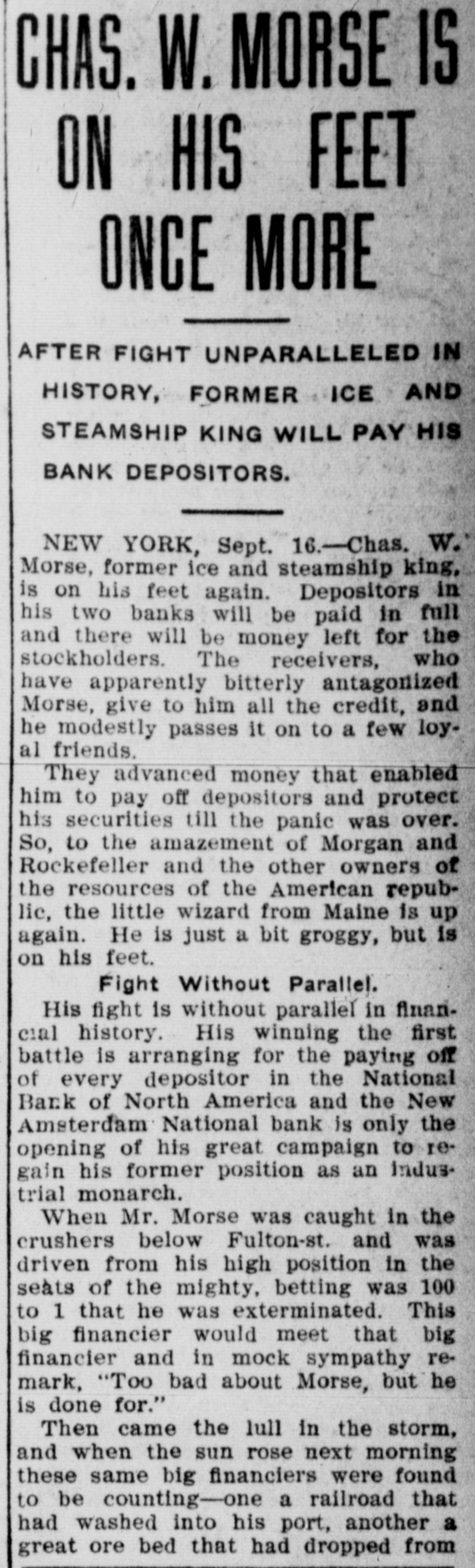
CHAS. W. MORSE IS ON HIS FEET ONCE MORE AFTER FIGHT UNPARALLELED IN HISTORY, FORMER ICE AND STEAMSHIP KING WILL PAY HIS BANK DEPOSITORS. NEW YORK, Sept. 16.-Chas. W. Morse, former ice and steamship king, is on his feet again. Depositors in his two banks will be paid in full and there will be money left for the stockholders. The receivers, who have apparently bitterly antagonized Morse, give to him all the credit, and he modestly passes it on to a few loyal friends. They advanced money that enabled him to pay off depositors and protect his securities till the panic was over. So, to the amazement of Morgan and Rockefeller and the other owners of the resources of the American republic, the little wizard from Maine is up again. He is just a bit groggy, but is on his feet. Fight Without Parallel. His fight is without parallel in financial history. His winning the first battle is arranging for the paying off of every depositor in the National Bank of North America and the New Amsterdam National bank is only the opening of his great campaign to regain his former position as an industrial monarch. When Mr. Morse was caught in the crushers below Fulton-st. and was driven from his high position in the seats of the mighty, betting was 100 to 1 that he was exterminated. This big financier would meet that big financier and in mock sympathy remark, "Too bad about Morse, but he is done for." Then came the lull in the storm, and when the sun rose next morning these same big financiers were found to be counting-one a railroad that had washed into his port, another a great ore bed that had dropped from


Article from New-York Tribune, October 23, 1908

Click image to open full size in new tab

Article Text

TOPICS OF THE STREET. FOREIGN TRADING.-Foreign houses bought 20,000 shares in the local market in the early dealings and subsequently sold 10,000 shares. It is understood that London is buying back some of the stock sold on the Balkan scare. The London market was dull and rather heavy. Mexican Railway issues were weak on the reduction in the company's dividend. Money was easy at the British capital. Bills were firmer at 2 per cent. The Bank of England made no change in its minimum rate of discount, a id showed a percentage of reserve to liabilities of 51.70. STANDARD MILLING COMPANY'S YEAR-At the annual meeting of the stockholders of the Standard Milling Company. held in Jersey City, A. P. Walker was elected a director in place of William L. Bull, who retired on account of III health. James P. Lee and Henry A. Murray, who were elected directors by the board several months ago to take the place of T. A. McIntvre and 1. Howard Latham. also were elected. The report for the year ended August 31. 1908. shows income of $801,692; interest on bonds, $175,350: net earnings, $626,342: dividends on preferred stock. $206,763: balance, $419.579: balance August 31, 1907, $1,892,097: total surplus. $2,311,676. At the meeting of the board of directors for organization purposes Brayton Ives was again chosen president; A. P. Walker. formerly auditor of the company, first vice-president, and III. R. Sheardown, formerly head of the sales department, was made second vice-president, and Joseph A. Knox, secretary and treasurer. REFINED SUGARS HIGHER.-The Federal Sugar Refining Company and B. H. Howell, Son & Co. have advanced their list prices for refined sugars 10 points to 5.10c net, less 1 per cent for cash. but are accepting orders at 5c and 4.90c, respectively. The American Sugar Refining Company and Arbuckle Brothers are still doing business on the old scale of 5c and 4.90c. respectively. The former company is accepting orders at 4,90c and the latter at 4.80c net, less 1 per cent for cash, for fine granulated COPPER PRICES HIGHER.-On the local Metal Exchange yesterday all grades of copper were advanced 1/80 a pound in the quoted price. Sales of copper continue to be made on a basis of 13% a pound for electrolytic. The feature of the situation has been a resumption of copper buying on the part of foreign interests. Early this month there was a falling off in the foreign demand, but within the last few days a large tonnage has been disposed of for shipment abroad. NEW AMSTERDAM BANK DIVIDEND.-J. H Edwards, receiver of the New Amsterdam National Bank. states that he has sufficient cash In hand to pay the depositors and other proved creditors 5'per cent of the remaining 10 per cent which is due them. TO VOTE ON EXTRA COTTON EXCHANGE HOLIDAY.--The members of the New York Cotton Exchange will vote to-day on a petition to close the exchange on November 2. in line with the exchange at New Orleans. Most members of the exchange here, however, appear to be opposed to an Extra holiday. DIVIDEND DECLARED.-The directors of the Corn Exchange Bank have declared the regular quarterly dividend of 4 per cent. payable Noveme ber 2. GOLD FOR CANADA.-The Bank of New York has shipped $300,000 gold coin to Canada.


Article from Gilpin Observer, January 7, 1909

Click image to open full size in new tab

Article Text

FINANCIAL $ $ Jan. 2-State Bank, Rockyford, Col., closed doors. Ka 6-Four big New York diamond firms forced into trustee's hands: liabilities, $4,500,000. 8-Chicago Great Western railroad JOHN placed in hands of D. receivers. ROCKEFELLER 16-Western Bank and Trust Co., Dallas, Tex. largest Texas saving bank, placed in receiver's hands. 18-John R. Walsh, president Chicago National bank and several railroads, convicted of misappropriating institution's funds. 21-Capital State Bank, Boise, Idaho, suspended. 22-Traders and Mechanics' Bank, Pittsburg. Pa.. closed doors. 25-National Bank of North America, New York, closed for liquidation, by order of government. 29-New Amsterdam National bank, capital $1,000,000, and Mechanics and Traders' bank, both of New York, taken in charge by comptroller of currency. 31-Oriental Bank of New York closed doors, following run. Feb. 13-W. B. Ridgely, comptroller of currency, accepted presidency of reorganized National Bank of Commerce, Kansas City, Mo. 26-International and Great Northern Railroad Co., a Gould line, placed in receivers' hands. 27-Financiers E. R. Thomas and O. F. Thomas indicted on charge of mismanagement of funds of Provident Savings Life Assurance society. Mar. 13-John R. Walsh denied new trial; sentenced to five years in federal prison. -People's National bank. Aspin. Col., closed. Apr. 1-Pike County Bank and Trust Co., Macomb City, Miss., placed in receiver's hands. 21-Bank of Wauseon. Wauseon, O., closed doors. 24-T. A. McIntyre & Co., with houses in many cities, failed for $1,000,000. May 8-Euclid Avenue Trust Co., Cleveland, O., assigned. 14-Reserve Trust Co., and American Savings bank, Cleveland, O., closed their doors. 28-G. W. MacMillen & Co., Pittsburg, Pa.. stockbrokers. failed; liabilities, $1,800,000. Jun. 3-Kosclusko Company bank, Warsaw, Ind., closed by state auditor. 23-Citizens' bank, Dover, Ky., closed doors. Jul. 14-National Deposit bank. Philadelphia, Pa., closed by comptroller of currency. 17-Farmers and Merchants' Banking Co., Cleveland, O., failed. 22-Standard on $29,240,000 fine declsion unanimously reversed by United States court of appeals at Chicago. Aug. 6-First National bank, Belle Plaine, Minn., closed by order comptroller of currency; bank was insolvent: President J. G. Lund committed suicide. 25-A. a Brown & Co., one of largest New York brokerage firms, failed; liabilities over $1,000,000. Sep. 10-A. Booth & Co., largest fish house in country, forced into receiver's hands. Oct. 16-Union National bank, Sommerville, Pa., closed by government. Nov. -Charles W. Morse and Alfred H. Curtis, great financiers, found guilty of misapplication of funds and falsifying books of National Bank of America, New York. 6-C. W. Morse sentenced to 15 years; Curtis given liberty on suspended sentence. 23-Eldred bank of Eldred, Pa., suspended: capital stock, $100,000. Dec. 7-National exchange bank at Springfield, Mo., closed: excitement caused by effort of W. O. Oldham, cashier of State Savings bank, to shoot President H. B. McDaniel, of Union National bank. 11-Springport, Mich., State Savings bank closed by bank examiner. 16-Somersworth, N. H., First National bank closed. following discovery of shortage of $85,000. 23-Thomas F. Ryan announced retirement from finance. 26-Henry W. Poor, New York broker, assigned for creditors.


Article from Perrysburg Journal, January 8, 1909

Click image to open full size in new tab

Article Text

Texas saving bank, placed in receiver's hands. 18-John R. Walsh, president Chicago National bank and several railroads, convicted of misappropriating institution's funds. 21-Capital State Bank, Boise, Idaho, suspended. 22-Traders and Mechanics' Bank, Pittsburg, Pa., closed doors. 25-N: ional Bank of North America, New Yor: closed for liquidation, by order of government. 29-New Amsterdam National bank, capital $1,000,000. and Mechanics and Traders' bank, both of New York, taken in charge by comptroller of currency. 31-Oriental Bank of New York closed doors, following run. Feb. 13-W. B. Ridgely, comptroller of currency, accepted presidency of reorganized National Bank of Commerce, Kansas City, Mo. 26-International and Great Northern Railroad Co., a Gould line, placed in receivers' hands. 27-Financiers E. R. Thomas and O. F. Thomas indicted on charge of mismanagement of funds of Provident Savings Life Assurance society. Mar. 13-John R. Walsh denied new trial; sentenced to five years in federal prison. 16-People's National bank, Aspin, Col., closed. Apr: 1-Pike County Bank and Trust Co., Macomb City, Miss., placed in receiver's hands. 21-Bank of Wauseon, Wauseon, O., closed doors. 24-T. A. McIntyre & Co., with houses in many cities, failed for $1,000,000. May 8-Euclid Avenue Trust Co., Cleveland, O., assigned. 14-Reserve Trust Co., and American Savings bank, Cleveland, O., closed their doors. 28-G. W. MacMillen & Co., Pittsburg, Pa., stockbrokers, failed; liabilities, $1,800,000. Jun. 3-Kosciusko Company bank, Warsaw, Ind., closed by state auditor. 23-Citizens' bank, Dover, Ky., closed doors. Jul. 14-National Deposit bank, Philadelphia, Pa., closed by comptroller of currency. 17-Farmers and Merchants' Banking Co., Cleveland, O., failed. 22-Standard Oil $29,240,000 flue decision unanimously reversed by United States court of appeals at Chicago. Aug. 6-First National bank, Belle Plaine, Minn., closed by order comptroller of currency: bank was insolvent: President J. G. Lund committed suicide. 25-A. O. Brown & Co., one of largest New York brokerage firms, failed; liabilities over $1,000,000. Sep. 10-A. Booth & Co., largest fish house in country, forced into receiver's hands. Oct. 16-Union National bank, Sommerville, Pa., closed by government. Nov. 5-Charles W. Morse and Alfred H. Curtis, great financiers, found guilty of misapplication of funds and falsifying books of National Bank of America, New York. 6-C. W. Morse sentenced to 15 years; Curtis given liberty on suspended sentence. 23-Eldred bank of Eldred, Pa., suspended; capital stock, $100,000. Dec. 7-National exchange bank at Springfield, Mo., closed; excitement caused by effort of W. O. Oldham, cashier of State Savings bank, to shoot President H. B. McDaniel, of Union National bank. 11-Springport, Mich., State Savings bank closed by bank examiner. 16-Somersworth, N. H., First National bank closed, following discovery of shortage of $85,000. 23-Thomas F. Ryan announced retirement from finance. 26-Henry W. Poor, New York broker, assigned for creditors.


Article from New-York Tribune, September 9, 1909

Click image to open full size in new tab

Article Text

FAVORS CENTRAL BANK Mr. Vreeland's Remedy for Defects in Currency System. Bedford Springs, Penn., Sept. -The feature of to-day's session of the State Bankers' Association of Pennsylvania Convention was an address by Representative Edward B. Vreeland, of New York, chairman of the Banking and Currency Committee of the House. He said, in part: Panics are merely the culmination of long continued disease. The defects in our system are such that a period of great prosperity and expansion almost certainly results in panic. So much so that many of our people accept a panic as inevitable once every ten or fifteen years. But we have the example of the other great commercial countries to show that periods of prosperity and expansion do not necessarily result in money panies. They may be avoided by better banking and currency methods. The greatest defect in our currency system is its lack of response to. the needs of business. We need this element of elasticity in our volume of money more than any other great nation. There are those who think that the trouble during the panic of 1907 and preceding panics might have been averted if the banks were compelied to keep their cash reserves in their own vaults. This would be true to the extent that the bankers of the country would not then become frightened, and all attempt at the time to withdraw their balances from New York in cash. This is what forced the suspension of cash payment by the New York banks in 1907. But the thought of those who advocate this change is that banks with the full cash reserve in their vaults would be fortifled against panic. This is not to any considerable extent true. We need greater further centralization rather than a further scattering of reserves. We need rather a centralization of reserves so that a bank. If solvent, with good assets. could obtain all the money needed to pay off its depositors. Of course, centralization of reserves would only be possible if the banks knew that, beyond question, their money could be obtained, if needed, as the banks of England, France and Germany know that their reserves. and any amount needed in addition, can be obtained of the central bank. I am opposed to the branch bank system. The branch bank system will drive any other system with which it competes out of existence. The establishment of the branch bank system in the United States would, in time, mean the extermination of the small independent bank. It seems to me that one hundred years of experience covering a very wide field point irresistibly toward the centralization of banknote issue and of bank reserve. It seems to me that if we have safety and stability and still have flexibility in our system, it must be in the hands of some form of central authority and with some measure of government control. I would have a distinctively American institution. I would have an institution which would round out and complete our banking system, which would be the keynote of the arch and not one which would enter the field as the rival and competitor of the banks which we have. I would have its dividends limited to a small amount, `say 4 per cent, and the remainder of its earnings go into the national Treasury for the security of its note circulation, the paying off of the greenbacks or similar purposes for the general good. The result would be that its management would direct its policy in relation to note circulation, reserves and rates of interest, for the general welfare and not with the hope of making increased profits for the bank.


Article from Tulsa Daily World, November 16, 1911

Click image to open full size in new tab

Article Text

# NECESSITY FOR CURRENCY REFORM. The National Citizens' league for the promotion of a sound banking system in the United States is receiving support and encouragement from every section in the country. It is purely a non-partisan organization and is approaching the subject of currency legislation from a business and not a political point of view. The indications are constantly growing brighter for the successful solution of this problem of national finances upon a basis that will make panics and consequent disasters a thing of the past. In discussing this subject the Saturday Evening Post relates the circumstances which Germany was recently called upon to face and asks the pertinent question, "What would have happenned here?" Upon this point the Post says: "They might have had a panic in Berlin this fall. There had been speculation and overtrading. Credit was under a severe strain. Some eighty million dollars of treasury notes were maturing. The war-clouded political horizon caused France to draw in her money, and the amount of Parsian funds lying at call in Berlin was estimated at 200 million dollars. In some parts of the empire signs of uneasiness among bank depositors appeared. The failure of the Bank of Egypt did not help matters. "The gravity of the situation appears from the fact that in a single week the Imperial Bank lost thirty-nine million dollars of its cash reserve. This is a rather larger loss of cash reserve than the New York associated banks suffered in October, 1907, when they resorted to clearing house loan certificates and restricted cash payments-leading to a wholesale dislocation of the country's banking system. There was no restriction of cash payments at Berlin, however. On the contrary, in six business days the Imperial bank increased its loans and discounts by 145 million dollars, and in order to do so increased its note issue by 154 million dollars. "Thus, notwithstanding the severe strain and the large loss of cash. October settlements were met without a hitch and Berlin paid back to Paris a 150 million dollars of call loans. Ten days later the discount rate at Berlin had fallen to 4 per cent. "All of which shows how a great central bank can deal with a crisis. What would have happened here under like conditions? Perhaps another suspension of cash payments; another breakdown of the banking system; another six or eight months of business doldrums-because we haven't the apparatus to meet a crisis. We know we are rather more liable to fiscal conflagrations than any other great nation; but we rely upon nothing but a volunteer bucket brigade to put them out."