Hamilton Bank (New York, NY)

Episode Information

Episode UID
1483683491294
Episode Type
Run β†’ Suspension β†’ Reopening
Bank Type
state
Bank ID
148368349 hash
Start Date
October 23, 1907
Location
New York, New York (40.714, -74.006)

Metadata

Model
gpt-5-mini (chosen from majority vote of a three-model LLM ensemble)
Short Digest
bdd5f587727979c8

Response Measures

None

Description

Suspension occurred during the Panic of 1907; receiver appointed and later discharged before formal reopening.

Events (5)

1. October 23, 1907 Run
Cause
Macro News
Cause Details
Run occurred during the broader Panic of 1907 and was fueled by panic withdrawals (reports indicate wealthy depositors were 'tipped off' to start the run).
Measures
Committee prepared a reorganization plan offering partial immediate cash and staggered certificates to obtain depositors' assents.
Newspaper Excerpt
the Hamilton Bank suspended after a run lasting for three days, in which 40 per cent of the total deposits of the institution was withdrawn.
Source
newspapers
2. October 23, 1907 Suspension
Cause
Macro News
Cause Details
Suspension followed heavy withdrawals during the Panic of 1907 and loss of depositor confidence.
Newspaper Excerpt
Hamilton Bank Closed Until Confidence Is Restored. ... the bank was solvent, but in justice to depositors payment had been suspended until public confidence in banking institutions was restored.
Source
newspapers
3. October 24, 1907 Receivership
Newspaper Excerpt
Frank White, temporary receiver of the Hamilton Bank, which suspended on October 23, was appointed ... (report of receiver made public).
Source
newspapers
4. December 26, 1907 Other
Newspaper Excerpt
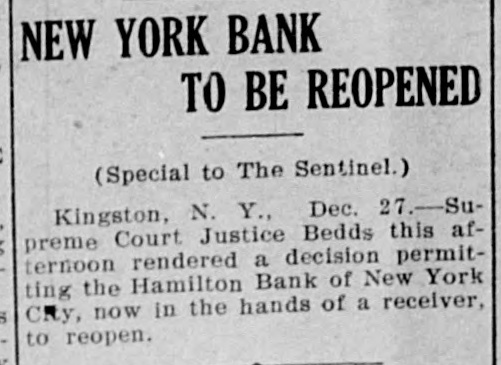
Supreme Court Justice Betts this afternoon rendered a decision permitting the Hamilton bank ... to reopen (receiver discharged).
Source
newspapers
5. January 20, 1908 Reopening
Newspaper Excerpt
The Hamilton bank has been found solvent and it will reopen January 20 with $1,800,000 on hand.
Source
newspapers

Newspaper Articles (20)

Article from The Coeur D'alene Press, October 25, 1907

Click image to open full size in new tab

Article Text

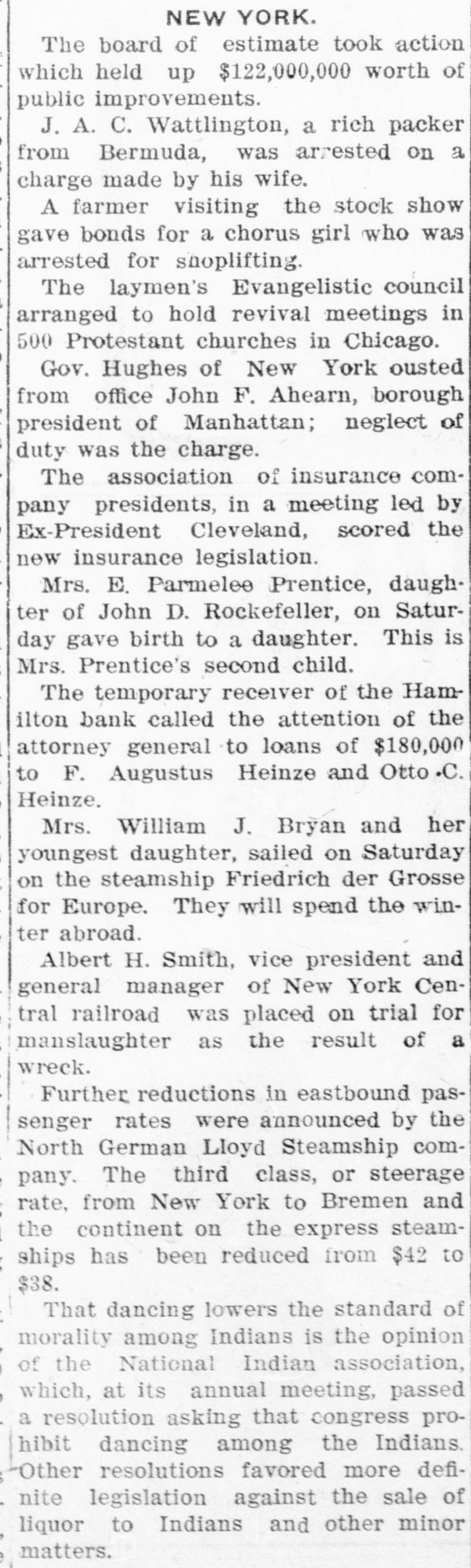
MONEY FOR NEW YORK stocks they were holding for their New York, Oct. 2.5-As a result customers. of todays dvelopments in the finanThe effect of the relief measures cial world, there is every indication was instantaneous, and the rate for that the crisis in the banking trust call money dropped from 100 per company situation has been safely cent to 10 per cent. When the stock exchange closed every one was getpassed. The Trust Company of ting all the money they wanted. America, all through the day's bankThe aggregate amount of money ing hours, paid out money to dewhich had been contributed to positors as rapidly as possible, and weather the storm and restore confidence assumes really colossal proclosed the day with all demands met. portions in all considerably in exThe company received over its cess of $1,000,000. couners in the morning hours in orThis morning Clark Williams, the dinary deposits more than $1,000,newly appointed state supreintend000. ent of banks, made public the folThey day was marked by these lowing statement: noteworthy episodes: First, and "So far as I have been able to early in the day, came the announcelearn during the short time which I ment of trouble in three minor state have had to examine into the situabanks in Harlem, the Hamilton tion I feel that all of the banks under Bank, the Twelfth Ward Bank, the my supervision in this city are solCity Savings bank. These banks vent, and it will be only because of transacted only a neighborhood busirash and unreasonable demands on ness, and their suspension of paythe part of the depositors that will ment was absoutely without sig further endanger the situation.' nifleance as bearing on the general insituation. State Bank Examiner Judson declared this afternoon that all three were solvent, and that their depositors would lose nothing. The second episode was a run begun upon the Lincoln Trust company. At the close of the day the company's officials announced that they were fully able to meet all obligations. By far the most notable event and most dramatic episode of the day was the emptying of money into the stock exchange through a pool headed by J. P. Morgan and "other financiers, in order to avert a ruthless selling out of stocks. The effect of the money stringency was to run the rate for money up to 100 per cent, and when that figure was quoted an extremely sharp de cline resulted in the stock market. Union Pacific a 10 per cent stock, sold down to par. At the time the excitement was at its height the announcement was WU TING FANG. made that a pool had been formed The shrewd and clever Celestial dipwith J. P. Morgan at its head, to lomat who has been appointed Chinese come to the rescue of the brokers. for minister to the United States, a post it was necessary to provide funds at in which he previously served for six once in order that they might carry years,


Article from The Bemidji Daily Pioneer, October 25, 1907

Click image to open full size in new tab

Article Text

INSTITUTION IS SOLVENT. Hamilton Bank Closed Until Confidence Is Restored. New York, Oct. 25.-The Hamilton bank in West One Hundred and Twenty-fifth street has suspended payment to depositors. A notice posted on the doors of the bank announced that the bank was solvent, but in justice to depositors payment had been suspended until public confidence in banking institutions was restored, E. R. Thomas, who was associated with F. A. Heinze and Charles W. Morse in several banks and financial ventures, was formerly president of the Hamilton bank, but resigned after the break in United Copper stock, which marked the beginning of the recent financial troubles in this city. Orlando F. Thomas, brother of E. R. Thomas, also recently resigned as a director and William R. Montgomery was elected president. The bank has a capital stock of $200,000 and deposits of about $7,000,000. The bank has four branches in New York city.


Article from New-York Tribune, October 31, 1907

Click image to open full size in new tab

Article Text

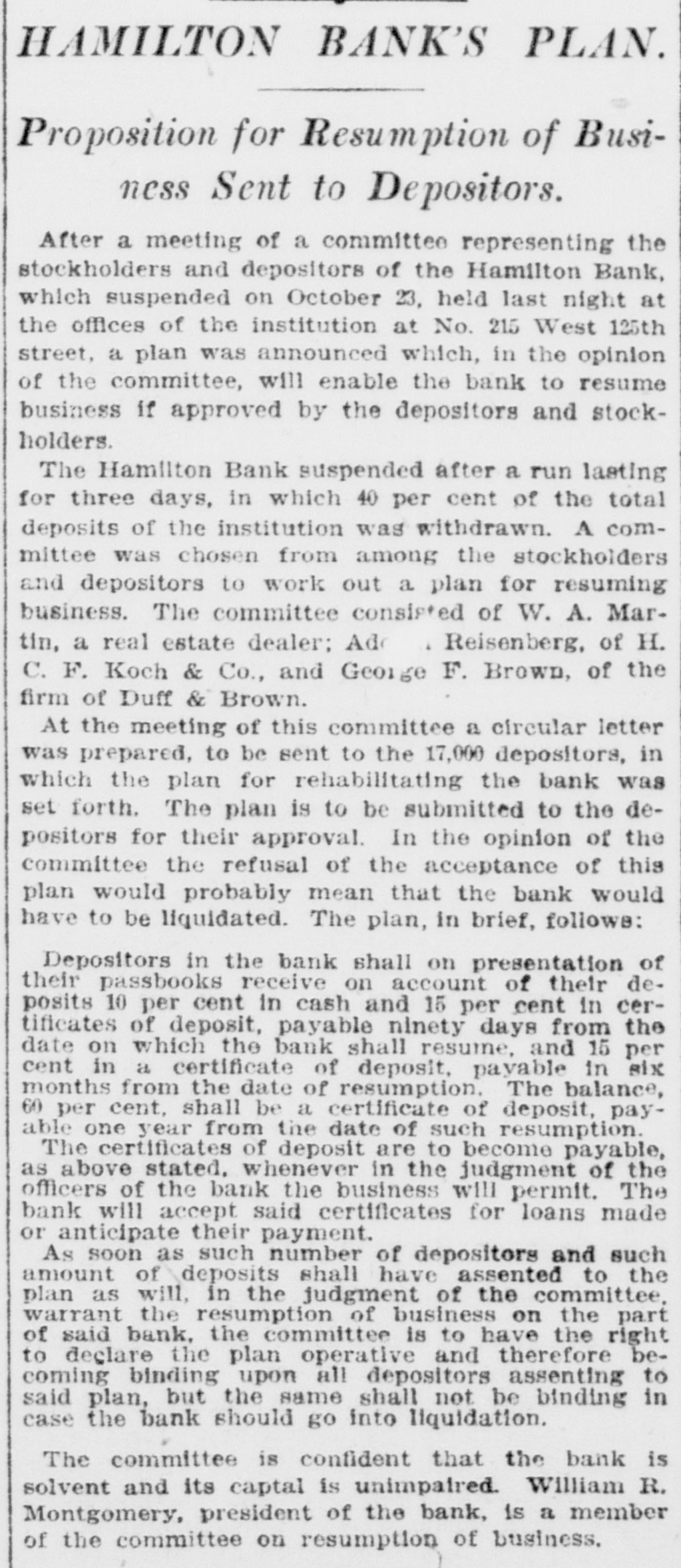
HAMILTON BANK'S PLAN. Proposition for Resumption of Business Sent to Depositors. After a meeting of a committee representing the stockholders and depositors of the Hamilton Bank, which suspended on October 23, held last night at the offices of the institution at No. 215 West 125th street, a plan was announced which, in the opinion of the committee, will enable the bank to resume business if approved by the depositors and stockholders. The Hamilton Bank suspended after a run lasting for three days, in which 40 per cent of the total deposits of the institution was withdrawn. A committee was chosen from among the stockholders and depositors to work out a plan for resuming business. The committee consisted of W. A. Martin, a real estate dealer; Add Reisenberg, of H. C. F. Koch & Co., and George F. Brown, of the firm of Duff & Brown. At the meeting of this committee a circular letter was prepared, to be sent to the 17,000 depositors, in which the plan for rehabilitating the bank was set forth. The plan is to be submitted to the depositors for their approval. In the opinion of the committee the refusal of the acceptance of this plan would probably mean that the bank would have to be liquidated. The plan, in brief, follows: Depositors in the bank shall on presentation of their passbooks receive on account of their deposits 10 per cent in cash and 15 per cent in certificates of deposit, payable ninety days from the date on which the bank shall resume, and 15 per cent in a certificate of deposit. payable in six months from the date of resumption. The balance, 60 per cent, shall be a certificate of deposit, payable one year from the date of such resumption. The certificates of deposit are to become payable, as above stated. whenever in the judgment of the officers of the bank the business will permit. The bank will accept said certificates for loans made or anticipate their payment. As soon as such number of depositors and such amount of deposits shall have assented to the plan as will, in the judgment of the committee, warrant the resumption of business on the part of said bank. the committee is to have the right to declare the plan operative and therefore becoming binding upon all depositors assenting to said plan, but the same shall not be binding in case the bank should go into liquidation. The committee is confident that the bank is solvent and its captal is unimpaired. William R. Montgomery, president of the bank, is a member of the committee on resumption of business,


Article from New-York Tribune, November 5, 1907

Click image to open full size in new tab

Article Text

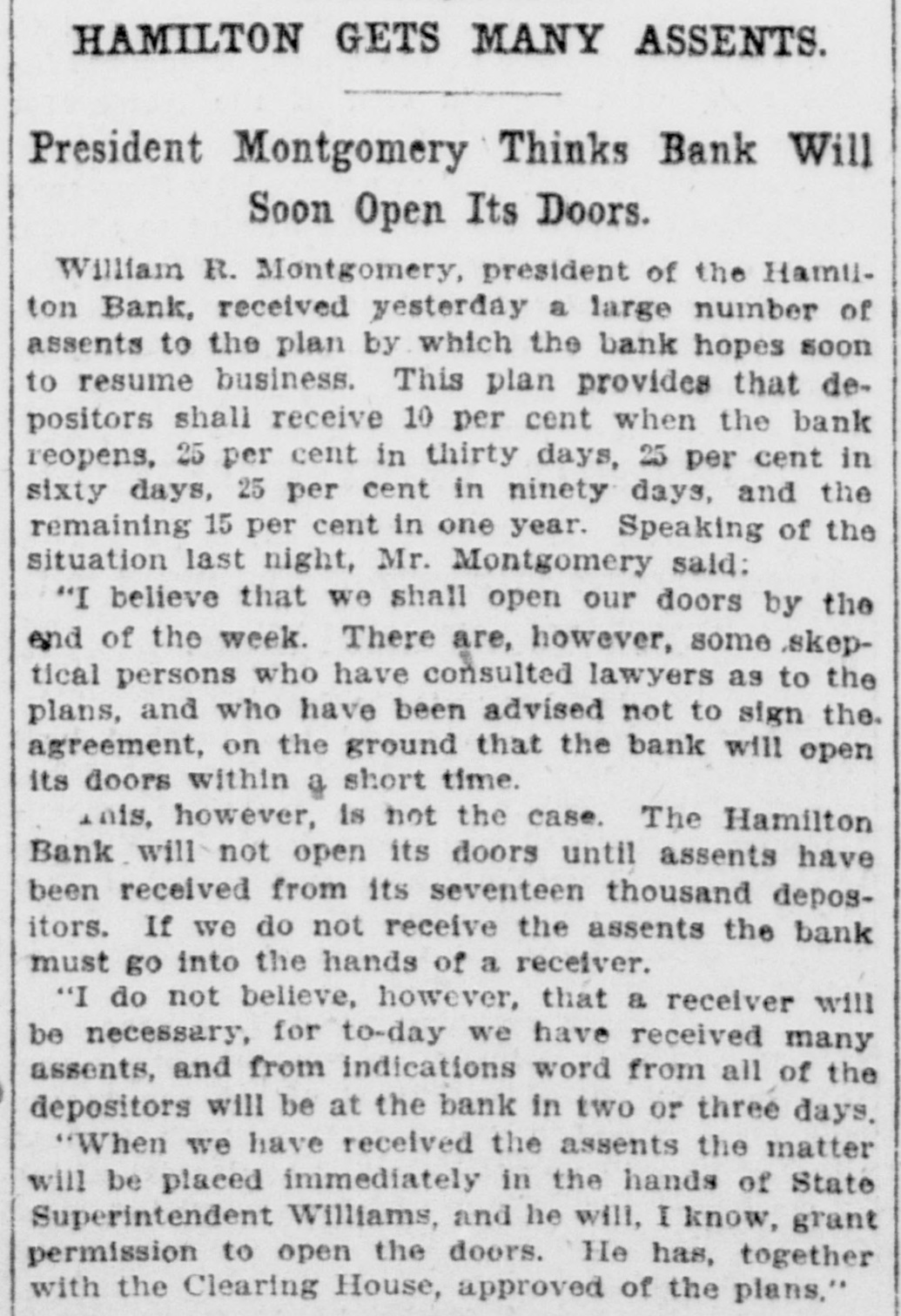
HAMILTON GETS MANY ASSENTS. President Montgomery Thinks Bank Will Soon Open Its Doors. William R. Montgomery, president of the Hamiton Bank, received yesterday a large number of assents to the plan by which the bank hopes soon to resume business. This plan provides that depositors shall receive 10 per cent when the bank reopens, 25 per cent in thirty days, 25 per cent in sixty days, 25 per cent in ninety days, and the remaining 15 per cent in one year. Speaking of the situation last night, Mr. Montgomery said: "I believe that we shall open our doors by the and of the week. There are, however, some skeptical persons who have consulted lawyers as to the plans, and who have been advised not to sign the. agreement, on the ground that the bank will open its doors within g short time. + nis, however, is not the case. The Hamilton Bank will not open its doors until assents have been received from its seventeen thousand depositors. If we do not receive the assents the bank must go into the hands of a receiver. "I do not believe, however, that a receiver will be necessary, for to-day we have received many assents, and from indications word from all of the depositors will be at the bank in two or three days. "When we have received the assents the matter will be placed immediately in the hands of State Superintendent Williams, and he will, I know, grant permission to open the doors. He has, together with the Clearing House, approved of the plans."


Article from Forest City Press, November 7, 1907

Click image to open full size in new tab

Article Text

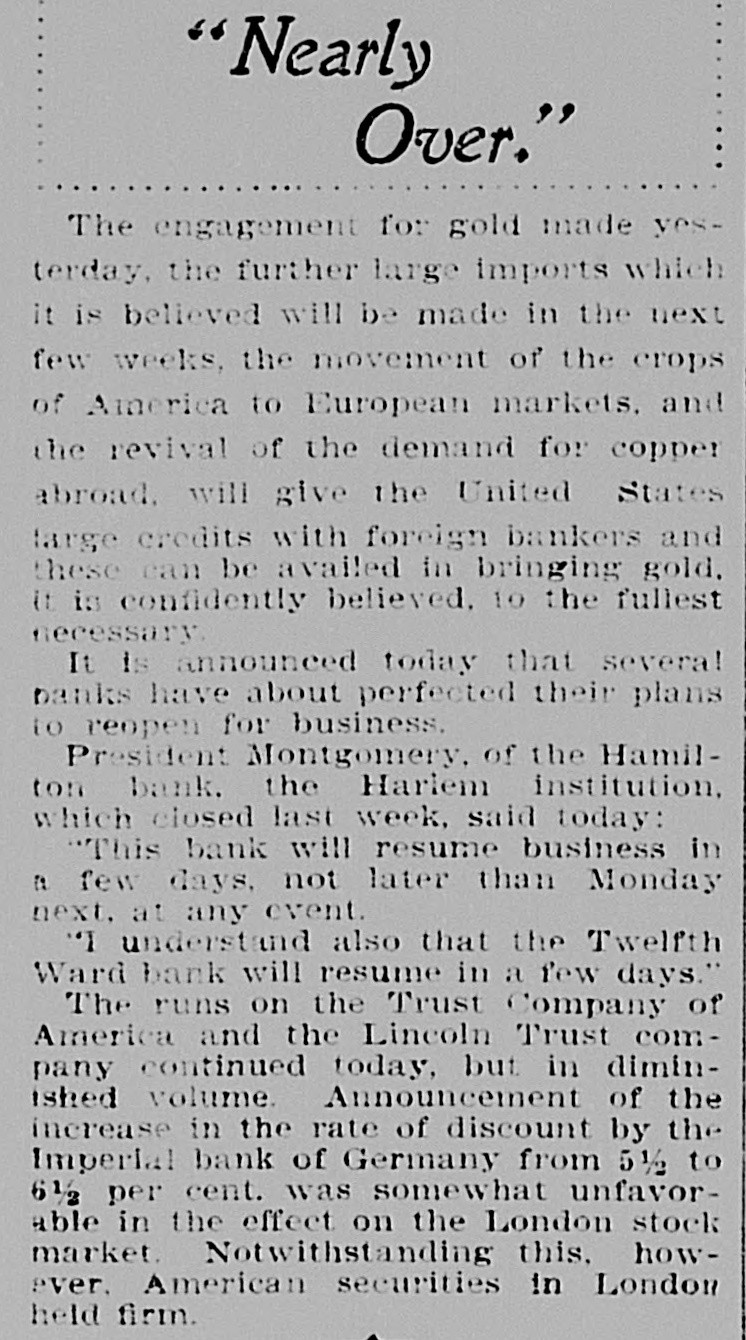
β€œNearly Over.” The engagement for gold made yesterday, the further large imports which it is believed will be made in the next few weeks, the movement of the crops of America to European markets, and the revival of the demand for copper abroad, will give the United States large credits with foreign bankers and these can be availed in bringing gold, it is confidently believed, to the fullest necessary. It is announced today that several banks have about perfected their plans to reopen for business. President Montgomery, of the Hamilton bank, the Harlem institution, which closed last week, said today: "This bank will resume business in a few days, not later than Monday next, at any event. "I understand also that the Twelfth Ward bank will resume in a few days." The runs on the Trust Company of America and the Lincoln Trust company continued today, but in diminished volume. Announcement of the increase in the rate of discount by the Imperial bank of Germany from 5Β½ to 6Β½ per cent. was somewhat unfavorable in the effect on the London stock market. Notwithstanding this, however, American securities in London held firm.


Article from New-York Tribune, November 19, 1907

Click image to open full size in new tab

Article Text

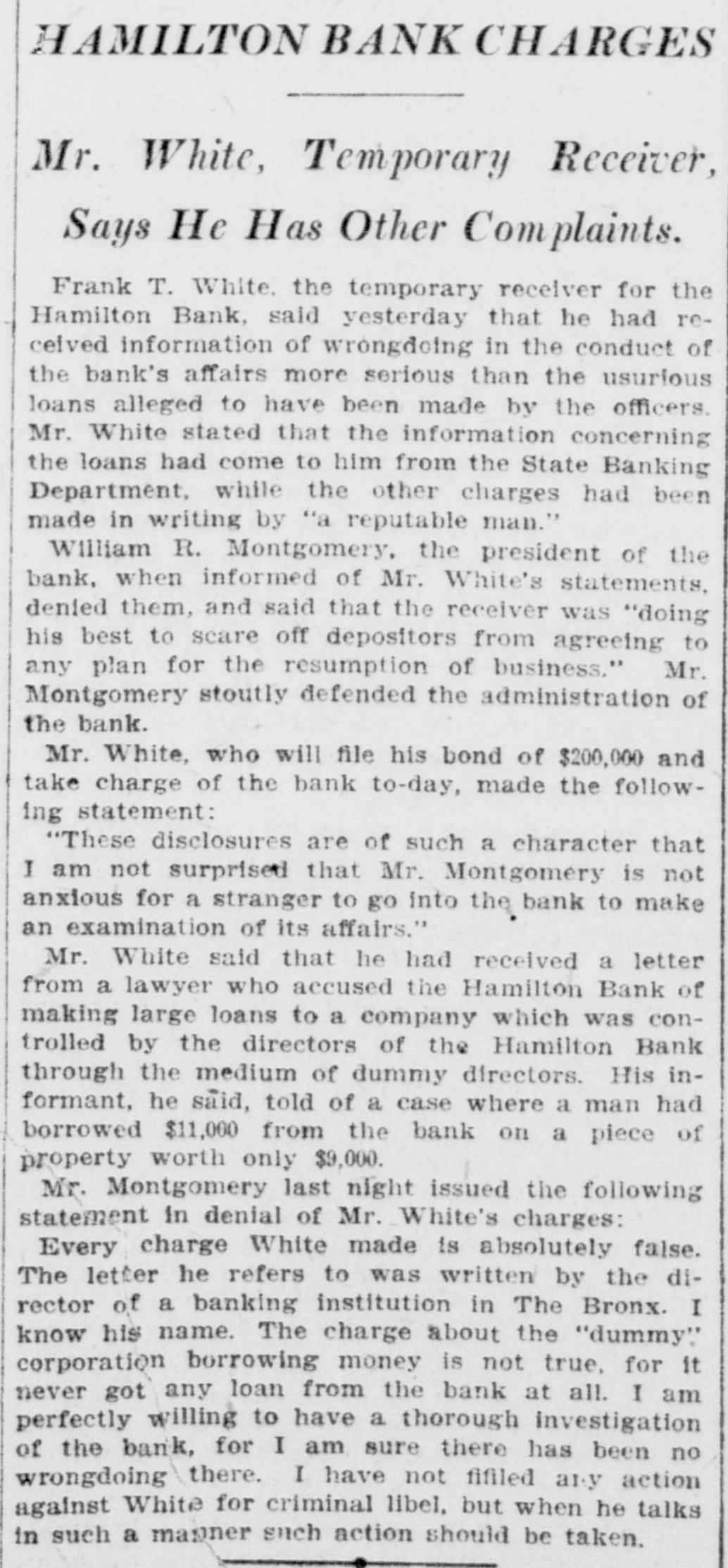
LIFE IN HAMILTON BANK Montgomery Wins Over Hostile Depositors-Plan to Reopen. President Montgomery of the Hamilton Bank, now in the hands of a receiver, appeared unexpectedly at a meeting of two thousand depositors last night at Calvary Methodist Episcopal Church, 127th street and Seventh avenue. His entrance was marked by hisses, groans and other evidences of hostility, but before he had finished speaking he had turned the tide of anger, and his utterances were greeted with shouts of approval. After he had reviewed the recent troublous history of the bank, which he said was closed by a run, "not by the small depositors, but by the wealthy depositors down in Wall Street, who had been tipped off to start the run." he asked those present if they wanted the bank given a chance to resume with $1,500,000, which had been promised from outside sources. A storm of approving cheers was the reply. There was a general denunciation of "political receivers," and then a vote of confidence and support was given to Mr. Montgomery with a roar that lasted for several seconds. A motion to denounce the Attorney General for his action was seconded by a score of voices. Only the emphatic statement of the chairman. Charles Blandy, of Blandy, Mooney & Shipman, that such action would be decidedly injudicious, prevented a vote being taken on this proposition. After it was all over forms of assent to a certificate of deposit plan were passed out by the thousands, and it was voted to call a meeting of depositors in the neighborhood of every branch to obtain the assents necessary to a resumption of business and to assure united action in opposing a permanent receivership and in bringing about a resumption of business. Mr. Montgomery said that he did not wish to become president of the Hamilton, but consented to accept the place, and as a condition to giving up the presidency E. R. Thomas had demanded that some one assume, for him, an obligation of $55,000. He added that he had assumed this obligation, although he could not afford to do so. He then said that after the Hamilton Bank had closed its doors he had gone to William A. Nash, president of the Corn Exchange Bank and a member of the Clearing House committee, in his latter capacity and had offered to give him, without any consideration, 660 shares of Hamilton Bank stock, all that he, Montgomery, had any control of, if he would but see to it that the doors of the bank were opened. The speaker denied the statement made yesterday by Frank T. White, temporary receiver, that no feasible plan had been presented to the State Banking Superintendent or the Attorney General with regard to the proposition to reopen the doors. Mr. Montgomery said last night regarding Mr. White's statement: "As to the remark which was made as to usurious loans, if it were true, Mr. White couldn't have said anything that would have done more to suggest to people that they decline to pay their obligations to the Hamilton Bank As to what are called usurious loans, many were to corporations to which the laws relating to usury do not apply. All that we ask Frank T. White is to keep his mouth closed until November 30, when we will go before the court with the names of those who are willing to help us out and put up $1,500,000. Frank White, ex-Deputy Attorney General, appointed temporary receiver of the Hamilton Bank last Saturday. said yesterday he had learned that usurious loans had been made by the Hamilton Bank He said the subject would receive prompt attention. He added that officially he had not been informed of anything that would warrant criminal proceedings. Speaking of the protest by the president of the bank against the appointment of a receiver, Mr. White said: 'From the date on which the bank closed its doors President Montgomery and James A. Gifford, counsel for the institution, have been, with others. urging that the appointment of a recelver be deferred, and promising that they would present some plan for rehabilitation. Superintendent Williams of the State Banking Department granted them time." Deputy Attorney General De Ford, when asked yesterday if the affairs of the Hamilton Bank would be brought to the attention of the grand jury, replied that the investigation being conducted by the Attorney General's office into the bank's affairs had not been concluded, and that until it was finished no definite steps would be taken. He added that all the closed banks were being Investigated to ascertain to what extent the officials were responsible for their suspension.


Article from Evening Star, December 10, 1907

Click image to open full size in new tab

Article Text

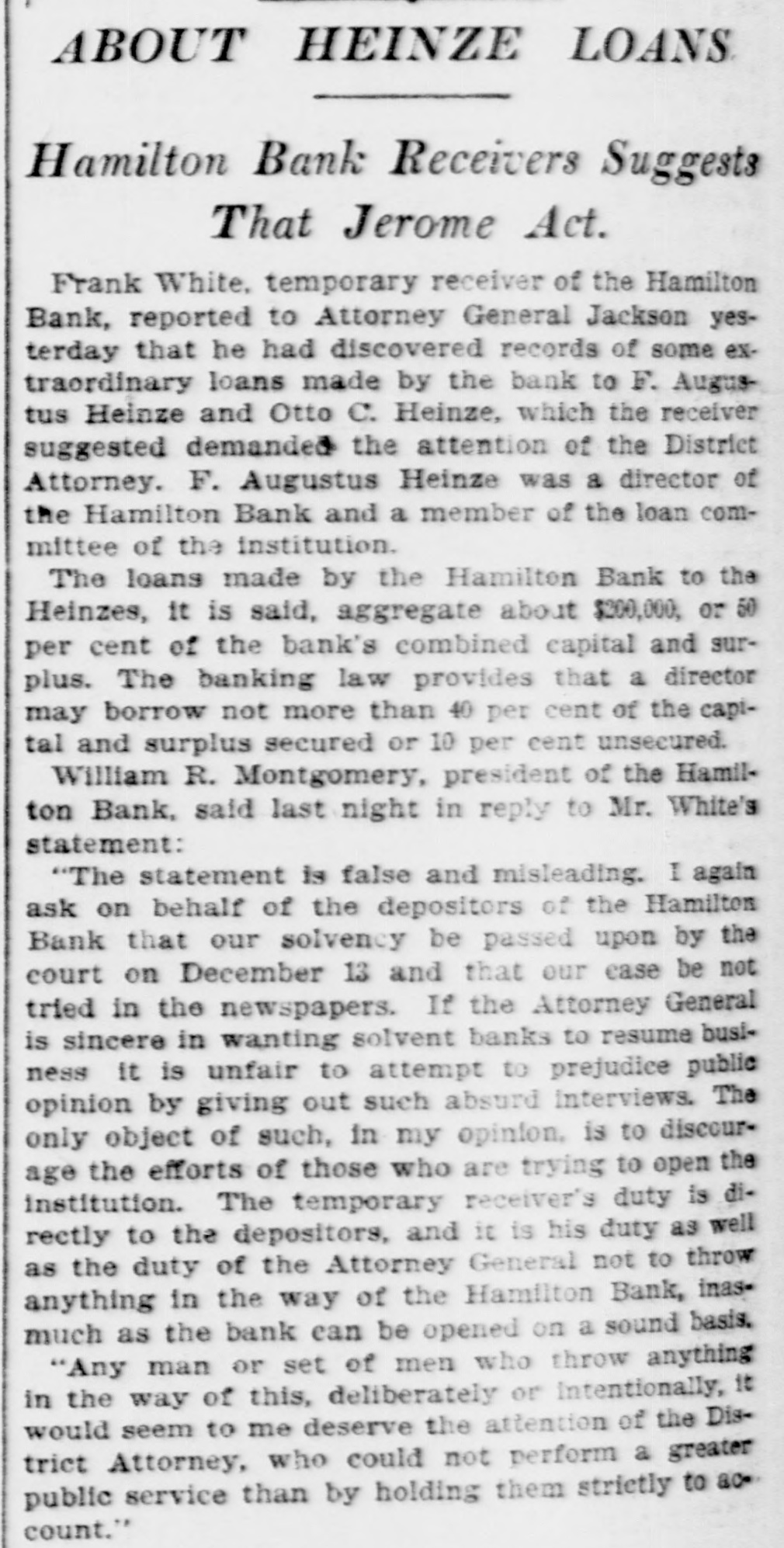
REPORT OF BANK PROBE. Receiver- - Declares Directors Withdrew Accounts in Large Sums. NEW YORK, December 10.-The report of Frank White, the temporary receiver of the Hamilton Bank, which suspended on October 23, was made public yesterday at the office of Attorney General Jackson. The report is in the form of an affidavit made by Mr. White. Mr. White says he finds that E. R. Thomas, who was president of the bank up to October 20, when his holdings were secured by President W. R. Montgomery and his friends. withdrew from the Hamilton Bank between October 1 and the day the bank closed the sum of $65,741. leaving a balance of $1,311, and that there is in the bank notes of which he is either the maker, indorser or guarantor amounting to $64,150. President Montgomery, the receiver says, drew out $1,518.67, October 22 and 23, leaving a balance of $7.11. O. F. Thomas, who retired as a director three days before the bank closed. drew out on the day the bank closed $800, leaving a balance of $149. The notes in the bank of which he is the maker, indorser or guarantor figure up to $51,266. Martin D. Fink. a director, drew out the day before the bank closed $3,500, which reduced his balance to $1,800. The F. W. Kinsman, jr., Company, of which Frank W. Kinsman, jr., a director of the bank, is an officer, withdrew from the bank the day it closed $1,578, leaving a balance of $378. The company, says the receiver, is liable to the bank for a note of $5,138, indorsed by Mr. Kinsman. William A. Martin, a director. withdrew $35,000 in the five days preceding the closing of the bank, leaving a balance of $9,472. The receiver finds that David A. Sullivan, who is president of the Mechanics and Traders' Bank, and who is a director of the Hamilton, is the maker, indorser or guarantor of paper discounted by the bank amounting to $125,000. He had no account in the bank. In his report Receiver White says that he finds that W. R. Montgomery, while he was in charge of the Tremont branch of the bank, had overdrafts in the branch varying in amounts from $52 to $34,261.


Article from New-York Tribune, December 10, 1907

Click image to open full size in new tab

Article Text

Frank W. Kinsman, jr., a director or the Dank, had no personal account with it, but the F. W. Kinsman, jr., Company, of which he is an officer, the report says, withdrew on October 23, the last day of business, $1,578 51, leaving $378 22 on deposit. In marked contrast to the action of other directors was that of Adolph Riesenberg, who, according to the receiver, had still $1,069 65 on deposit, and has it there still, not having withdrawn a cent. Besides the Thomases and Mr. Heinze, the following directors are declared liable to the Hamilton Bank as makers, indorsers or guarantors of notes in the following sums: Martin D. Fink, $11,000; David A. Sullivan, $125,000; George F. Brown. $2,000. The Fink liability is now due and unpaid. The F. W. Kinsman, jr., "Company was liable to the bank on its note for $5,136 85, and Frank W. Kinsman. jr., was an indorser of this note. Mr. White draws attention to the statement that some of the directors practically withdrew their entire accounts when it must have been apparent that the bank was in a precarious condition, and also points out that these heavy withdrawals were made despite the fact that the Fame directors. or at least some of them, were liable to the bank for large amounts on discounted notes. Mr. Montgomery testified before the State Superintendent of Banks that the Hamilton Bank received a commission on real estate transactions. He explained that the borrower was forced to borrow the whole amount and then place it in a collateral account, paying "6 per cent on the whole business." If the borrower was a corporation the charge was, made straight for the commission on the loan. The amount charged is according to the loan, although the bank always tried to get 5 per cent. "If the borrower was an individual," the testi"fied, "that money is paid to Parker & Aaron, and they take out their charge and pass the balance to the bank, which is deducted from the amount of the loan." Mr. White then incorporates in his report Mr. Montgomery's testimony in regard to "the


Article from The Fairmont West Virginian, December 12, 1907

Click image to open full size in new tab

Article Text

IN NEW YORK Cause of Panic To Be Sought NEW YORK, Dec. 11.-Arguments on the orders to show cause why the temporary receiverships of six bank. inb institutions of New York City, which succumbed during the recent panic, should not be made permanent, will be heard before Supreme Court Justice Botts at Kingston, beginning to-morrow. The cases of the International Trust Company, the Borough Bank of Brooklyn and the Brooklyn bank will be heard to-morrow. The Hamilton bank case will be considered on Friday, and the affairs of the WilTiamsburg Trust Company and the Jenkins Trust Company will be investigated on Saturday. On the latter date, the motion to appoint permanent recelvers for the Knickerbocker Trust Company will also come up for hearing before Supreme Court Justice Clark. Edward M. Shepard will represent the depositors of the Borough bank at the hearing and will urge that the Institution Is solvent and should be be allowed to re-open. The plan announced by the depositors for a re-organization is to pay 10 per cent. In cash, 15 per cent. in four months, 20 per cent. in eight months, 25 per cent. in twelve months and 30 per cent. in sixteen months. It Is allleged by representatives of the State that the bank is hopelessly Insolvent and that its funds have been managed in a criminal manner. The examination made by the receivers showed that, out of $3,186,863, bills discounted. more then feel obliged to deduct on account of paper regarded as forgeil, fictitious or of doubtful value, $1,382,842: that the realized value of the total amount is $1,804,021; of the $482,596 of loans made on demand, $78,584 had been deducted on account of worthless paper, such as collateral held in gold and silver mining stock, oil paintings, etc.; of the sums due from banks, given as $188,003. $158,104 had been deducted on account of offsets and receiverships; of the $148,000 credited to stocks and bonds, but one bond of $1,000 was on file with the State banking department. It is aldeged by the receivers that the total deficiency of the bank is $1,500,000. Ex-Judge Alton B. Parker is chief (counsel for the Hamilton bank. and will urge that that institution was forced to suspend business only because the bank through which It cleared could no longer serve In that capacity. Judge Parker declares that the 18,000 depositors are anxious for the bank to re-open its doors. and that 'he is prepared to show that there was nothing of a fraudulent nature connected with the management of this bank. The attorney general's office will make a hard fight aaginst the acceptance of the plan of re-organization sug-


Article from Spirit of the Age, December 14, 1907

Click image to open full size in new tab

Article Text

Mrs. Emma A. Huntley of Somerville, Mass., kills her two grandchildren, then gives herself up to police. Joseph Armstrong, publisher of Christian Science literature, dead at his home in Boston. filibusters Wounded American charged with rebellion in Brazil. King Gustave of Sweden receives homage of troops; King Oscar's funeral Dec. 19. Senator Tillman adds two sets of resolutions as basis for congressional bond inquiry. Steamship Yarmouth strikes on Black point, eight miles out, in making St. John, N. B., and will probably be lost; her 40 pasesngers taken off. Receiver of Hamilton bank of New York finds overdrafts by officers, withdrawals by directors just before suspension, loans poorly secured and other irregularities. Mark Twain humorouesly scores Carnegie for simplified spelling. Mrs. W. H. Taft has exciting experience and escape from wreck boarding steamer at Boulogne. John Mitchell, president of mine workers, refuses re-election and declares he has not decided upon his future. Leading brewers of country ready to join in abolition of dives and drunkards. New Bedford, Mass., cotton manufaeturers fail to reach agreement regarding curtailment.


Article from The Evening Star and Newark Advertiser, December 27, 1907

Click image to open full size in new tab

Article Text

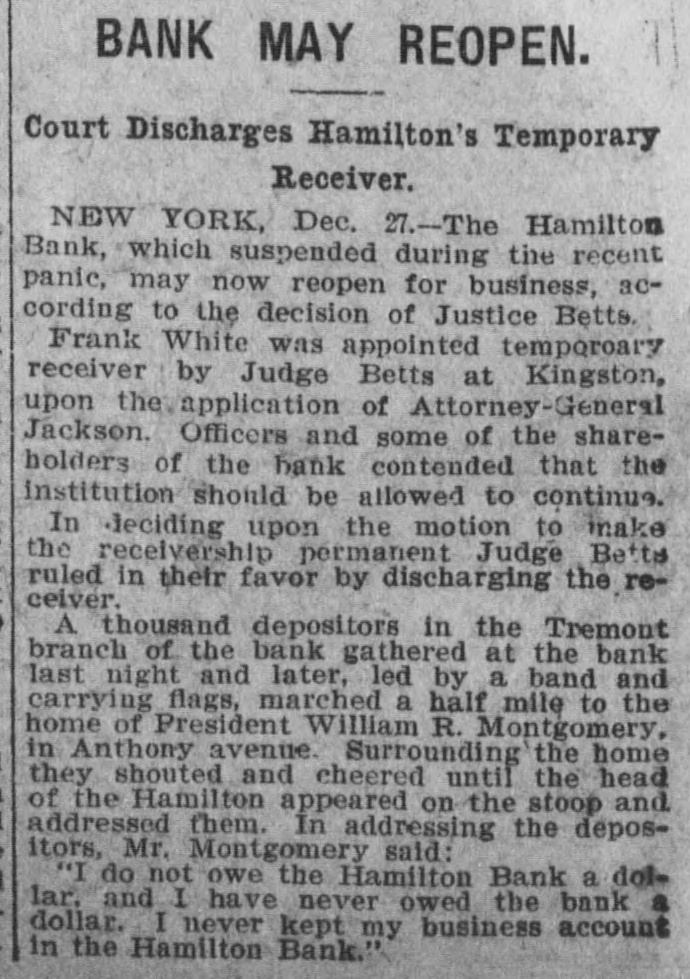
BANK MAY REOPEN. Court Discharges Hamilton's Temporary Receiver. NEW YORK, Dec. 27.-The Hamilton Bank, which suspended during the recent panic, may now reopen for business, according to the decision of Justice Betts. Frank White was appointed temporoary receiver by Judge Betts at Kingston, upon the application of Attorney-General Jackson. Officers and some of the shareholders of the bank contended that the institution should be allowed to continue. In deciding upon the motion to make the receivership permanent Judge Betts ruled in their favor by discharging the receiver. A thousand depositors in the Tremont branch of the bank gathered at the bank last night and later, led by a band and carrying flags, marched a half mile to the home of President William R. Montgomery, in Anthony avenue. Surrounding the home they shouted and cheered until the head of the Hamilton appeared on the stoop and addressed them. In addressing the depositors, Mr. Montgomery said: "I do not owe the Hamilton Bank a dollar. and I have never owed the bank a dollar. I never kept my business account in the Hamilton Bank."


Article from The Salt Lake Herald, December 27, 1907

Click image to open full size in new tab

Article Text

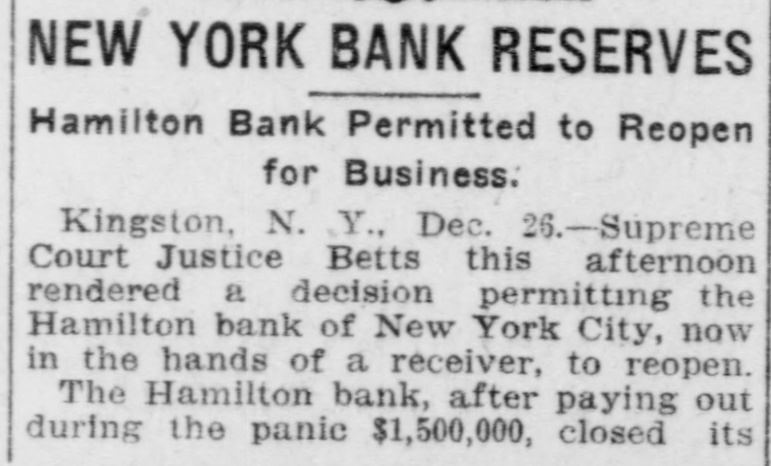
NEW YORK BANK RESERVES Hamilton Bank Permitted to Reopen for Business: Kingston, N. Y., Dec. 26.-Supreme Court Justice Betts this afternoon rendered a decision permitting the Hamilton bank of New York City, now in the hands of a receiver, to reopen. The Hamilton bank, after paying out during the panic $1,500,000, closed its


Article from The Spokane Press, January 14, 1908

Click image to open full size in new tab

Article Text

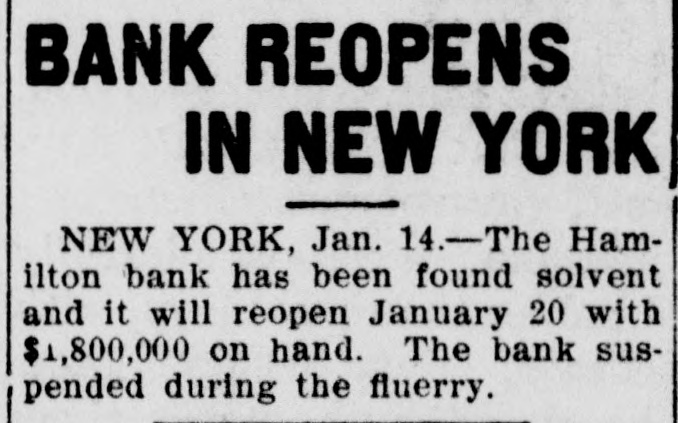
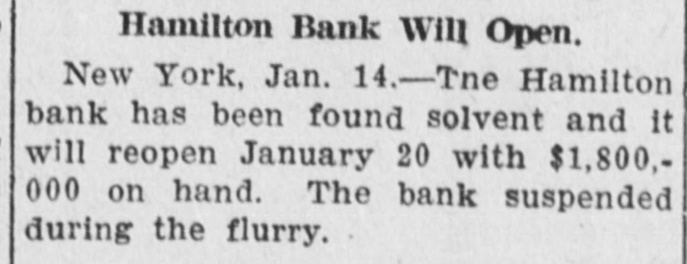
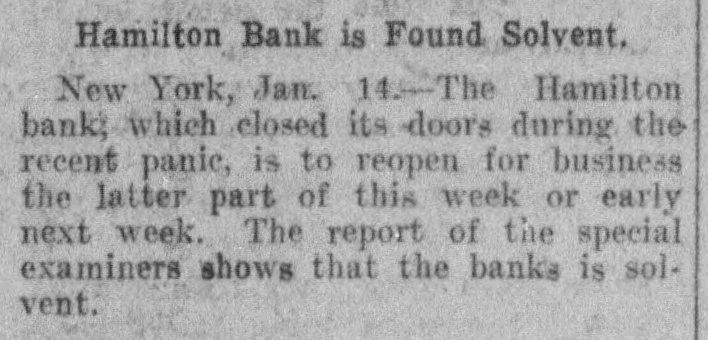
BANK REOPENS IN NEW YORK NEW YORK, Jan. 14.-The Hamilton bank has been found solvent and it will reopen January 20 with $1,800,000 on hand. The bank suspended during the fluerry.


Article from New-York Tribune, January 16, 1908

Click image to open full size in new tab

Article Text

HAMILTON BANK ARREST INDICTS MONTGOMERY. Special Grand Jury Finds Cause for Charge of Overwithdrawal. R. Montgomery, ex-president on of two the Hamilton William Bank, was indicted jury. yesterday The charges counts by the special grand that, while vice-president. the bank made he against made him two are overdrafts on the funds of caused indictment of Mr. Montgomery followed the The surprise to those who have it closed, on some the Hamilton Bank since of a reeffairs of and went into the hands speOctober 24, iti was known that the celver. for jury while was engaged in investigating affairs, it cial grand phases of the institution's than certain generally believed that other persons would be was ex-president of the Institution Montgomery himthe the bar. In fact, Mr. that him. called self testified to on Tuesday before the body District indicted bank official was at the Howard S The former office with his counsel. presented Attorney's when the indictments appeared were before Gans, him. and soon after of the against Dowling, in the Criminal Branch not guilty. Supreme Justice Court, where he pleaded $2,500 bail on each Justice Dowling held him in H. Birkmire, an counts. William director of of the two at No. 396 Broadway a bondsman. architect, Bank, qualified as Montgomery the Hamilton against Mr. The indictment consisting of him with a misdemeanor $21,000. made on charges overdrafts, one of made September alleged 6. 1907, and another, of $12,950, on October 29. Ham D. Ives. vice-president of the the inFrederick Bank, said yesterday in discussing "The overfiton dictment against Mr. Montgomery: were satisfied made by Mr. Montgomery Bank nothdrafts and he owes the Hamilton merely techby him. overdrafts are considered laws." ing. The violations of the banking nical before the court Mr. Montgomery he de In pleading to withdraw the plea, clerks if ap sired, jury grand obtained within leave a week. Several bank yesterday peared investigation before the special into the affairs of the at Ham- least, The was brought about, partly receiver of fiton Bank of Frank White, the Jackson. in by the institution, report to Attorney General alleged the called attention to certain William which he The report involved O. F. overwithdrawals. Montgomery and also E. R. Thomas, three lat R. and F Augustus Heinze, the official Thomas been forced to sever their Heinze ter having the bank F. Augustus grand relations with indicted by the federal has since connection been with alleged overcertification Na. jury in while president of the Mercantile the time of checks Bank. Mr. Montgomery said public: at tional report was made I and the receiver's never overdrawn my account cent I have owed the Hamilton Bank Attorney a have never directly or indirectly. I defy else the to prove either Frank White or any one my account General have I did not overdraw falseand that any I statements to that effect are absolutely false!" the WHAT RECEIVER REPORTED. Hamilton figures of the receiver of directors during The amounts drawn cut by balances Bank of prior to its closing and their Montgomthe week institution showed that Mr. balance ery-had with the drawn $1,518.67 which left a to his credit of $7 11. further reached the conclusion of The receiver examination of the individual Bank ledger that from an branch of the Hamilten account as the Mr. Tremont Montgomery had overdrawn his much as $34,261 23 indictments The specific charges in the two that on August Mr Montgomery were had it ceragainst a check for $12,950 and Strassburger 29 he drew made payable to B. L amount tified and No. 51 Maiden Lane the of a jeweller at $12,950. constituting an overdraft drew a of Dr. $12,869.77 In question and that on September L. C 6 Warner he for check to the order balance in the bank at the $21,000. when the his check was only $5,918.22. and time he drew days later, when the check had was only prethat sented three to and paid by the bank he $134.72 to his checks. credit it was said yesterday. It were was These two of the Hamilton Bank stock that for shares in the District Attorney's office Willalso said was acting for President Brooklyn Mr. Montgomery Damron, of the Home Bank of Code lam C. punishment provided by the Penal MontgomThe offence charged against Mr. $300. or ary for the is one year in prison or fine of both As Mr. Montgomery is no indictment longer an will official have of the Hamilton on the plans Bank for his the reopening of few the no institution effect and its several branches in a days less than three weeks ago that several the hun- man indicted It is yesterday was honored by which he depositors of the institution of Montgomery dred then the executive head. Mr. depositors was rendered yeoman service to the bank rehad in its effort to have the Justice committee When the news came that granted opened. had discharged the receiver and business Betts for the bank to resume brass band permission hundred depositors hired a Montgomery. several marched to the home of Mr. sereand at No. 1857 Anthony avenue, where they naded him. STATEMENT BY COUNSEL w. Osborne and Howard S. Gans. who James as counsel for Mr. Montgomery they issued are associated a statement last night, in which paid in part: was The fact that attention such of overdrafts the authorities the existed informa by Mr called himself, and but for in all probMontgomery he had offered. would From the tion which never have been discovered Montgomery's ability, the investigation Mr. Attorney's outset of offered to the District possession, and counsel have the information in their means whereby office all then access to every matter. The have given could be thrown on the to avail any light Attorney's office was unwilling indictments District the information, and the must of neitself of all founded, as indictments presentation have cessity been be founded, upon a partial of The the indictments facts. against Mr. violations Montgomery of are the based upon purely There technical are two charges. the made first being S Strassburger banking the law. overdraft in the case of a check The over- of payable to one B. of the negligence draft occurred by reason of the bank who was instructed of the to get the check of one purchase A. The check van. of the employes stock WBR of given the instead Hamilton for the David of Bank. getting Sulli- The Mr of some ager in the bank presented the check of Avot


Article from The L'anse Sentinel, January 25, 1908

Click image to open full size in new tab

Article Text

BRIEF REVIEW OF A WEEK'S EVENTS RECORD OF THE MOST IMPOR. TANT HAPPENINGS IN ITEMIZED FORM. HOME AND FOREIGN NEWS Information Gathered from All Quarters of the Civilized World and Prepared for the Perusal of the Busy Man. Over 165 persons were killed and many injured at Boyertown, The Pa., the opera house burned. of a moving explosion when picture were tank started a wild panic; oil lamps upblew up and the floor collapsed. victims were mostly and belonged to the set children The and women leading and families of the town. The special grand jury which was of sworn in to investigate the conduct rebanks in New York county two indictments certain turned president against of Wil- the liam R. Montgomery. Hamilton bank. A serious earthquake occurred at Gonalves, Hayti. A few houses were and others were damaged. of life has been destroyed No loss reported At their annual meeting in Detroit the Lumber Carriers' Association of the Great Lakes decided that it would be impossible to operate their boats during the coming season at the same expense and under the same condi- is tions as prevailed during 1907. It predicted that there will be a great labor struggle. The Maple-Leaf mills at Kenora, Ont., were destroyed by fire. The elevator, in which was stored over 300.000 bushels of wheat, was also de- instroyed. The loss was $1,000,000; sured. Oil-producing firms at St. Petersburg of received news from the Caucasus the opening of a mammoth oil gusher in the Bibi-Eybat field at Baku, flowing at the rate of 120,000 barrels a day. Farmers in Stanley county. South Dakota, were plowing during the first week in January. The coroner's jury practically exonerated the coal mining company for W. the great disaster at Monongah, Va. Edward Henry Strobel, general adviser of the government of Slam, died after a long illness. The body of Lieut. John W. Crawford, private secretary to Admiral Dewey, was found in the Potomac. The prince regent of Bavaria, who pardoned two to declared his tenced recently death, death murderers-sen warrants. intention not to sign any more of the American were breakfasted ship The fleet officers and by battle- Presi later dent Penna at Petropolis attended a garden party at the American embassy It was positively asserted that Sec would he was virtually retary though Cortelyou Knickerbocker not offered resign Trust the presidency of the company. John S. Peters, one of the jurymen who found R. Meade Shumway guilty of at Beatrice, the penalty, murder death committed drowned Neb., suicide. affixing while Five persons were skating in the Jimtown reservoir, near Connellsville, Pa hall. the girls' dormitory at Oxford, O., was Miami Hepburn university, destroyed by fire. E. D. Scott, cashier, and Roy W. bookkeeper of the Peo- N. bank of ple's Van National Hoesen, Franklinville, with Y., were arrested, charged viola- to the revised statutes relating a of false to the the tion making of statements controller. of greatest bank's Denmark's condition modern poet, Drachmann, died Holger sixty-first suddenly year at of Copenhagen, in the his age. Prof. Charles Baetens, for many years solo cellist in the Thomas or chestra, committed suicide in Omaha, Neb. The City National bank of Muskogee, Okla., purchased by Dr. J. L. Johnson the of St. Louis, was merged with First National. The Bank of Commerce will go into liquidation, its business having been sold to the Oklahoma State bank. Frank Nunno, a wealthy young banker, was found murdered near Ardsley, N. Y. William B. Thompson of De in his troit, Mayor Mich., annual that message, the city calls attention to the fact to deal with the street railquestion that "no new of year way will have and franchise urges in leases another of a !ife be given except on the basis three-cent fare.' General Freight Agent W. E. Estes the Central of Georgia railway was shot by his Ga. The was ac. of perhaps Savannah, fatally shooting wife at cidental. Peter Rasmussen of St. Charles, in., committed suicide because of do mestic and financial troubles. the Rebbi Bernhard Felsenthal, oldeut Jewish theologian in the Unirecognized as the world's Hebrew scholar, ten days cago ted greatest States, after of died illness. in Chi- the He was most widely known as founder of the 'reform' movement ama ag Chicago Jews.


Article from Daily Capital Journal, March 19, 1908

Click image to open full size in new tab

Article Text

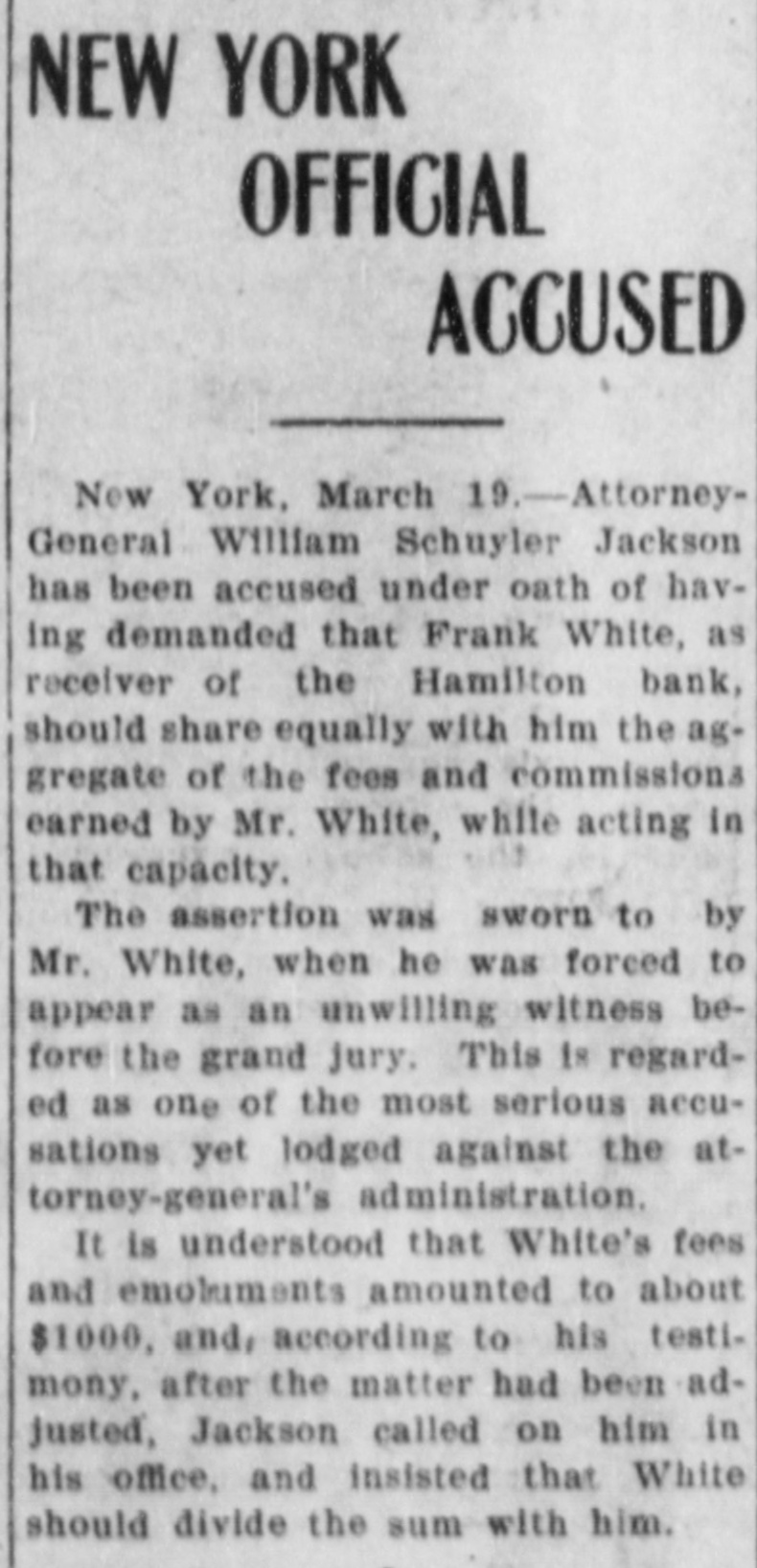
# NEW YORK OFFICIAL ACCUSED New York, March 19. -Attorney-General William Schuyler Jackson has been accused under oath of having demanded that Frank White, as receiver of the Hamilton bank, should share equally with him the aggregate of the fees and commissions earned by Mr. White, while acting in that capacity. The assertion was sworn to by Mr. White, when he was forced to appear as an unwilling witness before the grand jury. This is regarded as one of the most serious accusations yet lodged against the attorney-general's administration. It is understood that White's fees and emoluments amounted to about $1000, and, according to his testimony, after the matter had been adjusted, Jackson called on him in his office, and insisted that White should divide the sum with him.


Article from The Billings Gazette, March 20, 1908

Click image to open full size in new tab

Article Text

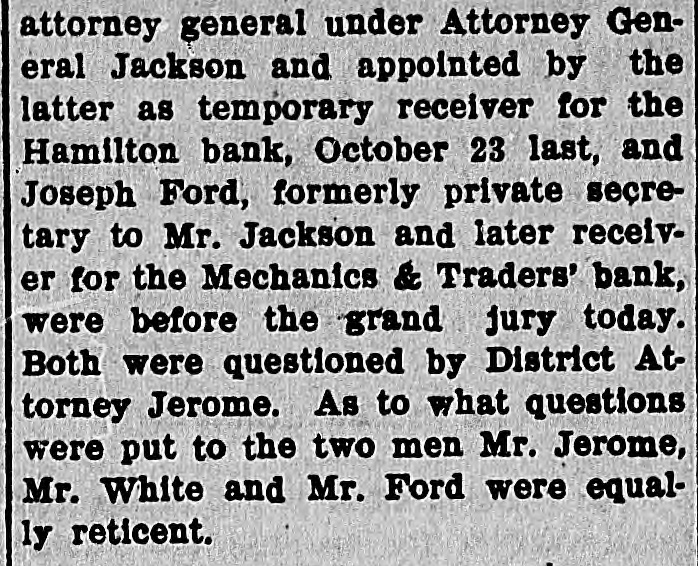
attorney general under Attorney General Jackson and appointed by the latter as temporary receiver for the Hamilton bank, October 23 last, and Joseph Ford, formerly private secretary to Mr. Jackson and later receiver for the Mechanics & Traders' bank, were before the grand jury today. Both were questioned by District Attorney Jerome. As to what questions were put to the two men Mr. Jerome, Mr. White and Mr. Ford were equally reticent.


Article from The Washington Herald, March 24, 1908

Click image to open full size in new tab

Article Text

# JACKSON FACES GRAND JURY New York's Attorney General Refuses to Talk About It. Expects to Be Vindicated, He Tells Reporters, but Considers the Time Has Not Come. New York, March 23.-Attorney General Jackson spent nearly two hours with the grand jury this afternoon at the Criminal Courts Building. Jackson's appearance was a result of the invitation sent to him last week by Foreman Muschenheimer after Frank White, Jackson's former deputy and receiver of the Hamilton Bank, had sworn before the grand jury that Mr. Jackson had asked for half his receiver's fees. Assistant District Attorneys Smyth and Perkins went into the grand jury room as soon as the jurors had assembled. There was only one absentee. Jackson was then informed the grand jury was ready to hear him, and he went in. The impression had been that the grand jury would not take long with Jackson, as there were a number of other cases waiting to go on. But he remained with the grand jury the entire afternoon. Both Perkins and Smyth left the grand jury room after the grand jury had been in session about an hour. Jackson was alone with the grand jury the rest of the time. It was nearly 4 o'clock when Jackson came out and made for the elevator. He told the reporters he thought it would be quite out of place for him to discuss what had happened, even to telling whether or not he had been under oath. Some one asked the attorney general if he did not desire to be vindicated before the public, in view of White's charges. "I expect to be in time, but this is hardly the place for it," he said, "unless the reporters are a jury." The grand jury was discharged for the day by Judge Foster without making any statement regarding the matter. It is still the impression that some statement regarding the matter will be made some time this week to Judge Foster, who is in charge of the March grand jury.


Article from Daily Press, April 8, 1908

Click image to open full size in new tab

Article Text

# What New York Attorney General and Receiver White Said. # LAWYER WAS EXCITED BY A HINT State Law Officer Denies Emphatically That His Remark Was Construable Into a Demand for Half Mr. White's $12,500 Allowance. Case. ALBANY, N. Y., April 7.-The presentment of the grand jury of New York County relative to matters affecting the attorney-general of the state, which was filed with Justice Foster in New York last week, with the request that it be submitted to the executive and legislative branches of the state government, with a copy of the testimony given before the grand jury, was read in the assembly and senate tonight. The presentment, already made public, said that the attorney-general appeared before the grand jury, and that there appeared to be a conflict in testimony with regard to the subject of the inquiry. The "conflict of testimony" according to the minutes of the grand jury, appears to relate entirely to an allegation by ex-Deputy Attorney-General Frank White, who was receiver of the Hamilton Bank of New York, that in conversation with Attorney-General Jackson an allusion was made to a possible division of fees which White received as receiver. White's Story of the Talk. In his testimony Mr. White said that his fee as receiver was $12,500, and that after the receipt of the fee, or after its allowance, he had a conversation with Attorney-General Jackson, and he declared: "I think Mr. Jackson said that those were pretty decent allowances, or some equivalent expression." "I said." Mr. White continued, "I don't think it is extraordinary for a man who has been in the habit of getting pretty decent fees from other people, and particularly from lawyers, who come in consultation. 'Well,' he said. 'I think it would be all right for $6,250 of this to go to the other man,' or to the other party,' or something of that kind. And I said, "That is preposterous. I won't entertain any proposition of that kind. This allowance is mine; it was made by the court, and I intend to keep it.' And I got very much excited. There was a great deal said after that, but that was the substance." Mr. White testified, according to the minutes read tonight, that the attorney-general told him that he would regret his attitude. White told the grand jury that he was so excited in his conversation that he did not "want to hear who the other man was." Jackson Contradicts White. Attorney-General Jackson made a sworn contradiction of White's testimony before the grand jury, declaring: "I have never, in reference to these receiverships, agreed to receive, asked, demanded, or expected to receive one penny from anybody concerned, for myself or for anybody else, and any language included in any purported or alleged conversation with Mr. White that has for its construction anything else is false." Attorney-General Jackson said in his statement before the grand jury that he felt he could straighten things out immediately if he was permitted to cross-examine Mr. White upon the witness stand. The attorney-general testified that he had a conversation in which Mr. White complained about the size of his receivership fee, and that he told White that he ought to be satisfied, as his fee was much too large. White, the attorney-general said, seemed to be apprehensive that he would be asked for some of his fees. Attorney-General Jackson, in this connection, testified: "I asked him: "Why, you don't think that I want any of your fees?" and he said something to the effect, 'Well, I don't know.' "I got angry at that, and we had some sharp words, and he left the office and I haven't seen him since."


Article from The Barre Daily Times, April 24, 1909

Click image to open full size in new tab

Article Text

BAIL OF $7,500. Required in the Case of W. R. Montgomery of New York. New York, April 24.-William R. Montgomery, former president of the Hamilton bank of this city, which went into the hands of a receiver in the financial panic of 1907, was arrested yesterday on a charge of grand larceny in alleged fraudulent note transactions during his presidency of the bank. The Hamilton bank has since been reopened and merged with other banks under a new name. The arrest took place in the office of the district attorney, where Montgomery had been summoned after having been indicted. He was promptly arraigned in the criminal branch of the supreme court and held in $7,500 bail. Montgomery was already under bail to answer charges of overdrawing his account with the Hamilton bank a few months prior to the closing of its doors.