5782. Huntington County Bank (Huntington, IN)

Bank Information

Episode Type
Run → Suspension → Closure
Bank Type
state
Start Date
January 1, 1926*
Location
Huntington, Indiana (40.883, -85.497)

Metadata

Model
gpt-5-mini
Short Digest
0ce8e9c0

Response Measures

Full suspension

Other: Other banks 'came to the rescue' and arranged to take assets and pay depositors; liquidating agent and receiver/ liquidation followed.

Description

Articles describe heavy withdrawals/a run in May 1926 that led the Huntington County State Bank to suspend business that month; other local banks initially came to the rescue, but the bank went into liquidation/receiver and did not resume. The provided bank name (Huntington County Bank) appears to refer to the Huntington County State Bank as used in the articles; I use the latter.

Events (3)

1. January 1, 1926* Receivership
Newspaper Excerpt
Afterwards a receiver was appointed for the bank. ... Charles N. McGrew, trustee in charge of the liquidation of the Huntington County State bank ... the building has been closed for many months since the bank suspended business there. Plans ... by Charles McGrew, liquidating agent for the bank. The building has been closed for many months since the bank suspended business there. (1927-1928 articles refer to liquidation/receiver/closed building.)
Source
newspapers
2. May 1, 1926* Run
Cause
Bank Specific Adverse Info
Cause Details
Discovery of check-kiting/bad checks connected to the Steinbrenner Rubber Company and related banking law violations led to losses and depositor withdrawals.
Measures
Other local banks arranged to take its assets and pay (a rescue pool); later a liquidating agent and receiver handled affairs.
Newspaper Excerpt
the bank suspended ation when a run started and the other banks came to the rescue.
Source
newspapers
3. May 1, 1926* Suspension
Cause
Bank Specific Adverse Info
Cause Details
Bank suspended after insolvency issues tied to notes/advances and check-kiting scandal connected with Steinbrenner Rubber Co.; insolvency found by examiner leading to suspension and later appointment of receiver.
Newspaper Excerpt
Huntington County State Bank, which suspended business last May, when the other three banks of the city arranged to take its assets and pay
Source
newspapers

Newspaper Articles (7)

Article from The Noblesville Ledger, November 2, 1926

Click image to open full size in new tab

Article Text

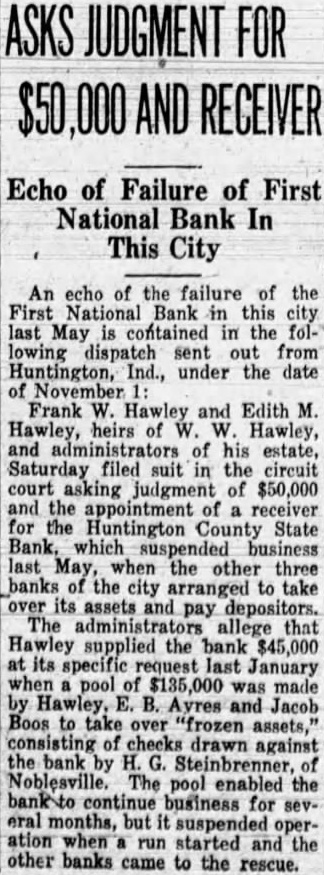
Echo of Failure of First National Bank In This City An echo of the failure of the First National Bank in this city last May the lowing dispatch sent out from Huntington, Ind., under the date November Frank Hawley and Edith Hawley, heirs of Hawley, and of his estate, Saturday filed suit the circuit court asking judgment of $50,000 and the appointment of receiver Huntington County State Bank, which suspended business last May, when the other three banks of the city arranged to take its assets and pay The allege that Hawley supplied the bank $45,000 its specific request last January when made Hawley, and Boos to take over "frozen assets," of checks drawn against the bank by Steinbrenner, The pool enabled the bank to continue business for eral months, but suspended ation when a run started and the other banks came to the rescue.


Article from The Huntington Herald, February 22, 1927

Click image to open full size in new tab

Article Text

COUNTY STOCK OFFERED FOR SALE Charles N. McGrew, trustee in charge of the liquidation of the Huntington County State bank, Tuesday issued legal notices of the offering for sale of stock belonging to E. B. Ayres and the late W. W. Hawley The stock will be offered for sale at an appraised price made by the state banking commission, preparatory to levying an assessment of 100 per cent against it. Ayres and the Hawley estate contested the made when the bank suspended business almost year ago, on the ground that the assessment did not conform to the statutory provision in such cases Judge Kenner sustained this conten-


Article from The Indianapolis Times, August 24, 1928

Click image to open full size in new tab

Article Text

125 CASES GO TO U.S. JURY IN FALL TERM District Attorney's Office Prepares for Opening Sept. 11. THREE BIG SUITS SLATED Strip Stamp Conspiracy Is Among Important Hearings. With seventy-five cases ready to present, Albert Ward, United States district attorney, is preparing for the fall Federal grand jury session, to start Sept. 11. Probably 125 cases. involving 150 to 175 individuals, will be presented to the grand jury for consideration. it is expected. A majority of the cases are for liquor law violations, there is run of white although narcotics, slavery, the usual counterfeiting, banking and postal violations. The district attorney's office has the summer to to spent paring go trial months in the in coun- preterfeit strip stamp conspiracy case, Steinbrenner Rubber Company banking law violation case, the Remus-Squibb distillery tax suit and others. Strip Stamp Case Up Briefs are being prepared by Ward and his assistant, Alexander G. Cavins, in appeal of Tony Ferracane, Indianapolis, and Charles W. Gay, Les Feldhaus, Leo Stabile and Steve Calendrina, all of Louisville, convicted in the Ferracane liquor conspiracy case last spring. All five appealed to the United States Circuit Court of Appeals at Chicago. The district attorney's office also is making efforts to obtain removal of Dave Fleigle, from Louisville here to face trial as a defendant in the Ferracane case. Several other defendants also are to be removed here from Chicago for trial. The nation-wide strip stamp conspiracy case involves ninteen defendants living in Albany, N. Y., Minneapolis, Chicago, Indianapolis, Muncie and Ft. Wayne. The case was originated here by George L. Winkler, deputy dry administrator, when some counterfeit strip stamps and whisky labels were found on a liquor raid. Based on information gained here, two Chicago warehouses were raided. resulting in confiscation of fourteen tons of counterfeit labels, revenue stamps and other paraphernalia for making "genuine bonded" whisky. Government Seeks $250,000 The Steinbrenner case involves alleged check-kiting by the Steinbrenner Rubber Company, Noblesville, now in receivership, resulting in failure of the Huntington County State Bank, Huntington, Ind.. and the First National Bank of Noblesville, Ind. Defendants are E. B. Ayres, 81. president of the Huntington bank. and his son. E. Porter Ayres; N. W. Cowgill, cashier. and Walter W. Bray, bookkeeper of the Noblesville bank. and S. Homer Federman. treasurer of the rubber company. A sixth defendant, Henry G. Steinbrenner. president of the rubber company, committed suicide in a Chicago hotel last winter after being indicted. In the Remus-Squibbs distillery case, the Government seeks to collect more than $250,000 alleged to be due as additional taxes because Remus sold liquor he illegally removed from the Squibbs Distillery, Lawrenceburg, Ind., for beverage purposes instead of for medicinal use. Remus himself may apear in the trial of the case, inasmuch as the American Surety Company of New York, which provided the distillery bonds, holds collateral he provided to insure the surety company against loss.
Article from The Huntington Herald, September 6, 1928

Click image to open full size in new tab

Article Text

PLANS ARE MADE TO REMODEL BANK BUILDING The Huntington County bank building on Jefferson street, between Frank lin and Market streets, will be remodeled for store room purposes, the lower floor to be divided into two rooms, it has been announced by Charles McGrew, liquidating agent for the bank. The building has been closed for many months since the bank suspended business there. Plans are being discussed with an architect for the remodeling which is expected to be started soon, it was said.


Article from The Huntington Press, March 29, 1929

Click image to open full size in new tab

Article Text

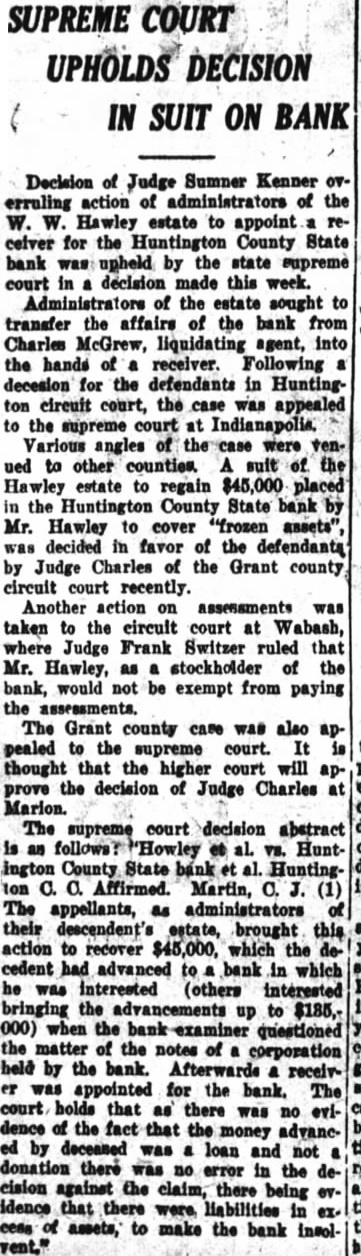
SUPREME COURT UPHOLDS DECISION IN SUIT ON BANK Decision of Judge Summer Kenner orerruling action of administrators of the W. W. Hawley estate to appoint receiver for the Huntington County State bank was upheld by the state supreme court in decision made this week. Administrators of the estate sought to transfer the affairs of the bank from Charles McGrew, liquidating agent, into the hands of receiver. Following decesion for the defendants in Huntington circuit court, the case was appealed to the supreme court at Indianapolis. Various angles of the case were venued to other counties. A suit of the Hawley estate to regain $45,000 placed in the Huntington County State bank by Mr. Hawley to cover "frozen assets", was decided in favor of the defendants by Judge Charles of the Grant county circuit court recently. Another action on assessments was taken to the circuit court at Wabash, where Judge Frank Switzer ruled that Mr. Hawley, as a stockholder of the bank, would not be exempt from paying the assessments. The Grant county case was also appealed to the supreme court. It is thought that the higher court will approve the decision of Judge Charles at Marion. The supreme court decision abstract is an follows "Howley et al. vs. Huntington County State bank et al. Huntington C. C. Affirmed. Martin, C. J. (1) The appellants, as administrators of their descendent's estate, brought this action to recover $45,000, which the decedent had advanced to bank in which he was interested (others interested bringing the advancements up to $185,000) when the bank examiner questioned the matter of the notes of a corporation held by the bank. Afterwards a receiver was appointed for the bank. The court holds that as there was no evidence of the fact that the money advanced by deceased was a loan and not donation there was no error in the decision against the claim, there being evidence that there were liabilities in ex. cess of assets, to make the bank insolvent."


Article from The Indianapolis Times, December 5, 1929

Click image to open full size in new tab

Article Text

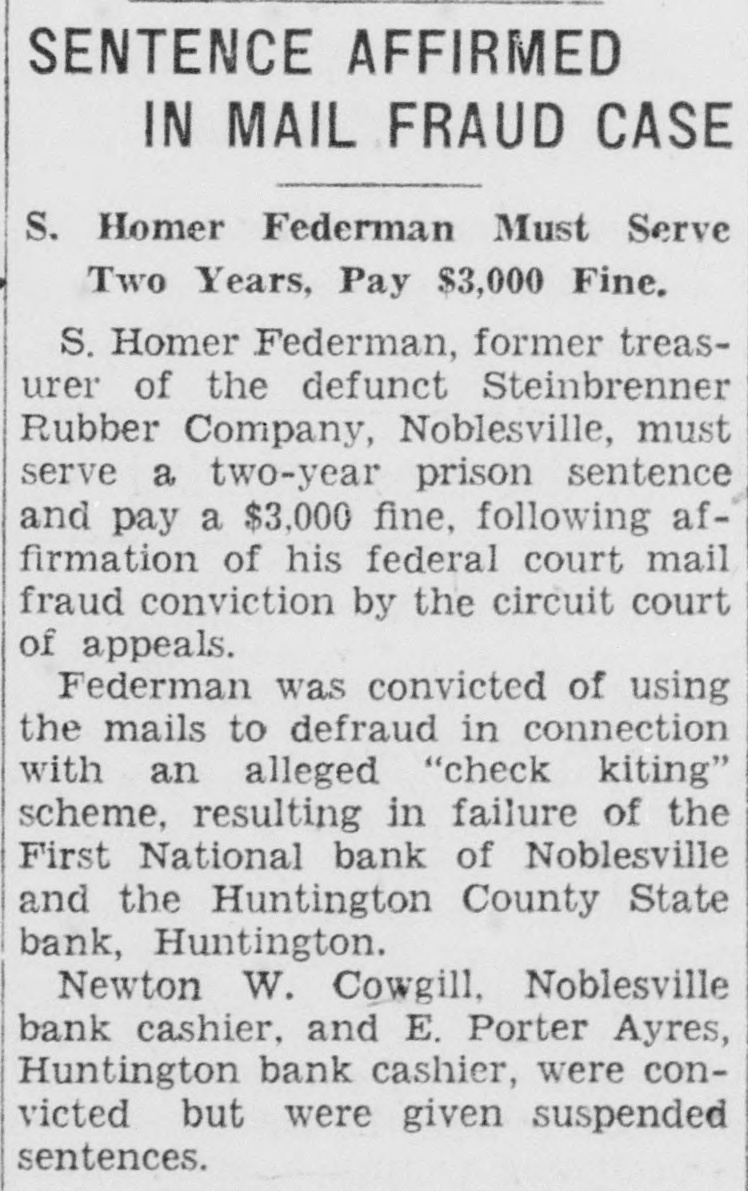
SENTENCE AFFIRMED IN MAIL FRAUD CASE S. Homer Federman Must Serve Two Years, Pay $3,000 Fine. S. Homer Federman, former treasurer of the defunct Steinbrenner Rubber Company, Noblesville, must serve a two-year prison sentence and pay a $3,000 fine, following affirmation of his federal court mail fraud conviction by the circuit court of appeals. Federman was convicted of using the mails to defraud in connection with an alleged "check kiting" scheme, resulting in failure of the First National bank of Noblesville and the Huntington County State bank, Huntington. Newton W. Cowgill, Noblesville bank cashier, and E. Porter Ayres, Huntington bank cashier, were convicted but were given suspended sentences.


Article from The Indianapolis Times, April 21, 1930

Click image to open full size in new tab

Article Text

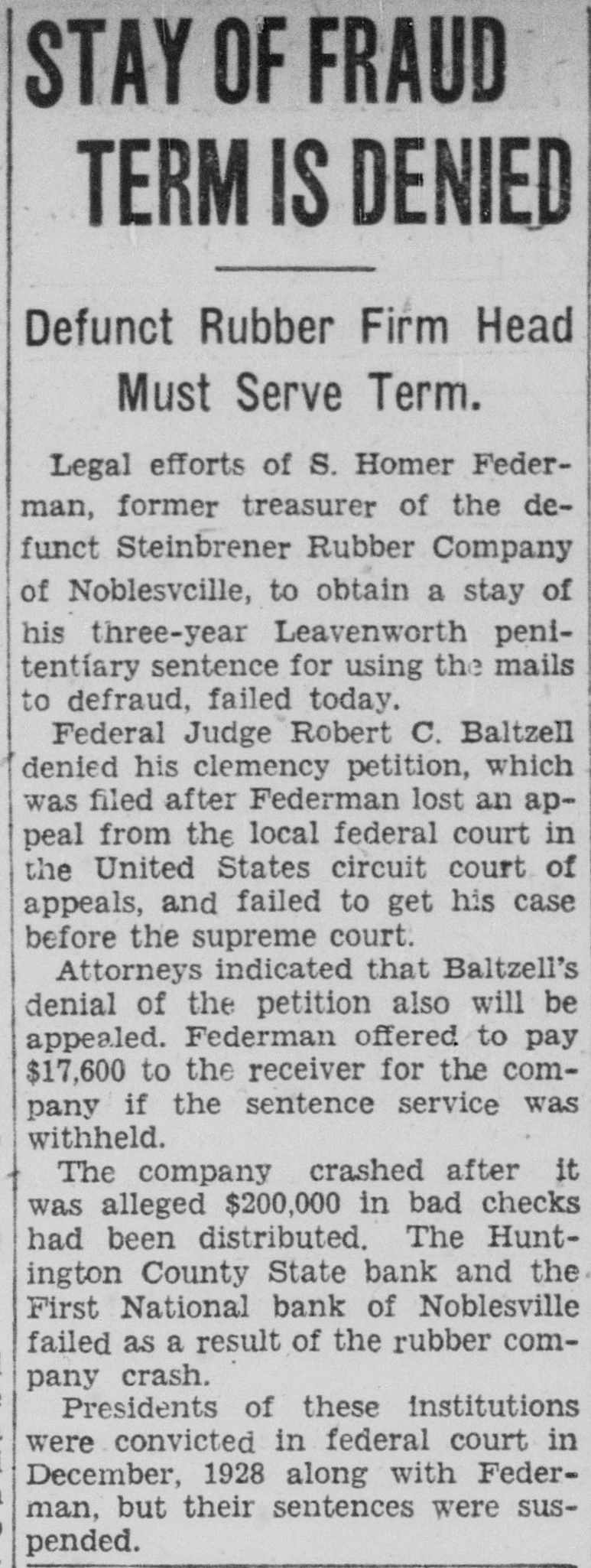
STAY OF FRAUD TERM IS DENIED Defunct Rubber Firm Head Must Serve Term. Legal efforts of S. Homer Federman, former treasurer of the defunct Steinbrener Rubber Company of Noblesvcille, to obtain a stay of his three-year Leavenworth penitentiary sentence for using the mails to defraud, failed today. Federal Judge Robert C. Baltzell denied his clemency petition, which was filed after Federman lost an appeal from the local federal court in the United States circuit court of appeals, and failed to get his case before the supreme court. Attorneys indicated that Baltzell's denial of the petition also will be appealed. Federman offered to pay $17,600 to the receiver for the company if the sentence service was withheld. The company crashed after it was alleged $200,000 in bad checks had been distributed. The Huntington County State bank and the First National bank of Noblesville failed as a result of the rubber company crash. Presidents of these institutions were convicted in federal court in December, 1928 along with Federman, but their sentences were suspended.