
5773. Emporia National Bank (Emporia, KS)

Bank Information

Episode Type
Suspension โ†’ Closure
Bank Type
national
Bank ID
1983
Charter Number
1983
Start Date
January 1, 1899*
Location
Emporia, Kansas (38.404, -96.182)

Metadata

Model
gpt-5-mini
Short Digest
195a7668e8194f74

Response Measures

None

Description

Articles describe the Emporia National Bank as a 'wrecked national bank' with a receiver (Mort Albaugh) and mention the bank's failure (president Cross committed suicide at time of failure). No article describes a depositor run; the bank was in receivership and under Comptroller oversight. Failure occurred earlier (articles refer to failure >2 years prior to 1901). Dates are approximate from the newspaper mentions.

Events (5)

1. May 13, 1872 Chartered
Source
historical_nic
2. January 1, 1899* Suspension
Cause
Government Action
Cause Details
Bank had failed and was placed in receivership; president committed suicide at time of failure; government (Comptroller) and receiver managing disposition of assets
Newspaper Excerpt
the wrecked national bank of Emporia
Source
newspapers
3. March 9, 1900 Receivership
Newspaper Excerpt
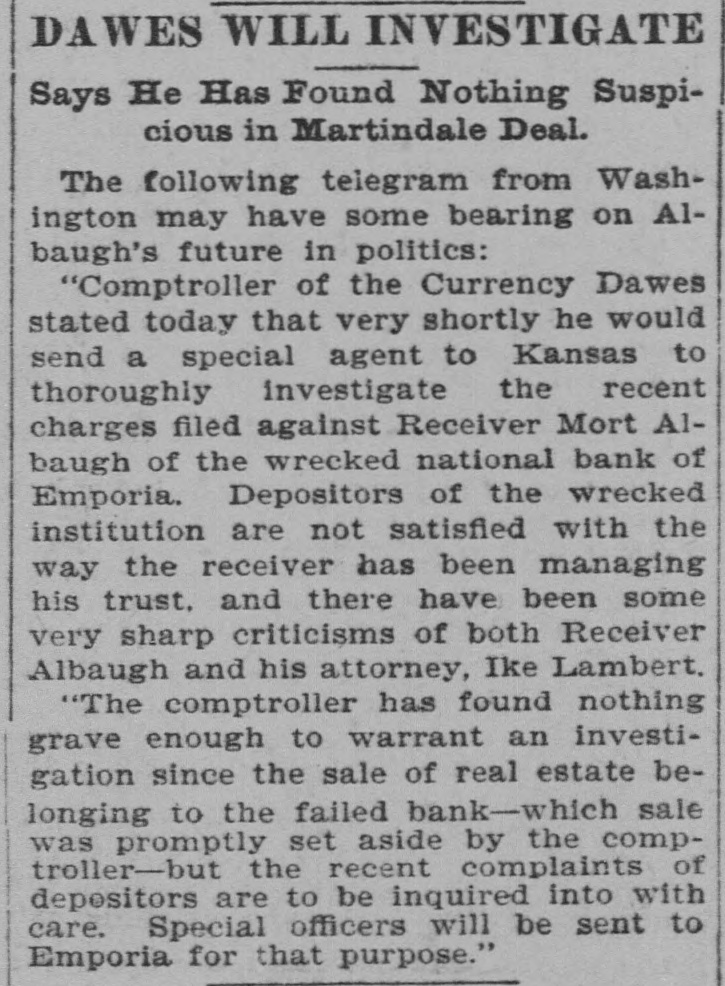
Comptroller of the Currency Dawes stated today that very shortly he would send a special agent to Kansas to thoroughly investigate the recent charges filed against Receiver Mort Albaugh of the wrecked national bank of Emporia. Depositors of the wrecked institution are not satisfied with the way the receiver has been managing his trust. ...the sale of real estate belonging to the failed bank-which sale was promptly set aside by the comptroller- said the dispatch; but the recent complaints of depositors are to be inquired into with care. Special officers will be sent to Emporia for that purpose.
Source
newspapers
4. September 11, 1901 Other
Newspaper Excerpt
the grand jury brought in a reindictment against Mr. William Martindale, charging him with wrecking the Emporia national bank, which failed more than two years ago. The president of the bank, Mr. Cross, committed suicide at the time of the failure.
Source
newspapers
5. May 15, 1920 Voluntary Liquidation
Source
historical_nic

Newspaper Articles (3)

Article from The Topeka State Journal, March 9, 1900

Click image to open full size in new tab

Article Text

DAWES WILL INVESTIGATE Says He Has Found Nothing Suspicious in Martindale Deal. The following telegram from Washington may have some bearing on Albaugh's future in politics: "Comptroller of the Currency Dawes stated today that very shortly he would send a special agent to Kansas to thoroughly investigate the recent charges filed against Receiver Mort Albaugh of the wrecked national bank of Emporia. Depositors of the wrecked institution are not satisfied with the way the receiver has been managing his trust. and there have been some very sharp criticisms of both Receiver Albaugh and his attorney, Ike Lambert. "The comptroller has found nothing grave enough to warrant an investigation since the sale of real estate belonging to the failed bank-which sale was promptly set aside by the comptroller-but the recent complaints of depositors are to be inquired into with care. Special officers will be sent to Emporia for that purpose."


Article from Iron County Register, September 19, 1901

Click image to open full size in new tab

Article Text

being drummed out of the grounds, for having manifested elation at the attempt upon the life of the president. Many of the pupils of a young ladies' school near Count Tolstoi's residence, at Yasnaia, Russia, who, with their teacher and other young persons of the neighborhood, called on himand presented the count with flowers, have been arrested, and their teacher has been dismissed. According to a story which was made public in New York, on the 13th, immigrant smugglers are bringing cargoes of foreigners in schooners to this country. Within a few days a vessel, said to be named the Lottie, landed 112 immigrants at Clarke's Cove, on Buzzard's bay. The first violence of the great steel workers' strike at McKeesport, Pa., took place, on the night of the 10th, when three workmen were set upon by strikers or strike sympathizers, and badly beaten. Twenty-five extra policemen were sworn in, and numerous arrests were made. Emma Goldman, the anarchist agitator, under whose red banner Leon Czolgosz claims he stands and whose words he says fired his heart and his brain to attempt the assassination of the president, was arrested in Chicago, on the 10th, charged with conspiracy to murder the president. It is reported that half the coffee crop of Porto Rico has been partially ruined by recent storms, and that the banana crop has suffered serious damage. The poorer classes will probably appeal for assistance in consequence. The new railway bridge across the Anasco river has also been destroyed by the floods. Early on the morning of the 13th, the president took a turn for the worse, and his condition gave rise to the gravest apprehension. While not considered in extremis, the worst was feared, owing to the weakness of the heart action. The trouble was said to be due to taking too much nourishment during the preceding day. Mayor Phinney of Kingston, N. Y., on the 11th, suspended Policeman Heppner for remarks regarding the attempted assassination of President McKinley. Heppner said it was a pity more people were not shot who insisted on making rich people richer and poor people poorer, and that the president's death would equalize wealth. At Wichita, Kas., on the 11th, the grand jury brought in a reindictment against Mr. William Martindale, charging him with wrecking the Emporia national bank, which failed more than two years ago. The president of the bank, Mr. Cross, committed suicide at the time of the failure. Mr. Martindale was vice-president of the bank. The ground plans of the Louisiana Purchase Centennial exposition are in such shape now that it will be possible to determine, within a very short time, by them the exact amount of space which each department can be allowed. As soon as the allotments are made the committees will commence the actual work of getting together their exhibits. The British Medical Journal, of the 12th, says: "The details in the McKinley bulletins are sufficient to justify the assertion that the treatment of the case in promptitude and complete efficiency, will rank as one of the greatest achievements of abdominal surgery recorded." The Journal compliments highly the skill and courage of the attending surgeons. The Schley court of inquiry began its sessions at the Washington navy yard, on the 12th, Admiral Dewey presiding. Rear-Admiral Howison's qualification as a member of the court was formally challenged by Rear-Admiral Schley, and the challenge sustained. The court then adjourned pending the selection of another member by the navy department. The first real day of the grand army encampment at Cleveland, O., opened, on the 10th, with nearly two hundred thousand visitors in the city. The day was the eighty-seventh anniversary of Commodore Perry's great victory on Lake Erie, and that memorable and decisive triumph of young America's naval prowess was fittingly celebrated by a great naval parade President McKinley, who was shot twice at the Pan-American exposition at Buffalo, N. Y., by the avowed anarchist Czolgosz, on the 6th, and who under the skillful treatment of his eminent surgeons and physicians, had made such apparently rapid progress toward recovery, began, unaccountably, to sink on the afternoon of the 12th. The alarm spread rapidly throughout the country and constantly grew in intensity until 2:15 a. m of the 14th, when he died. His last conscious words, spoken to his beloved wife, after chanting part of the words of the hymn, "Nearer, My God to Thee," were: "Good-by. All good by. It is God's way. His will be done."

Article from The Jasper Weekly Courier, September 20, 1901

Click image to open full size in new tab

Article Text

immigrant smugglers are bringing cargoes of foreigners in schooners to this country. Within a few days a vessel, said to be named the Lottie, landed 112 immigrants at Clarke's Cove, on Buzzard's bay. The first violence of the great steel workers' strike at McKeesport, Pa., took place, on the night of the 10th, when three workmen were set upon by strikers or strike sympathizers, and badly beaten. Twenty-five extra policemen were sworn in, and numerous arrests were made. Emma Goldman, the anarchist agitator, under whose red banner Leon Czolgosz claims he stands and whose words he says fired his heart and his brain to attempt the assassination of the president, was arrested in Chicago, on the 10th, charged with conspiracy to murder the president. It is reported that half the coffee crop of Porto Rico has been partially ruined by recent storms, and that the banana crop has suffered serious damage. The poorer classes will probably appeal for assistance in consequence. The new railway bridge across the Anasco river has also been destroyed by the floods. Early on the morning of the 13th, the president took a turn for the worse, and his condition gave rise to the gravest apprehension. While not considered in extremis, the worst was feared, owing to the weakness of the heart action. The trouble was said to be due to taking too much nourishment during the preceding day. Mayor Phinney of Kingston, N. Y., on the 11th, suspended Policeman Heppner for remarks regarding the attempted assassination of President McKinley. Heppner said it was a pity more people were not shot who insisted on making rich people richer and poor people poorer, and that the president's death would equalize wealth. At Wichita, Kas., on the 11th, the grand jury brought in a reindictment against Mr. William Martindale, charging him with wrecking the Emporia national bank, which failed more than two years ago. The president of the bank, Mr. Cross, committed suicide at the time of the failure. Mr. Martindale was vice-president of the bank. The ground plans of the Louisiana Purchase Centennial exposition are in such shape now that it will be possible to determine, within a very short time, by them the exact amount of space which each department can be allowed. As soon as the allotments are made the committees will commence the actual work of getting together their exhibits. The British Medical Journal, of the 12th, says: "The details in the McKinley bulletins are sufficient to justify the assertion that the treatment of the case in promptitude and complete efficiency, will rank as one of the greatest achievements of abdominal surgery recorded." The Journal compliments highly the skill and courage of the attending surgeons. The Schley court of inquiry began its sessions at the Washington navy yard, on the 12th, Admiral Dewey presiding. Rear-Admiral Howison's qualification as a member of the court was formally challenged by Rear-Admiral Schley, and the challenge sustained. The court then adjourned pending the selection of another member by the navy department. The first real day of the grand army encampment at Cleveland, O., opened, on the 10th, with nearly two hundred thousand visitors in the city. The day was the eighty-seventh anniversary of Commodore Perry's great victory on Lake Erie, and that memorable and decisive triumph of young America's naval prowess was fittingly celebrated by a great naval parade President McKinley, who was shot twice at the Pan-American exposition at Buffalo, N. Y., by the avowed anarchist Czolgosz, on the 6th, and who, under the skillful treatment of his eminent surgeons and physicians, had made such apparently rapid progress toward recovery, began, unaccountably, to sink on the afternoon of the 12th. The alarm spread rapidly throughout the country and constantly grew in intensity until 2:15 a. m of the 14th, when he died. His last conscious words, spoken to his beloved wife, after chanting part of the words of the hymn, "Nearer, My God to Thee," were: "Good-by. All good by. It is God's way. His will! Gone."