5679. First National Bank (Gary, IN)

Bank Information

Episode Type
Run → Suspension → Closure
Bank Type
national
Bank ID
8426
Charter Number
8426
Start Date
January 5, 1932
Location
Gary, Indiana (41.593, -87.346)

Metadata

Model
gpt-5-mini
Short Digest
703ca244

Response Measures

Borrowed from banks or large institutions, Full suspension

Other: Receiver appointed and RFC loans to receiver to pay dividends; bank went into liquidation.

Receivership Details

Depositor recovery rate
71.5%
Date receivership started
1932-01-27
Share of assets assessed as good
49.0%
Share of assets assessed as doubtful
45.6%
Share of assets assessed as worthless
5.4%

Description

Contemporary articles report a two-day run that forced the First National Bank of Gary to close (Jan 5, 1932). The closure led to receivership/liquidation; RFC loans to the bank-in-receivership were later authorized (Aug 1932) and dividends paid to depositors, but the bank remained closed and in liquidation. Dates chosen from the newspaper texts (closure Jan 5/6, 1932; RFC/receiver mentions Aug 23, 1932).

Events (6)

1. November 5, 1906 Chartered
Source
historical_nic
2. January 5, 1932 Run
Cause
Local Banks
Cause Details
Runs and failures in the Calumet district and the recent closing of the National Bank of America and Hammond banks precipitated heavy withdrawals at First National.
Newspaper Excerpt
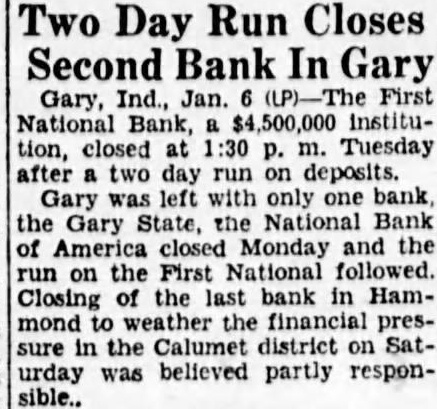
Two Day Run Closes Second Bank In Gary ... The First National Bank ... closed at 1:30 p. m. Tuesday after two day run on deposits.
Source
newspapers
3. January 5, 1932 Suspension
Cause
Local Banks
Cause Details
Closure/suspension was a direct result of the multi-day run triggered by nearby bank failures and runs in the Calumet district.
Newspaper Excerpt
The First National, a $4,500,000 institution, closed at 1:30 p. m. Tuesday after two day run on deposits.
Source
newspapers
4. January 27, 1932 Receivership
Source
historical_nic
5. August 23, 1932 Receivership
Newspaper Excerpt
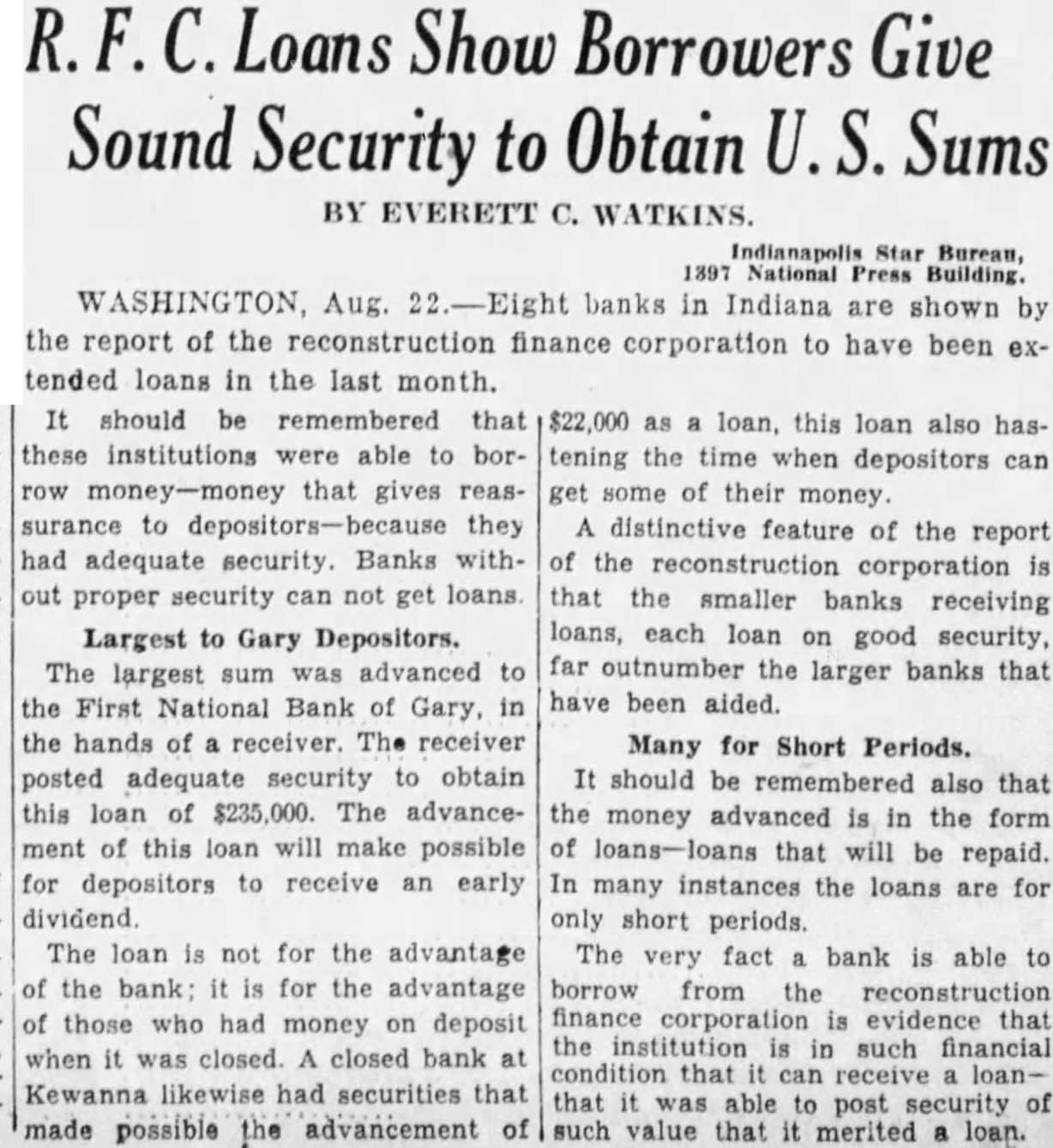
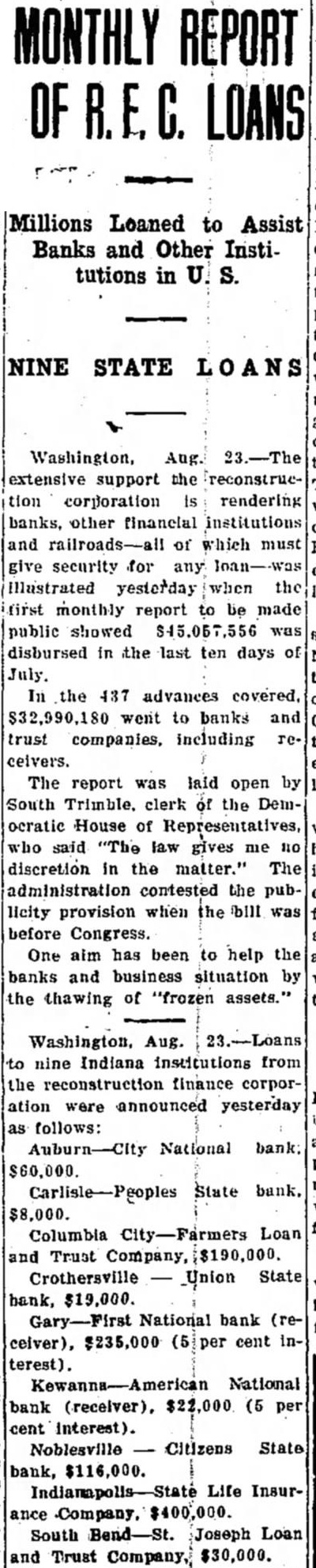
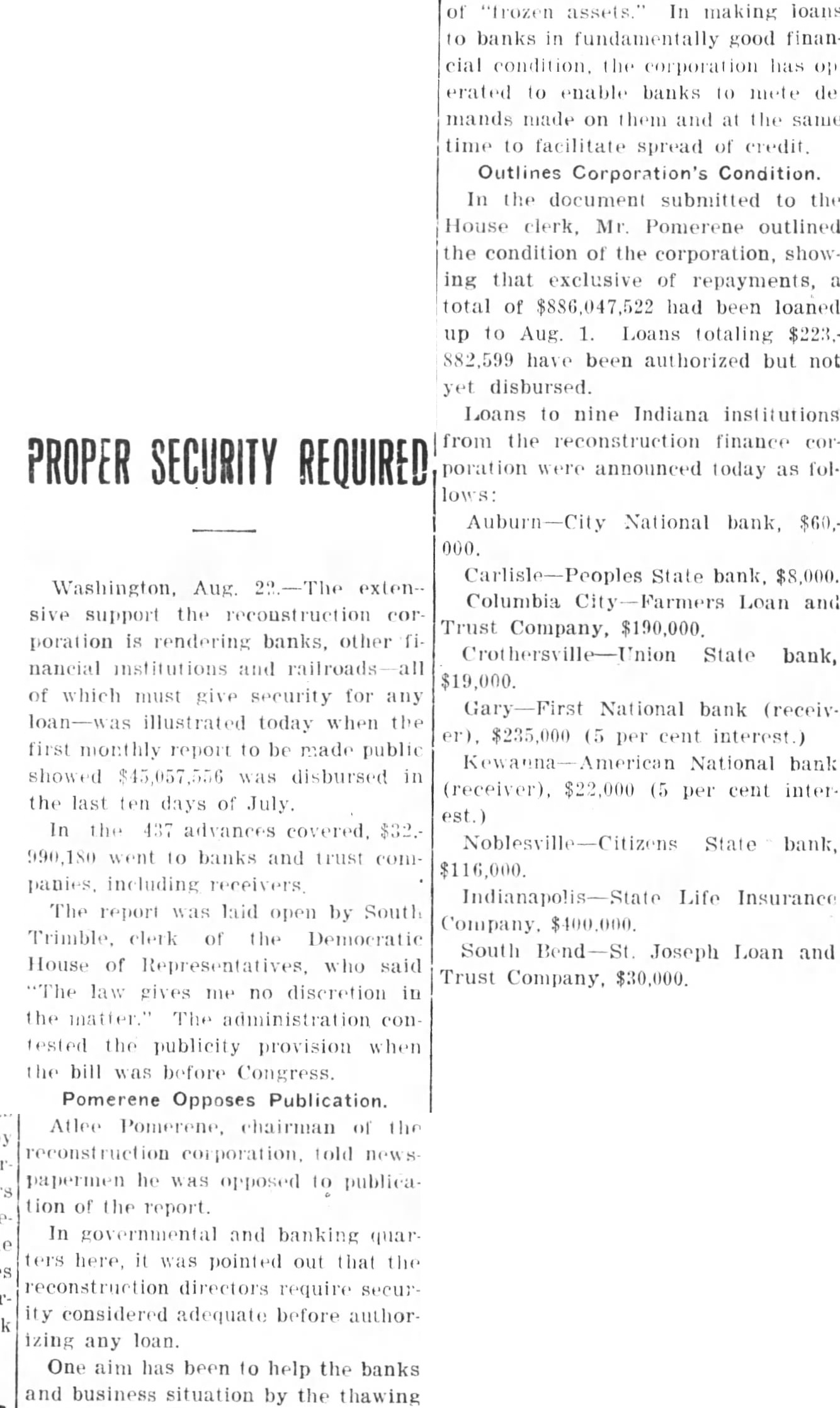
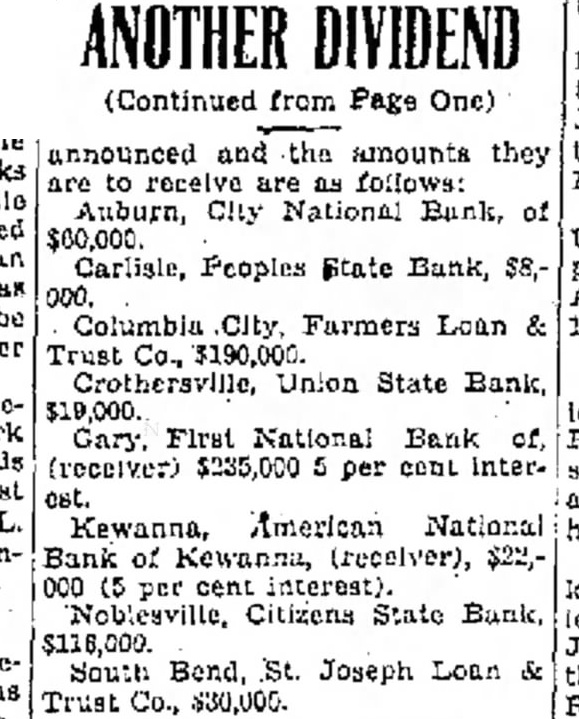
The First National Bank Gary, in the hands [of] receiver, was listed as having obtained loan ... $235,000 (5 per cent interest).
Source
newspapers
6. October 4, 1932 Other
Newspaper Excerpt
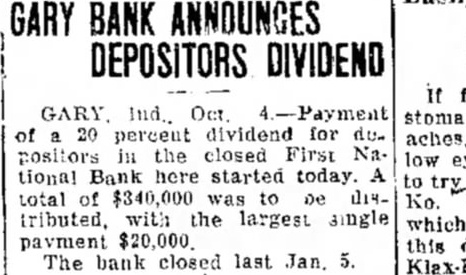
Payment of 20 percent dividend for depositors in the closed First National Bank here started today. ... The bank closed last Jan. 5.
Source
newspapers

Newspaper Articles (13)

Article from The Capital Journal, January 6, 1932

Click image to open full size in new tab

Article Text

Two Day Run Closes Second Bank In Gary Gary, Ind., Jan. 6 (LP)-The First National Bank, a $4,500,000 institution, closed at 1:30 p. m. Tuesday after two day run on deposits. Gary was left with only one bank, the Gary State, the National Bank of America closed Monday and the run on the First National followed. Closing of the last bank in Hammond to weather the financial pressure in the Calumet district on Saturday was believed partly responsible..


Article from The Producers News, January 8, 1932

Click image to open full size in new tab

Article Text

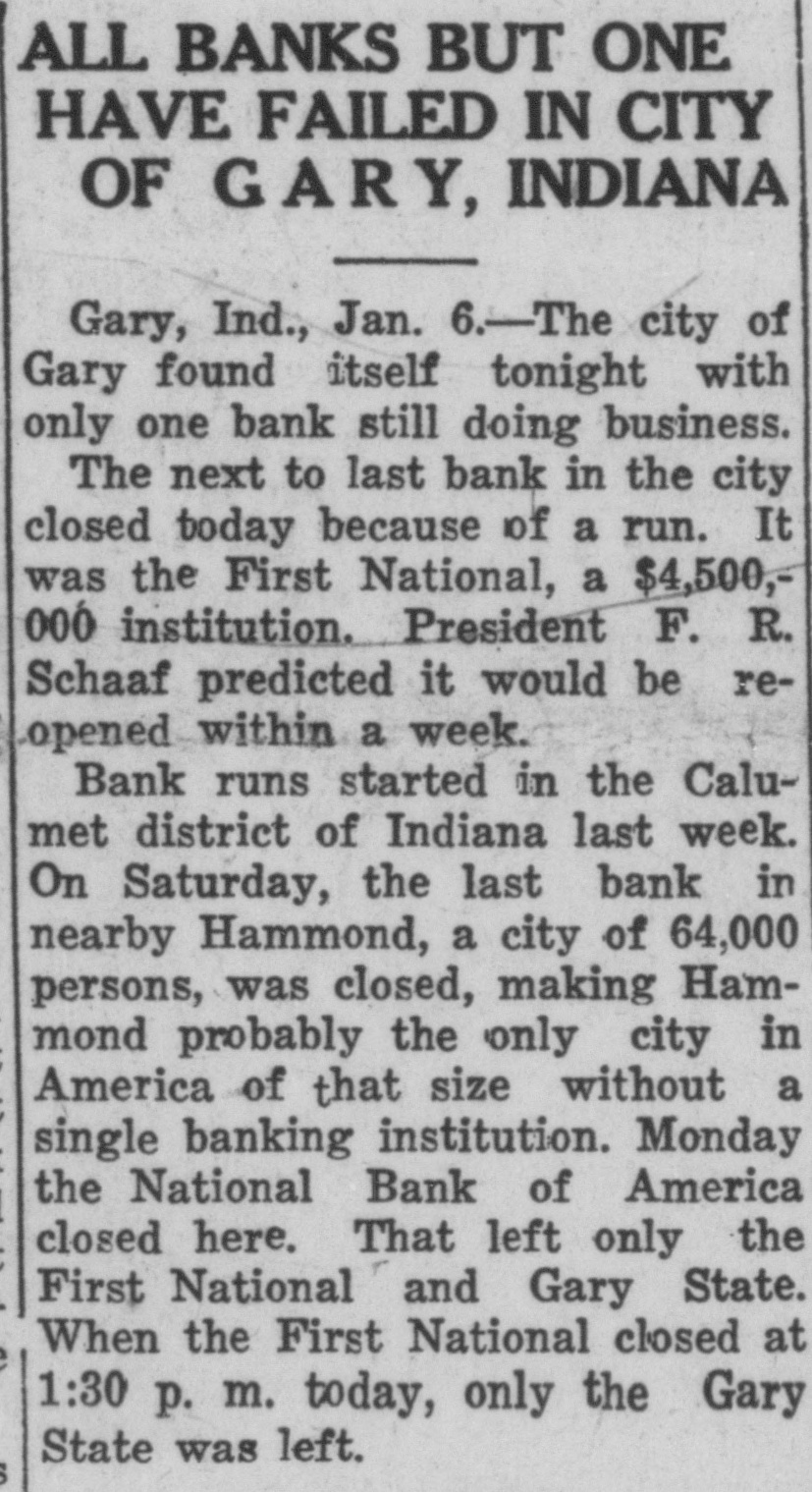
ALL BANKS BUT ONE HAVE FAILED IN CITY OF GARY, INDIANA Gary, Ind., Jan. 6.-The city of Gary found itself tonight with only one bank still doing business. The next to last bank in the city closed today because of a run. It was the First National, a $4,500,000 institution. President F. R. Schaaf predicted it would be reopened within a week. Bank runs started in the Calumet district of Indiana last week. On Saturday, the last bank in nearby Hammond, a city of 64,000 persons, was closed, making Hammond probably the only city in America of that size without a single banking institution. Monday the National Bank of America closed here. That left only the First National and Gary State. When the First National closed at 1:30 p. m. today, only the Gary State was left.


Article from Vidette-Messenger of Porter County, February 17, 1932

Click image to open full size in new tab

Article Text

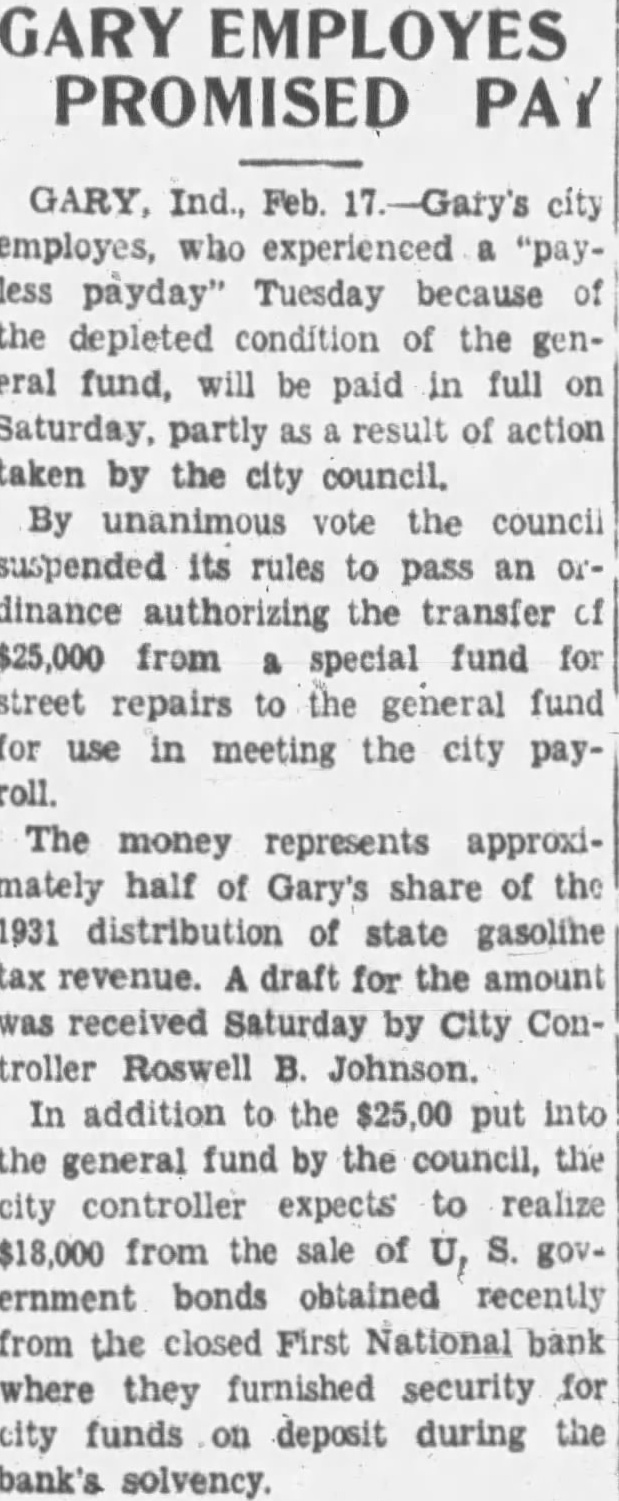
GARY EMPLOYES PROMISED PAY GARY, Ind., Feb. 17.-Gaty's city employes, who experienced "payless payday" Tuesday because the depleted condition of the general fund, will be paid in full on Saturday, partly result of action taken by the city council, By unanimous vote the council suspended its rules to pass an dinance authorizing the transfer $25,000 from special fund for street repairs to the general fund for use in meeting the city payroll. The money represents approximately half of Gary's share of the 1931 distribution of state gasoline tax revenue. A draft for the amount was received Saturday by City Controller Roswell B. Johnson. In addition to the $25,00 put into the general fund by the council, the city controller expects to realize $18,000 from the sale of U, S. government bonds obtained recently from the closed First National bank where they furnished security for city funds on deposit during the bank's solvency.


Article from The Indianapolis Star, August 23, 1932

Click image to open full size in new tab

Article Text

Show Borrowers Give Sound Security to Obtain BY EVERETT Aug. banks in Indiana are shown the report of the reconstruction finance corporation to have been extended loans in the last month. It should remembered institutions were able to row that gives surance to they had adequate security. Banks without proper security can not get Largest to Gary Depositors. The largest sum advanced the First National Bank Gary, the hands of receiver. The receiver posted adequate security obtain this loan $235,000. The advancement of this loan will make possible depositors receive early The loan not for the advantage the for the those who had money deposit closed bank Kewanna likewise had securities that advancement loan, this loan also hastening the time when depositors can get some their money. distinctive feature of the report the reconstruction corporation that the smaller banks receiving each loan good security, far outnumber the larger banks that been aided. Many for Short Periods. It should be remembered that also the money advanced in form that be repaid. In many instances the loans are for short periods. The very fact bank able borrow from that the such post security value merited


Article from The Tipton Daily Tribune, August 23, 1932

Click image to open full size in new tab

Article Text

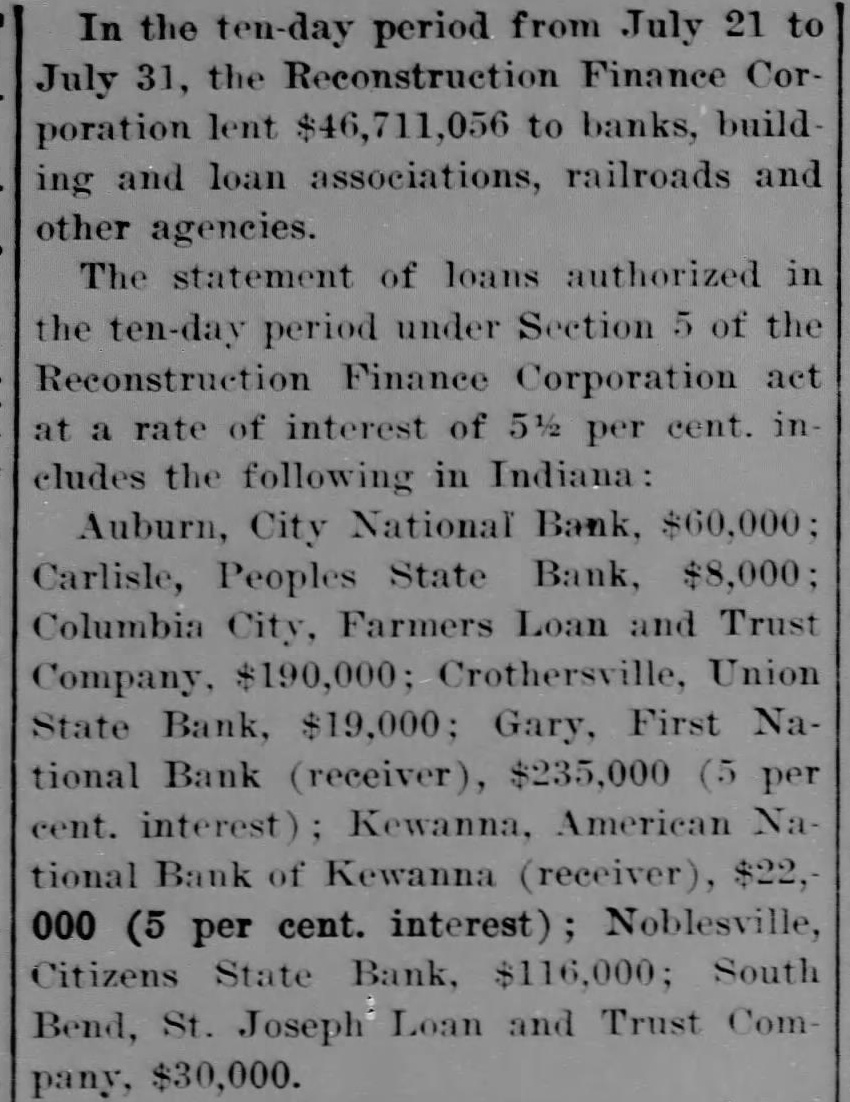
MONTHLY REPORT OF R.E.C. LOANS Millions Loaned to Assist Banks and Other Institutions in U. S. NINE STATE LOANS Washington, Aug. extensive support the reconstruetion corporation is rendering banks, other financial institutions and railroads-all of which must give security for any loan-was Illustrated yesterday when the first monthly report to be made public showed $45,057,556 was disbursed in the last ten days of July. In the 437 advances covered. $32,990,180 went to banks and trust companies, including receivers. The report was laid open by South Trimble. clerk of the Democratic House of Representatives, who said "The law gives me no discretion in the matter." The administration contested the publicity provision when the bill was before Congress. One aim has been to help the banks and business situation by the thawing of "frozen assets." Washington, Aug. 23.-Loans to nine Indiana institutions from the reconstruction finance corporation were announced yesterday as follows: Auburn-City National bank: Carlisle-Peoples State $8,000. Columbia City-Farmers Loan and Trust Company, Crothersville Union State bank, $19,000. Gary-First National bank (receiver), $235,000 (5 per cent interest). Kewanna-American National bank (receiver). $22,000 (5 per cent interest). Noblesville Citizens State bank, $116,000. Indianapolls-State Life Insurance Company, $400,000. South Bend-St. Joseph Loan and Trust Company, $30,000.


Article from The Call-Leader, August 23, 1932

Click image to open full size in new tab

Article Text

PROPER SECURITY REQUIRED Washington, Aug. 22.-The extensive support the reconstruction cor poration is rendering banks, other financial institutions and railroads all of which must give security for any loan-was illustrated today when the first monthly report to be made public showed $45,057,556 was disbursed in the last ten days of July. In the 437 advances covered, $32. 990,180 went to banks and trust companies, including receivers The report was laid open by South Trimble, clerk of the Democratic House of Representatives, who said "The law gives me no discretion in the matter." The administration contested the publicity provision when the bill was before Congress. Pomerene Opposes Publication. Atlee Pomerene, chairman of the reconstruction corporation, told news papermen he was opposed to publication of the report. In governmental and banking quar ters here, it was pointed out that the reconstruction directors require security considered adequate before authorizing any loan. One aim has been to help the banks and business situation by the thawing of "frozen assets." In making loans to banks in fundamentally good financial condition, the corporation has op erated to enable banks to mete de mands made on them and at the same time to facilitate spread of credit. Outlines Corporation's Condition. In the document submitted to the House clerk, Mr. Pomerene outlined the condition of the corporation, show ing that exclusive of repayments, a total of $886,047,522 had been loaned up to Aug. 1. Loans totaling $223.882,599 have been authorized but not yet disbursed. Loans to nine Indiana institutions from the reconstruction finance cor poration were announced today as follows: Auburn-City National bank, $60,000. Carlisle-Peoples State bank, $8,000. Columbia Farmers Loan and Trust Company, $190,000 Crothersville-Union State bank, $19,000. Gary-First National bank (receiver), $235,000 (5 per cent interest.) Kewanna-American National bank (receiver), $22,000 (5 per cent interest.) Noblesville-Citizens State bank, Indianapolis-State Life Insurance South Bend-St. Joseph Loan and Trust Company, $30,000.


Article from Vidette-Messenger of Porter County, August 24, 1932

Click image to open full size in new tab

Article Text

GARY GETS $235,000 FEDERAL Aug. totaling were authorized during the last eleven of days the detailed public report of the Finance corporation, released today South Trimble. clerk of the house, disclosed. letter from the chairman the board. Atlee accompanied the detailed report. set forth that 437 loans were made in the eleven-day period. The First National Bank Gary, in the hands receiver. was listed as having obtained loan five and percent, the uniform rate. Aug. authorized by the federal to the closed First National bank in Gary to provide cash with which the bank can its first twenty percent dividend its depositors. There has been much delay obtaining final approval of and because much red tape in Washington there further delay actually getting the cash on hand here that hurdle now passed and that will only short time until depositors will receive their first dividend checks. understood that the checks for the first twenty percent dividend the closed Naional Bank of America will paid within short time, perhaps even before the First National's The statement of loans authorised the ten-day period under Section of the Reconstruction Finance act at rate interest five and one-half includes the following in Indiana: National bank. $60.000; Carlisle, People's State bank, $8,000; Columbia City, Farmers' Loan and Trust Company, $190,000; Orothersville, Union State bank, $19,000; Gary, First National bank (receiver), Kewanna, American National Bank of Kewanna (receiver) $22,000 (five percent inNoblesville, Citizens' State $116,000; South Bend, St. Loan Trust company, $30,000. Loans to building and loan associations Indiana included Home Economy Loan association, Oakland City, $15,000, and to insurance companies, State Life Insurance company, Indianapolis,


Article from The Kokomo Tribune, August 24, 1932

Click image to open full size in new tab

Article Text

(Continued from One) announced and the amounts they to are follows: Auburn, City National Bank, $60,000 Carlisle, Peoples State Bank, $8,Columbia City, Farmers Loan Co., Union State Bank, Gary. Flrst National Bank of, (receiver) $235,000 per COOL interest. Kewanna, American National Bank of (receiver), $22,Noblesville, Citizens State Bank, South Bend, St. Joseph Loan Trust Co., $30,000.


Article from The Hancock Democrat, August 25, 1932

Click image to open full size in new tab

Article Text

In the period from July July the Reconstruction Finance Corporation lent to banks, build and loan associations, railroads and ing other agencies. The statement of loans authorized the period under Section of the Reconstruction Finance Corporation act rate of interest of per cent. cludes the following in Indiana: Auburn, City National Bank, $60,000; Carlisle, Peoples State Bank, $8,000; Columbia City, Farmers Loan Trust Crothersville, Union Company, State Bank, $19,000; Gary, First tional Bank (receiver), $235,000 cent. Kewanna, American tional Bank of Kewanna (receiver), 000 (5 per cent. Citizens State Bank, $116,000; South Bend, Joseph Loan and Trust $30,000.


Article from The Pharos-Tribune, October 4, 1932

Click image to open full size in new tab

Article Text

GARY BANK ANNOUNCES DEPOSITORS DIVIDEND Oct. 4.-Payment of 20 percent dividend for du. positors in the closed First Na. tional Bank here started today. A total of $340,000 was to De d14tributed, with the largest single The bank closed last Jan. 5.


Article from The Indianapolis Times, November 28, 1932

Click image to open full size in new tab

Article Text

OCTOBER LOANS FROM R. F. c. IN SHARP GAIN Grand Total of Nearly 195 Millions Is Reached by Borrowers. By United Press WASHINGTON, Nov. 28.-The Reconstruction Finance Corporation today reported to the clerk of the house that its loans during October had increased approximately $55,000,000 over September, reaching a grand October total of $194,923,447. Loans showed large increases in every classification except those to banks, trust companies, railroads and similar enterprises. The increase included a $24,000,000 subscription to the stock of the regional agricultural credit banks. Loans to banks, railroads and similar organizations totaled $59,023,185, as compared with $64,217,500 during September. Emergency relief advances to states showed an increase from $18,523,502 to $22,634,562; while loans for self-liquidating construction projects increased from $53,105,000 to $81,514,500. Relief through the agricultural department was $7,500,000 as against $2,500,000 during the previous month. Advances for financing sale of American agricultural products abroad totaled $251,000 for October. Get 601 Applications Of the $59,023,185 authorized for banks and other financial institutions, $21,448,494 was advanced to banks and trust companies, including $1,940,250 to aid in liquidating closed banks. Building and loan associations received $3,701,907; insurance, $1,209,000; mortgage loan companies, $4,392,500; joint stock land banks, $594,930; agricultural credit corporation, $1,272,978; live stock credit corporations, $477,105, and railroads, $25,926,269. Applications for loans totaled 601, including 484 from banks and trust companies, 62 from building and loan associations, 6 from insurance companies, 10 from mortgage loan companies, 2 from credit unions, 3 from joint stock land banks, 14 from agricultural credit corporations, and 10 each from live stock credit corporations and railroads. The bank applications included 21 from the receivers or liquidating agents of closed banks. State Banks Get Loans The corporation reported that since organization of the corporation a total of $4,765,448 in loans had been withdrawn or canceled by the organizations originally seeking them. Only three state relief loans during the month totaled more than $1,000,000; Illinois receiving the largest advance, $6,303,150. Loans to banks included: Indiana, Elwood, Elwood State bank, $20,000; Gary, the First National bank of Gary (receiver) $247,000 (5 per cent); the National Bank of America at Gary (receiver), $105,000 (5 per cent); Noblesville, Citizens State bank, $20,000; South Bend, the St. Joseph Loan and Trust Company, $42,500.
Article from The Times, January 12, 1933

Click image to open full size in new tab

Article Text

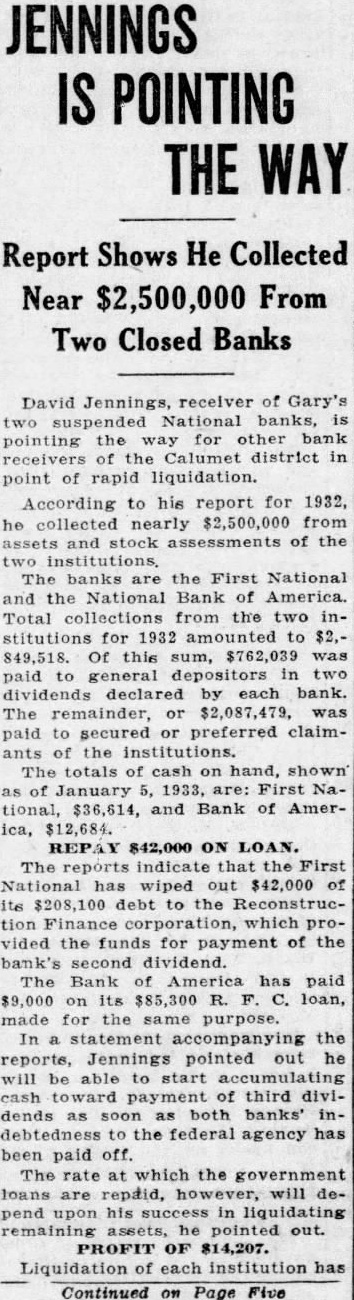
David Jennings, receiver of Gary's suspended pointing the for other receivers of district in point of rapid liquidation. According to his report for 1932, he collected nearly $2,500,000 from stock assessments of the the First National the National Bank of America. Total collections from the infor 1932 to 849,518. Of sum, $762,039 paid declared The remainder, $2,087,479. was secured or preferred claiminstitutions. totals cash hand, shown First National, $36,614, and Bank of America, $12,684. REPAY $42,000 ON LOAN. The indicate that the First has wiped $42,000 its $208,100 debt the Reconstruction Finance which provided the funds for payment of the bank's second dividend. The Bank America has paid $9,000 on $85,300 R. C. loan, made for the same purpose. statement the reports, Jennings pointed start payment of third dividends banks' inthe federal agency has paid at which the loans repaid, will pend upon his out. PROFIT OF $14,207. Liquidation each institution has Continued on Page Five


Article from The Times, January 12, 1933

Click image to open full size in new tab

Article Text

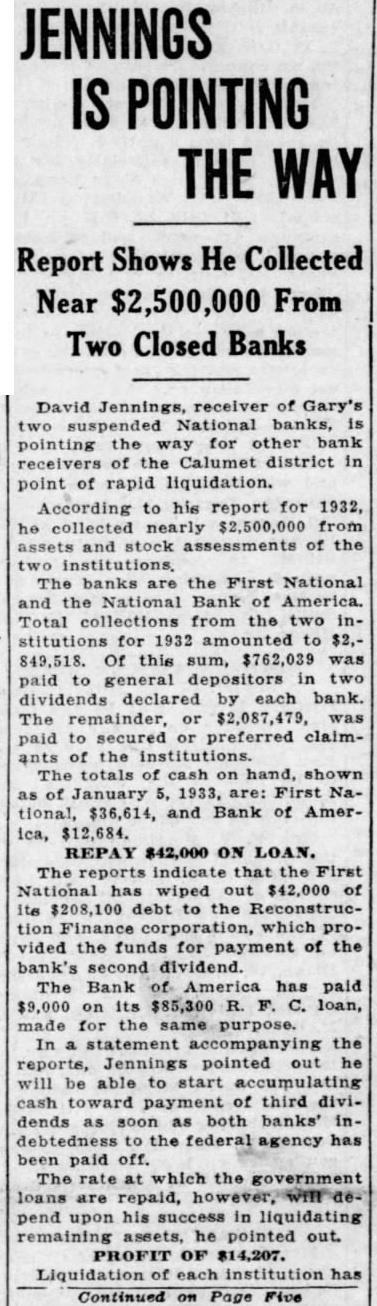
Report Shows He Collected Near $2,500,000 From Two Closed Banks David Jennings, receiver of Gary's suspended National banks, pointing way other bank receivers of the Calumet district in point of rapid liquidation. According his report for 1932, he collected nearly $2,500,000 from assets and stock assessments of the The banks the First National and the National Bank of America. Total collections from the two institutions for 1932 amounted $2.849,518. this sum, $762,039 was paid to general depositors two dividends declared each bank. The remainder, $2,087,479, paid secured or preferred claimants totals hand January First National, $36,614, and Bank of America, $12,684. REPAY $42,000 ON LOAN. The reports First $42,000 of its debt the tion which provided the funds for payment of the bank's second dividend. The Bank America has paid $9,000 its $85,300 R. loan, for accompanying the reports, Jennings pointed will able start cash toward payment third dividends soon both banks' indebtedness the federal agency has been paid off. The which the government loans are repaid, pend upon his success in liquidating remaining assets, he pointed out. PROFIT OF Liquidation each institution has Continued Page Five