Article Text
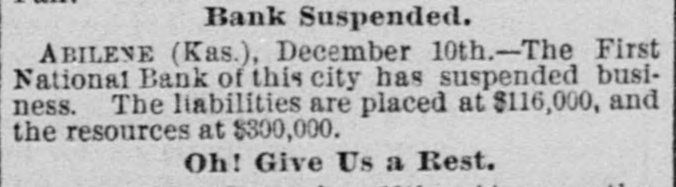
Bank Suspended. ABILENE (Kas.), December 10th.-The First National Bank of this city has suspended business. The liabilities are placed at $116,000, and the resources at $300,000. Oh! Give Us a Rest.
15d5c5b8222cb9a4Public signal of financial health, Full suspension, Books examined
Click image to open full size in new tab
Bank Suspended. ABILENE (Kas.), December 10th.-The First National Bank of this city has suspended business. The liabilities are placed at $116,000, and the resources at $300,000. Oh! Give Us a Rest.
Click image to open full size in new tab
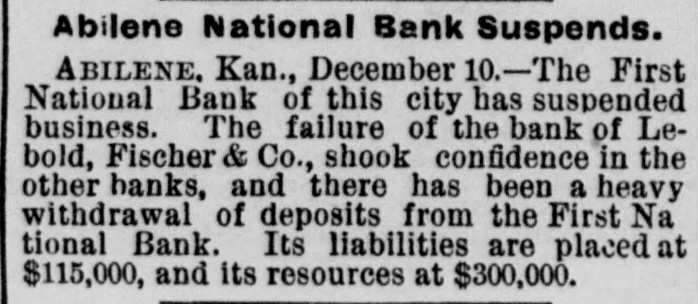
Abilene National Bank Suspends. ABILENE, Kan., December 10.-The - First National Bank of this city has suspended business. The failure of the bank of Lebold, Fischer & Co., shook confidence in the other banks, and there has been a heavy withdrawal of deposits from the First Na tional Bank. Its liabilities are placed at $115,000, and its resources at $300,000.
Click image to open full size in new tab
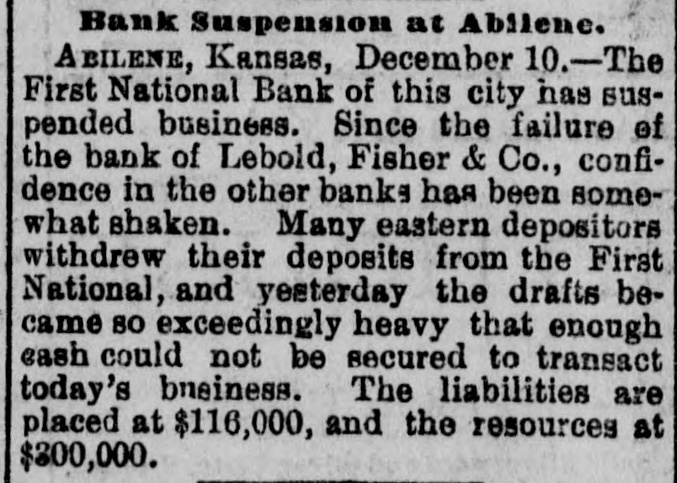
Bank Suspension at Abilene. ABILENE, Kansas, December 10.-The First National Bank of this city has suspended business. Since the failure of the bank of Lebold, Fisher & Co., confidence in the other banks has been somewhat shaken. Many eastern depositors withdrew their deposits from the First National, and yesterday the drafts became 80 exceedingly heavy that enough cash could not be secured to transact today's bneiness. The liabilities are placed at $116,000, and the resources at $300,000.
Click image to open full size in new tab
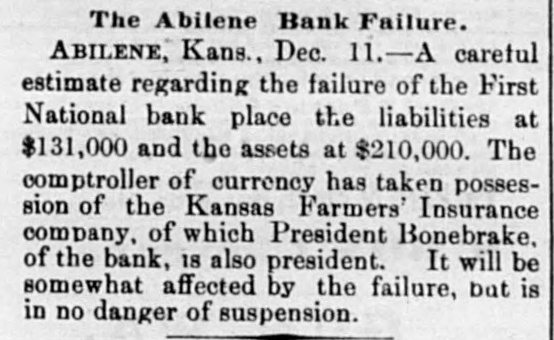
The Abilene Bank Failure. ABILENE, Kans., Dec. 11.-A careful estimate regarding the failure of the First National bank place the liabilities at $131,000 and the assets at $210,000. The comptroller of currency has taken possession of the Kansas Farmers' Insurance company, of which President Bonebrake, of the bank, 18 also president. It will be somewhat affected by the failure, but is in no danger of suspension.
Click image to open full size in new tab
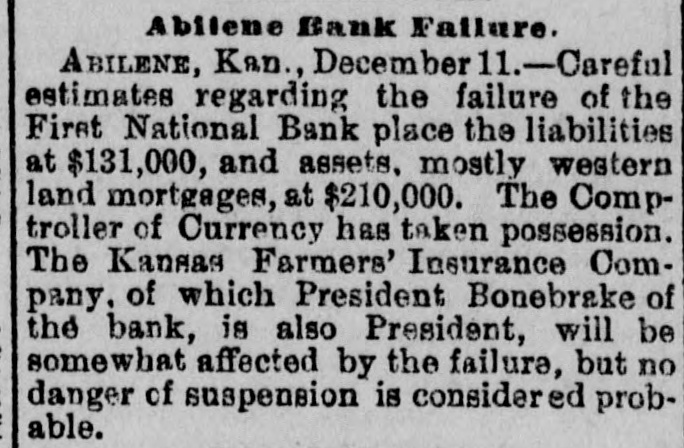
Abilene Bank Failure. ABILENE, Kan., December 11.-Careful estimates regarding the failure of the First National Bank place the liabilities at $131,000, and assets. mostly western land mortgages, at $210,000. The Comptroller of Currency has taken possession. The Kanaas Farmers' Insurance Company, of which President Bonebrake of the bank, is also President, will be somewhat affected by the failure, but no danger of suspension is considered probable.

Click image to open full size in new tab
Fisher was enough for this year, but today brought forth another failure of a similar character which, coming as it does SO soon after the former, will add considerably to the load of the city's misfortune. It is never a pleasure to a newspaper to tell of a business reverse and the REFLECTOR relates the story of today's failure with as much reluctancy as though it had a personal interest in the unfortunate corporation's downfall. THE FIRST NATIONAL'S CLOSE. Those who called at the cashier's window of the First National bank this morning up to 11 o'clock found everything all right, and business was transacted as usual. At that hour the doors were closed, a statement of the bank's standing made out and the institution turned over to the comptroller of the United States currency according to provisions made by law for such occasions. A statement posted on the door informed all, over the signature of the president, J. E. Bonebrake, that owing to the impossibility of securing cash for the transaction of business the doors had been closed, and assuring the public that all depositors would be paid in full. There was little excitement manifested during the afternoon, as all interested seemed to take the matter philosophically and be convinced that their interests would not suffer, altnough they might be inconvenienced for a time by the closing. This is probably the correct view, as it is beyond question that the bank's affairs will be eventually straightened out to the depositors' satisfaction. DRAGGED DOWN. At the last quarterly statement, Oct. 1st, the bank's resources were shown to be $256,064.57. The liabilities including capital stock were about $200,000 leaving a surplus fund of $17,600 and undivided profits of $4,661. The bank was doing a good business, enjoyed an extensive line of discounts and the confidence of the eastern stockholders. But on Oct. 28th came the failure of the Abilene Bank of Lebold, Fisher & Co., with all the widespread notoriety and panicky feeling attendant on such a happening. Every busiuess house in the city felt the stroke, the banks in particular and the First National more especially. The eastern correspondents who had been favoring the bank with their patronage began to get slightly nervous and one by one the certificates of deposit were sent in and the cash surplus diminished. Then valuable lines of discounts which had been given good returns were gradually tapered off and the cash on paper held was demanded. Altogether the drain upon an institution already weakened by the downfall of its neighbor was too much and as the re-discounts could not bei realized upon and accommodations could not be secured from loaners, owing to the uneasiness felt on account of the other bank's closure, it was a foregone conclusion that the crash must come. The fact of carrying considerable paper taken in flush times and now much depreciated was also a factor in the matter. The assets at the shutting of the doors this morning were $238,492.67 and the liabilities, including circulation, $116,254.59. The fact that much of the resources are made up of paper not negotiable at present and much that is only worth a small percentage of its face value caused the crisis. The depositors' claims amount to about $50,000 and will be met in full, as the stockholders are responsible for an amount equal in value to the stock held and in addition to the stock. THE ACTUAL LOSERS. The stockholders will be the ones who will feel the loss. The capital paid in is $100,000. divided into 1,000 shares. These are held by about 150 stockholders scattered all over the nation. Large blocks are held in Freeport, Ills.; Rochester, Victor and Canandaigua, New York; Madison, Ohio; Connecticut, Maine and Massachusetts. The Abilene holders are chiefly the officers and directors. The officers are J. E. Bonebrake, president; G. W. Hurd, vice-president; Harry .Hayes, cashier. OFFICERS NOT BLAMABLE. The officers of the bank have done all in their power to avert the disaster. They are not in any way blamable and could not carry the institution against the great odds which have during the past month been opposing it. On Mr. Harry Hayes, the cashier, the suspension is particularly hard. He has been indefatigable in bis efforts to build up the bank ever since his ac-
Click image to open full size in new tab
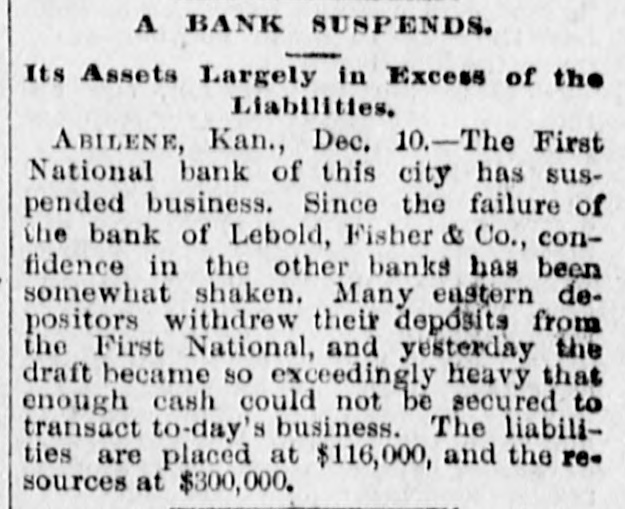
A BANK SUSPENDS. Its Assets Largely in Excess of the Liabilities. ABILENE, Kan., Dec. 10.-The First National bank of this city has suspended business. Since the failure of the bank of Lebold, Fisher & Co., confidence in the other banks has been somewhat shaken. Many eastern depositors withdrew their deposits from the First National, and yesterday the draft became so exceedingly heavy that enough cash could not be secured to transact to-day's business. The liabilities are placed at $116,000, and the resources at $300,000.
Click image to open full size in new tab
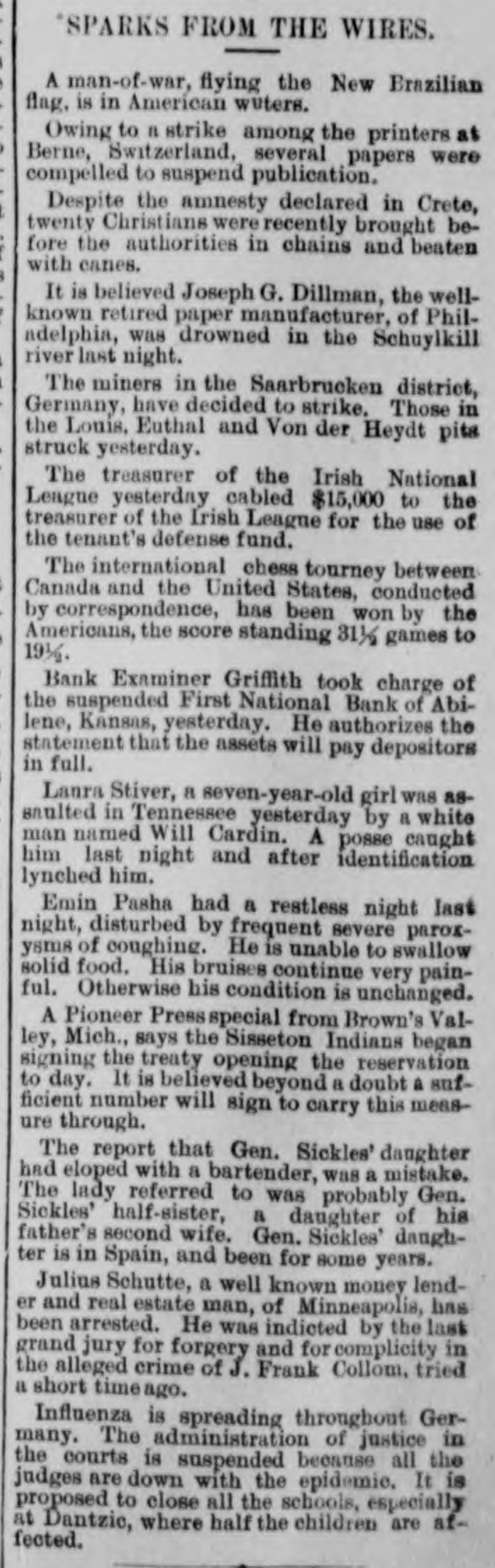
'SPARKS FROM THE WIRES. A man-of-war, flying the New Erazilian flag, is in American waters. Owing to n strike among the printers at Berne, Switzerland, several papers were compelled to suspend publication. Despite the amnesty declared in Crete, twenty Christians were recently brought before the authorities in chains and beaten with canes. It is believed Joseph G. Dillman, the wellknown retired paper manufacturer, of Philadelphia, was drowned in the Schuylkill river last night. The miners in the Saarbrucken district, Germany, have decided to strike. Those in the Louis. Euthal and Von der Heydt pita struck yesterday. The treasurer of the Irish National League yesterday cabled $15,000 to the treasurer of the Irish League for the use of the tenant's defense fund. The international chess tourney between Canada and the United States, conducted by correspondence, has been won by the Americans, the score standing 311/2 games to 191/4. Bank Examiner Griffith took charge of the suspended First National Bank of Abilene, Kansas, yesterday. He authorizes the statement that the assets will pay depositors in full. Lanra Stiver, a seven-year-old girl was assmulted in Tennessee yesterday by a white man named Will Cardin. A posse caught him last night and after identification lynched him. Emin Pasha had a restless night last night, disturbed by frequent severe paroxysms of coughing. He is unable to swallow solid food. His bruises continue very painful. Otherwise his condition is unchanged. A Pioneer Press special from Brown's Valley, Mich., says the Sisseton Indians began signing the treaty opening the reservation to day. It is believed beyond a doubt a sufficient number will sign to carry this messure through. The report that Gen. Sickles' daughter had eloped with a bartender, was a mistake. The lady referred to was probably Gen. Sickles' half-sister, a daughter of his father's second wife. Gen. Sickles' daughter is in Spain, and been for some years. Julius Schutte, a well known money lender and real estate man, of Minneapolis, has been arrested. He was indicted by the last grand jury for forgery and for complicity in the alleged crime of J. Frank Collom, tried a short timeago. Influenza is spreading throughout Germany. The administration of justice in the courts is suspended because all the judges are down with the epidemie. It is proposed to close all the schools, especially at Dantzie, where half the children are affected.

Click image to open full size in new tab
Peter Clausen, a lineman, was fatally burned and died entangled in a mass of wires. Whitney & Co., dry goods commission merchants, at 73 Worth street, New York, made an assignment Monday. The failure is thought to amount to $500,000. The burning of the National steamship dock in New York Saturday afternoon resulted in the death of four persous, the injury of several others and a property loss of $200,000. Mrs. Margaret Dilliard, who, with her paramour, William H. Bartholomew, was convicted of the murder of her husband on the night of September 6 at Biersville, Pa., has been sentenced to be hanged. Mrs. Helen R. Saltus has brought suit for divorce at New York from her husband, Edgar Saltus, the novelist, on the ground of adultery. Elsie W. Smith and Fanny Girvan are named as co-respondents. Rumple, Smith & Co. of New York have been awarded by the authorities of Havana, Cuba, a contract to erect a system of waterworks for that city, at a cost of $2,000,000. The firm bid against a number of European houses. The New York guarantee fund for a world's fair amounts to $5,135,826. A bill will be presented to Congress providing for the creation of a corporation which shall direct the exhibition subject to the supervision of the United States. Mrs. Wiliam J. Foster of Franklin, N. H., was shot dead Saturday evening by Madison G. Colby, a butcher of that town. A feud growing out of disputed boundaries was at the bottom of the deed, although the victim was innocent of connection with it. The Jerome park villa site and improvement company of New York have decided to discontinue racing. Jerome park is to be cut up into lots and sold. Nearly $100,000 was lost on last season's racing, largely owing to the opening of the rival Westchester track. The First national bank of Abilene, Kan., has suspended business. The failure of the bank of Lebold Fisher & Co. shook confidence in the other banks and there has been a heavy withdrawal of deposits from the First national bank. The liabilities are placed at $116,000 and the resources at $300,000. The officers of the bank are Kansas men. The work of refining sugar was begun Monday in Claus Spreckel's immense new sugar refinery on the Delaware river at the foot of Reed street in Philadelphia. The capacity of the refinery is 2,000,000 pounds of sugar every 24 hours. The building, machinery and site cost about $3,000,000 and Mr. Spreckels has already begun to duplicate the buildings, so that the refinery may turn out 4,000,000 pounds daily. The death of Jefferson Davis, ex-President of the southern confederacy, took place at New Orleans on Friday morning last, and the funeral was held in that city on Wednesday. Confederate and Union veterans joined in the service. Mr. Davis was born in Todd county, Ky., June 3, 1808, and graduated at the West Point military academy, but retired from the army in 1835 and entered politics. He was sent to the House in 1845, but resigned to go into the Mexican war. Returning from that he was made a Senator, in which capacity he served the most of the time till the breaking out of the rebellion. His later career is familiar to nearly every one. Johnstown, Pa., was the scene of a terrible disaster Tuesday night, by which ten persons lost their lives and over 75 were injured, some very seriously. As the performance of the "Uncle Tom's Cabin" troupe was drawing to an end in the Main-street opera house, the fire-bell was rung, causing a frantic scramble for the exit. There were 500 or 600 men, women and children in the hall, and to gain the street, it was necessary to pass down a narrow walled-up stair-case and through a very narrow door. The people from the streets rushed into the door from the outside and many were crushed before they could be forced out. It was necessary to turn the hose on the crowd at the door before the rescuers could get at the dead and wounded.
Click image to open full size in new tab
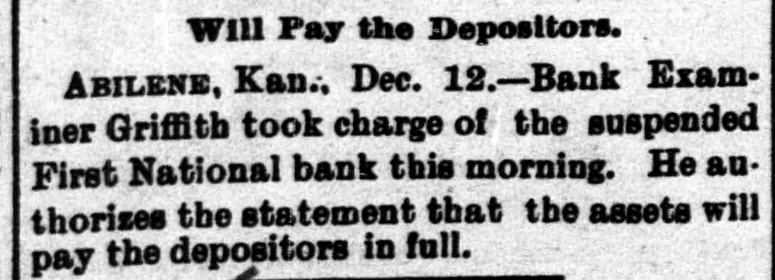
will Pay the Depositors. ABILENE, Kan., Dec. 12.-Bank Examiner Griffith took charge of the suspended First National bank this morning. He authorizes the statement that the assets will pay the depositors in full.

Click image to open full size in new tab
BY TELEGRAPH. Mount Vesuvius is in a state of eruption. 5Honors have commenced pouring in upon Stanley. The First National Bank of Abilene, Kansas, has suspended. Silcott. the defaulting cashier, is believed to be-in Montreal. Fires are still raging in the Anaconda mine at Butte, Montana. new Auditorium Chicago's ground. building cost $4,000,000 exclusive of the Mrs. Scott-Lord, the sister of Mrs. Harrison, died in Washington Tuesday Over 40,000 people viewed the re. mains of Jefferson Davis in New Orleans last Sunday. Chicago's greatly famed Auditorium was dedicated with imposing ceremonies Monday night. Hog cholera is prevalent in some is sections of Kansas. Greenwood County an especial sufferer. An engine on the Santa Fe road in Kansas was derailed the other day by running into a herd of antelope. Twelve lives were lost by a panic day, in a Johnstown, Pa., theater the other caused by a false alarm of fire. Congressman Samuel J. Randall's is much He made s health improved. week. has perceptible gain the last The disastrous tire in the Minneap olis Tribune building is believed to have been the work of an incendiary. The ex-Conferates intend to provide to a fund for the family of Mr. Davis and raise a monument to his memory Nellie Bly telegraphs the World she from Colombo, Island of Ceylon, that s two days ahead of her schedule time. The American legation at Constantinople has decided to demand the trial of Moussa Bey for the murder of a missionary. It is said that an improved telephone which greatly exceeds the present on instrument in range is soon to be placed the market. At the business men's banquet in Boston the other day speeches were made by ex-President Cleveland, Henry Grady and Mr. Carnegie. Spain is much offended at the suggestion of some Congressmen of this count try that negotiations for the purchase of Cuba be entered into Some opposition is being made to the confirmation of Judge Brewer on account of an anti-prohibition decision he made several years ago. Colonel J. R. Rathbone, founder of of the order of Knights of Pythias, who has been lying ill for several weeks at Lima, Ohio, died there Monday afternoon. The English syndicate which recently bought the great flouring mills and of Minneapolis, a for the largest mills and deal elevators have elevators closed of Duluth. Price, $4,000,000. There is a great.snow storm throughout all Central Germany. All the Thuringian railways, as well as all those of the Rhine provinces, are so obstructed that travel for a time is atan end. The ex-Empress of Brazil has received a telegram from Rio Janeiro informing her that all her jewels have been stolen. The loss will be a heavy blow to the imperial family. In the collection were comprised the finest Brazilian diamonds in the world. The Rosenfeld Construction Comhas closed a contract with a party of to build an Las Cruces, N. M., capitalists pany from thirty irrigating miles ditch east, to bring under cultivation 60,000 acres of land. The contract price was $150,000. Work begins at once. Stanley attended divine service on the British man-of-war Torquoise last Sunday. In a brief address to the crew, he said. that he considered that Living stone's mantle had fallen upon his shoulders: that his work had only commenced, of and that he would devote the remainder his life it. The grand prize of $500. offered by Agriculturist best has been to acre the American of potatoes. for awarded the Charles B. Coy, of Aroostook County. Me. was 728 bushels. second was given to Alfred Penn prize His crop Rose, 559 The of Yan, N. Y., for a crop of bushels. Similar prizes are offered for the coming year. The New Orleans Picayune, comon the failure of official notice of of menting tor to take Secretary the death Procsays: "We are strongly led to conclusion that the of so far from War, Mr. the Davis, intending Secretary wrong, has be adopted what he believed,and what we lieve was a wise and conservative course in the premises," woman's national potato contest has taken place. The recently Thisunique wives and contest was engaged in by the of farmers in many parts of the A aynopsis of the result 1,000 contestants and daughters country. there were 200 shows prem. iums uwarded. The first prize was won by Miss Mary Rusk of Madison County III. Yield, 970.00 bushels peracre. The rest of the prizes were awarded for all yields below 925 and above 300 bushels to the acre. steamer Alagias, with the exDom Pedro of party Emperor The Brazil and - that on board, and flying the old Brazilian flag,

Click image to open full size in new tab
Cholera has reappeared at Bagdad. Searle, the champion sculler, is dead. Oliver Johnson, the veteran abolition. ist, is glead, The manager of the London Times, McDonald, is dead. The First National bank, of Abilene, Kansas, has suspended. Peoria, Illinois, offers $50,000 for Sullivan and Jackson to fight there. The female convicts at the Kansas penitentiary mutinied a few days ago, Senator Cockrell, of Missouri, has introduded a bill for I-cent postage on letters. Kilrain was adjudged guilty of an assault and battery by a Mississippi jury and fined $200. The sun does not rise on Mirror lake Yosemite valley, until 11:30 e'clock in the merning. Mrs. Wilson Wadingham, wife of the noted cattle king, has secured a divorce from her husband. Foxes increase so rapidly in several districts of Australia that they are nearly as great a pest as the rabbits. Influenza, said to be the forerunner of cholera, prevails at St. Petersburg, Presth, London, Paris and other European cities. Denver has been assured that shops costing half a million dellars will be erected there by the Union Pacific early next year. Foreign engineers report that at the present rate of sinking, the northern coast of France will, in a few centuries, be completely submerged. Several people were killed and sevenfive injured in a crush caused by an alarm of fire in an opera house at Johnstown, Penn., on the 10th. In a revival meeting at Walla Walla, Oregon, a man confessed that he was a murderer and asked forgiveness. He refused to reveal the circumstances. J. B. Watkins, of Lawrence, Kan,, IS one of the largest land owner ins the United States. He owns 1,500,000 acres in Louisana, but much of it is swamp land. Vegetable flannel is a textile material now being largely manufactured in Germany out of pine leaves. The fiber IS spun, knitted and woren into undergarments and clothing of various kinds. The Russian government is building a railroad across Siberia to the Pacific ocean. There will be 4,000 miles of track and 2,500 miles of river transportation. A cloud burst at Santa Cruz, Califoruia, washed away many miles of railroad track and destoyed fine houses. Joseph Easton was drowned in the flood. Commissioner Morgan has refused his consent to the annual renewal of the contract by which Buffalo Bill secures the services of 300 Sioux Indians, who constitute the feature of Bill's show. Attorneys J. D. Bennett and W. D Kelsey, of Holyoke, Colorado, were fl >gged by the "white caps" and ordered to leave the country last Monday, Trouble over a county seat war was the cause. The Two Republics of the City of Mexico denounces the action of the Chibuabua legislature in repealing the law against ball fighting, although that journal admits that the law has always been evaded with impunity in the city of Juarez. The longest bridge in the world is said to be at Laugange, China, over an arm of the China sea. It is as much as five miles long, built entirely of stone, and has 400 arches, each seventy feet wide. The roadway is also seventy feet in width. A convict named Smith murdered a fellow-convict named Herman Brown in the Jefferson City penitentiary last June. The facts were concealed until a grand jury's investigation brought them out. Smith can be indicted for murder in the first degree. Last Friday night, at a negro festival, near Florence, Alabama, Bod Vaughan (white) quarreled with a negro named Griffin Jones, and began firing at him. Another negro named Brown killed Vaughan with an ax. A large number of armed men came to town with the avowed intentions of lynching the negroes. The sheriff telegraphed the governor for aid, and two militia companies are at Florence guarding the jail, while the lynchers are camped near the city. The Mexican government makes a pretty generous offer to negro colonists from the United States. If within three years 1,000 negro colonists have settled in Mexico it will permit the colonization of 2,000 more for ten years. They will be granted special privileges as soon as they occupy Mexican territary, the most important of which are exemption from military duty and the right to free importations and exportations. As the Mexicans themselves are the worst taxed people in the world the free trade permitted the negro colonists will make them an especially favored class.
Click image to open full size in new tab
An Abilene (Kan.) Bank Suspends. The First National Bank of Abilene, Kan., has suspended operations, and its affairs have been placed in the hands of the Deputy Comptroller of the Currency for settlement. The liabilities are placed at $116,000 and the resources at $800,000. The officers are all Kansas men.
Click image to open full size in new tab
A Receiver Will Be Appointed. ABILENE, Kan., Dec. 18.-Bank Examiner Griffith has completed his examination of the First National bank's affairs and forwarded his report to-day to the comptroller of the currency. The totals are about as at first stated. The assets amount to $232,000; the liabilities to $116,000. The examination shows that a larger portton of the assets than was at first suspected is worthless, being claims on persons of no financial standing. A receiver will be appointed in a few days.
Click image to open full size in new tab
An Abilene (Kan.) Bank Suspends. The First National Bank of Abilene, Kan., has suspended operations, and its affairs have been placed in the hands of the Deputy Comptroller of the Currency for settlement. The liabilities are placed at $116,000 and the resources at $300,000. The officers are all Kansas men.
Click image to open full size in new tab
BEING SETTLED. The Bank Examiner in Charge of the First National. The National bank examiner for Nebraska and Kansas, Mr. J. M. Griffith, of Wahoo, Neb., arrived last night and in pursuance of instructions from the comptroller of the currency took charge of the First National bank's office; and books. The REFLECTOR representative called on Mr. Griffith this afternoon and found him busily engaged looking over the books of the institution. It will be several days, he said, before he can make a detailed statement of the bank's actual condition. When it is prepared it will be transmitted to the comptroller and he will determine what course is to be taken in settling up the bank's affairs. It is probable that a receiver will then be appointed who, upon giving satisfactory bonds, will proceed to dispose of the assets and turn over their sum to the depositors and stockholders. Mr. G. remarked that the depositors, upon proving their claims, would be the first ones satisfied-a fact that will be appreciated by those having money in the bank's vaults. From henceforth the entire management of the institution is in the government's hands and the officers have turned over all memoranda and certificates to the examiner. When his work is completed our readers will be given fuller details of the bank's condition.

Click image to open full size in new tab
Gold Near Topeka. An old California miner by the name of E. Detrick has been prospecting on the place of "Billy" Meed, a farmer living about six miles northwest of Topeka, for some time past, and has found strong indications of gold. He took out some mineral and had it assayed, and found that it yielded gold in påying quantities. He was SO jubilant over his find that he could not keep it to himself, but went to the store of Frank Bebcock and, calling him aside, showed him the certificate of assay, and asked that he keep secret until he could lease the land. He also showed the same to Mr. J. H. Eouchi. Mr. Babcock says that Detrich is a man whom he can vouch for as being truly reliable and honest, and believes that he has found exactly what he claims. The Sugar Scheme. Judge O. B. Hamilton, of Meade, was in Topeka a few days ago, en route from the East. The judge is president of the American Sugar Company which has recently been written up quite extensively in the newspapers in connection with its great scheme to build a sugarmill in every township in Southwest Kansas. He admits, says a paper that city, that two barrels of sugar were imported from Dodge City, and that it was mixed with the sugar made at the Mineola factory by the roasting process. He says that the project to build a large number of sugar-mills was a bona fide enterprise, and that the company would have carried out their contract. The scheme has been so thoroughly aired that it is doubtful whether any thing more will come of it. Judge Hamilton says he has great confidence in the roasting process which is being used at Mineola. The Meade County Sugar Bonds. State Sugar Inspector Kellogg and Secretay Mahler of the board of agriculture have been consulting the Attorney General regarding the steps to be taken to recover $15,000 bonds of Bloom township, Ford County, issued to the American Sugar Company. These bonds are the only ones which were turned over to the company, out of several times that amount voted before the alleged frauds of the company were discovered. The company has given the bonds to a Kansas City banking firm to be negotiated. The Attorney General advised them to bring suits to enjoin the sale of the bonds and to declare them void and secure their cancelation. The Meade people were notified by telegraph of the Attorney General's advice and they telegraphed Secretary Mohler in reply that they would act on the advice immediately. Of Interest to Farmers. The annual meeting of the State Board of Agriculture will convene in Representative hall, Topeka, on January 8, and continue in session three days. The meeting promises to be of unusual interest and much the largest in the history of the board. Senator Plumb is expected to be present and will have something to say. Governor Humphrey will deliver an address, also President George T. Fairchild, ex-Governor Glick and others. Dr. D. E. Salmon, chief of the Bureau of Animal Industry, Washington, will be present and give an address on "Hog Cholera; its Prevention and Remedy." Also parties from Kansas who claim they have an infállible remedy for hog cholera. Colonel Tweedale, of Topeka, will give his theory of irrigation, the most original, comprehensive and practicable yet given to the public. Representativesof both the diffusion and roasting process of sugarmaking will be present and the sugar industry will be thoroughly ventilated and its true status made known. The Alliance and other organizations in the farmer's interest will be represented, and the advantage of thorough organization of farmers will be ably presented and fully discussed. Besides a wide range of interesting topics, agricultural and horticultural will be presented by live, practical farmers from every section of the State. In addition to the meeting of the Board of Agriculture, the Dairymen's Association, the Stockmen's convention and the Swine Breeders' Association all meet during the same week, commencing January 7. Reduced railroad rates will be secured. All farmers who desire to keep abreast of the times should be present at the meeting The Abilene Bank Failure. Bank ExaminerGriffith has completed his examination of the affairs of the First National Bank of Abilene, and has forwarded his report to the Comptroler of the Currency. The totals are about as at first stated. The assets amount to $232,000; the liabilities to $116,000. The examination shows that a larger portion of the assets than was at first supposed is worthless, being claims on persons of no financial standing. A receiver will be appointed. A Warning to Boys. Fred, the six-year-old son of F. W. Hanson. of Enterprise, while catching rides on the cars sastained such a severe injury to his foot and ankle that amputation at the knee was necessary. A Bank Failure. The Bank of Richfield failed to open a few mornings since, having made assignment for the benefit of creditors. Assets, $50,000; liabilities, $21,000. Want Sugar Factories.
Click image to open full size in new tab
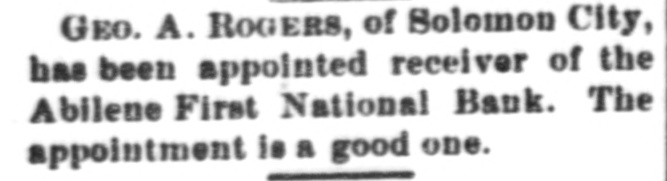
GEO. A. ROGERS, of Solomon City, has been appointed receiver of the Abilene First National Bank. The appointment is a good one.
Click image to open full size in new tab
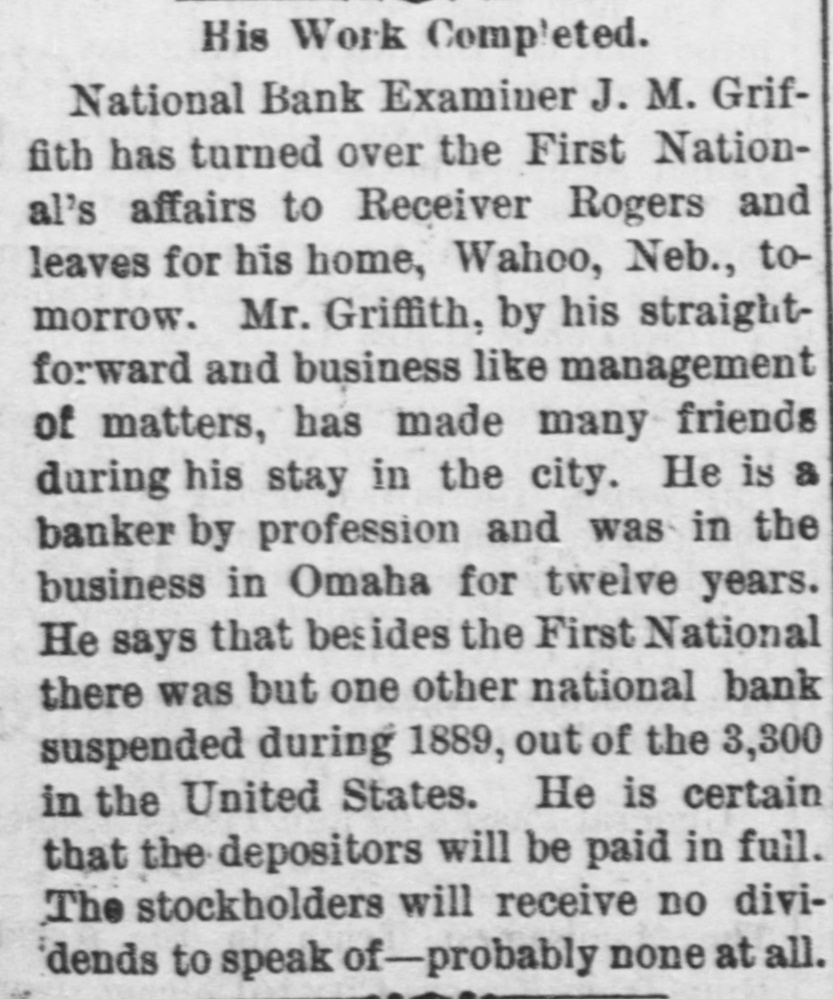
His Work Completed. National Bank Examiner J. M. Griffith has turned over the First National's affairs to Receiver Rogers and leaves for his home, Wahoo, Neb., tomorrow. Mr. Griffith, by his straightforward and business like management of matters, has made many friends during his stay in the city. He is a banker by profession and was in the business in Omaha for twelve years. He says that besides the First National there was but one other national bank suspended during 1889, out of the 3,300 in the United States. He is certain that the depositors will be paid in full. The stockholders will receive no dividends to speak of-probably none at all.
Click image to open full size in new tab
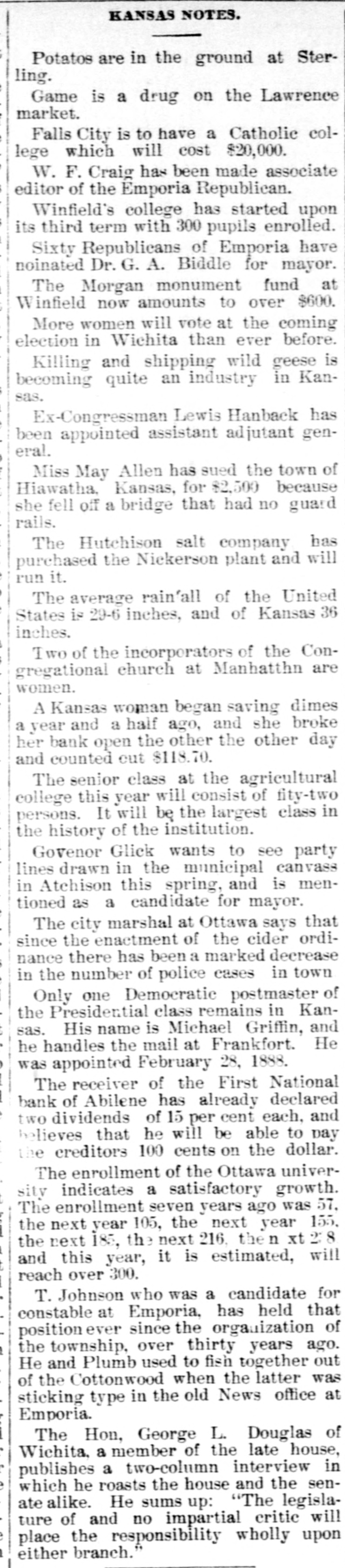
KANSAS NOTES. Potatos are in the ground at Sterling. Game is a drug on the Lawrence market. Falls City is to have a Catholic college which will cost $20,000. W. F. Craig has been made associate editor of the Emporia Republican. Winfield's college has started upon its third term with 300 pupils enrolled. Sixty Republicans of Emporia have noinated Dr. G. A. Biddle for mayor. The Morgan monument fund at Winfield now amounts to over $600. More women will vote at the coming election in Wichita than ever before. Killing and shipping wild geese is becoming quite an industry in Kansas. Ex-Congressman Lewis Hanback has been appointed assistant adjutant general. Miss May Allen has sued the town of Hiawatha, Kansas, for $2,500 because she fell off a bridge that had no guard rails. The Hutchison salt company has purchased the Nickerson plant and will run it. The average rainfall of the United States is 29-6 inches, and of Kansas 36 inches. Two of the incorporators of the Congregational church at Manhatthn are women. A Kansas woman began saving dimes a year and a half ago, and she broke her bank open the other the other day and counted cut $118.70. The senior class at the agricultural college this year will consist of fity-two persons. It will be the largest class in the history of the institution. Govenor Glick wants to see party lines drawn in the municipal canvass in Atchison this spring, and is mentioned as a candidate for mayor. The city marshal at Ottawa says that since the enactment of the cider ordinance there has been a marked decrease in the number of police cases in town Only one Democratic postmaster of the Presidential class remains in Kansas. His name is Michael Griffin, and he handles the mail at Frankfort. He was appointed February 28, 1888. The receiver of the First National bank of Abilene has already declared two dividends of 15 per cent each, and believes that he will be able to pay the creditors 100 cents on the dollar. The enrollment of the Ottawa university indicates a satisfactory growth. The enrollment seven years ago was 57, the next year 105, the next year 155, the next 185, the next 216, then xt 2:8 and this year, it is estimated, will reach over 300. T. Johnson who was a candidate for constable at Emporia, has held that position ever since the organization of the township, over thirty years ago. He and Plumb used to fish together out of the Cottonwood when the latter was sticking type in the old News office at Emporia. The Hon, George L. Douglas of Wichita, a member of the late house, publishes a two-column interview in which he roasts the house and the senate alike. He sums up: "The legislature of and no impartial critic will place the responsibility wholly upon either branch."
Click image to open full size in new tab
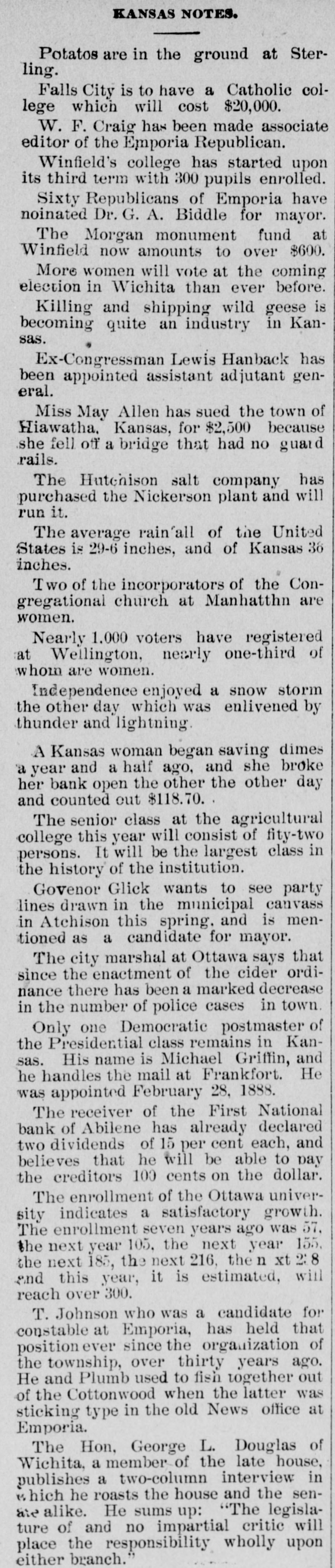
# KANSAS NOTES. Potatos are in the ground at Sterling. Falls City is to have a Catholic college which will cost $20,000. W. F. Craig has been made associate editor of the Emporia Republican. Winfield's college has started upon its third term with 300 pupils enrolled. Sixty Republicans of Emporia have noinated Dr. G. A. Biddle for mayor. The Morgan monument fund at Winfield now amounts to over $600. More women will vote at the coming election in Wichita than ever before. Killing and shipping wild geese is becoming quite an industry in Kansas. Ex-Congressman Lewis Hanback has been appointed assistant adjutant general. Miss May Allen has sued the town of Hiawatha, Kansas, for $2,500 because she fell off a bridge that had no guard rails. The Hutchison salt company has purchased the Nickerson plant and will run it. The average rain'all of the United States is 29-6 inches, and of Kansas 36 inches. Two of the incorporators of the Congregational church at Manhatthn are women. Nearly 1.000 voters have registered at Wellington, nearly one-third of whom are women. Independence enjoyed a snow storm the other day which was enlivened by thunder and lightning. A Kansas woman began saving dimes a year and a half ago, and she broke her bank open the other the other day and counted out $118.70. The senior class at the agricultural college this year will consist of fity-two persons. It will be the largest class in the history of the institution. Govenor Glick wants to see party lines drawn in the municipal canvass in Atchison this spring, and is mentioned as a candidate for mayor. The city marshal at Ottawa says that since the enactment of the cider ordinance there has been a marked decrease in the number of police cases in town. Only one Democratic postmaster of the Presidential class remains in Kansas. His name is Michael Griffin, and he handles the mail at Frankfort. He was appointed February 28, 1888. The receiver of the First National bank of Abilene has already declared two dividends of 15 per cent each, and believes that he will be able to pay the creditors 100 cents on the dollar. The enrollment of the Ottawa university indicates a satisfactory growth. The enrollment seven years ago was 57, the next year 105, the next year 155, the next 185, the next 216, then xt 2:8 and this year, it is estimated, will reach over 300. T. Johnson who was a candidate for constable at Emporia, has held that position ever since the organization of the township, over thirty years ago. He and Plumb used to fish together out of the Cottonwood when the latter was sticking type in the old News office at Emporia. The Hon, George L. Douglas of Wichita, a member of the late house, publishes a two-column interview in which he roasts the house and the senate alike. He sums up: "The legislature of and no impartial critic will place the responsibility wholly upon either branch."