5484. Citizens National Bank (South Bend, IN)

Bank Information

Episode Type
Run โ†’ Suspension โ†’ Unsure
Bank Type
national
Bank ID
4764
Charter Number
4764
Start Date
February 23, 1933
Location
South Bend, Indiana (41.683, -86.250)

Metadata

Model
gpt-5-mini
Short Digest
eed05915c9c4991c

Response Measures

Full suspension

Receivership Details

Depositor recovery rate
100.0%
Date receivership started
1934-03-23
Date receivership terminated
1940-03-30
Share of assets assessed as good
82.9%
Share of assets assessed as doubtful
13.9%
Share of assets assessed as worthless
3.1%

Description

Articles report heavy commercial withdrawals (chain stores and large firms) that forced heavy withdrawals in late February 1933 and the closing/suspension of the Citizens National Bank by mid-March 1933, tying up municipal and school funds. The sources do not state whether the bank later reopened or was placed in receivership, so permanence of closure is unclear.

Events (4)

1. June 25, 1892 Chartered
Source
historical_nic
2. February 23, 1933 Run
Cause Details
Large commercial accounts (chain stores and big firms) withdrew deposits, triggering heavy withdrawals/strain on bank liquidity.
Measures
Not specified for the bank; local institutions (First Bank & Trust, Merchants National) and county treasurer provided funds and loans to meet payrolls and obligations.
Newspaper Excerpt
the Citizens National Bank, a $10,000,000 institution, was forced to close because of the heavy withdrawals of commercial accounts by large firms, especially the chain stores, which transferred their accounts to Chicago
Source
newspapers
3. March 1, 1933* Suspension
Cause Details
Bank closed/suspended operations in March 1933, leaving city and school deposits tied up; likely a direct consequence of preceding heavy withdrawals by commercial accounts and the general banking moratorium in March 1933 but articles do not state specific legal action (receiver) or reopening plans for this bank.
Newspaper Excerpt
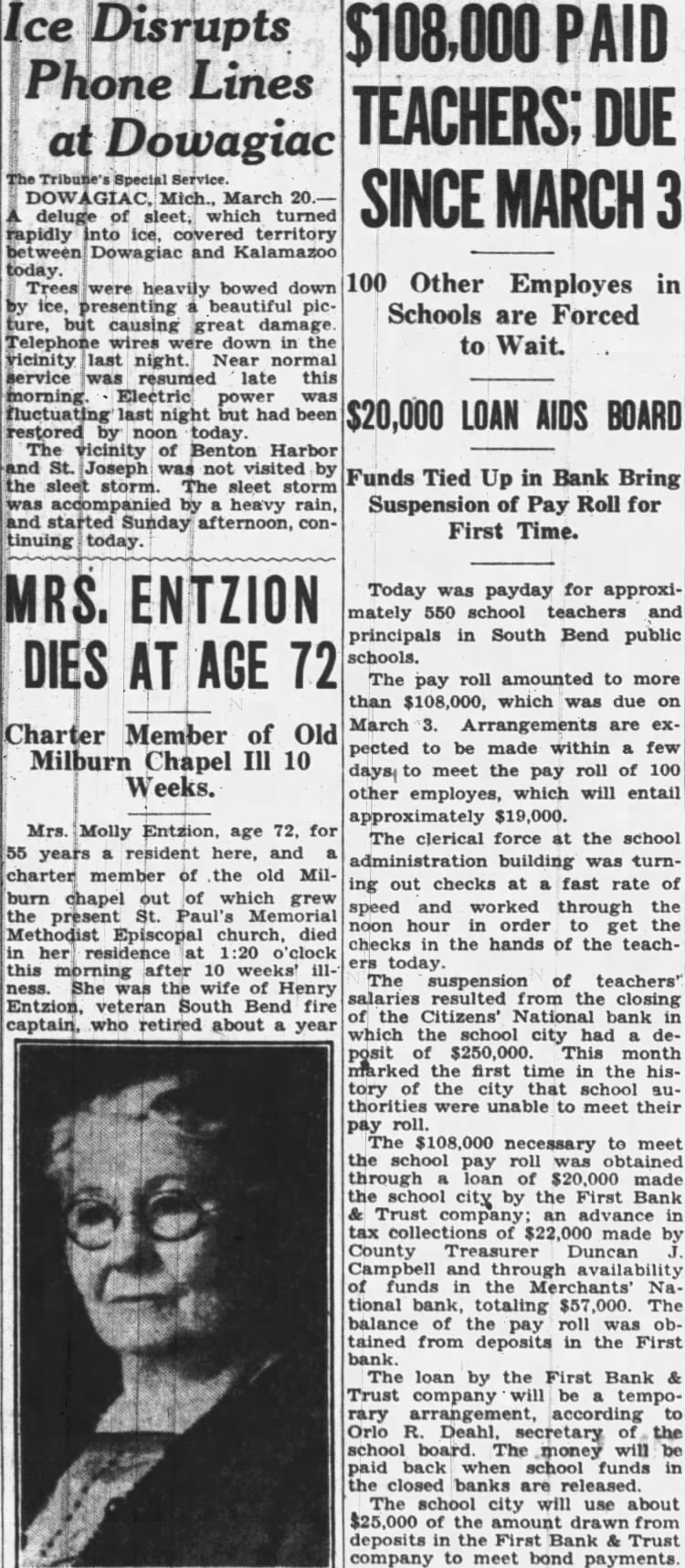
The suspension of teachers' salaries resulted from the closing of the Citizens' National bank in which the school city had deposit of $250,000.
Source
newspapers
4. March 23, 1934 Receivership
Source
historical_nic

Newspaper Articles (3)

Article from The South Bend Tribune, March 20, 1933

Click image to open full size in new tab

Article Text

$108,000 PAID TEACHERS; DUE SINCE MARCH 3 100 Other Employes in Schools are Forced to Wait. $20,000 LOAN AIDS BOARD Funds Tied Up in Bank Bring Suspension of Pay Roll for First Time. Today was payday for approximately 550 school teachers and principals in South Bend public schools. The pay roll amounted to more than $108,000, which was due on March 3. Arrangements are ex. pected to be made within a few days to meet the pay roll of 100 other employes, which will entail approximately $19,000. The clerical force at the school administration building was turning out checks at a fast rate of speed and worked through the noon hour in order to get the checks in the hands of the teachers today. The suspension of teachers' salaries resulted from the closing of the Citizens' National bank in which the school city had deposit of $250,000. This month marked the first time in the history of the city that school authorities were unable to meet their pay roll. The $108,000 necessary to meet the school pay roll was obtained through a loan of $20,000 made the school city by the First Bank & Trust company; advance in tax collections of $22,000 made by County Treasurer Duncan Campbell and through availability of funds in the Merchants National bank, totaling $57,000. The balance of the pay roll was obtained from deposits in the First bank. The loan by the First Bank & Trust company will be a temporary arrangement, according to Orlo R. Deahl, secretary of the school board The money will be paid back when school funds in the closed banks are released. The school city will use about $25,000 of the amount drawn from deposits in the First Bank & Trust company to meet bond payments


Article from The South Bend Tribune, March 20, 1933

Click image to open full size in new tab

Article Text

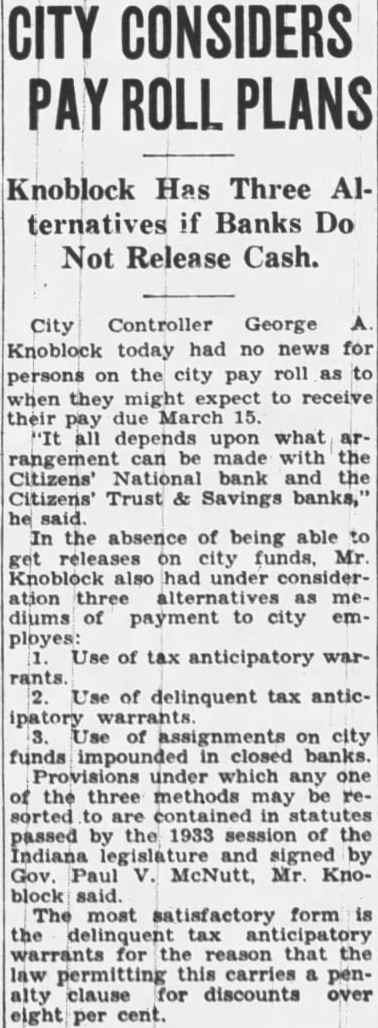
CITY CONSIDERS PAY ROLL PLANS Knoblock Has Three Alternatives if Banks Do Not Release Cash. City Controller George A Knoblock today had no news for persons on the city pay roll as to when they might expect to receive their pay due March 15. "It all depends upon what arrangement can be made with the Citizens' National bank and the Citizens' Trust & Savings banks," he said. In the absence of being able to get releases on city funds, Mr. Knoblock also had under consideration three alternatives as mediums of payment to city employes: 1. Use of tax anticipatory war2. Use of delinquent tax anticipatory warrants Use of assignments on city funds impounded in closed banks. Provisions under which any one of the three methods may be resorted to are contained in statutes passed by the 1933 session of the Indiana legislature and signed by Gov. Paul V. McNutt, Mr. Knoblock said The most satisfactory form is the tax anticipatory warrants for the that the law permitting this carries a penalty clause for discounts over eight per cent.


Article from Tri-State Alliance, April 6, 1933

Click image to open full size in new tab

Article Text

CHAIN WITHDRAWALS WORSE HOARDERS Hoarders Money Eventually Returns But Hoarders Never It is against the law of the Government to hoard gold according to the act passed by Congress in an effort to solve the banking problems of the country. In this proclamation closing the banks, the President also utilized the constitutional powers vested in him any financial transactions by banks, investment companies, the etc. in order to conserve the money of country. That indicated very definitely a serious condition but what difference is there between hoarding on the part of the people and wfhtdrawal of business and profits from communities by the chain systems? Taking money out of banks to be hoarded naturally reduces the available supply but in the end this money will be returned to circulation in the town where it was withdrawn from the banks. There is difference between hoarding money and chain store operations as they withdraw not only money but business from local concerns, manufacturers, wholesalers, banks, employment, etc. That disappears and none of it ever returns except the skimmed milk which hey leave for low taxes, rents on which they are now welching, the small salaries they pay to their employes and the little business they leave locally which is usually placed at no profit because of concessions demanded. Withdraw All Money The chain system of hoarding is far more reprehensible, therefore. But in this emergency they have shown their true patriotism (?) to the communities in which they do business by withdrawing all of the cash. they take in and cart it off to sette of the large cities. They have even withdrawn from the banks and placed in in safe deposit vaults, while in other instances just as soon as the scare asserted itself they instructed their executives around the country to take their money out of banks. Of course, the effect of that was to reduce the amount of currency in banks. That could not result otherwise than in hastening the closing of banks by declaring holiday. The illustration from South Bend, Ind. published last wek where the Citizens National Bank, a $10,000,000 institution, was forced to close because of the heavy withdrawals of commercial accounts by large firms, especially the chain stores, which transferred their accounts to Chicago" is a concrete illustration. That tells the whole story of the disloyalty of the chains to the communities in which they operate stores as also to the banks. This condition does not apply to South Bend alone, but as pointed out last week it was done in Ohio, where they withdrew their deposits February 23 before the Moratorium was declared. This demonstrates their policy of selfishness as they were not concerned over the trouble they were not concerned over the trouble they were making for these banks and the people. The Public Pays the Bill To what extent the chains contributed to the bank holiday will never be known but it is self evident from their actions in withdrawing their cash that no bank can operate on basis where money of town immediately transfered from it. The only opportunity for bank to recover is thru other tocal concerns whose busines the chain systems covet. Thev strain every way to take that from them and of course the banks must suffer the penalty. The public pays the bill when it patronizes any these chains because they are giving them their money which they earn locally and the chain stores immediately withdraw it from local circulation Aside from this the public is to blame also for aiding and abetting in destroying local business among manufacturers, wholesalers and retailers as that automatically reduces the number of jobs available. In other words the public is cutting off its nose to spite its face. This calamity which has overtaken the country is directly traceable to the chain system. That $10,771,000,000 which the chains obtained in 1929 according to the Government Census figures has hurt. When the past 12 years are taken into consideration the sum total of these withdrawals represent not less than $60,000,000,000. In addition there is the transfer of that business from local businesses to the chains which has added to the trouble. The cumulative result, as consequence, is more than even the United States could stand.-Interstate Gro-