Click image to open full size in new tab
Article Text
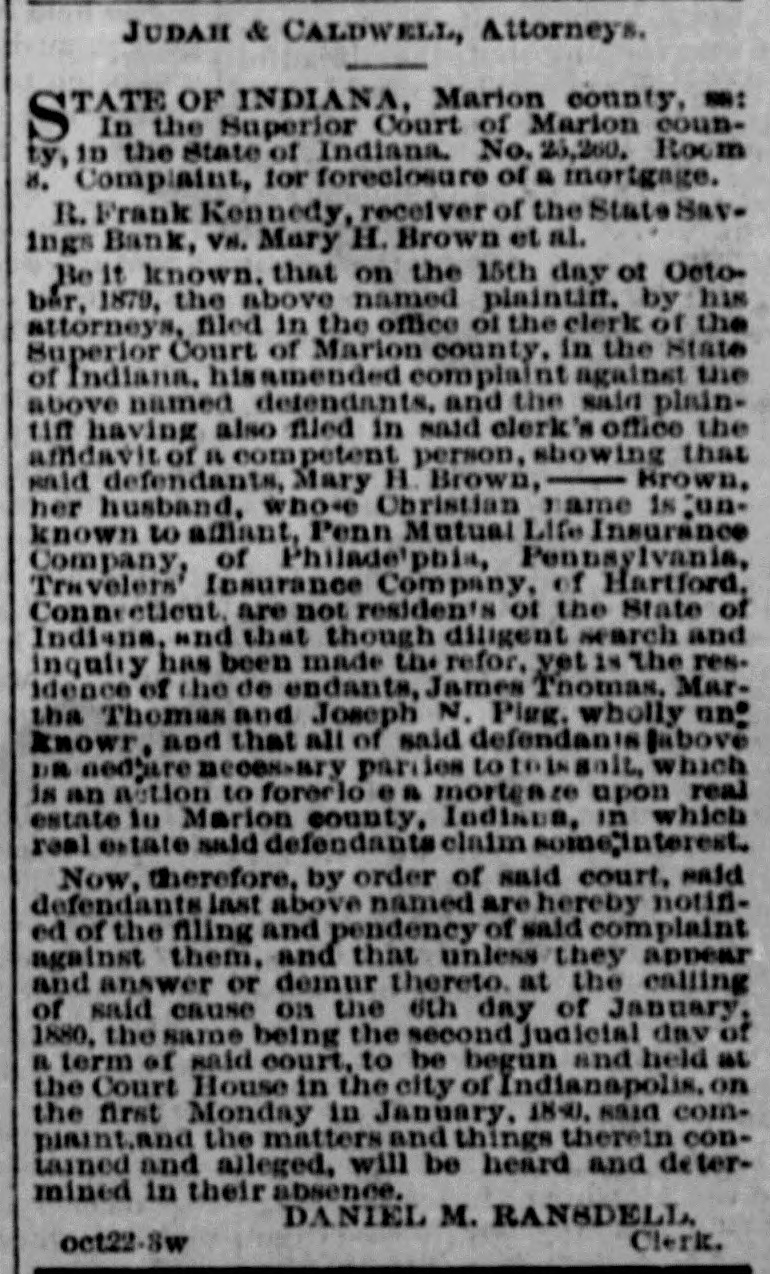
THE STATE SAVINGS BANKS. Examiner Bingham's Report Shows Them To Be in Good Condition. Their Business Growing and with Satisfactory Result-Suggestions to the Legislature for Amendments to the Law. The report of J. J. Bingham, examiner of the Indiana savings banks, has been filed with Auditor of State Rice. Besides giving a comprehensive statement of the condition of the savings banks, he makes several suggestions and recommendations to the General Assembly regarding changes in the laws govern ing the management of the savings institutions. Six years ago, the examiner says, I made an examination of the savings banks, when there were ten of these institutions doing business in Indiana, four of which have since gone into liquidation. The German Savings Bank, of Lafayette, paid all its obligations in full. The State Savings Bank, of Indianapolis, paid its depositors 95 per cent. The Richmond Savings Bank went into voluntary liquidation. The receiver of the Indianapolis Savings Bank has not yet wound up its business, but has paid the depositors thus far 60 per cent. There is yet remainingproperty unsold and appraised at $25.000, and if it sells for its valuation the depositors may receive 10 per cent. additional. It will thus be seen that the savings bank system in Indiana has not been altogether a success, as the number has decreased, with a loss to the depositors in two of those that went into liquidation. However, five now doing business have been successful in a marked degree, and one, while doing a limited business, has a good financial standing. The six banks now doing business are the People's Savings Bank, at Evansville; the St. Joseph County Savings Bank, at South Bend; the People's Savings Bank, at South Bend; the Terre Haute Savings Bank, the LaPorte Savings Bank and the Lafayette Savings Bank. The last named is the oldest and most prosperous in the State. The dividends paid by these banks are 21 and 3 per cent. semi annually. There has been a small increase in the deposits during the last year, notwithstanding the stagnation in business. The reports of the banks on Oct. 31, 1883, showed deposits amounting to $2,108,427.47. This year they reach $2,171,009.05, an increase of $62,581.58. The loans have also increased. A year ago they were $1,774,399 94, and this year they are $1,826,173.98, an increase of $51.774.54 "Our savings act," the examiner says, "tis an embodiment of the main features of the laws which govern such banks in the Eastern States. A careful review will show that the system is an anomaly in banking. The depositors, who are really the stockholders. have no word in their management. The trustees have no money invested in them. They give no assurance to the depositors but their good name for honesty, and their skill as financiers and business managers. They must each own unincumbered real estate worth at least $5,000, and they must have a certificate from the judge of the Circuit Court in the county in which the bank is located that they are in all respects suitable persons to be intrusted with the management of a savings bank. After this is done, the institutions. so far as the management is concerned, are self perpetuating. The law evidently contemplates them as charitable institutions, for the pay of the trustees is but a trifle. "There is one feature of the law which creates a guarantee for the security of the depositors, in requiring a certain per cent. of the profits to be set aside for a surplus fund, until it reaches at least 10 per cent. of the deposits. Only one of the banks thus far has carried out this provision of the law to the full extent. In other banks the losses have been charged to this fund, and the failure to credit it with a sufficient percentage of the profits has operated to keep it below a surplus of 10 per cent. of the de posits. In these cases it has been upon the theory that the earnings belong to the depositors and should be distributed among them. It would be better for the depositors to have appropriated a sufficient sum from the earnings to provide such a guarantee, rather than to have larger dividends, until this end is accomplished. While large dividends are very acceptable. security of the principal is a more important consideration." In examining the banksagreatdeal of liberty or license in carrying out the provisions of the law was found. but the examiner further says that his examinations, in many respects. have been gratifying and satisfactory. There is improvement in the methods of business. especially as to details. The system of book keeping exhibits the daily transactions accurately. and the accounts with the depositors have such corroborative proofs that they cannot fail to be satisfactory, as well as correct, which prevents controversy or dissatisfaction in settlements. Threeof the banks have women for book-keepers, and the work is done with an intelligence, neat ness and promptness that demonstrates their capacity in this department of labor, fully equal to the opposite sex. The examiner suggests to the Legislature. as additional security to the depositor. either an amendment to section 2730, Revised Statutes, 1881, to make imperative the accumulation of the surplus fund, to equal 10 per cent. of the deposits in a reasonable period, or by providing for a paid-up capital stock equal to at least 10 per cent of the deposits, to be regarded as a guarantee fund, and so invested in safe and valuable securities, with