5127. Indianapolis National Bank (Indianapolis, IN)

Bank Information

Episode Type
Run โ†’ Suspension โ†’ Closure
Bank Type
national
Bank ID
581
Charter Number
581
Start Date
July 25, 1893
Location
Indianapolis, Indiana (39.768, -86.158)

Metadata

Model
gpt-5-mini
Short Digest
60e05da64248321f

Response Measures

Borrowed from banks or large institutions, Public signal of financial health, Full suspension, Books examined

Receivership Details

Depositor recovery rate
61.0%
Date receivership started
1893-08-03
Date receivership terminated
1900-05-03
OCC cause of failure
Fraud
Share of assets assessed as good
41.9%
Share of assets assessed as doubtful
24.9%
Share of assets assessed as worthless
33.3%

Description

Contemporary articles report a heavy run and that the Indianapolis National Bank did not open on July 25, 1893; suspension was attributed to stringency and failures of other local banks (Louisville, New Albany) and large withdrawals by country banks. The bank was placed in receivership and its officers (President Theodore P. Haughey and others) were later arrested and convicted for misapplication/embezzlement, indicating permanent closure. Dates are drawn from newspaper datelines (July 25, 1893 for run and suspension).

Events (5)

1. November 21, 1864 Chartered
Source
historical_nic
2. July 25, 1893 Run
Cause
Local Banks
Cause Details
Failures at Louisville and New Albany and heavy withdrawals by country banks aggravated local stringency and triggered large withdrawals from the Indianapolis National.
Measures
President Theodore Haughey consulted with other bankers and had previously secured $50,000 to tide the bank over; sought assistance but ultimately suspended.
Newspaper Excerpt
At 11 o'clock a heavy run was being made on the Indiana National.
Source
newspapers
3. July 25, 1893 Suspension
Cause
Local Banks
Cause Details
Bank suspended due to monetary stringency and contagion from failures (Louisville, New Albany) plus withdrawals by country banks reducing balances.
Newspaper Excerpt
The Indianapolis National bank did not open its doors this morning... it was thought best to suspend.
Source
newspapers
4. August 3, 1893 Receivership
Source
historical_nic
5. * Receivership
Newspaper Excerpt
Receiver Hawkins (receiver) and subsequent federal investigations and indictments of officers are reported; Receiver Hawkins is mentioned in later proceedings and suits by the receiver follow the failure.
Source
newspapers

Newspaper Articles (25)

Article from The Columbia Herald, May 19, 1893

Click image to open full size in new tab

Article Text

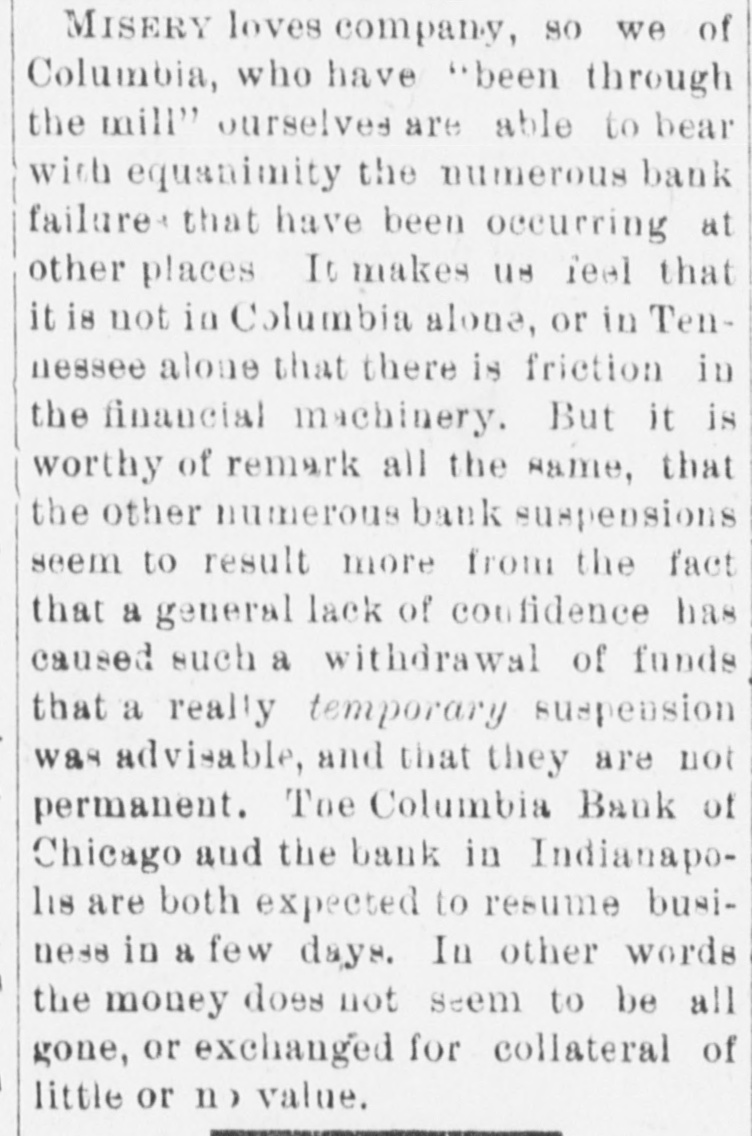
MISERY loves company, so we of Columbia, who have "been through the mill" ourselves are able to bear with equanimity the numerous bank failure+ that have been occurring at other places It makes us feel that it is not in Columbia alone, or in Tennessee alone that there is friction in the financial machinery. But it is worthy of remark all the same, that the other numerous bank suspensions seem to result more from the fact that a general lack of confidence has caused such a withdrawal of funds that a really temporary suspension was advisable, and that they are not permanent. Toe Columbia Bank of Chicago and the bank in Indianapolis are both expected to resume business in a few days. In other words the money does not seem to be all gone, or exchanged for collateral of little or n value.


Article from The Providence News, July 25, 1893

Click image to open full size in new tab

Article Text

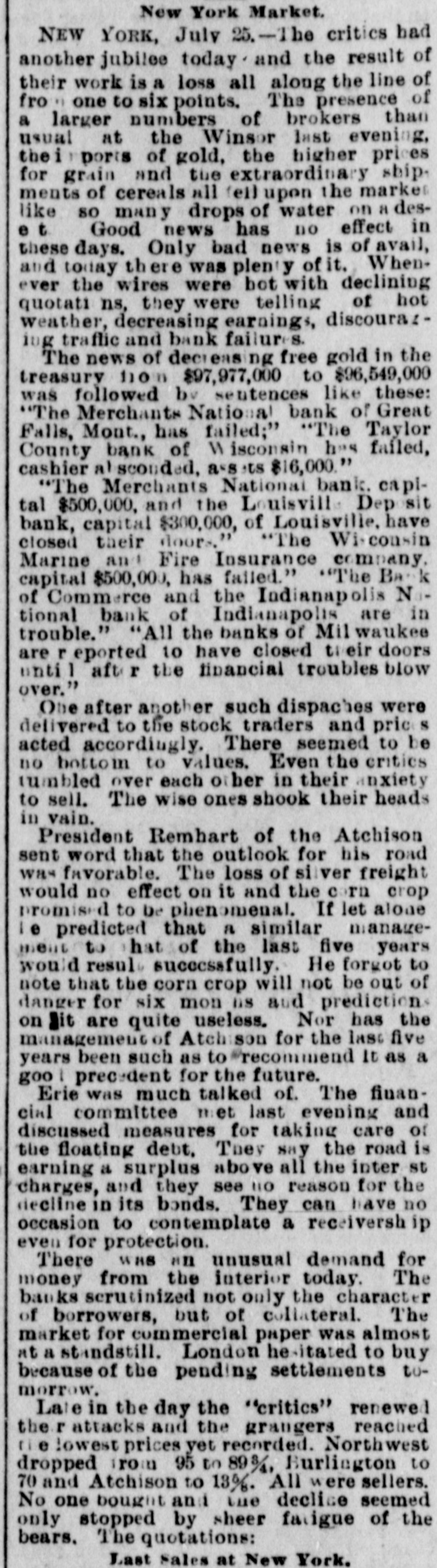
New York Market. NEW YORK, July 25.-The critics had another jubilee today and the result of their work is a loss all along the line of fro one to six points. The presence of a larger numbers of brokers than usual at the Winsor last evening, thei ports of gold, the higher prices for grain and the extraordinary shipments of cereals all (ell upon the market like so many drops of water on a deset Good news has no effect in these days. Only bad news is of avail, and today there was plenty of it. Whenever the wires were bot with declining quotati ns, they were telling of hot weather, decreasing earnings, discouraziug traffic and bank failures. The news of decreasir free gold in the treasury non $97,977,000 to $96,549,000 was followed bv sentences like these: "The Merchants National bank of Great Falls, Mont., has failed;" "The Taylor County bank of isconsin has failed, cashier sconded, assets $16,000." "The Merchants National bank. capital $500,000, and the Louisville Dep sit bank, capital $300,000, of Louisville, have closed their doors." "The Wi-consin Marine and Fire Insurance company. capital $500,000, has failed." "The Bank of Commerce and the Indianapolis Notional bank of Indianapolis are in trouble." "All the banks of Mil waukee are r eported to have closed tweir doors until aft. r the financial troubles blow over." One after another such dispaches were delivered to the stock traders and price S acted accordingly. There seemed to be no bottom to values. Even the critics tumbled over each other in their anxiety to sell. The wise ones shook their heads in vain. President Rembart of the Atchison sent word that the outlook for his road was favorable. The loss of silver freight would no effect on it and the corn crop promised to be phenomenal. If let alone le predicted that a similar management to shat of the last five years would resule successfully. He forgot to note that the corn crop will not be out of danger for six mon ns and predictions on Bit are quite useless. Nor has the management of Atchison for the last five years been such as to Precommend It as a goo I precedent for the future. Erie was much talked of. The financial committee met last evening and discussed measures for taking care of the floating debt. They say the road is earning a surplus above all the inter st charges, and they see no reason for the decline in its bonds. They can have no occasion to contemplate a receiversh ip even for protection. There WHS an unusual demand for money from the interior today. The banks scrutinized not only the character of borrowers, but of collateral. The market for commercial paper was almost at a standstill. London he-itated to buy because of the pending settlements tomorrow. Late in the day the "critics" renewed the r attacks and the grangers reached rie lowest prices yet recorded. Northwest dropped from 95 to 89 3/4, Burlington to 70 and Atchison to 13%. All were sellers. No one bought and tue declise seemed only stopped by sheer fatigue of the bears. The quotations: Last Sales at New York.


Article from The Herald, July 26, 1893

Click image to open full size in new tab

Article Text

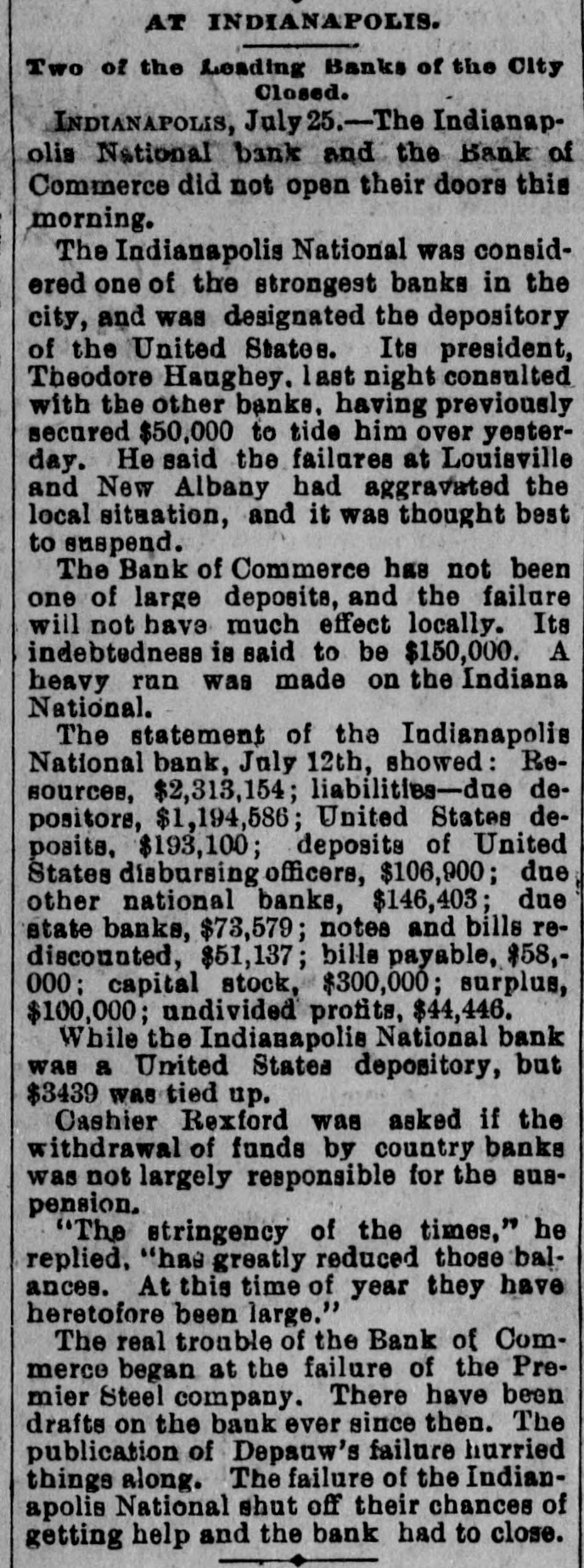
AT INDIANAPOLIS. Two of the Leading Banks of the City Closed. INDIANAPOLIS, July 25.-The Indianapolis National bank and the Bank of Commerce did not open their doors this morning. The Indianapolis National was considered one of the strongest banks in the city, and was designated the depository of the United States. Its president, Theodore Haughey. last night consulted with the other banks, having previously secured $50,000 to tide him over yesterday. He said the failures at Louisville and New Albany had aggravated the local situation, and it was thought best to suspend. The Bank of Commerce has not been one of large deposits, and the failure will not have much effect locally. Its indebtedness is said to be $150,000. A heavy run was made on the Indiana National. The statement of the Indianapolis National bank, July 12th, showed: Resources, $2,313,154; liabilities-due depositore, $1,194,586; United States deposits, $193,100; deposits of United States disbursing officers, $106,900; due other national banke, $146,403; due state banks, $73,579; notes and bills rediscounted, $51,137; bille payable, $58,000: capital stock, $300,000; surplus, $100,000; undivided profits, $44,446. While the Indianapolis National bank was a United States depository, but $3439 was tied up. Cashier Rexford was asked if the withdrawal of funds by country banks was not largely responsible for the BUSpension. "The stringency of the times, he replied, "has greatly reduced those balances. At this time of year they have heretofore been large." The real trouble of the Bank of Commerce began at the failure of the Premier Steel company. There have been drafts on the bank ever since then. The publication of Depauw's failure hurried things along. The failure of the Indianapolis National shut off their chances of getting help and the bank had to close.


Article from The Morning Call, July 26, 1893

Click image to open full size in new tab

Article Text

HEAVY. BANK FAILURES. The Trouble Getting Farther East Every Day. INDIANAPOLIS, Jvly 25.-The Bank of Commerce did not open its doora this morning. The Indianapolis National Bank also failed to open its doors. The Indianapolis National was considered one of the strongest banks in the city, and was designated as a depository of the United States. President Theodore Haughey consulted with other bankers last night, having previously secured $50,000 to tide him over yesterday. He said the failures at Louisville and New Albany had aggravated the local situation, and it was thought best to suspend. The Bank of Commerce has not been one of large deposits, and the failure will not have much effect locally. The indebtedness is said to be $150,000. At 11 d'clock a heavy run was being made on the Indiana National. The statement of the Indianapolis National Bank, July 12, showed resources of $2,313,154; liabilities due depositors, $1,194,586: United States deposits, $193,100; deposits of United States disbursing officers, $100,800; due other national banks, $140.403; due State banks. $73,570; notes and bills rediscounted, $51,137; bills payable, $58,060; capital stock. $300,000; surplus, $100,000; undivided profits, $44,448. While the Indianapolis National Bank was a United States depository but $3439 was tied up. Cashier Rexford was asked if the withdrawal of funds by country banks was not largely responsible for the suspension. "The stringency of the times." he replied, "has greatly reduced those balances. At this time of the year they have heretofore been large." The real trouble of the Bank of Commerce began at the failure of the Premier Steel Company. There have been drafts on the bank ever since then. The publication of Depauw's failure hurried things along. The failure of the Indianapolis National shut off their chances of getting help and the bank had to close. FINDLAY, Ohio. July 25.-The Farmers' National Bank, one of the popular financial institutions of the city, closed to-day because of the inability to realize upon its assets. The officers assert that they will be able to pay the depositors dollar for dollar and have a surplus when the affairs of the bank are settled up. Ever since the failure of ex-Secretary Charles Foster the bank has been drawn upon heavily, and was unable at the present time to meet the constant drain. There was no run on the other banks in the city. LOUISVILLE, Ky., July 25.-The Louisville Deposit Bank failed to open its doors to-day. The Merchants' National Bank has suspended. The Fourth National Bank has suspended. were runs on several other banks, but mostly There small, all stood the strain. The failure of the Merchants' National was caused by the withdrawals of country banks. The Deposit Bank was not a member of the Clearing-house, and none of the other banks would assist it. The National as a the caused by the Fourth panic failed failure considered result of others. of bad. None of the failures are The depositors of the two national will be in National has a chants' banks paid capital fnll. of The $500,000. Merthe Fourth National a capital of $300,000 and surplus of $25,000. The Deposit Bank has a capital of $300,000, surplus $16,000. The last statement of the Fourth National showed a paid in capital stock of $300,000, surplus fund of $37,000 and undivided profits of $27,956. The Merchants had a paid in capital of $500,000. a surplns of $100,000 and undivided profits of $21,384. The Deposit Bank statement showed a capital stock of $300,000 and undivided profits of $19,155. All the bank officials confidence that no one a express realize will on lose the cent if they get time to assets. Shortly after the assignment of the Louisville Deposit Bank President Schwartz filed an individual assigament of personal property to the same The assignee. all his Sweetwood assignment, Distillery Com- Mr. pany also made an Schwartz being president of that company also. No statement has yet been prepared.


Article from The Daily Morning Astorian, July 26, 1893

Click image to open full size in new tab

Article Text

WRECKS IN INDIANAPOLIS. Indianapolis, July 25,-The Indianapolis National bank, and the Bank of Com merce failed to open their doors this morning: The Indianapolis National was considered one of the strongest banks in the city and was the desig nated depository of the United States. At eleven a heavy run was begun on the Indiana National.


Article from The Record-Union, July 26, 1893

Click image to open full size in new tab

Article Text

BANK FAILURES. Several More Large Institutions in the East Suspend. INDIANAPOLIS, July 25.-The Bank of Commerce did not open its doors this morning. The Indianapolis National Bank also failed to open its doors. The Indianapolis National was considered one of the strongest banks in the city, and was designated as a depository of the United States. President Theodore Haughey consulted with other bankers last night, having previously secured $50,000 to tide him over yesterday. He said the failures at Louisville and New Albany had aggravated the local situation and it was thought best to suspend. The Bank of Commerce has not been one of large deposits, and the failure will not have much effect locally. The indebtedness is said to be $150,000. At 11 o'clock a heavy run was being made on the Indiana National. The statement of the Indianapolis National Bank July 12th showed resources of $2,313,154; liabilities-due depositors, $1,194,586; United States deposits, $193,100; deposits of United States disbursing officers, $100,800; due other National banks, $140,403; due State banks, $73,570; notes and bills rediscounted, $51,137; bills payable, $58,060; capital stock, $300,000; surplus, $100,000; undivided profits, $44,448. While the Indianapolis National Bank was a United States depository, but $3,687 was tied up. Cashier Tiexford was asked if the withdrawal of funds by country banks were not largely responsible for suspension. "The stringency of the times," he replied, "has greatly reduced those balances. At this time of the year they have heretofore been large." The real trouble of the Bank of Commerce began at the failure of the Premier Steel Company. There have been drafts on the bank ever since. Then the publication of Depauw's failure hurried things along. The failure of the Indianapolis National shut off their chances of getting help, and the bank had to close. CLOSED ON ACCOUNT OF THE STRINGENCY. MILWAUKEE, July 25.-The Wisconsin Fire and Marine Insurance Bank closed its doors this morning. The bank was commonly known as the Mitchell Bank. A notice on the door says: "Closed on account of monetary stringency." The statement on the 1st inst. places the resources at $8,946,344. The liabilities are: Due depositors, $7,870,504; due others, $500,000. The bank has a capital of $500,000, of which John I. Mitchell holds $313,300; David Ferguson, $166,600; Washington Becker, $20,000; J. B. Murphy, $100. The undivided profits are $75,841. The Milwaukee people had become imbued with the idea that this old bank was a Gibraltar of finance, and could not credit the reports that it had closed. It was the general belief that when all the other banking institutions had disappeared from the face of the earth the bank which Alexander Mitchell founded would continue to do business at the old stand. Cashier Murphy says the bank has been subjected to a heavy strain and the end was inevitable, but that the bank is not insolvent, and only time is needed to meet every liability. Washington Becker has been appointed receiver. The city of Milwaukee has $1,600,000 in the bank and will probably have to temporarily suspend payment. The bank was the depository of the Chicago, Milwaukee and St. Paul Railroad, and arrangements had been made for the payment of checks drawn on that bank by the Wisconsin National Bank. Runs were at once started on a number


Article from The Kimball Graphic, July 29, 1893

Click image to open full size in new tab

Article Text

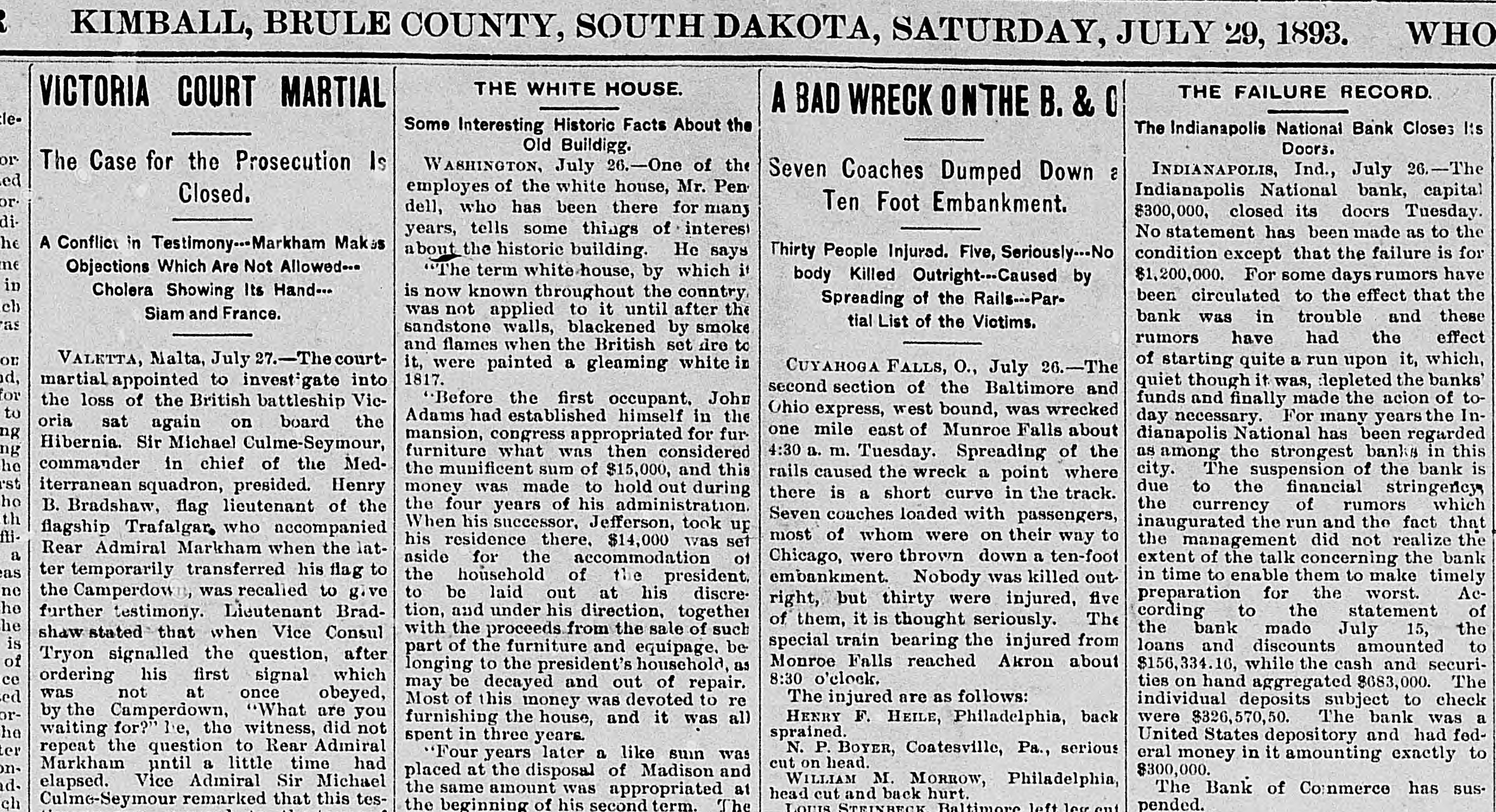
KIMBALL, BRULE COUNTY, SOUTH DAKOTA, SATURDAY, JULY 29, 1893. WHO THE WHITE HOUSE. THE FAILURE RECORD. VICTORIA COURT MARTIAL A BAD WRECK ONTHE B. & 0 leSome Interesting Historic Facts About the The Indianapolis National Bank Close: Its Old Buildigg. Doors. or The Case for the Prosecution Is WASHINGTON, July 26.-One of the INDIANAPOLIS, Ind., July 26.-The Seven Coaches Dumped Down a led employes of the white house, Mr. Pen Indianapolis National bank, capital Closed. or. Ten Foot Embankment. dell, who has been there for many $300,000, closed its doors Tuesday. diyears, tells some things of interest No statement has been made as to the he A Conflict in Testimony. Markham Makes about the historic building. He says Thirty People Injured. Five, Seriously.. condition except that the failure is for ne Objections Which Are Not Allowed"The term white house, by which it $1,200,000. For some days rumors have body Killed Outright---Caused by in Cholera Showing Its Hand-.. is now known throughout the country been circulated to the effect that the Spreading of the Rails---Parch was not applied to it until after the Siam and France. bank was in trouble and these tial List of the Viotims. as sandstone walls, blackened by smoke rumors have had the effect and flames when the British set dre to or VALKTTA, Malta, July 27.-The courtof starting quite a run upon it, which, it, were painted a gleaming white in CUYAHOGA FALLS, O., July 26.-The d, 1817. martial appointed to investigate into quiet though it was, depleted the banks' second section of the Baltimore and for Before the first occupant, John funds and finally made the acion of tothe loss of the British battleship VicOhio express, west bound, was wrecked to Adams had established himself in the day necessary. For many years the Inoria sat again on board the one mile east of Munroe Falls about ng dianapolis National has been regarded mansion, congress appropriated for furHibernia. Sir Michael Culme-Seymour, ng furniture what was then considered as among the strongest banks in this 4:30 a. m. Tuesday. Spreading of the commander in chief of the Medhe the munificent sum of $15,000, and this city. The suspension of the bank is rails caused the wreck a point where rst iterranean squadron, presided. Henry due to the financial stringency, money was made to hold out during there is a short curve in the track. ho the currency of rumors which the four years of his administration. B. Bradshaw, flag lieutenant of the Seven coaches loaded with passengers, th inaugurated the run and the fact that When his successor, Jefferson, took up flagship Trafalgar. who accompanied ffimost of whom were on their way to his residence there, $14,000 was set the management did not realize the Rear Admiral Markham when the lata aside for the accommodation of Chicago, were thrown down a ten-foot extent of the talk concerning the bank as ter temporarily transferred his flag to in time to enable them to make timely the household of the president, embankment. Nobody was killed outne to be laid out at his discrethe Camperdow was recalled to give preparation for the worst. Acright, but thirty were injured, five he cording to the statement of tion, and under his direction, together further testimony. Lieutenant Bradof them, it is thought seriously. The he the bank made July 15, the with the proceeds from the sale of such shaw stated that when Vice Consul is special train bearing the injured from loans and discounts amounted to part of the furniture and equipage. be Tryon signalled the question, after of Monroe Falls reached Akron about $156,334.16, while the cash and securilonging to the president's household, as 8:30 o'clock. ordering his first signal which ce may be decayed and out of repair. ties on hand aggregated $683,000. The was not at once obeyed, ed The injured are as follows: individual deposits subject to check Most of this money was devoted to re by the Camperdown, "What are you orHENRY F. HEILE, Philadelphia, back were $326,570,50. The bank was a furnishing the house, and it was all waiting for?" be, the witness, did not he sprained. spent in three years. United States depository and had fedrepeat the question to Rear Admiral ter N. P. BOYER, Coatesville, Pa., serious "Four years later a like sun was eral money in it amounting exactly to cut on head. Markham until a little time had on$300,000. placed at the disposal of Madison and WILLIAM M. MORROW, Philadelphia, elapsed. Vice Admiral Sir Michael d. The Bank of Commerce has susthe same amount was appropriated at head cut and back hurt. Culme-Seymour remarked that this tesch Louis STEINBECK Baltimore left less cut pended. the beginning of his second term. The
Article from St. Paul Daily Globe, August 5, 1893

Click image to open full size in new tab

Article Text

PAYING PENSIONS. How the Old Soldiers Got Their Money. INDIANAPOLIS, Ind., Aug. The payment of pensions began in this city at 6 o'clock this morning by checks issued on the subtreasury at New York. In order to expedite matters four of the leading local banks agreed to furnish currency to the amount represented by checks presented in person. This action was made necessary by the suspension of the indianapolis National bank some time ago, which was a United States depository. This morning the banks sent a representative with $105,000 to the pension office, and au noon this sum was about exhausted. The banks say, however, that they will continue to furmish the money, and when the payment is completed will express these checks to the sub-treasury at New York. The checks are being taken up without expense to the pensioners. The crowd presenting certificates this morning was greater than ever before on the first day of the payment of pensions. Quite a number, on appearing at the office, learned that the payment of their pensions had been suspended, and, taken as a whole, the long line was an uneasy one.


Article from The Seattle Post-Intelligencer, August 22, 1893

Click image to open full size in new tab

Article Text

Donaldson, president of the First National bank, of Marion, Kan. It is charged that Donaldson secured loans from the bank, of which he is president, for personal use without adequate security. He has since disappeared and the bank is short $23,013. James Doughty, of Sioux City, arrived today and after a conference with Attorney Wollman and Bank Examiner Latimer swore out a warrant for Donaldson's arrest, alleging embezzlement, misappropriation of funds and forgery. The facts as told by Mr. Doughty make Donaldson's embezzlement from the Marion bank appear simply a drop in the bucket compared with the ex-banker's transactions in Iowa, Donaldson, who is in the eighties, besides owning a majority of the stock of the First National bank of Kansas City, controlled two state banks. His transactions through them were not successful, and in 1886 he closed out the two small banks and, securing considerable money from the Marion bank, started the Union Trust Company, of Sioux City, Ia. As feeders for it he established a chain of banks in Iowa, eleven in number. His ventures, however, did not develop according to his expectations, and from subsequent events it becomes apparent that he determined to realize what cash he could and leave the country. Accordingly, last winter he opened a branch office here and disposed of a large amount of the securities and assets of the Iowa concerns. The Union Trust Company was among the first financial institutions to go under when the financial difficulties began last spring. With it went down the eleven Iowa banks. Doughty, who was interested in the Union Trust Company, says the examination of the company's affairs and the affairs of the eleven Iowa banks shows a deficit of at least $600,000. # Indianapolis Bank-Wreckers Arrested. INDIANAPOLIS, Aug. 21. -This afternoon Theodore P. Haughey, president of the wrecked Indianapolis National bank, was arrested at his home near this city on a warrant sworn out by Receiver Hawkins, charging him with embezzlement and misapplication of funds and credits of the bank. Simultaneously with the arrest of Haughey Federal officers arrested his son, Schuyler C. Haughey, president of the Indianapolis Curled Hair Works and Indianapolis Glue Works, and later Francis A. Coffin, president of the Indianapolis Cabinet Company; Percival Coffin, vice president of the company and Albert T. Reed, treasurer of the same concern. Young Haughey, Coffin and Reed are charged with having aided and abetted the elder Haughey in the embezzlements and misappropriations charged against him. The arrested men were taken before United States Commissioner Van Buren, who released them on bonds furnished as follows: Theodore P. Haughey, $10,000; Schuyler C. Haughey, $10,000; Francis A. Coffin, $5,000; Percival Coffin, $5,000, and Albert T. Reed, $5,000.


Article from Essex County Herald, November 3, 1893

Click image to open full size in new tab

Article Text

Domestic News in Brief. Wm Scanlin, the Oneonta, N. Y., wife murderer, was sentenced to life imprisonment. The gold mining fever has again broken out in Brown and Morgan counties, Indiana. "Uncle" Perry who killed a woman years ago to get $15 for her corpse, died in a Baltimore. Md., poorhouse. One of four men arrested for robbery at Buffalo, N. Y., has confessed that they had planned to rob the bank of Buffalo. Gov. Pattison, of Pennsylvania, says he will stand by the state statues if any coal combine is formed. The Battle Creek wreck victim sent to Edwardsburg, Mich., as Mrs. E. A. Aldrich has been identified as Mrs. S. D. Wood, of Cato, N. Y. The United States Treasury gold reserve is now $88,000,000 and by continued redemptions of paper currency it is hoped to steadily increase it. Ex-Senator William S. Woodin, of Auburn, N. Y., sustained a stroke of paralysis and lies in a precarious condition. A blizzard from the North, accompanied by a dense snow storm, swept over Lake Supetior. The schooner George was destroyed. at a loss of $28,000, and other wrecks are expected. The Pennsylvania Nautical Schoolship Saratoga was damaged to the extent of $500 by being run into by a schooner in tow of a tug. August Summerfelt, of Pittsburg, beat his ten year-old son so seriously that the little fellow leaped from a window and was killed. The father is held for murder. John Hempleman, a farm hand, under arrest in Portsmouth, O., for raising an order from 35 cents to 45 cents, borrowed a L. knife from a bystander and severed his jugular vein, dying in a short time. 3. The worst drought in twenty years prevails 2 in Southern and Western Texas. The Coloro ado River is lower than since 1881. Farmers x near Austin are hauling water ten and fifteen e miles. Cattle are in bad condition to begin e the winter. of d The officers of the International Typoat graphical Union have sued the officers of the d failed Indianapolis, Ind., National Bank for y 835,000 damages, setting forth that false rep4. resentations by the bank officers led them to h make deposits for the union. t. William V. Maroney, a wealthy North Caro in lina tobacco planter, objected to the presence he of a negro at a depot lunch-counter at Cin xoinnati, and undertook to eject him. Both were badly bruised in the fight. Marone or lost a $125 diamond ring and was fined $2 ed and costs. ty


Article from The Waco Evening News, November 6, 1893

Click image to open full size in new tab

Article Text

THE EVENING NEWS. MONDAY, NOVEMBER 6, 1893. Bank Officers in Court. Special to The News. INDIANAPOLIS, Ind., Nov. 6,The federal grand jury for the November term was impanelled today. Among those who were in 2 DELIVERY WE court in response to summonses Local Time Card. were President Haughey and his son Schuyler of the bankrupted Missourt, Mansas a Texas. Indianapolis National bank, and Passenger Trains-South Bound Francis and Percival Coffin, the No. Iarrives book keeper and treasurer respec10:40 p. No. 1 leaves 10:00 p. tively of the wrecked institution. To, 8 arrives 10:40 a. No. Sleaves 10:50a They have been at liberty under bonds of $10,000 each in the case of North Bound. 5- G W THE TRA the Haugheys, and of $5,000 each No. 2 arrives 6:30 No. 2 leaves 6:40 s, m for the salaried tools. Expert No. 4 arrives 6 10 p. Hayes has completed his examina. No. 4 leaves 6 20 P, m J. H. SMITH tion of the books, and a dupli. Ticket Agent, No. 119 South Fourth Street cate of his report is in the hands of United States The Cotton Belt Attorney Burke. The expert and Has increased her service to double daily Receiver Hawking will be the two trains. principal witnesses, while addiTrain No. 4 leaves 7.00 8. II Great rain No. 1 arrives 8:45 tional evidence will be vouchsafed carin No. 1 leaves 10:00 a. Train No 2 arrives 6.40 p.m to the grand jury by depositors who Irain No. 2 leaves 7:40 p. n. intrusted their funds to the bank liNo. 2 carries through sleer er for St, Louis via A within a few hours of its collapse. Iron Mounta'n. No 4 carries through sleeper to Cairo All trains through to Memphis and The two Haugheys have been just Cairo without change. as much in evidence around the For further particulars call on W. 8. GILLESP R Agent, town since the collapse of the bank 112 South Fourth St. as at any time in the heyday of H.&T.C. their popularity, and judging from No. 88 Arr 8:15 2. m the greetings that they receive on of BANI 38 L'v 6:80 a. Vest bound 81 Arr the streets their friends may still be 8:45 p. of numbered by the legion. The venerable ex president has a figure of 11:45 a. 82 L'v Monday Gast bound 34 Arr 8:20 p. just as erect, a step just as firm, in 84 L'v 8:40 p. I and just as clear a complexion as will W.E. OWENS. Ticket Agent, when he was one of the most popDress Under Pacific Hotel Block. Opposite Postomer ular and trusted citizens of Indiana polis, while his son Schuyler connSan Antonio and Aransas Pass. Between tinues to attire himself with all the fastidiousness that characterized his 10UTH BOUND--NO. 82.--NORTH BOUND--NO 8 appearance while ducks and drakes Lv Waco at 7 a. m. I Arrives 9:30 D. n ir were being played with the money Will of the unfortunate depositors. NIN AUANIA porte


Article from The Indianapolis Journal, November 14, 1893

Click image to open full size in new tab

Article Text

# QUESTION OF OFFSETS Propositions Made by Creditors of the Indianapolis Bank. How the Controller of the Currency Is Likely to Handle the Matter- Some Precedents. Complications in the affairs of the Indianapolis National Bank have reopened at the office of the Controller of Currency over the question of offsets. It has been the tradition of the office for almost as many years as the oldest employe can remember, to permit no offsets in making collections for liquidating national banks except in rare cases. The instances where offsets were permitted were where the makers of the notes were found to be worthless, but the indorsers were depositors with and creditors of the bank. Rather than demand the cash of the indorsers, they were permitted to take up the notes with checks against their own credit with the bank. But in every instance where this was permitted the bank was solvent and all depositors were paid in full. Wherever the bank was unable to fully liquidate, offsets were refused, even to favor the unfortunate indorsers, as related, because it made it possible for injustice to be worked upon those who were not fortunate enough to arrange for offsets; and then it was possible for the maker of a note who was really able to pay his obligation to the bank to plead inability, and so throw the payment upon his indorser, who wanted to turn in his account against the bank and who received the cash from the drawer of the note. The Controller of the Currency will, shortly, take up for decision some knotty problems reported to have been sent either by Receiver Hawkins or others connected with the affairs of the Indianapolis. A number of debtors and creditors of the bank have submitted propositions bearing directly or indirectly upon the general question of offsets. It is known that the creditors of the defunct institution cannot be paid in full, and the disposition of the Controller is to protect the depositors in every way possible, and to not allow those who owe the bank to go about and coolly arrange with those who have deposits in it so as to take up their paper, even though there is not an arrangement by which the debtor and creditor share and share alike the benefits which would accrue through the offset plan, although it is acknowledged that it may be necessary to permit a limited amount of offsets. The Controller has intimated that he would likely treat each offset proposition upon its merits. If this is done, and no general rule applies, there may be offsets allowed. Controller Eckels, who is a good lawyer, a hard and practical worker, is conscientiously studying the question, and it will be no surprise if he should depart somewhat from traditions.


Article from The Indianapolis Journal, November 17, 1893

Click image to open full size in new tab

Article Text

AFTER THE WRECKERS Federal Grand Jury Begins to Examine Witnesses. Expert Hays and Examiner Young Among Those Called Yesterday -More Documents. The federal grand jury got down to business yesterday and were behind closed doors from 9 o'clock in the morning until 4 o'clock in the afternoon. Deputy United States Attorney Edwin Corr took charge of the jury in the morning. Eight of the jurymen summoned to appear were absent on account of sickness. The jury elected a clerk whose business it is to write out all the testimony submitted for the use of the United States attorney. The case of the Indianapolis National Bank was the first considered, and the jury listened to a detailed account of all that has happened since the failure of the bank. Assistant United States Attorney Corr informed them that Theodore P. Haughey, Schuyler C. Haughey, Francis A. Coffin, Percival B. Coffin and Frank Reed had been arrested and were under bond subject to the action of the grand jury. In the meantime the witnesses who are to testify in the case surged into the clerk's office for registration. Among them were E. E. Rexford, who was cashier of the bank at the time of its suspension; W. F. Golt, paying teller; William A. Bradshaw and N. W. Ferguson, clerks, and Frank W. Hays, the controller's expert sent here to go through the books. William A. Bradshaw was the first man put on the witness stand. He had charge of the bank's discount books. Expert Hays occupied the rest of the forenoon with the jury. The witnesses kept pouring in until it was necessary to open United States Attorney Burke's office for their comfort. Voiney T. Malott presented himself for service in the forenoon and was given permission to go back to his business subject to telephone call. National Bank Examiner Hugh Young, who took charge of the bank soon after its suspension, also reported for duty and spent the afternoon in the jury room. Documents and papers from banks outside of this city, who did business with the Indianapolis National, were received and stored away with Officer Corrigan, who guards these documents in the absence of the jury. From the present indications the grand jury will facilitate matters as much as ,possible and push the investigation through at a good rate of speed, as the amount of matter to pass under their observation is so voluminous such action will be necessary.


Article from The Portland Daily Press, November 24, 1893

Click image to open full size in new tab

Article Text

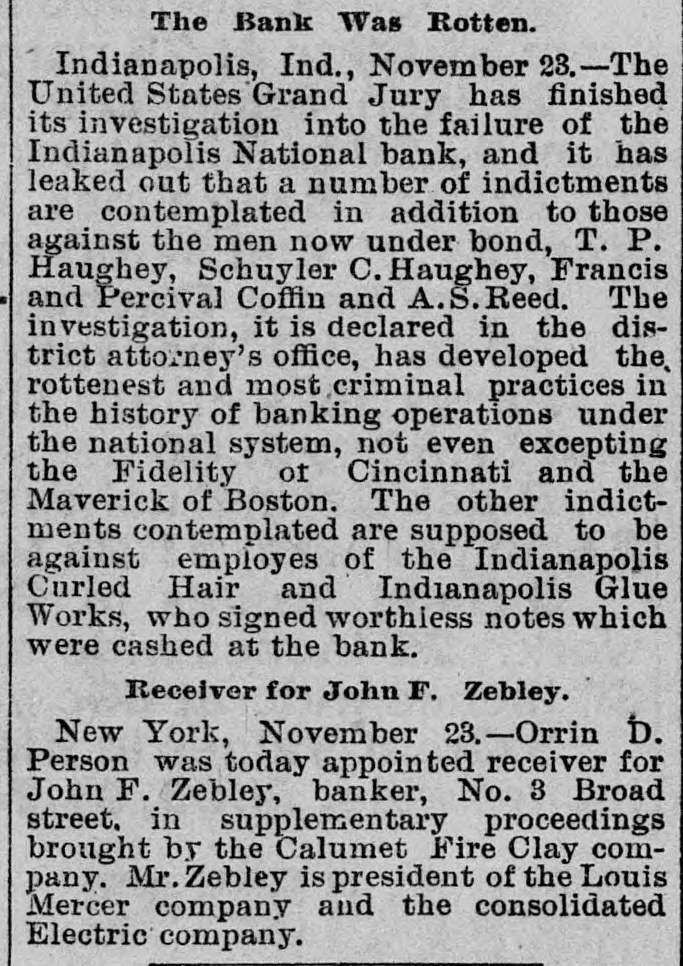
The Bank Was Rotten. Indianapolis, Ind., November 23. - The United States Grand Jury has finished its investigation into the failure of the Indianapolis National bank, and it has leaked out that a number of indictments are contemplated in addition to those against the men now under bond, T. P. Haughey, Schuyler C. Haughey, Francis and Percival Coffin and A.S.Reed. The in vestigation, it is declared in the district attorney's office, has developed the rottenest and most criminal practices in the history of banking operations under the national system, not even excepting the Fidelity of Cincinnati and the Maverick of Boston. The other indictments contemplated are supposed to be against employes of the Indianapolis Curled Hair and Indianapolis Glue Works, who signed worthiess notes which were cashed at the bank. Receiver for John F. Zebley. New York, November 23.-Orrin D. Person was today appointed receiver for John F. Zebley, banker, No. 3 Broad street. in supplementary proceedings brought by the Calumet Fire Clay company. Mr.Zebley is president of the Louis Mercer company and the consolidated Electric company.


Article from The Princeton Union, December 7, 1893

Click image to open full size in new tab

Article Text

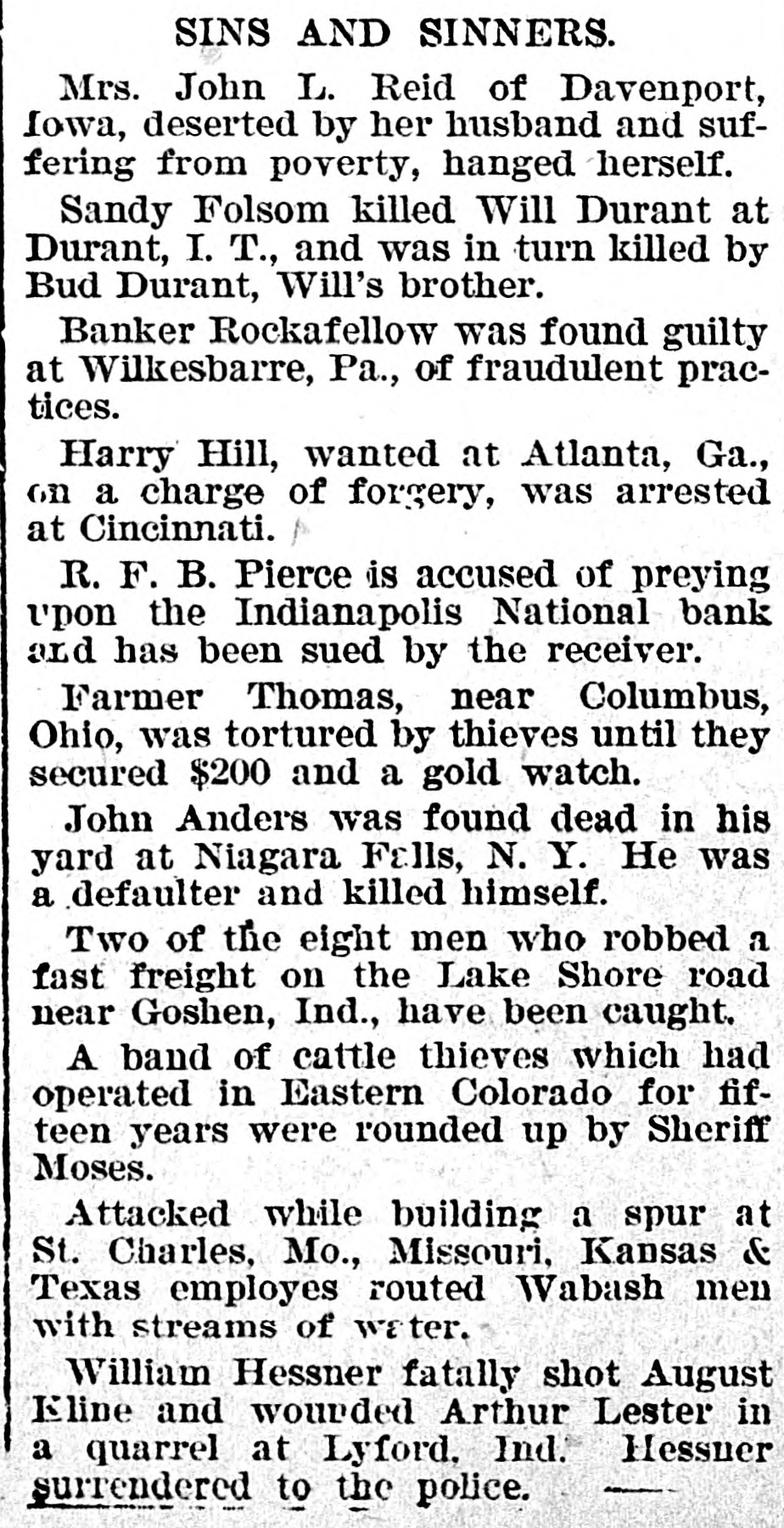
# SINS AND SINNERS. Mrs. John L. Reid of Davenport, Iowa, deserted by her husband and suf- fering from poverty, hanged herself. Sandy Folsom killed Will Durant at Durant, I. T., and was in turn killed by Bud Durant, Will's brother. Banker Rockafellow was found guilty at Wilkesbarre, Pa., of fraudulent prac- tices. Harry Hill, wanted at Atlanta, Ga., on a charge of forgery, was arrested at Cincinnati. R. F. B. Pierce is accused of preying upon the Indianapolis National bank and has been sued by the receiver. Farmer Thomas, near Columbus, Ohio, was tortured by thieves until they secured $200 and a gold watch. John Anders was found dead in his yard at Niagara Falls, N. Y. He was a defaulter and killed himself. Two of the eight men who robbed a fast freight on the Lake Shore road near Goshen, Ind., have been caught. A band of cattle thieves which had operated in Eastern Colorado for fif- teen years were rounded up by Sheriff Moses. Attacked while building a spur at St. Charles, Mo., Missouri, Kansas & Texas employes routed Wabash men with streams of water. William Hessner fatally shot August Kline and wounded Arthur Lester in a quarrel at Lyford, Ind. Hessner surrendered to the police.


Article from Shiner Gazette, December 7, 1893

Click image to open full size in new tab

Article Text

# A GENERAL BREVIARY. Interesting Items from All Over the World Selected from Various Sources. # A FULL AND COMPREHENSIVE REVIEW, Embracing Serious and Sensational Happenings, and Current News Covering Many Topics of Interest to All Readers. Enoch Hogate, Grand Master, in his recent report to the Grand Lodge, said that there was due to the Grand Lodge by T. P. Haughey, President of the suspended Indianapolis National bank and late grand tressurer of the I. O. O. F. of Indiana, $42,366.87; that securities surrendered by Mr. Haughey to secure the Grand Lodge have a prospective value of $45,250, but the future can only develop what can be realized. A shooting affray took place recently near Thackerville, I. T.. at a brush dance. Louis Montry was shot under the left eye, the ball passing through coming out behind the ear and striking a bystander in the breast knocking him down. The attending physician said there was some chance for Montry's recovery. After the shooting the dance proceeded. The report of the postmaster general shows that the deficiency for the year ended June 30, 1893, was $5,177,171 instead of $1,552,428 as estimated by Mr. Wanamaker, and instead of a surplus of $872,245 for the current fiscal year, as estimated by Mr. Wanamaker, there will be an estimated deficit of $7,830,473. The Baptist ladies of Kirksville, Mo., recently gave an "experience party" where each one related how hshe earned a sum of money for the church. The prize "experience" was awarded to a couple of young ladies who sawed a half cord of wood into neat and convenient lengths for the stove. Princess Colonna, a daughter of Mrs John Mackay of San Francisco, has brought suit for divorce at Paris, France, against her husband, Prince Ferdinand Gallatero Colonna. She charges him with numerous acts of adultery and general profligacy. She also asks for her three children. The Newton (Massachusetts) Worsted company has formally notified its 300 operatives that the reduction of the tariff by the proposed new law will make it absolutely necessary to reduce wages or stop the mills. The mills have been operated fourteen years without interruption. The statehood convention recently held at Kingfisher, Okla., was largely attended. They passed a resolution declaring for pre-emption rights, a residence of five years to perfect title, and appointed four delegates to go to Washington and lobby for the passage of the bill. At Chicago, Ill., a man supposed to be W. Raftney, of New York city, was drowned in the river recently. He was walking against a driving rain with his head down and walked off the abutment of the Randolph street bridge. The Louisville and Jeffersonville bridge company recently filed a mortgage to the United States trust company of New York and the Union trust company of Indianapolis to cover a bond issue of $5,000,000. T. V. Powderly's resignation as grand master workman of the Knights of Labor was accepted. J. R. Sovereign of Iowa was elected to succeed him and an entirely new executive board was chosen. The discovery of gold near Phoenix, Ariz., on Camp creek, has recently been made. It is a large ledge of gold ore two feet thick assaying $1500 a ton. Two Colorado miners developed the discovery. Idaho and Montana copper mining camps continue to increase their output. The Lovelock mine, which was closed down some months ago, resumes work this week with a force of thirty miners. One man killed, one fatally and others seriously injured is the result of a Mississippi Valley railway gravel train coming in contact with a tie across the track near Lutcher, La., recently. A report has been circulated that Logan Carlisle will resign the chief alerkship of the treasury department and be succeeded by his brother, Wm. K. Carlisle. Mr. Carlisle denies the report. Como, Colo, people, who live in sight of coal mines complain because they have to pay $4.50 a ton for coal while the same coal is hauled to Denver and sold at $1 less per ton. At Phoenix, Ariz., contractors aro employing all men who make application to work on the railroad being built from Phoenix to Prescott. Idle men are scarce in Arizonia. A charge that two of the jurors had been bribed by the defense brought the Coughlin trial for the murder of Cronin, at Chicago, to an abrupt end for the present.


Article from Richmond Dispatch, December 22, 1893

Click image to open full size in new tab

Article Text

Telegrams Boiled Down. All the mills in Olneyville, R. I., started up yesterday morning. The Memphis (Tenn.) Public Ledger, an afternoon paper, has suspended. Billy Thompson, Mitchell's manager, has arrived at Jacksonville, and states that Mitchell is confident of winning, and is in most excellent condition. New York State-Bank-Superintendent Preston has taken charge of the St. Nicholas Bank, New York city, and pending examination the bank will be closed. The United States grand jury, at Indianapolis, yesterday returned eleven indictments against alleged wreckers of the Indianapolis National Bank. On account of certain personal remarks in the Italian Chamber of Deputies yesterday it is probable that there will be a duel between Minister Ferrari and Signor Cavalotti, the Radical leader. Assistant Attorney-General Thomas, of the Post-Office Department, has decided that the Atianta Investment Company, Atlanta, Ga., is not entitled to the use of the mails, being regarded by Mr. Thomas as a lottery. Hon. Charles T. Mezreve, superintendent of the United States Industrial School at Lawrence, Kan., has forwarded his resignation to the President Cleveland, and will accept the presidency of the Shaw University, at Raleigh, N. C. Judge Barrett yesterday afternoon formally dismissed the jury in the Meyer murder case, New York, on account of the Insanity of Juror Low. stating that he did SO with the greatest regret, but that it was the only course open to him. Secretary Herbert has given out his decision in the case of Commodore Stanton. detached from command of the South Atlantic station for saluting Mello in the harbor of Rio, restoring Stanton to duty, and assigning to the command of the North Atlantic squadron. Cashier John E. Vall, of the Commercial Bank, Brooklyn, N. Y., was arrested yesterday charged with perjury in connection with the wrecking of the bank, and application for bail being refused until the judge could examine the papers, Vall went to the county jail. F. J. Pinton, a stockman. brings news to San Antonio of the murder of Frank Gordon, of Chicago, by Mexican robbers on the Mexican side of the Rio Grande, a few miles south of Pinton's ranch, the murdered man having gone to Mexico three weeks ago on a hunting expedition. The merchant vessels lying in the regular anchorage for trading vessels at Rio de Janeiro have been asked by the government to leave the vicinity in order that the government forces may fire on the insurgents without running the risk of striking the merchant vessels. The new short line between New York, Washington, Jacksonville, and Tampa, Fla., by way of the Richmond and Danville railroad. will be opened for business December 24th, and vestibuled, limited trains will be operated between the points mentioned from and after the date named. The United Press correspo dent at Honolulu, writing under date of December 14th, says Minister Willis's obvious avoidance of any expression tending towards a disavowal of the extremely hostile intentions commonly attributed to him, gives to the government an unfavorable impression, and enhances the hopes of the Royalists. In the British House of Commons yesterday, Prime Minister Gladstone stated that Duke Alfred, of Saxe-Coburg-Gotha (the Duke of Edinburgh), being anxious to anticipate the wish of Parliament, had arranged to renounce ยฃ15,000 yearly received from England, but would continue to enjoy the ยฃ10,000 granted to him under the royal-marriage act. A meeting of the Populist leaders of Alabama was held in Birmingham yesterday. It was secret, and for that reason all that was done or said could not be learned, but it leaked out last evening that they considered the matter of Captain Kolb's receiving the support of the Populist party, and that they disclaimed the right of any one man or men to pledge the party's support to any individual. The Provisional Government of Hawaii has framed an ultimatum in which it declines to negotiate for the restoration of the crown. and declares that it will resist with military force each and every attempt to overthrow the Provisional Government, and this ultimatum is held ready to be sent to Minister Willis should he enter upon the fulfilment of his instructions. The feeling of the adherents of the Provisional Government is one of positive determination, so much so as to be generally accepted as a conclusive sign that monarchy in Hawaii is a thing of the past.


Article from The Providence News, December 23, 1893

Click image to open full size in new tab

Article Text

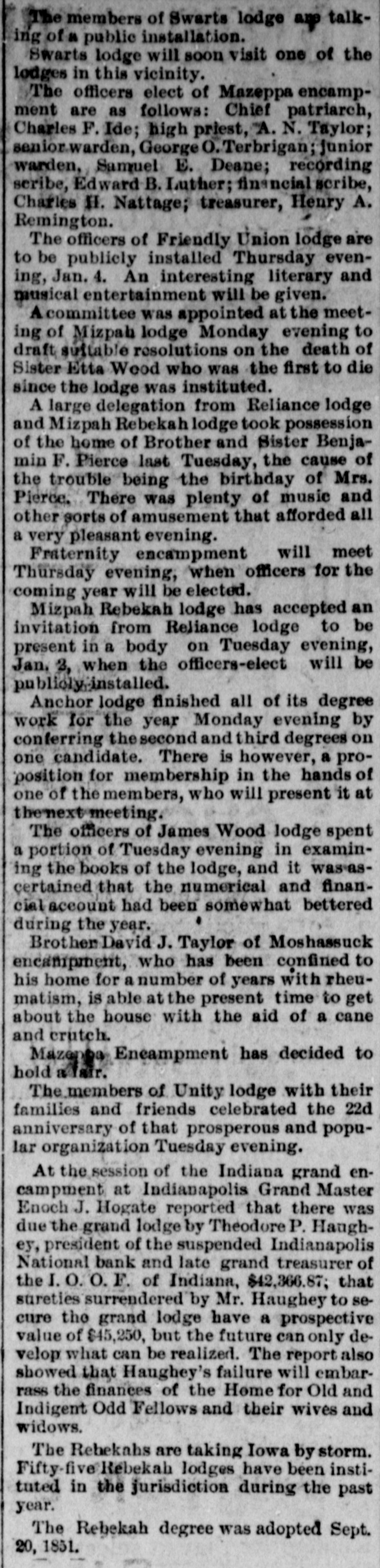
The members of Swarts lodge are talking of a public installation. Swarts lodge will soon visit one of the lodges in this vicinity. The officers elect of Mazeppa encampment are as follows: Chief patriarch, Charles F. Ide; high priest, "A. N. Taylor; senior warden, George O. Terbrigan; junior warden, Samuel E. Deane; recording scribe, Edward B. Luther; financial scribe, Charles H. Nattage; treasurer, Henry A. Remington. The officers of Friendly Union lodge are to be publicly installed Thursday evening, Jan. 4. An interesting literary and musical entertainment will be given. A committee was appointed at the meeting of Mizpah lodge Monday evening to draft suitable resolutions on the death of Sister Etta Wood who was the first to die since the lodge was instituted. A large delegation from Reliance lodge and Mizpah Rebekah lodge took possession of the home of Brother and Sister Benjamin F. Pierce last Tuesday, the cause of the trouble being the birthday of Mrs. Pierce. There was plenty of music and other sorts of amusement that afforded all a very pleasant evening. Fraternity encampment will meet Thursday evening, when officers for the coming year will be elected. Mizpah Rebekah lodge has accepted an invitation from Reliance lodge to be present in a body on Tuesday evening, Jan. 2, when the officers-elect will be publicly installed. Anchor lodge finished all of its degree work for the year Monday evening by conferring the second and third degrees on one candidate. There is however, a proposition for membership in the hands of one of the members, who will present it at the next meeting. The officers of James Wood lodge spent a portion of Tuesday evening in examining the books of the lodge, and it was ascertained that the numerical and financial account had been somewhat bettered during the year. Brother David J. Taylor of Moshassuck encampment, who has been confined to his home for a number of years with rheumatism, is able at the present time to get about the house with the aid of a cane and crutch. Mazepa Encampment has decided to hold a fair. The members of Unity lodge with their families and friends celebrated the 22d anniversary of that prosperous and popular organization Tuesday evening. At the session of the Indiana grand encampment at Indianapolis Grand Master Enoch J. Hogate reported that there was due the grand lodge by Theodore P. Haughey, president of the suspended Indianapolis National bank and late grand treasurer of the I. O. O. F. of Indiana, $42,366.87; that sureties surrendered by Mr. Haughey to secure the grand lodge have a prospective value of $45,250, but the future can only develop what can be realized. The report also showed that Haughey's failure will embarrass the finances of the Home for Old and Indigent Odd Fellows and their wives and widows. The Rebekahs are taking Iowa by storm. Fifty-five Rebekah lodges have been instituted in the jurisdiction during the past year. The Rebekah degree was adopted Sept. 20, 1851.


Article from The Evening World, December 29, 1893

Click image to open full size in new tab

Article Text

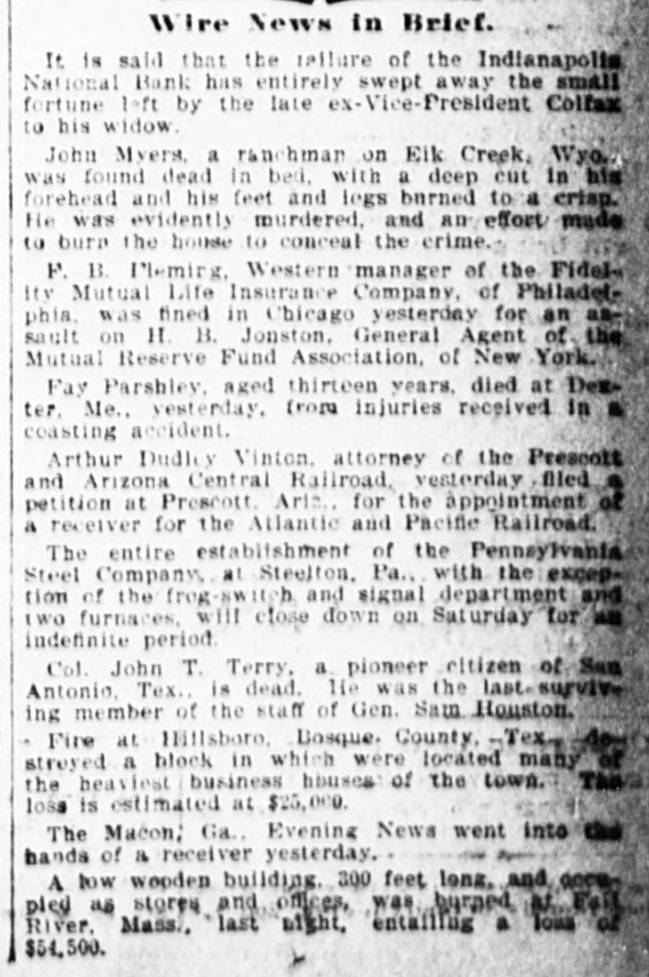
# Wire News in Brief. It is said that the reilure of the Indianapolis National Bank has entirely swept away the small fortune left by the late ex-Vice-President Colfax to his widow. John Myers, a ranchman on Eik Creek, Wyo., was found dead in bed, with a deep cut in his forehead and his feet and legs burned to a crisp. He was evidently murdered, and an effort made to burn the house to conceal the crime. F. B. Fleming, Western manager of the Fidelity Mutual Life Insurance Company, of Philadelphia, was fined in Chicago yesterday for an assault on H. B. Jonston, General Agent of the Mutual Reserve Fund Association, of New York. Fay Parshley, aged thirteen years, died at Dexter, Me., yesterday, from injuries received in a coasting accident. Arthur Dudley Vinton, attorney of the Prescott and Arizona Central Railroad, yesterday, filed a petition at Prescott, Ariz., for the appointment of a receiver for the Atlantic and Pacific Railroad. The entire establishment of the Pennsylvania Steel Company, at Steelton, Pa., with the exception of the frog-switch and signal department and two furnaces, will close down on Saturday for an indefinite period. Col. John T. Terry, a pioneer citizen of San Antonio, Tex., is dead. He was the last surviving member of the staff of Gen. Sam. Houston. Fire at Hillsboro, Bosque, County, Tex., destroyed a block in which were located many of the heaviest business houses of the town. The loss is estimated at $25,000. The Macon, Ga., Evening News went into the hands of a receiver yesterday. A low wooden building, 300 feet long, and occupied as stores and offices, was burned at Fall River, Mass., last night, entailing a loss of $54,500.


Article from The Indianapolis Journal, March 6, 1894

Click image to open full size in new tab

Article Text

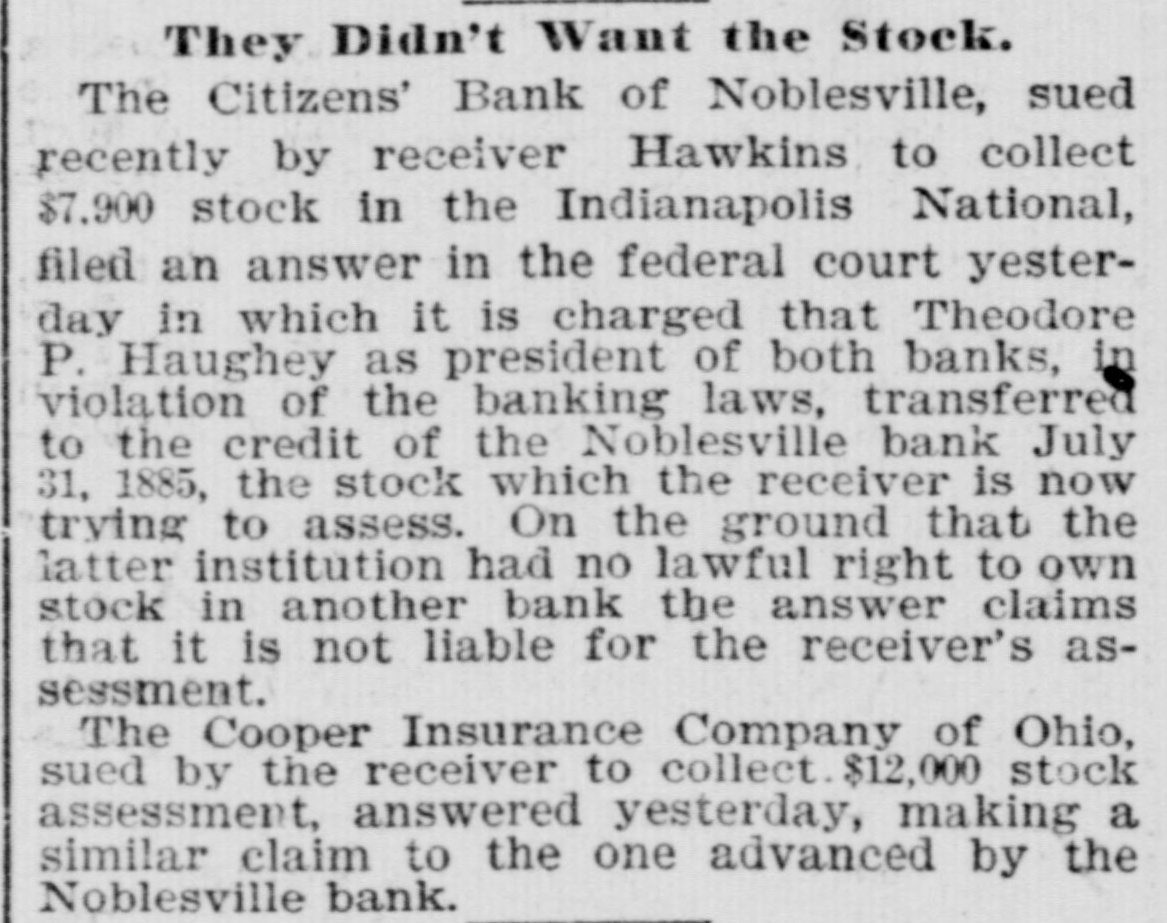
They Didn't Want the Stock. The Citizens' Bank of Noblesville, sued recently by receiver Hawkins to collect $7,900 stock in the Indianapolis National, filed an answer in the federal court yesterday in which it is charged that Theodore P. Haughey as president of both banks, in violation of the banking laws, transferred to the credit of the Noblesville bank July 31, 1885, the stock which the receiver is now trying to assess. On the ground that the latter institution had no lawful right to own stock in another bank the answer claims that it is not liable for the receiver's assessment. The Cooper Insurance Company of Ohio, sued by the receiver to collect $12,000 stock assessment, answered yesterday, making a similar claim to the one advanced by the Noblesville bank.


Article from The Indianapolis Journal, April 11, 1894

Click image to open full size in new tab

Article Text

The First Bit of Evidence Introduced Shows the Defense Will Fight Hard for Every Technical Point. COMPOSITION OF THE JURY Opening Statement of the Government Reveals New Charges. Defense of the Coffin Brothers and Albert S. Reed Outlined-Expert Hayes the Only Witness Allowed in Court. Francis A. Coffin, lately the president of the Indianapolis Cabinet Company, Percival B. Coffin, the vice president, and Albert S. Reed, treasurer of the same corporation, were placed on trial in the United States District Court yesterday. The charges against them are summarized as aiding and abetting President Haughey, of the Indianapolis National Bank, to willfully misapply the funds of the bank to the extent of $375,000 and to make false reports to the Controller of the Currency. During the day a jury was impaneled, opening statements were made by the government and by the defense, and preliminary evidence introduced. The first introduction showed that the fight of the defense was to be largely a technical one. The government made known several allegations that have not heretofore appeared in the press, all of them relating to the actions of the Coffins in connection with the looting of the bank. The defense claimed it would show that the Indianapolis Cabinet Company's plant and good will was sufficient to cover all of the company's indebtedness and that the moneys alleged to have been fraudulently taken from the bank were obtained in a manner not unusual in the ordinary course of banking business. The opening statement, made by Assistant United States Attorney Corr, in the afternoon, was not considered a very strong one by attorneys who gathered in the court room, but it was regarded as very clear by others, and sufficiently explicit without going into details. There was a large crowd in the court room, both at the morning and afternoon sessions, but there was no uncomfortable jamming. Judge Baker is a very prompt judge, and at 9 o'clock precisely he ordered the bailiff to open the court, the bailiff's "Oh, ye, oh, ye," bringing the lawyers to their tables. The jury box is in the same position where it was during the famous tally-sheet cases, the last notable cases tried in this court room. The members of the jury are in the dark southeast corner, flanked by two windows that flood glaring light into the eyes of the lawyers as they address the twelve good men, and true. The two brothers, Francis and Percival Coffie. and Albert S. Reed came into the room with their lawyers and sat down at the end of the table furthest from the judge's bench. They have as strong a legal corps enlisted in their behalf as has appeared in the federal court at any preceding criminal trial in the Indiana district. On one side of the table for the defense sat Messrs. John B. Elam, W. H. H. Miller, Ferd Winter and Solomon F. Claypool, and on the other side of the same table was A. C. Harris. At the table for the prosecution were United States District Attorney Burke, Elmer Corr, his assistant, and John W. Kern, with expert Hayes to advise them and furnish them with points and information. Francis A. Coffin was very cool during the day, and showed no signs of nervousness. Occasionally he would perch his eyeglasses on his nose and look about the room. His brother Percy seemed to have no impression whatever of the proceedings. Reed, whom it is somewhat generally believed was a tool in the hands of the Coffins, appreciated the seriousness of the situation. Once during the day he bent his head down to the table for a few moments. Francis Coffin was faultlessly dressed, from his neat black cravat down to his patentleather shoes. Expert Hayes and Receiver Hawkins will probably be put on the stand to-day.


Article from The Indianapolis Journal, May 29, 1894

Click image to open full size in new tab

Article Text

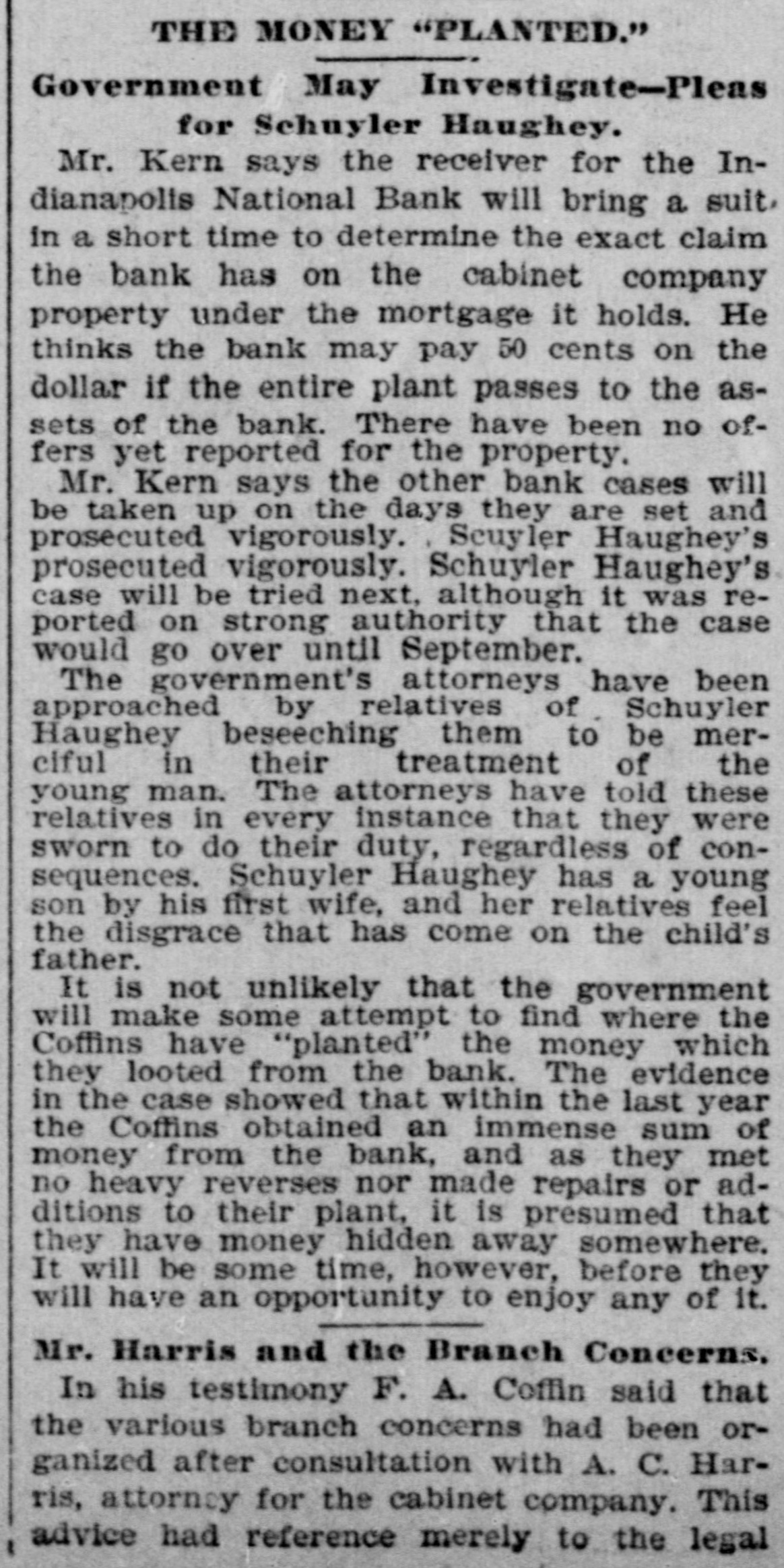
# THE MONEY "PLANTED." Government May Investigate-Pleas for Schuyler Haughey. Mr. Kern says the receiver for the Indianapolis National Bank will bring a suit in a short time to determine the exact claim the bank has on the cabinet company property under the mortgage it holds. He thinks the bank may pay 50 cents on the dollar if the entire plant passes to the assets of the bank. There have been no offers yet reported for the property. Mr. Kern says the other bank cases will be taken up on the days they are set and prosecuted vigorously. Scuyler Haughey's prosecuted vigorously. Schuyler Haughey's case will be tried next, although it was reported on strong authority that the case would go over until September. The government's attorneys have been approached by relatives of Schuyler Haughey beseeching them to be merciful in their treatment of the young man. The attorneys have told these relatives in every instance that they were sworn to do their duty, regardless of consequences. Schuyler Haughey has a young son by his first wife, and her relatives feel the disgrace that has come on the child's father. It is not unlikely that the government will make some attempt to find where the Coffins have "planted" the money which they looted from the bank. The evidence in the case showed that within the last year the Coffins obtained an immense sum of money from the bank, and as they met no heavy reverses nor made repairs or additions to their plant, it is presumed that they have money hidden away somewhere. It will be some time, however, before they will have an opportunity to enjoy any of it. Mr. Harris and the Branch Concerns. In his testimony F. A. Coffin said that the various branch concerns had been organized after consultation with A. C. Harris, attorney for the cabinet company. This advice had reference merely to the legal


Article from Morning Journal and Courier, June 5, 1894

Click image to open full size in new tab

Article Text

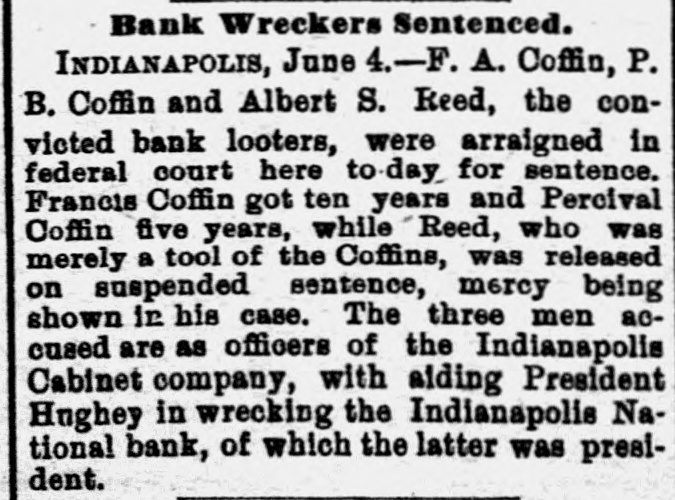
Bank Wreckers Sentenced. INDIANAPOLIS, June 4.-F. A. Coffin, P. B. Coffin and Albert S. Reed, the convicted bank looters, were arraigned in federal court here today for sentence. Francis Coffin got ten years and Percival Coffin five years, while Reed, who was merely a tool of the Coffins, was released on suspended sentence, mercy being shown in his case. The three men accused are as officers of the Indianapolis Cabinet company, with aiding President Hnghey in wrecking the Indianapolis National bank, of which the latter was president.


Article from The Scranton Tribune, June 8, 1894

Click image to open full size in new tab

Article Text

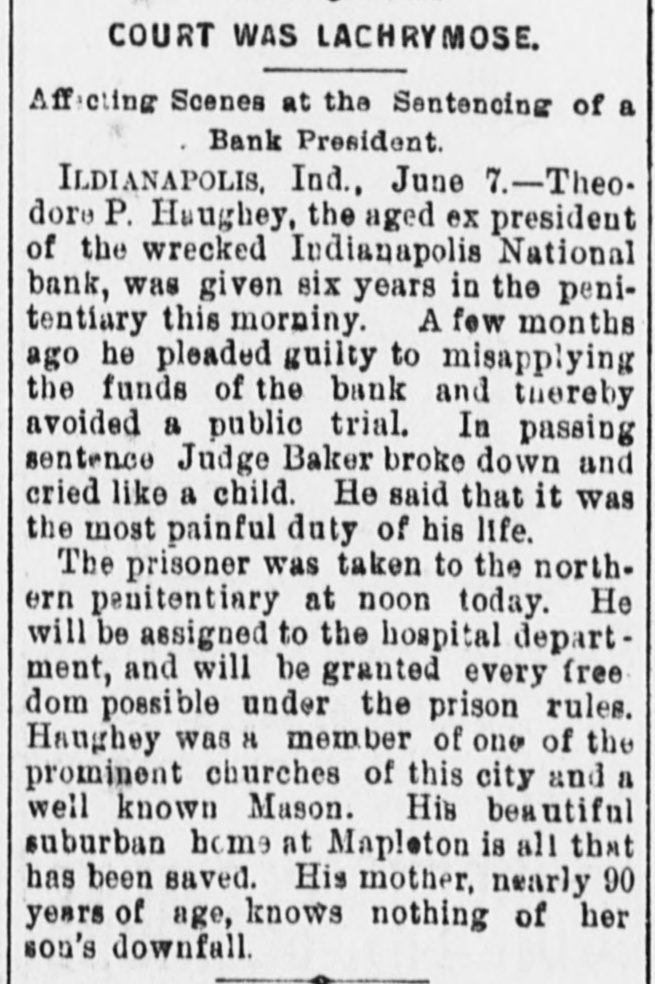
COURT WAS LACHRYMOSE. Afficting Scenes at the Sentencing of a Bank President. ILDIANAPOLIS, Ind., June 7.-Theodore P. Haughey, the aged ex president of the wrecked Indianapolis National bank, was given six years in the penitentiary this morniny. A few months ago he pleaded guilty to misapplying the funds of the bank and thereby avoided a public trial. In passing sentence Judge Baker broke down and cried like a child. He said that it was the most painful duty of his life. The prisoner was taken to the northern penitentiary at noon today. He will be assigned to the hospital department, and will be granted every free dom possible under the prison rules. Haughey was a member of one of the prominent churches of this city and a well known Mason. His beautiful suburban home at Mapleton is all that has been saved. His mother, nearly 90 years of age, knows nothing of her son's downfall.


Article from The Farmers' Union, June 14, 1894

Click image to open full size in new tab

Article Text

EQUITY OF THE CLAIM SUIT AGAINST THE STANFORD ESTATE. Mr. Hoar Deprecates Its Prosecution While Mr. Blackburn Questions the Ownership-Six Years Penal Service for Bank Wrecker Haughey of Indianapolis Told In a Few Words. -The Government's suit for $15,000.00 against the Stanford estate was on Thurs day made the subject of discussion in the Senate. The question arose upon a resolution introduced by Mr. Hoar, instructing the Committee on Judiciary to pass upon the equity of the claim. and whether 1 should not be set at rest Senator Hoat said the Government ought at once to decide the question of extinguishing and putting this claim at rest He did not suppo e. be said. that any one seriously supposed that the Govern ment had a claim against the Stanford estate. and it was proper that the judiciary committee should inquire whether this alleged claim was founded on IL technicality or upon law and equity. Mr. Hoar recited the benefactions under the will of Gov. ernor Stanford and added: "If the Govern ment had a claim of $15,000,000. that was only twenty cents apiece for the inhab Itants of the United States, to whom Mr. Stanford had consecrated his large estate and it ought not to embarrass the closing years of his widow and cripple and. per. haps, destroy the great gift he bad made for the benefit of the poor by seeking to press it." No one, Mr. Blackburn said 11 reply. felt more deeply than he the public spirit manifested by his late associate in devoting so much t educational purposes. But the rea question was. did he own the estate or had he sought to divert to this high purpose an estate that belonged to the United States? The Attorney General had already taken steps to determine this question, and it was the first time he had ever heard of either house of Congress at tempting to stay the hand of the law officer of the Government. -Theodore P. Haughey. President of the defunct Indianapolis National Bank, "N on Thursday morning sentenced to six years in the penitentiary for his part is the wrecking of that institution. Judge Baker expressed deep regret in pronouneing sentence, saying that it was an un pleasant duty to sentence a man that has SO long been respected for his uprightness and integrity as Mr. Haughey. After pro nouncing sentence, Judge Baker shook Mr Haughey's hand. Mr. Haughey is sixty eight years of age. Previous to the reve lations of his mismanagement of the bank Mr. Haughey was one of the most prom inent citizens of Indianapolis Had simi lar revelations been made about Benjami Harrison they would hardly have cause a greater sensation. Haughey had been : resident since 1878. For nearly forty year ne was Treasurer of the Grand Lodge o Odd Fellows, was prominent in Sunday school work. and has represented Indian as a lay delegate in the Methodist Gen eral Conference. -In Alexandria Bay. St. Lawrence Riv er. the steamer Ocean collided with th barge Kent. Both boats sunk. Two pas sengers are missing. -The German National Bank. of Den ver. Col., did not open its doors Thursday Cashier Kunzmiller says that the institu tion is compelled to go out of business The German National is one of the oldes banks in the city, The President is J. J Reithmann, who is very wealthy. At on time the bank's stock sold for 1335 a share The bank was closed during the panic las summer, but subsequently reopened on a