Tremont Trust Company (Boston, MA)

Episode Information

Episode UID
5015671449
Episode Type
Run → Suspension → Closure
Bank Type
trust
Bank ID
501567 routing
Routing Number
5-0156
Start Date
September 27, 1920
Location
Boston, Massachusetts (42.358, -71.060)

Metadata

Model
gpt-5-mini (chosen from majority vote of a three-model LLM ensemble)
Short Digest
d0c4c3d2a3343d20

Response Measures

None

Description

Initial action (90-day moratorium) applied to savings deposits only; later taken over by state commissioner.

Events (4)

1. September 27, 1920 Run
Cause
Local Banks
Cause Details
Withdrawals triggered by closing of other Boston trust companies (Cosmopolitan, Hanover, etc.) and fallout from the Ponzi collapse.
Measures
Invoked 90-day notice (moratorium) on savings withdrawals; police called to keep order.
Newspaper Excerpt
The run on the Tremont Trust Company started Saturday...a crowd of 800 men and women was lined outside the Tremont Trust Company today.
Source
newspapers
2. September 27, 1920 Suspension
Cause
Local Banks
Cause Details
Bank officials invoked the 90-day law to check heavy withdrawals prompted by runs on other local banks and general alarm after Ponzi failures.
Newspaper Excerpt
The Tremont Trust Company...invoked the ninety-day clause of the banking laws...payment of funds was stopped at the Tremont Trust Company branch...
Source
newspapers
3. February 18, 1921 Receivership
Newspaper Excerpt
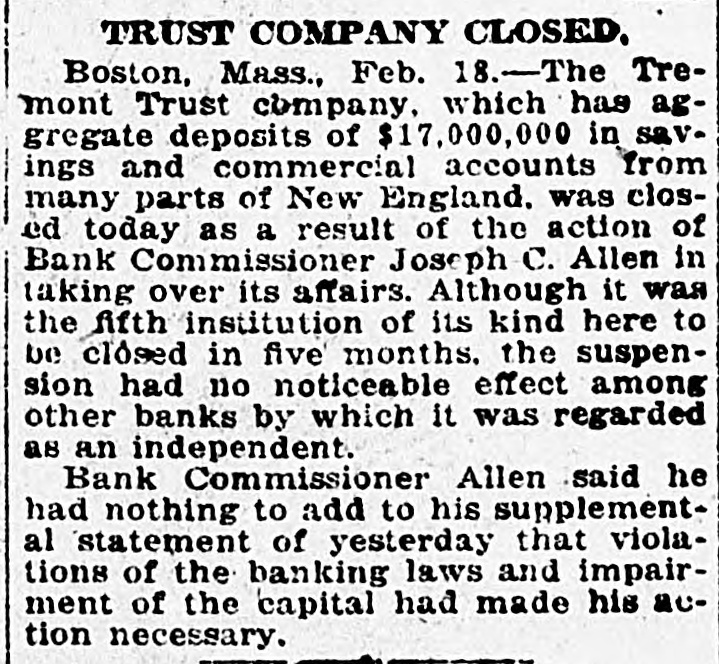
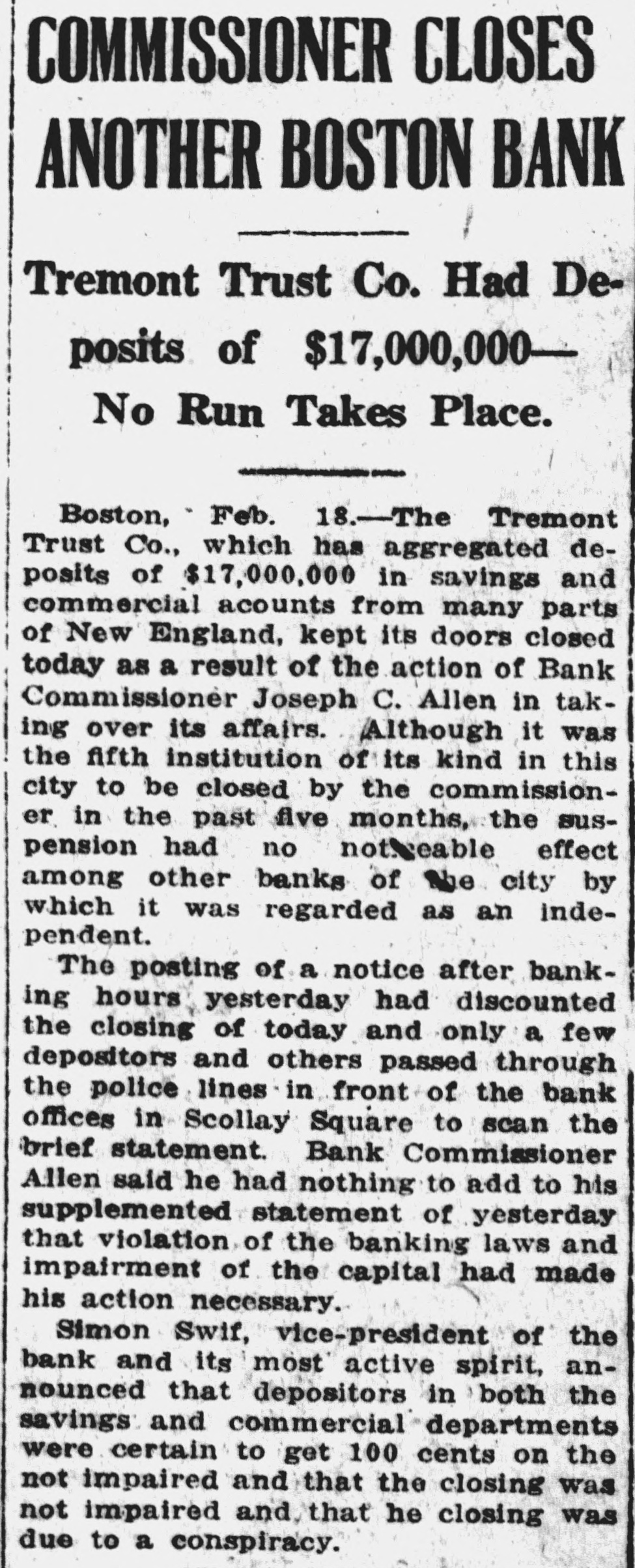
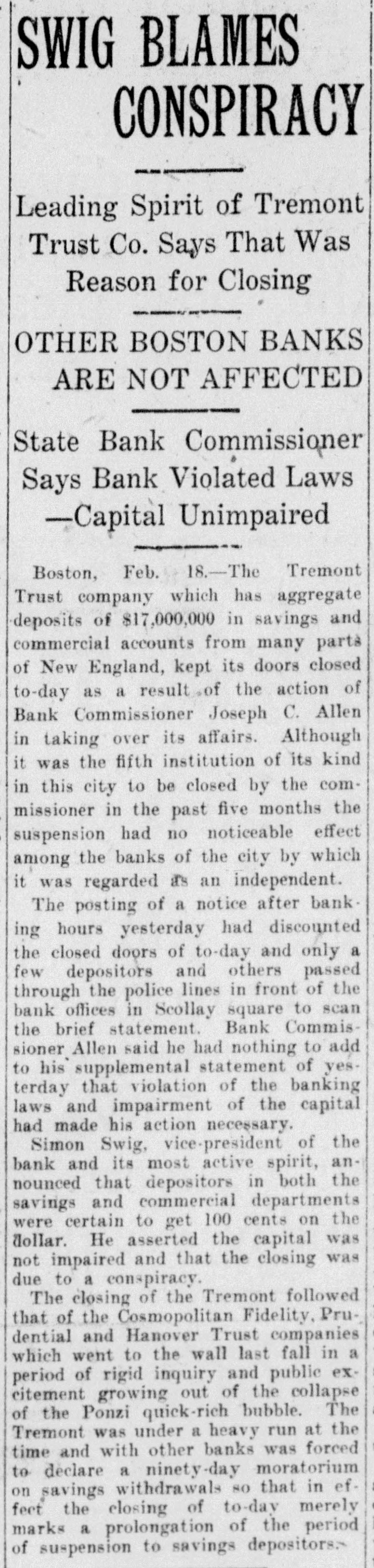
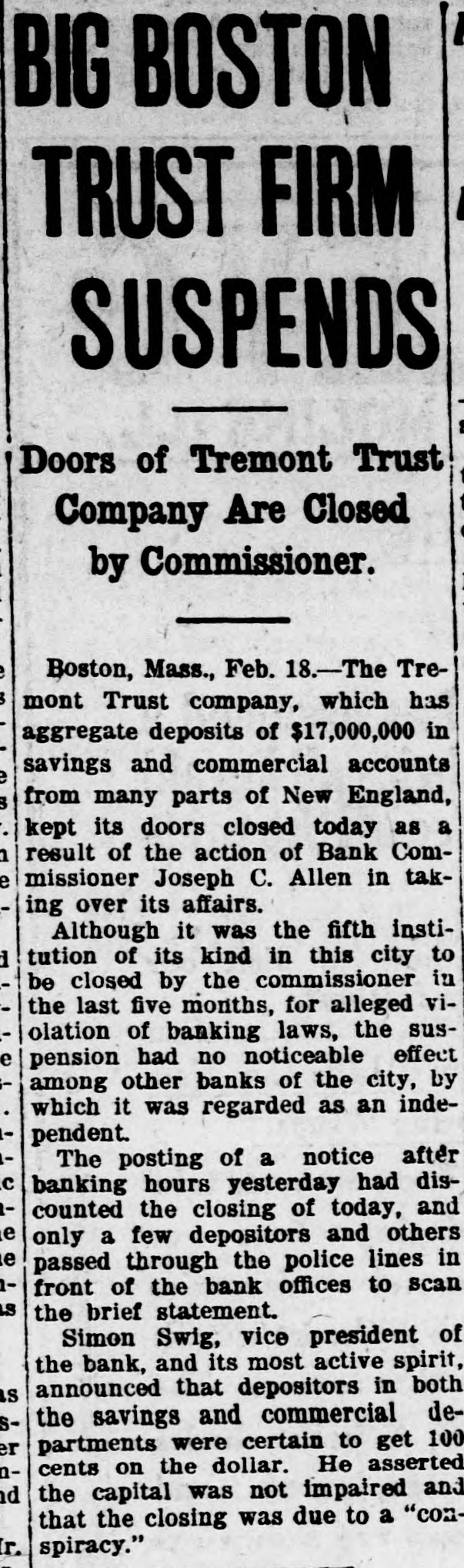
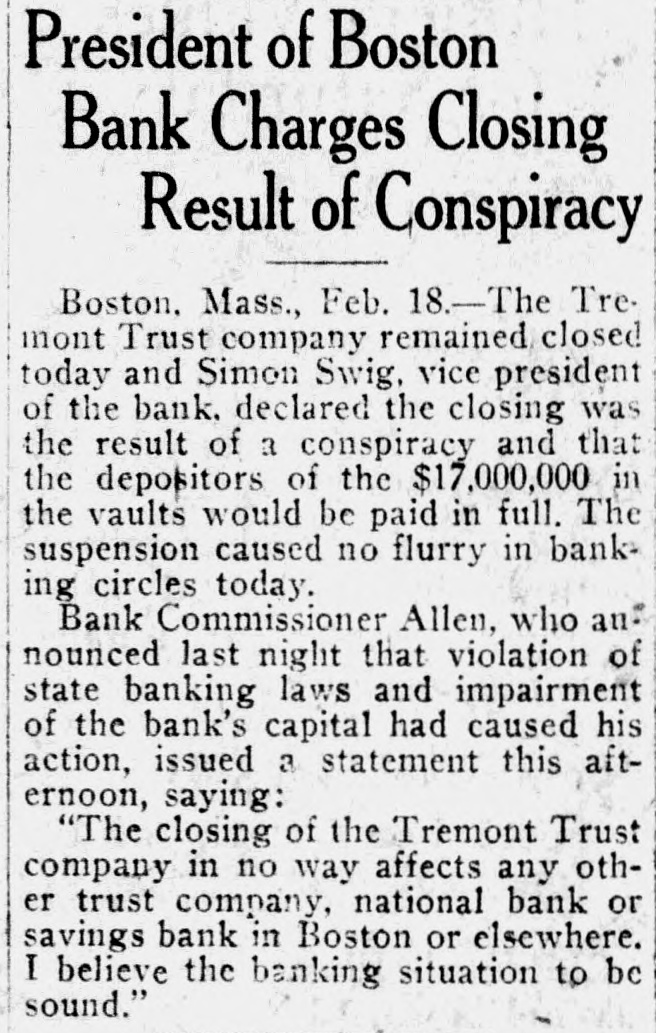
The Tremont Trust company...was closed today as a result of the action of Bank Commissioner Joseph C. Allen in taking over its affairs. ...violations of the banking laws and impairment of the capital had made his action necessary. Commissioner Allen took over the affairs of the Fidelity Trust company here to-day his action marked the closing... (Feb. 18 reports). The Tremont Trust Co....kept its doors closed today as a result of the action of Bank Commissioner Joseph C. Allen in taking over its affairs. Bank Commissioner Allen said...violation of the banking laws and impairment of the capital had made his action necessary. Simon Swig...said the closing was due to a conspiracy. (Feb. 18).
Source
newspapers
4. * Other
Source
newspapers

Newspaper Articles (20)

Article from The Washington Times, September 27, 1920

Click image to open full size in new tab

Article Text

BOSTON BANKS STOP PAYMENT Three Trust Companies Invoke Ninety-Day Rule to Check Threatened Runs. BOSTON, Sept. 27.-The Tremont Trust Company, the Fidelity Trust Company, and the Dorchester Trust Company today established moratoriums, by which depositors will be required to wait ninety days before withdrawing funds. Officials of all the companies declared their institutions were sound and that the moratoriums were established to "protect the people from themselves." RUN STARTED SATURDAY. Payment of funds was stopped at the Tremont Trust Company branch in Warren street, Roxbury, soon after this opening hour. The run on the Tremont Trust Company started Saturday, following the closing by State order of the Cosmopolitan Trust Company. the fourth bank to be suspended since the burst. ing of Charles Ponzi's get-rich-quick bubble. A crowd of 800 men and women was lined outside the Tremont Trust Company today. Thirty policemen were on duty keeping the throng in order and protecting them from pickpockets. Two women fainted just as the doors were opened. Men were fighting for places in the line and several were taken out of the crowd by the officers. Mounted policemen cleared A lane for traffic. Crowds of depositors outside the Dorchester Trust Company. at Uphams corner. Dorchester. caused that bank to Invoke the ninety day moratorium The Derchester Trust is one of the string of so-called McKnight banks. of which the Fidelity Trust is an other. Edwin T. McKnight, president of the State senate and vice-president of the Fidelity Trust Company said: "Our bank is sound and able to meet obligations. But this withdrawal of funds as a result of the closing of one bank is wrong. The people have lost their heads. They need to be protected from themselves."


Article from Grand Forks Herald, September 27, 1920

Click image to open full size in new tab

Article Text

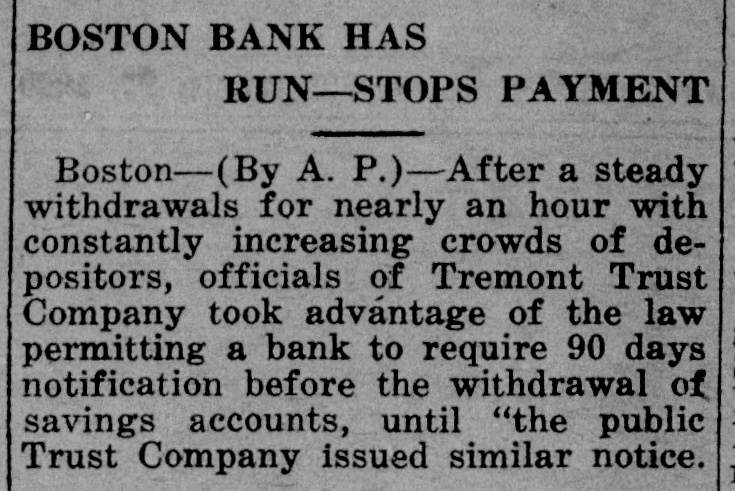
MONEY ASKED BY DEPOSITORS Ninety Day Law. Put Into Effect to Protect General Public. Boston, Sept. 27.-Several hundred persons gathered outside the offices of the Tremont Trust company here today when the doors were opened and lines quickly formed before the paying tellers' windows. After steady withdrawals for an hour with the crowds increasing, bank officials announced the law permitting a bank to require ninety days' notice for withdrawls from the sayings departments would be invoked forthwith "for the protection of the depositors. They regulation would be withdrawn "as soon as the public calmed itself. it was announced. 'We have plenty of money to pay everybody,' officials said, "and we are prepared to do so today but the crowd became so large it was impossible to handle and we invoked the law for the protection of depositors, not for our own protection." The Fidelity Trust company today served notice it would take advantage of the law permitting it to require ninety days' notice of withdrawals from the savings department. It was stated this was done upon the direction of Joseph C.- Allen, state bank commissioner. At his office it was said this action was optional with the banks. Several banks opened their doors with large amounts of ready cash as provision against a repetition of the rung which developed Saturday out of the closing of the Cosmopolitan Trust company. Bank officials announced there was no connection between the Cosmopolitan, which was the fifth bank closed here within two months, and their institution, and Bank Commissioner Allen declared no other banking institution was involved in the Cosmopolitan's troubles. More Runs Anticipated. Nevertheless a recurrence of the runs was anticipated, depositors having become alarmed and, in the case of the Tremont Trust company, having made constant withdrawals from early morning to nearly midnight Saturday. The feeling of uncertainty over the banking situation was the subject of discussion by Governor Coolidge and bankers yesterday, but without announced decision of any contemplated action. One effect of the close scrutiny of local banks which Commissioner Allen has been making was an order from him to the Old South Trust company to drop from its payroll former Governor Samuel W. McCall and four other officials. including two vice presidents. As chairman of the board of directors, Mr. McCall, who was appointed recently, is drawing a salary of $8,000 a year. The object of the order is to reduce the bank's expenses, it being the opinion of the bank commissioner that the men asked to have dropped are holding merely nominal positions. In .each instance, they may continue to, serve in their present capacities without salary, according to the order from the bank commissioner. The Old South Trust company was closed a year ago, but reopened recently after having rehabilitated its finances without loss to depositors.


Article from The Topeka State Journal, September 27, 1920

Click image to open full size in new tab

Article Text

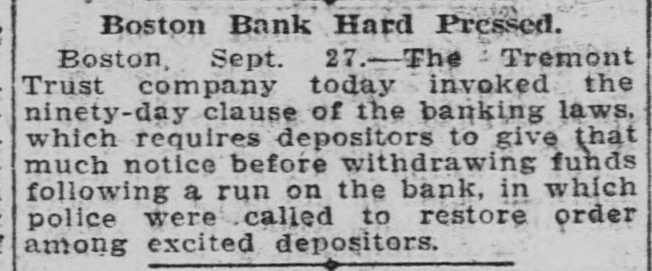
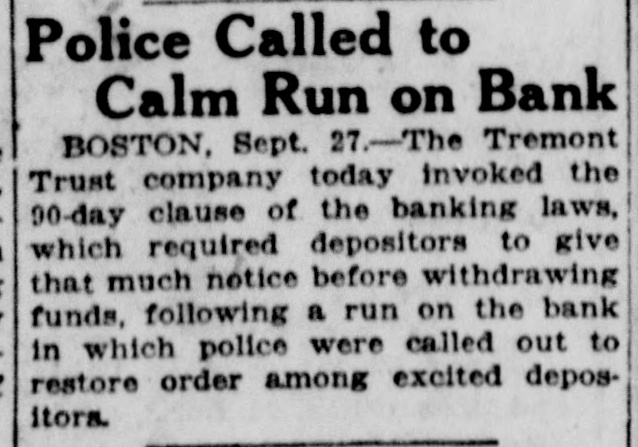
Boston Bank Hard Pressed. Boston, Sept. 27.-The Tremont Trust company today invoked the ninety-day clause of the banking laws. which requires depositors to give that much notice before withdrawing funds following a run on the bank, in which police were called to restore order among excited depositors.


Article from Evening Journal, September 27, 1920

Click image to open full size in new tab

Article Text

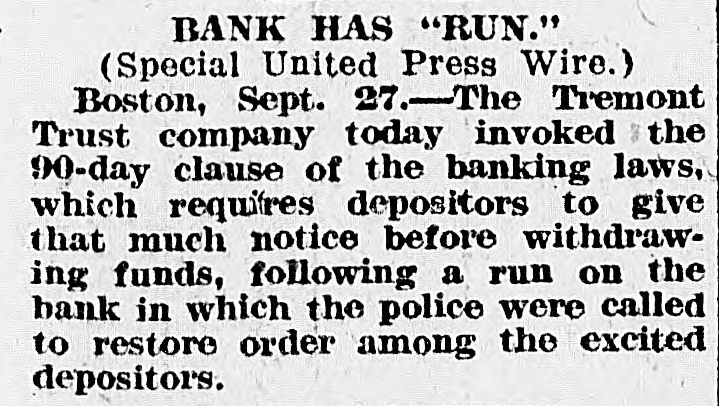
CALL POLICE WHEN BANK RUN STARTS BOSTON, Sept. 27 (United Press.)The Tremont Trust Company today in-, voked the 90-day clause of the banking laws, which requires depositors to-give that much notice before withdrawing funds following a run on the bank in which police were called out to restore order among excited depositors. Officials said that although no money would be paid out from the savings department the bank would be open for receiving deposits. Simon Swig, vice-president, addressed the crowd in front of the building, saying the trust company is well able to pay all depositors and urging them to cease withdrawals. CHICAGO GRAIN. CHICAGO, Sept. 27 (United Press.)Wheat, Dec. 210 1/2 ; March 212 1/2. Corn, Sept. 122; Dec. 93%. Oats, Dec. 59.


Article from The Caledonian-Record, September 27, 1920

Click image to open full size in new tab

Article Text

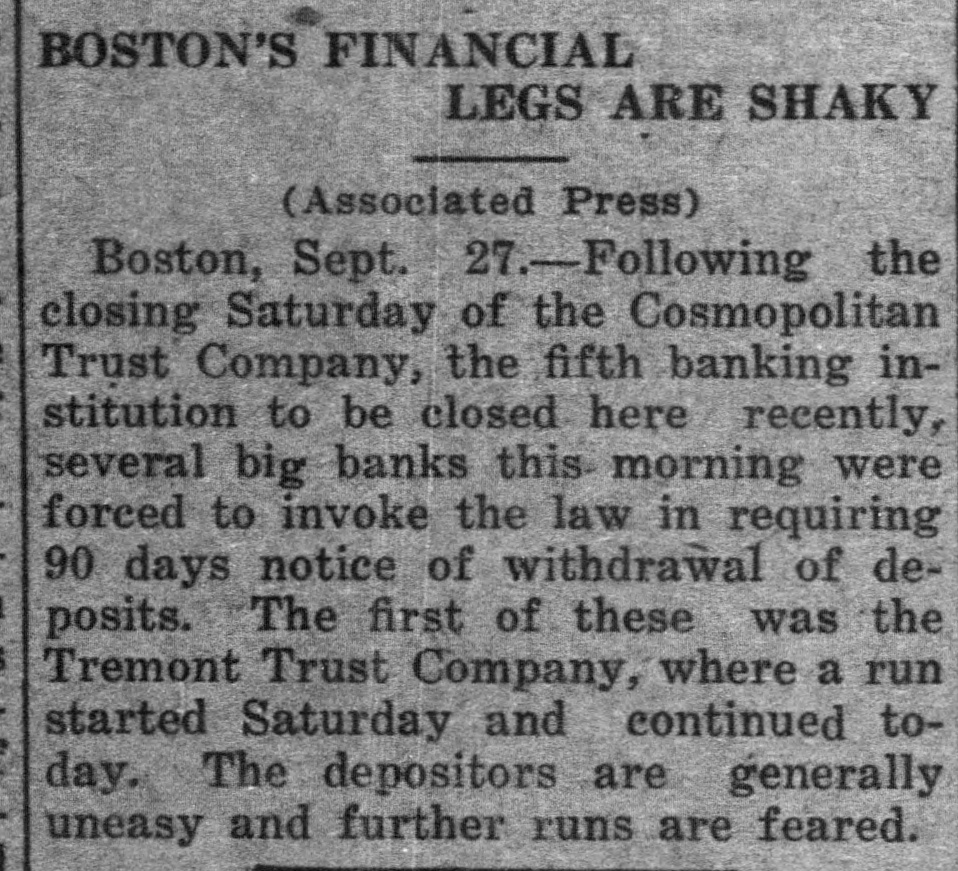
Three Boston Banks Suspend Payments (Continued from page one) was said, the taking of this action was optional with the banks. The run on the Tremont Trust Co. was participated in by hundreds and the proportion of the crowd became so great that police mounted and afoot were called to keep the crowd in order. The bank tried for an hour to meet the claims against it and officials announced there was money on hand to pay all, but the crush became so great that vice president Simon Swig announced that the 90-day notice would be required. At the Fidelity Trust Co. which also had offices in the downtown district the run was of small volume but the law was called upon. It was stated "to allow the public to recover from the prevailing unrest." There has been a run on the Dorchester Trust Co., for several days and the invocation of the law there stopped the payments. The virtual suspension of payments of these three banks follows the closing of five banking institutions in this city within the past two months by Bank Commissioner Allen. In no case was the bank a member of the Federal Reserve system. State officials say that the Ponzi crash was clearly reflected in the trouble of the several banks which hda been under a run by depositors. In each case except that of the Hanover Trust and the small affiliated private banks it has been indicated that the banks were solvent but were lacking ready cash to meet the demands of depositors. At all three of the banks that suspended payments in its savings department is was announced that transactions in the commercial department would proceed as e usual. Gov. Coolidge conferred with State treasurer James Jackson and Bank Commissioner Allen regarding the banking situation. The only statement issued was made by the governor, who said: "Some time ago I advised all big banks in Boston that plans should be worked out through which there would be co-operation between all the banks. A clearing house committee is now working out details of such a plan."


Article from The Bridgeport Times and Evening Farmer, September 27, 1920

Click image to open full size in new tab

Article Text

PEOPLE DEMAND SAVINGS FROM BOSTON BANKS Boston, Sept. & 27.-The Tremont Trust company and the Dorchester Trust comapny today established moratoriums, by which depositors will be required to wait 90 days before withdrawing funds. Officials of both companies declared their institutions were sound and that the moratoriums were established to "protect the people from themselves.' Payment of funds was stopped at the Tremont Trust company branch on Warren street, Roxbury, shortly after the opening hour., Crowds of apprehensive depositors had gathered outside the Tremont company's Court street office and the State street headquarters of the Fidelity hours before the opening time. will be greeted by the flower The run on the Tremont Trust Co. started Saturday following the closing by State order of the Cosmopolitan company, the fourth bank to be closed since the bursting of Charles Ponzi's get-rich-quick bubble. A crowd of men and women was lined up outside the Tremont Trust company in Courts treet today. Thirty police were on duty keeping the people in order and protecting them from pickpockets. Mounted police kept a lane through Court St. clear for traffic. The line extended in twos from the bank down Court street and Franklin avenue to Cornhill and in the other direction up Court street to Tremont Row. Smaller and somewhat less demonstrative crowds were gathered outside the Tremont Trust branch in Roxbury and the Fidelity Trust company on Summer street. Thomas J. Boynton former United State's Attorney and an officer of the Tremont Trust addressed the gathering on Court street, assuring them that the 90 day close was invoked for their protection and that all would get their money. Applause greeted soynton's re. marks but the crowd did not move away. Several more "inactive" officials connected with Boston banks are likely to be dropped it was learned today following the order of Bank Commissioner Allen that the Old South Trust company dispense with the services of former Governor Samuel W. McCall recently named on the federal tariff commission. McCall was appointed chairman of the Old South's board of directors shortly before the bank reopened on July. receives a salary of $8,000 for his services.


Article from The Washington Herald, September 28, 1920

Click image to open full size in new tab

Article Text

Coolidge Blames Banks' Failure On Distressing Influences The Tremont Trust Company, of Reserve Board's Opinion. Federal Reserve Board officials Boston, yesterday invoked the ninety-day clause of the banking laws, here, although acknowledging that the condition of various State banks which requires depositors to give that much notice before withdraw in Boston was reported to be bad, they declared they had no interest ing funds, following a run on the in the general financial situation bank in which police were called in the Massachusetts city. The out to restore order among excited trouble was a State matter. they said, and as such was in the hands depositors. of the State authorities. Some dozOfficials of the trust company en banks and trust companies are said that while no money would be affected, it is understood, but so far paid ont from the savings departas known no national banks OF Federal reserve system institutions are ments, the bank would be open for suffering. receiving deposits. I Reassuring statements were made Simon Swig, vice president. adby Comptroller of the Currency dressed the crowd in front of the Williams concerning the national building, saying the trust company bank situation in Boston, as well as in the New England district. is well able to pay all depositors Williams sent out reassuring stateand urging them to cease withments pointing out that the Federal drawals. reserve system was checking the Gov. Coolidge intimated in an incourse of events and was ready to terview that he believed interests lend assistance in any way that which seek to break down conwould protect member banks. fidences in established institutions might be responsible for the cirPREDICTS REDUCTION IN FOOD cumstances causing the closing of PRICES. the banks. Chicago, Sept. 27.-A general reWhen asked what he believed duction in retail food costs was forebrought about this financial condicast here by Sol Westerfeld, prestion, Coolidge replied: "It is hard ident of the Retail Grocers' Assoto determine, but We all know that ciation. He declared all food prices influences are at work in the comwith the exception of eggs and butmunity to break down confidence ter are scheduled for continued dein established institutions." Coolclines. It is due, he said, to the idge pointed out that the foreign refusal of banks to loan money. population is most susceptible to This has caused producers to unradical influences. He drew attenload stocks at cheaper prices. The tion to the fact that most of the reduction has already begun. depositors in the banks which are in trouble are foreigners. When PERSONAL. asked if he believed the banks affected by the runs are solvent. George B. Chapman, manager of Coolidge said: "I know of nothing Harriman and Company, stock to the contrary. The trouble bebrokers, returned to his office yesgan when the people began to deterday morning after an enforced mand their money over the countvacation of a week owing to IIIer." ness.


Article from Richmond Times-Dispatch, September 28, 1920

Click image to open full size in new tab

Article Text

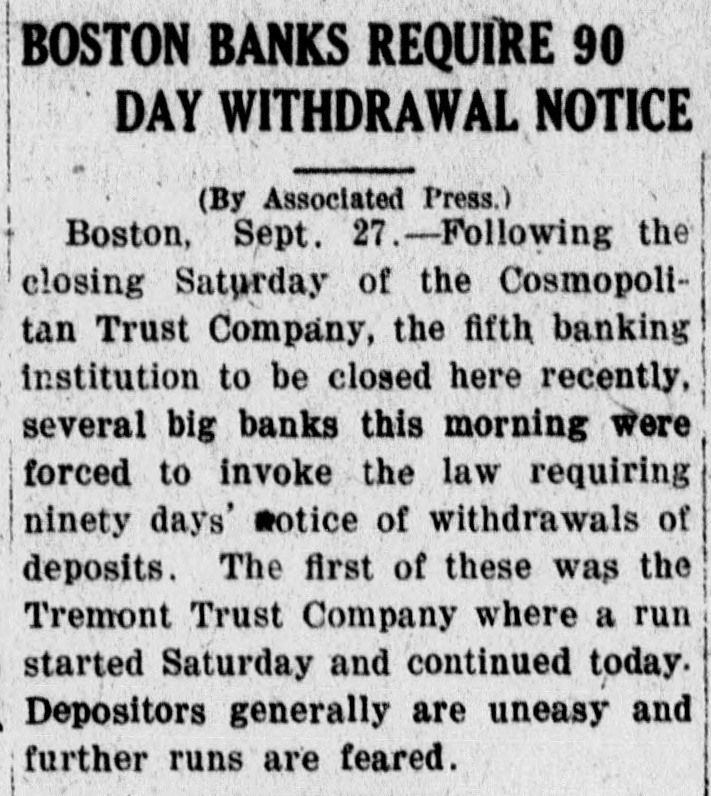
ALARMED DEPOSITORS RUSH TO BOSTON BANKS Three Institutions Invoke Law for Ninety-Day Notice of Withdrawals. LACKED CASH FOR ACCOUNTS Governor Coolidge Assures Public Funds Are Safe-Fidelity Trust Company to Be Taken Over by State Officials. (By Associated Press. BOSTON, Sept. 27.-Three Boston banks were forced today to invoke the law requiring ninety days' no. tice of withdrawals from the savings departments, as a measure of protection from depositors who had become alarmed over local banking conditions as a result of the closing of five banks in the last two months and the Ponzi financial flasco. Officers of all three. the Tremont Trust Company, The Fidelity Trust Company, and the Dorchester Trust Company. asserted that their Institutions were solvent, but lacked cash to meet the heavy demands made upon them by thousands of depositors who desired to withdraw their accounts at once. The bank officers were joined by Governor Coolidge, Bank Commissioner Joseph C. Allen, and city offlcials in statements assuring the public that the Boston banks were in sound condition and that funds intrusted to them were safe. At all three of the banks which suspended payments in their savings departments, it was announced that business in the commercial departments would continue as usual with no ban on withdrawals there. Action suspending payments in the savings departments was taken this forenoon, after hundreds had crowded the banking offices to withdraw their accounts, and the bank officials had surveyed the situation and seen frightened depositors gathering outside their offices until police details were required to keep them in control. The bank officials acted entirely upon their own initiative and without suggestion from Commissioner Allen, it was announced. The Fidelity Trust Company, one of the banks which invoked the ninety day clauses covering the withdrawal Of savings deposits today, will be taken over by the State Bank Commissioner tomorrow morning, according to a statement tonight by Commissioner Joseph C. Allen. The commissioner made the announcement at the close of a conference with officers of the trust company, State Treasurer James Jackson and Henry A. Wyman, former Attorney-General, who is acting as Mr. Allen's legal adviser. "The reasons which make necessary this step," Mr. Allen said, "are the same which brought about the closing of the Cosmopolitan Trust Company, namely, the steady withdrawal of deposits and slow, doubtful loans." Mr. Allen said that the case of the Fidelity Trust Company was the only one discussed at tonight's conference, and added that nothing was said about the several banking institutions affiliated with that bank. He expressed the belief that the general bank situation "was improving every day."


Article from Arizona Republican, September 28, 1920

Click image to open full size in new tab

Article Text

DEPT GOV. CAMPBELL FLAYS STATE LAND Three Banks in Mining Engineer THOUSANDS GREET GIVEI IS EXECUTIVE CHIEF COX DISAPPROVES Boston Suspend Reports Mexican REPUBLICAN CHIEF Bandits Active Saving Payments A SPLENDID RECEPTION A' [Republican A. P. Leased Wire] [Republican A. P. Leased Wire] ON, MARYLAND TOUR BURLESON-KNOXBOSTON, Sept. 27-Three Bos. BISBEE, Ariz., Sept. 27ton banks were forced today to enFranklin B. Harding, chief convoke the law requiring 90 days' notice of withdrawals from the sulting engineer for the Chicago ROUSING REPUBLICAN RALLY Senator Harding Outlines Policy for Sound Business savings departments as a measure Exploration and Development corPALMER RULE IN of protection from the depositors Administration and Reconstruction Plan poration, who returned from the who had become alarmed over local company's property at Tonichi, banking conditions as a result of (Republican Associated Press Leased Wire) Ralph H. Cameron and Other Candidates Speak-E Sonora, Mexico, today stated to the the closing of five banks in the last BALTIMORE, Sept. 27-Before a throng which two months and the Ponzi finanthusiastic Crowd That Fills Every Inch of Stadiu Associated Press correspondent cial fiasco. Officers of all three, CABINET AFFAIRS taxed the capacity of the Baltimore armory and voiced that during his stay at that place With Hundreds Standing Wait Until Late Hour the Tremont Trust company, the a band of outlaws attacked the Fidelity Trust company, and the its approbation in repeated crashes of applause, Senator I Hear the Governor Give Accounting to People town, which is located south of the Dorchester Trust company, assertCox Tells Omaha Audience Warren G. Harding outlined tonight his policy for sound ed that their institutions were Past Two Years Administration of State Affairsmin,e and murdered four Mexican solvent, but lacked ready cash to He Would Support Bryan miners and carried eight women business and rehabilitated American territory. meet the heavy demands made Challenges Mit Simms to Debate Land Board Affai into the hills. If Nebraska Man Was In upon' them by thousands of deEvery place in the armory was taken and many were Or Any Other State Issues Federal soldiers from a nearby positors who desired to withdraw Campaign Today their accounts at once, standing when Senator Harding arrived. At his appeargarrison immediately took pursuit, I challenge Mit Simms to appear on any platform with me in this rescuedthe kidnaped women, and The bank officers were joined by ance the audience rose and cheered for two minutes and state and debate the land issue. I will state my case against the land returned four of the bandits to ToGovernor Coolidge, Bank Commis BIGGEST CROWD OF board and the land grabbers. Let him justify, if he can, his position sioner Allen and city officials in nichi, where they were hanged in then renewed the ovation after the band had played the statements assuring the public and let the people judge which one of us they wish to trust the next the public square as a lesson to TOUR GREETS COX that the Boston banks were in Star Spangled Banner. The nominee many times was infuture raiders. two years. sound condition and that funds According to Mr. Harding, the terrupted with cheering and when he concluded he was entrusted to them were safe. outlaws came from the state of More than 2,000 persons heard Governor Thomas I Overflow Crowd Waits For At all three banks which susSinaloa, where several "lynching" sent away with a great roar of applause. pended payments in their savings parties have recently been held by Campbell, Ralph Cameron and James R. Dunseath, co Chance to Hear DemoThe address was the fourth to be made today by Senaauthorities in an effort to rid the departments it was announced that business in the commercial state of outlawry. gressional candidates, and a half dozen candidates f cratic Nominee - South tor Harding. In Baltimore he was received by a cheering departments would continue as Mr. Harding declares that the state offices, fire the opening guns of the 1920 Republica usual. Dakota on Today's ProMexican officials are of the opinthrong at the railway station, was tumultously acclaimed Action suspending payments in ion that hte latest bandit gangs campaign in Maricopa county at the Y. M. C. A. stadiu gram the savings departments was taken are composed of soldiers, recently along a ride through the city and was personally welcomed this forenoon after hundreds had discharged from the federal army last night. [Republican A.P Leased Wire] by hundreds who filed by to shake his hands at a public crowded the banking offices to through its reorganization. OMAHA, Neb. Sept. -Governor Campaign issues were clearly defined by the respe withdraw their accounts. Cox of Ohio. Democratic presidential reception. Saural Republic


Article from The Caledonian-Record, September 28, 1920

Click image to open full size in new tab

Article Text

months. The others were the Hanover Trust Company of which Charies Ponzi, the financial wizard, was a director and one of its largest ind.vidual depositors, the Prudential and Cosmopolitan Trust Companies and two private banks. The capital of the Fidelity Trust Company is $3,000, 000 and according to the latest available statement from the company, it had a surplus of $700,000. Its deposits totalled $18,000,000. The President, James G. Ferguson is affiliated with several other financial and industrial institutions as is Edwin T. McKnight, vice-president. The Fidelity Trust Company was one of the three banks, which yesterday invoked the law requiring 90 days notice for the withdrawal of savings deposits. The reason for the closing of the bank, Commissioner Allen said was the "steady withdrawal of deposits and the slow and doubtful loans.' Only a few persons were on hand when the formal notice announcing the closing was posted on the doors of the Fidelity Trust Company at 9 a. m. A squad of policemen were on duty and extra officers patrolled the financial district but there was no excitement. At the offices of the Tremont Trust Company, a small crowd gathered shortly before the opening hour but the police had no difficulty in keeping order. The bank continued to do business in its usual commercial department but depositors in the savings department were required to give a 90 day notice of intention to withdraw. The same situation existed at - the Dorchester Trust Company. The closing of the Fidelity ties up between $50,000 and $52.000 of state funds, State Treasurer Jackson announced. On August 1, the bank held $633,023 of state money. The state treasurer expressed himself as "content that the money of thes tate on deposit at the Fidelity is safe." "I believe also that the money of all depositors is safe. This is a time for the public to remain calm and to have confidence in our banking institutions. They deserve it."


Article from The Barre Daily Times, September 28, 1920

Click image to open full size in new tab

Article Text

Was One of Three Boston is Banks to Invoke the 90a N I Day Law , d e "SLOW AND DOUBTFUL e LOANS" ONE CAUSE 8 i. State of Massachusetts Has Over $50,000 Deposited h in the Bank f t I Boston, Sept. 28. When Bank Com missioner Joseph C. Allen took over 1 the affairs of the Fidelity Trust comf ) pany here to-day his action marked the closing of the sixth banking institution in this city within two I months. The others were the Hanover Trust company, of which Charles i Ponzi, the "financial wizard," was a e director and largest individual depositor ; the Prudential and Cosmopolitan Trust companies and two private banks. The capital of the Fidelity was $3,000,000 and, according to the latest available statement from the company, had a surplus of $700,000. Its deposits totalled about $18,000,000. James G. Ferguson, its president, is affiliated with several other financial and in dustrial institutions. as is Edwin T. MeKnight, the vice president. The Fidelity was one of three banks which yesterday invoked the law requiring 90 days notice for withdrawal of savings deposits. The reasons for the closing of the bank. Commissioner Allen said, are "the steady withdrawals of deposits and slow and doubtful loans. Only a few persons were on hand when the notice announcing it closing was posted at 9 clock on the door A of the Fidelity Trust company squad of policemen was on duty and extra policemen patroiled the financial district, but there was no excitement. At the offices of the Tremont Trust company a small crowd gathered before the opening hour, but the police had no difficulty in keeping order. The bank continued to do business as usual in its commercial department, but depositors in the savings depart ment were required to file 90 days notice of intention to withdraw. The same situation existed at the Dorches ter Trust company. The closing of the Fidelity tied up between $50,000 and $52,000 of state funds. State Treasurer Jackson an I nounced. On August 1 the bank held $633,023 of state money. Treasurer Jackson expressed him self as "confident that the money of i the state on deposit in the Fidelity Trust company is safe." "I believe, also," he added, "that the I money of all depositors is as safe. a This is a time for the public to remain 1 calm and to have confidence in our T banking institutions. They deserve it." t The city of Boston had no money i on deposit with the Fidelity, Treasurer a Thomas W. Murray said. Half a million in city funds was in the custody 2 of the Fidelity last December. but F since that time all has been gradually h withdrawn. In none of the recent r closings of banks here has the city had 8 funds tied up. P


Article from Daily Kennebec Journal, September 28, 1920

Click image to open full size in new tab

Article Text

BANKS HALT RUSH (Continued from Page One) control. The action was taken entirely upon the initiative of the bank officials and at no suggestion from Commissioner Allen, it was announced. The situation was considered at conferences later in the day between Commissioner Allen, the Clearing House Commission and other officials but no statements were issued at the close of the several meetings. Vice-President Simon Swig of the Tremont Trust Company, who had announced that he would conduct a mass meeting in Faneuil hall late toda yto explain the situation to his depositors, abandoned the plan after suspension of payments had been decided upon. Former Governor Samuel W. McCall issued a statement tonight commenting upon the action of Bank Commissioner Allen, announced today. in ordering the Old South Trust Company ot discontinue paying salaries tô Mr. McCall and four other officials. As chairman of the board of directors of the bank since its recent re-organization, he has drawn a salary of $8,000 a year. The commissioner took the position that the duties of the five officials were nominal and that the bank ought not to spend its money in salaries to them, although he did not object to their continuing in office without pay. Mr. McCall said that it was only "at the present solicitation of friends of the bank" that he entered its service and that his salary has been "much more than earned." He pointed to the fact that twice in former years he had served as receiver of a trust company and each time received payment in full for depositors. adding: "In neither case did the supreme court. which appointed me declare that I should work for nothing, as the commissioner decides." He asserted that it was unnecessary for the commissioner to take this action, "which can do the bank 1:0 good and which the contrivers of the situation were obviously aiming at me." Officials of the Tremont Trust Company announced tonight that in today's run, before the 90-day restriction was imposed. the bank paid out $531,699. and that during the day it received deposits amounting to $1,048,066. In a statement tonight the executive board of the bank said that things "would be normal again in a few days 'and that the 90-day restriction on savings withdrawais would be lifted" as soon as the excitement is over." Vice President Edward T. McKnight of the Fidelity Trust Company, said that deposits today far exceeded the amount withdrawn.


Article from New-York Tribune, September 28, 1920

Click image to open full size in new tab

Article Text

Law Invoked to Check Runs on 3 Boston Banks Thousands of Depositors Clamor for Savings, but Are Held Off by NinetyDay Notice Requirement State Takes Action One Institution Will Be Taken Over by Examiner; Police Keep Crowds Back (Special Dispatch to The Tribune.) BOSTON, Sept. 27.-The Fidelity Trust Company, one of three banks which to-day invoked the ninety-day clause covering the withdrawal of savings deposits, will be taken over by the State Bank Commissioner at 9 o'clock to-morrow morning, according to a statement to-night by Commissioner Joseph C. Allen. Thousands of depositors, uneasy over the closing of five other banks in Boston in the last two months and the Ponzi financial bubble, were clamoring to withdraw their funds at once when three institutions resorted to the law requiring that ninety-days' notice be given before withdrawals of savings deposits can be made. Besides the Fidelity Trust Company, the banks were the Tremont Trust and the Dorchester Trust companies. Governor Coolidge held 8 conference to-day with State Treasurer James Jackson, Bank Commissioner Allen and the bank commissioner's counsel, former Attorney General Wyman, after which the Governor said he was making efforts to have all the banks join in a plan to prevent any solvent bank from being forced to close. It is understood the plan is now being worked out by the Clearing House Commission, the members of which include representatives of the Shawmut, Merchants' and First National banks and the Old Colony Trust Company. "I suggested some time ago," the Governor said, after the conference, "that the banks cooperate and support each other, so that no bank that is solvent should be forced to close its doors because it cannot get funds to meet the demands of its depositors." The Governor said that the meaning of the Federal Reserve act is that banks sustain each other. The Federal Bank also has been asked to take any action it can to clear the situation. "The money of the people of Massachusetts is safer in any banking institution in the commonwealth than in their pockets or their homes," said the Governor. "The present crisis apparently was started by the Ponzi affair. I don't know that there has been anything malicious, but it is well known that there are interests in the community that would like to break down all our institutions, whether banks or churches or institutions of government. I do not know whether these interests have had the ear of the class of people depositing in such banks as


Article from Every Evening, Wilmington Daily Commercial, September 28, 1920

Click image to open full size in new tab

Article Text

DEPOSITORS MAKE RUN ON BANKS AT BOSTON Public Uneasiness Forces Three to Invoke 90-Day Notice Law. Boston, Sept. 27.-Public uneasiness over banking conditions yesterday caused runs on some institutions with the result that the Tremont Trust Company, the Fidelity Trust Company and the Dorchester Trust Company invoked the law which makes it possible to require 90 days' notice of withdrawals from the savings departments in order to stop the rush of frightened depositors. In the run on the Tremont Trust Company the crowd became so great that the police were called to maintain order. The virtual suspension of payments for the present by the savings departments of these three banks, follows the closing of five banking institutions in this city within the last two months by bank Commissioner Joseph C. Allen. The several closings and suspensions of payment have occurred since the collapse of Charles Ponzi's get-rich-quick scheme, which involved the Hanover Trust Com-


Article from The Washington Herald, September 28, 1920

Click image to open full size in new tab

Article Text

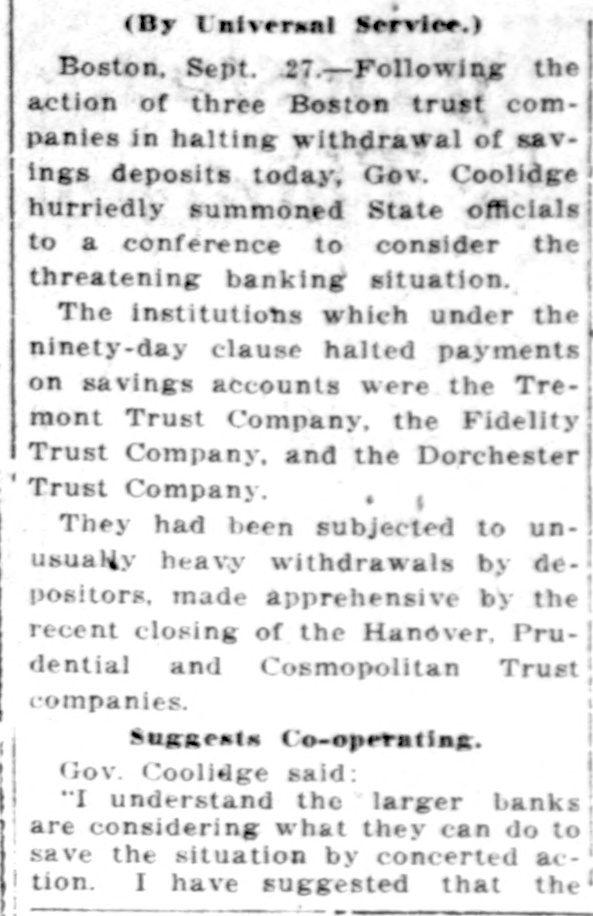
(By Universal Service.) Boston, Sept. 27.-Following the action of three Boston trust companies in halting withdrawal of savings deposits today, Gov. Coolidge hurriedly summoned State officials to a conférence to consider the threatening banking situation. The institutions which under the ninety-day clause halted payments on savings accounts were the Tremont Trust Company, the Fidelity Trust Company, and the Dorchester Trust Company. They had been subjected to unusually heavy withdrawals by depositors, made apprehensive by the recent closing of the Hanover. Prudential and Cosmopolitan Trust companies. Suggests Co-operating. Gov. Coolidge said: "I understand the larger banks are considering what they can do to save the situation by concerted action. I have suggested that the


Article from The Brattleboro Daily Reformer, September 29, 1920

Click image to open full size in new tab

Article Text

CHARGES PLOT TO CLOSE BANKS Simon Swig of Tremont Trust Co., Claims Rivals Are Responsible PROMISES GREAT EXPOSURE SOON One of Greatest Plots Known In Banking History of United States - Other Bankers Calm and No More Closures In Sight. BOSTON, Sept. 29.-The runs on local banks within the past few days as a result of which two have been closed and two others have suspended payment in their savings deposits were due to a plot, Simon Swig, vice president of Tremont Trust Co., charged in a statement given out today after an interview with Bank Commissioner Joseph Allen. "It is a case of business rivalry-of lion eat lion," he asserted, and announced his intention in a day or two to expose publicly "one of the greatest plots known in the banking history of the United States." In this exposure he said a director of the Fidelity Trust Co. would join with him. The banking situation in this city appeared to have returned to conditions approaching calm today. A committee of the Boston clearing house association which went into session to draw un an agreement by which it was proposed to have the association go to the rescue of any solvent bank that might undergo a run, suspended its duties for the time being with the statement by Thomas P. Beals, president of the association, that the "conditions under which the agreement was to become operative did not materialize, and so nothing will be done until we think it advisable to act." Gov. Coolidge took notice of the calmer conditions of yesterday with a statement saying that "the second thought of the people is coming to the rescue. The disquieting rumors have ceased and the ordinary confidence of the people has returned. All that is necessary to provide any adequate remedy is a continuance of public confidence which seems to exist."


Article from Grand Forks Herald, February 18, 1921

Click image to open full size in new tab

Article Text

TRUST COMPANY CLOSED. Boston, Mass., Feb. 18.-The Tremont Trust company, which has aggregate deposits of $17,000,000 in savings and commercial accounts from many parts of New England. was closed today as a result of the action of Bank Commissioner Joseph C. Allen in taking over its affairs. Although it was the fifth institution of its kind here to be closed in five months. the suspension had no noticeable effect among other banks by which it was regarded as an independent. Bank Commissioner Allen said he had nothing to add to his supplemental statement of yesterday that violations of the banking laws and impairment of the capital had made his action necessary.


Article from New Britain Herald, February 18, 1921

Click image to open full size in new tab

Article Text

COMMISSIONER CLOSES ANOTHER BOSTON BANK Tremont Trust Co. Had Deposits of $17,000,000No Run Takes Place. Boston, Feb. 18.-The Tremont Trust Co., which has aggregated deposits of $17,000,000 in savings and commercial acounts from many parts of New England, kept its doors closed today as a result of the action of Bank Commissioner Joseph C. Allen in taking over its affairs. Although it was the fifth institution of its kind in this city to be closed by the commissioner in the past five months, the suspension had no not.reable effect among other banks of The city by which it was regarded as an independent. The posting of a notice after banking hours yesterday had discounted the closing of today and only a few depositors and others passed through the police lines in front of the bank offices in Scollay Square to scan the brief statement. Bank Commissioner Allen said he had nothing to add to his supplemented statement of yesterday that violation of the banking laws and impairment of the capital had made his action necessary. Simon Swif, vice-president of the bank and its most active spirit, announced that depositors in both the savings and commercial departments were certain to get 100 cents on the not impaired and that the closing was not impaired and, that he closing was due to a conspiracy.


Article from The Barre Daily Times, February 18, 1921

Click image to open full size in new tab

Article Text

SWIG BLAMES CONSPIRACY Leading Spirit of Tremont Trust Co. Says That Was Reason for Closing OTHER BOSTON BANKS ARE NOT AFFECTED State Bank Commissioner Says Bank Violated Laws -Capital Unimpaired Boston, Feb. 18.-The Tremont Trust company which has aggregate deposits of $17,000,000 in savings and commercial accounts from many partà of New England, kept its doors closed to-day as a result of the action of Bank Commissioner Joseph C. Allen in taking over its affairs. Although it was the fifth institution of its kind in this city to be closed by the commissioner in the past five months the suspension had no noticeable effect among the banks of the city by which it was regarded as an independent. The posting of a notice after bank ing hours yesterday had discounted the closed doors of to-day and only a few depositors and others passed through the police lines in front of the bank offices in Scollay square to scan the brief statement. Bank Commissioner Allen said he had nothing to add to his supplemental statement of yesterday that violation of the banking laws and impairment of the capital had made his action necessary. Simon Swig, vice-president of the bank and its most active spirit, announced that depositors in both the savings and commercial departments were certain to get 100 cents on the dollar. He asserted the capital was not impaired and that the closing was due to a conspiracy. The closing of the Tremont followed that of the Cosmopolitan Fidelity, Prudential and Hanover Trust companies which went to the wall last fall in a period of rigid inquiry and public exeitement growing out of the collapse of the Ponzi quick-rich bubble. The Tremont was under a heavy run at the time and with other banks was forced to déclare a ninety-day moratorium on savings withdrawals so that in ef feet the closing of to-day merely marks a prolongation of the period of suspension to savings depositors.


Article from Norwich Bulletin, February 19, 1921

Click image to open full size in new tab

Article Text

Battey. Rev. J. C. Mathieu, pastor of the Sacred Heart church at Wauregan, will come to Putnam Tuesday evening next to deliver the sermon, which will be in French, at the Lenten service at St. Mary's church. Visiting priests will be hearl each Tuesday evening during Lent at St. Mary's. Prize Beston terriers owned by Mr. and Mrs. George H. Dresser of this city will be entered for exhibition only at the Boston dog show to be held during the coming week. The dogs recently were exhibited at the New York show, where they attracted great attention. Willis Carroll, Lionel Charron, John Kennedy, Thomas Howarth and Frank H. Cordier are members of a committee named by Cargill council K. of C. to arrangè for a whist the proceeds of which will be devoted to the Hoover fund for the relief of starving children in Europe. As the need of these children is great the date for the event is fixed during the period of Lent. OR motion of Representative Molley of Derby, the house at Hartford voted to name a committee of three to draft memorial resolutions relative to the 1 death of "Souvenir" W. H. Taylor 01 this city, so long identified with the A legislature and its activities and publisher of a number of legislative souvenirs. h The senate bill providing for the construction of a section of state highway r from Mechanicsville to Grosvenordale, r favorably reported by the roads committee, has been referred to the appropriations committee, from which a favorable e report also is expected. The fact that immigrant trains are bee ing run out of Boston for New York via a Hartford kept some people on the watch is here Friday for the possible passing of through this city of such traffic. a Inspector Edgarton of the motor vehiele department will not be in Putnam h next Tuesday, Washington birthday. The B, announcement was made on Friday. Attorney Andrew J. Bowen, who died e Thursday at his home in Willimantic bwas well known in this city, where he had many friends. 7Henry Grinsell has gone to Peoria, Ill. ol where he is to take 2 course at an optic B al school. ; Miss Antoinette Caron is spending t. th week at her home in Taftville. B. It was stated here Friday that not a in little money belonging to Putnam people 45 is tied up in the Tremont Trust company he Boston, which was closed Thursday by he the Massachusetts bank commisioner ir who decribed the bank's methods as "unsound and unauthorized." Albert McC. Matthewson, a native of ed Weedstock, has been elected vice presi g dent and attorney for the Citizens' Trust tcompany of New Haven, where he has n been 2 resident for years. h. Captain Robert Hurley and Office ve Howard Elliott of the state police have is practically closed up another arson case to over in ToHand, where they caused the h 1