Local runs followed several recent bank closings (Ponzi affair) and commissioner then took over Fidelity.
Events (3)
1.September 27, 1920Run
Cause
Local Banks
Cause Details
Depositors alarmed by recent closings of other Boston banks (Hanover/Pru/ Cosmopolitan/Ponzi affair) prompting withdrawals.
Measures
Served notice invoking 90-day notice for withdrawals from savings department.
Newspaper Excerpt
At the Fidelity Trust Company the run was far less serious.
Source
newspapers
same day
2.September 27, 1920Suspension
Cause
Local Banks
Cause Details
Bank invoked the 90-day notice law to halt heavy withdrawals of savings provoked by runs on local institutions.
Newspaper Excerpt
Opening for business today, the Fidelity Trust company served notice on depositors that its savings department would take advantage of the same law.
Source
newspapers
+1 day
3.September 28, 1920Receivership
Newspaper Excerpt
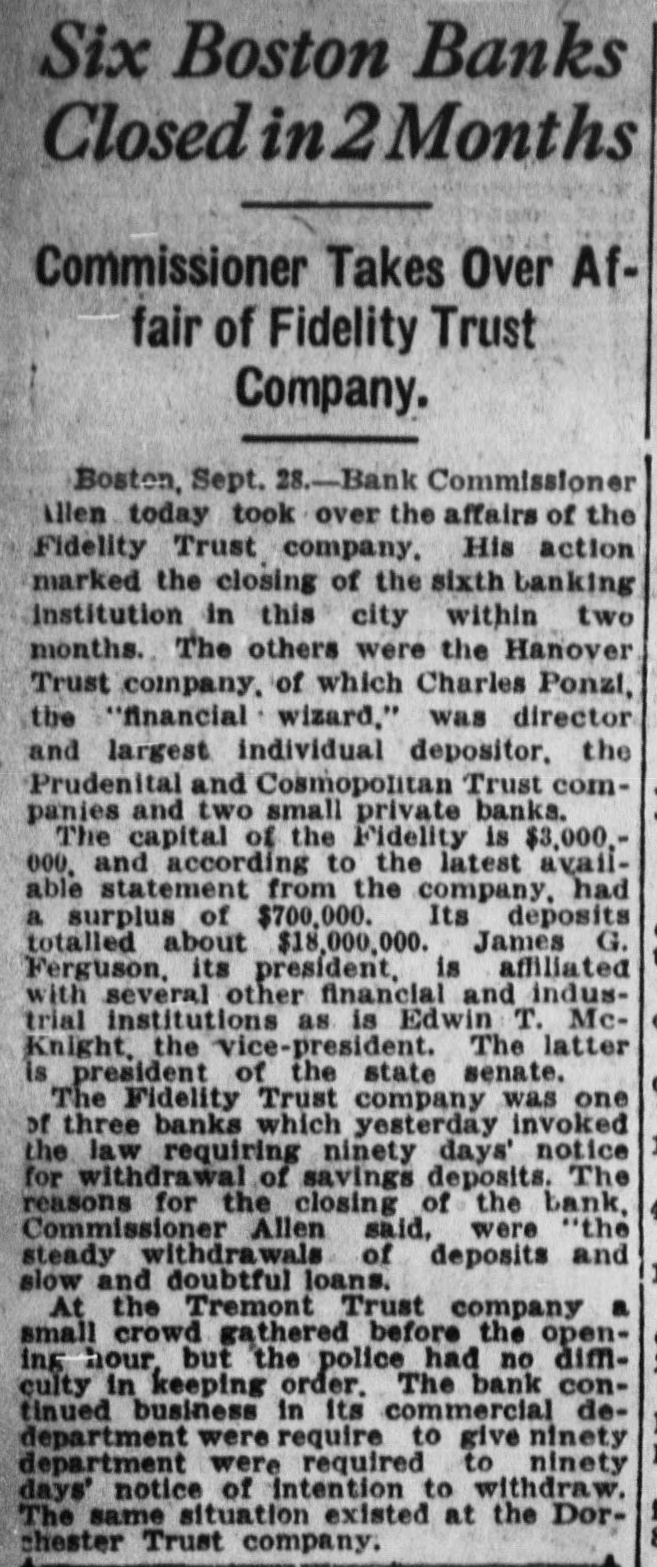
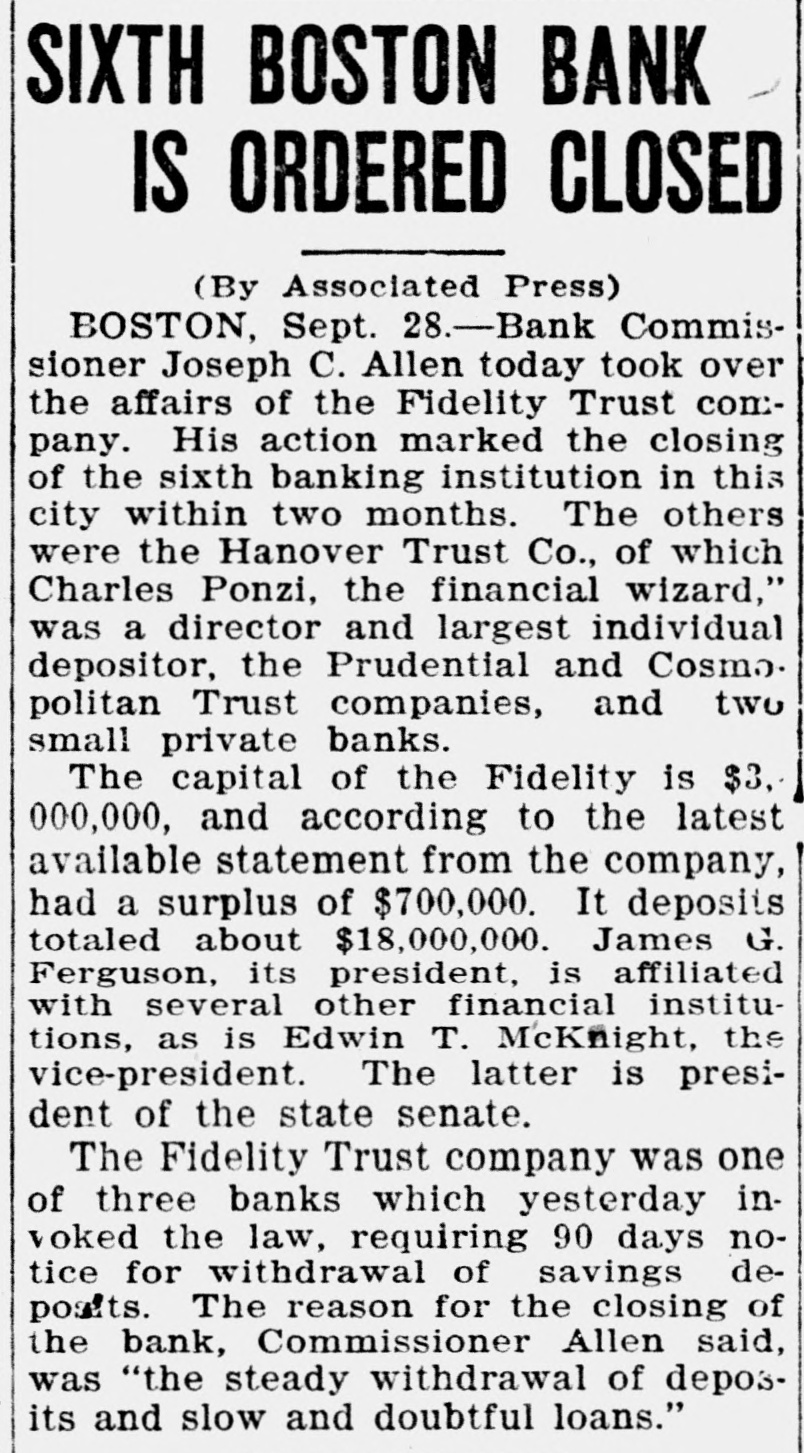
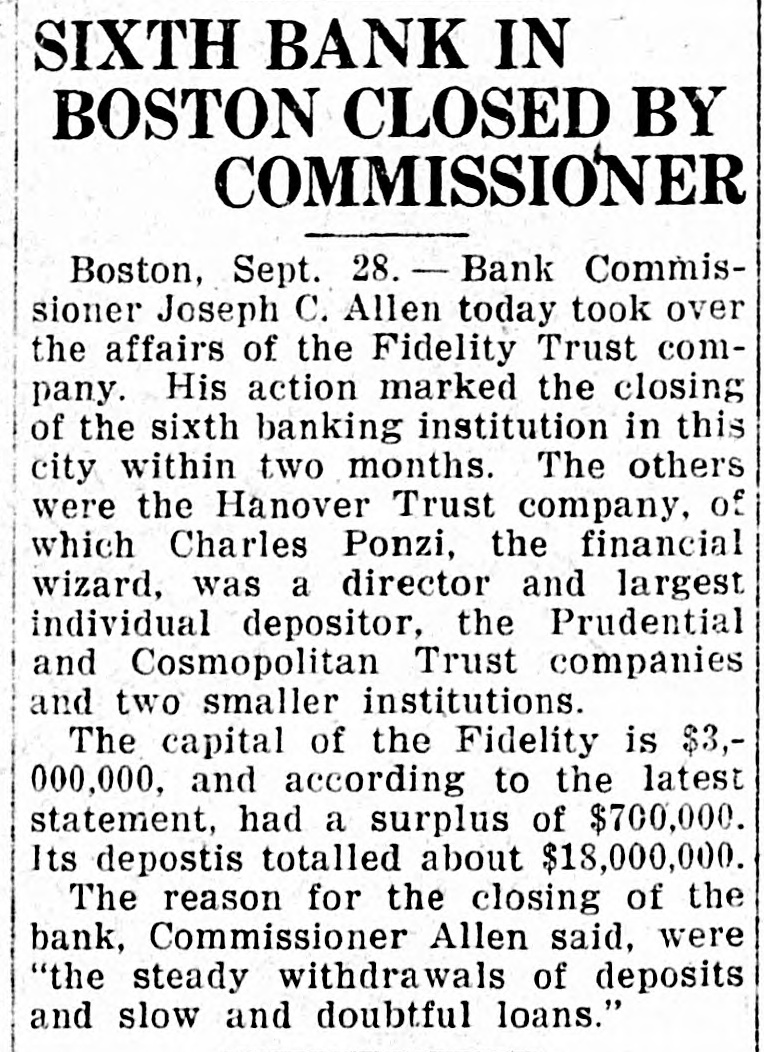
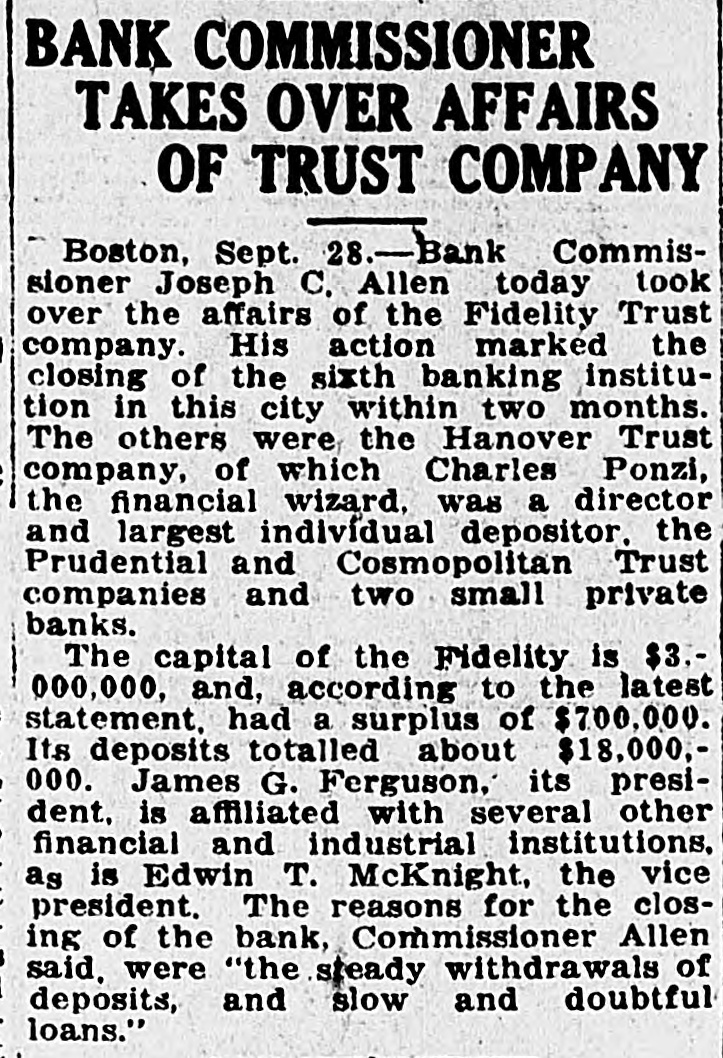
Bank Commissioner Joseph C. Allen today took over the affairs of the Fidelity Trust company. His action marked the closing of the sixth banking institution in this city within two months.
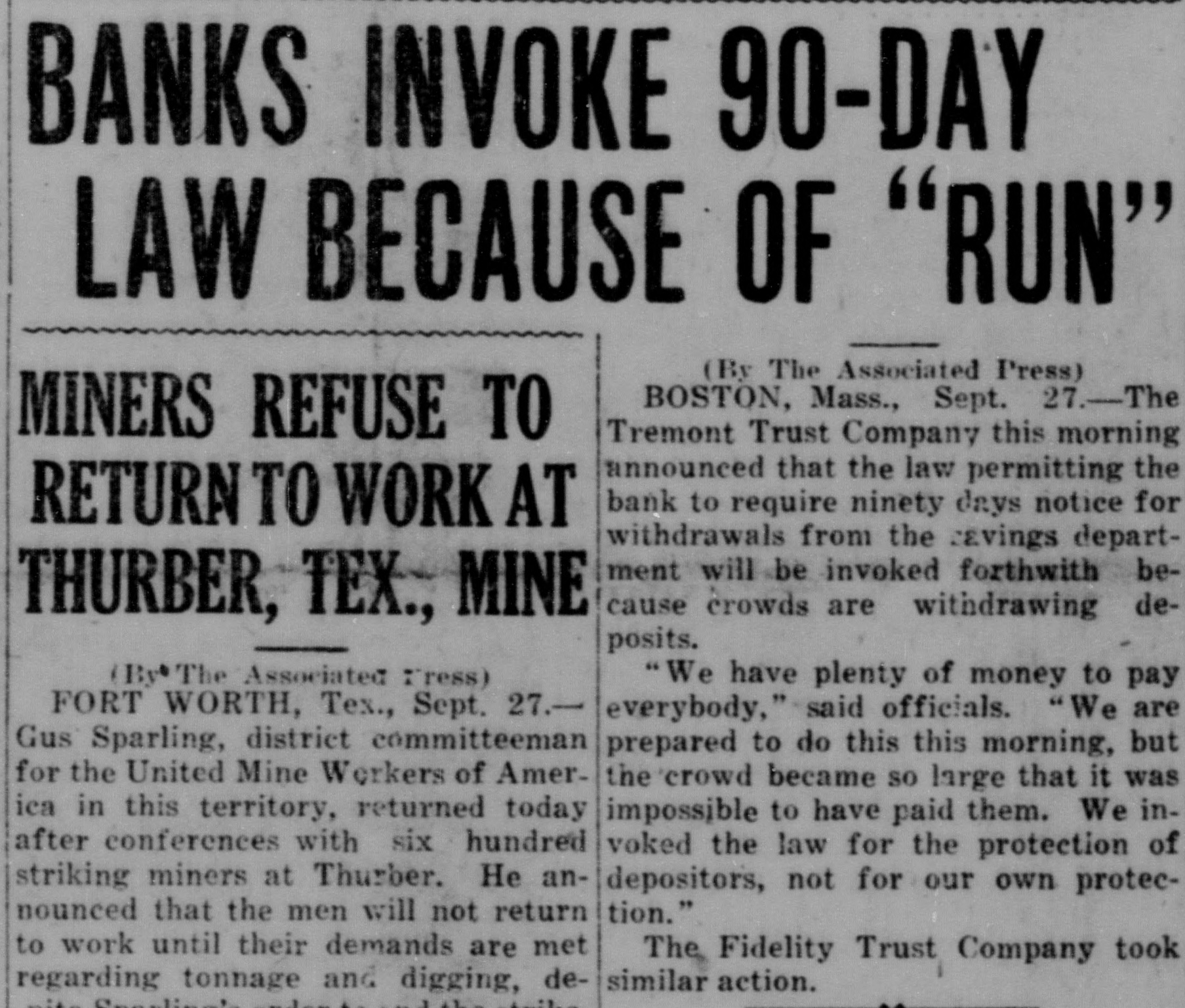
BANKS INVOKE 90-DAY " 'RUN" LAW BECAUSE OF / (By The Associated Press) BOSTON, Mass., Sept. 27.-The MINERS REFUSE TO Tremont Trust Company this morning announced that the law permitting the bank to require ninety days notice for RETURN TO WORK AT withdrawals from the ravings department will be invoked forthwith because crowds are withdrawing deTHURBER, TEX., MINE posits. "We have plenty of money to pay (By The Associated Tress) FORT WORTH, Tex., Sept. 27.everybody," said officials. "We are Gus Sparling, district committeeman prepared to do this this morning, but for the United Mine Workers of Amerthe crowd became so large that it was ica in this territory, returned today impossible to have paid them. We inafter conferences with six hundred voked the law for the protection of striking miners at Thurber. He andepositors, not for our own protecnounced that the men will not return tion." to work until their demands are met The Fidelity Trust Company took regarding tonnage and digging, de- similar action.
2.September 27, 1920Capital JournalSalem, OR
Click image to open full size in new tab
Article Text
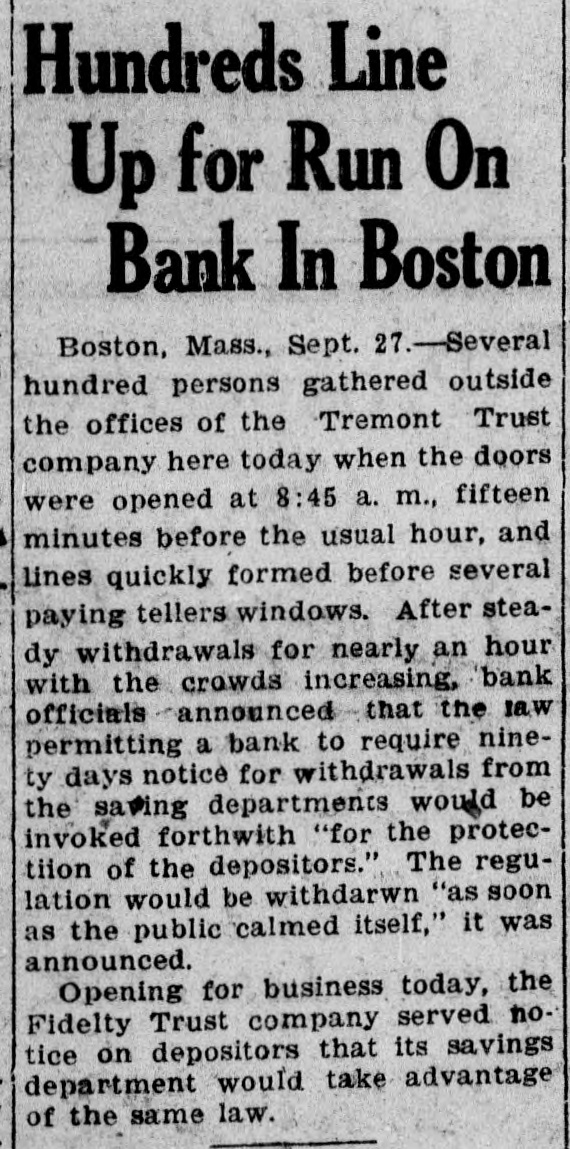
Hundreds Line Up for Run On Bank In Boston Boston, Mass., Sept. 27.-Several hundred persons gathered outside the offices of the Tremont Trust company here today when the doors were opened at 8:45 a. m., fifteen minutes before the usual hour, and lines quickly formed before several paying tellers windows. After steady withdrawals for nearly an hour with the crowds increasing, bank officials announced that the law permitting a bank to require ninety days notice for withdrawals from the saving departments would be invoked forthwith "for the protectiion of the depositors." The regulation would be withdarwn "as soon as the public calmed itself," it was announced. Opening for business today, the Fidelty Trust company served notice on depositors that its savings department would take advantage of the same law.
3.September 27, 1920East Oregonian : E.OPendleton, OR
Click image to open full size in new tab
Article Text
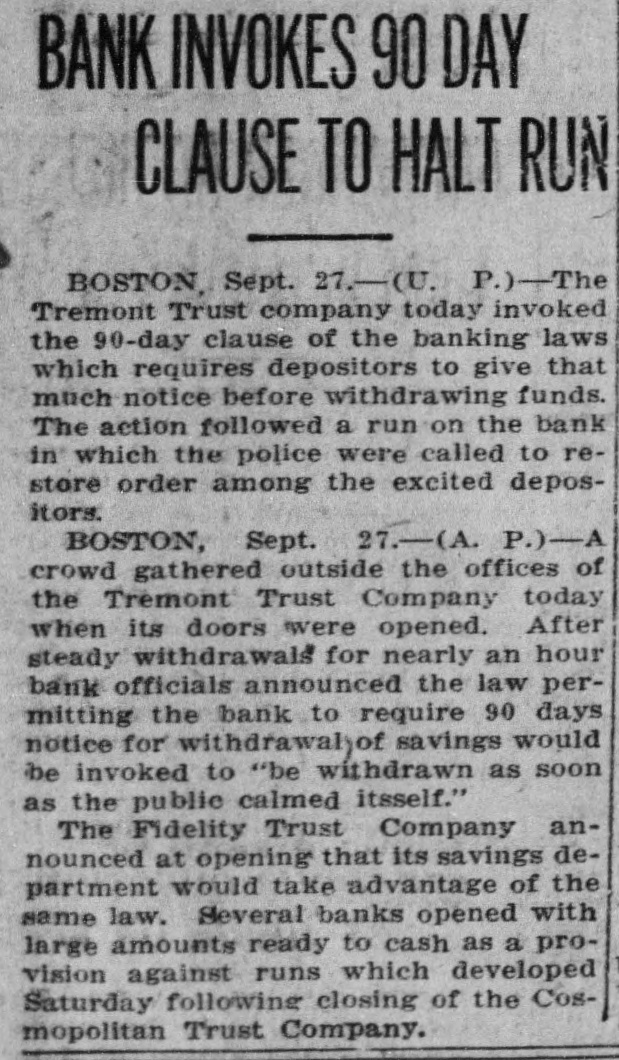
BANK INVOKES 90 DAY CLAUSE TO HALT RUN BOSTON, Sept. 27.-(U. P.)-The Tremont Trust company today invoked the 90-day clause of the banking laws which requires depositors to give that much notice before withdrawing funds. The action followed a run on the bank in which the police were called to restore order among the excited depositors. BOSTON, Sept. 27.-(A. P.)-A crowd gathered outside the offices of the Tremont Trust Company today when its doors were opened. After steady withdrawals for nearly an hour bank officials announced the law permitting the bank to require 90 days notice for withdrawaly of savings would be invoked to "be withdrawn as soon as the public calmed itsself." The Fidelity Trust Company announced at opening that its savings department would take advantage of the same law. Several banks opened with large amounts ready to cash as a provision against runs which developed Saturday following closing of the Cosmopolitan Trust Company.
4.September 27, 1920The Evening WorldNew York, NY
Click image to open full size in new tab
Article Text
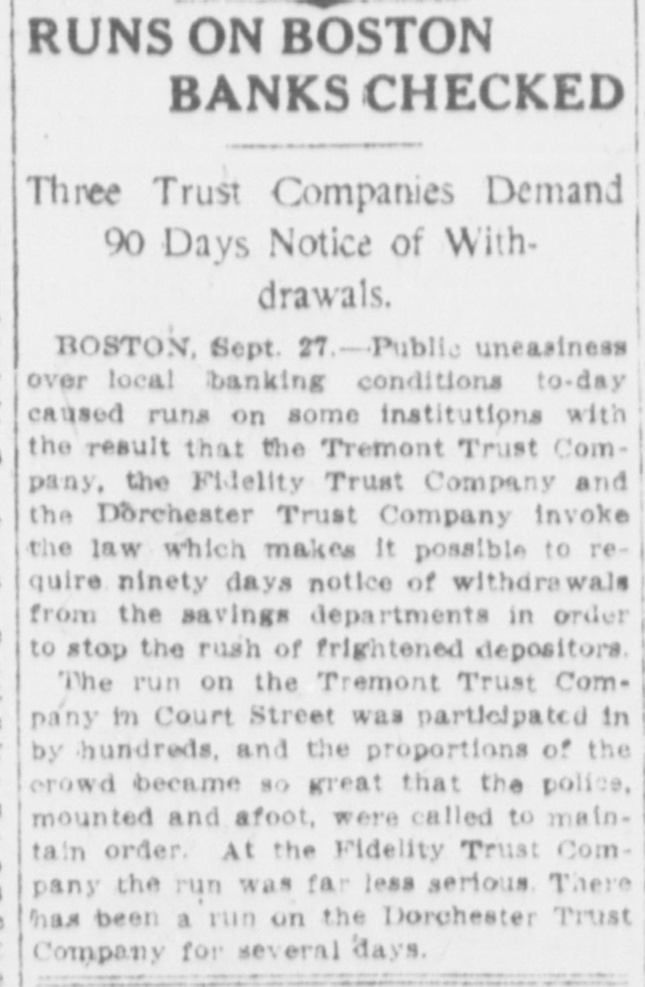
RUNS ON BOSTON BANKS CHECKED Three Trust Companies Demand 90 Days Notice of Withdrawals. BOSTON, Sept. 27.-Public uneasiness over local banking conditions to-day caused runs on some institutions with the result that the Tremont Trust Company, the Fidelity Trust Company and the Dorchester Trust Company invoke the law which makes it possible to require ninety days notice of withdrawals from the savings departments in order to stop the rush of frightened depositors. The run on the Tremont Trust Company in Court Street was participated in by hundreds, and the proportions of the crowd became so great that the police, mounted and afoot, were called to maintain order. At the Fidelity Trust Company the run was far less serious. There has been a run on the Dorchester Trust Company for several days.
5.September 27, 1920Evening StarWashington, DC
Click image to open full size in new tab
Article Text
RUN BEGINS AGAIN ON BOSTON BANK Tremont Trust Company Invokes Ninety-Day Notice to Protect Deposits. BOSTON, September 27 (by the Associated Press).-Several hundred persons gathered outside the offices of the Tremont Trust Company here today when the doors were opened at 8:45 a.m., fifteen minutes before the usual hour, and lines quickly formed before the several paying tellers' windows. After withdrawals had been going on steadily for nearly an hour. with the crowds constantly increasing. the bank officials announced that the law permitting a bank to require ninety days' notice for withdrawals from the savings departments would be invoked forthwith "for the protection of the depositors." The regulation would be withdrawn "as soon as the public calmed itself." it was announced. "We have plenty of money to pay everybody." officials said, "and we're prepared to do SO this morning. but the crowd became so large that it was impossible to handle them. and we invoked the law for the protection of the depositors, not for our own protection." Notice Served on Depositors. Upon opening for business today the Fidelity Trust Company served notice on depositors that it would take advantage of the law permitting it to require ninety days' notice of withdrawals from the savings department. It was stated at the bank that this was done upon the direction of Joseph C. Allen, state bank commistioneer. At his office it was said that the taking of this action was optional with the banks. Several banks opened their doors with large amounts of ready cash piled high within the tellers' cages as provision against a repetition of the runs which developed Saturday out of the closing of the Cosmopolitan Trust Company. No Other Banks Involved. Bank officials in several instances announced by statement or advertisement that there was no connection between the Cosmopolitan, which was the fifth bank to be closed here within two months, and their banks, and Bank Commissioner Allen declared that no other banking institution was involved in the Cosmopolitan's troubles. Nevertheless, a recurrence of the runs in some degree was anticipated, depositors having become alarmed. and. in the case of the Tremont Trust Company having made constant withdrawal from early morning to nearly midnight Saturday, the management extending the closing hour from noon to accommodate them. The feeling of uncertainty over the banking situation was the schedule of discussion by Gov. Coolidge and bankers yesterday, but without announced decision of any contemplated action. McCall Ordered Dropped. As result of the close scrutiny of affairs of local banks which Commissioner Allen has been making, was an order from him to the management of the Old South Trust Company to drop from its pay roll former Gov. Samuel W. McCall and four other officials, including two vice presidents. As chairman of the board of directors of the company, Mr. McCall. who was appointed recently, is drawing a salary of $8,000 a year. The object of the order is to reduce the bank's expenses. it being the opinion of the bank commissioner that the men he asked to have dropped are holding merely nominal positions. In each instance. they may continue to strye in their present capacity without salary, according to the order from the bank commis-
Six Boston Banks Closed in 2 Months Commissioner Takes Over Affair of Fidelity Trust Company. Boston, Sept. 28.-Bank Commissioner Allen today took over the affairs of the Fidelity Trust company. His action marked the closing of the sixth banking Institution in this city within two months. The others were the Hanover Trust company. of which Charles Ponzl, the "financial wizard." was director and largest individual depositor. the Prudenital and Cosmopolitan Trust companies and two small private banks. The capital of the Fidelity is $3,000.000. and according to the latest available statement from the company. had a surplus of $700,000. Its deposits totalled about $18,000,000. James G. Ferguson, its president. is affiliated with several other financial and industrial institutions as is Edwin T. McKnight. the vice-president. The latter is president of the state senate. The Fidelity Trust company was one of three banks which yesterday invoked the law requiring ninety days' notice for withdrawal of savings deposits. The reasons for the closing of the bank, Commissioner Allen said, were "the steady withdrawals of deposits and slow and doubtful loans. At the Tremont Trust company a small crowd gathered before the opening hour, but the police had no dimculty in keeping order. The bank continued business in its commercial dedepartment were require to give ninety department were required to ninety days' notice of intention to withdraw. The same situation existed at the Dorchester Trust company.
7.September 28, 1920The Richmond Palladium and Sun-TelegramRichmond, IN
Click image to open full size in new tab
Article Text
SIXTH BOSTON BANK IS ORDERED CLOSED (By Associated Press) BOSTON, Sept. 28.-Bank Commissioner Joseph C. Allen today took over the affairs of the Fidelity Trust company. His action marked the closing of the sixth banking institution in this city within two months. The others were the Hanover Trust Co., of which Charles Ponzi, the financial wizard," was a director and largest individual depositor, the Prudential and Cosmo. politan Trust companies, and two small private banks. The capital of the Fidelity is $3, 000,000, and according to the latest available statement from the company, had a surplus of $700,000. It deposits totaled about $18,000,000. James G. Ferguson, its president, is affiliated with several other financial institutions, as is Edwin T. McKnight, the vice-president. The latter is president of the state senate. The Fidelity Trust company was one of three banks which yesterday invoked the law, requiring 90 days notice for withdrawal of savings depoalts. The reason for the closing of the bank, Commissioner Allen said, was "the steady withdrawal of deposits and slow and doubtful loans."
8.September 28, 1920The Bismarck TribuneBismarck, Mandan, ND
Click image to open full size in new tab
Article Text
SIXTH BANK IN BOSTON CLOSED BY COMMISSIONER Boston, Sept. 28. - Bank Commissioner Joseph C. Allen today took over the affairs of the Fidelity Trust company. His action marked the closing of the sixth banking institution in this city within two months. The others were the Hanover Trust company, of which Charles Ponzi, the financial wizard, was a director and largest individual depositor, the Prudential and Cosmopolitan Trust companies and two smaller institutions. The capital of the Fidelity is $3,000,000, and according to the latest statement, had a surplus of $700,000. Its depostis totalled about $18,000,000. The reason for the closing of the bank, Commissioner Allen said, were "the steady withdrawals of deposits and slow and doubtful loans."
BANK COMMISSIONER TAKES OVER AFFAIRS OF TRUST COMPANY Boston, Sept. 28.-Bank Commissioner Joseph C. Allen today took over the affairs of the Fidelity Trust company. His action marked the closing of the sixth banking institution in this city within two months. The others were the Hanover Trust company, of which Charles Ponzi, the financial wizard, was a director and largest indivídual depositor. the Prudential and Cosmopolitan Trust companies and two small private banks. The capital of the Fidelity is $3.000,000, and, according to the latest statement, had a surplus of $700,000. Its deposits totalled about $18,000,000. James G. Ferguson, its president, is affiliated with several other financial and industrial institutions. as is Edwin T. McKnight, the vice president. The reasons for the closing of the bank, Commissioner Allen said. were "the steady withdrawals of deposits, and slow and doubtful loans."
10.September 28, 1920Capital JournalSalem, OR
Click image to open full size in new tab
Article Text
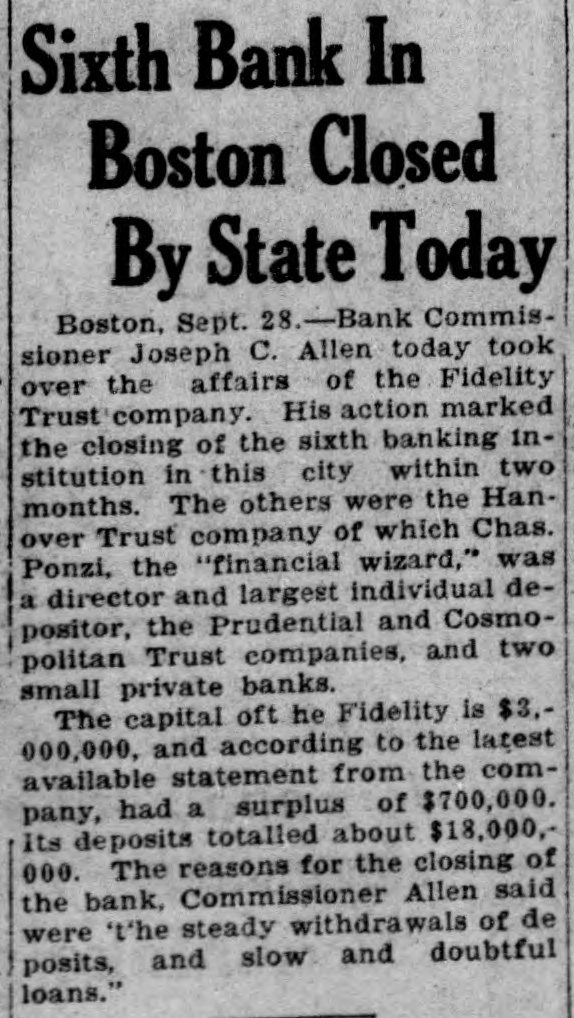
Sixth Bank In Boston Closed By State Today Boston, Sept. 28.-Bank Commissioner Joseph C. Allen today took over the affairs of the Fidelity Trust company. His action marked the closing of the sixth banking institution in this city within two months. The others were the Hanover Trust company of which Chas. Ponzi, the "financial wizard," was a director and largest individual depositor, the Prudential and Cosmopolitan Trust companies, and two small private banks. The capital oft he Fidelity is $3.000,000, and according to the latest available statement from the company, had a surplus of $700,000. Its deposits totalled about $18,000,000. The reasons for the closing of the bank, Commissioner Allen said were 't'he steady withdra wals of de posits, and slow and doubtful loans."
11.September 28, 1920El Paso HeraldEl Paso, TX
Click image to open full size in new tab
Article Text
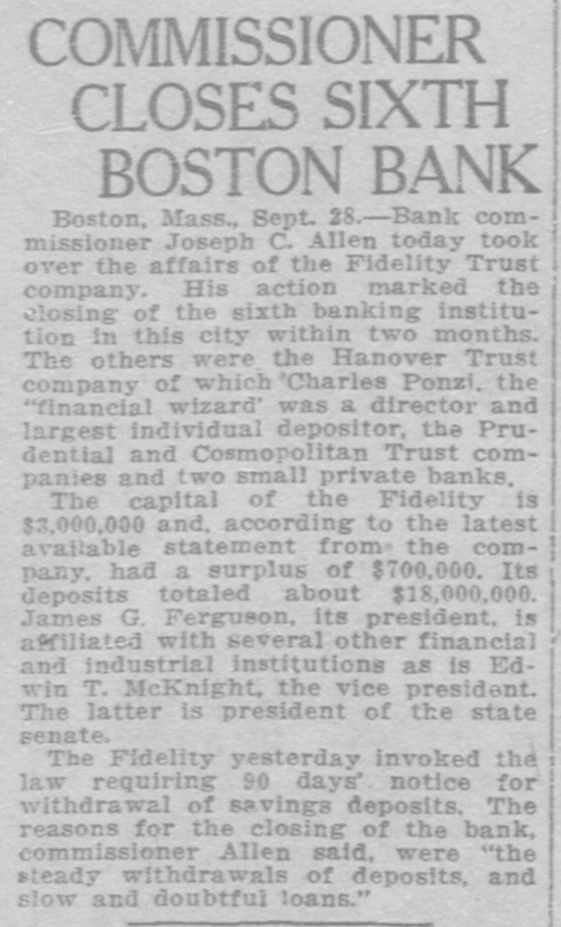
COMMISSIONER CLOSES SIXTH BOSTON BANK Boston, Mass., Sept. 28.-Bank commissioner Joseph C. Allen today took over the affairs of the Fidelity Trust company. His action marked the closing of the sixth banking institution in this city within two months. The others were the Hanover Trust company of which Charles Ponzi, the "financial wizard' was a director and largest individual depositor, the Prudential and Cosmopolitan Trust companies and two small private banks, The capital of the Fidelity is $3,000,000 and, according to the latest available statement from the company, had a surplus of $700,000. Its deposits totaled about $18,000,000. James G. Ferguson, its president, is affiliated with several other financial and industrial institutions as is Edwin T. McKnight, the vice president. The latter is president of the state senate. The Fidelity yesterday invoked the law requiring 90 days' notice for withdrawal of savings deposits. The reasons for the closing of the bank, commissioner Allen said, were "the steady withdrawals of deposits, and slow and doubtful loans."
12.September 28, 1920Every Evening, Wilmington Daily CommercialWilmington, DE
Click image to open full size in new tab
Article Text
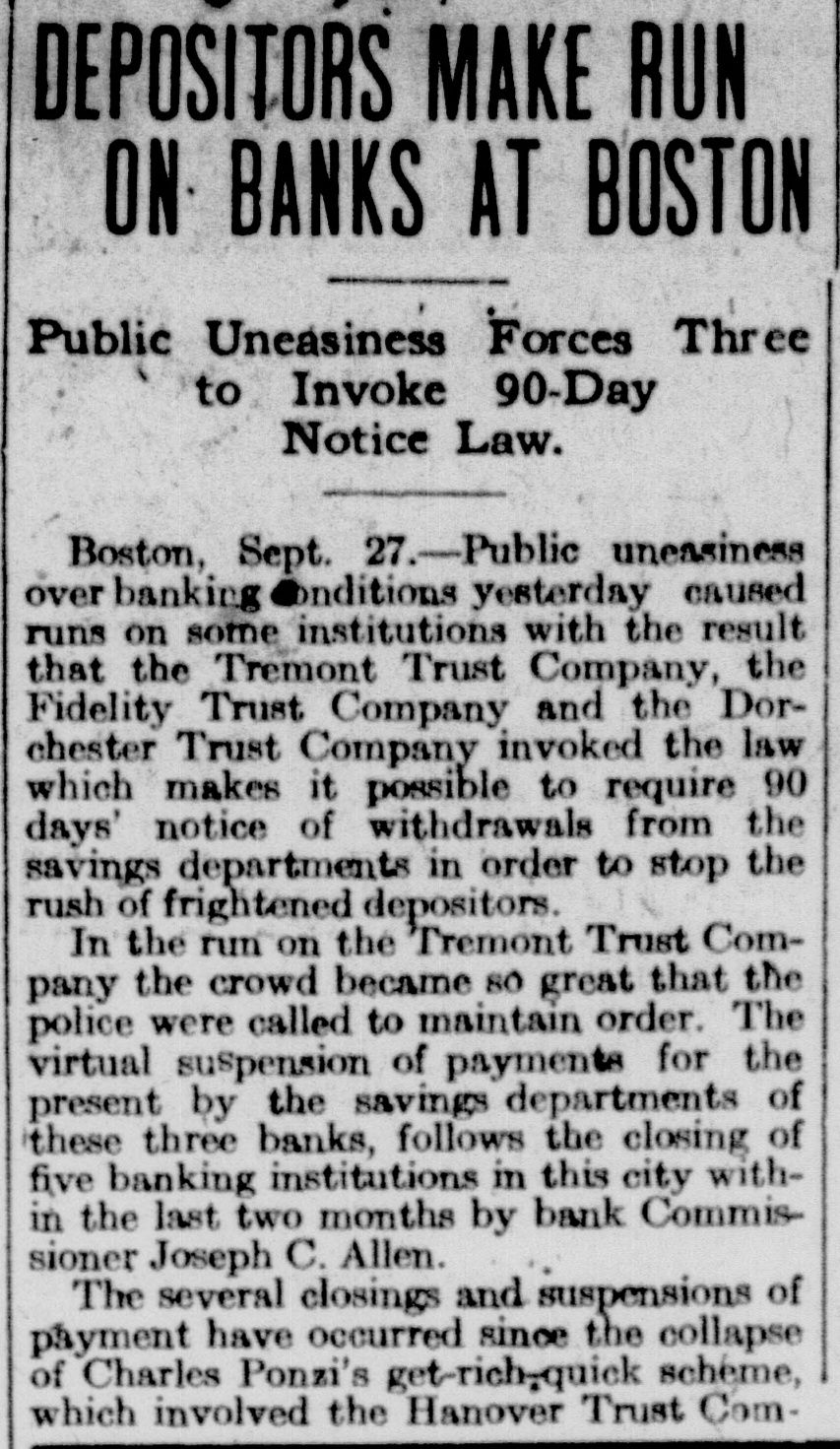
DEPOSITORS MAKE RUN ON BANKS AT BOSTON Public Uneasiness Forces Three to Invoke 90-Day Notice Law. Boston, Sept. 27.-Public uneasiness over banking conditions yesterday caused runs on some institutions with the result that the Tremont Trust Company, the Fidelity Trust Company and the Dorchester Trust Company invoked the law which makes it possible to require 90 days' notice of withdrawals from the savings departments in order to stop the rush of frightened depositors. In the run on the Tremont Trust Company the crowd became so great that the police were called to maintain order. The virtual suspension of payments for the present by the savings departments of these three banks, follows the closing of five banking institutions in this city within the last two months by bank Commissioner Joseph C. Allen. The several closings and suspensions of payment have occurred since the collapse of Charles Ponzi's get-rich-quick scheme, which involved the Hanover Trust Com-
13.September 28, 1920The Washington HeraldWashington, DC
Click image to open full size in new tab
Article Text
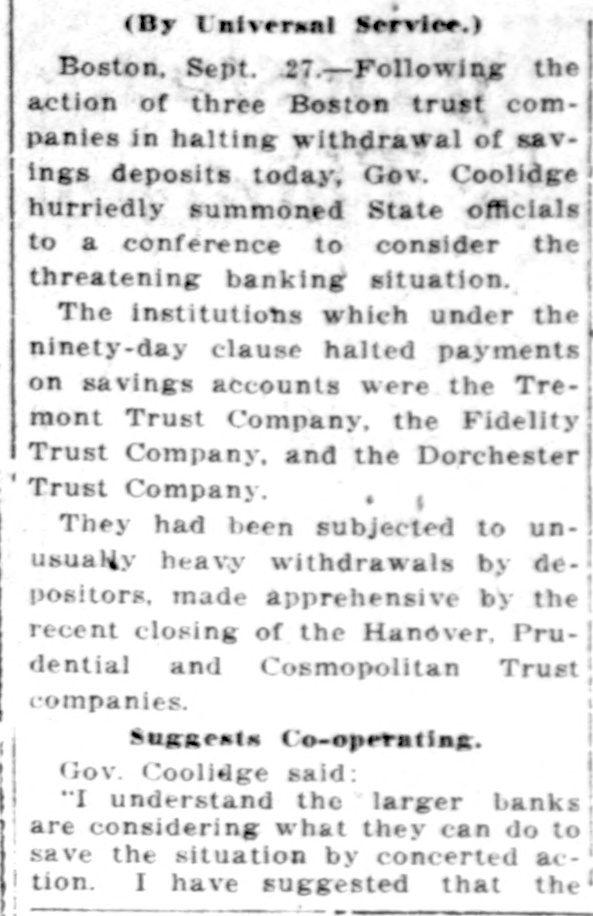
(By Universal Service
) Boston, Sept. 27.-Following the action of three Boston trust companies in halting withdrawal of savings deposits today, Gov. Coolidge hurriedly summoned State officials to a conférence to consider the threatening banking situation. The institutions which under the ninety-day clause halted payments on savings accounts were the Tremont Trust Company, the Fidelity Trust Company, and the Dorchester Trust Company. They had been subjected to unusually heavy withdrawals by depositors, made apprehensive by the recent closing of the Hanover. Prudential and Cosmopolitan Trust companies. Suggests Co-operating. Gov. Coolidge said: "I understand the larger banks are considering what they can do to save the situation by concerted action. I have suggested that the
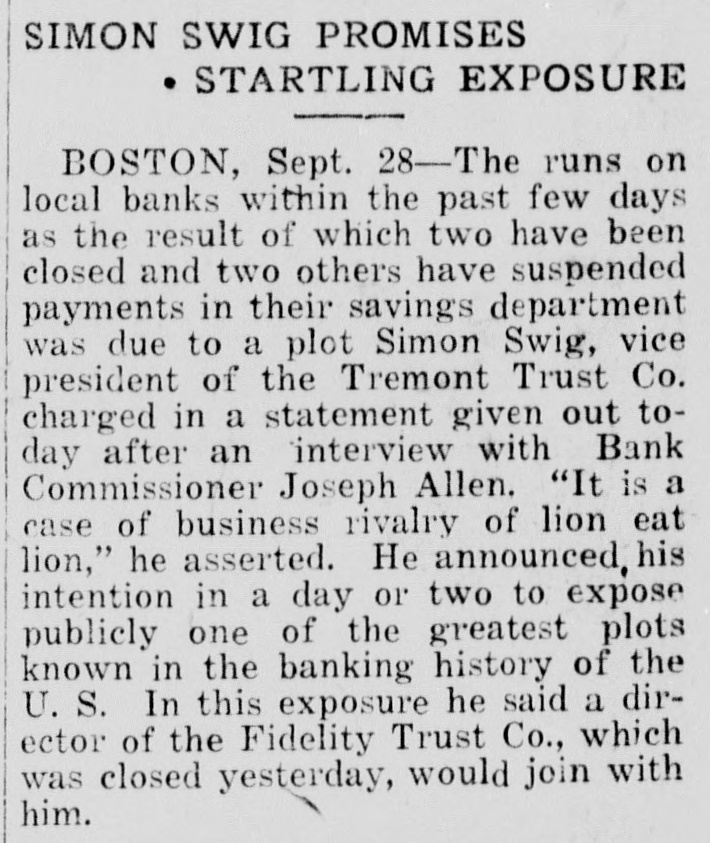
SIMON SWIG PROMISES STARTLING EXPOSURE BOSTON, Sept. 28-The runs on local banks within the past few days as the result of which two have been closed and two others have suspended payments in their savings department was due to a plot Simon Swig, vice president of the Tremont Trust Co. charged in a statement given out today after an interview with Bank Commissioner Joseph Allen. "It is a case of business rivalry of lion eat lion," he asserted. He announced, his intention in a day or two to expose publicly one of the greatest plots known in the banking history of the U. S. In this exposure he said a director of the Fidelity Trust Co., which was closed yesterday, would join with him.
15.September 29, 1920Omaha Daily BeeOmaha, NE
Click image to open full size in new tab
Article Text
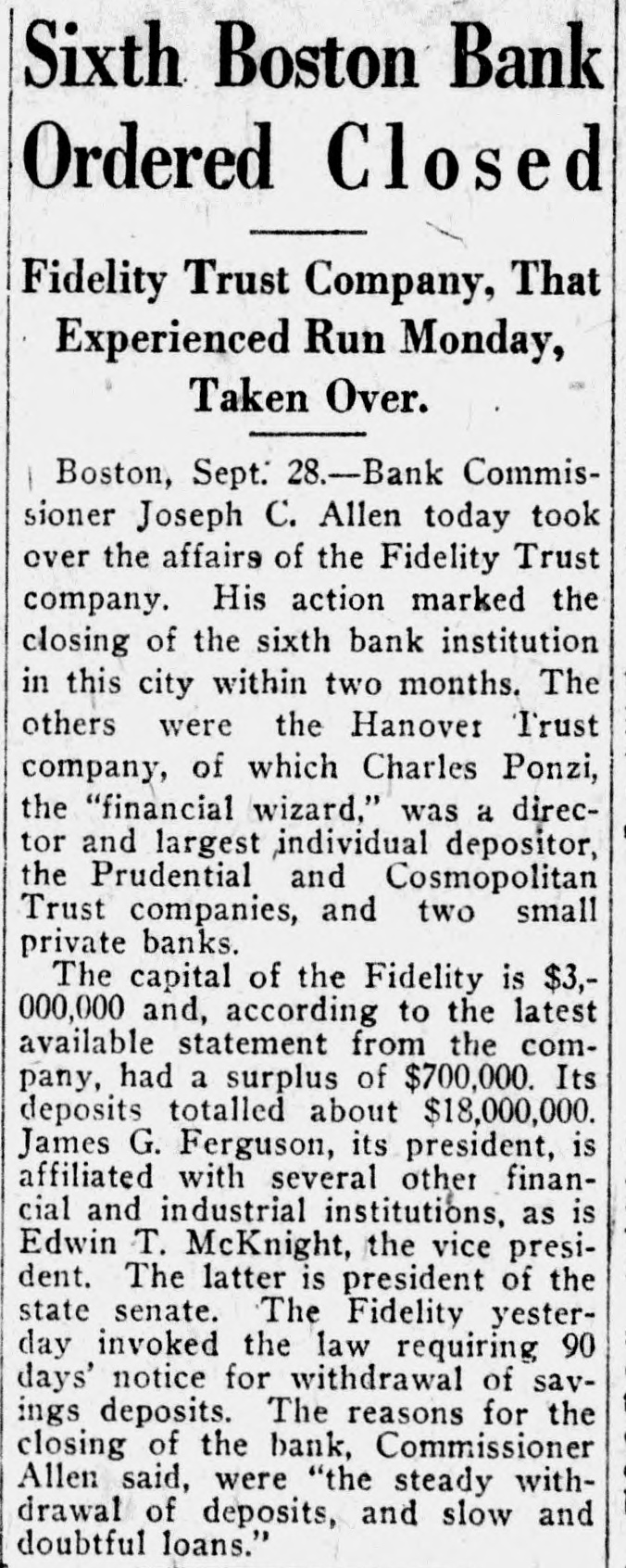
Sixth Boston Bank Ordered Closed Fidelity Trust Company, That Experienced Run Monday, Taken Over. Boston, Sept. 28.-Bank Commissioner Joseph C. Allen today took over the affairs of the Fidelity Trust company. His action marked the closing of the sixth bank institution in this city within two months. The others were the Hanover Trust company, of which Charles Ponzi, the "financial wizard." was a director and largest individual depositor, the Prudential and Cosmopolitan Trust companies, and two small private banks. The capital of the Fidelity is $3,000,000 and, according to the latest available statement from the company, had a surplus of $700,000. Its deposits totalled about $18,000,000. James G. Ferguson, its president, is affiliated with several other financial and industrial institutions, as is Edwin T. McKnight, the vice president. The latter is president of the state senate. The Fidelity yesterday invoked the law requiring 90 days' notice for withdrawal of savings deposits. The reasons for the closing of the bank, Commissioner Allen said, were "the steady withdrawal of deposits, and slow and doubtful loans."
16.September 29, 1920Daily Kennebec JournalAugusta, ME
Click image to open full size in new tab
Article Text
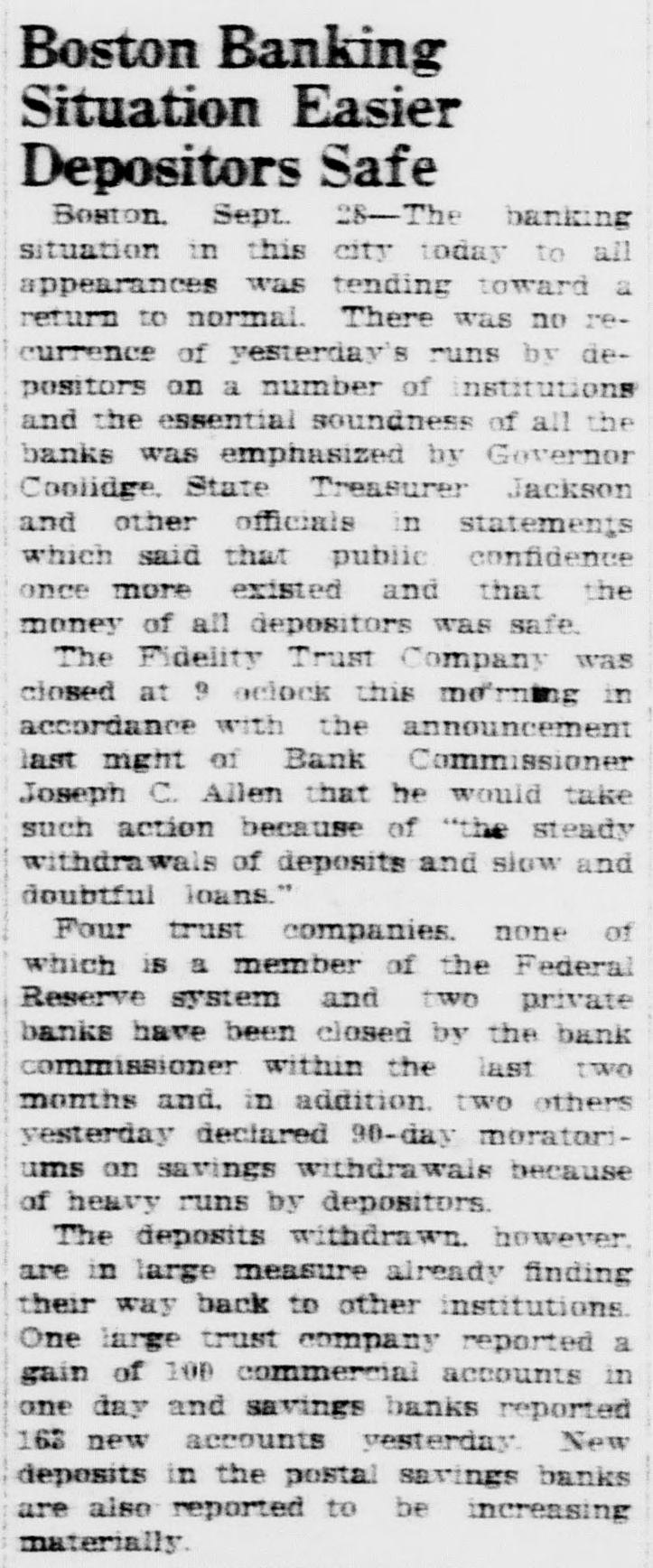
Boston Banking Situation Easier Depositors Safe Boston. Sept. 28-The banking situation in this city today to all appearances was tending toward a return to normal. There was no recurrence of yesterday's runs by depositors on a number of institutions and the essential soundness of all the banks was emphasized by Governor Coolidge. State Treasurer Jackson and other officials in statements which said that public confidence once more existed and that the money of all depositors was safe. The Fidelity Trust Company was closed at 9 oclock this me"rming in accordance with the announcement last mght of Bank Commissioner Joseph C. Allen that he would take such action because of "the steady withdrawals of deposits and slow and doubtful loans." Four trust companies. none of which is a member of the Federal Reserve system and two private banks have been closed by the bank commissioner within the last two months and. in addition. two others yesterday declared 90-day moratoriums on savings withdrawals because of heavy runs by depositors. The deposits withdrawn. however. are in large measure already finding their way back to other institutions. One large trust company reported a gain of 100 commercial accounts in one day and savings banks reported 163 new accounts yesterday. New deposits in the postal savings banks are also reported to be increasing materially.
17.September 29, 1920The Manning TimesManning, SC
Click image to open full size in new tab
Article Text
TREMONT TRUST CO
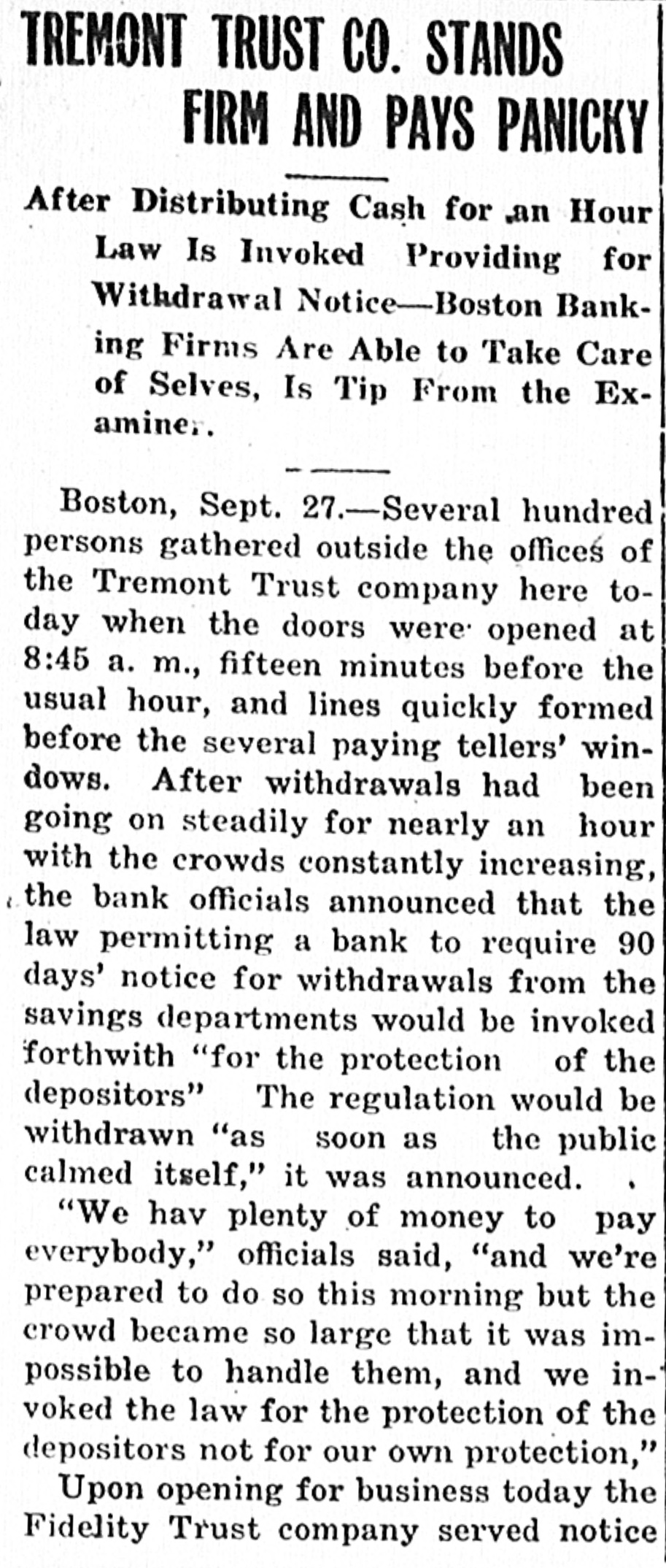
STANDS FIRM AND PAYS PANICKY After Distributing Cash for an Hour Law Is Invoked Providing for Withdrawal Notice-Boston Banking Firms Are Able to Take Care of Selves, Is Tip From the Examine, Boston, Sept. 27.-Several hundred persons gathered outside the offices of the Tremont Trust company here today when the doors were: opened at 8:45 a. m., fifteen minutes before the usual hour, and lines quickly formed before the several paying tellers' windows. After withdrawals had been going on steadily for nearly an hour with the crowds constantly increasing, the bank officials announced that the law permitting a bank to require 90 days' notice for withdrawals from the savings departments would be invoked forthwith "for the protection of the depositors" The regulation would be withdrawn "as soon as the public calmed itself," it was announced. "We hav plenty of money to pay everybody," officials said, "and we're prepared to do SO this morning but the crowd became so large that it was impossible to handle them, and we invoked the law for the protection of the depositors not for our own protection," Upon opening for business today the Fidelity Trust company served notice
18.September 29, 1920South Bend News-TimesSouth Bend, IN
Click image to open full size in new tab
Article Text
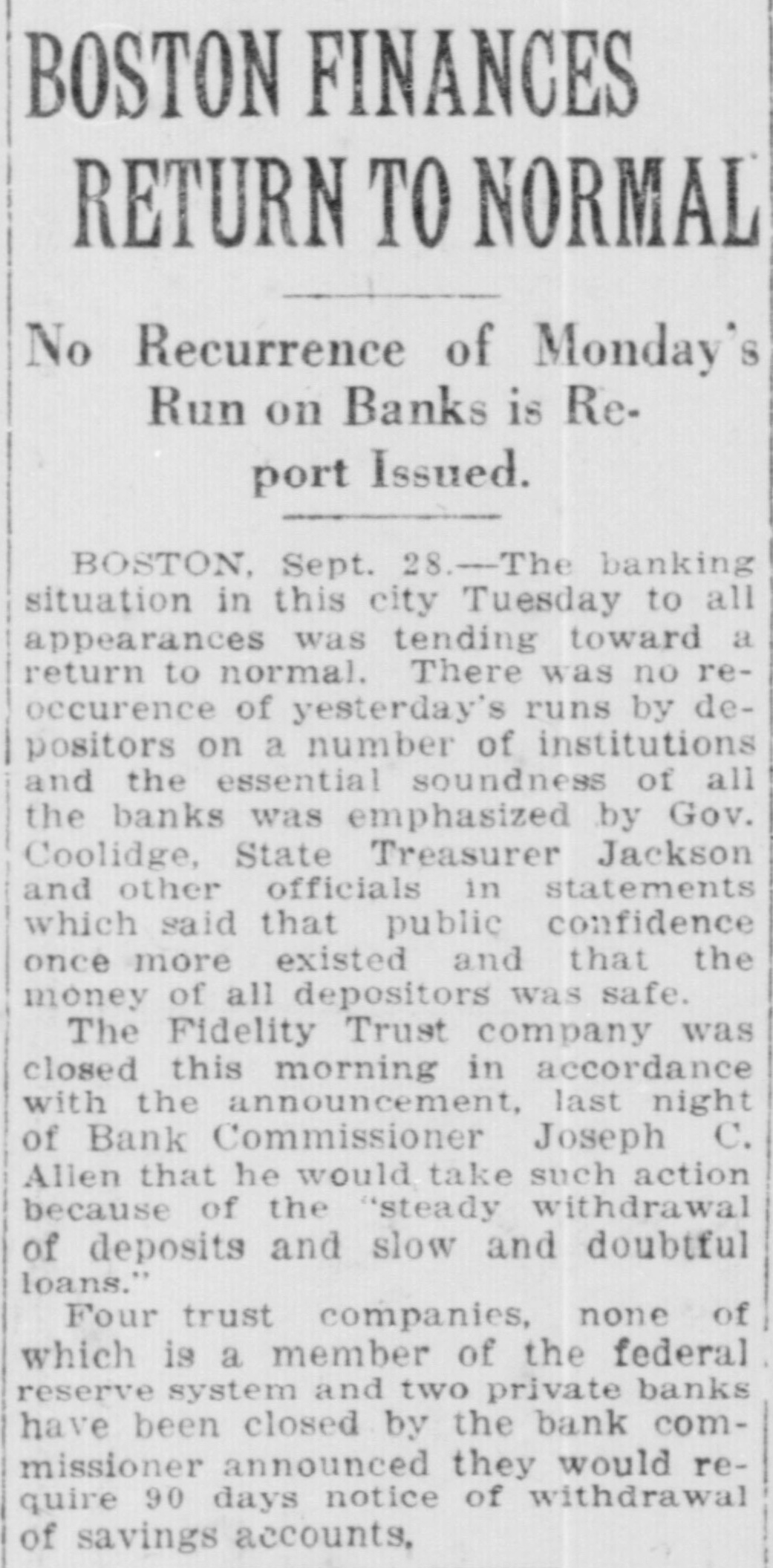
BOSTON FINANCES RETURN TO NORMAL No Recurrence of Monday's Run on Banks is Report Issued. BOSTON, Sept. 28.-The banking situation in this city Tuesday to all appearances was tending toward a return to normal. There was no reoccurence of yesterday's runs by depositors on a number of institutions and the essential soundness of all the banks was emphasized by Gov. Coolidge, State Treasurer Jackson and other officials in statements which said that public confidence once more existed and that the money of all depositors was safe. The Fidelity Trust company was closed this morning in accordance with the announcement, last night of Bank Commissioner Joseph C. Allen that he would take such action because of the "steady withdrawal of deposits and slow and doubtful loans." Four trust companies, none of which is a member of the federal reserve system and two private banks have been closed by the bank commissioner announced they would require 90 days notice of withdrawal of savings accounts,
19.September 29, 1920The Abbeville Press and BannerAbbeville, SC
Click image to open full size in new tab
Article Text
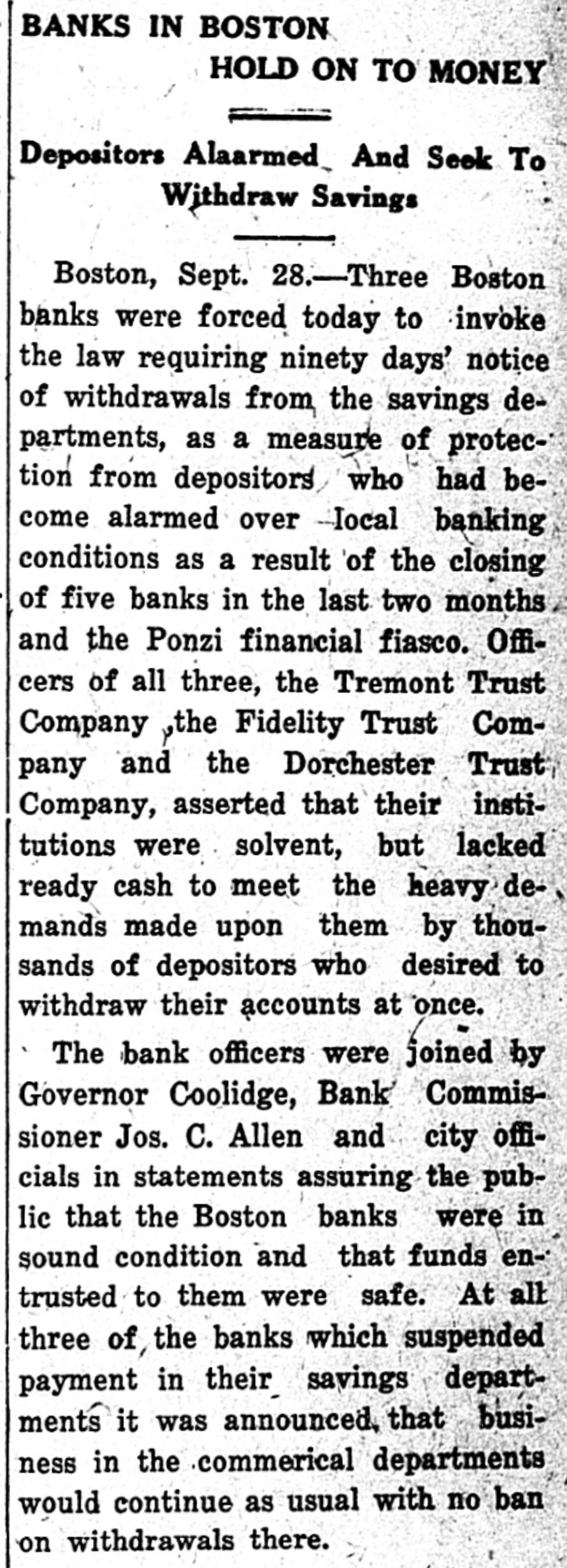
BANKS IN BOSTON HOLD ON TO MONEY Depositors Alaarmed And Seek To Withdraw Savings Boston, Sept. 28.-Three Boston banks were forced today to invoke the law requiring ninety days' notice of withdrawals from the savings departments, as a measure of protection from depositors who had become alarmed over local banking conditions as a result of the closing of five banks in the last two months and the Ponzi financial fiasco. Officers of all three, the Tremont Trust Company the Fidelity Trust Company and the Dorchester Trust Company, asserted that their institutions were solvent, but lacked ready cash to meet the heavy demands made upon them by thousands of depositors who desired to withdraw their accounts at once. The bank officers were joined by Governor Coolidge, Bank Commissioner Jos. C. Allen and city officials in statements assuring the public that the Boston banks were in sound condition and that funds entrusted to them were safe. At all three of the banks which suspended payment in their savings departments it was announced, that business in the commerical departments would continue as usual with no ban on withdrawals there.
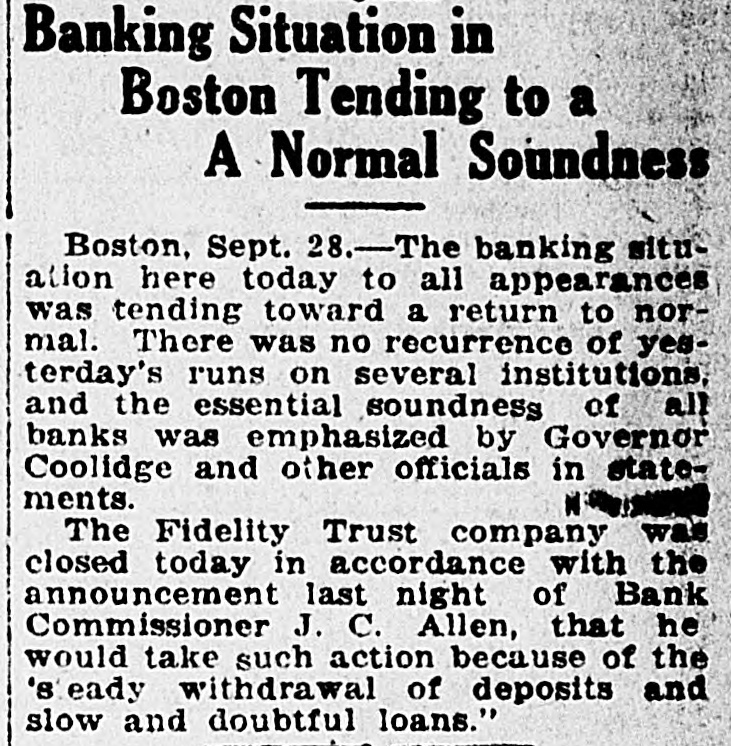
Banking Situation in Boston Tending to a A Normal Soundness Boston, Sept. 28.-The banking situation here today to all appearances was tending toward a return to normal. There was no recurrence of yesterday's runs on several institutions, and the essential soundness of all banks was emphasized by Governor Coolidge and other officials in statements. N The Fidelity Trust company was closed today in accordance with the announcement last night of Bank Commissioner J. C. Allen, that he would take such action because of the 's eady withdrawal of deposits and slow and doubtful loans."
21.September 30, 1920The Nenana Daily NewsNenana, AK
Click image to open full size in new tab
Article Text
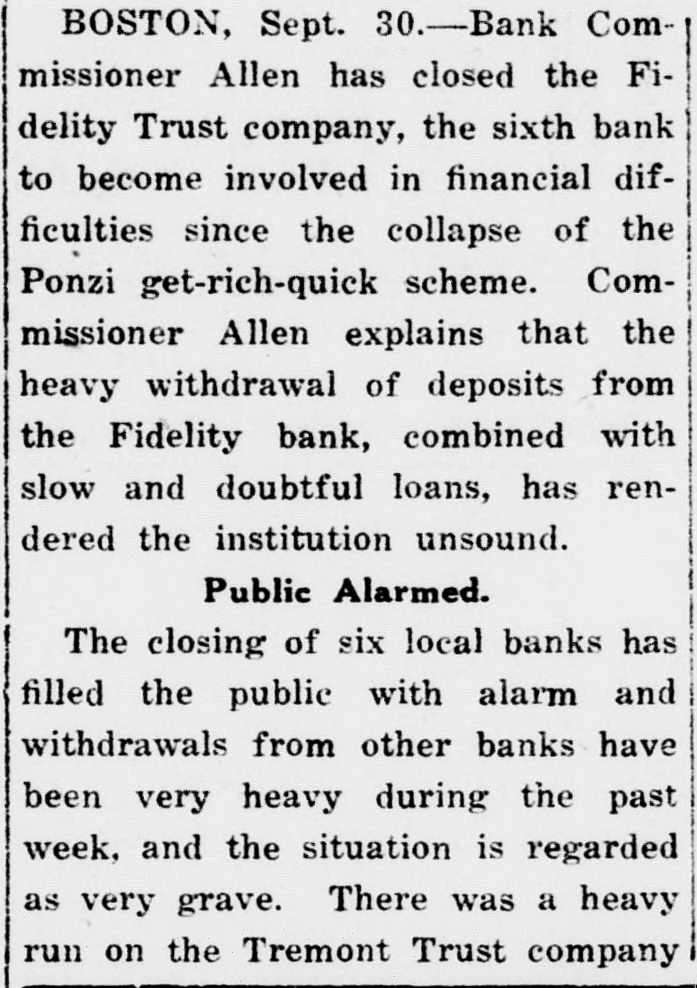
BOSTON, Sept. 30.-Bank Commissioner Allen has closed the Fidelity Trust company, the sixth bank to become involved in financial difficulties since the collapse of the Ponzi get-rich-quick scheme. Commissioner Allen explains that the heavy withdrawal of deposits from the Fidelity bank, combined with slow and doubtful loans, has rendered the institution unsound. Public Alarmed. The closing of six local banks has filled the public with alarm and withdrawals from other banks have been very heavy during the past week, and the situation is regarded as very grave. There was a heavy run on the Tremont Trust company
Bank runs are almost always and everywhere a deterioration of bank fundamentals.
But not for you.
You are the measure-zero exception: great fundamentals, solid bank, and yet the Diamond Dybvig fairy spread its rumor. Depositors woke up. Your collateral was not prepositioned. The Clearinghouse had it for you.
Do not pass Go. Do not collect $200. Go directly to jail… or worse.