Click image to open full size in new tab
Article Text
TOOK OWATONNA
RELATIVES ABROAD
Continued from First Page.
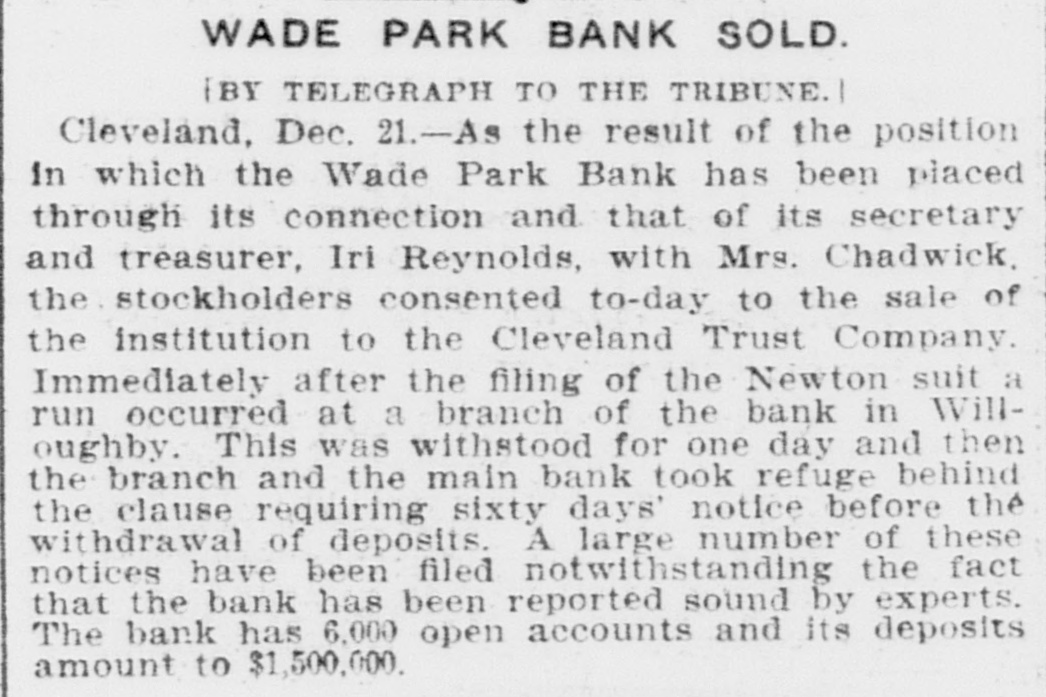
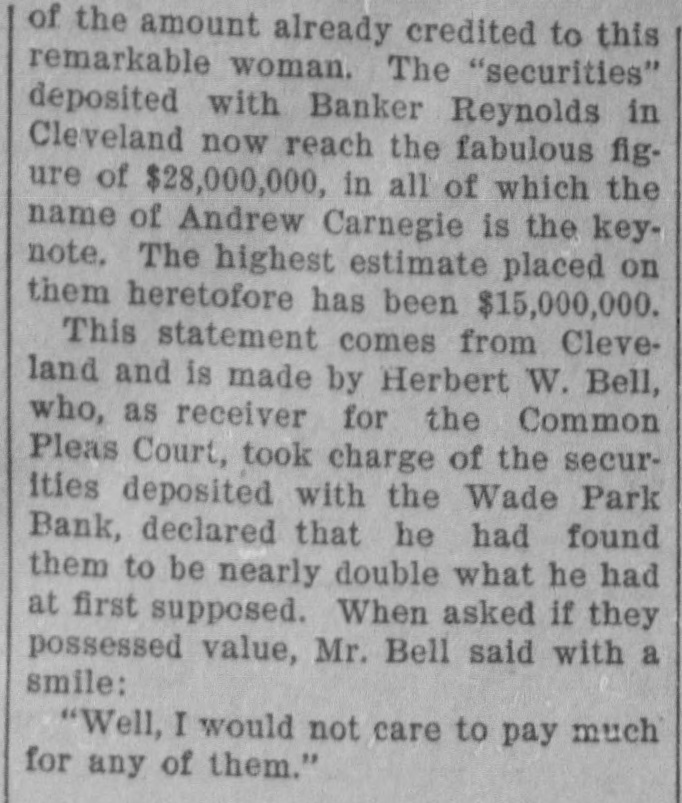
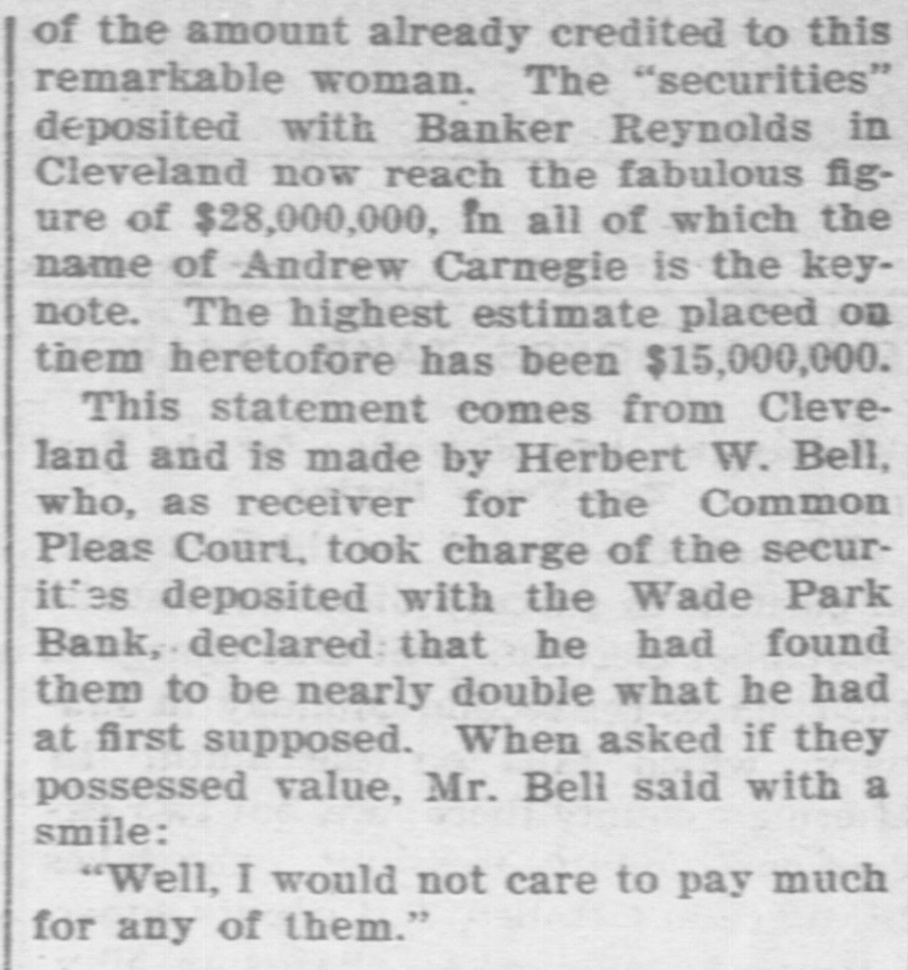
eral. I consulted my committee and with their consent I loaned her the money. The next day she brought a package which she said contained $200,000 in United States Steel bonds and a $250,000 certificate, which I was to hold in trust for her, under the same conditions as the previous package. I held these until a month ago, when, in the presence of several gentlemen, they were opened. It was about the time Mr. Newton began his suit. They contained bonds all right, but they were not Steel bonds."
When asked what they were, Mr. Reynolds said: "There were five $1,000 bonds of the Home Telegraph company of Niagara, N. Y., and six certificates of the Buckeye Fish company."
Armful of "Steel Bonds."
Just before he was appointed custodian of this last package, Mr. Reynolds says, Mrs. Chadwick came to the bank one afternoon with a package she said contained steel bonds. "There was as many as you could carry in your two arms," he said. "She left them in the vault, and when she returned from Europe she took them away, saying she had been advised to put such a vast amount of valuable paper in a better vault."
Mr. Reynolds understood she was to take them to New York or Pittsburg. At one time, he said, she made a written statement to his committee that she had over two million in bonds in the safety deposit vault in the Wade Park bank.
Repeated efforts on Mr. Reynolds' part to close up the dealings with Mrs. Chadwick met with excuse and delay. He was put off time after time, yet did not lose confidence. He detailed one instance, that on May 11, 1904, when he went to New York expecting to settle the entire affair. Mrs. Chadwick was in consultation with a number of lawyers and after waiting two days he returned to Cleveland without seeing her.
He had read the trust agreement, but had never seen the signature.
And He Believed Her.
Mrs. Chadwick had told him the original was in the package he held. He confidently believed everything would be paid, up to a week ago, and had no suspicion of anything wrong until a few days before Mr. Newton brought his suit. Then his attorney, Mr. Carver of Boston, called at the Wade Park bank and said he understood he held some Steel securities of Mrs. Chadwick's and showed him a paper assigning all her right and title in Reynolds' holdings.
Several notes of $10,000, each payable to Dr. Chadwick had been taken up by Mr. Reynolds. He declared they were payable out of any moneys that might have been on credit to Mrs. Chadwick in the First National bank of Cleveland on Aug. 20. Some of these were paid in February or March, 1904, money was placed to her credit in this bank. Mr. Reynolds thought money came from the east to pay all of these, and felt assured that what he held was all right.
He was further assured when Judge Olcott of New York came to Cleveland and was introduced to him over the telephone by Mrs. Chadwick. Judge Olcott assured him that he would relieve Mrs. Chadwick from her unenviable position. He knew Judge Olcott was here because he was assured by a check for $1,500 signed by Judge Olcott he received the next day.
He last saw Mrs. Chadwick on Nov. 10. She desired to go east and had no money.
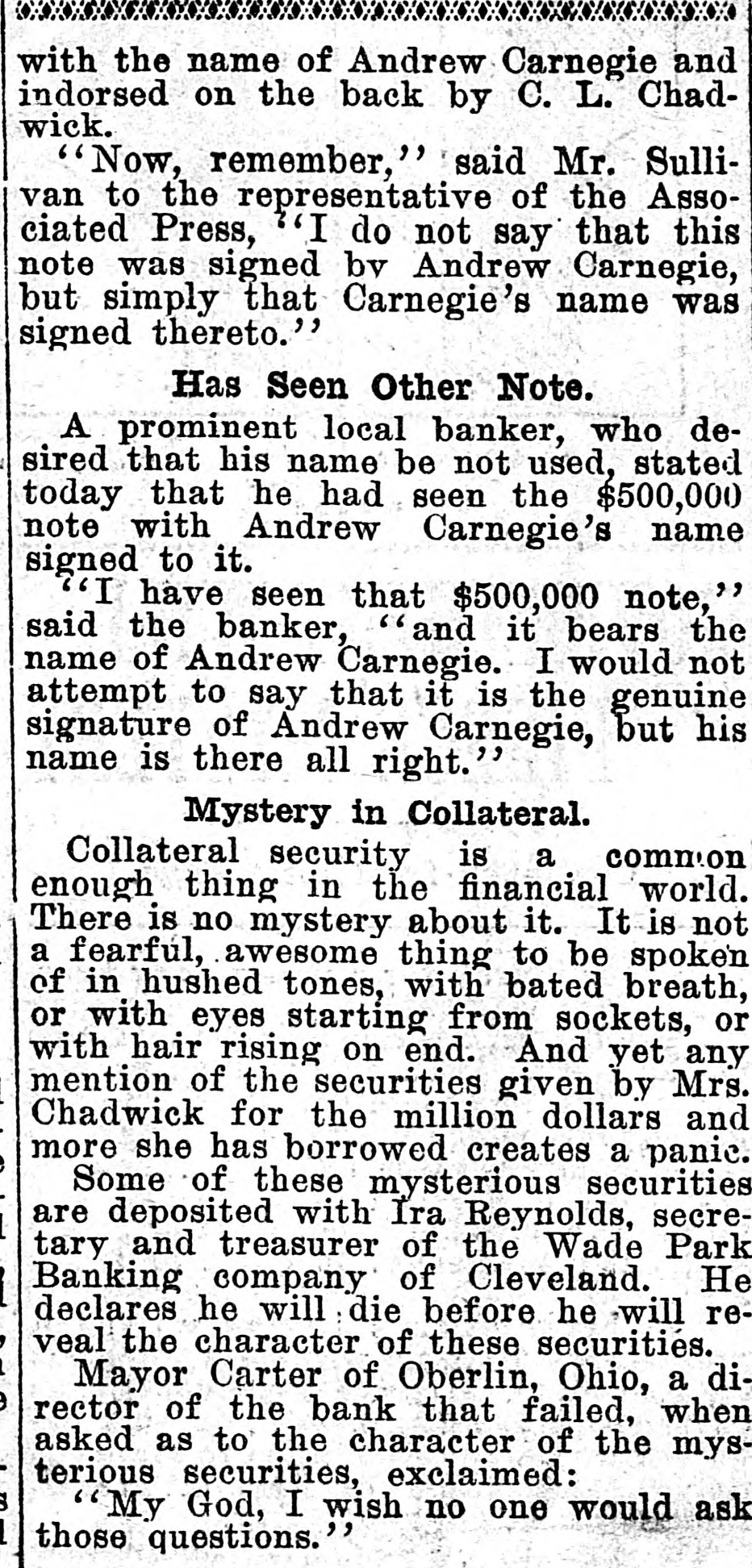
He cashed a check on the Lincoln Trust company of New York. It was returned marked "account closed." He took it out of the Wade Park bank, paid it and has it in his possession. He brought the Newton debt to her attention and advised her to go east and raise the money and settle the whole affair, and he thought she went east to see Andrew Carnegie.
"Broke" in New York.
Mr. Reynolds came away from New York, he says, because he did not have money enough to stay there two hours. "She has fooled me, and many men smarter than me; she has pulled the wool over everybody's eyes." Then, with a faint smile, as tho the humor of the case appealed to him, despite his troubles, he said: "Once she wrote to me to ask if I needed help because of the run on the bank." Still another incident was detailed by the witness. "When Mrs. Chadwick was in Europe," he said, "she wrote that Dr. Chadwick was in the hospital seriously ill, the daughter also was ill and she was in sore distress. Emil came home to save expenses and he was taken with typhoid fever. She cabled me that she had no money and I sent her $15,000. The shock of Emil's illness made her seriously ill, and when she arrived here she was thought to be dying. She then told me where, if anything happened to her, I would find a letter to Mr. Carnegie, and he would settle all her indebtedness."
Witness had seen no other notes, but had seen a check which was sent to his house when he was ill. It was for $60,000, and had Andrew Carnegie's name signed to it. Whether any money was ever produced on it he did not know. As to the value of Mrs. Chadwick's household fittings Mr. Reynolds thought they might be worth about $200,000. He said he took a chattel mortgage about two years ago, but had never recorded it.
ONE LAMB OWNS UP