Other: Stockholders/board undertook liquidation efforts and stockholder assessments were later levied to raise funds to pay depositors; offers from other banks to take over the institution for liquidation were considered.
Receivership Details
Depositor recovery rate
100.0%
Date receivership started
1915-02-17
OCC cause of failure
Losses
Share of assets assessed as good
36.1%
Share of assets assessed as doubtful
57.9%
Share of assets assessed as worthless
6.0%
Description
Bank experienced steady withdrawals (a run) and directors did not open the bank June 19–20, 1914; examiner initially found it solvent but it was later liquidated and a receiver appointed (Feb 1915). Misapplication of funds by officers was subsequently uncovered and prosecutions followed.
Events (7)
1.July 29, 1903Chartered
Source
historical_nic
2.June 19, 1914Run
Cause
Bank Specific Adverse Info
Cause Details
Steady withdrawals by depositors since March; later investigations revealed misapplication of funds and impaired capital.
Measures
Directors closed bank (did not open); turned affairs over to directors/board for liquidation; later placed in hands of liquidating agent.
Newspaper Excerpt
After an all night conference of the directors of the State National Bank of this city the institution did not open for business today... President W. H. Garantio said the action of the directors was taken because of a steady withdrawal of deposits.
Source
newspapers
3.June 20, 1914Suspension
Cause
Bank Specific Adverse Info
Cause Details
Directors suspended payments/closed because continued heavy withdrawals had reduced deposits drastically and capital was impaired.
Newspaper Excerpt
the institution did not open for business today... action of the directors was taken because of a steady withdrawal of deposits.
Source
newspapers
4.July 3, 1914Other
Newspaper Excerpt
Stockholders to meet to select liquidating agent; State National pronounced solvent by examiner but to be liquidated by stockholders or taken over for liquidation by other banks under comptroller's supervision. (July 3, 1914).
Source
newspapers
5.July 9, 1914Voluntary Liquidation
Source
historical_nic
6.February 16, 1915Receivership
Newspaper Excerpt
Lloyd England... received notice of his appointment as receiver for the State National bank of this city, which has been in the hands of a liquidating agent since it was closed by the directors last June. ... The announcement of the appointment of a receiver followed. (Feb. 16, 1915).
Source
newspapers
7.February 17, 1915Receivership
Source
historical_nic
Newspaper Articles (22)
1.June 21, 1914The SunNew York, NY
Click image to open full size in new tab
Article Text
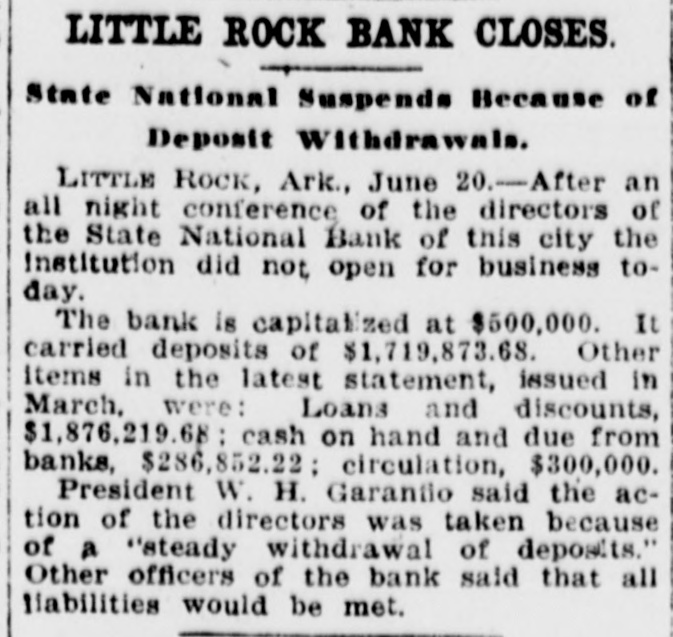
LITTLE ROCK BANK CLOSES. State National Suspends Because of Deposit Withdrawals. LITTLE ROCK, Ark., June 20.-After an all night conference of the directors of the State National Bank of this city the institution did not open for business today. The bank is capitalized at $500,000. It carried deposits of $1,719,873.68. Other items in the latest statement, issued in March, were: Loans and discounts, $1,876,219.68 : cash on hand and due from banks, $286,852.22; circulation, $300,000. President W. H. Garantio said the action of the directors was taken because of a "steady withdrawal of deposits." Other officers of the bank said that all liabilities would be met.
2.June 25, 1914Iron County RegisterIronton, MO
Click image to open full size in new tab
Article Text
has been connected with the Roehry, McKinley who Electric Line at Decatur, Illinois, for several in years past, visited his parents Ironton a couple of days the past week. Emil is a mighty fine boy and we are always glad to see him. A card from Miss Annie Shane O'Conner announces her safe arrival at Columbia, where she will pursue her studies during the summer months. She says she hopes the band boys will make $250 out of their picnic. We believe they could if she were here to help us. Frank Parker, late of Centerville, is running the blacksmith and wagonmaking shop at Belleview lately in charge of R. E. Johnston. Mr. Parker guarantees his work and asks the patronage of the public. Will take such family produce in exchange as his needs may require. The Budweiser beer agency in Ironton sold nearly a hundred cases of beer last Saturday. In view of the fact that at the recent local option election there were 202 dry votes and only 72 wet votes cast at the Ironton precinct, it is plain to see that with many people profession is one thing, and practice another. I am in receipt of a letter from my old friend, Pat O'Brien, of Los Angeles, wherein he says he is about to take his summer vacation. He will come as far east as Denver, and maybe on back to his old stamping ground. His friends hereabouts will be glad to greet him if he does come, and we all wish him all possible enjoyment during his "lay-off." Thousands and thousands of fishmostly perch and bass-have been taken out of Rainbow Dam in the Shut-In the past few weeks. The water is rapidly running out of the dam and it was either capture the fish or let them perish for lack of water. What a pity! But the dam has demunquestionably, what a mage nificent fish pond can be maintained e in the Shut-In. e A telegram was received in Ironton e last Friday afternoon announcing the birth that day, June 19, 1914, of a baby boy to Mr.and Mrs. Chas.DeBlieux, of Natchitoches, Louisiana. Mrs. Dea Bleux was formerly May Wemp, an n Ironton girl, born and reared. This e visit of the stork makes Bill and Dora y Wemp grandparents. What do you II know about that? Our congratulations to all! Taken Up-By the undersigned at his farm, one mile north of Graniteville, Mo., three horse mules describof ed as follows: a dark bay and two black ones; all about the same size and two years old. If not called for xt in ten days will be posted according to law. Owner can have the mules by 's es. proving property and paying expensJ. C. ROEHRS, Belleview, Mo. City Marshal Walter Fisher says rt that complaint has been made to him that a number of young men have a g habit of congregating in front of some n buildings on Main street and expectorating tobacco juice on the granitoid it walks. This is strictly against the orId dinance in such case made and provided; and Mr. Fisher says the ordlh nance will be strictly enforced in the 0future. boys. Heed a friendly warning, ht FOR SALE OR LEASE-The finestand a best located residence in Ironton, in suitable also for Hotel or Institution. d. Splendid brick dwelling and and ample grounds, in prime condition; has an unfailing spring (known as Grant 't Spring; with ample water supply for u all purposes. This property hast not 1only a present investment value, but is also of historical interest. Address 11 H. M. Blossom, Pierce Building, St. xt Louis, or Frank Mullin, Ironton, Mo. a What was known as the Franklin r. bank in Little Rock, Arkansas, the le State National, failed to open up for re business last Saturday. It is said that an assessment of 25 per cent. will at probably have to be made on the stockholders to pay the depositors. a On the St. Louis Stock Exchange is Monday Bankers' Trust stock made a nd new low record; a few shares sold at 14, $49 and $50; at the close of the sesy. sion no takers a lot was offered at $48.50 with
3.June 26, 1914The Forrest City TimesForrest City, AR
Click image to open full size in new tab
Article Text
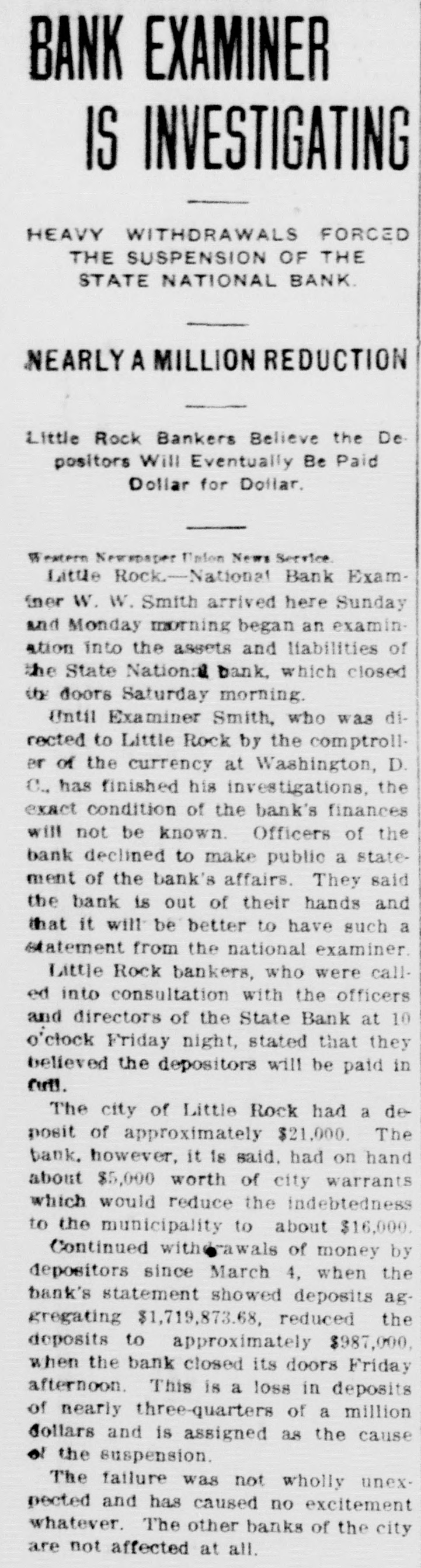
BANK EXAMINER IS INVESTIGATING HEAVY WITHDRAWALS FORCED THE SUSPENSION OF THE STATE NATIONAL BANK NEARLY A MILLION REDUCTION Little Rock Bankers Believe the De positors Will Eventually Be Paid Dollar for Dollar. Wextern Newspaper Union News Service Little Rock-National Bank Examiner W. W. Smith arrived here Sunday and Monday morning began an examination into the assets and liabilities of the State National bank, which closed the doors Saturday morning. Until Examiner Smith, who was directed to Little Rock by the comptrollor of the currency at Washington, D. C., has finished his investigations, the exact condition of the bank's finances will not be known. Officers of the bank declined to make public a statement of the bank's affairs. They said the bank is out of their hands and that it will be better to have such a statement from the national examiner. Little Rock bankers, who were called into consultation with the officers and directors of the State Bank at 10 o'clock Friday night, stated that they believed the depositors will be paid in full. The city of Little Rock had a deposit of approximately $21,000. The bank. however, it is said, had on hand about $5,000 worth of city warrants which would reduce the indebtedness to the municipality to about $16,000. Continued withdrawals of money by depositors since March 4, when the bank's statement showed deposits aggregating $1,719,873.68, reduced the deposits to approximately $987,000. when the bank closed its doors Friday afternoon. This is a loss in deposits of nearly three-quarters of a million dollars and is assigned as the cause of the suspension. The failure was not wholly unexpected and has caused no excitement whatever. The other banks of the city are not affected at all.
4.June 26, 1914Pine Bluff Daily GraphicPine Bluff, AR
Click image to open full size in new tab
Article Text
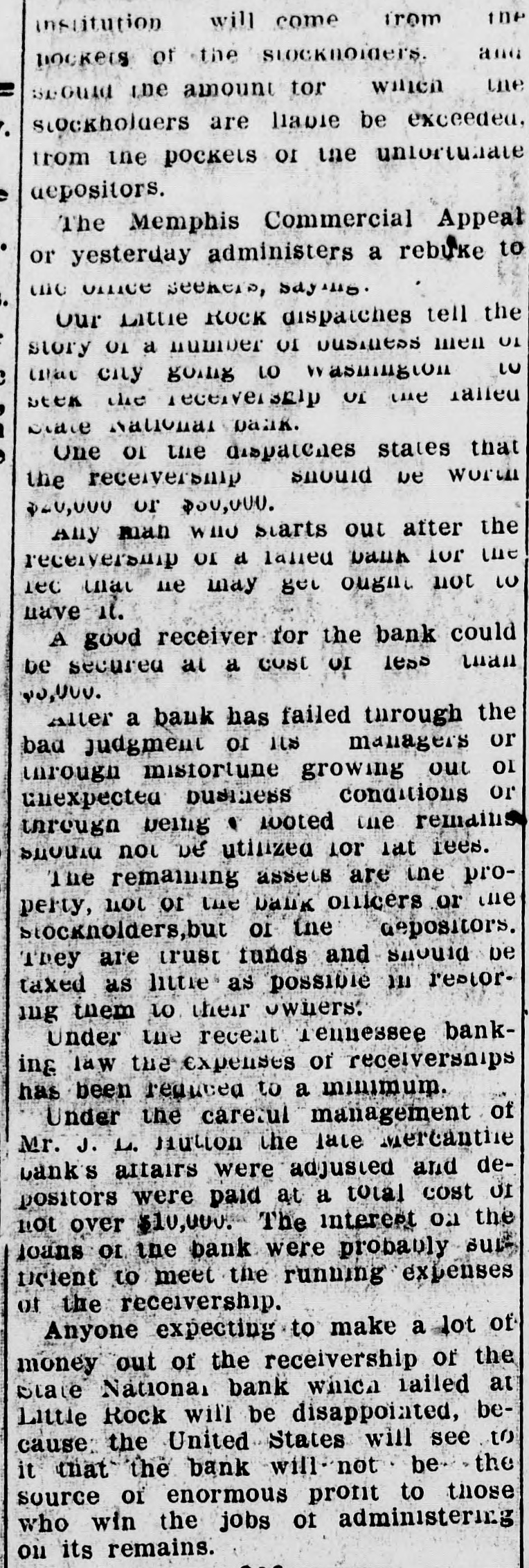
institution will come irom the ROCKERS of the stockholders. and seould the amount tor withen me stockholders are liable be exceeded, from the pockets or the unfortunate depositors. The Memphis Commercial Appeal or yesterday administers a rebuke to me once seencis, saymo. our Little ROCK dispatches tell the story 01 a number 01 business men U1 was city gong LO washington 10 wetk the receiverscly UI we alleu wate Nallynas Dark. One or the dispatches states that the receiversmy snould we WORLD P-U,UUU or $00,000. Any man who starts out after the receivership or a lause wauh for the rec unai ue may get ougni not 10 nave it. A good receiver for the bank could be secured ai a cost or less wall NO,UCC. Alter a bauk has failed through the bad judgment or ILS managers or through mistoriune growing out ol unexpected business conditions or through being , woted me remains noi WE utilized ior 1at rees. The remaining assets are ine property, not or lue bauk officers or me blocknolders,but or the depositors. They are trust funds and snould be taxed as little as possible 111 restor111g them to their owners. Under the recent Tennessee banking law the expenses or receiverships has been reaunced to a minimum. Under the care.ul management of Mr. J. La. Julion the late mercantile banks attairs were adjusted and depositors were paid at a total cost OI not over $10,000. The interept on the loans or the bank were probably BULF Detent to meet the running expenses of the receivership. Anyone expecting to make a lot of money out of the receivership or the Diate National bank which lailed at Little Rock will be disappointed, because the United States will see to it that the bank will not be > the source or enormous profit to those who win the jobs ot administering ou its remains.
5.June 30, 1914The Prescott Daily NewsPrescott, AR
Click image to open full size in new tab
Article Text
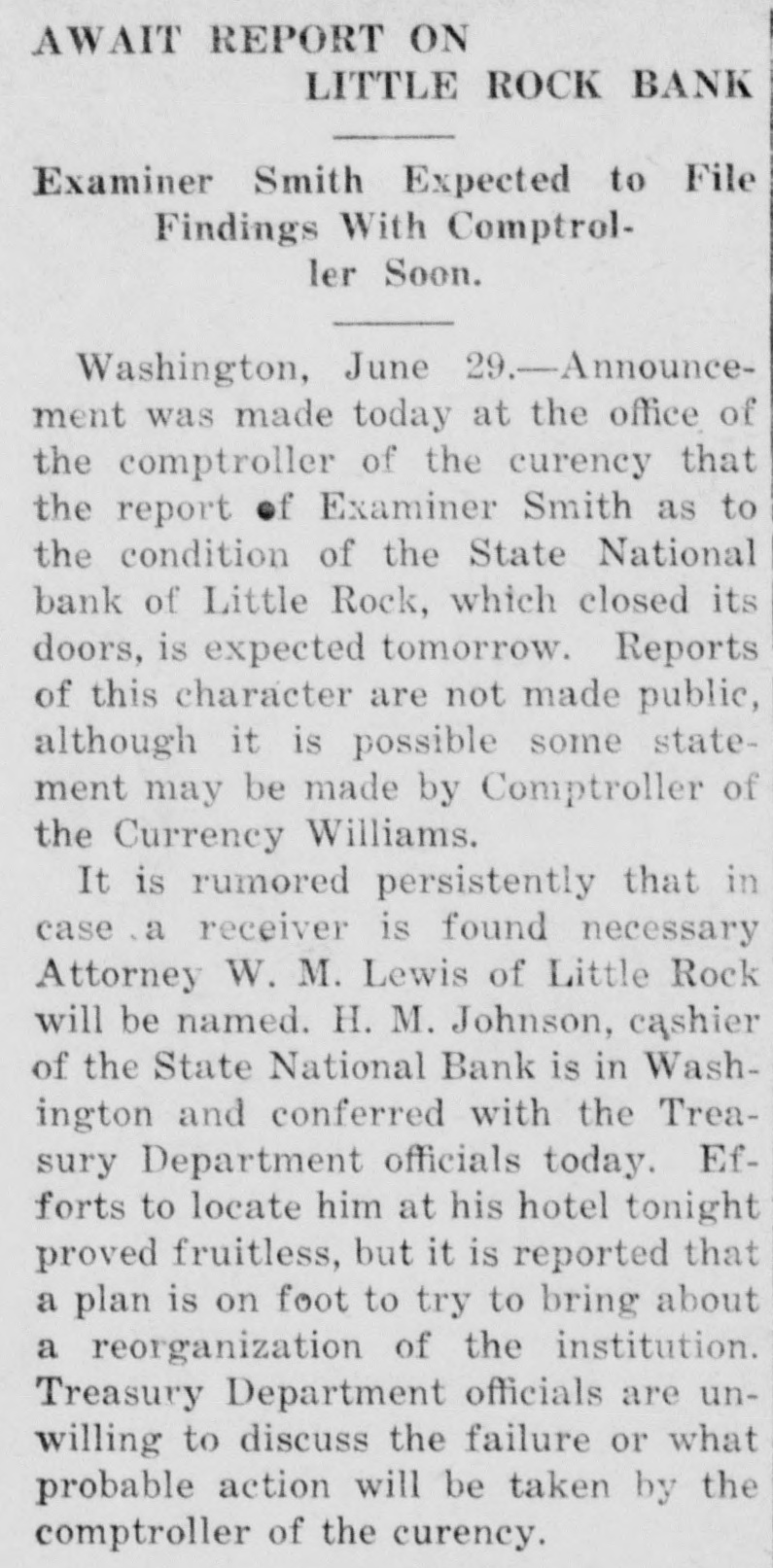
AWAIT REPORT ON LITTLE ROCK BANK Examiner Smith Expected to File Findings With Comptroller Soon. Washington, June 29.-Announcement was made today at the office of the comptroller of the curency that the report of Examiner Smith as to the condition of the State National bank of Little Rock, which closed its doors, is expected tomorrow. Reports of this character are not made public, although it is possible some statement may be made by Comptroller of the Currency Williams. It is rumored persistently that in case a receiver is found necessary Attorney W. M. Lewis of Little Rock will be named. H. M. Johnson, cashier of the State National Bank is in Washington and conferred with the Treasury Department officials today. Efforts to locate him at his hotel tonight proved fruitless, but it is reported that a plan is on foot to try to bring about a reorganization of the institution. Treasury Department officials are unwilling to discuss the failure or what probable action will be taken by the comptroller of the curency.
6.July 1, 1914Tulsa Daily WorldTulsa, OK
Click image to open full size in new tab
Article Text
No Receiver Is Necessary. WASHINGTON June 30.-An examiner's report today to the comptroller of the currency, announced that it would not be necessary to appoint a receiver for the State National bank at Little Rock, Ark., as it had been found solvent. although the capital Is impaired. Several banks have offered to take over the institution, and these offers are now being considered by the treasury department.
7.July 1, 1914The Log Cabin DemocratConway, AR
Click image to open full size in new tab
Article Text
STATE NATIONAL BANK SOLVENT DEPOSITORS TO BE PAID / BALANCE LEFT FOR STOCKHOLDERS, SAYS WASHINGTON REPORT. Local stockholders of the State National Bank of Little Rock which closed its doors June 19. were pleased to learn from a report from the Tresury Department at Washington published today that the institution has been found to be solvent and no receiver will be named. The depositors, it is understood, will be paid in full and there will be a balance left for the stockholders. Hendrix College, the largest local stockholder in the bank, owns stock amounting to $10,000, and it was feared when the closing was first announced that the college would not only lose this amount but would be called upon to pay an assessment of an equal amount in order that the depositors might be paid. Among other Conway stockholders are Attorney J. C. Clark and his daughter, Miss Bessie Clark. A dispatch from Washington says the Treasury Department now is considering offers made by several banks to take over the institution for purposes of liquidation. Among the Little Rock banks said to have submitted some sort of a proposition to effect the liquidation are the W. B. Worthen Company and the new Bankers' Trust Company. Other local banks also are said to have made offers. The report of National Bank Examiner W. W. Smith, who has been in charge of the bank since it closed its doors, was to the effect that it will not be necessary to name a receiver for the bank, as he has found it solvent. The capital is impaired, he stated, but the announcement from Washington last night did not indicate at what figure, if any, the examiner's report fixed the loss to the stockholders. Two avenues of liquidation, bankers in Little Rock said last night, are open. One would be to turn the bank back to the stockholders to select a liquidating agent and the other, generally considered the preferable action, would be to accept the offer of another bank to take over the institution to effect a liquidation. The announcement in Washington that the Treasury Department is considering offers made by several banks to take over the institution indicates that whatever step is to be taken it will be subject to the approval or with the consent of Comptroller of the Currency John Skelton Williams. Cashier H. M. Johnson of the State National bank and J. F. McIntyre, one of the bank's directors were in conference with Treasury Department officials for several hours yesterday afternoon. They left for Little Rock late yesterday. Offers to take over the closed bank are considered as confidential business, and are not disclosed by either the Treasury Department or the banks making the offers. The Treasury Department's announcement, based on Examiner Smith's report of his investigations, indicates that in the examiner's opinion the bank will not only pay the depositors in full, but also will return some amount to the stockholders. The assets of the bank, if collected without loss, would pay all depositors and leave a balance estimated at be tween $200.000 and 300,000 for stockholders.
8.July 1, 1914The Prescott Daily NewsPrescott, AR
Click image to open full size in new tab
Article Text
FIND BANK SOLVENT Receiver will Not Be Necessary for Little Rock Institution. Washington, June 30.-An examiner's report today to the comptroller of the currency announced that it would not be necessary to appoint a receiver for the State National Bank at Little Rock, Ark., as it had been found solvent, although captial is impaired. Several banks have offered to take over the institution and these offers are now being considered by the Treasury Department.
9.July 2, 1914The Log Cabin DemocratConway, AR
Click image to open full size in new tab
Article Text
STATE NATIONAL BANK SOLVENT DEPOSITORS TO BE PAID BALANCE LEFT FOR STOCKHOLDERS, SAYS WASHINGTON REPORT. Local stockholders of the State National Bank of Little Rock which closed its doors June 19. were pleased to learn from a report from the Tresury Department at Washington published today that the institution has been found to be solvent and no receiver will be named. The depositors, it is understood, will be paid in full and there will be a balance left for the stockholders. Hendrix College, the largest local stockholder in the bank, owns stock amounting to $10,000, and it was feared when the closing was first announced that the college would not only lose this amount but would be called upon to pay an assessment of an equal amount in order that the depositors might be paid. Among other Conway stockholders are Attorney J. C. Clark and his daughter, Miss Bessie Clark. A dispatch from Washington says the Treasury Department now is considering offers made by several banks to take over the institution for purposes of liquidation. Among the Little Rock banks said to have submitted some sort of a proposition to effect the liquidation are the W. B. Worthen Company and the new Bankers' Trust Company. Other local banks also are said to have made offers. The report of National Bank Examiner W. W. Smith, who has been in charge of the bank since it closed its doors, was to the effect that it will not be necessary to name a receiver for the bank, as he has found it solvent. The capital is impaired, he
10.July 3, 1914The Prescott Daily NewsPrescott, AR
Click image to open full size in new tab
Article Text
STOCK HOLDERS WILL UNDERTAKE LIQUIDATION State National Pronounced Solvent. Cashier Johnson Anounces Meeting of Stockholders Consider Selection of Agent. Little Rock, July 3.--The public had been prepared for the announcement that the stock-holders will undertake the liquidation of the State National Bank, since the examiner, W. W. Smith, has pronounced it solvent. Cashier Johnson returned Thursday from Washington, D. C. and announced that a meeting of the stockholders will be held within the ensuing ten days for the purpose of considering the selection of a liquidating agent. The W. S. Wortham Company, bankers, of Little Rock, are being most prominently mentioned in connection with this position, and it is believed the affair of the bank will be wound up through that institution. There had been a strong pull for the appointment of receiver, and several applicants went to Washington to push their claims, but this was rendered unnecessary by the decision of the Comptroller that the bank is in a solvent condition, and will not only be able to pay the depositors in full, but a considerable sum to the stockholders by a proper husbanding of the available assets.
11.July 3, 1914Pine Bluff Daily GraphicPine Bluff, AR
Click image to open full size in new tab
Article Text
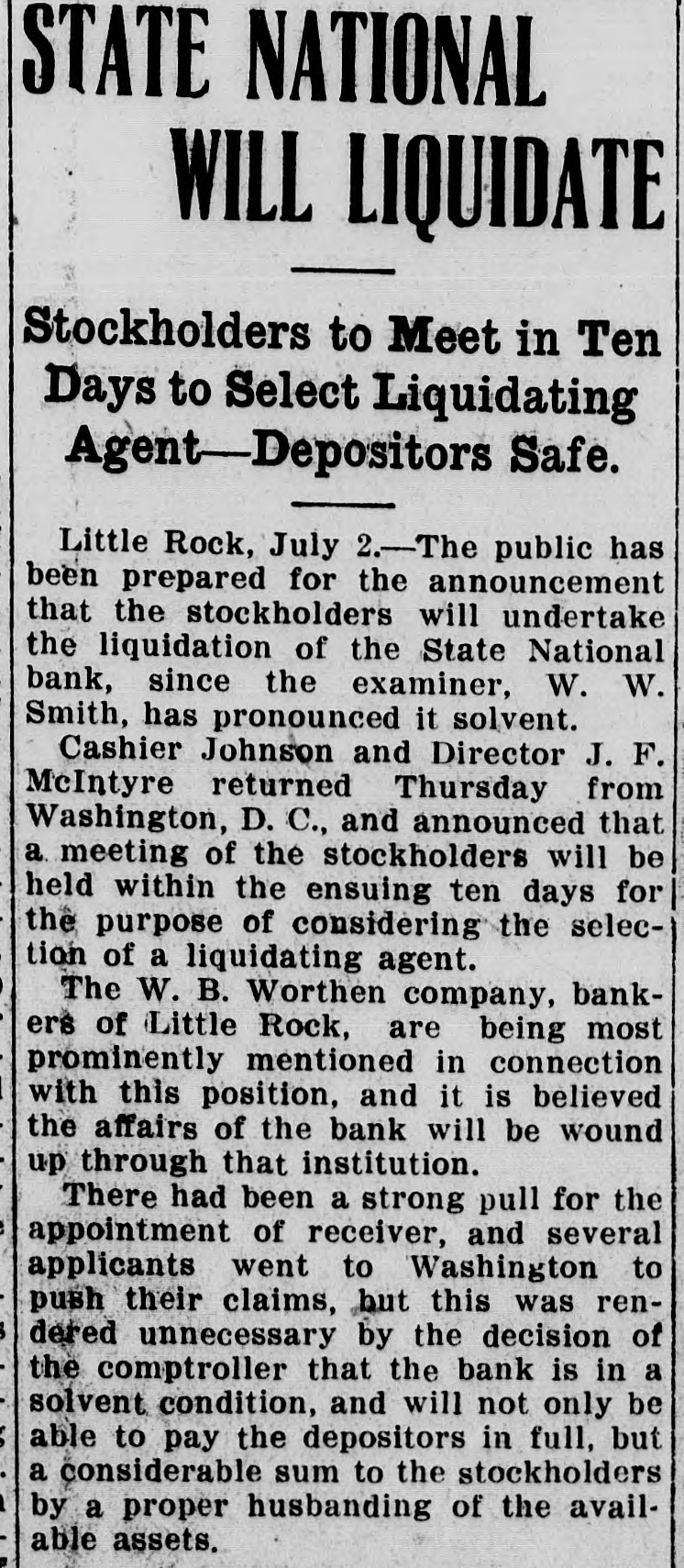
STATE NATIONAL WILL LIQUIDATE Stockholders to Meet in Ten Days to Select Liquidating Agent-Depositors Safe. / Little Rock, July 2.-The public has been prepared for the announcement that the stockholders will undertake the liquidation of the State National bank, since the examiner, W. W. Smith, has pronounced it solvent. Cashier Johnson and Director J. F. McIntyre returned Thursday from Washington, D. C., and announced that a meeting of the stockholders will be held within the ensuing ten days for the purpose of considering the selection of a liquidating agent. The W. B. Worthen company, bankers of Little Rock, are being most prominently mentioned in connection with this position, and it is believed the affairs of the bank will be wound up through that institution. There had been a strong pull for the appointment of receiver, and several applicants went to Washington to push their claims, but this was rendered unnecessary by the decision of the comptroller that the bank is in a solvent condition, and will not only be able to pay the depositors in full, but a considerable sum to the stockholders by a proper husbanding of the available assets.
12.July 17, 1914The Forrest City TimesForrest City, AR
Click image to open full size in new tab
Article Text
*********** Point The has Elberta State bank of Bank sold out to the Center That the and Trust Company of Nashville Planters' able enterprise was signed investment was the not reason a profit. transfer. by the stockholders for the as. . the Adjutant General Lloyd . England warded Arkansas National Guard has of and to the company commanders for. formal staff officers throughout the annual notification of the date of state Logan encampment to be held at Fort the H. Roots August 11. late There will be a . heavier planting forage crops in Baxter and of joining than counties this summer and adof for many years past. The fall the passed few days have put rains ground ing is in fine shape, and much the and in progress now of cane, millet plantcow peas. 0 . . Congressman T. H. Caraway introduced erate a bill whereby all Confed- has and Union veterans are eligible for appointment under made civil service rules to any position in government service, regardless of age, the provided they are physically fit. . The semi-annual O reports . of tions subject to the supervision corpora- of the "Blue Sky" department of the State Bank Commission are now due and 30. being received. They were due July are in There are 120 such corporations the state. The reports of bank and trust companies, called for the are also rebank ceived. commissioner, being by There are 440 financial institutions subject to state supervision. . S . Those who recently accompanied Governor Hays on his trip to the Panama Exposition found in San Francisco a large and active Arkansas Society. The officers are: President, J. S. P. Dean: secretary, Mrs. W. Kelley; treasurer, G. H. Roberts. . O O At a meeting of the stock-holders of the State National Bank in Little Rock a Liquidating Committee was named consisting of H. M. Johnson, the cashier, Thos, C. McRae of Prescott. Max Mayer, Maurice Altheimer and W. 1 Lewis. The committee named H. M. Johnson as the liquidating agent. This must be confirmed at another meeting of the stockholders to be held in 30 days. While no statement is yet available of the bank's condition, it is generally believed that it will pay depositors in full and good dividends to the stock-holders. : . . G. A. Hulen, county examiner for N Lawrence county, has removed to Craighead county, and tendered his resignation. County Judge Dud Bassett has appointed R. C. Waldron as his successor, and the apointment has been sent to Supt. Cook to issue the license. . . . The production of coal in Arkansas in 1913 was 2,343,107 short tons, valued at $3,923,701 compared with 2,100,819 tons, valued at $3,582,789 in 1912, a gain of 133,288 tons in quantity and of $340,912 in value. a in County school fairs and contests are becoming quite popular throughout the state. At least half the counties are undertaking them. Boone county leads in one of the most successful school fairs of the country, and the organizations are well under way in Monroe, Faulkner. Saline and a number of other counties. . . . "The garden is holding up fine, and we have shown that proper cultivation will beat the drouth." This is the report of R. J. Hubbard, superintendent of the Special Consolidated public school, writing of a school garden that has been worked under demonstration methods . . Sheriff J. H. Parker of Quachita county. who was nominated and confirmed as United States marsha! for the of refrom cently, Western has received District applications Arkansas 500 people seeking positions as deputy marshal. . Creditors of the Central Bank and Trust Company. which failed at sort Smith December 30, 1911, will re. on ing to the ceive 22 cents receiver's the dollar, final accord- report, which was approved. The bank failed after being in existence four months. It carried but a small amount of deposits and was a member of a string of banks affiliated with Night and Day banks at Memphis and in Arkansas and Oklahoma cities. . @ a An appropriation for $237,840 for the building of a storm sewer system the is carried in the tion bill, was to upon which Hot sundry Springs reported civil reservation appropria- the Sonate by the Appropriations Com-
13.February 17, 1915Tulsa Daily WorldTulsa, OK
Click image to open full size in new tab
Article Text
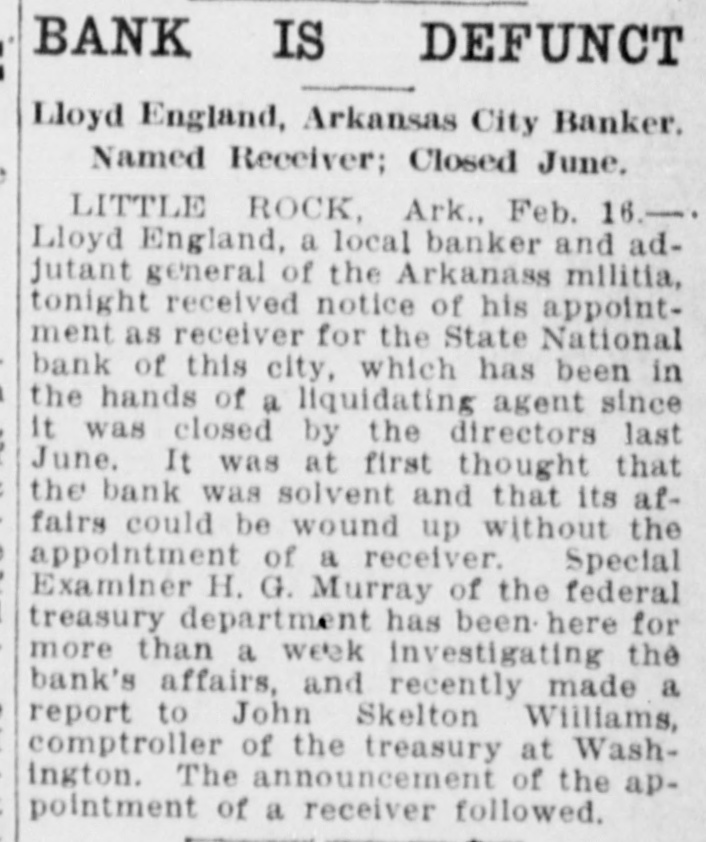
BANK IS DEFUNCT Lloyd England, Arkansas City Banker. Named Receiver; Closed June. LITTLE ROCK, Ark., Feb. 16.Lloyd England, a local banker and adjutant general of the Arkanass militia, tonight received notice of his appointment as receiver for the State National bank of this city, which has been in the hands of a liquidating agent since It was closed by the directors last June. It was at first thought that the bank was solvent and that its atfairs could be wound up without the appointment of a receiver. Special Examiner H. G. Murray of the federal treasury department has been here for more than a week investigating the bank's affairs, and recently made a report to John Skelton Williams, comptroller of the treasury at Washington. The announcement of the appointment of a receiver followed.
14.February 18, 1915Tulsa Daily WorldTulsa, OK
Click image to open full size in new tab
Article Text
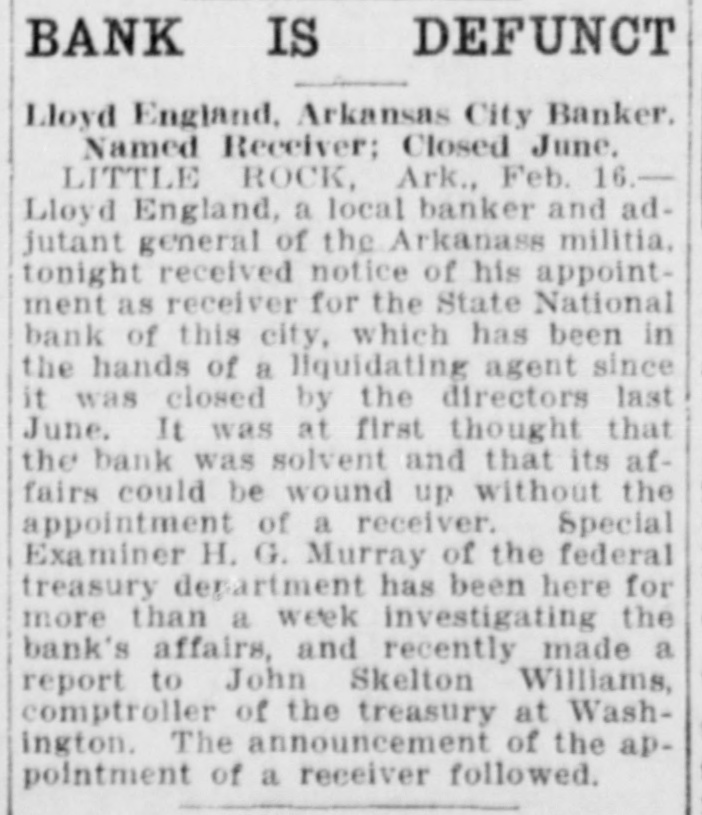
BANK IS DEFUNCT Lloyd England, Arkansas City Banker. Named Receiver; Closed June. LITTLE ROCK, Ark., Feb. 16.Lloyd England, a local banker and adjutant general of the Arkanass militia. tonight received notice of his appointment as receiver for the State National bank of this city, which has been in the hands of a liquidating agent since it was closed by the directors last June. It was at first thought that the bank was solvent and that its affairs could be wound up without the appointment of a receiver. Special Examiner H. G. Murray of the federal treasury department has been here for more than a week investigating the bank's affairs, and recently made a report to John Skelton Williams, comptroller of the treasury at Washington. The announcement of the appointment of a receiver followed.
15.June 17, 1915The Carlisle IndependentCarlisle, AR
Click image to open full size in new tab
Article Text
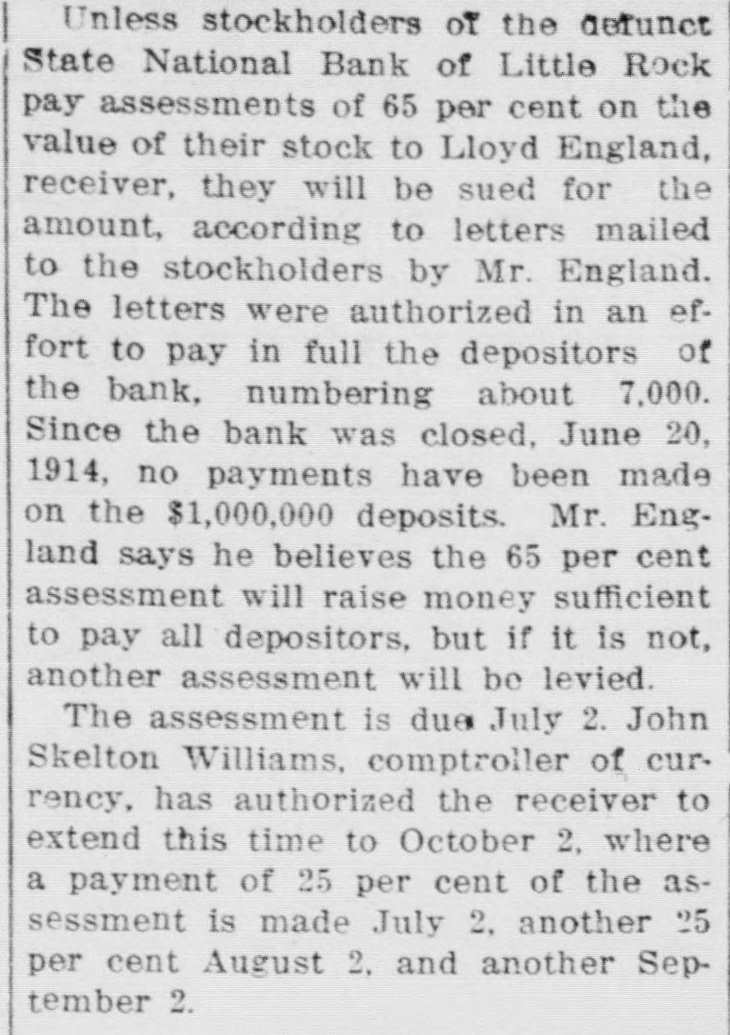
Unless stockholders of the defunct State National Bank of Little Rock pay assessments of 65 per cent on the value of their stock to Lloyd England, receiver, they will be sued for the amount, according to letters mailed to the stockholders by Mr. England. The letters were authorized in an effort to pay in full the depositors of the bank, numbering about 7,000. Since the bank was closed, June 20, 1914, no payments have been made on the $1,000,000 deposits. Mr. England says he believes the 65 per cent assessment will raise money sufficient to pay all depositors, but if it is not, another assessment will be levied. The assessment is due July 2. John Skelton Williams, comptroller of currency, has authorized the receiver to extend this time to October 2, where a payment of 25 per cent of the assessment is made July 2. another 25 per cent August 2. and another September 2.
16.June 18, 1915The SpectatorOzark, AR
Click image to open full size in new tab
Article Text
man behind the gun as to profits. Leakage is pretty heavy where prosperity is not fully understood and appreciated." Unless stockholders of the defunct State National Bank of Little Rock pay assessments of 65 per cent on the value of their stock to Lloyd England, receiver, they will be sued for the amount, according to letters mailed to the stockholders by Mr. England. The letters were authorized in an effort to pay in full the depositors of the bank. numbering about 7,000. Since the bank was closed, June 20, 1914, no payments have been made on the $1,000,000 deposits. Mr. Eng. land says he believes the 65 per cent assessment will raise money sufficient to pay all depositors. What is said to be the largest walnut tree in the United States stands in the Arkansas forest reserve 25 miles west of Glenwood on the Montgomery-Pike county line. It is more than six feet in diameter at the base, and the first limb is 40 feet from the ground. It was planned to take the tree to the Panama-Pacific exposition, but the project was abandoned when engineers estimated the cost would exceed $800. Advices received by Col. Gus Waterman, chairman of the board ap pointed by the recent drainage meeting at McGehee, is in receipt of advices from other members of the board saying that the sum of $50,000 had been contributed toward defraying the expenses of closing the gap in the lower Red Fork levee on the Arkansas River. Jefferson County Road District No. 7 sold an issue of $105,000 20-year bonds to Judge James Gould of Pine Bluff for 971/2 cents, the largest price for which road bonds ever sold in Arkansas. News was received at Texarkana that the town of Fouke, 22 miles south of here on the Texarkana, Shreveport and Natchez railroad, was visited by a fire causing about $7,500 loss. As an experiment several farmers in Calhoun and adjoining counties planted wheat this past season, and the crop yield has exceeded all expectations. In a movement to cut down expenses and place Stuttgart on a cash basis again, the City Council has ordered the street lights cut out temporarily. The Sport Observer, a new paper, has made its appearane at Arkadelphia as the outgrowth of the recently organized Arkadelphia Sunday School League. Cross country macadam public roads for Johnson county are being discussed. Indications point to the building of 40 miles of road in the county soon. Almost an entire block of the busiI ness section of Kenset was destroyed by fire. The loss is estimated at be tween $25,000 and $30,000. I p Ten thousand gallons of crude oil : will be used on Plainview streets this summer. The Robinson Drug Company of Blytheville, capitalized at $5,000, has been chartered by the state.
17.July 1, 1915The MonticellonianMonticello, AR
Click image to open full size in new tab
Article Text
Captain Lloyd England, receiver for the State National Bank, announced that checks for the 10 per cent dividend to depositors of the bank will be mailed to nonresidents of Little Rock at once. "We've been swamped with letters of inquiry about checks," said Mr. England, "and I wish to say that all delay has been caused by the rush of business at the office. We have now about cleared up the Little Rock business and will start mailing checks.
18.October 21, 1915The Newark JournalNewark, AR
Click image to open full size in new tab
Article Text
BANKERS ARRESTED ON FEDERAL CHARGE President and Cashier Defunct State National Bank Charged With Wrecking Institution. Little Rock, Oct. 20.-W. H. Granflo, president and R. D. Duncan, former cashier, of the (StateNationalBank,whichclosed in June, 1914, today were arrested on Federal indictments, charging the two former bank officials with misapplicaton of funds of the defunct institution and with conspiracy todefraud. Five counts on the former charge were returned against each of the men by the Federal grand jury, which reported yesterday afternoon. The men were arrested today and their bonds fixed at $10,000 each. According to charges of R. M. Huston, a special accountant for the department of justice, the two bank officials violated the Federal banking statutes in allowing the State Trust Company, a subsidiary concern, to draw approximately $80,000 on overdrafts. The loans were made in an effort to defraud, according to the count in the indictments charging conspiracy. There were five loans made by the State National Bank through the two officers to the trust company, according tothe indictments. The funds loaned were $40,000; $10,565 $3,000 $15,000, and $12,500. It is charged that the loans were made without knowledge. When the State Bank failed 7,000 depositors had more than $900,000 on deposit in theinstituton. The bank first was turned over to a committee of the directors for liquidation, having been declared solvent. Later it was declared insolvent and Lloyd England was appointed receiver. Since the appointment of the receiver two 10 per cent dividends have been paid the depositors.
19.November 26, 1915The Weekly SoliphoneParagould, AR
Click image to open full size in new tab
Article Text
LOCAL NEWS (From Friday's Daily Press) W .R. Morris was here from Hornersville yesterday. J. R. Cooper of Rector spent yesterday in the city on business. L. R. Mohar of Campbell, was a business visitor here yesterday. R. C. McCullough and wife were here from Stonewall this morning. M. G. Newsom has returned from Poinsett county where he spent several days hunting deer. He brought a fine buck back with him. Dr. R. J. Haley and Dr. Paul Dickson of this city, and Dr. R. E. Bradsher of Marmaduke, returned last night from Memphis where they attended the meeting of the TriState Medical association. The Paragould physicians say the meeting was the best in the history of the organization. Capt. Lloyd England, receiver for the defunct State National Bank of Little Rock, accompanied by Mr. Altheimer, were in the city yesterday enroute to Little Rock from Marmaduke where they had been to inspect some tracts of land belonging to W. E. Talley. Talley was interested in the State National and the receiver is digging up some of his assets to apply on an assessment made upon the stockholders to pay the deficit in the bank's resources.
20.March 22, 1916Judsonia Weekly AdvanceJudsonia, AR
Click image to open full size in new tab
Article Text
Chancellor J. E. Martineau ordereà the sale of the real and personal property of the Weil Packing Company to satisfy the claim of Lloyd England, as receiver of the State National Bank of Little Rock for $63,650.63 and $5,996.44 interest, and the claim of the Ravenswood National Bank of Chica. go, $3,800 and $371.92 interest.
21.March 23, 1916The MonticellonianMonticello, AR
Click image to open full size in new tab
Article Text
Chancellor J. E. Martineau ordered the sale of the real and personal property of the Weil Packing Company to satisfy the claim of Lloyd England, as receiver of the State National Bank of Little Rock for $63,650.63 and $5,996.44 interest, and the claim of the Ravenswood National Bank of Chicago, $3,800 and $371.92 interest.
22.April 15, 1916Pine Bluff Daily GraphicPine Bluff, AR
Click image to open full size in new tab
Article Text
TWO BANKERS OF LITTLE ROCK ARE FOUND GUILTY Garanflo and Duncan Convicted on All of Six Charges. Little Rock, April 14.-W. H. Garanflo, former president, and R. D. Duncan, former vice president and cashier of the defunct State National bank, were convicted bya jury in the United States court today of five charges of misapplication of funds and one charge of conspiracy. Judge Frank Youmans announced he would impose sentence Monday. Each count upon which they were convicted carries a minimum penitentiary sentence of five years, and a. maximum of ten. A fine of $5,000 also also can be assessed for each charge. Attorneys for the convicted men said immediate appeals to the United States circuit court of appeals would be taken. Mr. Garanflo and Mr. Duncan were indicted October 20, 1915, on charges that originated when R. M. Huston, of the department of justice, acting under the comptroller of the currency, investigated conduct of the State National bank and the State Trust company, a subsidiary concern. The Sate National bank closed June 24, 1914. When the bank closed deposits on its books aggregated approximately $900,000. There were 7,000 depositors. At first the bank was declared solvent and the comptroller turned it over to a board of the directors. Later it was declared insolvent and Lloyd England was named receiver. Two 10 per cent dividends have been paid the depositors since Mr. England took charge. The five charges on misapplication of funds were based on five wrafts issued by the officials, drawn Off the State Trust company's account with the State National bank.