4389. Equitable Trust Company (Chicago, IL)

Bank Information

Episode Type
Suspension → Closure
Bank Type
trust company
Start Date
December 18, 1905
Location
Chicago, Illinois (41.850, -87.650)

Metadata

Model
gpt-5-mini
Short Digest
35be5088

Response Measures

None

Description

The Equitable Trust Company (Chicago) was one of three Walsh-controlled institutions that were ordered to suspend on Dec 18, 1905 and subsequently wound up/liquidated; depositors were guaranteed by the Chicago clearing house but the institutions quit business. Cause attributed to large loans to John R. Walsh's railroad/coal enterprises (bank-specific adverse information). Articles report suspension and planned liquidation/receivership; depositors lined up and were paid by clearing house banks but the company did not reopen.

Events (2)

1. December 18, 1905 Receivership
Newspaper Excerpt
The Equitable Trust company ... will go into the state's hands. Liquidation of the Chicago National Bank, the Home Savings Bank and the Equitable Trust Company ... was announced ... to wind up their affairs and quit business in this city; a syndicate was formed to take over the business ... National Bank Examiner C. H. Bosworth was elected president to liquidate the bank's indebtedness. (articles summarize actions taken).
Source
newspapers
2. December 18, 1905 Suspension
Cause
Bank Specific Adverse Info
Cause Details
Forced suspension by Comptroller and clearing house after examiners found large loans and investments in John R. Walsh's railroad, coal and quarry enterprises which made assets illiquid or overvalued; refusal to accept Walsh's valuation precipitated action to wind up affairs.
Newspaper Excerpt
The Chicago National bank, the Home Savings bank and the Equitable Trust company, institutions controlled largely by John R. Walsh, did not open for business today.
Source
newspapers

Newspaper Articles (22)

Article from Wausau Pilot, November 3, 1903

Click image to open full size in new tab

Article Text

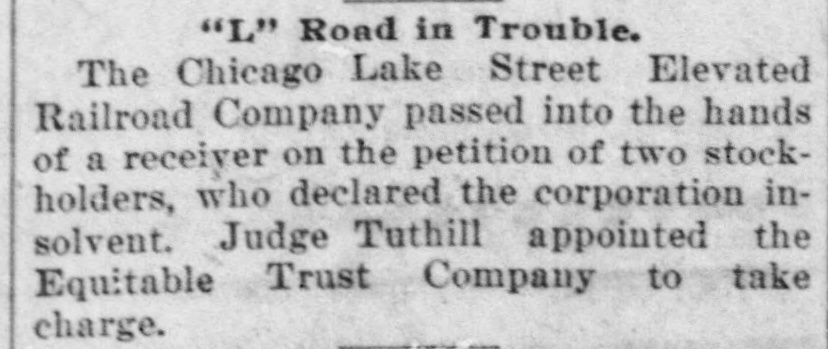
"L" Road in Trouble. The Chicago Lake Street Elevated Railroad Company passed into the hands of a receiver on the petition of two stockholders, who declared the corporation insolvent. Judge Tuthill appointed the Equitable Trust Company to take charge.


Article from The Montgomery Advertiser, November 17, 1903

Click image to open full size in new tab

Article Text

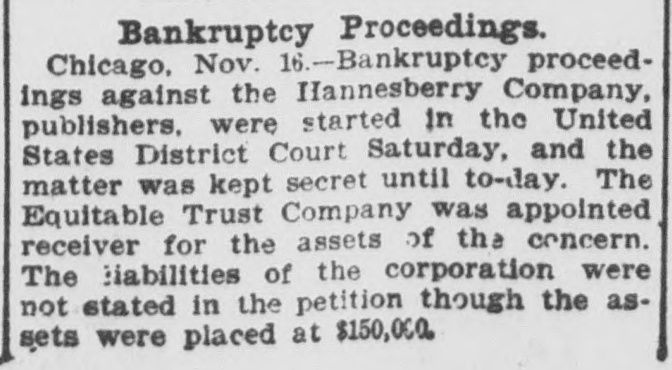
Bankruptcy Proceedings. Chicago, Nov. 16.-Bankruptcy proceedings against the Hannesberry Company, publishers, were started in the United States District Court Saturday, and the matter was kept secret until to-day. The Equitable Trust Company was appointed receiver for the assets of the concern. The liabilities of the corporation were not stated in the petition though the assets were placed at $150,000.


Article from New-York Tribune, January 15, 1905

Click image to open full size in new tab

Article Text

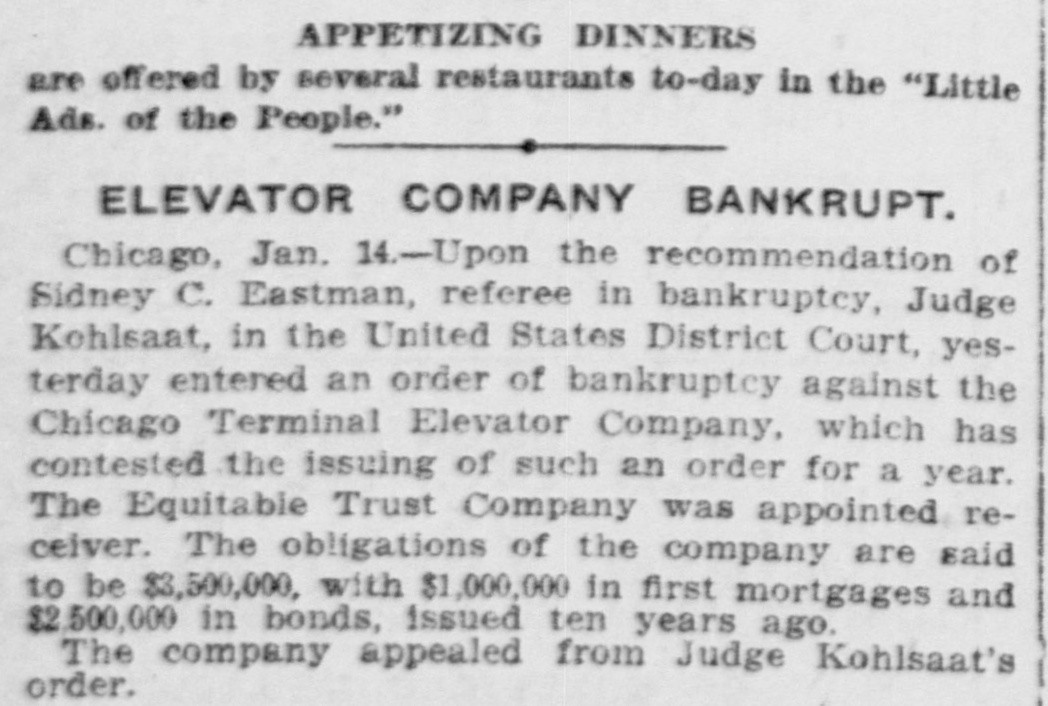
APPETIZING DINNERS are offered by several restaurants to-day in the "Little Ads. of the People." ELEVATOR COMPANY BANKRUPT. Chicago, Jan. 14.-Upon the recommendation of Sidney C. Eastman, referee in bankruptcy, Judge Kohlsaat, in the United States District Court, yesterday entered an order of bankruptcy against the Chicago Terminal Elevator Company, which has contested the issuing of such an order for a year. The Equitable Trust Company was appointed receiver. The obligations of the company are said to be $3,500,000, with $1,000,000 in first mortgages and $2,500,000 in bonds, issued ten years ago. The company appealed from Judge Kohlsaat's order.


Article from The Topeka State Journal, December 18, 1905

Click image to open full size in new tab

Article Text

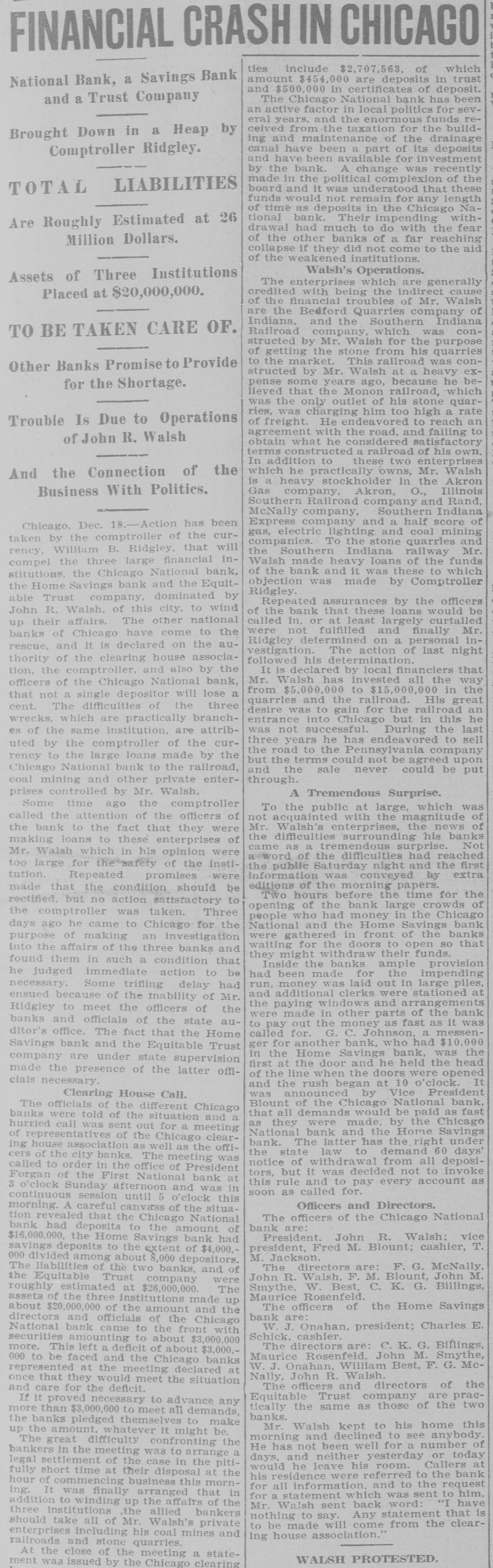
FINANCIAL CRASH CHICAGO ties include $2,707,563. of which amount $454,000 are deposits in trust National Bank, a Savings Bank and $500,000 in certificates of deposit. and a Trust Company The Chicago National bank has been an active factor in local politics for several years, and the enormous funds received from the taxation for the buildBrought Down in a Heap by ing and maintenance of the drainage canal have been a part of its deposits Comptroller Ridgley. and have been available for investment by the bank. A change was recently made in the political complexion of the LIABILITIES board and it was understood that these TOTAL funds would not remain for any length of time as deposits in the Chicago National bank. Their impending withAre Roughly Estimated at 26 drawal had much to do with the fear of the other banks of a far reaching Million Dollars. collapse if they did not come to the aid of the weakened institutions. Walsh's Operations. Assets of Three Institutions The enterprises which are generally credited with being the indirect cause Placed at $20,000,000. of the financial troubles of Mr. Walsh are the Bedford Quarries company of Indiana, and the Southern Indiana Railroad company, which was conTO BE TAKEN CARE OF. structed by Mr. Walsh for the purpose of getting the stone from his quarries to the market. This railroad was conOther Banks Promise to Provide structed by Mr. Walsh at a heavy expense some years ago, because he befor the Shortage. lieved that the Monon railroad, which was the only outlet of his stone quarries, was charging him too high a rate Trouble Is Due to Operations of freight. He endeavored to reach an agreement with the road, and failing to of John R. Walsh obtain what he considered satisfactory terms constructed a railroad of his own In addition to these two enterprises which he practically owns, Mr. Walsh And the Connection of the is a heavy stockholder in the Akron Business With Politics. Gas company, Akron, O., Illinois Southern Railroad company and Rand, McNally company, Southern Indiana Express company and a half score of Chicago, Dec. 18.-Action has been gas, electric lighting and coal mining taken by the comptroller of the curcompanies. To the stone quarries and rency, William B. Ridgley, that will the Southern Indiana railway Mr. Walsh made heavy loans of the funds compel the three large financial inof the bank and it was these to which stitutions, the Chicago National bank, objection was made by Comptroller the Home Savings bank and the EquitRidgley. able Trust company, dominated by Repeated assurances by the officers John R. Walsh, of this city, to wind of the bank that these loans would be called in, or at least largely curtailed up their affairs. The other national were not fulfilled and finally Mr. banks of Chicago have come to the Ridgley determined on a personal inrescue, and it is declared on the auvestigation. The action of last night thority of the clearing house associafollowed his determination. It is declared by local financiers that tion, the comptroller, and also by the Mr. Walsh has invested all the way officers of the Chicago National bank. from $5,000,000 to $15,000,000 in the that not a single depositor will lose a quarries and the railroad. His great cent. The difficulties of the three desire was to gain for the railroad an wrecks. which are practically branchentrance into Chicago but in this he was not successful. During the last es of the same institution, are attribthree years he has endeavored to sell uted by the comptroller of the curthe road to the Pennsylvania company rency to the large loans made by the but the terms could not be agreed upon Chicago National bank to the railroad, and the sale never could be put through. coal mining and other private enterprises controlled by Mr. Walsh. A Tremendous Surprise. Some time ago the comptroller To the public at large, which was called the attention of the officers of not acquainted with the magnitude of Mr. Walsh's enterprises, the news of the bank to the fact that they were the difficulties surrounding his banks making loans to these enterprises of came as a tremendous surprise. Not Mr. Walsh which in his opinion were a word of the difficulties had reached too large for the safety of the instithe public Saturday night and the first information was conveyed by extra tution. Repeated promises were editions of the morning papers. made that the condition should be Two hours before the time for the rectified, but no action satisfactory to opening of the bank large crowds of the comptroller was taken. Three people who had money in the Chicago days ago he came to Chicago for the National and the Home Savings bank were gathered in front of the banks purpose of making an investigation waiting for the doors to open so that into the affairs of the three banks and they might withdraw their funds. found them in such a condition that Inside the banks ample provision he judged immediate action to be had been made for the impending run, money was laid out in large piles, necessary. Some trifling delay had and additional clerks were stationed at ensued because of the inability of Mr. the paying windows and arrangements Ridgley to meet the officers of the were made in other parts of the bank banks and officials of the state auto pay out the money as fast as it was called for. G. C. Johnson, a messenditor's office. The fact that the Home ger for another bank, who had $10,000 Savings bank and the Equitable Trust in the Home Savings bank. was the company are under state supervision first at the door and he held the head made the presence of the latter offiof the line when the doors were opened cials necessary and the rush began at 10 'clock. It was announced by Vice President Clearing House Call. Blount of the Chicago National bank, The officials of the different Chicago that all demands would be paid as fast banks were told of the situation and a as they were made, by the Chicago hurried call was sent out for a meeting National bank and the Home Savings of representatives of the Chicago clearbank. The latter has the right under association as well the state law to demand 60 days' cers ing house of the city banks. as the offiThe meeting was notice of withdrawal from all deposicalled to order in the office of President tors, but it was decided not to invoke First National this rule and to pay every account as Forgan o'clock of the bank at 3 Sunday afternoon and was in soon as called for continuous session until 5 o'clock this Officers and Directors. morning. A careful canvass of the situaThe officers of the Chicago National tion revealed that the Chicago National bank are: bank had deposits to the amount of President. John R. Walsh: vice $16,000,000. the Home Savings bank had president, Fred M. Blount; cashier, T. savings deposits to the extent of $4,000,M. Jackson 000 divided among about 8,000 depositors. The directors are: F. G. McNally, The liabilities of the two banks, and of John R. Walsh, F. M. Blount, John M. the Equitable Trust company were Smythe, W. Best, C. K. G. Billings, roughly estimated at $26,000,000. The Maurice Rosenfeld. assets of the three institutions made up The officers of the Home Savings about $20,000,000 of the amount and the bank are: directors and officials of the Chicago W. J. Onahan, president; Charles E. came to the Schick, cashier. to about securities National bank amounting front $3,000,000 with The directors are: C. K. G. Billings, more. This left a deficit of about $3,000.Maurice Rosenfeld. John M. Smythe, 000 to be faced and the Chicago W.J Onahan, William Best, F. G. Mcat the represented meeting declared banks at Nally, John R. Walsh. once that they would meet the situation The officers and directors of the and care for the deficit. Equitable Trust company are pracIf it proved necessary to advance any tically the same as those of the two more than $3,000,000 to meet all demands, banks. the banks pledged themselves to make Mr. Walsh kept to his home this up the amount, whatever it might be. morning and declined to see anybody The great difficulty confronting the He has not been well for a number of bankers in the meeting was to arrange a days. and neither yesterday or today legal settlement of the case in the pitiwould he leave his room Callers at fully short time at their disposal at the his residence were referred to the bank hour of commencing business this mornfor all information, and to the request was finally for a statement which was sent to him, ing. addition It to winding arranged that in up the affairs of the Mr. Walsh sent back word: "I have three institutions ,the allied bankers nothing to say. Any statement that is should take all of Mr. Walsh's private to be made will come from the clearenterprises including his coal mines and ing house association.' railroads and stone quarries. At the close of the meeting a stateWALSH PROTESTED. ment was issued by the Chicago clearing
Article from Evening Journal, December 18, 1905

Click image to open full size in new tab

Article Text

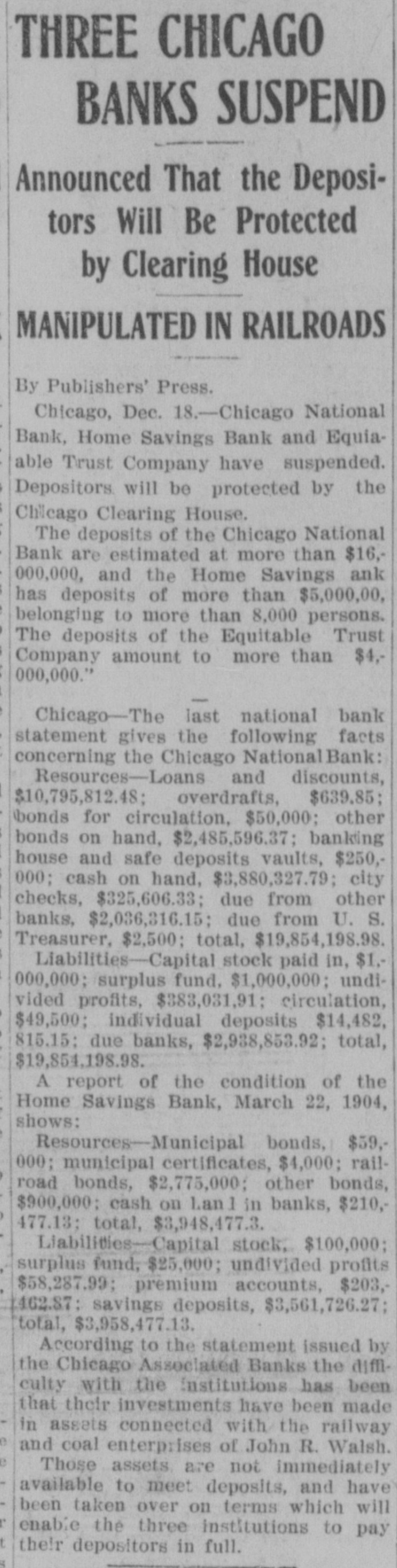
THREE CHICAGO BANKS SUSPEND Announced That the Depositors Will Be Protected by Clearing House MANIPULATED IN RAILROADS By Publishers' Press. Chicago, Dec. 18.-Chicago National Bank, Home Savings Bank and Equiaable Trust Company have suspended. Depositors will be protected by the Chicago Clearing House. The deposits of the Chicago National Bank are estimated at more than $16,000,000, and the Home Savings ank has deposits of more than $5,000.00, belonging to more than 8,000 persons. The deposits of the Equitable Trust Company amount to more than $4,000,000. Chicago-The last national bank statement gives the following facts concerning the Chicago National Bank: Resources-Loans and discounts, $10,795,812.48; overdrafts, $639.85; bonds for circulation, $50,000; other bonds on hand, $2,485,596.37 banking house and safe deposits vaults, $250,000: cash on hand, $3,880,327.79; city checks, $325,606.33; due from other banks, $2,036,316.15; due from U. S. Treasurer, $2,500; total, $19,854,198.98. Liabilities-Capital stock paid in, $1.000,000; surplus fund, $1,000,000; undivided profits, $383,031.91; circulation, $49,500; individual deposits $14,482. 815.15: due banks, $2,938,853.92 total, $19,854,198.98. A report of the condition of the Home Savings Bank, March 22, 1904, shows: Resources-Municipal bonds, $59.000; municipal certificates, $4,000; railroad bonds, $2,775,000; other bonds, $900,000; cash on Lanl in banks, $210, 477.13; total, $3,948,477.3. Liabilities-Capital stock, $100,000; surplus fund, $25,000; undivided profits $58,287.99; premium accounts, $203, 462.87: savings deposits, $3,561,726.27 total, $3,958,477.13. According to the statement issued by the Chicago Associated Banks the difficulty with the institutions has been that their investments have been made in assets connected with the railway and coal enterprises of John R. Walsh. Those assets are not immediately available to meet deposits, and have been taken over on terms which will enable the three institutions to pay t their depositors in full. of


Article from The Laramie Republican, December 18, 1905

Click image to open full size in new tab

Article Text

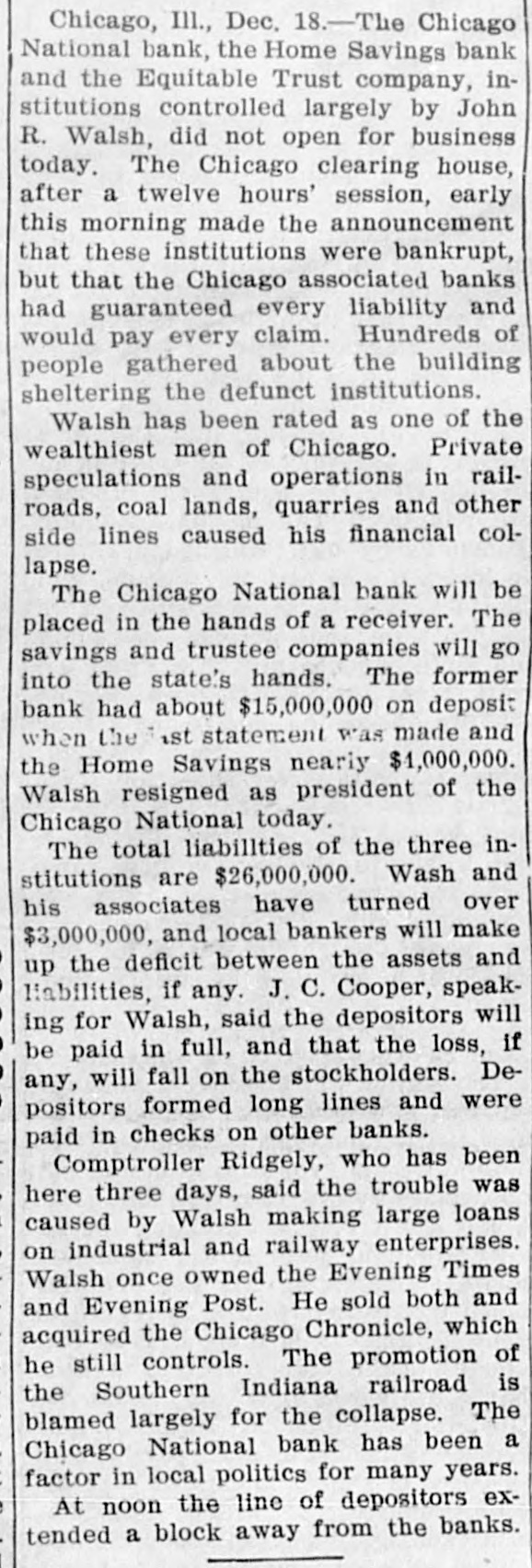
Chicago, Ill., Dec. 18.-The Chicago National bank, the Home Savings bank and the Equitable Trust company, institutions controlled largely by John R. Walsh, did not open for business today. The Chicago clearing house, after a twelve hours' session, early this morning made the announcement that these institutions were bankrupt, but that the Chicago associated banks had guaranteed every liability and would pay every claim. Hundreds of people gathered about the building sheltering the defunct institutions. Walsh has been rated as one of the wealthiest men of Chicago. Private speculations and operations in railroads, coal lands, quarries and other side lines caused his financial collapse. The Chicago National bank will be placed in the hands of a receiver. The savings and trustee companies will go into the state's hands. The former bank had about $15,000,000 on deposit when the ist statement was made and the Home Savings nearly $1,000,000. Walsh resigned as president of the Chicago National today. The total liabillties of the three institutions are $26,000,000. Wash and his associates have turned over $3,000,000, and local bankers will make up the deficit between the assets and liabilities, if any. J. C. Cooper, speaking for Walsh, said the depositors will be paid in full, and that the loss, if any, will fall on the stockholders. Depositors formed long lines and were paid in checks on other banks. Comptroller Ridgely, who has been here three days, said the trouble was caused by Walsh making large loans on industrial and railway enterprises. Walsh once owned the Evening Times and Evening Post. He sold both and acquired the Chicago Chronicle, which he still controls. The promotion of the Southern Indiana railroad is blamed largely for the collapse. The Chicago National bank has been a factor in local politics for many years. At noon the line of depositors extended a block away from the banks.


Article from The Minneapolis Journal, December 18, 1905

Click image to open full size in new tab

Article Text

John R. Walsh, head of t tions which have been decl vent, was not at themeeting. ing were the members at the meeting: J. B. Forgan, cha J. Mitchell, J. H. Eckels, Smith and Ernest A. Hamill Payments Pledged. In addition to the formal of the failure and the ann that the banks involved woul their doors this morning the announcement was made, sig clearinghouse committee of t Associated banks: To the public: Deposit Chicago National bank, the ings bank and the Equit company are respectfully ad their deposits will be paid in " demand. Statement by Ridge The following statement out today by Controller of th William M. Ridgely: "The action of the Chicag house banks in coming to the Chicago National bank, the ings bank and the Equitable pany, has relieved a most c: ation, which, if it had not promptly in hand, might h very serious consequences, I Chicago, but elsewhere. Th the clearinghouse banks mal lutely certain that all the o the three institutions will re money immediately and shou lieve any apprehension on the public in regard to financ in Chicago. Cause of the Break "The critical situation these three concerns / placed has been due to loans made to the rail mining and other enterpri and controlled by John R. V again emphasized the dan managing officers of banks ested in outside institution e large amounts of money. The controller's office h time been criticising the o tional bank and calling upon and directors to reduce the these loans and the investm bonds of Mr. Walsh's corp Promises Not Kep "In spite of repeated pr this should be done these been continued in the bank 8 to prevent further encroachr necessary for the controller t cal action. The controller's office h time been endeavoring to I amination of the Chicago Na simultaneously with the exa the state institutions by the examiner, but was not able t e about until a few days ago. IS of these examinations reve d serious condition that it wa to take immediate action. ] n er telephoned from Washing k ing Bank Examiner Boswor : the matter at once to the the clearinghouse committee Chicago on the first train to d to personally take whatever al necessary. r The Long Confere p "On the arrival of the ( Chicago a conference was e held with the state authori of clearinghouse committee, W it ned from 10 o'clock Sund until 5 o'clock Monday n addition to the clearing ho S. tee, representatives of all Id ing-house banks were calle or ference at about 7 o'clock controller feels that great ( not only to the clearing tee, but to all the other cl banks, for the prompt, vig and the broad-minded spir to meeting this emergency. The Failed Bank The Chicago National b: th ganized in November, 188 authorized capital of $3 creased to $500,000 in 1887 W. 000 in 1901. Its resources, according t th latest reports made to th we of the currency, are $21 e, which nearly $11,000,000 a discounts, with $4,000,000 c The liabilities include nea 000 in individual deposits to 000 due to other banks. the The Home Savings bank the ized originally in 1867, wit zation of $100,000. A late the resources shows an a $4,232,271, of which $3,78 ported as being held in mu road and other bonds. The 1 posits aggregate $3,982,65 The Equitable Trust co i chartered by the state of 0 29, 1887, to act as execu trator, trustee, guardian, B receiver, and to receive trusts of every character. O stock is $500,000. Its r II $4,612,381. The liabilit $2,707,563; of deposits in 323; certificates of depos thru various trusts. i Bank in Politic n The Chicago National ba an active factor in' local several years, and the eng


Article from Alexandria Gazette, December 18, 1905

Click image to open full size in new tab

Article Text

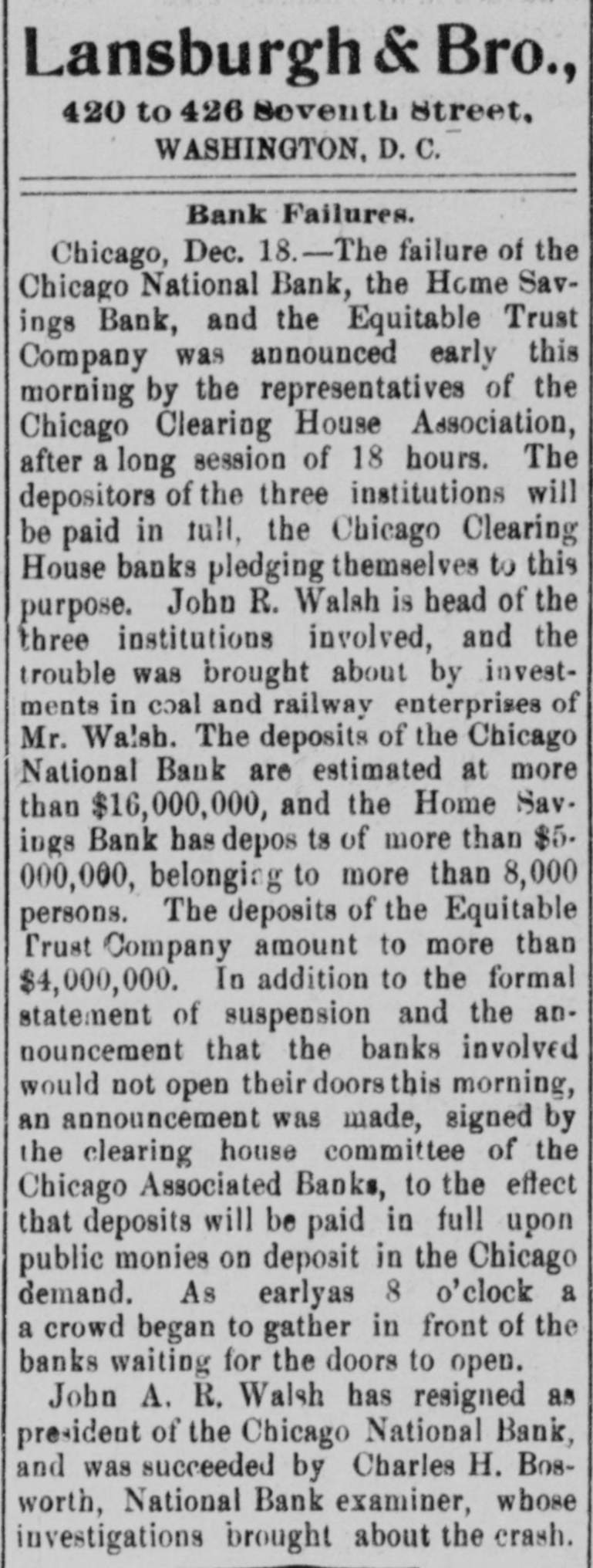
Lansburgh & Bro., 420 to 426 Seventh Street, WASHINGTON, D. C. Bank Failures. Chicago, Dec. 18.-The failure of the Chicago National Bank, the Home Savings Bank, and the Equitable Trust Company was announced early this morning by the representatives of the Chicago Clearing House Association, after a long session of 18 hours. The depositors of the three institutions will be paid in tull, the Chicago Clearing House banks pledging themselves to this purpose. John R. Walsh is head of the three institutions involved, and the trouble was brought about by investments in coal and railway enterprises of Mr. Walsh. The deposits of the Chicago National Bank are estimated at more than $16,000,000, and the Home Savings Bank has depos ts of more than $5. 000,000, belonging to more than 8,000 persons. The deposits of the Equitable Trust Company amount to more than $4,000,000. In addition to the formal statement of suspension and the announcement that the banks involved would not open their doors this morning, an announcement was made, signed by the clearing house committee of the Chicago Associated Banks, to the effect that deposits will be paid in full upon public monies on deposit in the Chicago demand. As earlyas 8 o'clock a a crowd began to gather in front of the banks waiting for the doors to open. John A. R. Walsh has resigned as president of the Chicago National Bank, and was succeeded by Charles H. Bosworth, National Bank examiner, whose investigations brought about the crash.


Article from The Providence News, December 18, 1905

Click image to open full size in new tab

Article Text

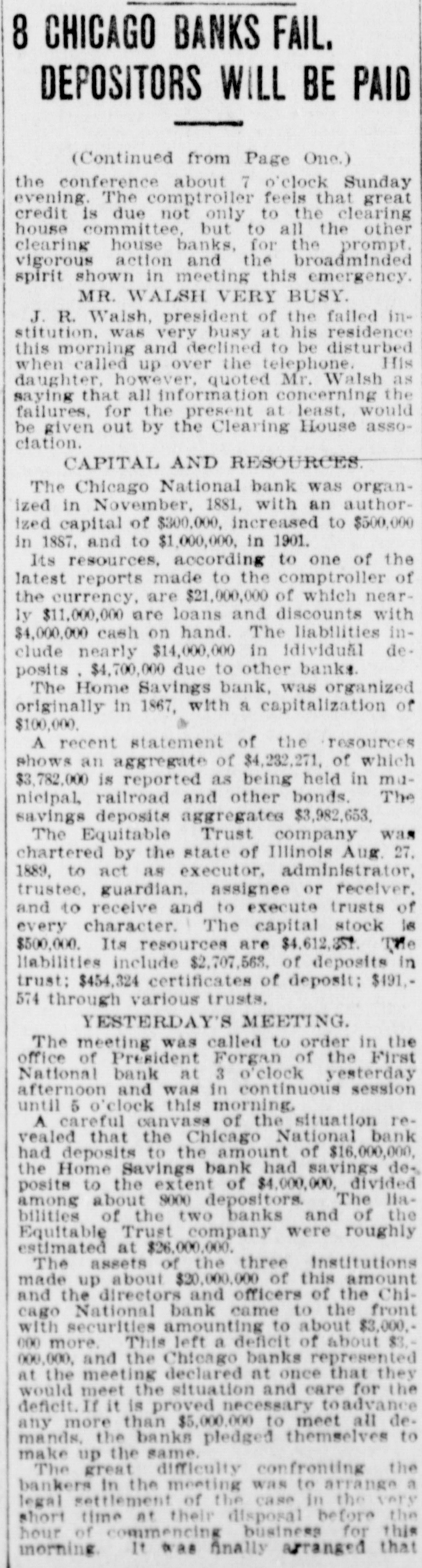
8 CHICAGO BANKS FAIL. DEPOSITORS WILL BE PAID (Continued from Page One.) the conference about 7 o'clock Sunday evening. The comptroller feels that great credit is due not only to the clearing house committee, but to all the other clearing house banks, for the prompt. vigorous action and the broadminded spirit shown in meeting this emergency. MR. WALSH VERY BUSY. J. R. Walsh, president of the failed institution. was very busy at his residence this morning and declined to be disturbed when called up over the telephone. His daughter, however, quoted Mr. Walsh as saying that all information concerning the failures, for the present at least, would be given out by the Clearing House assoclation. CAPITAL AND RESOURCES. The Chicago National bank was organized in November, 1881, with an authorized capital of $300,000, increased to $500,000 in 1887, and to $1,000,000, in 1901. Its resources, according to one of the latest reports made to the comptroller of the currency, are $21,000,000 of which nearly $11,000,000 are loans and discounts with $4,000,000 cash on hand. The liabilities include nearly $14,000,000 in idividual deposits $4,700,000 due to other banks. The Home Savings bank, was organized originally in 1867, with a capitalization of $100,000. A recent statement of the resources shows an aggregate of $4,232,271, of which $3,782,000 is reported as being held in municipal, railroad and other bonds. The savings deposits aggregates $3,982,653. The Equitable Trust company was chartered by the state of Illinois Aug. 27. 1889, to act as executor, administrator, trustee, guardian, assignee or receiver. and to receive and to execute trusts of every character. The capital stock is $500,000. Its resources are $4,612,351. The liabilities include $2,707,568. of deposits in trust: $454,324 certificates of deposit: $491,574 through various trusts. YESTERDAY'S MEETING. The meeting was called to order in the office of President Forgan of the First National bank at 3 o'clock yesterday afternoon and was in continuous session until 5 o'clock this morning, A careful canvass of the situation revealed that the Chicago National bank had deposits to the amount of $16,000,000, the Home Savings bank had savings deposits to the extent of $4,000,000, divided among about 8000 depositors. The Habilities of the two banks and of the Equitable Trust company were roughly estimated at $26,000,000. The assets of the three Institutions made up about $20,000.000 of this amount and the directors and officers of the Chicago National bank came to the front with securities amounting to about $3,000.000 more. This left a deficit of about $3.000,000, and the Chicago banks represented at the meeting declared at once that they would meet the situation and care for the deficit. If it is proved necessary toadvance any more than $5,000,000 to meet all demands. the banks pledged themselves to make up the same. The great difficulty confronting the bankers In the meeting was to arrange a legal settlement of the case in the very short time at their disposal before the hour of commencing business for this morning. It was finally arranged that


Article from Daily Kennebec Journal, December 19, 1905

Click image to open full size in new tab

Article Text

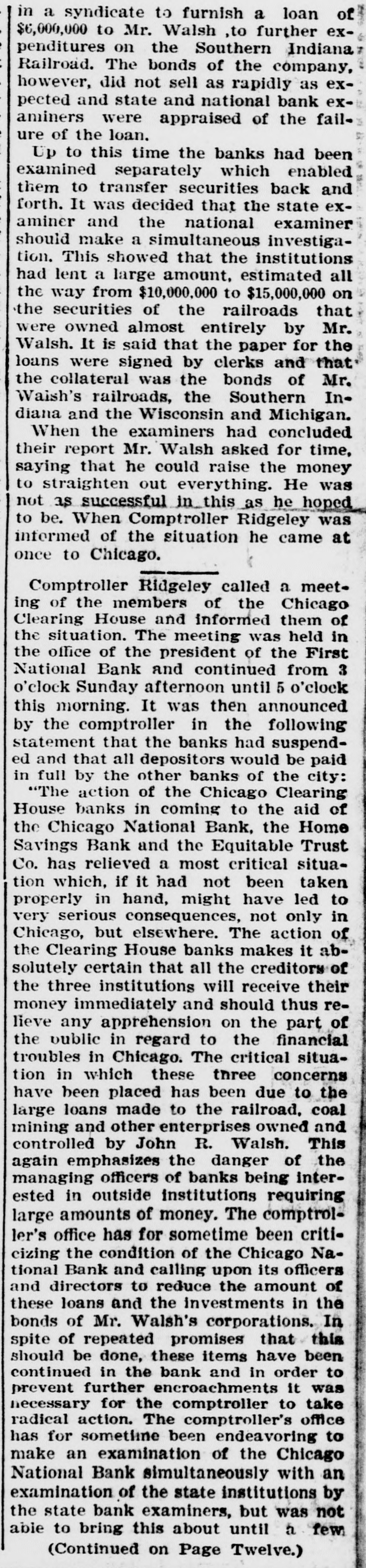
in a syndicate to furnish a loan of $6,000,000 to Mr. Walsh ,to further expenditures on the Southern Indiana Railroad. The bonds of the company, however, did not sell as rapidly as expected and state and national bank examiners were appraised of the failure of the loan. Up to this time the banks had been examined separately which enabled them to transfer securities back and forth. It was decided that the state examiner and the national examiner should make a simultaneous investigation. This showed that the institutions had lent a large amount, estimated all the way from $10,000,000 to $15,000,000 on the securities of the railroads that were owned almost entirely by Mr. Walsh. It is said that the paper for the loans were signed by clerks and that the collateral was the bonds of Mr. Waish's railroads, the Southern Indiana and the Wisconsin and Michigan. When the examiners had concluded their report Mr. Walsh asked for time, saying that he could raise the money to straighten out everything. He was not as successful in this as he hoped to be. When Comptroller Ridgeley was informed of the situation he came at once to Chicago. Comptroller Ridgeley called a meeting of the members of the Chicago Clearing House and informed them of the situation. The meeting was held in the office of the president of the First National Bank and continued from 3 o'clock Sunday afternoon until 5 o'clock this morning. It was then announced by the comptroller in the following statement that the banks had suspended and that all depositors would be paid in full by the other banks of the city: "The action of the Chicago Clearing House banks in coming to the aid of the Chicago National Bank, the Home Savings Bank and the Equitable Trust Co. has relieved a most critical situation which, if it had not been taken properly in hand, might have led to very serious consequences, not only in Chicago, but elsewhere. The action of the Clearing House banks makes it absolutely certain that all the creditors of the three institutions will receive their money immediately and should thus relieve any apprehension on the part of the public in regard to the financial troubles in Chicago. The critical situation in which these three concerns have been placed has been due to the large loans made to the railroad, coal mining and other enterprises owned and controlled by John R. Walsh. This again emphasizes the danger of the managing officers of banks being interested in outside institutions requiring large amounts of money. The comptroller's office has for sometime been criticizing the condition of the Chicago National Bank and calling upon its officers and directors to reduce the amount of these loans and the investments in the bonds of Mr. Walsh's corporations. In spite of repeated promises that this should be done, these items have been continued in the bank and in order to prevent further encroachments it was necessary for the comptroller to take radical action. The comptroller's office has for sometime been endeavoring to make an examination of the Chicago National Bank simultaneously with an examination of the state institutions by the state bank examiners, but was not able to bring this about until a few (Continued on Page Twelve.)


Article from New-York Tribune, December 19, 1905

Click image to open full size in new tab

Article Text

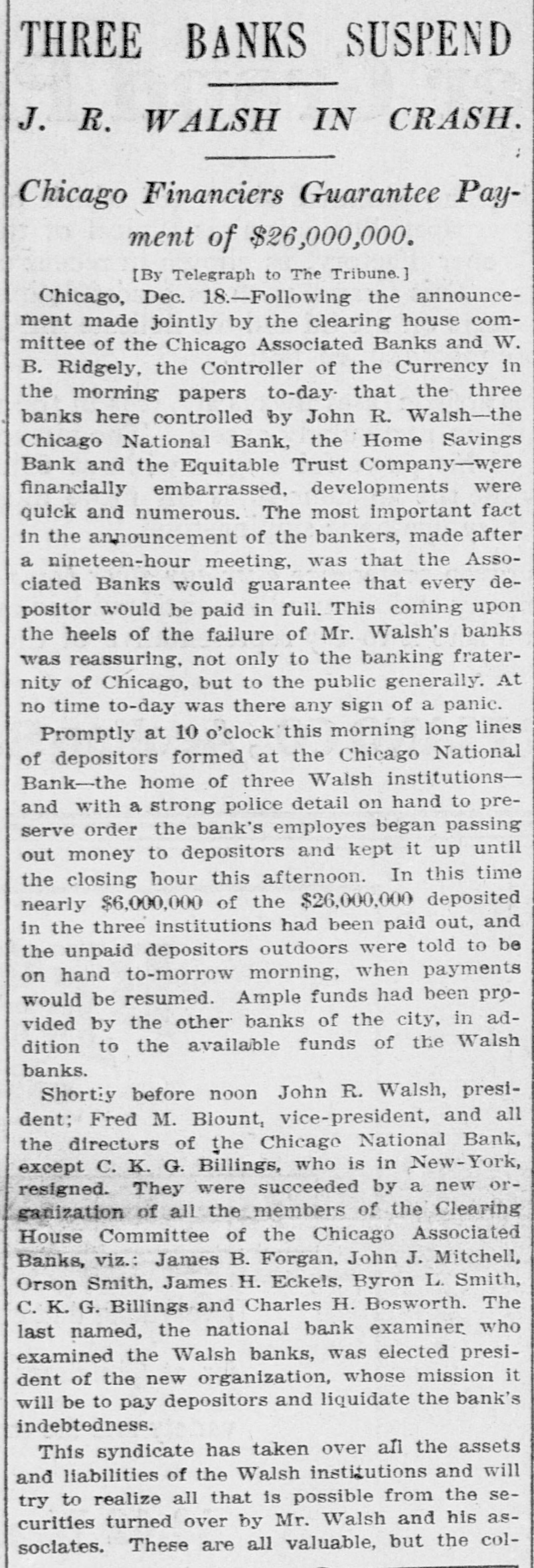
THREE BANKS SUSPEND J. R. WALSH IN CRASH. Chicago Financiers Guarantee Payment of $26,000,000. [By Telegraph to The Tribune.] Chicago, Dec. 18.-Following the announcement made jointly by the clearing house committee of the Chicago Associated Banks and W. B. Ridgely, the Controller of the Currency in the morning papers to-day- that the three banks here controlled by John R. Walsh-the Chicago National Bank, the Home Savings Bank and the Equitable Trust Company-were financially embarrassed, developments were quick and numerous. The most important fact in the announcement of the bankers, made after a mnineteen-hour meeting, was that the Associated Banks would guarantee that every depositor would be paid in full. This coming upon the heels of the failure of Mr. Walsh's banks was reassuring, not only to the banking fraternity of Chicago, but to the public generally. At no time to-day was there any sign of a panic. Promptly at 10 o'clock this morning long lines of depositors formed at the Chicago National Bank-the home of three Walsh institutionsand with a strong police detail on hand to preserve order the bank's employes began passing out money to depositors and kept it up until the closing hour this afternoon. In this time nearly $6,000,000 of the $26,000,000 deposited in the three institutions had been paid out, and the unpaid depositors outdoors were told to be on hand to-morrow morning, when payments would be resumed. Ample funds had been provided by the other banks of the city, in addition to the available funds of the Walsh banks. Shortly before noon John R. Walsh, president; Fred M. Blount, vice-president, and all the directors of the Chicago National Bank, except C. K. G. Billings, who is in New-York, resigned. They were succeeded by a new orgarization of all the members of the Clearing House Committee of the Chicago Associated Banks, viz.: James B. Forgan, John J. Mitchell, Orson Smith, James H. Eckels. Byron L. Smith, C. K. G. Billings and Charles H. Bosworth. The last named, the national bank examiner who examined the Walsh banks, was elected president of the new organization, whose mission it will be to pay depositors and liquidate the bank's indebtedness. This syndicate has taken over all the assets and liabilities of the Walsh institutions and will try to realize all that is possible from the securities turned over by Mr. Walsh and his associates. These are all valuable, but the col-


Article from The News & Observer, December 19, 1905

Click image to open full size in new tab

Article Text

(By the Associated Press.) Chicago, Dec. 18.-Three of the largest financial institutions in the the west, the Chicago National Bank, Home Savings Bank and the Equitable Trust Company. all of them controlled by John R. Walsh, of Chica- by and in a great mearsure owned him, go, suspended operations today. as Their affairs will be liquidated rapidly as possible and they will go out of business. Mr. Walsh, who was the President of the Chicago National Bank and of the Equitable Trust Company and all the other afficers and all the direcof the Chicago National Bank tors have resigned. Naional Bank Exami- Mr. C. H. Bosworth has succeeded ner Walsh at the head of the Chicago the National Bank, and the places of directors have been filled by men appointed by the Chicago Clearing House. Back of the new management stands which aliled banks of Chicago, tnat the eryhave pledged their resources the deposior shall be paid to of every cent. and that no customes lose last of the three institutions shall susany lose anything by reason of the disThis action prevented a was, pension. financial panic. As it world astrous effect on the financial a was the decline on of 2 1-2 in Biscuits common Buscult stock of The the of National only Chicago National exchange Company the stock. price has as employed the Equitable Trust dealagent. and had besides the Chicago is not affected by the degree. The of ings in but transfer the it with slightest National closing also failure Bank, of two banks had the effect local the off all demand on the of exchange shutting for bank stocks, none them being purchased. The Cause of the Collapse. immediate cause of the colThe of the institutions controlled largest by lapse Walsh is said to be the have Mr. of monev which they of various private the Southern the Bedford way Indiana. Mr. lent amount his. noably to and of enterprises Quarry Indian Walsh banks, Com- Rall- says pany, if he could have saved his himthat made enormous profits for this and and his associates. He bases value self statement on his estimate of the Indiana of the bonds of the Southern Railroad Company. The comptroller, the State Chicago auditor, the members of the the and Clearing House Committee place the value of the bonds at one half was valuation of Mr. Walsh, and it their refusal to accept his valuation the that caused the suspension of banks. Liabilities Twenty-Six Millions. The liabilities of the three institutions are estimated in the aggregate $26,000,000. Against this amount at the banks and the trust company have resources, that are, on a conservative The estimate, worth $16,000,000. bends o fthe Southern Indiana Rail- Mr. road Company are estimated by Walsh at $16,000,000. They are considered by the comptroller, the State avditor and the clearing house committee to be worth a little more than sum. Their value is to be determined in of the matter half that the future banks a if the Mr. admit and the that presidents estimate local the of Walsh is found to be correct two banks and the trust company will not only pay all of their debts, but leave a surplus besides. The directors of the two banks, as as Mr. Walsh, who has turned all well of his private property as well Mrs. as that standing in the name of Walsh. have pledged real estate and securities valued at $5.000.000. making a total in assets of $29,000.000 estimating the raiiroad bonds at $8,000,000, against $26,000,000 liabilities, An Unheeded Warning. For some time there has been a difference of opinion between the off)of the Chicago National Bank and cers Comptroller Ridgeley, regarding


Article from The Morning Astorian, December 19, 1905

Click image to open full size in new tab

Article Text

James B. Forgan, president of the First National bank, as head of the clearing house committee of the Chicago Associated banks, gave forth the statement. The assets of these institutions, it was asserted, were involved in coal and railway properties of John R. Walsh, the president of the Chicago National bank. John R. Walsh, head of the institutions which have been declared insolvent, was not at the meeting. The following were the members of the committee at the meeting. James B. Forgan, chairman; John J. Mitchell, James H. Eckles, Orson B. Smith, Ernest A. Hamill. The statement was issued at the offices of the First National bank. It is as follows: "The Chicago National bank, the Home Savings bank, and Equitable Trust Company, which have been controlled and managed by John R. Walsh and his associates have concluded to wind up their affairs and quit business in this city. After a thorough and careful examination of their affairs by the Chicago clearing house banks, it is stated that all of the depositors of these institutions will be paid in full upon demand, the Chicago Clearing House banks having pledged themselves to this result, thus putting all the resources of the Chicago banks behinb the depositers of these three institutions. The difficulty with the institutions has been that investments have been made in assets connected with the railway and coal enterprises of John R. Walsh. "These assets were not immediately available to meet deposits and have been taken over on terms which will enable the three institutions to pay their dem positors in full. Mr. Ridgly, comptroller of the currency, and Charles Eubank, of the auditor's department at Springfield, were seem and expressed themselves as greatly pleased with the action of the Chicago banks, and stated that it rekected great credit upon the associated banks of Chicago which have again indicated their ability to meet and emergency in a manner entirely satisfactory to the public." The meeting of the Chicago clearing house association began at noon Sunday. Notices were sent to the members of the board by Mr. Forgan after it 00 had been learned of the condition of the banks and the trust company. t Clerks were notified and fifty or more with ten stenographers hurried to the First-National Bank. Behind closed doors the Clearing House Association be gan its work of finding a way that might enable them to ride the financial sea in safety. That a panic would be likely to follow was the first thought of the committee. Resolutions were adopted and heads of other banks. pledged themselves to give assistance. The amount involved in the failure would not be stated by 8 the committee members. it All informatin concerning the meetW ing of the committee was kept secret W until three o'clock this morning and half


Article from The Salt Lake Herald, December 19, 1905

Click image to open full size in new tab

Article Text

Equitable Trust company, and all the other officers and all the directors of the Chicago National bank. have resigned. National Bank Examiner C. IN Bosworth has succeeded Mr Walsh as the head of the Chicago National bank, and the places of the directors have been filled by men appointed by the Chicago clearing house. Backed by Clearing House. Back of the new management stand the allied banks of Chicago, who have pledged their resources that every depositor shall be paid to the last cent. and that no customer of any one of the three institutions shall lose anything by reason of the suspension. Had not this action been taken by the banks of the city a disastrous pante must have followed in the financial world As it was, the only effect in this city was the decline on the local stock exchange of 2 1-2 in the price of National Biseult commno stock which has employed the Equitable Trust as transfer agent and had beside dealings with the Chicago National bank. but it is not affected by the failure in the slightest degree. The closing of the two banks had the effect also of shutting off all demand on the local exchange for bank stocks, none of them being purchased. Cause of the Collapse. The immediate cause of the collapse of the institutions controlled by Mr. Walsh is said to be the large amount of money which they have loaned to various private enterprises of his-notably the Southern Indiana railway and the Bedford Quarries company of Indiana, Mr. Walsh claims that if he could have had a little more time and been left untrammeled in his operations, be could have saved his banks. and made enormous profits for himself and his associates. He bases this statement on his estirnate of the value of the bonds of the Southern Indiana Railroad company The comptroller. the state auditor and the members of the Chicao clearing house committee place the value of the bonds at onehalf the valuation of Mr. Walsh and It was their refusal to accept his valuation that caused the suspension of the banks. Liabilities $26,000,000. The liabilities of the three institutions are estimated in the aggregate at $26,000,000. Against this amount the banks and the trust company have rethat are on a conservative estimate worth $16,000,000. The bonds of Southern Indiana Rallway comare estimated by Mr. Walsh as 15 worth $16,000,000. They are conagered by the comptroller state audifor and the clearing house committee to be worth a little more than half that sum. Their value is a matter to be determined in the future, and the presidents of the local banks admit that if the estimate of Mr. Walsh is found to be correct the two banks and the trust company will not only pay all of their debts. but leave a surplus beside. The directors of the two banks and Mr. Walsh, who has turned over all of his private property as well as that standing in the name of Mrs. Walsh, have pledged real estate and securities valued at $5,000,000. and estlmating the railroad bonds at $8,000,000 more. making a total of $29,000,000 assets against $26,000,000 liabilities. Promises Were Not Kept. For some time there has been a difference of opinion betwen the officers of the Chicago National bank and Comptroller Ridgely regarding the method of conducting the affairs of the bank. The comptroller took exception to the large loans made by the bank to the private enterprises of Mr. Walsh, and decided that a portion of them must be called in Assurances were given to him. he declares, that this would be done but the promises were not kept. Finally the incentive to a close scrutiny of the affairs of the Chicago National and Home Savings banks was given by a banker in New York who had been requested to take part in a syndicate to furnish a loan of $6,000,000 to Mr. Walsh for the purpose of further expenditures on the Southern Indiana railroad. The bonds of the company however, did not sell as rapidly as was expected. and the state and national examiners were apprised of the failure of the loan. Up to this time the banks had been examined separately which enabled them to transfer securities back and forth. It was decided that the state examiner and the national examiner should make a simultaneous investigation. This showed that the institutions had leaned a large amount, estimated all the way from $10,000.00 to $15,000,000. on the securities of the railroads that were owned practically by Mr. Walsh alone. Paper Signed by Clerks. It is said that the paper for these Joans was signed by clerks and that they were substantiated by the bonds of Mr. Walsh's railroads, the Southern Indiana, the Chicago Southern, which is an extension of the Southern Indiana, and the Wisconsin and Michigan. When the examiners had concluded their report Mr. Walsh asked for a little time, saying that he could raise the money to straighten out everything. He was not as successful in this as he hoped to be. and when Comptroller Ridgley was informed of th fact he came at once to Chicago

Article from The Hawaiian Star, December 19, 1905

Click image to open full size in new tab

Article Text

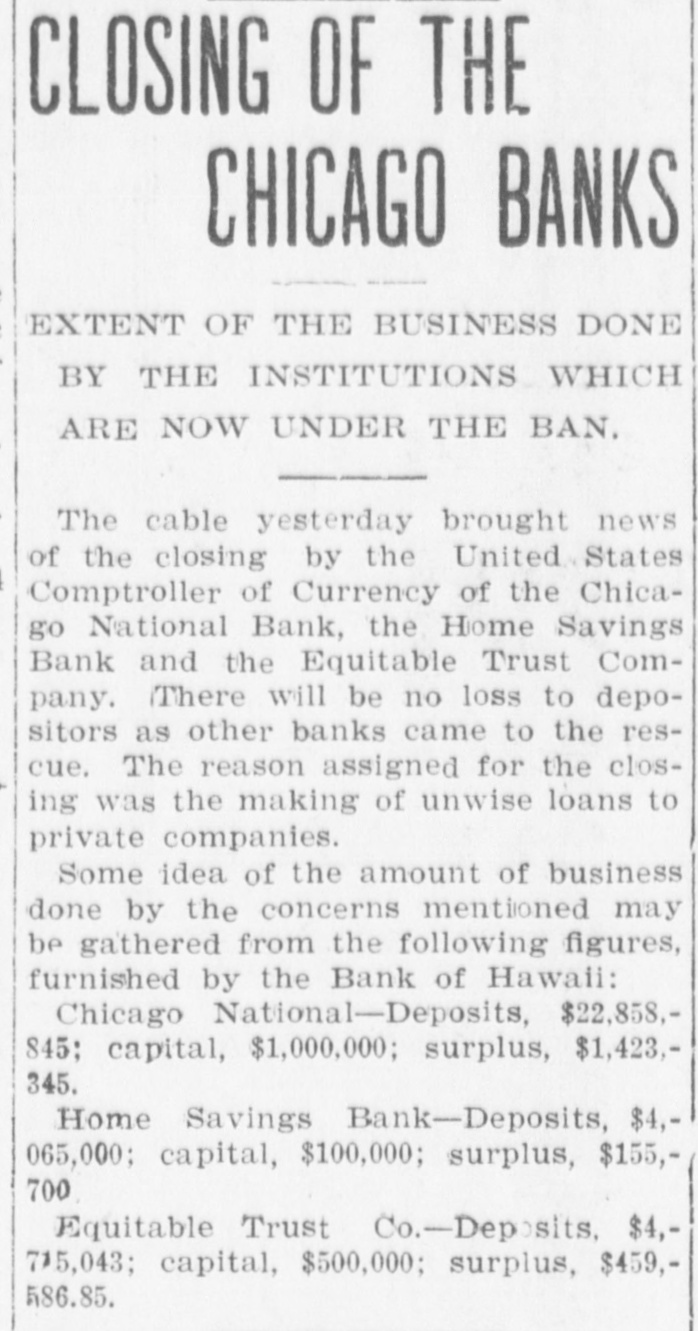
CLOSING OF THE CHICAGO BANKS EXTENT OF THE BUSINESS DONE BY THE INSTITUTIONS WHICH ARE NOW UNDER THE BAN. The cable yesterday brought news of the closing by the United States Comptroller of Currency of the Chicago National Bank, the Home Savings Bank and the Equitable Trust Company. There will be no loss to depositors as other banks came to the rescue. The reason assigned for the closing was the making of unwise loans to private companies. Some idea of the amount of business done by the concerns mentioned may be gathered from the following figures, furnished by the Bank of Hawaii: Chicago National-Deposits, $22,858.845; capital, $1,000,000; surplus, $1,423,345. Home Savings Bank-Deposits, $4,065,000; capital, $100,000; surplus, $155,700 Equitable Trust Co.-Deposits, $4,715,043; capital, $500,000; surplus, $459,586.85.


Article from Bryan Morning Eagle, December 19, 1905

Click image to open full size in new tab

Article Text

THREE HAVE FAILED. Two Chicago Banks and a Trnst Company Go Under. RIDGELEY ON HAND Clearing House Association will See to It That the Depositors Are Reimbursed For Every Cent Deposited. Chicago, Dec 18.-The failure of the Chicago National bank, the Home SavIngs bank, and the Equitable Trust company, all of Chicago, was announced at 3:30 o'clock Monday morning by a representative of the Chicago Clearing House association after a session lasting eighteen hours. James B. Hogan, president of the First National bank. as head of the Clearing House committee of the Chicago Associated banks, gave forth the statement. The assets of these institutions. it was asserted, were involved in coal and railway properties of John R. Walsh, presIdent of the Chicago National bank. John R. Walsh, president % the Institutions which have been declared insolvent. was not at the meeting. John R. Walsh was very busy at his residence Monday morning and declined to be disturbed when called up over the telephone. His daughter, however. quoted Mr. Walsh as stating that all infirmation concerning the failures. for the present at least, would be given out by the Clearing House association. The Chicago National bank was organized in November, 1831. with an authorized capital stock of $200.000. increased to $500,000 in 1887 and to $1,000,000 in 1901. Its resources. according to the latest report made to the comptroller of the currency. were $21,000,000. of which nearly $11,000,000 was loans and discounts: $4000.000 cash on hand. Liabilities include nearly $14,000,000 in individual deposits and $4,700,000 due to other banks The Home Savings bank was organIzed originally in 1867 with a capitalization of $100,000. A late statement of resources shows an aggregate of $4.232,271,20 which $3,782.000 are reported es'being held in municipal. railway and other bonds. Savings deposits age gregate $3,982,653 The Equitable Trust company was chartered by the state of Illinois Aug. 29. 1887. to act as executor, administrator. trustee, guardian, assignee or receiver to receive and execute every character of estate The capital stock is $500,000. Its resources are $4,612,381. Liabilities include $2,707,563 deposits, trusts $454,323. certificates of deposits $491.574 through variou trusts. The following statement concerning the failure of the Chicago National bank. Home Savings bank. and Equitable Trust company has be n given out by Comptroller of the Currency William Wt Ridgeley: "The action of the Clearing House banks in coming to the aid of the Chicago National bank. Home Savings bank and Equitable Trust company. relieved a most critical situation. which. if it had not been taken promptly in hand might have led to very serious consequences, not only in Chicago but elsewhere. "The act of the Clearing House makes It absolutely certain that all creditors will receive their money immediately. and should thus relieve any apprehension on the part of the pubin regard to financial troubles in Chicago. The critical situation in which these three concerns have been placed has been due to large loans made to railroad. coal mining and other enterprise owned and controlled by John R. Walsh. This again emphasizes the danger of managing officers of banks being interested in outside institutions requiring large amounts of money The comptroller's office for some time has been criticising the methods of the Chieago National bank and calling on officers and directors to reduce the amount of these loans and investments in bonds of Mr. Walsh's corporations. In spite of repeated promises that this would be done, these items have been continued in the bank, and in order to prevent encroachments it was necessary for the comptroller to take radical action. The comptroller office for some time has been endeavoring to make an examination of the Chicago National bank simultaneously with exanination of state institutions by state bank examiners, but has not been able to bring this about until a few days ago. The result of these examinations revealed such R. condition that It became necessary to take Immediate action. The comptroller telephoned from Washington instructing Examiner Bosworth to bring the matter at once to the attention of the committee and left for


Article from Durango Semi-Weekly Herald, December 21, 1905

Click image to open full size in new tab

Article Text

will be secured. general impression is that a conviche Chicago ed tion CHICAGO, Dec. 18.-The Savings bank gh bank. Home int, National Equitable Trust company. by John d and the controlled largely business in stitutions R. Walsh, did not open for a 1. today. Chicago clearing house, this after morn g twelve-hours that these The session early institutions o, ing announced that the Chicago e bankrupt, but every liaassociated are banks guaranteed claim. bility and would pay every gathered about 8 Hundreds of people the defunct 1 buildings sheltering been rated n the Walsh had of Chiinstitutions. of the wealthiest men operations as one Private speculation, and 1. cago. railroads, coal lands, quarries financial d in side lines caused the bank other The Chicago National of a recollapse. placed in the hands comwill be Savings and Trust is ceiver. The into state hands. There panies go have been $18,000,000 institutions. in public d said to deposited in the three inmoneys total liabilities of the and $3. stitutions The are $26,000,000. Walsh over associates have turned will his the local bankers 000.000, between C make up and the deficit any, liabili- J. and assets if there are said the ties speaking for Walsh, full. The Cooper. would be paid in the stock depositors loss, if any, will fall on holders. depositors formed in long other lines The paid in checks on the and were Comptroller Ridgelick says making banks. caused by Walsh trouble large loans was on industrial and railway enterprises. once owned the Evening sold Walsh and the Evening Post, but ChronTimes and acquired the Chicago The proboth which be still controls. rail fa icle, of the Southern Indiana the cola motion blamed largely for bank road was The Chicago National for in years. has lapse. been a factor in local politics h many advices show that the $15,000. Chican Later National bank had about state a go deposit when the last Savings 000 on made. The Home rement had was nearly $4,000,000. Walsh intoday. signed bank as president of the former stitution noon the depositors extended a At away from the banks. in The block WASHINGTON. Dec. 18. made of the currency has action of p comptroller statement saying: "The banks in a Chicago clearing house Na the to the aid of the Chicago bank coming bank. the Chicago Savings has tional the Equitable Trust company, If a and a most critical situation. in h relieved not been taken promptly seriit had it might have led to very Chicago c hand consequences, not only in will in ous but elsewhere. All the creditors now be paid.' a a comptroller's officers had an been exfo The for some time to make National to trying of the Chicago was h amination hearing that Mr. Walsh enterprises, g bank, loans to private promises making always safe. Repeated should not made that the situation satisfactory were rectified, but no action so Mr. v be comptroller was taken, yester b to the went to Chicago and bete Ridgely brought the matter strongly the ren day associated banks, with this fore sult that the drastic action was taken to tl morning. YORK, Dec. 18. The banks result NEW failures of the Chicago street in a a of the morning put Wall that c this notwithstanding the report Chicago panic, house banks of dism the clearing together to avert a national all to is stood The stock market went was aster. and liquigation of stocks were pieces The bigest breaks U II general. copper. Amalgamated dropped fell t made in to 93, Union Pacific Transit c from 100 to 141 and Brooklyn all the from 144 to 83. The losses in was h from 88 were noticed. The market the day enormously stocks active. Later in Copper enormous losses stopped. and the the running back to 99, one to rallied, moved up from the other points. stocks It was found late due entire- in two the flurries were there the stock after the house day ly was to that no reason for gamblers the panic had and come to Chicago clearing of the defunct institutions. the he rescue Dec. 19. When CHICAGO. houses opened today the Chicago runs banking began yesterday at the banks which and Home Savings of deNational continued and long lines crowd were formed. A large positors were of the Savings bank in front despergathered opened and shoved the door before to it gain entrance when call to the ately unlocked. A hurry detail of of was station brought a into line. police who forced the men now ficers about 500 depositors work of There are it is believed the the in line and will continue until topaying them paid off. probably District by e last man night. is United States Attors morrow Morrison and State's morning 's Attorney Healey both said this the affairs of le that ney nothing concerning called to their ate had been been lifted the banks finger. has n tention and no Walsh into custody, in take John R. that excessive loans to although to it is own admitted enterprises are his


Article from Orleans County Monitor, December 25, 1905

Click image to open full size in new tab

Article Text

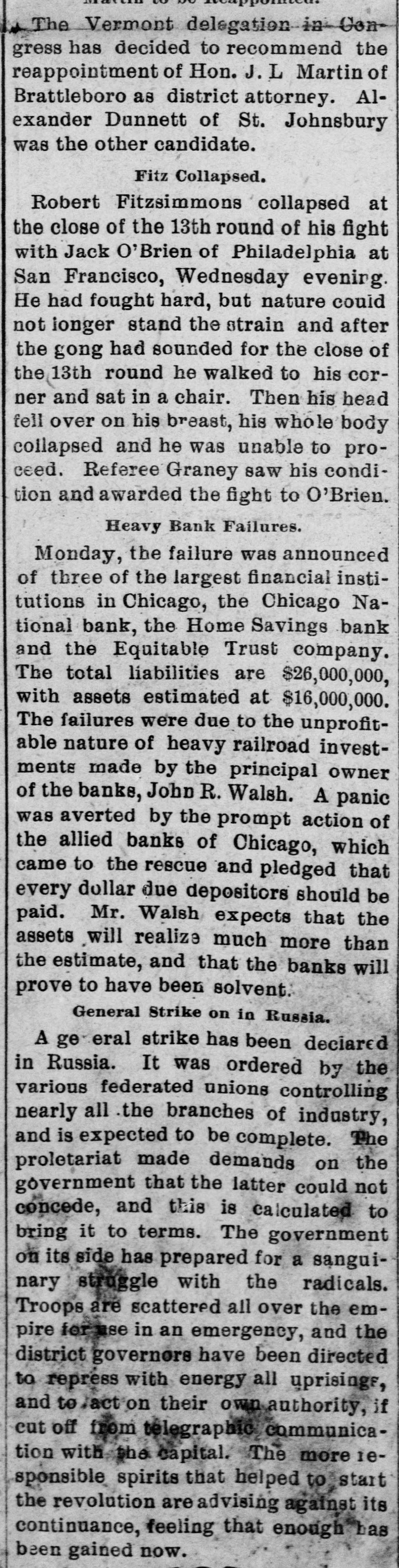
The Vermont delegation in Congress has decided to recommend the reappointment of Hon. J. L Martin of Brattleboro as district attorney. Alexander Dunnett of St. Johnsbury was the other candidate. Fitz Collapsed. Robert Fitzsimmons collapsed at the close of the 13th round of his fight with Jack O'Brien of Philadelphia at San Francisco, Wednesday evening. He had fought hard, but nature could not longer stand the strain and after the gong had sounded for the close of the 13th round he walked to his corner and sat in a chair. Then his head fell over on his breast, his whole body collapsed and he was unable to proceed. Referee Graney saw his condition and awarded the fight to O'Brien. Heavy Bank Failures. Monday, the failure was announced of three of the largest financial institutions in Chicago, the Chicago National bank, the Home Savings bank and the Equitable Trust company. The total liabilities are $26,000,000, with assets estimated at $16,000,000. The failures were due to the unprofitable nature of heavy railroad investments made by the principal owner of the banks, John R. Walsh. A panic was averted by the prompt action of the allied banks of Chicago, which came to the rescue and pledged that every dollar due depositors should be paid. Mr. Walsh expects that the assets will realize much more than the estimate, and that the banks will prove to have been solvent. General Strike on in Russia. A ge eral strike has been declared in Russia. It was ordered by the various federated unions controlling nearly all the branches of industry, and is expected to be complete. The proletariat made demands on the government that the latter could not concede, and this is calculated to bring it to terms. The government on its side has prepared for a sanguinary struggle with the radicals. Troops are scattered all over the empire for use in an emergency, and the district governors have been directed to repress with energy all uprisings, and to /act on their own authority, if cut off from telegraphic communication with the capital. The more responsible spirits that helped to start the revolution are advising against its continuance, feeling that enough bas been gained now.


Article from Wausau Pilot, December 26, 1905

Click image to open full size in new tab

Article Text

THREE BANKS QUIT CHICAGO INSTITUTIONS OF JOH R. WALSH GO OUT. Chicago National, Equitable Tru Company and Home Savings Ban Close Business-Two Banks Alon Carry $22,500,000 of Deposits. Liquidation of the Chicago Nation: Bank, the Home Savings Bank, an the Equitable Trust Company, all ( Chicago, was announced at 3:3 o'clock Monday morning by represen atives of the Chicago Clearing Hous Association, after a session lastin eighteen hours. James B. Forga President of the First National Banl as head of the clearing house commi tee of the Chicago Associated bank gave forth the statement. The asset of these institutions, it was asserte were involved in coal and railwa properties of John R. Walsh, Pres dent of the Chicago National Banl The statement was issued in the offic of the First National Bank. It is a follows: "The citizens of Chicago will un doubtedly be surprised to learn tha the Chicago National Bank, the Hom Savings Bank, and the Equitab Trust Company, which have been co trolled, managed, and officered b John R. Walsh and his associate have concluded to wind up their a fairs and quit business in the city Chicago, but they will be gratified 1 learn that after a thorough and car ful examination of their affairs by tl Chicago Clearing House banks th all of the depositors of these instit tions will be pand in full upon d mand, the Chicago clearing hous banks having pledged themselves this result, thus putting all the r sources of the Chicago banks behir the depositors of these three instit tions. The difficulty with the instit tions has been that their investmen have been made in assets connect with the railway and coal enterpris of John R. Walsh. These assets we not immediately available to meet d posits in full." The meeting of the Chicago Cleari House Association began at noon Su day. Notices were sent members of ti board by Mr. Forgan after the condition of the banks and the trust company h: been learned. Clerks were notified a fifty or more with their stenographe hurried to the First National bank. B hind closed doors the Clearing Hou Association began its work of finding way that might enable them to ride t financial sea in safety. That a panic would be likely to f low was the first thought of the con mittee. Resolutions were adopted a heads of other banks pledged themselv to give assistance. The amount invol ed in the fa.lure would not be discuss by the committee members. In addition to the formal stateme of the failure, the following annound ment was made, signed by the cleari house committee of the Chicago asso iated banks: "To the Public: Depositors of the Cl cago National bank, the Home Savin bank, and the Equitable Trust Compar are respectfully advised that their di posits will be paid in full upon demand Syndicate Takes Control. A syndicate was formed during t day to take over the business of t three embarrassed financial institution As the first step all the old directors the Chicago National bank retired, M Walsh resigning as president, and complete reorganization was effecte The bank will be conducted by Nation Bank Examiner C. H. Bosworth, w was elected president in place of M


Article from The Miller Sun, December 27, 1905

Click image to open full size in new tab

Article Text

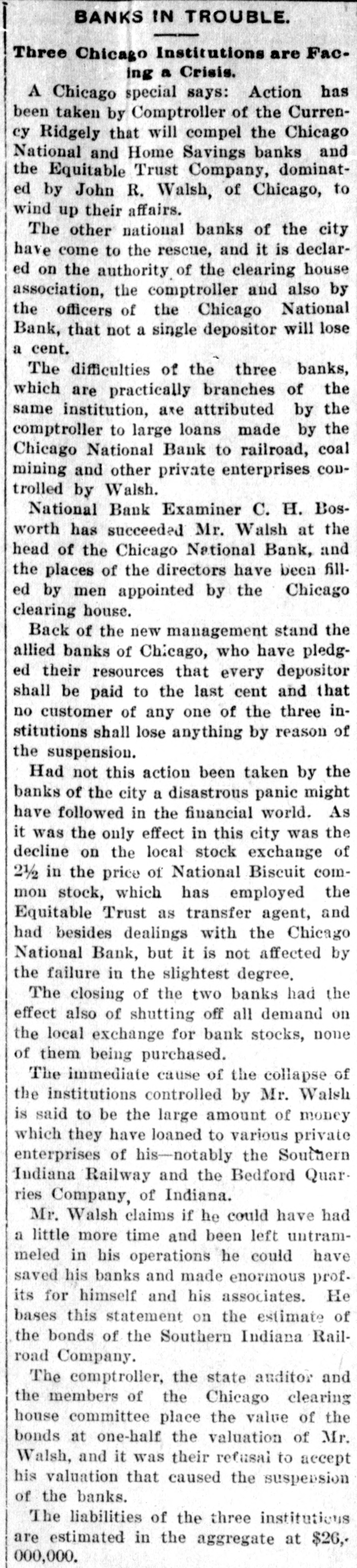
BANKS IN TROUBLE. Three Chicago Institutions are Facing a Crisis. A Chicago special says: Action has been taken by Comptroller of the Currency Ridgely that will compel the Chicago National and Home Savings banks and the Equitable Trust Company, dominated by John R. Walsh, of Chicago, to wind up their affairs. The other national banks of the city have come to the rescue, and it is declared on the authority of the clearing house association, the comptroller and also by the officers of the Chicago National Bank, that not a single depositor will lose a cent. The difficulties of the three banks, which are practically branches of the same institution, are attributed by the comptroller to large loans made by the Chicago National Bank to railroad, coal mining and other private enterprises controlled by Walsh. National Bank Examiner C. H. Bosworth has succeeded Mr. Walsh at the head of the Chicago National Bank, and the places of the directors have been filled by men appointed by the Chicago clearing house. Back of the new management stand the allied banks of Chicago, who have pledged their resources that every depositor shall be paid to the last cent and that no customer of any one of the three institutions shall lose anything by reason of the suspension. Had not this action been taken by the banks of the city a disastrous panic might have followed in the financial world. As it was the only effect in this city was the decline on the local stock exchange of 2½ in the price of National Biscuit common stock, which has employed the Equitable Trust as transfer agent, and had besides dealings with the Chicago National Bank, but it is not affected by the failure in the slightest degree. The closing of the two banks had the effect also of shutting off all demand on the local exchange for bank stocks, none of them being purchased. The immediate cause of the collapse of the institutions controlled by Mr. Walsh is said to be the large amount of money which they have loaned to various private enterprises of his-notably the Southern Indiana Railway and the Bedford Quarries Company, of Indiana. Mr. Walsh claims if he could have had a little more time and been left untrammeled in his operations he could have saved his banks and made enormous profits for himself and his associates. He bases this statement on the estimate of the bonds of the Southern Indiana Railroad Company. The comptroller, the state auditor and the members of the Chicago clearing house committee place the value of the bonds at one-half the valuation of Mr. Walsh, and it was their refusal to accept his valuation that caused the suspension of the banks. The liabilities of the three institutions are estimated in the aggregate at $26,000,000.


Article from The Miller Sun, December 27, 1905

Click image to open full size in new tab

Article Text

HREE BANKS QUIT. ICAGO INSTITUTIONS OF JOHN R. WALSH GO OUT. icago National, Equitable Trust Company and Home Savings Bank Close Business-Two Banks Alone Carry $22,500,000 of Deposits. Liquidation of the Chicago National nk, the Home Savings Bank, and , Equitable Trust Company, all of icago, was announced at 3:30 lock Monday morning by representves of the Chicago Clearing House sociation, after a session lasting thteen hours. James B. Forgan, esident of the First National Bank, head of the clearing house commit: of the Chicago Associated banks, ve forth the statement. The assets these institutions. it was asserted, re involved in coal* and railway perties of John R. Walsh, Presiit of the Chicago National Bank. el statement was issued in the office the First National Bank. It is as lows: "The citizens of Chicago will unibtedly be surprised to learn that : Chicago National Bank, the Home vings Bank, and the Equitable Company, which have been conlled, managed, and officered by in R. Walsh and his associates e concluded to wind up their afrs and quit business in the city of icago, but they will be gratified to rn that after a thorough and careexamination of their affairs by the icago Clearing House banks that of the depositors of these instituas will be pand in full upon dend, the Chicago clearing house ks having pledged themselves to s result, thus putting all the rerees of the Chicago banks behind depositors of these three instituis. The difficulty with the instituhs has been that their investments e been made in assets connected h the railway and coal enterprises John R. Walsh. These assets were immediately available to meet deits in full." The meeting of the Chicago Clearing use Association began at noon Sun. Notices were sent members of the rd by Mr. Forgan after the condition the banks and the trust company had n learned. Clerks were notified and y or more with their stenographers ried to the First National bank. Bed closed doors the Clearing House sociation began its work of finding a y that might enable them to ride the incial sea in safety. That a panic would be likely to fol- was the first thought of the comtee. Resolutions were adopted and ds of other banks pledged themselves give assistance. The amount involvin the failure would not be discussed the committee members. in addition to the formal statement the failure, the following announcent was made, signed by the clearing ise committee of the Chicago assocbanks: pa To the Public: Depositors of the Chio National bank, the Home Savings k. and the Equitable Trust Company


Article from Valentine Democrat, December 28, 1905

Click image to open full size in new tab

Article Text

THREE BANKS QUIT. CHICAGO INSTITUTIONS OF JOHN R. WALSH GO OUT. Chicago National, Equitable Trust Company and Home Savings Bank Close Business-Two Banks Alone Carry $22,500,000 of Deposits. Liquidation of the Chicago National Bank, the Home Savings Bank, and the Equitable Trust Company, all of Chicago, was announced at 3:30 o'clock Monday morning by representatives of the Chicago Clearing House Association, after a session lasting eighteen hours. James B. Forgan, President of the First National Bank, as head of the clearing house committee of the Chicago Associated banks, gave forth the statement. The assets of these institutions, it was asserted, were involved in coal and railway properties of John R. Walsh, President of the Chicago National Bank. The statement was issued in the office of the First National Bank. It is as follows: "The citizens of Chicago will undoubtedly be surprised to learn that the Chicago National Bank, the Home Savings Bank, and the Equitable DLD Company, which have been controlled. managed, and officered by John R. Walsh and his associates have concluded to wind up their affairs and quit business in the city of Chicago, but they will be gratified to learn that after a thorough and careful examination of their affairs by the Chicago Clearing House banks that all of the depositors of these institutions will be pand in full upon demand. the Chicago clearing house banks having pledged themselves to this result, thus putting all the resources of the Chicago banks behind the depositors of these three institutions. The difficulty with the institutions has been that their investments have been made in assets connected with the railway and coal enterprises of John R. Walsh. These assets were not immediately available to meet deposits in full." The meeting of the Chicago Clearing House Association began at noon Sunday. Notices were sent members of the board by Mr. Forgan after the condition of the banks and the trust company had been learned. Clerks were notified and