Article Text
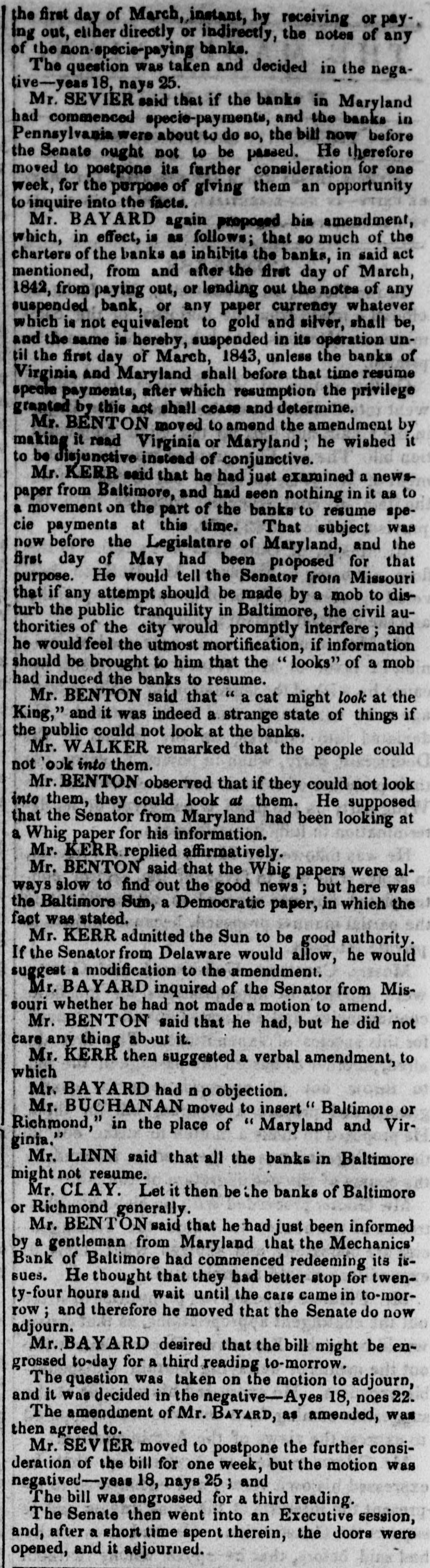
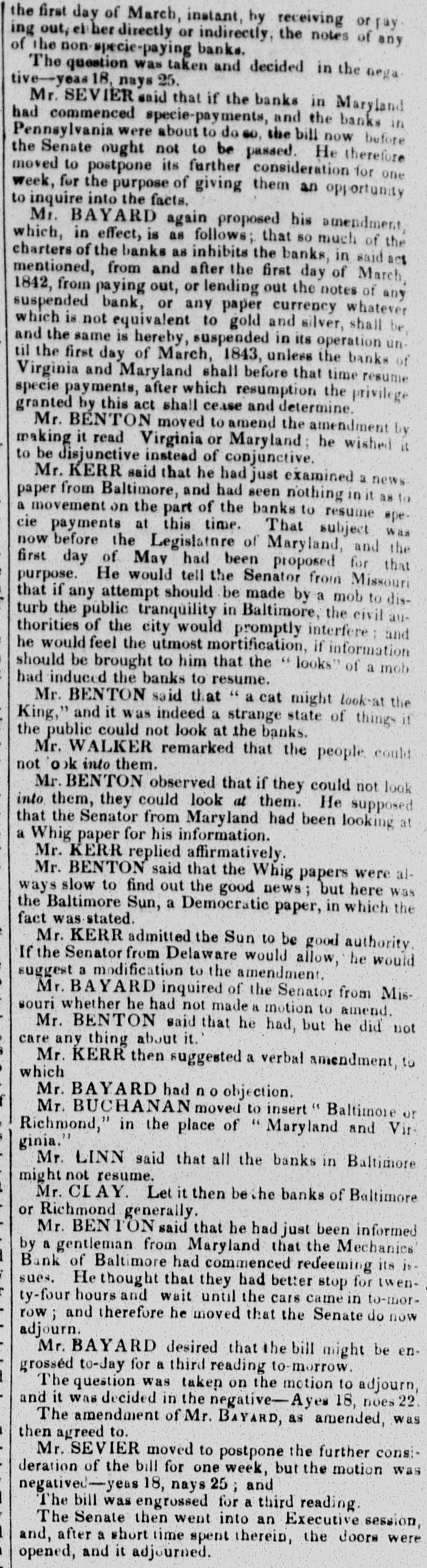
the first day of March, instant, by receiving or pay ing out, el her directly or indirectly, the notes of any of the specie -paying banks. The question was taken and decided in the nega tive-yeas 18, nays 25. Mr. SEVIER said that if the banks in Maryland had commenced pecie-payments, and the were to do so, the bill now Pennsylvania Senate about banks before in the ought not to be passed. He therefore moved to postpone its further consideration for one week, for the purpose of giving them an opportunity to inquire into the facts. Mr. BAYARD again proposed his amendment which, in effect, is as follows: that so as the in charters of the banks inhibits banks, much said of the act mentioned, from and after the first day of March 1842, from paying out, or lending out the notes of any suspended bank, or any paper currency whatever not to and which the is equivalent is hereby, gold and in silver, shall be same suspended its operation until the first day of March, 1843, unless the banks that time Virginia and Maryland shall before resume of specie payments, after which resumption the privilege granted by this act shall cease and determine. Mr. BENTON moved to amend the amendment by making it read Virginia or Maryland he wished it to be disjunctive instead of conjunctive. Mr. KERR said that he had just examined a news paper from Baltimore, and had seen nothing in it as to a movement on the part of the banks to resume apecie payments at this time. That subject Was now before the Legislature of Maryland, and the first day of May had been proposed for that purpose. He would tell the Senator from Missouri that if any attempt should be made by a mob to disturb the public tranquility in Baltimore, the civil authorities of the city would promptly interfere and he would feel the utmost mortification, if information should be brought to him that the looks" of a mob had induced the banks to resume. Mr. BENTON said that " a cat might look at the King," and it was indeed a strange state of things if the public could not look at the banks. Mr. WALKER remarked that the people could not look into them. Mr. BENTON observed that if they could not look into them, they could look at them. He supposed that the Senator from Maryland had been looking at a Whig paper for his information. Mr. KERR replied affirmatively. Mr. BENTON said that the Whig papers were always slow to find out the good news; but here was the Baltimore Sun, a Democratic paper, in which the fact was stated. Mr. KERR admitted the Sun to be good authority. If the Senator from Delaware would allow, he would suggest a modification to the amendment. Mr. BAYARD inquired of the Senator from Missouri whether he had not made a motion to amend. Mr. BENTON said that he had, but the did not care any thing about it. Mr. KERR then suggested a verbal amendment, to which Mr. BAYARD had n o objection. f Mr. BUCHANAN moved to insert is Baltimore or Richmond," in the place of Maryland and Vir ginia. Mr. LINN said that all the banks in Baltimore might not resume. Mr. AY. Let it then be he banks of Baltimore or Richmond generally. Mr. BENTON said that he had just been informed by a gentleman from Maryland that the Mechanics Bank of Baltimore had commenced redeeming its issues. He thought that they had better stop for twenty-four hours and wait until the cars came in to-morrow; and therefore he moved that the Senate do now adjourn. Mr. BAYARD desired that the bill might be engrossed to-Jay for a third reading to-morrow. The question was taken on the motion to adjourn, and it was decided in the negative-Ayee 18, noes 22. The amendment of Mr. BAYARD, as amended, was then agreed to. Mr. SEVIER moved to postpone the further consderation of the bill for one week, but the motion was negative.-year 18, nays 25 ; and The bill was engrossed for a third reading. The Senate then went into an Executive session, I and, after a short time spent therein, the doors were opened, and it adjourned.