414. Bank of the State of Arkansas (Little Rock, AR)

Bank Information

Episode Type
Suspension → Closure
Bank Type
state
Start Date
January 1, 1840*
Location
Little Rock, Arkansas (34.746, -92.290)

Metadata

Model
gpt-5-mini
Short Digest
e4e35503d6722cda

Response Measures

None

Description

Articles indicate the Bank of the State of Arkansas at Little Rock had been placed in liquidation with receivers (closure/receivership) following an earlier suspension of specie payments in the region. No article describes a depositor run on this specific bank. Key dates: resumption of specie payments by the principal bank at Little Rock noted 1840-10-01 (other banks debated resumption), and a receivers' notice dated 1841-03-20 referencing liquidation. OCR corrected minor capitalization/spacing; no change to bank name or city.

Events (2)

1. January 1, 1840* Suspension
Cause
Macro News
Cause Details
General suspension of specie payments across the South and West; correspondent dishonoring drafts (North American Trust and Banking Co.) contributed to embaraassment.
Newspaper Excerpt
the general suspension of specie payments by the banks in the whole south and west
Source
newspapers
2. March 20, 1841 Receivership
Newspaper Excerpt
Receivers Office, Bank of the State of Arkansas at Little Rock... Act placing the Bank in Liquidation (notice dated March 20, 1841).
Source
newspapers

Newspaper Articles (2)

Article from The Arkansas Banner, March 27, 1844

Click image to open full size in new tab

Article Text

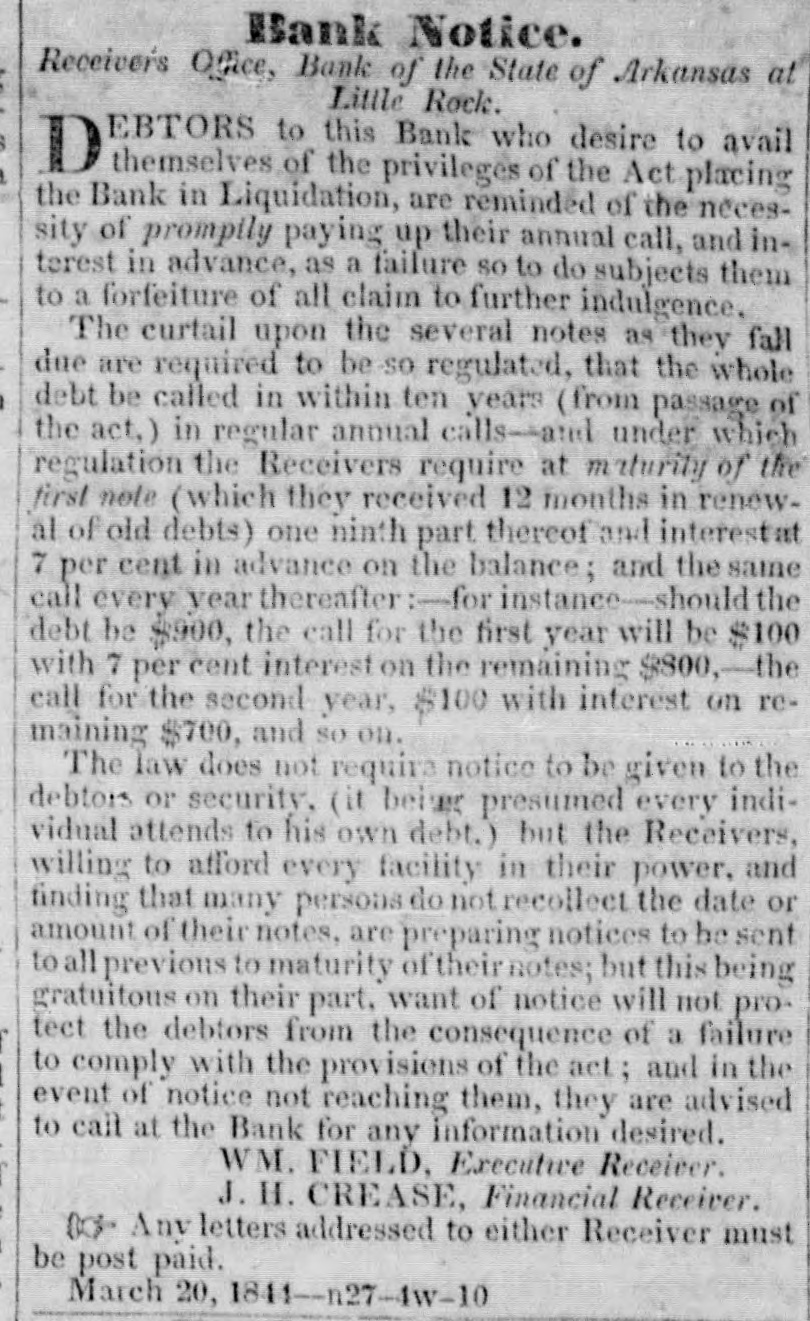
Bank Notice. Receivers Office, Bank of the State of Arkansas at Little Rock. EBTORS to this Bank who desire to avail D themselves of the privileges of the Act placing the Bank in Liquidation, are reminded of the nécessity of promptly paying up their annual call, and interest in advance, as a failure so to do subjects them to a forfeiture of all claim to further indulgence. The curtail upon the several notes as they fall due are required to be so regulated, that the whole debt be called in within ten years (from passage of the act,) in regular annual calls-and under which regulation the Receivers require at maturity of the first note (which they received 12 months in renewal of old debts) one ninth part thereof and interestat 7 per cent in advance on the balance; and the same call every year thereafter:-for instance should the debt be $900, the call for the first year will be $100 with 7 per cent interest on the remaining $800,- the call for the second year, $100 with interest on remaining $700, and so on. The law does not requira notice to be given to the debtors or security, (it being presumed every individual attends to his own debt.) but the Receivers, willing to afford every facility in their power, and finding that many persons do not recollect the date or amount of their notes, are preparing notices to be sent to all previous to maturity of their notes; but this being gratuitous on their part, want of notice will not protect the debtors from the consequence of a failure to comply with the provisions of the act; and in the event of notice not reaching them, they are advised to call at the Bank for any information desired. WM. FIELD, Executive Receiver. J. H. CREASE, Financial Receiver. los Anv letters addressed to either Receiver must be post paid. March 20, 1841--22-4w-10

Article from The Russellville Democrat, April 20, 1876

Click image to open full size in new tab

Article Text

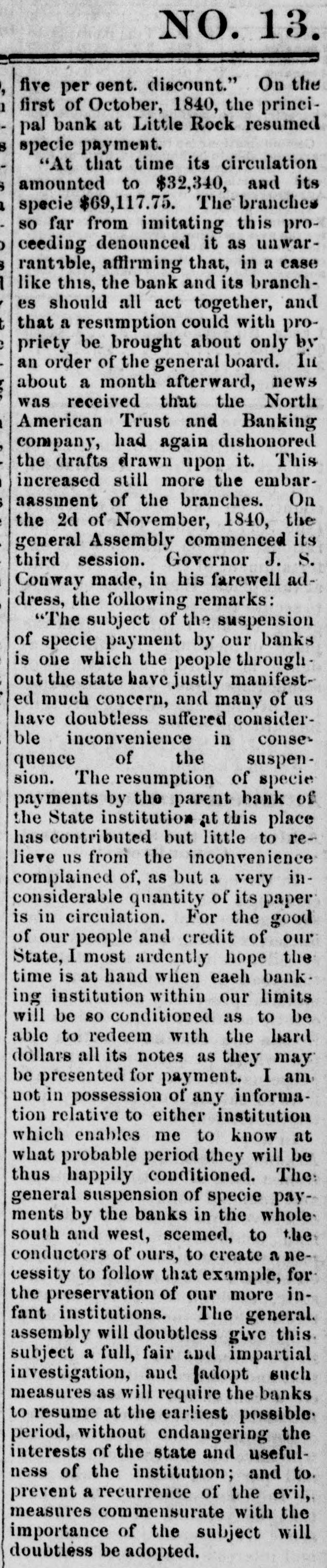
NO. 13. five per cent. discount." On the , 1 first of October, 1840, the principal bank at Little Rock resumed 8 specie payment. "At that time its circulation $ amounted to $32,340, and its 1 specie $69,117.75. The branches so far from imitating this proD ceeding denounced it as unwar8 rantable, affirming that, in a case I like this, the bank and its branches should all act together, and t that a resumption could with pro$ priety be brought about only by an order of the general board. In about a month afterward, news was received that the North American Trust and Banking company, had again dishonored the drafts drawn upon it. This increased still more the embaraassment of the branches. On the 2d of November, 1840, the general Assembly commenced its third session. Governor J. S. Conway made, in his farewell address, the following remarks: "The subject of the suspension of specie payment by our banks is one which the people through out the state have justly manifested much concern, and many of us have doubtless suffered considerble inconvenience in consequence of the suspension. The resumption of specie payments by the parent bank of the State institution at this place has contributed but little to relieve us from the inconvenience complained of, as but a very inconsiderable quantity of its paper is in circulation. For the good of our people and credit of our State, I most ardently hope the time is at hand when each bank ing institution within our limits will be so conditioned as to be able to redeem with the hard dollars all its notes as they may be presented for payment. I am not in possession of any information relative to either institution which enables me to know at what probable period they will be thus happily conditioned. The general suspension of specie payments by the banks in the whole south and west, seemed, to the conductors of ours, to create a necessity to follow that example, for the preservation of our more infant institutions. The general. assembly will doubtless give this. subject a full, fair and impartial investigation, and [adopt such measures as will require the banks to resume at the earliest possible. period, without endangering the interests of the state and usefulness of the institution; and to. prevent a recurrence of the evil, measures commensurate with the importance of the subject will doubtless be adopted.