Bank suspended payment Jan 20, 1903 after heavy exposure to the failed Alphin-Lake Cotton Company. A receiver (Senator James P. Clarke) was appointed; later the president arranged to reopen and depositors were paid in full. No article describes a depositor run prior to suspension.
Events (3)
1.January 20, 1903Suspension
Cause
Bank Specific Adverse Info
Cause Details
Temporary suspension due to loans/advances to the failed Alphin-Lake Cotton Company (firm failure and alleged fraudulent compress receipts).
Newspaper Excerpt
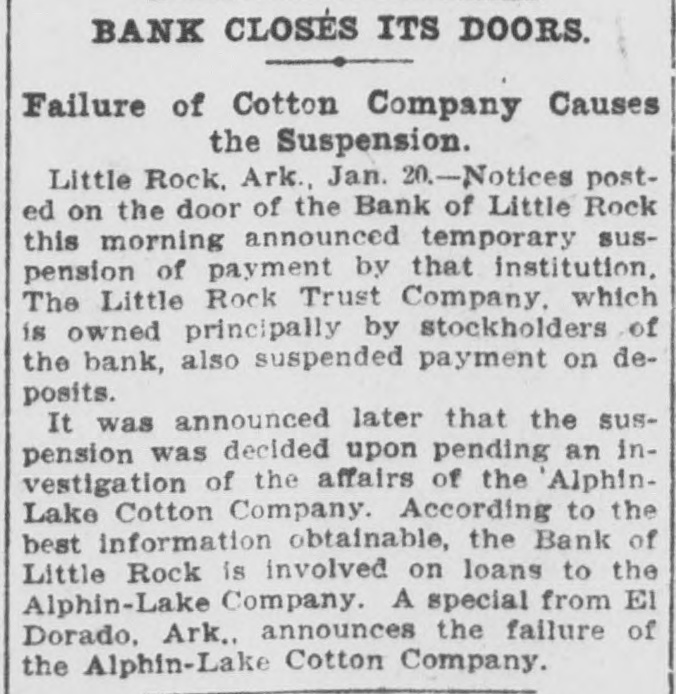
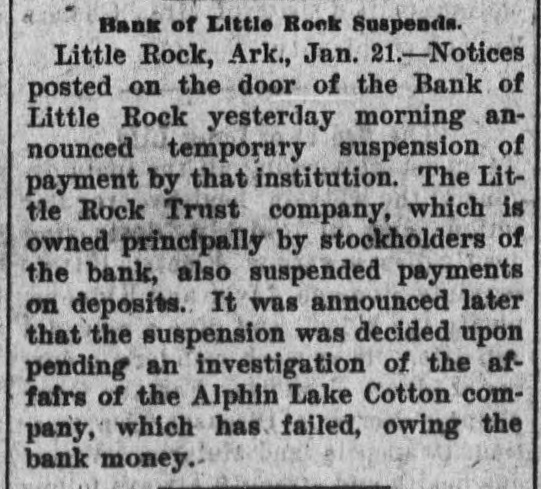
Notices posted on the door of the Bank of Little Rock this morning announced temporary suspension of payment by that institution...the suspension was decided upon pending an investigation of the affairs of the Alphin-Lake Cotton Company.
Source
newspapers
2.January 24, 1903Receivership
Newspaper Excerpt
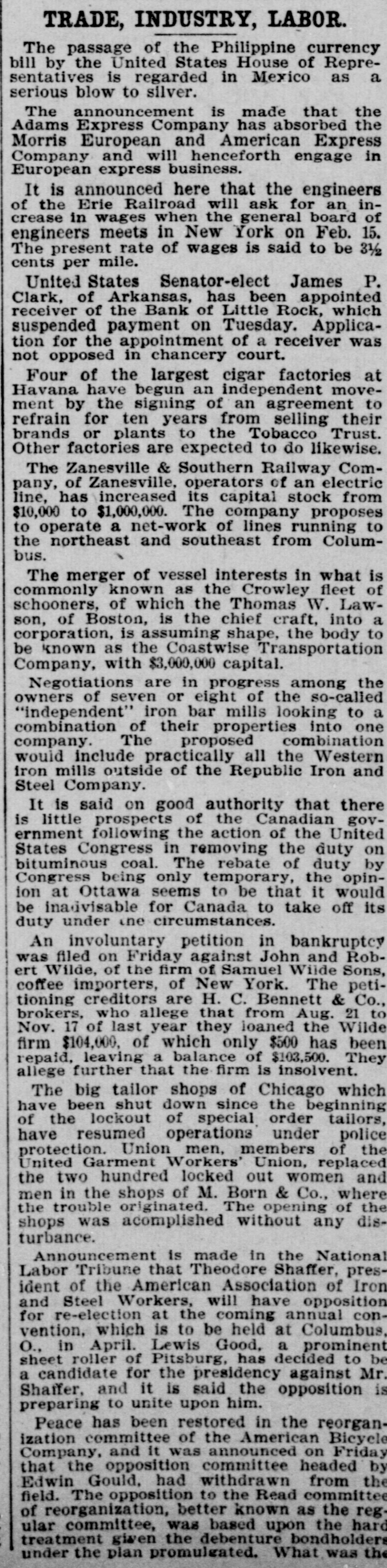
United States Senator-elect James P. Clark, of Arkansas, has been appointed receiver of the Bank of Little Rock, which suspended payment on Tuesday. Application for the appointment of a receiver was not opposed in chancery court.
Source
newspapers
3.February 13, 1903Reopening
Newspaper Excerpt
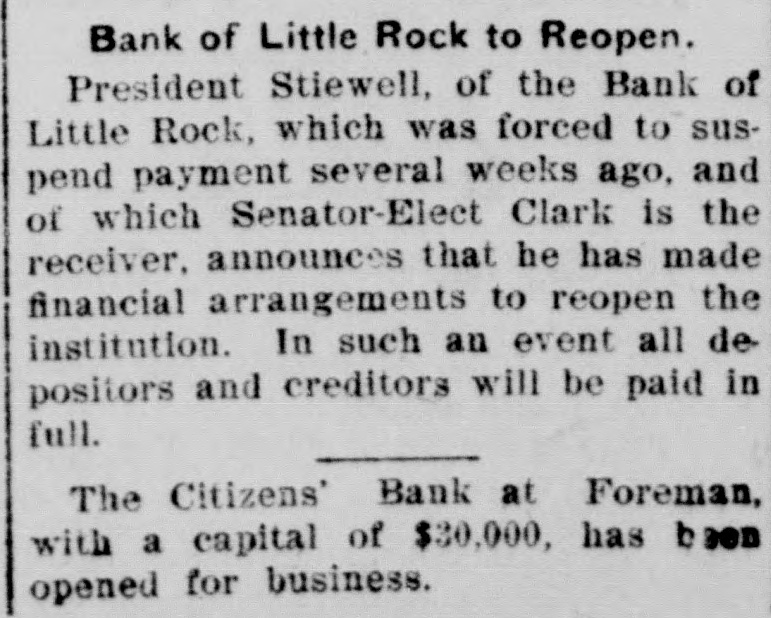
Bank of Little Rock to Reopen. President Stiewell, of the Bank of Little Rock, which was forced to suspend payment several weeks ago, and of which Senator-Elect Clark is the receiver, announces that he has made financial arrangements to reopen the institution. In such an event all depositors and creditors will be paid in full.
Source
newspapers
Newspaper Articles (23)
1.January 21, 1903The Montgomery AdvertiserMontgomery, AL
Click image to open full size in new tab
Article Text
BANK CLOSÉS ITS DOORS. Failure of Cotton Company Causes the Suspension. Little Rock, Ark., Jan. 20.-Notices posted on the door of the Bank of Little Rock this morning announced temporary suspension of payment by that institution, The Little Rock Trust Company. which is owned principally by stockholders of the bank, also suspended payment on deposits. It was announced later that the suspension was decided upon pending an investigation of the affairs of the 'AlphinLake Cotton Company. According to the best information obtainable, the Bank of Little Rock is involved on loans to the Alphin-Lake Company. A special from El Dorado, Ark.. announces the failure of the Alphin-Lake Cotton Company.
2.January 21, 1903Richmond DispatchRichmond, VA
Click image to open full size in new tab
Article Text
GENERAL. New York Stock market closes weak, Coill, and at lowest 01 ine way WHIST, oats, au provisions au Chicagu minbeceral Denate passes legislauvt, CACCUtive, and Judicial appropriation Die: house passes DISTRICT 01 Columbia oili, and lakes up Pninppine comage measure -DlaLtmen by Congressmall on 11001 of House mei with crs of you ue! moin young woman in nery-Agumnaldo appears LO this country for a loan or day,000,000 and a credit of $80,000,000, for the development and improvement or Phinppine agnculture-mmster Bowen arrives 111 washigton-President Mitchell reads his annual report at Mintre National Conventon-rrank Rice, Tioga, and John Peters the winning favorites at New Orieans-- J. Pupe elected chier justice of the Supreme Court of South Carouna-J. B. Frazier (Dtmo(print), inaugurated Governor of Tennessee-bank or C. N. Flaeger & Co., Jackbonville, Tex. suspends-Bank of Little Rock, Ark., and the Little Rock Trust Company suspend payment temporarily -Julian Rall dies at his home in New York-Southern Lumber Manufacturers' Association meets in New OrleansLieutenant Greenleaf, of Hydrogram Office, dies at Savannah-Kimball and Rose, of Seventh National Bank, New York, plead guilty of over-certifying checksStreet-car men indicted for death of Craig, the President's body-guard, at Pittsfield, Mass., change pleas to guilty; one of them sentenced-The indications are that Teller will be re-elected Senator from Colorado to-day--Delaware, Lackawanna and Western Railroad Company concludes its case before the Coal Strike Commission, and Temple Iron Company begins presentation of its side-German cruiser Vineta said to have been ordered to Maracalbo--Sentiment among Southerners in Washington regarding the proposal of a statue of Lee for Statuary Hall, Washington, is that it should be first definitely ascertained that the statue would be accepted-Two thousand people attend funeral of N. G. GonzalesCongressman Lester, of New York. charges that he has been approached with a bribe-Hearing of base-ball injunction cases at Philadelphia postponed until Friday-Reed Smoot. W. J. Stone. and R. A. Alger elected United States Senators: C. W Fairbanks Boise Penrose. T. C. Platt and Orville H. Platt re-electedRev. A. S. Llovd D. D.. of Virginia, elected Bishop of Mississippl-Voling on Senatorship begins in Delaware-S. W. T Lanham inaugurated as Governor of Texas --Executive Council of Federation of Labor decides to prosecute active campaign in behalf of anti-child-labor laws American residents of Isle of Pines cline to pay taxes to Citha-Cantain Marmaduke, late commander of Colombian guinboat Bogota. arrives at New York-New York Supreme Court declares special franchise tax law unconstitutional.
3.January 21, 1903The Savannah Morning NewsSavannah, GA
Click image to open full size in new tab
Article Text
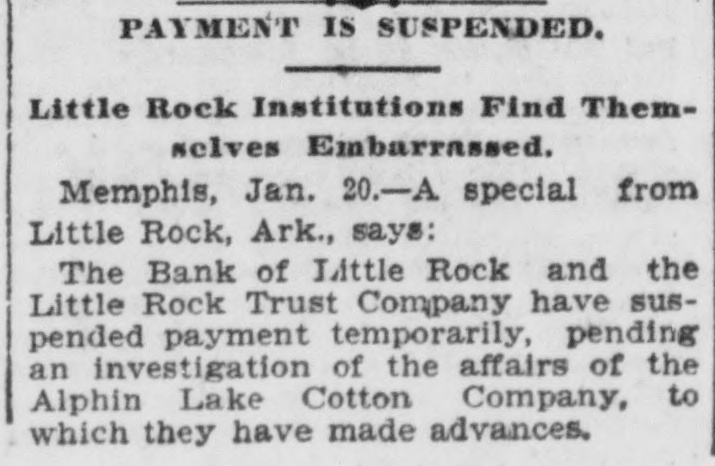
PAYMENT IS SUSPENDED. Little Rock Institutions Find Themselves Embarrassed. Memphis, Jan. 20.-A special from Little Rock, Ark., says: The Bank of Little Rock and the Little Rock Trust Company have suspended payment temporarily, pending an investigation of the affairs of the Alphin Lake Cotton Company, to which they have made advances.
4.January 21, 1903Richmond DispatchRichmond, VA
Click image to open full size in new tab
Article Text
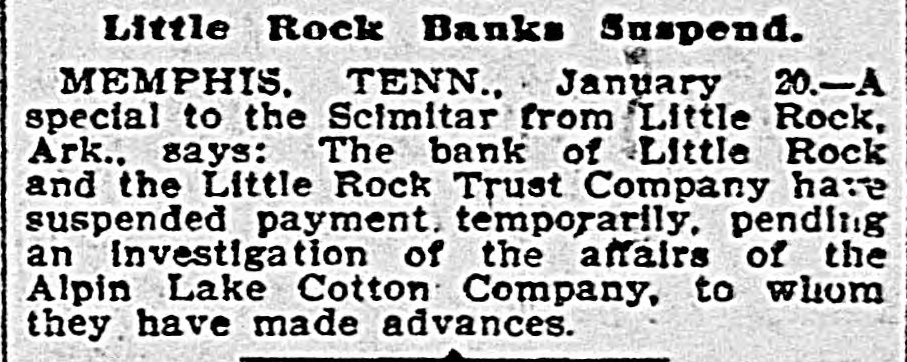
Little Rock Banks Suspend. MEMPHIS, TENN., January 20.-A special to the Scimitar from Little Rock, Ark., says: The bank of Little Rock and the Little Rock Trust Company have suspended payment temporarily, pending an investigation of the affairs of the Alpin Lake Cotton Company, to whom they have made advances.
Bank of Little Rock Suspends. Little Rock, Ark., Jan. 21.-Notices posted on the door of the Bank of Little Rock yesterday morning announced temporary suspension of payment by that institution. The Little Rock Trust company, which is owned principally by stockholders of the bank, also suspended payments on deposits. It was announced later that the suspension was decided upon pending an investigation of the affairs of the Alphin Lake Cotton company, which has failed, owing the bank money.
6.January 24, 1903The Indianapolis JournalIndianapolis, IN
Click image to open full size in new tab
Article Text
TRADE, INDUSTRY, LABOR. The passage of the Philippine currency bill by the United States House of Representatives is regarded in Mexico as a serious blow to silver. The announcement is made that the Adams Express Company has absorbed the Morris European and American Express Company and will henceforth engage in European express business. It is announced here that the engineers of the Erie Railroad will ask for an increase in wages when the general board of engineers meets in New York on Feb. 15. The present rate of wages is said to be 3½ cents per mile. United States Senator-elect James P. Clark, of Arkansas, has been appointed receiver of the Bank of Little Rock, which suspended payment on Tuesday. Application for the appointment of a receiver was not opposed in chancery court. Four of the largest cigar factories at Havana have begun an independent movement by the signing of an agreement to refrain for ten years from selling their brands or plants to the Tobacco Trust. Other factories are expected to do likewise. The Zanesville & Southern Railway Company, of Zanesville, operators of an electric line, has increased its capital stock from $10,000 to $1,000,000. The company proposes to operate a net-work of lines running to the northeast and southeast from Columbus. The merger of vessel interests in what is commonly known as the Crowley fleet of schooners, of which the Thomas W. Lawson, of Boston, is the chief craft, into a corporation, is assuming shape, the body to be known as the Coastwise Transportation Company, with $3,000,000 capital. Negotiations are in progress among the owners of seven or eight of the so-called "independent" iron bar mills looking to a combination of their properties into one company. The proposed combination would include practically all the Western iron mills outside of the Republic Iron and Steel Company. It is said on good authority that there is little prospects of the Canadian government following the action of the United States Congress in removing the duty on bituminous coal. The rebate of duty by Congress being only temporary, the opinion at Ottawa seems to be that it would be inadvisable for Canada to take off its duty under the circumstances. An involuntary petition in bankruptcy was filed on Friday against John and Robert Wilde, of the firm of Samuel Wilde Sons, coffee importers, of New York. The petitioning creditors are H. C. Bennett & Co., brokers, who allege that from Aug. 21 to Nov. 17 of last year they loaned the Wilde firm $104,000, of which only $500 has been repaid, leaving a balance of $103,500. They allege further that the firm is insolvent. The big tailor shops of Chicago which have been shut down since the beginning of the lockout of special order tailors, have resumed operations under police protection. Union men, members of the United Garment Workers' Union, replaced the two hundred locked out women and men in the shops of M. Born & Co., where the trouble originated. The opening of the shops was acomplished without any disturbance. Announcement is made in the National Labor Tribune that Theodore Shaffer, president of the American Association of Iron and Steel Workers, will have opposition for re-election at the coming annual convention, which is to be held at Columbus, O., in April. Lewis Good, a prominent sheet roller of Pitsburg, has decided to be a candidate for the presidency against Mr. Shaffer, and it is said the opposition is preparing to unite upon him. Peace has been restored in the reorganization committee of the American Bicycle Company, and it was announced on Friday that the opposition committee headed by Edwin Gould, had withdrawn from the
7.January 29, 1903The MonticellonianMonticello, AR
Click image to open full size in new tab
Article Text
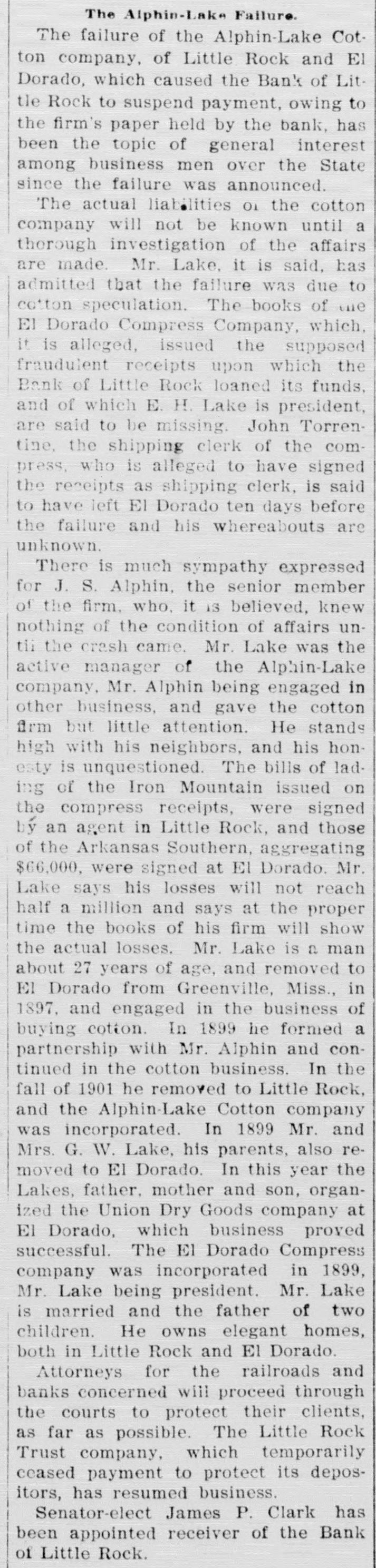
The Alphin-Lake Failure. The failure of the Alphin-Lake Cotton company, of Little Rock and El Dorado, which caused the Ban's of Lit. tle Rock to suspend payment, owing to the firm's paper held by the bank, has been the topic of general interest among business men over the State since the failure was announced. The actual liabilities 01 the cotton company will not be known until a thorough investigation of the affairs are made. Mr. Lake, it is said, has admitted that the failure was due to cotton speculation. The books of me El Dorado Compress Company, which, it is alleged, issued the supposed fraudulent receipts upon which the Bank of Little Rock loaned its funds. and of which E. H. Lake is president, are said to be missing. John Torrentine, the shipping clerk of the compress, who is alleged to have signed the receipts as shipping clerk, is said to have left El Dorado ten days before the failure and his whereabouts are unknown. There is much sympathy expressed for J. S. Alphin, the senior member of the firm. who, it is believed, knew nothing of the condition of affairs until the crash came. Mr. Lake was the active manager of the Alphin-Lake company, Mr. Alphin being engaged in other business, and gave the cotton firm but little attention. He stands high with his neighbors, and his honesty is unquestioned. The bills of lading of the Iron Mountain issued on the compress receipts, were signed by an agent in Little Rock, and those of the Arkansas Southern, aggregating $66,000, were signed at El Dorado. Mr. Lake says his losses will not reach half a million and says at the proper time the books of his firm will show the actual losses. Mr. Lake is a man about 27 years of age, and removed to El Dorado from Greenville, Miss., in 1897, and engaged in the business of buying cotton. In 1899 he formed a partnership with Mr. Alphin and continued in the cotton business. In the fall of 1901 he removed to Little Rock, and the Alphin-Lake Cotton company was incorporated. In 1899 Mr. and Mrs. G. W. Lake, his parents, also removed to El Dorado. In this year the Lakes, father, mother and son, organized the Union Dry Goods company at El Dorado, which business proved successful. The El Dorado Compress company was incorporated in 1899, Mr. Lake being president. Mr. Lake is married and the father of two children. He owns elegant homes, both in Little Rock and El Dorado. Attorneys for the railroads and banks concerned will proceed through the courts to protect their clients, as far as possible. The Little Rock Trust company, which temporarily ceased payment to protect its depositors, has resumed business. Senator-elect James P. Clark has been appointed receiver of the Bank of Little Rock.
8.January 29, 1903Woodruff County NewsMcCrory, AR
Click image to open full size in new tab
Article Text
The Alphin-Lake Failure. The failure of the Alphin-Lake Cotton company, of Little Rock and El Dorado, which caused the Bank of Little Rock to suspend payment, owing to the firm's paper held by that bank, has been the topic of general interest among business men over the State since the failure was announced. The actual liabilities of the cotton company will not be known until a thorough investigation of the affairs are made. Mr. Lake, it is said, has admitted that the failure was due to cotton speculation. The books of the El Dorado Compress company, which, it is alleged, issued the supposed fraudulent receipts upon which the Bank of Little Rock loaned its funds, and of which E. H. Lake is president, are said to be missing. John Torrentine, the shipping clerk of the compress, who is alleged to have signed the receipts as shipping clerk, is said to have left El Dorado ten days before the failure and his whereabouts are unknown. There is much sympathy expressed for J. S. Alphin, the senior member of the firm, who, it is believed, knew nothing of the condition of affairs until the crash came. Mr. Lake was the active manager of the Alphin-Lake company, Mr. Alphin being engaged in other business, and gave the cotton firm but little attention. He stands high with his neighbors, and his honesty is unquestioned. The bills of lading the Iron Mountain issued on the compress receipts, were signed by an agent in Little Rock, and those of the Arkansas South ern, aggregating $66,000, were signed at El Dorado. Mr. Lake says his losses will not reach half a million and says at the proper time the book of his firm will show the actual losses Mr. Lake is a man about 27 years of age, and removed to El Dorado from Greenville, Miss., in 1897, and engaged in the business of buying cotton. In 1889 he formed a partnership with Mr. Alphin and continued in the cotton business. In the fall of 1901 he removed to Little Rock, and the Alphin-Lake Cotton company was incorporated. In 1889 Mr. and Mrs. G. W. Lake, his parents, also removed to El Dorado. In this year the Lakes, father, mother and son, organized the Union Dry Goods company at El Dorado, which business proved successful. The El Dorado Compress company was incorporated in 1899, Mr. Lake being president. Mr. Lake is married and the father of two children. He owns elegant homes both in Little Rock and El Dorado. Attorneys for the railroads and banks concerned will proceed through the courts to protect their clients as far as possible. The Little Rock Trust company, which temporarily ceased payment to protect its depositors, has resumed business. Senator-elect James P. Clarke has been appointed receiver of the Bank of Little Rock.
9.January 30, 1903Newport Weekly IndependentNewport, AR
Click image to open full size in new tab
Article Text
The Alphin-Lake Failure. The failure of the Alphin-Lake Cotton company, of Little Rock and El Dorado, which caused the Bank of Little Rock to suspend payment, owing to the firm's paper held by that bank, has been the topic of general interest among business men over the State since the failure was announced. The actual liabilities of the cotton company will not be known until a thorough investigation of the affairs are made. Mr. Lake, it is said, has admitted that the failure was due to cotton speculation. The books of the El Dorado Compress company, which, it is alleged, issued the supposed fraudulent reccipts upon which the Bank of Little Rock loaned its funds, and of which E. II. Lake is president, are said to be missing. John Torrentine, the shipping clerk of the compress, who is alleged to have signed the receipts as shipping clerk, is said to have left El Dorado ten days before the failure and his whereabouts are unknown. There is much sympathy expressed for J. S. Alphin, the senior member of the firm, who, it is bclieved, knew nothing of the condition of affairs until the crash came. Mr. Lake was the active manager of the Alphin-Lake company, Mr. Alphin being engaged in other business, and gave the cotton firm but little attention. He stands high with his neighbors, and his honesty is unquestioned. The bills of lading the Iron Mountain issued on the compress receipts, were signed by an agent in Little Rock, and those of the Arkansas Southern, aggregating $66,000, were signed at El Dorado. Mr. Lake says his losses will not reach half a million and says at the proper time the book of his firm will show the actual losses Mr. Lake is a man about 27 years of age, and removed to El Dorado from Greenville, Miss., in 1897, and engaged in the business of buying cotton. In 1889 he formed a partnership with Mr. Alphin and continued in the cotton business. In the fall of 1901 he removed to Little Rock, and the Alphin-Lake Cotton company was incorporated. In 1889 Mr. and Mrs. G. W. Lake, his parents, also removed to El Dorado. In this year the Lakes, father, mother and son, organized the Union Dry Goods company at El Dorado, which business proved successful. The El Dorado Compress company was incorporated in 1899, Mr. Lake being president. Mr. Lake is married and the father of two children. He owns elegant homes both in Little Rock and El Dorado. Attorneys for the railroads and banks concerned will proceed through the courts to protect their clients as far as possible. The Little Rock Trust company, which temporarily ceased payment to protect its depositors, has resumed business. Senator-elect James P. Clarke has been appointed receiver of the Bank of Little Rock
10.February 13, 1903The Forrest City TimesForrest City, AR
Click image to open full size in new tab
Article Text
Bank of Little Rock to Reopen. President Stiewell, of the Bank of Little Rock, which was forced to suspend payment several weeks ago, and of which Senator-Elect Clark is the receiver, announces that he has made financial arrangements to reopen the institution. In such an event all depositors and creditors will be paid in full. The Citizens' Bank at Foreman, with a capital of $30,000, has b oen opened for business.
11.February 14, 1903The Van Buren PressVan Buren, AR
Click image to open full size in new tab
Article Text
Bank of Little Rock to Reopen. President Stiewell, of the Bank of Little Rock, which was forced to suspend payment several weeks ago, and of which Senator-Elect Clark is the receiver, announces that he has made financial arrangements to reopen the institution. In such an event all deposttors and creditors will be paid in full. The Citizens' Bank at Foreman, with a capital of $30,000, has been opened for business.
12.February 19, 1903Woodruff County NewsMcCrory, AR
Click image to open full size in new tab
Article Text
Bank to Reopen. President Stiewell, of the Bank of Little Rock, which was forced to suspend payment several weeks ago, and of which Senator-Elect Clark is the receiver, announces that he has made fi ancial arrangements to reopen the institution. In such an event all depositors and creditors will be paid in full.
13.February 27, 1903The Forrest City TimesForrest City, AR
Click image to open full size in new tab
Article Text
The Alphin-Lake Cotton Company of Little Rock and El Dorado, has been declared a bankrupt. This is the firm whose transactions caused a big sensation a few weeks ago, and resulted in the Bank of Little Rock suspending payment.
14.February 27, 1903Newport Weekly IndependentNewport, AR
Click image to open full size in new tab
Article Text
BRIEF MENTION. The Texarkana Eagles and Woodmen will give a street fair and carnival in April. Dr. W. A. Noel, of Pine Bluff, slipped and fell on the icy pavement and fractured his hip. T. G. Norris, a former resident of Carroll county, has been appointed city attorney of Prescott, Arizona. After a bitter fight, the prohis have been defeated at Newport, and whisky will be sold there this year. Cotton has reached the highest price in several years. One planter at Little Rock last week sold 1,200 bales at 10 cents. The Cleburne County Bank at Heber has filed articles of incorporation with the secretary of state. Capital, $10,000. Judge Mahoney, of Union county, has resigned, it is understood, to accept the chancellorship of the new Seventh chancery district. The Arkansas Coal Company, which will operate in the vicinity of Clarksville, has been incorporated with a capital of $25,000. A new town has been platted near Pocahontas, on the east bank of Black river, and on the Pocahontas and O'Kean road. It will be called Surridge. Stephen B. Wing, a prominent fruit grower of Benton county, is dead. Mr. King was a prime mover in the fruit industry of northwest Arkansas. Mr. and Mrs. J. F. Ray, of Little Rock, are the parents of a baby boy, who, when but six days old, developed two front teeth. The teeth are in the lower jaw in front. While in the act of kindling a fire at her mother's home in Pine Bluff, Pearl Walters, colored, was horribly burned, dying in a few minutes. The girl's mother, in attempting to extinguish the flames, was badly burned. The Alphin-Lake Cotton Company of Little Rock and El Dorado, has been declared a bankrupt. This is the firm whose transactions caused a big sensation a few weeks ago, and resulted in the Bank of Little Rock suspending payment.
15.March 31, 1903Newport Daily IndependentNewport, AR
Click image to open full size in new tab
Article Text
New consignment or R. & G. Corsets at including the new deep hip style Chas. Meyer's Great Bargain Store. Sigmund Wolff returned Tuesday St. morning from a short visit in Louis. He reports Mr. lke Goldman about the same and says Miss Ray Brandenburg and Elise Hooker are getting along nicely. G.A. Predeau, a young man who alcomes well recommended and has artistic ready proven himself an has printer as well as speedy typo, as accepted a permanent position foreman of the INDEPENDENT. William Hencke left Tuesday mornfor St. Louis, where he will take at six ing months' course of short-hand Barnes Business College to prepare office himself to assist his father as an Merman with the Wolff-Goldman cantile Company. The Missionary Ladies of the Meth- at odist church will hold their bazar the Hazel Hotel, Saturday April 11, the day before Easter Sunday. Special orders for plants or cut flowers should be placed now with Mesdames T.B. R. W. Bandy, J. W. Wallace or 91 dtf Stewart. Mr. J. D. Goldman of the LesserGoldman Cotton Company, spent Sun- Ad in Little Rock the guest of Mr. just day Hamberg. Mr. Goldman has and started a bank at Nashville, Ark., and he thinks well of Arkansas, investsays Little Rock in particular, for ment purposes.-Little Rock Democrat. Miss Cora Warner, the only lady cotton buyer in the state of Arkansas, came down from Batesville Tuesday morning on her way to Smithville, an Texas. Miss Warner is said to be expert judge of the fleecy article and the has been in the employ of Lesser Cotton Company at Batesville the past season. Capt. W. L. Heckman, owner of the steamboats Kennedy and Buck Elk, which have been engaged in hauling ) supplies for the White River railroad and construction, was here Tuesday expected the arrival of his boats, St. which are to be taken around to the Louis. This leaves the hauling on Joe Upper White in the hands of the Wheeler. "The Missouri Girl," which comes to Newport, April 3, produces more genuine, hearty laughter than any comedy yet written. In connection it with a strong and interesting plot, contains the most ludicrous situations ever conceived. The company pre- of senting the play is fully capable it out extracting this fun, and dealing to the public in a most satisfactory dtd. manner. 1 The Duncan-Clarke minstrel comleft on No. 2 Tuesday morning Kid pany for Poplar Bluff. Their treasurer, Berry,who was bound over to the next term of court on the charge of embez- them zlement refused to accompany his and returned to Batesville with newly found friend, Tom. G. Cushing, and his attorney, Dene H. Coleman, y both of whom attended the preliminary here Monday night. S The first drawing in the Star Cloth- held d House Suit Club No. 1 was and ing Monday-evening at eight o'clock e George E. Tremper, who is absent from the city, proved himself a lucky a S man, his number 28 being drawn by . disinterested party. The scheme, and 1 which afford no chances to lose one-fourth of the entire number to win, aside from the advantage of payt ing for a suit in a way that the money t is hardly missed, has been received with general favor. It is learned on good authority that o the fourth 25 per cent of deposits with will d the Little Rock Trust Company this be paid by that institution during the week, completing the payment of the entire deposits on hand when on y company temporarily suspended January 20. The ninety days will expire April 20. It is also learned that P. f during this week Receiver James Clarke of the Bank of Little Rock will file his report with Chancellor Hart the and be discharged, after which el bank will reopen and pay all deposa itors the full amount of their deposits. -Little Rock Gazette. h WATCH REPAIRING
16.April 17, 1903The Newark JournalNewark, AR
Click image to open full size in new tab
Article Text
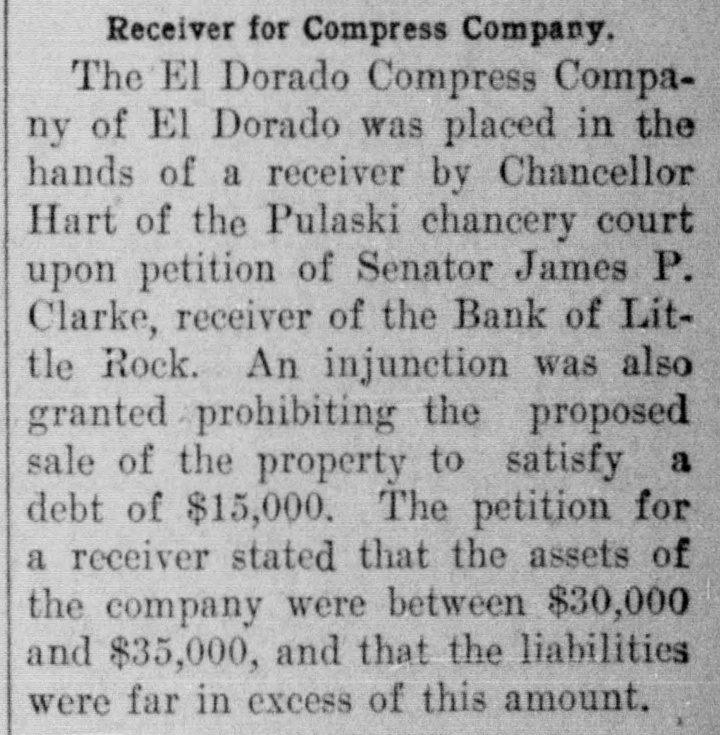
Receiver for Compress Company. The El Dorado Compress Company of El Dorado was placed in the hands of a receiver by Chancellor Hart of the Pulaski chancery court upon petition of Senator James P. Clarke, receiver of the Bank of Little Rock. An injunction was also granted prohibiting the proposed sale of the property to satisfy a debt of $15,000. The petition for a receiver stated that the assets of the company were between $30,000 and $35,000, and that the liabilities were far in excess of this amount.
17.April 23, 1903Woodruff County NewsMcCrory, AR
Click image to open full size in new tab
Article Text
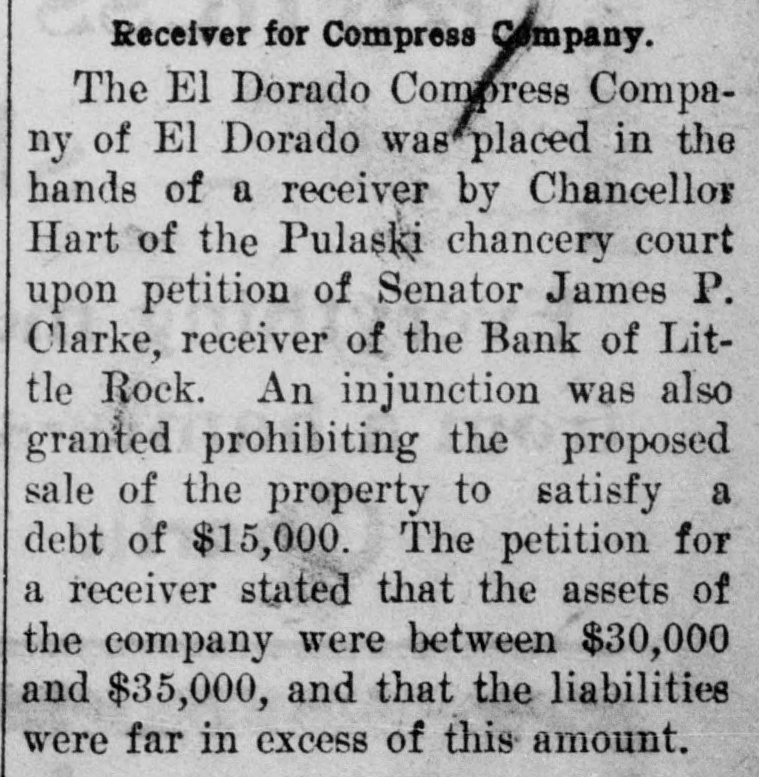
Receiver for Compress Company. The El Dorado Compress Company of El Dorado was placed in the hands of a receiver by Chancellor Hart of the Pulaski chancery court upon petition of Senator James P. Clarke, receiver of the Bank of Little Rock. An injunction was also granted prohibiting the proposed sale of the property to satisfy a debt of $15,000. The petition for a receiver stated that the assets of the company were between $30,000 and $35,000, and that the liabilities were far in excess of this amount.
18.May 2, 1903The Van Buren PressVan Buren, AR
Click image to open full size in new tab
Article Text
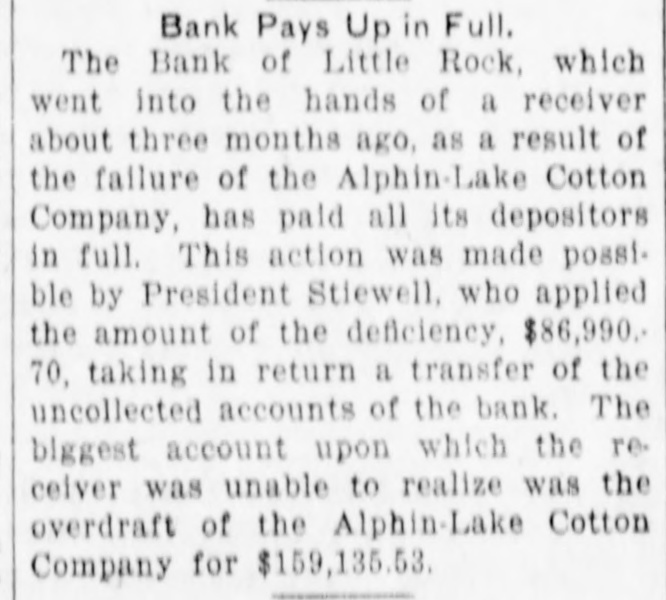
Bank Pays Up in Full. The Bank of Little Rock, which went into the hands of a receiver about three months ago, as a result of the failure of the Alphin-Lake Cotton Company, has paid all its depositors in full. This action was made possible by President Stiewell, who applied the amount of the deficiency, $86,990.70, taking in return a transfer of the uncollected accounts of the bank. The biggest account upon which the receiver was unable to realize was the overdraft of the Alphin-Lake Cotton Company for $159,135.53.
19.May 7, 1903The MonticellonianMonticello, AR
Click image to open full size in new tab
Article Text
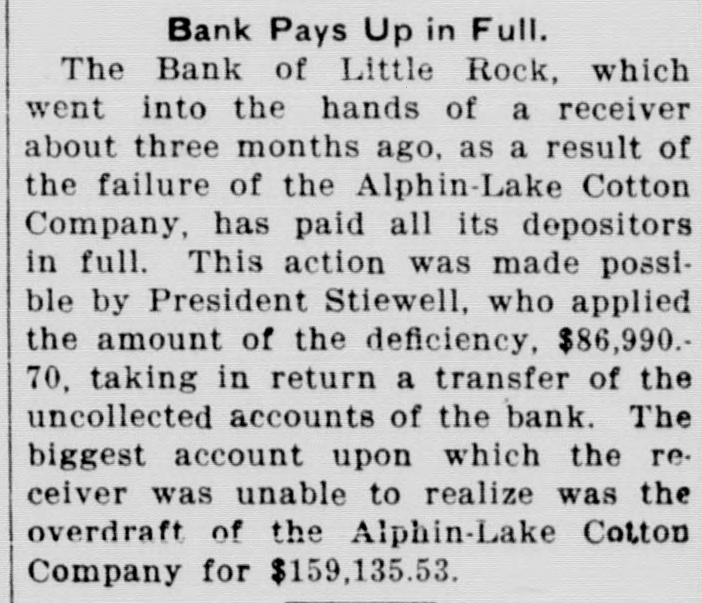
Bank Pays Up in Full. The Bank of Little Rock, which went into the hands of a receiver about three months ago, as a result of the failure of the Alphin-Lake Cotton Company, has paid all its depositors in full. This action was made possible by President Stiewell, who applied the amount of the deficiency, $86,990.70, taking in return a transfer of the uncollected accounts of the bank. The biggest account upon which the receiver was unable to realize was the overdraft of the Alphin-Lake Cotton Company for $159,135.53.
20.May 30, 1903The Van Buren PressVan Buren, AR
Click image to open full size in new tab
Article Text
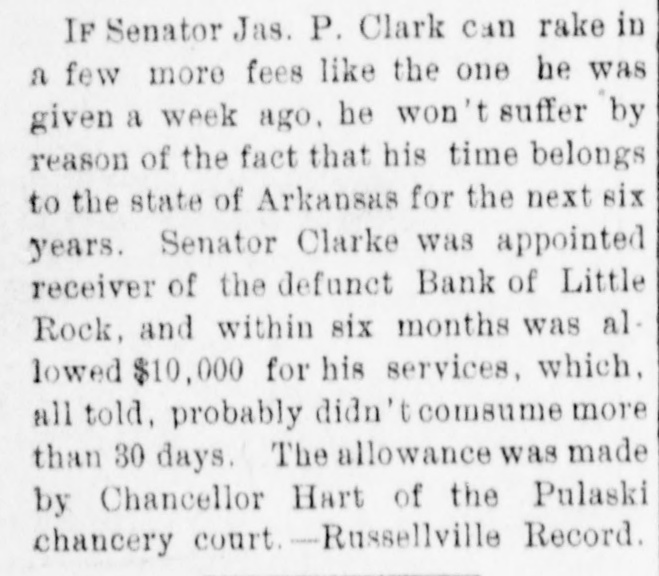
IF Senator Jas. P. Clark can rake in a few more fees like the one he was given a week ago, he won't suffer by reason of the fact that his time belongs to the state of Arkansas for the next six years. Senator Clarke was appointed receiver of the defunct Bank of Little Rock, and within six months was al lowed $10,000 for his services, which, all told, probably didn't comsume more than 30 days. The allowance was made by Chancellor Hart of the Pulaski chancery court. - Russellville Record.
21.June 12, 1903The Newark JournalNewark, AR
Click image to open full size in new tab
Article Text
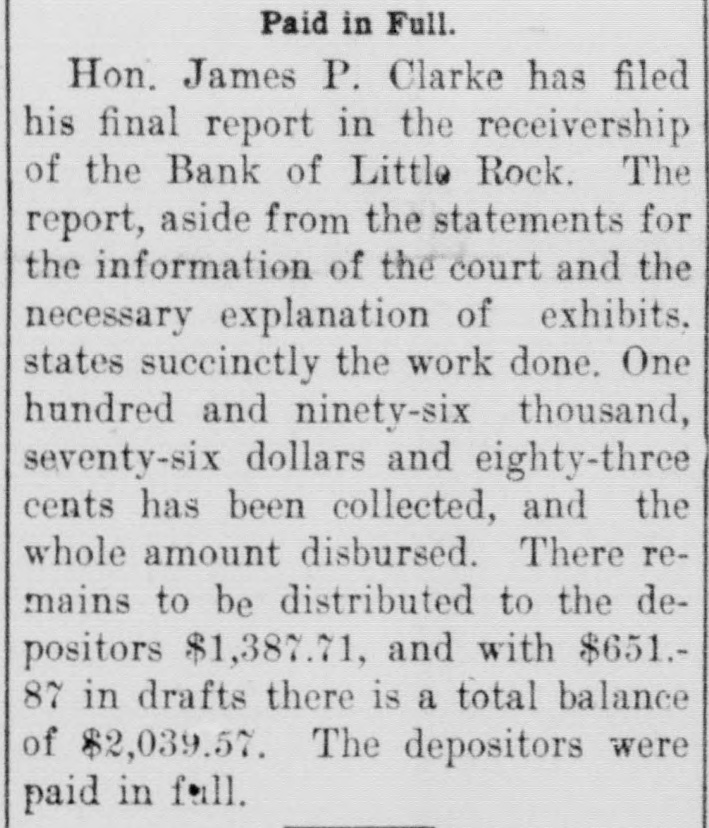
Paid in Full. Hon. James P. Clarke has filed his final report in the receivership of the Bank of Little Rock. The report, aside from the statements for the information of the court and the necessary explanation of exhibits. states succinctly the work done. One hundred and ninety-six thousand, seventy-six dollars and eighty-three cents has been collected, and the whole amount disbursed. There remains to be distributed to the depositors $1,387.71, and with $651.87 in drafts there is a total balance of $2,039.57. The depositors were paid in full.
22.September 15, 1903Newport Daily IndependentNewport, AR
Click image to open full size in new tab
Article Text
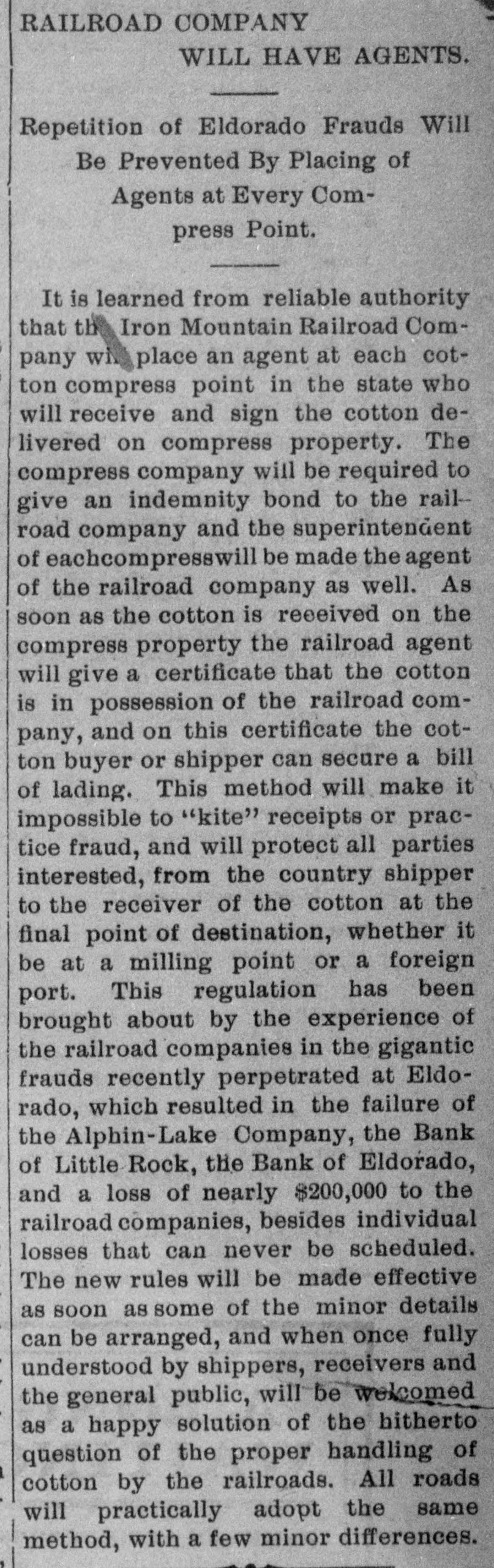
RAILROAD COMPANY WILL HAVE AGENTS. Repetition of Eldorado Frauds Will Be Prevented By Placing of Agents at Every Compress Point. It is learned from reliable authority that th Iron Mountain Railroad Company wi place an agent at each cotton compress point in the state who will receive and sign the cotton delivered on compress property. The compress company will be required to give an indemnity bond to the railroad company and the superintendent of eachcompresswill be made the agent of the railroad company as well. As soon as the cotton is received on the compress property the railroad agent will give a certificate that the cotton is in possession of the railroad company, and on this certificate the cotton buyer or shipper can secure a bill of lading. This method will make it impossible to "kite" receipts or practice fraud, and will protect all parties interested, from the country shipper to the receiver of the cotton at the final point of destination, whether it be at a milling point or a foreign port. This regulation has been brought about by the experience of the railroad companies in the gigantic frauds recently perpetrated at Eldorado, which resulted in the failure of the Alphin-Lake Company, the Bank of Little Rock, the Bank of Eldorado, and a loss of nearly $200,000 to the railroad companies, besides individual losses that can never be scheduled. The new rules will be made effective as soon as some of the minor details can be arranged, and when once fully understood by shippers, receivers and the general public, will be welcomed as a happy solution of the hitherto question of the proper handling of cotton by the railroads. All roads will practically adopt the same method, with a few minor differences.
23.September 18, 1903Newport Weekly IndependentNewport, AR
Click image to open full size in new tab
Article Text
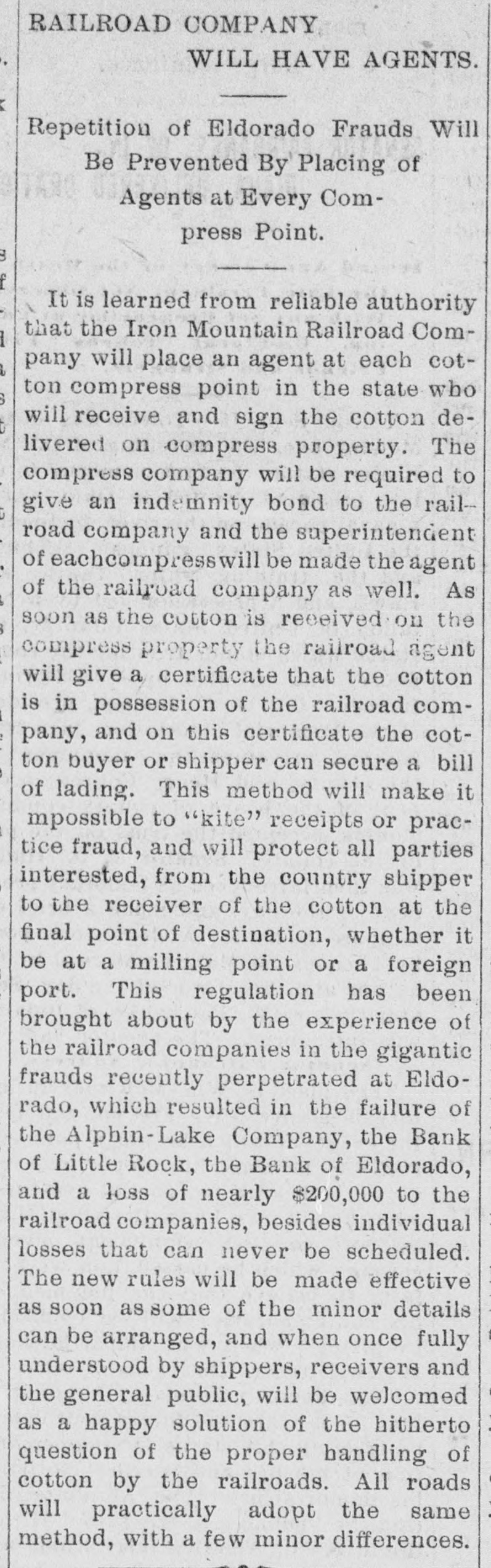
RAILROAD COMPANY WILL HAVE AGENTS. Repetition of Eldorado Frauds Will Be Prevented By Placing of Agents at Every Compress Point. It is learned from reliable authority that the Iron Mountain Railroad Company will place an agent at each cotton compress point in the state who will receive and sign the cotton delivered on compress property. The compress company will be required to give an indemnity bond to the railroad company and the superintendent of eachcompresswill be made the agent of the railroad company as well. As soon as the cotton is received on the compress property the railroad agent will give a certificate that the cotton is in possession of the railroad company, and on this certificate the cotton buyer or shipper can secure a bill of lading. This method will make it impossible to "kite" receipts or practice fraud, and will protect all parties interested, from the country shipper to the receiver of the cotton at the final point of destination, whether it be at a milling point or a foreign port. This regulation has been brought about by the experience of the railroad companies in the gigantic frauds recently perpetrated at Eldorado, which resulted in the failure of the Alphin-Lake Company, the Bank of Little Rock, the Bank of Eldorado, and a loss of nearly $200,000 to the railroad companies, besides individual losses that can never be scheduled. The new rules will be made effective as soon as some of the minor details can be arranged, and when once fully understood by shippers, receivers and the general public, will be welcomed as a happy solution of the hitherto question of the proper handling of cotton by the railroads. All roads will practically adopt the same method, with a few minor differences.