4053. West Englewood Trust & Savings Bank (Chicago, IL)

Bank Information

Episode Type
Run → Suspension → Closure
Bank Type
trust
Start Date
June 9, 1931
Location
Chicago, Illinois (41.850, -87.650)

Metadata

Model
gpt-5-mini
Short Digest
c86b38148ca12d1b

Response Measures

None

Description

Articles report heavy withdrawals June 9, 1931 leading to the bank's closing (suspension) as part of the Bain chain. A receiver (Irwin T. Gilruth) was appointed and later litigation and criminal investigation followed, indicating permanent closure/receivership rather than a temporary suspension and reopening. The immediate trigger was runs prompted by the suspension/closures of other local banks.

Events (3)

1. June 9, 1931 Receivership
Newspaper Excerpt
the West Englewood Trust and Savings, ... where John Bain made his start ... and where the Bain bank receiver, Irwin T. Gilruth, now has headquarters.
Source
newspapers
2. June 9, 1931 Run
Cause
Local Banks
Cause Details
Heavy withdrawals triggered by suspension/closing of several other Chicago neighborhood banks; panic spread among local banks in the Bain group.
Measures
Bank officers closed the bank; part of the Bain group suspended operations; receiver later took charge.
Newspaper Excerpt
Closing of the Bain banks followed the suspension of business at six other neighborhood banking institutions yesterday. Heavy withdrawals were made on the banks ... West Englewood Trust and Savings Bank.
Source
newspapers
3. June 9, 1931 Suspension
Cause
Local Banks
Cause Details
Suspension/closure resulted from heavy withdrawals following the closing of other neighborhood banks and the spreading crisis among Bain institutions.
Newspaper Excerpt
Twelve outlying Chicago banks ... were closed today because of 'heavy withdrawals following closing of several other Chicago banks.' ... West Englewood Trust and Savings Bank.
Source
newspapers

Newspaper Articles (5)

Article from The Washington Times, June 9, 1931

Click image to open full size in new tab

Article Text

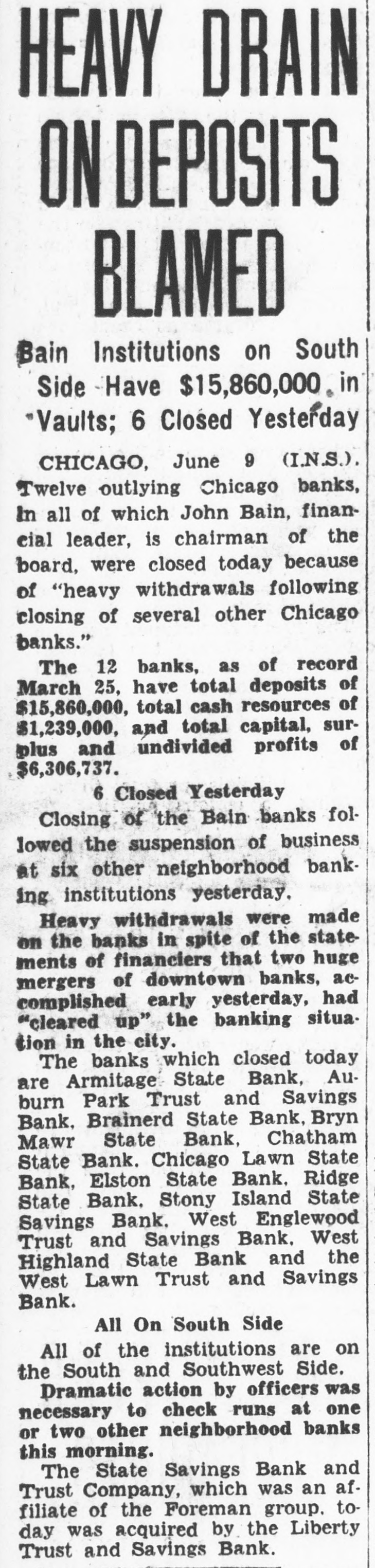
HEAVY DRAIN ON DEPOSITS BLAMED Bain Institutions on South Side Have $15,860,000 e in "Vaults; 6 Closed Yesterday CHICAGO, June 9 (I.N.S.). I welve outlying Chicago banks, In all of which John Bain, financial leader, is chairman of the board, were closed today because of "heavy withdrawals following closing of several other Chicago banks." The 12 banks, as of record March 25, have total deposits of $15,860,000, total cash resources of $1,239,000, and total capital, surplus and undivided profits of $6,306,737. 6 Closed Yesterday Closing of the Bain banks followed the suspension of business at six other neighborhood banking institutions yesterday. Heavy withdrawals were made on the banks in spite of the statements of financiers that two huge mergers of downtown banks, accomplished early yesterday, had "cleared up" the banking situa. tion in the city. The banks which closed today are Armitage State Bank, Auburn Park Trust and Savings Bank, Brainerd State Bank, Bryn Mawr State Bank, Chatham State Bank. Chicago Lawn State Bank, Elston State Bank, Ridge State Bank. Stony Island State Savings Bank. West Englewood Trust and Savings Bank. West Highland State Bank and the West Lawn Trust and Savings Bank. All On South Side All of the institutions are on the South and Southwest Side. Dramatic action by officers was necessary to check runs at one or two other neighborhood banks this morning. The State Savings Bank and Trust Company, which was an affiliate of the Foreman group. today was acquired by the Liberty Trust and Savings Bank.


Article from Chicago Tribune, August 20, 1931

Click image to open full size in new tab

Article Text

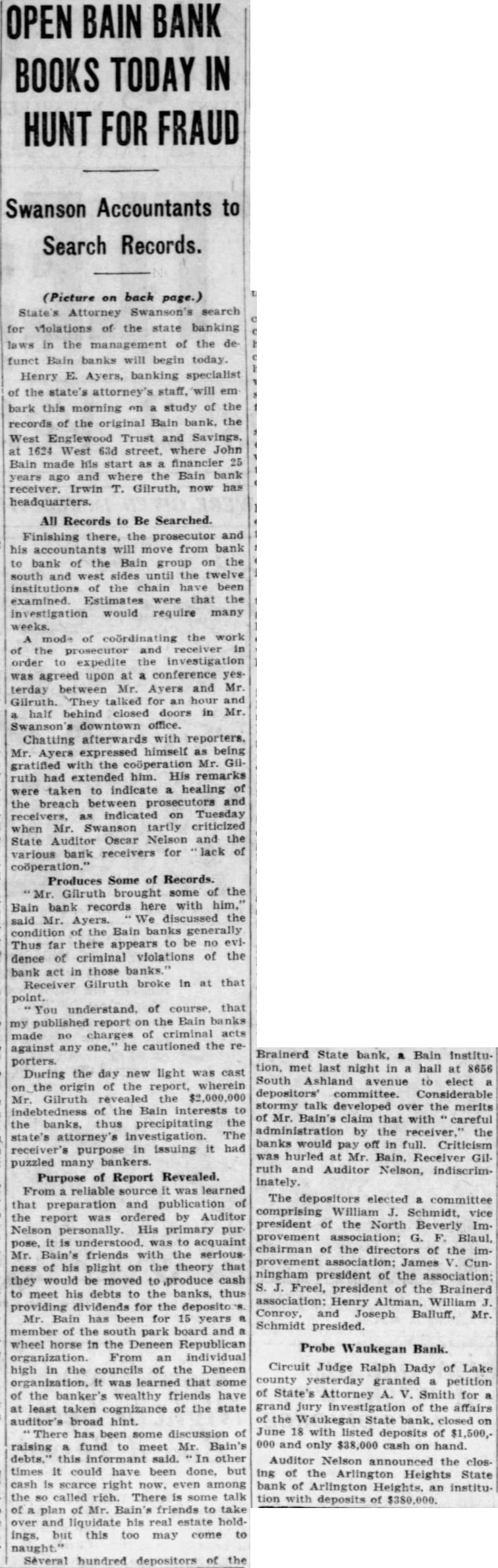
OPEN BAIN BANK BOOKS TODAY IN HUNT FOR FRAUD Swanson Accountants to Search Records. (Picture on back page.) State's Attorney search for of the state banking in the management of the de funct Bain banks will begin today. Henry E. Ayers, banking specialist of the state's staff, will em bark this morning on study of the records of the original Bain bank. the West Englewood Trust and Savings, at 1624 West 63d street, where John Bain made his start as financier 25 years ago and where the Bain bank receiver. Irwin T. Gilruth, now has headquarters. All Records to Be Searched. Finishing there, the and his will from bank to bank of the Bain group on the south and the twelve institutions the chain have been examined. Estimates were that the investigation would require many weeks. mode of the work the and receiver in order to expedite the investigation was agreed upon at a conference yes terday between Mr. Ayers and Mr. Gilruth. They talked for and half behind closed doors in Mr. Swanson's downtown office. Chatting afterwards with reporters, Mr. Ayers expressed himself as being gratified with the Mr. Gilruth had extended him. His remarks were taken to indicate a healing of the breach between and as Tuesday when Mr. Swanson tartly criticized State Auditor Oscar Nelson and the various bank receivers for "lack of Produces Some of Records. Mr. Gllruth some of the Bain bank records here with him,' Mr. Ayers. We discussed the said condition of the Bain banks generally Thus there appears to be no far dence of criminal violations of the bank act in those banks. Receiver Gilruth broke in at that point. of that my published report on the Bain banks made charges of criminal acts against any one,' he cautioned the reporters. During the day new light was cast the origin of the report, wherein Mr. Gilruth the $2,000,000 indebtedness of the Bain to the banks, thus precipitating the state's investigation. The receiver' purpose in issuing it had puzzled many Purpose of Report Revealed. From reliable was learned that preparation and of the report was by Auditor Nelson personally. His purpose, it is understood, was to acquaint Mr. Bain's friends with the seriousness of his plight on the theory that they would be produce cash to meet his debts to the banks, thus providing for the deposito Mr. Bain has been for 15 years of the south park board and wheel horse in the Deneen Republican organization. From an individual high in the councils of the Deneen It was learned that some of the banker's wealthy friends have at least taken cognizance of the state auditor's broad hint. There has been some discussion of raising fund to meet Mr. Bain's debts," this informant said. In other times it could have been done, but cash is scarce right now. among the so called There is talk of plan of Mr. to take over and his real holdings, but this too may come to naught.' Several hundred depositors of the Brainerd State bank, a Bain Institution. met last night in hall at 8656 South avenue to elect depositors' committee. Considerable stormy talk developed the merits of Mr. Bain's claim that with careful administration by the receiver," the banks would pay off in full. Criticism was hurled Mr. Bain. Receiver Gilruth and Auditor Nelson, indiscriminately. The depositors elected committee comprising William Schmidt, vice president of the North Beverly Improvement association; G. F. Blaul, chairman of the directors of the improvement James Cunningham president of the association: S. Freel, president of the Brainerd association: Henry Altman, William and Joseph Balluff, Mr. Schmidt presided. Probe Waukegan Bank. Circuit Judge Ralph Dady of Lake county yesterday granted petition of State's Attorney A. Smith for grand jury investigation of the affairs of the Waukegan State bank. closed on June 18 with listed deposits of 000 and only $38,000 cash on hand. Auditor Nelson announced the closing of the Arlington Heights State bank of Arlington Heights. an institution with deposits of


Article from Daily News, November 16, 1931

Click image to open full size in new tab

Article Text

OWNERS SAID TO HAVE LENT CHICAGO, Nov. 15.-(U.P)-Ruins of the Bain bank chain crumbled with what prosecutors called astounding reverberations tonight in the investigation of the $13,500,000 failure of a Scotch immigrant's dozen banks. John Bain Sr., who came from Scotland, became a plumber, then a real estate dealer and finally the president of 12 banks scattered through Chicago, was in a hospital, virtually penniless, he said, and unable to defend himself from the charges that he and his two sons displayed "colossal mismanagement" of their properties. FAGE BALEFUL GLARES The sons, George and John Jr., have been subjected to the baleful glares of depositors in court daily for the last week, while Judge Michael Feinberg tried to trace their tangled assets. "Most astounding of all," said Assistant State's Attorney Henry Ayers, "was the situation in the West Englewood Trust and Savings bank, where officers lent themselves one of every two dollars put in the bank by depositors." UP TO GRAND JURY Ayers said he would tell the grand jury tomorrow that when the bank closed, owing depositors $3,500,000, last June, its officers had helped themselves to half of the deposits on unsecured loans. Ayers added that he would prove the bank was insolvent before it closed, laying the officers open to criminal proceedings. The Bain banks, Judge Feinberg's investigations have revealed, were allied in complicated fashion through an investment firm known as John Bain, Inc., which, it is said, borrowed money at will from all of them. DENEEN TO TESTIFY Former Senator Charles S. Deneen, political ally of John Bain, will be called before the judge Tuesday to tell what he knows of the manipulations of Bain's many corporations. Judge Feinberg was particularly nettled when he finally found the "brown package" that Bain took from his safe deposit vault a few days after the banks failed. The judge had been led to believe that it contained several million dollars in liquid assets. PAPERS WORTHLESS When he opened it he found instead a sheaf of worthless and near worthless securities, including those of the Earl Motor company, which failed years ago, those of a "consolidated company" which no one could identify, and those of Bain's own defunct banks. Reports that the only depositor to get his money back was Edward (Spike) O'Donnell, gangster, caused him to be subpoenaed before the grand jury. O'Donnell was said to have placed a gun at the chest of John Bain and to have demanded $20,000 "or else."


Article from Chicago Tribune, November 26, 1931

Click image to open full size in new tab

Article Text

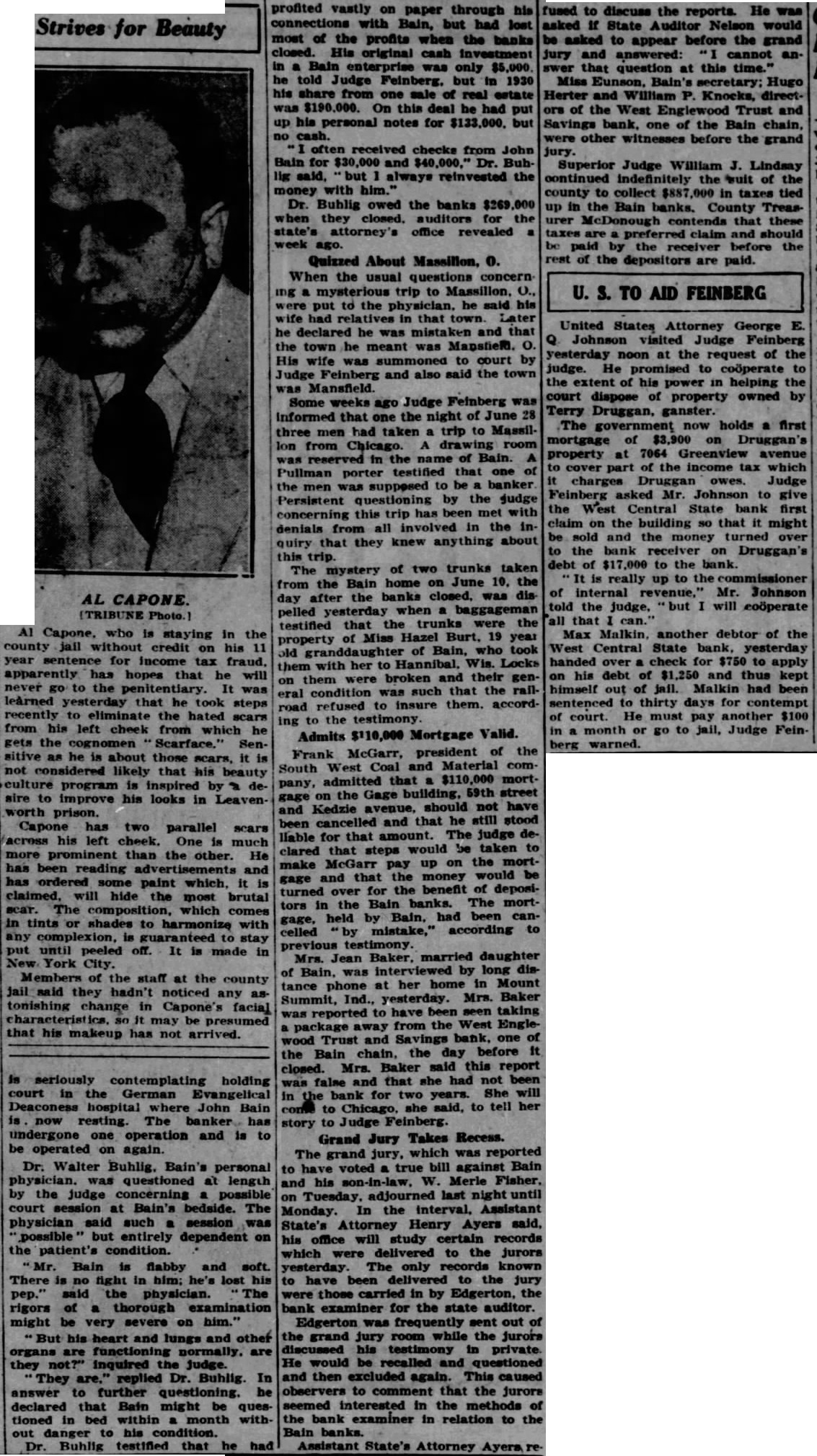
Strives for Beauty A1 Capone, who is staying in the county jall without credit on his 11 year for Income tax fraud. apparently has hopes that he will never to the penitentiary. It was learned that he took steps recently to the hated scars from his left cheek from which he gets the cognomen Scarface. Sensitive as he is about those scars, it is not considered likely that his beauty program inspired by desire to improve his looks in Leavenworth prison. Capone has two parallel scars across his left cheek. One is much more prominent than the other. He has been reading advertisements and has ordered some paint which, it is claimed, will hide the most brutal scar. The composition, which comes in tints or shades to harmonize with any complexion, is guaranteed to stay put until off. It is made in New York City. Members of the staff at the county jail said they hadn't noticed any as tonishing change in Capone's facial so It may be that his makeup has not arrived. in seriously contemplating holding was false and that she had not been court in the German Evangelical in the bank for two years She will Deaconess hospital where John Bain come to Chicago, she said, to tell her is now resting. The banker has story to Judge Feinberg. undergone one operation and is to Grand Jury Takes Recess. be operated on again. The grand jury, which was reported Dr. Walter Buhlig. Bain's personal to have voted true bill against Bain questioned at length and his W. Merle Fisher by the judge concerning a possible on Tuesday. adjourned last night until court at Bain's bedside. The Monday. In the interval. Assistant physician said such session was State's Attorney Henry Ayers said, but entirely dependent on his office will study certain records the patient's which were delivered to the jurors Mr. Bain flabby and soft. yesterday The only records known There is no fight in him: he's lost his to have been delivered to the jury pep.' said the physician. The were those carried in by Edgerton, the rigors of thorough examination bank examiner for the state auditor might be very on Edgerton was frequently sent out of his heart and lungs and other the grand jury room while the jurors organs are functioning normally. are discussed his testimony in private they the judge. He would be recalled and questioned They replied Dr. In and then excluded again. This caused answer to further questioning. observers to comment that the jurors declared that Bain might be ques- seemed interested in the methods of tioned in bed within month with. the bank examiner in relation to the out danger to his condition. Bain banks. Dr. testified that he had Assistant State's Attorney re profited vastly on paper through his connections with Bain, but had lost most of the profits when the banks closed. His original cash investment in a Bain enterprise was only $5,000 he told Judge Feinberg. but in 1930 his share from one sale of real estate was $190,000. On this deal be had put up his personal notes for $133,000. but no cash. often received checks from John Bain for $30,000 and $40,000," Dr. Buhlig said, but always reinvested the money with him." Dr. Bublig owed the banks $269,000 when they closed. auditors for the state's attorney office revealed week ago. Quizzed About Massillon. O. When the usual questions concern mg a mysterious trip to Massillon, O., were put to the physician. he said his had relatives in that town. Later he declared he was mistaken and that the town he meant was Masstield. O. His wife was summoned to court by Judge Feinberg and also said the town Some weeks ago Judge Feinberg was informed that one the night of June 28 three men had taken a trip to lon from Chicago. drawing room was reserved in the name of Bain. Pullman porter testified that one of the men was supposed to be banker Persistent questioning by the judge concerning this trip has been met with denials from all involved in the quiry that they knew anything about this trip The mystery of two trunks taken from the Bain home on June 10. the day after the banks closed. was dis pelled yesterday when baggageman testified that the trunks were the of Miss Hazel Burt. 19 year property old granddaughter of Bain. who took them with her to Hannibal. Wis. Locks on them were broken and their general condition was such that the railroad refused to insure them. accord. ing to the testimony Admits $110,000 Mortgage Valid. Frank McGarr, president of the South West Coal and Material company, admitted that a $110,000 mortgage on the Gage building. 59th street and Kedzie avenue, should not have been cancelled and that he still stood liable for that amount. The judge declared that steps would be taken to make McGarr pay up on the mortgage and that the money would be turned over for the benefit of depositors in the Bain banks. The mortgage, held by Bain. had been cancelled mistake," according to previous Mrs. Jean Baker, married daughter of Bain. was interviewed by long distance phone at her home in Mount Summit, Ind., yesterday. Mrs. Baker was reported to have been seen taking a package away from the West Englewood Trust and Savings bank. one of Bain the day before the closed. Mrs. Baker said this report fused to discuss the reports. He was asked If State Auditor Nelson would be asked to appear before the grand jury and answered: "I cannot answer that question at this time. Miss Eunson. Bain's secretary; Hugo Herter and William P. Knocks, directors of the West Englewood Trust and Savings bank, one of the Bain chain, were other witnesses before the grand jury. Superior Judge William J. Lindsay continued indefinitely the wuit of the county to collect in taxes tied up in the Bain banks. County Treasurer McDonough contends that these taxes are preferred claim and should be paid by the receiver before the rest of the depositors are paid. U. S. TO AID FEINBERG United States Attorney George E. Q Johnson visited Judge Feinberg yesterday noon at the request of the judge. He to coöperate to the extent of his power in helping the court dispose of property owned by Terry Druggan, ganster. The government now holds a first mortgage of $3,900 on Druggan's property at 7064 Greenview avenue to cover part of the income tax which it charges Druggan owes. Judge Feinberg asked Mr. Johnson to give the West Central State bank first claim on the building so that might be sold and the money turned over to the bank receiver on Druggan's debt of $17,000 to the bank It is really up to the commissioner of internal revenue,' Mr. Johnson told the will all that can. Max another debtor of the West Central State yesterday handed over check for $750 to apply on his debt of $1,250 and thus kept himself out of jail. Malkin had been sentenced to thirty days for contempt of court He must pay another $100 in a month or go to jail, Judge Feinberg warned.

Article from Chicago Tribune, February 15, 1933

Click image to open full size in new tab

Article Text

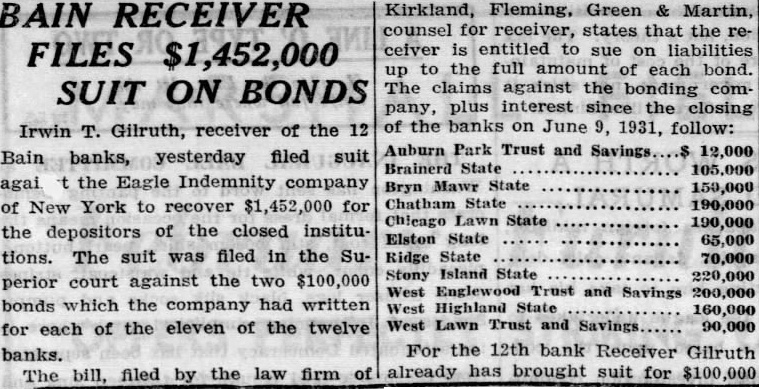
BAIN RECEIVER FILES $1,452,000 SUIT ON BONDS Irwin T. Gilruth, receiver of the 12 Bain banks, yesterday filed suit agai the Eagle Indemnity company of New York to recover $1,452,000 for the depositors of the closed institutions. The suit was filed in the Superior court against the two $100,000 bonds which the company had written for each of the eleven of the twelve banks. The bill, filed by the law firm of Kirkland, Fleming, Green & Martin, counsel for receiver, states that the receiver is entitled to sue on liabilities up to the full of each bond. The claims against the bonding company, plus interest closing of the banks on June 9, 1931, follow: Auburn Park Trust and Savings. 12,000 Brainerd State 105,000 Bryn Mawr State 150,000 Chatbam State 190,000 Chicago Lawn State 190,000 Elston State 65,000 Ridge State 70,000 Stony Island State 220,000 West Englewood Trust and Savings 200,000 West Highland State 160,000 West Lawn Trust and 90,000 For the 12th bank Receiver Gilruth already has brought suit for $100,000