Article Text
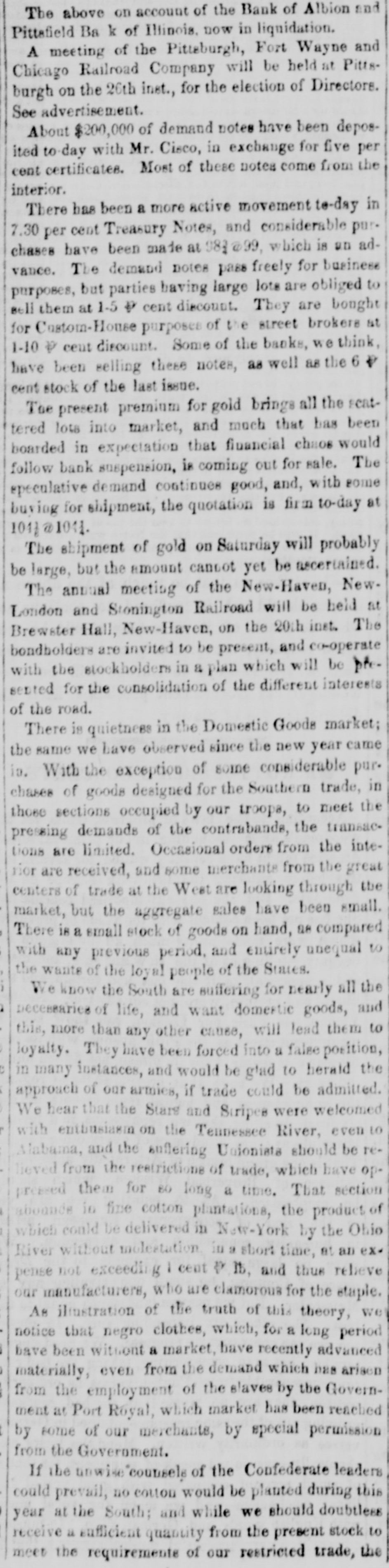
The above on account of the Bank of Albion and Pittsfield Ba k of Illinois, now in liquidation. A meeting of the Pittsburgh, Fort Wayne and Chicago Railroad Company will be held at Pitts- burgh on the 20th inst., for the election of Directors. See advertisement. About $200,000 of demand notes have been depos- ited to-day with Mr. Cisco, in exchange for five per cent certificates. Most of these notes come from the interior. There has been a more active movement to-day in 7.30 per cent Treasury Notes, and considerable pur- chases have been made at 98½@99, which is an ad- vance. The demand notes pass freely for business purposes, but parties having large lots are obliged to sell them at 1-5 ¢ cent discount. They are bought for Custom-House purposes of the street brokers at 1-10 ¢ cent discount. Some of the banks, we think, have been selling these notes, as well as the 6 ¢ cent stock of the last issue. The present premium for gold brings all the scat- tered lots into market, and much that has been boarded in expectation that financial chaos would follow bank suspension, is coming out for sale. The speculative demand continues good, and, with some buying for shipment, the quotation is firm to-day at 104¼ @104½. The shipment of gold on Saturday will probably be large, but the amount cannot yet be ascertained. The annual meeting of the New-Haven, New- London and Stonington Railroad will be held at Brewster Hall, New-Haven, on the 20th inst. The bondholders are invited to be present, and co-operate with the stockholders in a plan which will be pre- sented for the consolidation of the different interests of the road. There is quietness in the Domestic Goods market; the same we have observed since the new year came in. With the exception of some considerable pur- chases of goods designed for the Southern trade, in those sections occupied by our troops, to meet the pressing demands of the contrabands, the transac- tions are limited. Occasional orders from the inte- rior are received, and some merchants from the great centers of trade at the West are looking through the market, but the aggregate sales have been small. There is a small stock of goods on hand, as compared with any previous period, and entirely unequal to the wants of the loyal people of the States. We know the South are suffering for nearly all the necessaries of life, and want domestic goods, and this, more than any other cause, will lead them to loyalty. They have been forced into a false position, in many instances, and would be glad to herald the approach of our armies, if trade could be admitted. We hear that the Stars and Stripes were welcomed with enthusiasm on the Tennessee River, even to Alabama, and the suffering Unionists should be re- lieved from the restrictions of trade, which have op- pressed them for so long a time. That section abounds in fine cotton plantations, the product of which could be delivered in New-York by the Ohio River without molestation, in a short time, at an ex- pense not exceeding 1 cent ℔, and thus relieve our manufacturers, who are clamorous for the staple. As illustration of the truth of this theory, we notice that negro clothes, which, for a long period have been without a market, have recently advanced materially, even from the demand which has arisen from the employment of the slaves by the Govern- ment at Port Royal, which market has been reached by some of our merchants, by special permission from the Government. If the unwise counsels of the Confederate leaders could prevail, no cotton would be planted during this year at the South; and while we should doubtless receive a sufficient quantity from the present stock to meet the requirements of our restricted trade, the