Fort Dearborn National Bank (Chicago, IL)

Episode Information

Episode UID
369801294
Episode Type
Suspension โ†’ Reopening
Bank Type
national
Bank ID
36980 national
Charter Number
3698
Start Date
October 28, 1907
Location
Chicago, Illinois (41.850, -87.650)

Metadata

Model
gpt-5-mini (chosen from majority vote of a three-model LLM ensemble)
Short Digest
1306df610d47681c

Response Measures

None

Events (3)

1. May 5, 1887 Chartered
Source
historical_nic
2. October 28, 1907 Suspension
Cause
Macro News
Cause Details
Clearinghouse/city banks ceased cash payments and paid by checks in response to the nationwide Panic of 1907 originating in eastern financial centers.
Newspaper Excerpt
The banks of this city are today largely upon a checking basis. They refuse to pay out large amounts of currency, and will not return to paying in cash until the financial condition in the east improves.
Source
newspapers
3. January 9, 1924 Voluntary Liquidation
Source
historical_nic

Newspaper Articles (11)

Article from The Topeka State Journal, October 28, 1907

Click image to open full size in new tab

Article Text

PAYING WITH CHECKS. Chicago Banks Are Hanging On to Their Cash. Chicago, Oct. - -The banks of this city are today largely upon a checking basis. They refuse to pay out large amounts of currency, and will not return to paying in cash until the finan-cial condition in the east improves. Depositors seeking today to withdraw money were given checks of the bank instead of cash. Commercial depositors are allowed to draw the full amount of their balances, but must accept the bank's checks instead of currency. The rule requiring savings bank depositors to give thirty days' notice before drawing out less than $100, and 60 days' notice before drawing out more than $100 was also put in force. The local banks declare they were compelled to adopt these rules because of the action taken by the banks in the east, which would soon have drained this city of its cash resources. Within an hour after the opening of the doors fully 400 people were lined up at the withdrawal windows of the Illinois Trust and Savings bank, which has the largest number of savings accounts in the city. Depositors were allowed, if they wished to take out sums under $100, but for all amounts over, the full legal notice was required. The majority of those in the banks during the early part of the day gave notice of their intention to draw money. There was no excitement. In the Hibernian Savings bank about 100 people had given notice of withdrawal by 11 o'clock and many more were waiting in line. At all other savings banks business appeared to be on a normal basis. Depositors having checking accounts did not appear to be worried in the least by the situation and business proceeded upon normal lines in all the banks.


Article from Deseret Evening News, October 28, 1907

Click image to open full size in new tab

Article Text

CHICAGO BANKS DOING A CHECKING BUSINESS Chicago, Oct. 28.-The banks of this city are today largely upon a checking basis. They refuse to pay out large amounts of currency, and will not return to paying in cash until the financial condition in the east improves. Depositors seeking today to withdraw money were given checks of the bank instead of cash. Commercial depositors are allowed to draw the full amount of their balances, but must accept the banks' checks instead of currency. The rule requiring savings banks depositors to give 30 days' notice before drawing out less than $100 and 60 days' notice before drawing out force. more than $100 was also put into The local banks in the city declare they were compelled to adopt these rules because of the action taken by the banks in the east, which would scon have drained this city of its capital resources. An hour after the opening of the foors fully 500 people were lined 1172 the withdrawals window of the Tinois Trust & Savings bank, which has the largest nume in the city. Howed. if they wished to take out sums under $100, but for all amounts over this, the full legal notice required. The majority of these in the banks during the early part of the day gave notice of their intention to draw money. There was no excitement. Shortly after noon a call was sent from the Hibernian Savings bank for a number of police. At the bank about 100 people were in line anxious to withdraw funds or give notice of withdrawal, and the officers were destred for keeping the line in order There was no excitement and the situation there was unchanged. Depositers having checking accounts 414 not appear to be worried in the least by the situation and bustITCMM proceeded upon normal lines in all the banks


Article from The Madison Daily Leader, October 29, 1907

Click image to open full size in new tab

Article Text

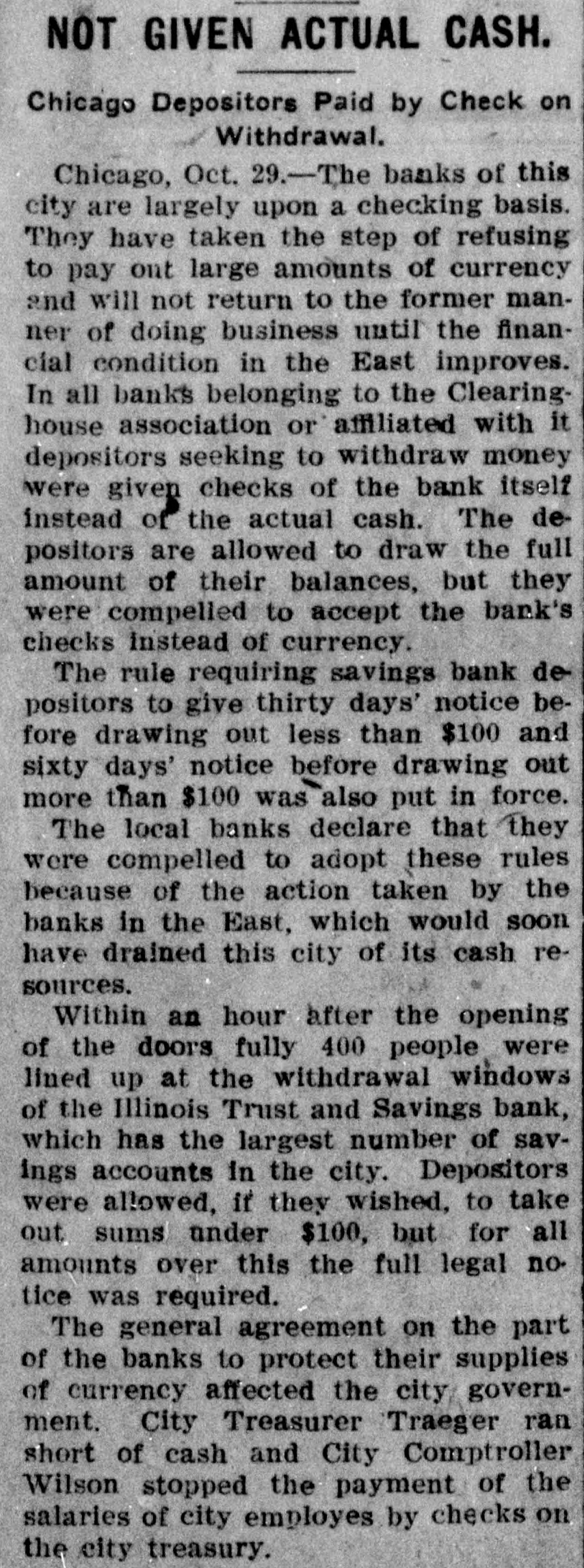
NOT GIVEN ACTUAL CASH. Chicago Depositors Paid by Check on Withdrawal. Chicago, Oct. 29.-The banks of this city are largely upon a checking basis. They have taken the step of refusing to pay out large amounts of currency and will not return to the former manner of doing business until the financial condition in the East improves. In all banks belonging to the Clearinghouse association or affiliated with it depositors seeking to withdraw money were given checks of the bank itself instead of the actual cash. The depositors are allowed to draw the full amount of their balances, but they were compelled to accept the bank's checks instead of currency. The rule requiring savings bank depositors to give thirty days' notice before drawing out less than $100 and sixty days' notice before drawing out more than $100 was also put in force. The local banks declare that they were compelled to adopt these rules because of the action taken by the banks in the East, which would soon have drained this city of its cash resources. Within an hour after the opening of the doors fully 400 people were lined up at the withdrawal windows of the Illinois Trust and Savings bank, which has the largest number of savings accounts in the city. Depositors were allowed, if they wished, to take out sums under $100, but for all amounts over this the full legal notice was required. The general agreement on the part of the banks to protect their supplies of currency affected the city government. City Treasurer Traeger ran short of cash and City Comptroller Wilson stopped the payment of the salaries of city employes by checks on the city treasury.


Article from The Washington Herald, October 30, 1907

Click image to open full size in new tab

Article Text

WEST REPORTS ARE ALL RIGHT Financial Situation There Is Declared to Be Satisfactory. Check and Certificate Plan Said to Be Working Well in All Sections, Chicago, Oct. 29.-There is better conditions among Chicago banks, there being fewer people at the tellers' windows. giving notice of withdrawals of funds. Depositors seem to be firmly assured of the strength of the local banks. At four of the largest savings banks, which have an aggregate of 250,000 depositors, it was reported that the number of sixtyday notices for withdrawals filed on Monday did not exceed 500. Depositors who give notice of withdrawals now lose interest at the rate of 3 per cent from July 1. Bankers generally feel that Chicago and other points will be in position to return to a currency basis again within thirty days. The continued movement of produce for export is growing to proportions that will warrant large importations of gold for some time to come. The movement of currency from Chicago to the interior has been nearly as large in October thus far as it was last year, when local banks made their high record shipments of more than $30,000,000. The decision made by Chicago clearinghouse banks on Monday not to send any more currency to the country until the present crisis is past has developed that country banks have drawn heavily upon Chicago for currency, in anticipation of such a step being taken. Rural institutions are believed, therefore, to be very strongly intrenched, and since banks in the clearing-house association at all money centers have thrown a safeguard around their money supplies, the country banks have been constrained to adopt similar measures, but their position in these matters is entirely individual and local in effect. If country banks can hold their communities to the custom of paying and receiving in checks, such as is now in vogue in all the cities, trouble probably will be averted. The position of country banks in this respect can well be realized when it is taken into consideration that these interior institutions have carried larger surpluses of money than ever before in history, due to the abnormal prosperity in agricultural districts in the West. But, at the same time, the banks have been eager to make money, and funds available in excess of the 15 per cent reserve requirements have been allowed to remain in the hands of reserve agents of the money centers for investment in commercial paper at the high rates of interest which have prevailed throughout the summer and fall.


Article from The Citizen-Republican, October 31, 1907

Click image to open full size in new tab

Article Text

# CHICAGO BANKS ON # A CHECKING BASIS Chicago, Oct. 30. -The banks of this city are today largely upon a checking basis. They refuse to pay out large amounts of currency, and will not return to paying cash until the financial condition in the east improves. Depositors seeking today to withdraw their money were given checks on the bank instead. Commercial depositors were allowed to draw the full amount of their balances, but they must accept bank checks instead of currency. The rule requiring savings bank depositors to give thirty days' notice before drawing out less than $100, and sixty days' notice before drawing out more than $100 was also put in force.


Article from The Worthington Advance, November 1, 1907

Click image to open full size in new tab

Article Text

# NOT GIVEN ACTUAL CASH. Chicago Depositors Paid by Check on Withdrawal. Chicago, Oct. 28. -The banks of this city are largely upon a checking basis. They have taken the step of refusing to pay out large amounts of currency and will not return to the former manner of doing business until the financial condition in the East improves. In all banks belonging to the Clearing-house association or affiliated with it depositors seeking to withdraw money were given checks of the bank itself instead of the actual cash. The depositors are allowed to draw the full amount of their balances, but they were compelled to accept the bank's checks instead of currency. The rule requiring savings bank depositors to give thirty days' notice before drawing out less than $100 and sixty days' notice before drawing out more than $100 was also put in force.


Article from Lewiston Evening Teller, November 22, 1907

Click image to open full size in new tab

Article Text

Chicago banks are ready to resume cash business and will do so whenever New York banks consent and co-operate. The magnates who have been asking the people to have confidence can now reciprocate and loosen up the wheels of trade bot' east and west. It was the east that locked the doors on western reserves and started the flurry among western institutions. but in spite of that the west has had no run on its. banks and has only used due precaution In guarding its cash waiting for the east to get over its scare and resume normal business relations. New York can very properly be instructed that the only proper way to resume is to resume.


Article from The Maui News, November 23, 1907

Click image to open full size in new tab

Article Text

Head Officials of a Bank to be Prosecuted for Larceny.----Mrs. Hartje Wins.----A Family is Cremated. A TAHITIAN PRINCE IS JAILED. Runs Expense Account He Cannot Pay and is Arrested for Dodging Autorrobile Bills.-Japanese Make Charges Against Swansey. (SPECIAL TO THE MAUI NEWS.) Sugar 96 deg. test 3.80 Beets 9s. 3d. HONOLULU, November 22.-Alexander Garvie is dead as a result of an operation for kidney trouble. Wallach demands changes in the proposed agreement with the Board of Health whereby he is to treat lepers. As a result of this the row may be reopened. The Japanese accuse Swansey of announcing the Vancouver riots. They say it is a scheme of the Hawaiian planters to hold the Japs here in the islands. SAN FRANCISCO, November 22.-Prince Salmon is in jail here. MELBOURNE, November 22.- In the automobile long distance race here one machine made 774 miles in twenty four hours. ,NEW YORK, November 22.-The President, the Cashier, and one of the directors of the Brooklyn Bank have been arrested as a result of an indictment charging them with larceny. MUSKOGEE, November 22.-The next Trans-Mississippi Congress will be held in San Francisco. PHILADELPHIA, November 22.-Mrs. Hartje has won the final decision in the divorce case. HAMBURG, November 22.--Moeller, the manufacturer of shellac and candles has failed for two million dollars. MARIETTA, November 22.-Edgar Grubb, his wife and two children were cremated here today by the burning of their house. NEWTON, Mass. November 22.-Mrs. Hodges killed herself and two sons by asphyxiation. HONOLULU, November 21.-Rev. Doremus Seudder was yesterday installed as Pastor of Central Union Church. Work has begun on the leprosarium. Attorney General Hemenway has decided that the Government can cut wood from the Forest Reserves and sell the same. Acting-Governor Mott-Smith has refused Consul General Miki Saito a transcript in the Lovell trial. HONOLULU, November -Consul General Saito has requested an abstract of the evidence in the Kauai murder case. Harmon, President of the Mormon Church at Laie, is to be arrested for subordination of perjury. The constitutionality of the liquor law has again been attacked. The Kihei deal may be delayed but it will be completed. COLUMBUS, O., November 21.-A league of Republican Clubs has endorsed Foraker for President. WASHINGTON, November 21.-Miss Shonts will marry the Duke of Chaulneas. CALCUTTA,November 21.-Striking engineers havestopped transportation and 6000 passengers are held up in traffic. WASHINGTON, November 20.-Mrs. Bradley swore that she did not know she fired the shot that killed Senator Brown. Hereafter gradunting exercises at West Point will be held in February. TOKIO, November 20.-Japan will limit Japanese immigration. SACRAMENTO, November 20.-The Senate has approved four amendments to the San Francisco Charter. MUSKOGEE, November 20.-Governor Frear has introduced a resolution recommending the deepening of Pearl Harbor and inviting the Atlantic fleet to visit Hawaii. HILO, November 19.-C. C. Kennedy was married yesterday evening to Mrs. Laura Marsh at San Jose California. They will arrive on the Enterprise. HONOLULU, November 20.--The Supereme Court issued a writ of habeas corpus yesterday in the case of Attorney Vivas sentenced to five days imprisonment by the District of Court Wailuku for contempt of court. The County Supervisors held a peaceful meeting last night. The Steamer Admiral Boreson, from Seattle to China with lumber put into Honolulu yesterday dismasted and with her deck load of lumber washed away as a result of a tidal wave. MONTGOMERY, November 20.--Alabama voted yesterday to become a dry state. LONDON, November 20.--The profits of the round trip of the Lusitania were $60,000. NEW YORK, November 20.-Mrs. Leslie Carter, the actress, is bankrupt. CHICAGO, November 20.-The banks here are ready to resume business on a cash basis. They will redeem all clearing house certificates.
Article from The Birmingham Age-Herald, November 26, 1907

Click image to open full size in new tab

Article Text

Resumption Past and Present Although the gold engagements now aggregate $85,000,000 the cash reserve in the clearing-house banks of New York was increased last week to the extent of only $436,650. It now stands at 19.9 per cent of the total deposits. It is short $54,103,600 of the 25 per cent required by law. And yet the state banks in Chicago hold the largest cash reserve in their entire history. They have in cash $102,339,497, or 30.03 per cent of their deposits. The reserves in Chicago are being increased rapidly. If New York sends money to Chicago to move crops, it is plain Chicago is not sending plain everyday cash to the lesser cities in the wheat belt. The banks everywhere are reducing loans, and are accumulating specie, and the inquiry begins to arise as to when they will get back to a currency basis. Chicago is awaiting a cue from New York. Chicago is ready for a resumption of cash payments. In 1893 a panic was precipitated by the failure of the Erie railroad on July 26, and gold imports were resorted to just as they have been this year. On September 2 the banks returned to a cash basis-just 39 days. Already 32 days have elapsed in the course of the present financial troubles, and unless resumption come in the next six days the present tie-up will outlast that of 1893. "The root of the whole trouble," says the Philadelphia Inquirer, "is in New York and it is to be found in the thoroughly selfish and short-sighted policy of its banks. Although millions of Philadelphia money are on deposit there, they are refusing to accept Philadelphia checks except for collection, and are playing the part of the dog in the manger. Were some big New York bank to announce its readiness to pay all comers in cash the deadlock would be broken, the financial machine would get off the 'dead center' and business would again begin to hum. As Horace Greeley once remarked, the way to resume is to resume." The suspension of cash payments lasted eight weeks in 1857, and a little less than six weeks in 1873, and in 1893 full resumption came in New York in a little over five weeks. Confidence in the soundness of the banks and in the general trade of the country has returned, and there seems to be no reason why the country cannot safely come back to a cash basis, even if New York in its desire to help crop-movers has not been able to accumulate the legal requirement in cash reserves.


Article from Omaha Daily Bee, November 28, 1907

Click image to open full size in new tab

Article Text

It Will Cost Millions and Much Time to Regain It. BANKERS BLAME IT FOR PANIC Westerners Believe New York Sought to Protect Itself Only. FORGAN BACK FROM WASHINGTON Three Hundred Bankers in Mid-West Write that They Are Ready to Do Business on Cash Basis. Nov. 27.-Former Secretary Leslie M. Shaw, of NEW the Treasury YORK, president returned Carnegie Trust company, York yesterday from conferred with many of to where the New he Chicago, bankers In disregarding the financial gituation. cussing conditions, he said: west has lost confidence in the will cost us here of we regain the east. dollars "The It before prestige millions The men and relationship of the past. west say that refor the financial of cordial sponsible the New stringency; York is that came the to clearing York when the resorted squeeze banks house of of certifi- New the cates first and forced the rest country to do the same. The bankers of western cities have no love now for the bankers of New York. They had placed their money on deposit here, but when they asked for it they were refused. They say New York sought to protect only itself and tied up everything so that all the rest of the country was forced to adopt urgent measures to save itself. Lazard Freres announced the engagement of $1,000,000 in gold today. This brings the total during the present movement to $88,400,000. Forgan Back from Washington. CHICAGO, Nov. 27.-James B. Forgan, president of the First National bank, returned yesterday from Washington. where he had a conference with President Roosevelt regarding the financial situation. "I was a busy man during the three and a half hours I spent in Washington," said Mr. Forgan. "The president asked many questions concerning the financial situation in Chicago and other western cities and I gave him my views. I told him matters were improving every day and I was hopeful that normal currency payments would be resumed before long. He seemed glad to receive this information." Nearly 700 letters were received yesterday from western bankers by the Chicago Clearing house committee in response to the letter sent out asking their views on the resumption of normal currency payments. Most of the letters indicated that the bankers were ready and desirous of resuming currency payments. The letters are from bankers in Illinois, Iowa, Michigan, Kansas, Nebraska, Minnesota, Wisconsin and Missouri. Bankers in the far west have not had time to reply. Washington Situation Better. WASHINGTON Nov. 27. .-The situation at the treasury was so far relaxed this afternoon that Secretary Cortelyou was able to leave early to attend the wedding of Miss Rott and Lieutenant Grant. There is no longer any doubt felt among treasury officials of the success of both the loans-the Panama canal bonds and the one-year treasury certificates. If considerably lless than $1,000,000,000 is alloted in the certificates it will not be because the subscriptions are not more than sufficient to cover the amount. It will be because so large an issue 18 no longer felt to be necessary to restore the situation. Calculations are already being made as to the probable conditions in the money market next spring and the ability to call in part of the certificates. If the amount issued should be only $50.000.000 and half of these should be paid off in six months, the interest charges would fall materialy below the $3,000,000 originally calculated upon the full issue for one year. The sum of $25,000,000 for six months would draw interest to the amount of $375,000 and an additional amount of $25,000,000 for one year would draw $750,000. making a total of $1,125.I 000. This would be at the rate of less than 1 1/2 cents per capita for the people h of the country, and it is argued that this would be a cheap means of escape from difficulty even for the humbleat citizen, 1 whose labor might be affected by the con) tinuance of the crisis. Des Moines is Ready. 1 DES MOINES, Nov. 27.-A circular to I the banks of Iowa has been sent out by ) the Des Moines clearing house committee urging them to aid in an effort to get currency in circulation so that Des Moines banks will be ready to follow the lead of Chicago and New York and resume currency payments in full in two weeks. ASSIST THE FARMERS


Article from Imperial Valley Press, January 11, 1908

Click image to open full size in new tab

Article Text

NEWS IN BRIEF Happenings of the Week Boiled Down For Busy Readers New York landlords cause great suffering to poor people on East Side by wholesale evictions. U.S. Senator Owen, of Oklahoma, accused of acquiring illegally 4,000 acres of land from Indians. Chicago banks have returned to cash basis and financial situation is just what it was before the pinch. President Roosevelt denounces the patronage system and urges enforcement of civil service rules in Census Bureau. Chicago Great Western railroad has been placed in lhe hands of receivers. Overcapitalization caused the trouble. H.O. Havemeyer's will leaves estate of $25,000,000 to widow and three children. No bequests to public institutions. Many gun fights, assaults and on in of tumults Brooklyn and New other Year's camps day the wild and woolly east. This is really important. Los Angeles court decides that a woman need not pay for a tailormade suit that doesn't fit. George Pettibone, accused of complicity in murder of Ex-Gov. Steunenberg, of Idaho, acquitted. Case against Moyer dismissed. District Court of Austin, Texas, appoints receiver to take charge of all property in the state belonging to Standard Oil. Proceedings to dissolve combination between Union Pacific and Southern Pacific to be begun soon by Attorney-General Bonaparte. London Times passes from control of Walter family and into hands of C. A. Pearson, publisher of several newspapers and magazines. Jury in Caleb Powers case disagrees, ten for acquittal and two of for conviction. Fifth trial Powers for the murder of Goebel set for July 6. John D. Rockefeller gives $2, 000,000 to Chicago University as New Year present, making total contribution more than $23, ,000,000. But he hasn't paid that fine yet. United States Supreme Court, by five to four, decides that the employers' liability act, applicable to common carriers engaged in interstate commerce, is unconstitutional. F. Augustus Heinze, the copper operator, indicted and arrested in New York for aiding his brother in looting the Mercantile National Bank to the tune of $400,000. Fowler banking bill proposes to retire all outstanding national bank bond secured notes, and thorizes in lieu thereof a currency based on the general assets of the bank. Hudson Maxim announces invention of torpedo boat to travel