Multiple articles state the bank closed voluntarily and subsequently a federal receiver was appointed.
Events (4)
1.December 4, 1885Chartered
Source
historical_nic
+12 years
2.July 31, 1897Suspension
Cause
Voluntary Liquidation
Cause Details
Bank posted notice it would go into voluntary liquidation due to inability to collect and stringency of the times; did not open July 31 and no run occurred.
Newspaper Excerpt
A notice was posted stating that owing to the inability to collect and the stringency of the times, the bank will go into voluntary liquidation.
Source
newspapers
+23 days
3.August 23, 1897Receivership
Newspaper Excerpt
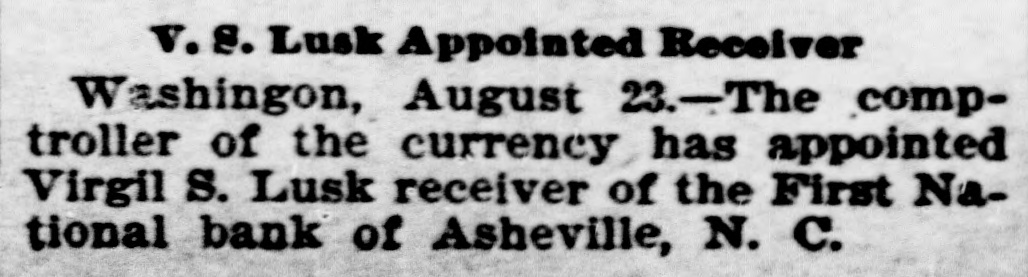
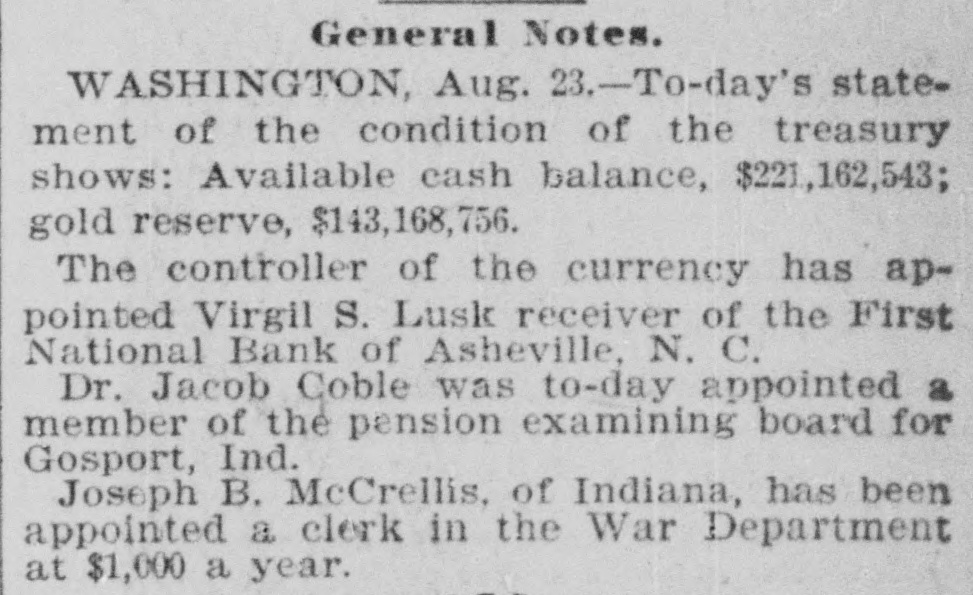
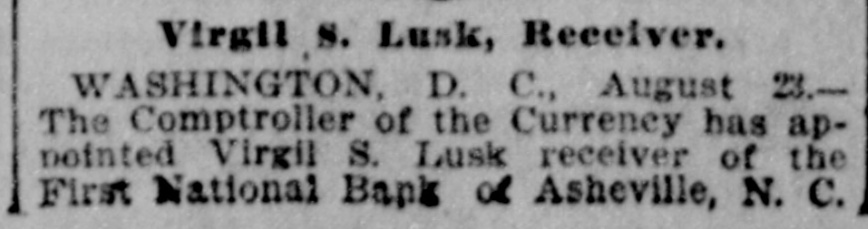
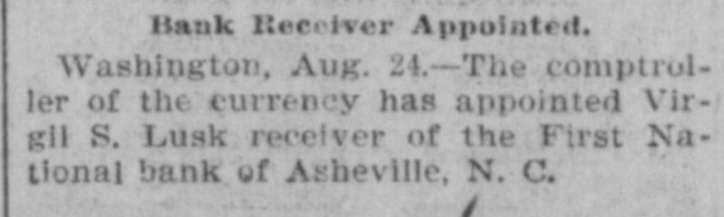
The comptroller of the currency has appointed Virgil S. Lusk receiver of the First National Bank of Asheville, N. C.
Source
newspapers
same day
4.August 23, 1897Receivership
Source
historical_nic
Newspaper Articles (24)
1.July 31, 1897Santa Fe Daily New MexicanSanta Fe., Santa Fe, NM
Click image to open full size in new tab
Article Text
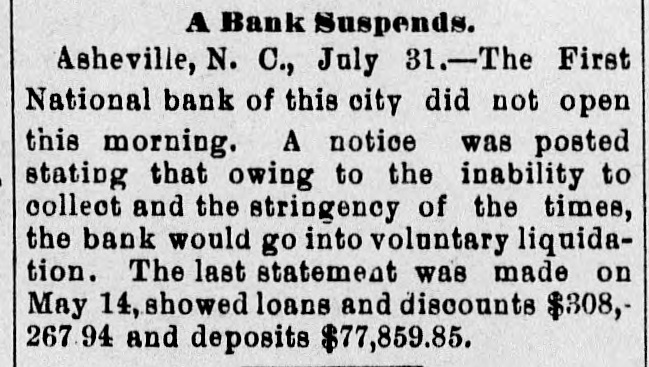
A Bank Suspends
Asheville, N. C., July 31.-The First National bank of this city did not open this morning. A notice was posted stating that owing to the inability to collect and the stringency of the times, the bank would go into voluntary liquidation. The last statement was made on May 14, showed loans and discounts $308,267.94 and deposits $77,859.85.
2.July 31, 1897The Jersey City NewsJersey City, NJ
Click image to open full size in new tab
Article Text
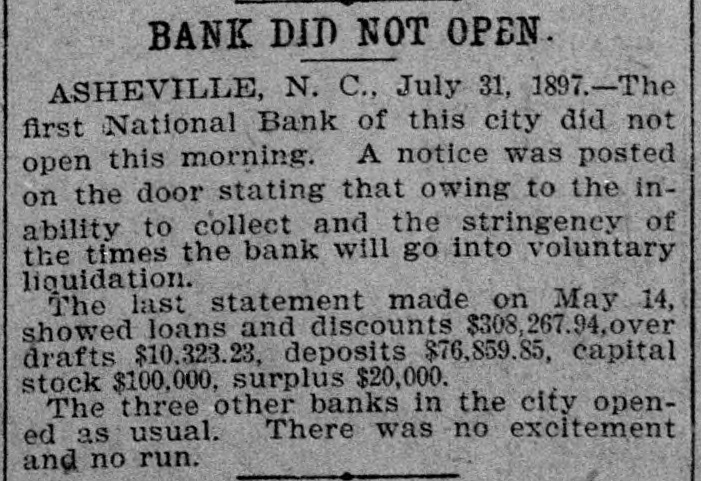
BANK DID NOT OPEN
ASHEVILLE, N. C., July 31, 1897.- - The first National Bank of this city did not open this morning. A notice was posted on the door stating that owing to the inability to collect and the stringency of the times the bank will go into voluntary liquidation. The last statement made on May 14, showed loans and discounts $308,267.94,over drafts $10,323.23, deposits $76,859.85, capital stock $100,000, surplus $20,000. The three other banks in the city opened as usual. There was no excitement and no run.
3.July 31, 1897Alexandria GazetteAlexandria, VA
Click image to open full size in new tab
Article Text
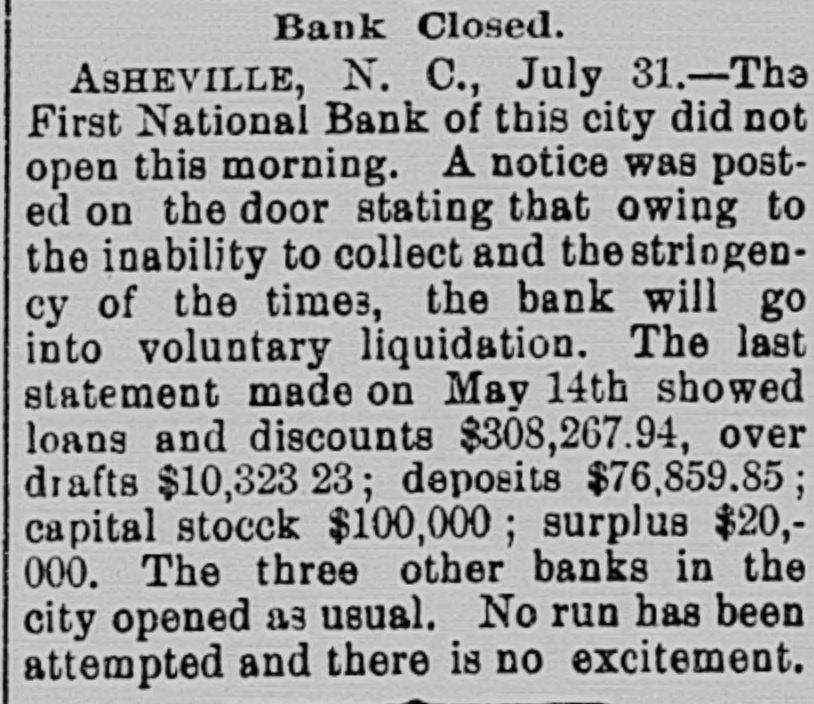
Bank Closed
ASHEVILLE, N. C., July 31.-The First National Bank of this city did not open this morning. A notice was posted on the door stating that owing to the inability to collect and thestringency of the times, the bank will go into voluntary liquidation. The last statement made on May 14th showed loans and discounts $308,267.94, over drafts $10,323.23; deposits $76,859.85; capital stocck $100,000; surplus $20,000. The three other banks in the city opened as usual. No run has been attempted and there is no excitement.
4.July 31, 1897San Antonio Daily LightSan Antonio, TX
Click image to open full size in new tab
Article Text
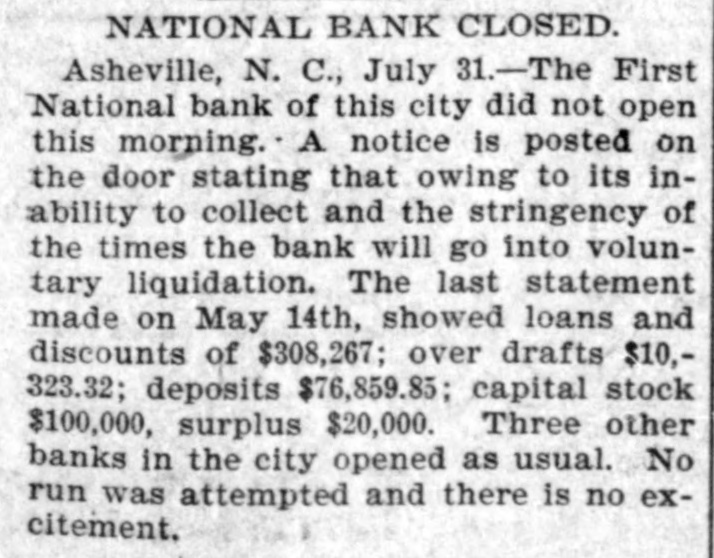
NATIONAL BANK CLOSED
Asheville, N. C., July 31.-The First National bank of this city did not open this morning. A notice is posted on the door stating that owing to its inability to collect and the stringency of the times the bank will go into voluntary liquidation. The last statement made on May 14th, showed loans and discounts of $308,267; over drafts $10,323.32; deposits $76,859.85; capital stock $100,000, surplus $20,000. Three other banks in the city opened as usual. No run was attempted and there is no excitement.
5.August 1, 1897The Brunswick TimesBrunswick, GA
Click image to open full size in new tab
Article Text
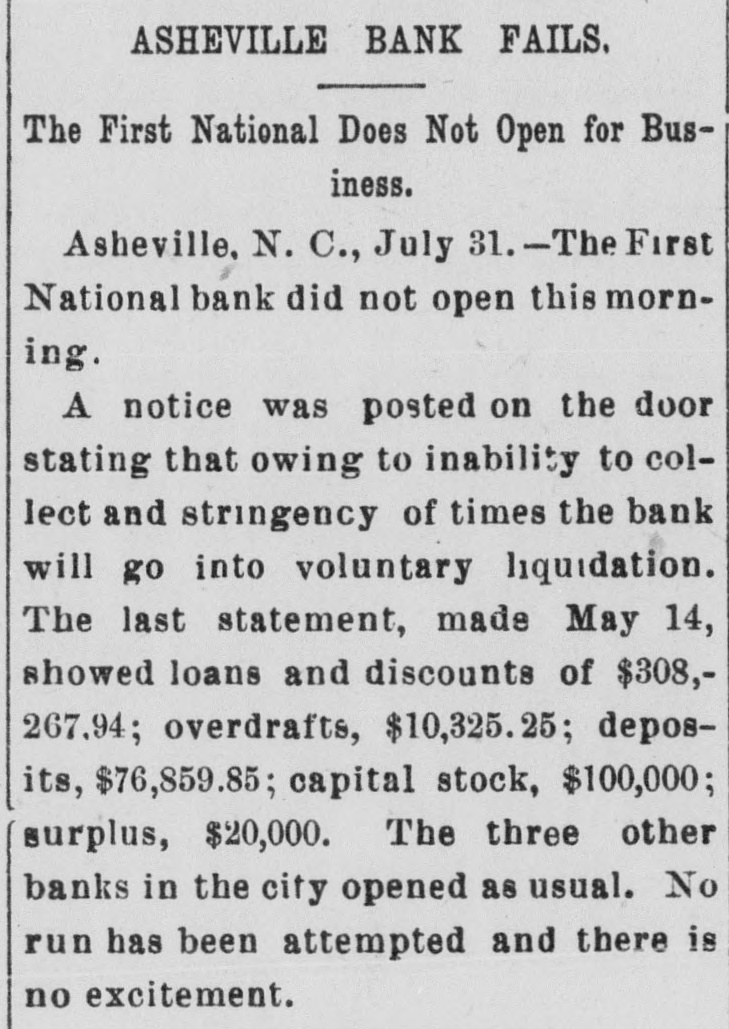
ASHEVILLE BANK FAILS
The First National Does Not Open for Business. Asheville, N. C., July 31.-The First National bank did not open this morning. A notice was posted on the door stating that owing to inability to collect and stringency of times the bank will go into voluntary liquidation. The last statement, made May 14, showed loans and discounts of $308,267.94; overdrafts, $10,325.25; deposits, $76,859.85; capital stock, $100,000; surplus, $20,000. The three other banks in the city opened as usual. No run has been attempted and there is no excitement.
6.August 1, 1897The Indianapolis JournalIndianapolis, IN
Click image to open full size in new tab
Article Text
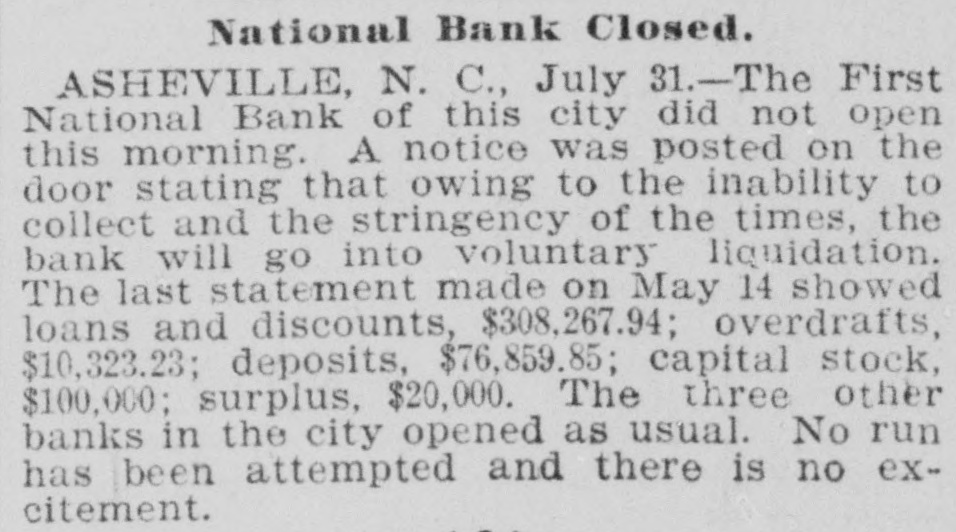
National Bank Closed
ASHEVILLE, N. C., July 31.-The First National Bank of this city did not open this morning. A notice was posted on the door stating that owing to the inability to collect and the stringency of the times, the bank will go into voluntary liquidation. The last statement made on May 14 showed loans and discounts, $308,267.94; overdrafts, $10,323.23; deposits, $76,859.85; capital stock, $100,000; surplus, $20,000. The three other banks in the city opened as usual. No run has been attempted and there is no excitement.
7.August 1, 1897The Morning NewsSavannah, GA
Click image to open full size in new tab
Article Text
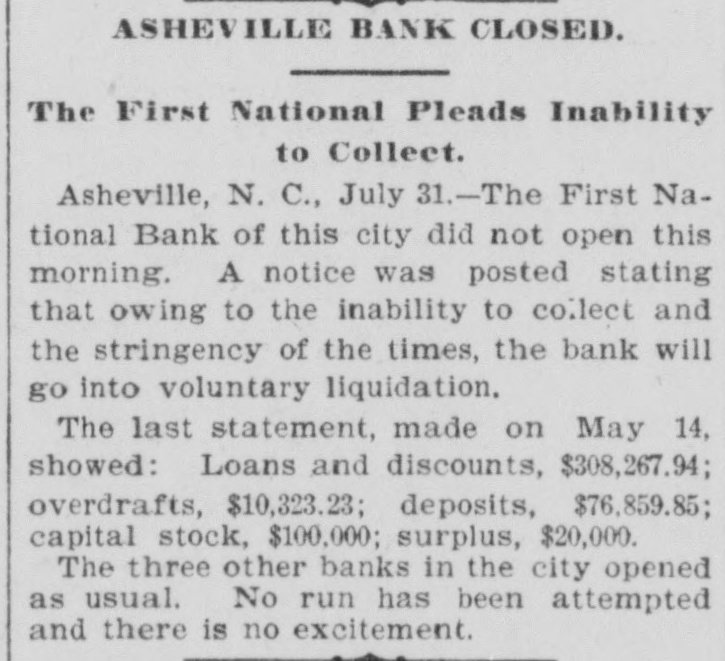
ASHEVILLE BANK CLOSED
The First National Pleads Inability to Collect. Asheville, N. C., July 31.-The First National Bank of this city did not open this morning. A notice was posted stating that owing to the inability to collect and the stringency of the times, the bank will go into voluntary liquidation. The last statement, made on May 14, showed: Loans and discounts, $308,267.94; overdrafts, $10,323.23; deposits, $76,859.85; capital stock, $100,000; surplus, $20,000. The three other banks in the city opened as usual. No run has been attempted and there is no excitement.
8.August 1, 1897The Saint Paul GlobeSaint Paul, MN
Click image to open full size in new tab
Article Text
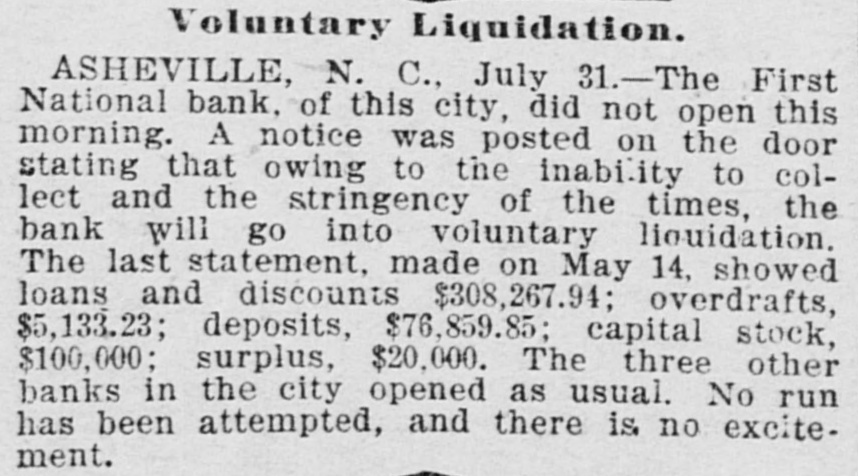
Voluntary Liquidation
ASHEVILLE, N. C., July 31.-The First National bank, of this city, did not open this morning. A notice was posted on the door stating that owing to the inability to collect and the stringency of the times, the bank will go into voluntary liouidation. The last statement, made on May 14, showed loans and discounts $308,267.94; overdrafts, $5,133.23; deposits, $76,859.85; capital stock, $100,000; surplus, $20,000. The three other banks in the city opened as usual. No run has been attempted, and there is no excitement.
9.August 4, 1897The Breckenridge NewsHardinsburg, Cloverport, KY
Click image to open full size in new tab
Article Text
Failures
The First National bank of Asheville. N. C., has gone into voluntary liquida sion. The George 8. MacDonald company, manufacturers of brooms and brushes F Huntington, W. Va., has assigned. Assets and liabilities unknown. The Golden Rod Silk company of Paterson, N.J., has given notice of its failure and a receiver has been appointed. Liabilities, $108,000; assets, about $75,000. S. F. Westeont, ex-county terasurer, grain dealer and miller, of Wilmington, 0,, has assigned to F.M. Moore, Jr. Mrs. S. F. Westcoat has also assigned. Assets and liabilities unknowa.
10.August 17, 1897The News & ObserverRaleigh, NC
Click image to open full size in new tab
Article Text
ASHEVILLE'S BANK RECEIVER
Asheville, N. C., Aug. 16.-George S. Powell, of this city, to-day received official notification of his appointment as receiver of the First National Bank of Asheville, which recently closed its doors.
11.August 17, 1897Richmond DispatchRichmond, VA
Click image to open full size in new tab
Article Text
Receiver of Asheville Bank
ASHEVILLE, N. C., August 16.George S. Powell, of this city, to-day received official notification of his appointment as receiver of the First National Bank of Asheville, which recently closed its doors.
12.August 23, 1897Evening StarWashington, DC
Click image to open full size in new tab
Article Text
Appointed Bank Receive & The cohtroller of the currency has appointed Virgil S. Lusk receiver of the First National Bank of Asheville, N. C.
V.S. Lusk Appointed Receiver Washingon, August 23.-The comptroller of the currency has appointed Virgil S. Lusk receiver of the First National bank of Asheville, N. C.
14.August 24, 1897The Indianapolis JournalIndianapolis, IN
Click image to open full size in new tab
Article Text
General Notes
WASHINGTON, Aug. 23.-To-day's statement of the condition of the treasury shows: Available cash balance, $221,162,543; gold reserve, $143,168,756. The controller of the currency has appointed Virgil S. Lusk receiver of the First National Bank of Asheville, N. C. Dr. Jacob Coble was to-day appointed a member of the pension examining board for Gosport, Ind. Joseph B. McCrellis, of Indiana, has been appointed a clerk in the War Department at $1,000 a year.
15.August 24, 1897Richmond DispatchRichmond, VA
Click image to open full size in new tab
Article Text
Virgil S
Lusk, Receiver. WASHINGTON, D. C., August 23.The Comptroller of the Currency has apnointed Virgil S. Lusk receiver of the First National Bank of Asheville, N. C.
16.August 24, 1897Evening JournalWilmington, DE
Click image to open full size in new tab
Article Text
Bank Receiver Appointed
Washington, Aug. 24.-The comptroller of the currency has appointed Virgil S. Lusk receiver of the First National bank of Asheville, N. C.
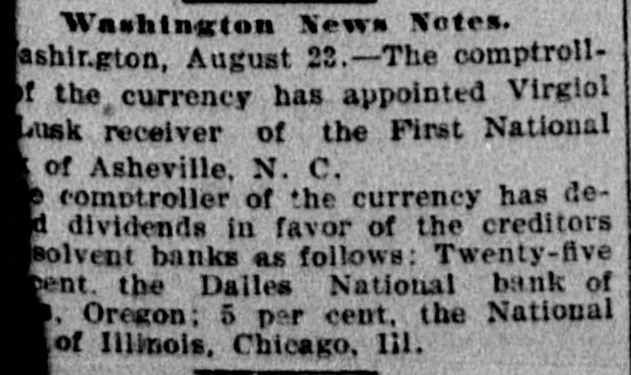
ashir.gton, August 23.-The comptrollf the currency has appointed Virgiol Lusk receiver of the First National $ of Asheville, N. C. e comptroller of the currency has ded dividends in favor of the creditors solvent banks as follows: Twenty-five ent. the Dalles National bank of 3, Oregon: 5 per cent, the National of Illinois, Chicago, IiI.
Washington, Aug. 23.-The comptroller of the currency has appointed Virgil S. Lusk receiver of the First National bank of Asheville, N. C.
19.October 8, 1897The TimesRichmond, VA
Click image to open full size in new tab
Article Text
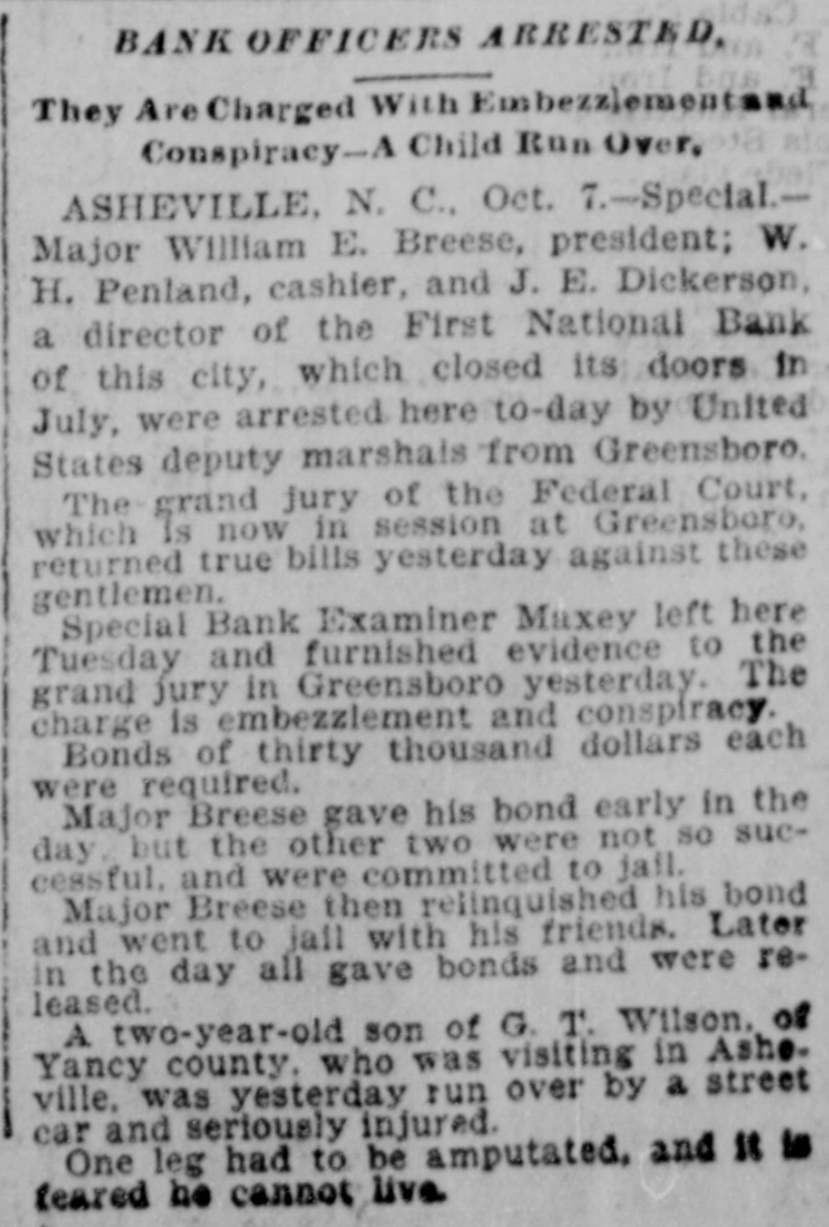
BANK OFFICERS ARRESTED
They Are Charged With Embezzlementand Conspiracy-A Child Run Over, ASHEVILLE, N. C., Oct. 7.-Special.Major William E. Breese, president; W. H. Penland, cashier, and J. E. Dickerson, a director of the First National Bank of this city, which closed its doors in July, were arrested here to-day by United States deputy marshals from Greensboro. The grand jury of the Federal Court, which is now in session at Greensboro, returned true bills yesterday against these gentlemen. Special Bank Examiner Maxey left here Tuesday and furnished evidence to the grand jury in Greensboro yesterday. The charge is embezzlement and conspiracy. Bonds of thirty thousand dollars each were required. Major Breese gave his bond early in the day but the other two were not so successful, and were committed to jail. Major Breese then relinquished his bond and went to jail with his friends. Later in the day all gave bonds and were released. A two-year-old son of G. T. Wilson. of Yancy county. who was visiting in Asheville. was yesterday run over by a street car and seriously injured. One leg had to be amputated, and n is feared he cannot live.
20.November 6, 1897The TimesRichmond, VA
Click image to open full size in new tab
Article Text
ASHEVILLE'S BROKEN BANK
The Trial of the Indicted Officers Postponee and Their Bail Reduced. ASHEVILLE, N. C., Nov. 5.-Special.The case against Breese, Penland and Dickinson. the officers of the suspended First National Bank came up in the Federal Court to-day. The case was continued till the May term and their bonds reduced to $15,000.
21.July 22, 1904The News & ObserverRaleigh, NC
Click image to open full size in new tab
Article Text
THEY KNEW IT ALL So Says Breese of Officers of National Banking System. (By the Associated Press.) Charlotte, N. C., July 21.-Wm. E. Breese remained on the witness stand ir the United States District court today, continuing the testimony in his own behalf in the case against him for wrecking the First National Bank of Asheville, of which he was president. When court adjourned his testimony was not finished. The line of his testimony, in addition to bringing out certain facts is to snow that the officers of the government having in charge the national banking system were at all times cogpizant of everything he did and that nothing whatever was concealed from the Comptroller of the Currency. The testimony embraced dozens of letters that had been passed between him and officers of the government, dating from August 30, 1893, four years before the failure of the bank. The letters related to the efforts he was making to save the bank from ruin and to arrange ararngements for liquidating the indebtedness of the institution for the purpose of converting it into a State bank. District Attorney Holton objected to the admission of many letters and several of them were ruled out. After the District Attorney had made repeated objections, this when he had asked that the witness read a certian letter, Maj. Breese created a little amusement by turning to Judge Kelier and saying: "The district attorney wants me to read all the letters that are favorable to him, but he objects to those that are in my favor." The court announced that it was the preogative of the district attorney to object when he saw fit and that the presiding judge would rule on all matters as the merits of the case in question might deserve. The witnes swas starting to tell of a run on the National Bank of Asheville when District Attorney Holton objected, unless the defense proposed to go into the affairs of the National Bank of Asheville. "If they propose to do that, I am willing. Some of the officers of that bank are now in the penitentiary." Counsel for the defense objected sericusly to this remark, Judge Moore saying it could not be excused on any ground.
Interesting Evidence Brought OutSensational Testimony-The Defendant on the Stand. Charlotte, N. C., July 20.-Today proceedings in the trial of William E. Breese for embezzlement were the most interesting since the trial began, over a week ago, the district attorney resting the case for the government and the defendant, who is accused of taking $114,000 of the funds of the First National bank of Asheville, of which he was president, going on the stand in his own behalf. The most interesting evidence brought out by the prosecution was in connection with the declaration that the First National bank of Asheville, had collected for other banks and failed to remit. Evidence was also brought out to show that officers of the bank had overdrawn their accounts for large sums after they had notified customers that they had agreed to cease "this form of accommodation." The sensation of the day occurred when evidence was introduced connecting the name of J. S. Adams, one of the attorneys for the defense, with the transactions of the bank just prior to its failure. It was shown that a note signed by him had been taken up and replaced by an insolvent note. The insolvent note was discontinued and the proceeds placed to the credit of Mr. Adams. The defense placed Mr. Adams on the stand and a satisfactory explanation was made of the entire transaction. The witness swore that his note which was in the bank was an accommodation note and that he derived no benefit from the proceeds. In order that his position might be understood fully, District Attorney Holton stated that he did not intend to convey the impression that Mr. Adams was connected with any wrong doing. In his testimony, Mr. Breese explained that the failure of the bank was due to the panic of 1892 and 1893, which caused a depreciation in all values in the Asheville section. The ill effects of the panic were visible in Asheville for years. There was a wholesale deprecation of values, ranging from 50 to 75 per cent. and the entire community was almost ruined. He claimed that his investments for the bank were made with the consent of the directors. The witnesses said in a large pocket book were all the notes he had made and the collateral security thereof and that this had disappeared since the second trial. District Attorney Holton said the pocket book would be produced. Breese's direct testimony was in progress when court adjourned until tomorrow. The cases against Penland and Dickerson, other officers of the defunct bank, who are accused of taking about $175,000 have been continued to October, owing to the fact that Judge Keller is called to West Virginia on business.
23.July 22, 1904The Times DispatchRichmond, VA
Click image to open full size in new tab
Article Text
BREESE ON STAND
Submits Correspondence to Show Official Knowledge of Course. (By Associated Press.) CHARLOTTE, N. C., July 21.-William E. Breese remained on the witness stand in the United States District Court today, continuing the testimony in his own behalf in the case against him for wrecking the First National Bank of Asheville, of which he was president. When court adjourned this testimony was not finished. The line of his testimony, in addition to bringing out certain facts. is to show that the officers of the government having In charge the national banking system were at all times cognizant of everything he did, and that nothing whatever was concealed from the Comptroller of the Currency. The testimony embraced dozens of letters that had passed between him and officers of the government, dating from August 30, 1893, practically four years before the failure of the bank. The letters related to the efforts he was making to save the bank, from ruin and to arrangements for liquidating the indebtedness of the Institution for the purpose of converting It into a. State bank. District Attorney Holton objected to the admission of many of the letters, and several of them were ruled out. After the district attorney had made repeated objections, and when he had asked that the witness read a certain letter. Major Breese created a little amusement by turning to Judge Keller and saying: "The district attorney wants me to read all the letters that are favorable to him. but he objects to everything that is in my favor.' The court announced that it was the prerogative of the district attorney to object when he saw fit. and that the presiding judge would rule on all matters as the merits of the case in question might deserve. The witness was starting to tell of a run on the National Bank of Asheville, when District Attorney Holton objected. unless the defense proposed to go into the affairs of the National Bank of Asheville. "If they propose to do that," he sald, "I am willing. Some of the officers of that bank are now in the penitentiary." Counsel for the defense objected seriously to this remark, Judge Moore saying it could not be excused on any ground.
Progress in the Breese Trial-The Do fendant Again Gives Evidence in His Own Behalf. Charlotte. N. C., July 23.-Today marked the close of the second week of the Breese embezzlement trial. one of the most interesting and important actions ever brought in the federal courts in this or any other state. A great mass of testimony has been Introduced, and the indications are that at least one more week will be required in bringing the case to a close. William E. Breese, the defendant, has been on the witness stand the greater part of the time since Wednesday at noon. and it is probabie that his direct testimony will not be finished before the adjournment of court Monday afternoon. The district attorney will have him under cross examination for a day and perhaps longer. The defendant was taken off the stand this morning to permit several witnesses who were anxious to return home to testify. Four witnesses tes. tifled to the character of Breese, and the government introduced a witness to testify concerning a note which the First National Bank at Asheville had discounted in Charleston shortly before the failure. Breese resumed his direct termmony. He took up the discount ledger. a book of which S. T. Dorsett testified at length and explained to the jury the method of keeping the book and why it was kept. Considerable time was consumed in the examination in reference to the letters Breese had written other banks concerning notes signed by insolvent persons. The witness said he considered the notes good by reason of the fact that they were endorsed by J. E. Dickerson & Co., the First National Bank of Asheville and ther firms and corporations. He had no intention to deceive when he wrote banks which had re-discounted the notes. Touching the failure of the First National Bank to remit checks for drafts that had been collected for other banks, Major Breese said they were signed and held for the simple reason that it was impossible to send them off. It had been necessary to withdraw the money from the banks upon which the checks were drawn, and as money was being withdrawn from the First National Bank faster than it was being deposited. it was impossible to re-place the funds. The witness was striving to carry the bank along. and still hoped to be able to avert the threatened panic. As it turned out. the depositors at home got the benefit of this action. and the creditor banks in the north lost. The witness averred that he received no personal benefit from any of the money that was withdrawn from the bank. the checks that were charged against his account having been drawn to pay various bills. His overdrafts were for the purpose of making good the interest and renewals of notes.
Bank runs are almost always and everywhere a deterioration of bank fundamentals.
But not for you.
You are the measure-zero exception: great fundamentals, solid bank, and yet the Diamond Dybvig fairy spread its rumor. Depositors woke up. Your collateral was not prepositioned. The Clearinghouse had it for you.
Do not pass Go. Do not collect $200. Go directly to jail… or worse.