3354. Waterloo Savings Bank (Waterloo, IA)

Bank Information

Episode Type
Suspension โ†’ Closure
Bank Type
savings bank
Start Date
November 1, 1873*
Location
Waterloo, Iowa (42.493, -92.343)

Metadata

Model
gpt-5-mini
Short Digest
17e4f4efe0401420

Response Measures

None

Description

Newspapers report Waterloo Savings Bank closed its doors in November with assets very much short of its liabilities, then made an assignment and a court-appointed receiver was later named; conflict between Circuit and District courts over custody of assets followed and the matter went to the state Supreme Court. No run is described. I infer the November closure was Nov 1873 (articles dated Feb 1874), but I do not invent an exact day. 'Savings' bank likely state-chartered; listed as 'state'.

Events (3)

1. November 1, 1873* Suspension
Cause
Bank Specific Adverse Info
Cause Details
Bank closed because assets were much short of liabilities (insolvency/deficit discovered).
Newspaper Excerpt
The Waterloo Savings Bank, which closed its doors in November with assets very much short of its liabilities,
Source
newspapers
2. February 1, 1874* Receivership
Newspaper Excerpt
At the next term of the District Court a petition was presented praying for the appointment of Receiver, and Judge Wilson appointed G. W. Miller. Mr. Miller filed his bond, and upon demanding possession of the books and assets of the Bank, was met by a refusal from the assignee, Mr. Hurlbut.
Source
newspapers
3. * Other
Newspaper Excerpt
finally made an assignment. Mr. L. Hurlbut, of Waterloo, was named as assignee, and accepting the trust, entered upon his duties.
Source
newspapers

Newspaper Articles (2)

Article from Chicago Daily Tribune, February 3, 1874

Click image to open full size in new tab

Article Text

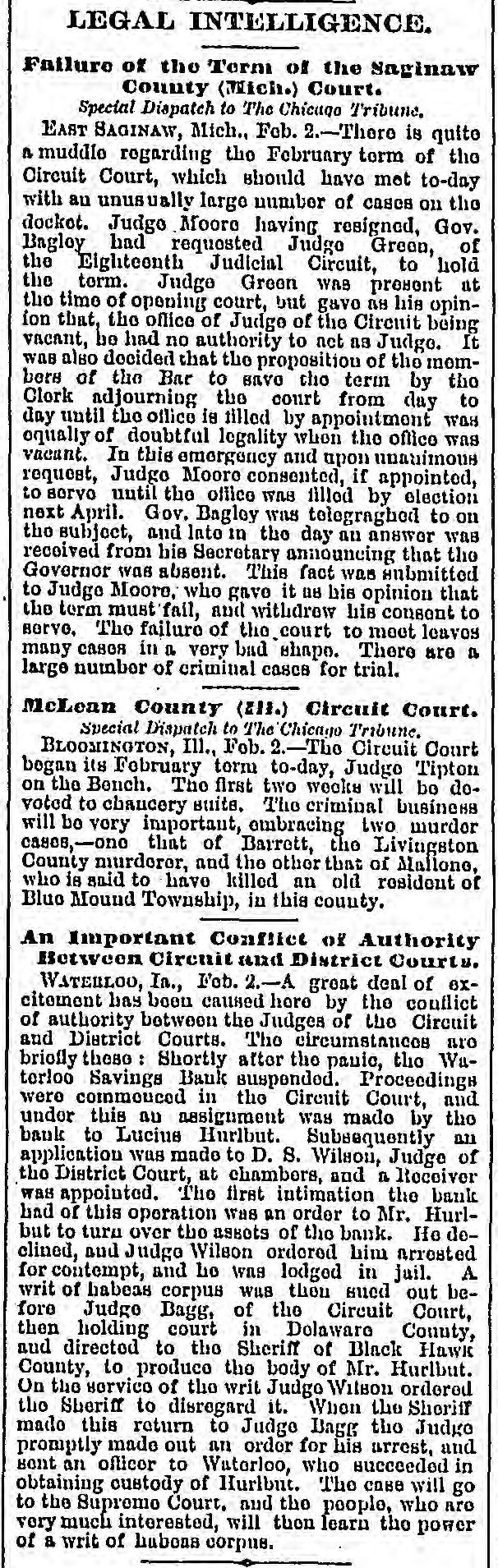
LEGAL INTELLIGENCE. Failure of the Term of the Saginaw County (Mich.) Court. Special Dispatch to The Chicago Tribune, EAST SAGINAW, Mich., Feb. 2.-There is quite n muddle regarding the February term of the Circuit Court, which should have met to-day with an unusually large number of cases on the docket. Judge Moore having resigned, Gov. Bagloy had requested Judge Green, of the Eighteenth Judicial Circuit, to hold the torm. Judge Green WAB present at the time of opening court, but gavo as his opinion that, the office of Judge of the Circuit being vacant, be had no authority to net as Judge. It was also decided that the proposition of the mombore of the Bar to save the term by the Clork adjourning the court from day to day until the office is filled by appointment was equally of doubtful legality when the office was vacant. In this emergency and upon unanimous request, Judge Moore consented, if appointed, to servo until the office WAS filled by election next April. Gov. Bagley was telegraghed to on the subject, and Into in the day an answer was received from his Secretary announcing that the Governor was absent. This fact was submitted to Judge Moore, who gave it as his opinion that the term must fail, and withdrew his consent to serve, The failure of the court to meet leavos many cases in a very bad shape. There are a large number of criminal cases for trial. McLenn County (211.) Circuit Court. Special Dispatch to The Chicago Tribune. BLOOMINGTON, Ill., Fob. 2.-The Circuit Court began its February torm to-day, Judge Tipton on the Bench. The first two weeks will be dovoted to chancery suite. The criminal business will be vory important, embracing two murder cases,-one that of Barrett, the Livingston County murderer, and the other that of Mallone, who is said to have killed an old resident of Blue Mound Township, in this county. An Important Conflict of Authority Between Circuit and District Courts. WATERLOO, In., Fob. 2.-A great deal of excitement has been caused here by the conflict of authority between the Judges of the Circuit and District Courts. The circumstances are briofly these Shortly after the paulc, the Waterloo Savings Bank suspended. Proceedings were commonced in the Circuit Court, and under this au assignment was made by the bank to Lucius Hurlbut. Subsequently an application was made to D. S. Wilson, Judge of the District Court, at chambers, and a Receiver was appointed. The first intimation the bank had of this operation was an order to Mr. Hurlbut to turn over the assets of the bank. He declined, and Judge Wilson ordered him arrested for contempt, and he was lodged in juil. A. writ of habeas corpus Was then sued out before Judge Bagg, of the Circuit Court, then holding court in Dolaware County, and directed to the Sheriff of Black Hawk County, to produce the body of Mr. Hurlbut. On the service of the writ Judge Wilson ordered the Sheriff to disregard it. When the Sheriff mado this return to Judge Bagg the Judge promptly made out an order for his arrest, and sent an officer to Waterloo, who succeeded in obtaining custody of Hurlbut. The case will go to the Supremo Court, and the people, who are very much interested, will thon learn the power of a writ of hubons corpus.


Article from Buchanan County Bulletin, February 13, 1874

Click image to open full size in new tab

Article Text

District vs. Circuit Court. Waterloo was favored with agen uine sensation last week in the shape of the locking of horns by Judge Wilson of the District Court, and Judge Bagg of the Circuit Court, on 8 questisn of jurisdiction. The merits of the case are, in brief, as follows: The Waterloo Savings Bank, which closed its doors in November with assets very much short of its liabilities, in default of efforts by its creditors to come to some equitable arrangement respecting the claims, finally made an assignment. Mr. L. Hurlbut, of Waterloo, was named as assignee, and accepting the trust, entered upon his duties. At the next term of the District Court a petition was presented praying for the appointment of Receiver, and Judge Wilson appointed G. W. Miller. Mr. Miller filed his bond, and upon demanding possession of the books and assets of the Bank, was met by a refusal from the assignee, Mr. Hurlbut. The matter was remand ed to Judge Wilson, who, on motion of Miller's attorneys, cited Hurlbut to appear and show cause why he should not be punished for contempt. Upon hearing, he was given three days to turn over the assetts to the Receiver; at the end of which time, still refusing, he was committed to Waterloo jail. The same day a writ of habeas corpus was issued by Judge Bagg at Delhi, directing the Sheriff of Blackhawk county to bring Hurlbut before him. Judge Wilson ordered the Sheriff to diso bey the writ and make return that Hurlbut was held in jail on the order of the District Court for contempt, and could not be legally deliv ered up. The Sheriff accordingly made this return to Judge Bagg in person at Delhi. The latter thereupon placed the writ in the hands of the Sheriff of Delaware county for service. This officer went to Waterloo and returned with Hurlbut. A hearing on the writ was fixed for Monday of this week in this city, but before this came off the case was sent to the Supreme Court on certiorari. Meanwhile Hurlbut is at large on his own recognizance. As to the merits or the legal points involved in the conflict, it is proper to withhold comment at this time. We can only say that it seems from the reading of the law and constitution that in granting the writ of habeas corpus, Judge Bagg simply performed a duty which be could not have evaded with safety. He is given no discretion to refuse it when a prima facie case is brought to his notice. Regarding the action of some fifteen attorneys-some of them interested in the case-professing to be the bar of Blackhawk county, who got together at Waterloo, and, by solemn preamble and resolution,pro ceeded to declare the action of Judge Wilson all right and that of Judge Bagg all wrong, it is not improper to characterize it as not only in the worst possible taste, but as supremely ridiculous. The idea of a lot of attorneys calling a meeting to settle a point of law or jurisdiction, as cross-roads politicians decide intricate points of diplomacy, by whereas and resolution, is SO broadly farcical that we apprehend the "Blackhawk bar" will not soon hear the last of it. It may have been a salve for the worsted attorneys in the case to thus metaphorically snap their fingers at Judge Bagg, but why the others should have joined in it, except from motives that will not bear examination, we can not see. So far as we have heard the opinion of legal men regarding it, this performance is characterized as unwise, if not impertinent. It is not free from the imputation of petty malice and professional jealousy, and this is not entirely concealed by the afterthought of the added resolution, to the effect that they "do not intend to oondemn one court and extol another." P. S.-Since the above was written the Waterloo Courier has been received, containing a note from C. W. Mullan, one of the attorneys whose names appear in the report I of the above meeting as participating in it. Mr. Mullan explains that, of the fifteen attorneys at the meeting-just half the bar of Blackhawk county-seven voted for the foolish resolutions, four were opposed to them, and four, including J. B. Powers the Chairman, did not express opinion, or vote on the question