Click image to open full size in new tab
Article Text
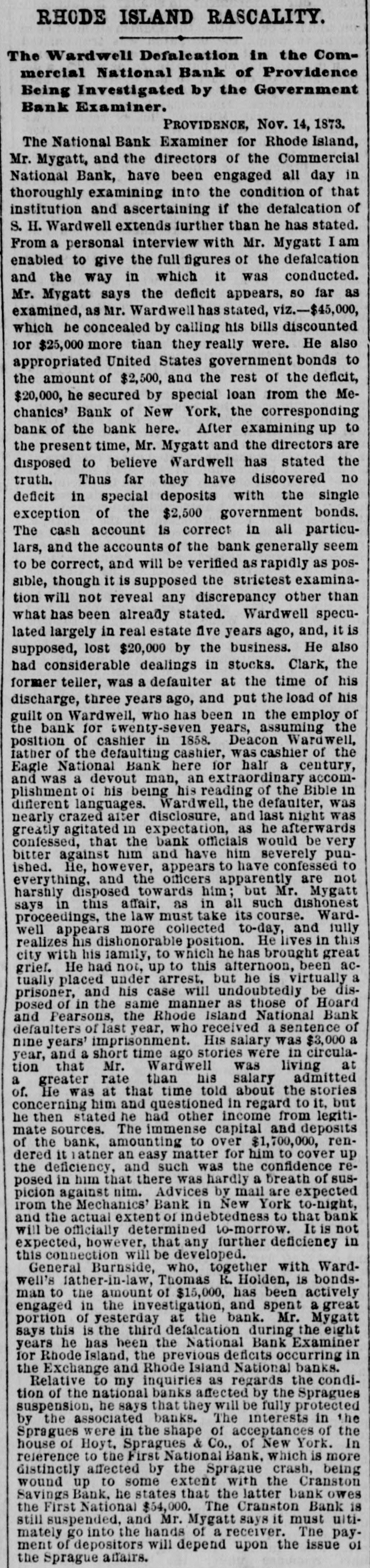
RHODE ISLAND RASCALITY. The Wardwell Defalcation in the Commercial National Bank of Providence Being Investigated by the Government Bank Examiner. PROVIDENCE, Nov. 14, 1873. The National Bank Examiner for Rhode Island, Mr. Mygatt, and the directors of the Commercial National Bank, have been engaged all day in thoroughly examining into the condition of that institution and ascertaining if the defalcation of S. H. Wardwell extends further than he has stated. From a personal interview with Mr. Mygatt I am enabled to give the full figures of the defalcation and the way in which it was conducted. Mr. Mygatt says the deficit appears, so far as examined, as Mr. Wardwell has stated, viz.-$45,000, which be concealed by calling his bills discounted for $25,000 more than they really were. He also appropriated United States government bonds to the amount of $2,500, and the rest of the deficit, $20,000, he secured by special loan from the Mechanics' Bank of New York, the corresponding bank of the bank here. After examining up to the present time, Mr. Mygatt and the directors are disposed to believe Wardwell has stated the truth. Thus far they have discovered no deficit in special deposits with the single exception of the $2,500 government bonds. The cash account is correct in all particulars, and the accounts of the bank generally seem to be correct, and will be verified as rapidly as possible, though it is supposed the strictest examination will not reveal any discrepancy other than what has been already stated. Wardwell speculated largely in real estate five years ago, and, it is supposed, lost $20,000 by the business. He also had considerable dealings in stocks. Clark, the former teller, was a defaulter at the time of his discharge, three years ago, and put the load of his guilt on Wardwell, who has been in the employ of the bank for twenty-seven years, assuming the position of cashier in 1858. Deacon Wardwell, father of the defaulting cashier, was cashier of the Eagle National Bank here for half a century, and was a devout man, an extraordinary accomplishment of his being his reading of the Bible in different languages. Wardwell, the defaulter. was nearly crazed after disclosure, and last night was greatly agitated in expectation, as he afterwards confessed, that the bank officials would be very bitter against him and have him severely punished. He, however, appears to have confessed to everything, and the officers apparently are not harshly disposed towards him; but Mr. Mygatt says in this affair. as in all such dishonest proceedings, the law must take its course. Wardwell appears more collected to-day, and jully realizes his dishonorable position. He lives in this city with his family, to which he has brought great grief. He had not, up to this afternoon, been actually placed under arrest. but he is virtually a prisoner, and his case will undoubtedly be disposed of in the same manner as those of Hoard and Pearsons, the Rhode Island National Bank defaulters of last year, who received a sentence of nine years' imprisonment. His salary was $3,000 a year, and a short time ago stories were in circulaat tion that Mr. Wardwell was living a greater rate than his salary admitted of. He was at that time told about the stories concerning him and questioned in regard to it. but he then stated he had other income from legitimate sources. The immense capital and deposits of the bank, amounting to over $1,700,000, rendered it latner an easy matter for him to cover up the deficiency, and such was the confidence reposed in him that there was hardly a breath of suspicion against nim. Advices by mail are expected irom the Mechanics' Bank in New York to-night, and the actual extent of indebtedness to that bank will be officially determined to-morrow. It is not in expected, however, that any further deficiency this connection will be developed. General Burnside, who, together with Wardwell's father-in-law, Thomas R. Holden, is bondsman to the amount of $15,000, has been actively engaged in the investigation, and spent a great portion of yesterday at the bank. Mr. Mygatt says this is the third defalcation during the eight years he has been the National Bank Examiner for Rhode Island, the previous deficits occurring in the Exchange and Rhode Island National banks. Relative to my inquiries as regards the condition of the national banks affected by the Spragues suspension, he says that they will be fully protected by the associated banks. The interests in the Spragues were in the shape of acceptances of the house of Hoyt, Spragues & Co., of New York. In reference to the First National Bank, which is more distinctly affected by the Sprague crash, being wound up to some extent with the Cranston Savings Bank, he states that the latter bank owes the First National $54,000. The Cranston Bank 18 still suspended, and Mr. Mygatt says it must ultimately go into the hands of a receiver. The payment of depositors will depend upon the issue 01 the Sprague affairs.