3249. Corning State Savings Bank (Corning, IA)

Bank Information

Episode Type
Run → Suspension → Closure
Bank Type
savings bank
Start Date
February 15, 1904
Location
Corning, Iowa (40.990, -94.741)

Metadata

Model
gpt-5-mini
Short Digest
165212fe

Response Measures

Full suspension, Books examined

Other: Receiver appointed; bank remained closed and paid dividends over time under receiver.

Description

Articles report a steady run that drained the bank and bad loans/poor assets; bank closed Feb 15, 1904, was placed in the hands of the state auditor and a receiver appointed Feb 23, 1904. The bank remained in receivership and paid dividends later (1905), indicating permanent closure rather than reopening. President Frank L. LaRue subsequently committed suicide (Mar 4/5, 1904).

Events (4)

1. February 15, 1904 Run
Cause
Bank Specific Adverse Info
Cause Details
A steady run drained the bank's funds; bank also had bad loans and worthless paper which undermined solvency; additionally local crop loss, flood and population out-migration drained deposits and 'bad talk' created unrest.
Newspaper Excerpt
the closing of the institution was the result of a steady run, not sensational not excited, but one that has drained the resources of the bank
Source
newspapers
2. February 15, 1904 Suspension
Cause
Bank Specific Adverse Info
Cause Details
Suspension followed heavy withdrawals and discovery of bad/tangled affairs and bad loans; state examiners took charge and institution was placed in hands of the state auditor.
Newspaper Excerpt
The Corning Savings bank ... was closed yesterday because of a shortage of funds.
Source
newspapers
3. February 23, 1904 Receivership
Newspaper Excerpt
Upon application of its stockholders F. Andrew was today appointed receiver of the Corning Savings bank, which has been in the hands of the state auditor for a week.
Source
newspapers
4. March 4, 1904 Other
Newspaper Excerpt
Frank L. Larue, president of the Corning State Savings bank, now in the hands of a receiver, shot and killed himself this afternoon.
Source
newspapers

Newspaper Articles (19)

Article from Ottumwa Tri-Weekly Courier, February 18, 1904

Click image to open full size in new tab

Article Text

CORNING BANK FAILS SAVINGS INSTITUTION FORCED TO CLOSE DOORS ON ACCOUNT OF LACK OF FUNDS. Depositors, Will, It is Said, be Paid in Full and the Bank May be Freshly Financed and Re-Opened for Business After a Few Weeks. Creston, Feb. 16.-(Special.)- The Corning Savings bank, located at Corning, in Adams county, was closed yesterday because of a shortage of funds. It is stated that the depositors will be paid in full and it is hoped that the bank will again be able to resume business in a few weeks. The closing of the institution was the result of a steady run, not sensational not excited, but one that has drained the resources of the bank so that business was necessarily suspended. Then too, it is said that bad loans upon which nothing could be realized were made and these had a bad effect upon the bank's finances. F. L. La Rue, the president of the bank, is an old resident of Corning and has always enjoyed the confidence of the people. Even now there is no hint at any crooked work on the part of the bank's officers and there is no excitement as the result of the failure of the institution. Causes of Failure. The causes leading up to the closing of the doors are many. In the last two or three years numerous Adams county people have gone to Montana, Missouri and other places and have drawn their surplus cash from the local banks and it is generally conceded that the majority of these were patrons of the savings bank. The people who purchased their farms also drew a great amount from the banks. Then this summer the hail storm destroyed the corn crop in a large portion of the county and on the heels of this disaster came the flood of August and the drain for the payment of corn shipped in has been another serious drain on the bank To head all these disasters there has been a certain personal fight for a long time or rather talk, that was bad. This has created an unrest that has been detrimental to the banking business of the town and created a suspicion and uneasiness in the minds of the people. May Reopen Soon. It is generally thought that all the depositors will be paid in full. In fact there is a movement on foot to finance the institution and the doors may open on the proposed scheme. Parties interested in the bank have said the depositors will be paid in full. It is true that the bank has some bad paper but with the assessment of the stockholders and the realization on the good paper there can be but a little, if any loss. Pella Bank Not Failure. Pella, Feb. 16.- (Special) - The assignment of the Pella Savings bank is due to a misunderstanding and is not considered in the nature of a failure. The elder Vanderploeg, who is worth in the neighborhood of a quarter of a million dollars, some time ago agreed to advance $20,000 capital, providing his son, W. G. Vanderploeg was made cashier, succeeding Herman Riepold, Riepold resigned and Vanderploeg took charge of the bank as treasurer. When the time came for the advance-
Article from Rock Island Argus, February 23, 1904

Click image to open full size in new tab

Article Text

RECEIVER FOR A BANK: PRESIDENT COLLAPSES Corning, Iowa, Feb. 23.-Upen application of its stockholders O. F. Andrew was today appointed receiver of the Corning Savings bank, whieh has been in the hands of the state auditor for a week. President Larue is in a state of mental collapse. The liabilities are $30,000.


Article from Evening Times-Republican, February 23, 1904

Click image to open full size in new tab

Article Text

A RECEIVER APPOINTED. F. Andrew to Have Charge of the Failed Corning Savings Bank. Special to Times-Republican. Corning. Feb. 23.-Upon application of its stockholders F. Andrew was today appointed receiver for the Corning Savings Bank, which has been in the hands of the state auditor for a week. President Larue is in R state of mental collapse. Liabilities, $30,000.


Article from The Minneapolis Journal, March 5, 1904

Click image to open full size in new tab

Article Text

LARUE KILLS HIMSELF Failure of His Bank Broke Him Down Physically and Mentally. CORNING, IOWA-Frank L. Larue, president of the Corning State Savings bank, in the hands of a receiver. shot and killed himself to-day. The savings bank closed its doors Feb. 15 and its affairs were found to be badly tangled. The strain and worry of the weeks preceding the failure had affected Larue both physically and mentally, and he had been confined to the house ten days or more.


Article from The Indianapolis Journal, March 5, 1904

Click image to open full size in new tab

Article Text

SUICIDE OF PRESIDENT OF A FAILED BANK Frank L. Larue Locks Himself in Bathroom and Ends Life with Bullet. SIOUX CITY, Ia., March 4.-Frank L. Larue, president of the Corning State Savings Bank, now in the hands of a receiver, shot and killed himself this afternoon. The savings bank closed its doors Feb. 1 and its affairs were found to be badly tangled. The strain and worry of the weeks prephysically and mentally, and he had been ceding the failure had affected Larue both confined to the house for ten days or more. This afternoon he locked himself in the bathroom and shot himself in the temple, death being instantaneous. He had long been one of the leading business men of Corning.


Article from The Times Dispatch, March 5, 1904

Click image to open full size in new tab

Article Text

TAKES HIS LIFE BECAUSE OF WORRY President of a Closed Sioux City Bank Is Driven to Suicide. (By Associated Press.) SIOUX CITY, IOWA, March 4.-Frank L. Larue, president of the Corning State Savings Bank, now in the hands of a recelver, shot and killed himself this afternoon. The savings bank closed its doors February 15th, and its affairs were found to be badly tangled. The strain and worry preceding a failure had affected Mr. Larue both physically and mentally, and he had been confined to the house for ten days or more. This afternoon he locked himself in the bath room and shot himself in the temple, death being instantaneous, Ho had long been one of the leading business men of Corning.


Article from The Savannah Morning News, March 5, 1904

Click image to open full size in new tab

Article Text

BANK PRESIDENT KILLED HIMSELF. LaRue Put a Bullet Through His Head at Corning, Ia. Sioux City, Ia., March 4.-Frank L. LaRue, president of the Corning State Savings Bank, now in the hands of a receiver, shot and killed himself this afternoon. The savings bank closed its doors Feb. 15 and its affairs were found to be badly tangled. The strain and worry preceding a failure had affected Mr. LaRue both physically and mentally, and he had been confined to the house for ten days or more. This afternoon he locked himself in the bathroom and shot himself in the temple, death being instantaneous. He had long been one of the leading business men of Corning.


Article from Evening Times-Republican, March 5, 1904

Click image to open full size in new tab

Article Text

THE SUICIDE OF BANKER LARUE Corning Greatly Shocked by the Tragic Ending of the Banker's Life RECEIVER FOR ELECTRIC CO. Various Complications Growing Out of The Failure of the Bank of Which Larue Was the President-Worry Over the Failure Cause of the ActHealth Was In Bad Condition. Special to Times-Republican, Corning, March 5.-The suicide of Banker F. L. Larue, last night was a great shock to Corning people. The causes are well known here, as Larue has been physically and mentally unstrung over the failure of his bank, and the fact that his affairs are under investigation by the grand jury. He was the president of the Corning State Savings bank which renetly went into the hands of a receiver. Last night he locked himself up in the bathroom of his home and fired a bullet into his brain. His wife and 16-year-old son were in the house at the time. He made an unsuccessful attempt to commit suicide with poison a week ago. Larue's bank was closed on February 15, and its affairs were found to be so badly tangled that it was placed under a receivership. A local paper published rumors that other banks held about $75,000 worth of securities as collateral for loans to the Corning bank, and that part or all of the paper bore forged signatures of business men of Corning. State Auditor Carroll said he had heard rumors to that effect, but that the bank passed under the receivership before the state examiners had investigated all its as. sets. After the failure Larue turned over two farms, valued at $65,000, and had arranged to transfer to the receiver his $10,000 residence. Whatever remains of the indebtedness his wife expects to liquidate with the proceeds of $69,000 in life insurance, which he carried. He had taken out $25,000 within the last year, and all was made payable to his wife. None of it is said to be contestable on account of suicide. Larue had been confined to his home ever since the bank's failure and physicians refused to permit anyone to see him. He was 45 years of age and had been cashier or president of the bank for the last fifteen years. Larue was a talented man and his judgment was considered of the best. Yet among his assets and resources were found large notes of persons whose credit is regarded as worthless. One note of a man three years dead, was found listed among his resources. E He did not speculate on the board of trade, but was a high liver. His Nabilities are said to have amounted in all to about $200,000.


Article from The Bennington Evening Banner, March 5, 1904

Click image to open full size in new tab

Article Text

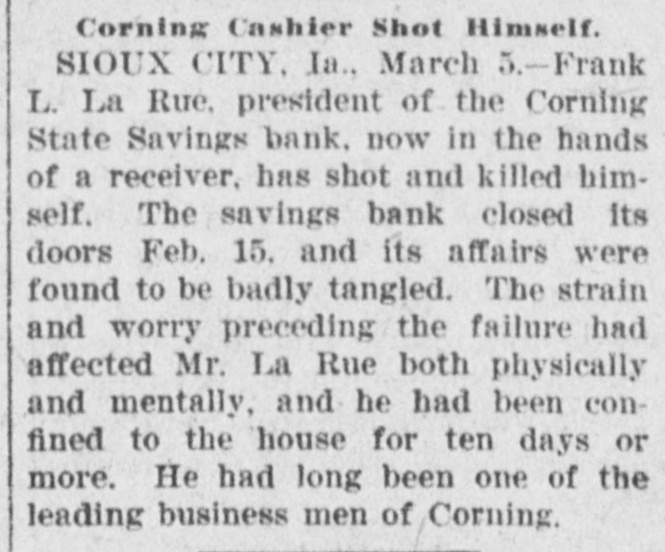
Corning Cashier Shot Himself. SIOUX CITY, Ia., March 5.-Frank L. La Rue, president of the Corning State Savings bank, now in the hands of a receiver, has shot and killed himself. The savings bank closed its doors Feb. 15. and its affairs were found to be badly tangled. The strain and worry preceding the failure had affected Mr. La Rue both physically and mentally, and he had been confined to the house for ten days or more. He had long been one of the leading business men of Corning.


Article from The Salt Lake Herald, March 5, 1904

Click image to open full size in new tab

Article Text

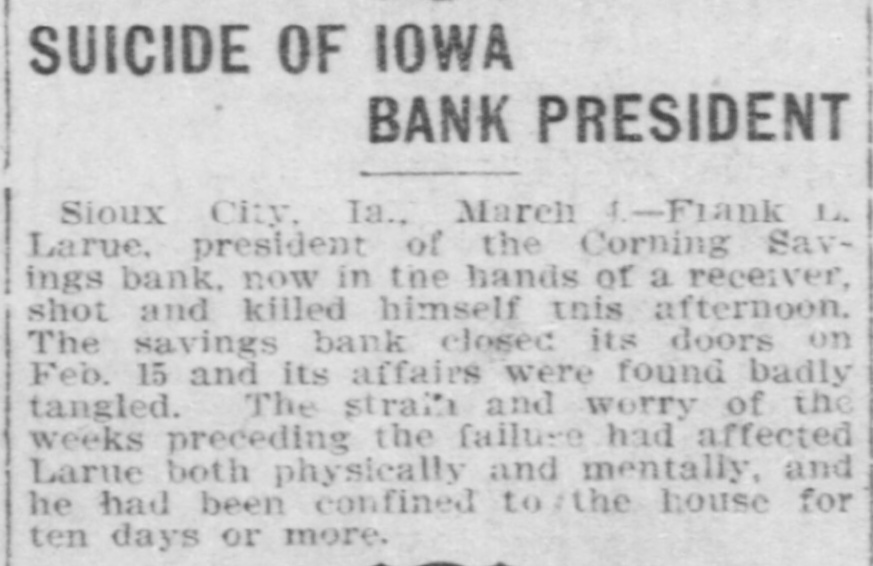
SUICIDE OF IOWA BANK PRESIDENT Sioux City, Ia., March 1.-Fiank L. Larue, president of the Corning Savings bank, now in the hands of a receiver, shot and killed himself this afternoon. The savings bank closed its doors on Feb. 15 and its affairs were found badly tangled. The strain and worry of the weeks preceding the failure had affected Larue both physically and mentally, and he had been confined to /the house for ten days or more.


Article from Waterbury Evening Democrat, March 5, 1904

Click image to open full size in new tab

Article Text

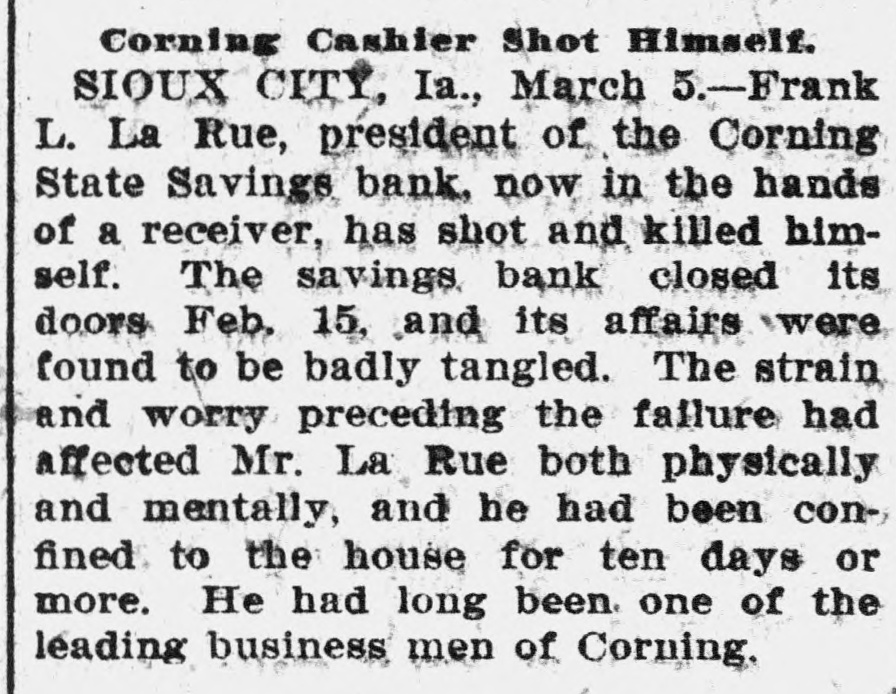
Corning Cashier Shot Himself. SIOUX CITY, Ia., March 5.-Frank L. La Rue, president of the Corning State Savings bank. now in the hands of a receiver, has shot and killed himself. The savings bank closed its doors Feb. 15, and its affairs were found to be badly tangled. The strain and worry preceding the failure had affected Mr. La Rue both physically and mentally, and he had been confined to the house for ten days or more. He had long been. one of the leading business men of Corning.


Article from The News & Observer, March 6, 1904

Click image to open full size in new tab

Article Text

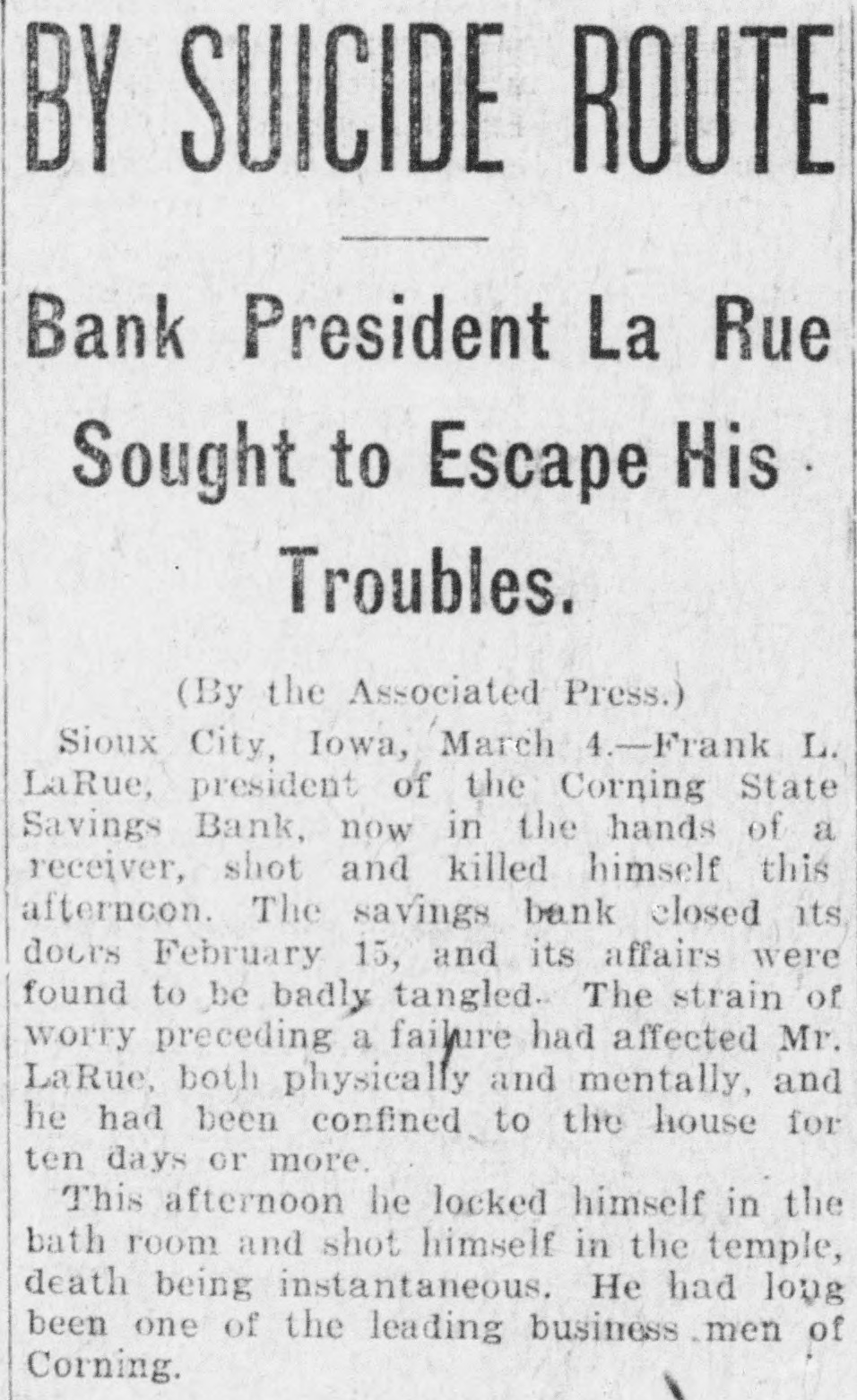
BY SUICIDE ROUTE Bank President La Rue Sought to Escape His Troubles. (By the Associated Press.) Sioux City, Iowa, March 4.-Frank L. LaRue, president of the Corning State Savings Bank, now in the hands of a receiver, shot and killed himself this afternoon. The savings bank closed its doors February 15, and its affairs were found to be badly tangled. The strain of worry preceding a failure had affected Mr. LaRue, both physically and mentally, and he had been confined to the house for ten days or more. This afternoon he locked himself in the bath room and shot himself in the temple, death being instantaneous. He had long been one of the leading business men of Corning.


Article from The Madison Daily Leader, March 7, 1904

Click image to open full size in new tab

Article Text

IOWA BANKER SUICIDES. President of Failed Institution Shoots Himself. Sioux City, Ia., March 7.-Frank L. Larue, president of the Corning State Savings bank, now in the hands of a receiver, shot and killed himself during the afternoon. The savings bank closed its doors Feb. 15 and its affairs were found to be badly tangled. The strain and worry preceding the failure had affected Larue both physically and mentally.


Article from The Penn's Grove Record, March 11, 1904

Click image to open full size in new tab

Article Text

Bank President a Suicide. Frank L. La Rue, President of the Corning (Iowa) State Savings Bank, now in the hands of a receiver, shot and killed himself.


Article from Oakes Republican, March 11, 1904

Click image to open full size in new tab

Article Text

BULLET TO END WORRY. AND President of Bank Which Closed Kills Himself. Sioux City, Iowa, March 6.-Frank L. Larue, president of the Corning State Savings bank, now in the hands of a receiver, shot and killed himself yesterday afternoon. The savings bank closed its doors Feb. 15 and its affairs were found to be badly tangled. The strain and worry of the weeks preceding the failure had affected Larue both physically and mentally, and he had been confined to the house ten days or more.


Article from Twice-A-Week Plain Dealer, March 11, 1904

Click image to open full size in new tab

Article Text

Banker Commits Suicide. Frank L. Larue, president of the Corning State Savings bank, now in the hands of a receiver, shot and killed himself Friday afternoon. The bank elosed its doors Feb. 15 and its affairs were found to be badly tangled. The strain and worry of the weeks preceding the failure had affected Larue both physically and mentally, and he had been confined to the house for several days,


Article from Audubon Republican, September 8, 1904

Click image to open full size in new tab

Article Text

NOTES FROM THE CAPITAL Des Moines, Sept. 2. 1904. The question of whether or not Sarah Kuhn, now serving a life sentence for the murder of her crippled husband in Keokuk county, shall participate in his estate is before the supreme court. Mrs. Kuhn's statement of her claim on the estate has been filed in the supreme court. She is appellant in the case, her father in-law having won in the lower court. The estate consists of the life insurance which her husband left and the small estate he had accumulated by cobbling shoes, possibly $1,500. Iowa coal is to be tested by the government of the United States for the purpose of determining its rela tive value for the production of steam for the manufacture of coke and for other commercial purposes of very great importance. Already leading mine operators have been asked tc participate in the tests which are about to begin at St. Louis. Each is asked to donate a car load of coal Mine operators who are interested it the proposed tests have been asked to notify the state geologist, Frank A Wilder at the State university at Iowa City, and he will consult with them in person. About 100 feet under the surface or Polk county is a forest, and in the forest the bones of animals, possibly of human beings. At least that is the case at Enterprise, about twelve miles northeast of Des Moines, on the Iowa Falls Short Line. Parts of this forest are now in the office of the state mine inspector at the capitol The trees from which the pieces were cut were about a foot in diameter and floriculturists and chemists are now engaged in figuring out, scienti fically, what kind of wood it is. In this work they have the aid of In spector Ed. Sweeney, in whose territory the find was made. Superintend ent R. J. Shawhan of the Deer Creek Coal Mining company. found the for est. It was located about 100 feet be neath the surface. There are 759 automobile licenses out from the office of the secretary of state. Five of these, however were issued to non-residents who were exhibiting automobiles on the state fair ground recently. Another ten were re-registered. Under the law, a dealer in autos must have : registered number for each one, and this is true whether he be a non resident or not. It is also one of the wise provisions of the law that every man who purchases a machine al ready registered must put up another dollar and get a brand new number. Actually. therefore, but 769 automo biles are doing business in Iowa, for it is believed that practically every one is registered. It is supposed that they represent an investment of not less than $1,000 each. Nearly a million of dollars may be said to be tied up in horseless carriages in this state. Another complication growing OLD of the Corning bank failure and the suicide of Frank La Rue has made its appearance in the Polk county court in the suit of Harry T. Blackburn, vice president and cashier of the Iowa Na tional bank of Des Moines, against the Aetna Life Insurance company to recover on a policy on the life of La Rue to the amount of $2,000, which was assigned by the deceased banker to Blackburn before his death. Mr. Blackburn's bank was interested somewhat in the failure of the Corning bank, but was secured to some extent by the assignment of the La Rue life insurance policy. The assign ment was all made in good form but on the death of Mr. La Rue the Aetna insurance company refused to pay the the policy, basing its refusal on the fact that La Rue had committed suicide. On the other hand, however Mr. Blackburn insists that he is not held by the suicide of the banker and that the policy is good in his hands even though there is a question as LC the manner of Mr. La Rue's death. Commissioner Lincoln will begin the planting of fish in Iowa waters about the middle of the month. The car is now in the shops at Dubuque and will be ready about September 11 for the resumption of this work. The fish will be placed where none have gone before, except the great lakes into which each year a carload, each is planted. Game fish, only, of course are used for this. The United States is aiding the Iowa department in this work to some extent. Last year. the govern ment distributed 5,000,000 fish to the waters of Iowa. This work is directed from the fish hatchery at Manchester R. S. Johnson is superintendent in charge. But the government has adopted the Iowa plan of securing a supply of fish. It has a boat on the Mississippi gathering the fish. This scheme was devised by Commissioner Lincoln and has been taken over by the govern ment, which no longer depends on the hatchery for its supply for general "It is a very bad form for a person to make a spectacular display of his wealth." "Yes," answered Senator Sor ghum; and in politics it's worse than that. Star. It's in judicious."-Washington Mr. Sport-"Ethel, I'll bet you a


Article from Iowa State Bystander, September 9, 1904

Click image to open full size in new tab

Article Text

NOTES FROM THE CAPITAL Des Moines, Sept. 7. 1904 There are 759 automobile licenses out from the office of the secretary of state. Five of these, however, were issued to non-residents who were exhibiting automobiles on the state fair ground recently. Another ten were re-registered. Under the law, a dealer in autos must have a registered number for each one, and this is true whether he be a nonresident or not. It is also one of the wise provisions of the law that every man who purchases a machine already registered must put up another dollar and get a brand new number. Actually, therefore, but 769 automo biles are doing business in Iowa, for it is believed that practically every one is registered. It is supposed that they represent an investment of not less than $1,000 each. Nearly a million of dollars may be said to be tied up in horseless carriages in this state. Another complication growing out of the Corning bank failure and the suicide of Frank La Rue has made its appearance in the Polk county court In the suit of Harry T. Blackburn, vicepresident and cashier of the Iowa National bank of Des Moines, against the Aetna Life Insurance company to recover on a policy on the life of La Rue to the amount of $2,000, which was assigned by the deceased banker to Blackburn before his death. Mr. Blackburn's bank was interested somewhat in the failure of the Corning bank, but was secured to some extent by the assignment of the La Rue life insurance policy. The assignment was all made in good form. but on the death of Mr. La Rue the Aetna insurance company refused to pay the the policy, basing its refusal on the fact that La Rue had committed suicide. On the other hand, however, Mr. Blackburn insists that he is not held by the suicide of the banker and that the policy is good in his hands even though there is a question as to the manner of Mr. La Rue's death. Commissioner Lincoln will begin the planting of fish in Iowa waters about the middle of the month. The car is now in the shops at Dubuque and will be ready about September 15 for the resumption of this work. The fish will be placed where none have gone before, except the great lakes, into which each year a carload, each, is planted. Game fish, only, of course, are used for this. The United States is aiding the Iowa department in this work tc some extent. Last year, the govern. ment distributed 5,000,000 fish to the waters of Iowa. This work is directed from the fish hatchery at Manchester R. S. Johnson is superintendent in charge. But the government has adopted the Iowa plan of securing a supply of fish. It has a boat on the Mississippi gathering the fish. This scheme was devised by Commissioner Lincoln and has been taken over by the govern. ment, which no longer depends on the hatchery for its supply for general distribution. Two new industries are in course of establishment at the state institution at Eldora. They are printing and wood working. Superintendent Drake is now engaged in buying the machinero for the printing establishment and the wood working machinery bids are in the hands of the board of control. They wll not be opened for a day or two, or until the bidders all have an opportunity. The Eldora band has just been equipped with new band instruments, throughout, at a cost of several hundred dollars. These instruments were supposed to be here for the state fair SO that the boys might then have them to use. Ole Hura, an inmate of the city jail, was assaulted and unmercifully beaten by three of the other prisoners who had been incarcerated on the charge of drunoenness. Pat Crowe, Walter McNealy and John Hammock fell upon him without any apparent cause than to vent their spite and left him in an almost senseless condition on the floor before the attention of Jailer Willis was called to the squabble. The Des Moines police have been notified to look out for a deserter who has escaped from Fort Des Moines. John Burdy is the soldier who deserted. He is described as being 5 feet 10 inches in height, with light brown hair and a short turned-up nose. The army officers have asked for assistance in the search, but as yet no one answering to the description has been found. The state board of control has pur. chased about ten tons of liver, fourteen tons of sausage and about six tons of bologna for the institutes under its management. This went along with the nearly 150 tons of fresh beef and the nearly seven tons of ham. The contracts let by the board of control were for meat requisitioned by superintendents of the respective institutions. They cover the supply for the last quarter of the present year. Agar & Co., of Des Moines got all of the ham, bacon, sausage, bologna, pork dried beef and mess pork contracts for all of the state institutions. The board was especially pleased with the samples submitted by the Agars. The beef liver and mutton contracts went to Armour, swift and Cudahy. Customer-"The last fish I had from you didn't seem very fresh. Fish Dealer-"Well, mum, 'ow can you ex pect fresh fish to come out o' sait water?"-New Yorker. "I don't want poverty, an' I don't want riches," says Brother Dickey; "all I wants is plenty political cam paigns an' canderdates runnin de year


Article from The Leon Reporter, September 7, 1905

Click image to open full size in new tab

Article Text

An order was signed by Judge H. M. Towner, this week, granting the receiver of the Corning State Savings bank to pay a third dividend of 10 per cent to the depositors of the defunct institution and Mr. Andrews is now busily engaged in writing the checks. It requires $14,980 to pay a dividend of 10 per cent and after declaring the dividend the receiver had just $12 on hands. The distribution of nearly $15,000 will be quite a sum for those who were so unfortunate as to be doing business with the bank at the time of the failure. This dividend all goes to the depositors and none of it to those who only established a general claim against the bank. It is thought, by those who are familiar with the situation, that there will be another dividend of 10 per cent and quite probably still another for a less amount. If everything works to the best advantage of the defunct institution it is possible the fifth dividend will be for 10 per cent, but it cannot be depended upon. The depositors will have to be content with from 40 to 50 per cent and to get that amount they were fortunate enough in getting certain legal points sustained, not only by the lower court, but by the supreme court. The receiver says the Carbon mill is one of the most difficult assets he has to realW ize on. The bank has a claim for about S $1,500 against it and it is the intention to sell the same at "piece meals." Corning Free Press. n, Piles may be your trouble. Antiseptic Piles Cones will cure you. We sell them. 50c. box W. C. Stempel &;Co.