3248. Fidelity Loan & Trust Company (Sioux City, IA)

Bank Information

Episode Type
Suspension โ†’ Closure
Bank Type
trust
Start Date
January 1, 1895*
Location
Sioux City, Iowa (42.500, -96.400)

Metadata

Model
gpt-5-mini
Short Digest
689df502c91f685a

Response Measures

None

Description

The articles describe a firm that failed in January 1895, had a receiver appointed then, and remained in receivership/subject to suit; the state sought to terminate the corporation in Nov 1898 and a new receiver (U. G. Whitney) was appointed in Aug 1899. The Iowa supreme court's 1901 dismissal left stockholders subject to double liability. There is no mention of a depositor run โ€” the sequence is regulatory/legal actions and receivership leading to permanent winding up, consistent with suspension leading to closure. OCR minor corrections: Milon -> Milton Remley (attorney-general) inferred; dates taken from article text/publication dates.

Events (4)

1. January 1, 1895* Receivership
Newspaper Excerpt
This company failed first in January, 1895, and Joseph Sampson, the president, was named receiver.
Source
newspapers
2. November 16, 1898 Other
Newspaper Excerpt
In the name of the state of Iowa, Milton Remley, the attorney general, has made an application in the district court, asking that the existence of the Fidelity Loan and Trust company of Sioux City be terminated and that the court appoint a receiver to wind up its affairs.
Source
newspapers
3. August 1, 1899* Receivership
Newspaper Excerpt
District Judge George W. Wakefield has appointed U. G. Whitney receiver of the Fidelity Loan and Trust company, of Sioux City.
Source
newspapers
4. April 1, 1901* Other
Newspaper Excerpt
The dismissal by the Iowa supreme court of the appeal of the suit of the state against the defunct Fidelity Loan and Trust company of Sioux City, means that the stockholders in the concern will be subject to a double liability.
Source
newspapers

Newspaper Articles (5)

Article from Audubon Republican, November 24, 1898

Click image to open full size in new tab

Article Text

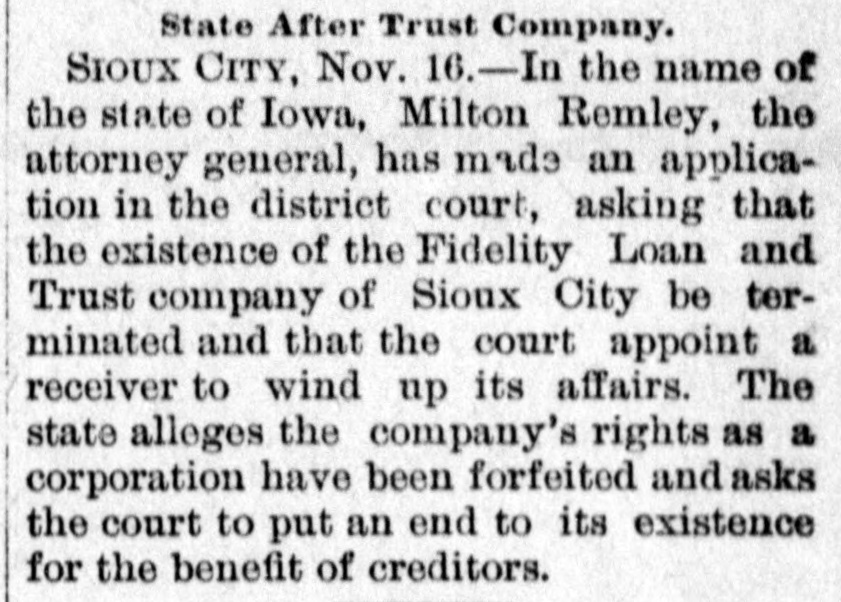
State After Trust Company. SIOUX CITY, Nov. 16.-In the name of the state of Iowa, Milton Remley, the attorney general, has made an application in the district court, asking that the existence of the Fidelity Loan and Trust company of Sioux City be terminated and that the court appoint a receiver to wind up its affairs. The state alleges the company's rights as a corporation have been forfeited and asks the court to put an end to its existence for the benefit of creditors.


Article from Twice-A-Week Plain Dealer, December 2, 1898

Click image to open full size in new tab

Article Text

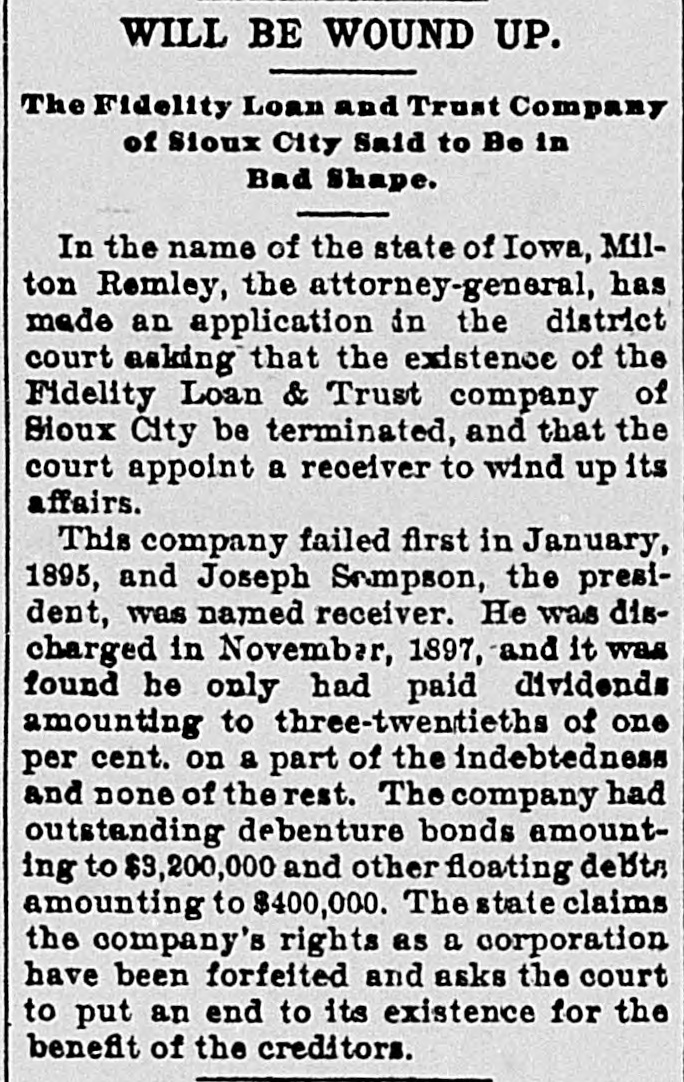
WILL BE WOUND UP. The Fidelity Loan and Trust Company of Sioux City Said to Be in Bad Shape. In the name of the state of Iowa, Milton Remley, the attorney-general, has made an application in the district court asking that the existence of the Fidelity Loan & Trust company of Sioux City be terminated, and that the court appoint a receiver to wind up its affairs. This company failed first in January, 1895, and Joseph Sampson, the president, was named receiver. He was discharged in November, 1897, and it was found he only had paid dividends amounting to three-twentieths of one per cent. on a part of the indebtedness and none of the rest. The company had outstanding debenture bonds amounting to $3,200,000 and other floating debts amounting to $400,000. The state claims the company's rights as a corporation have been forfeited and asks the court to put an end to its existence for the benefit of the creditors.


Article from Audubon Republican, June 1, 1899

Click image to open full size in new tab

Article Text

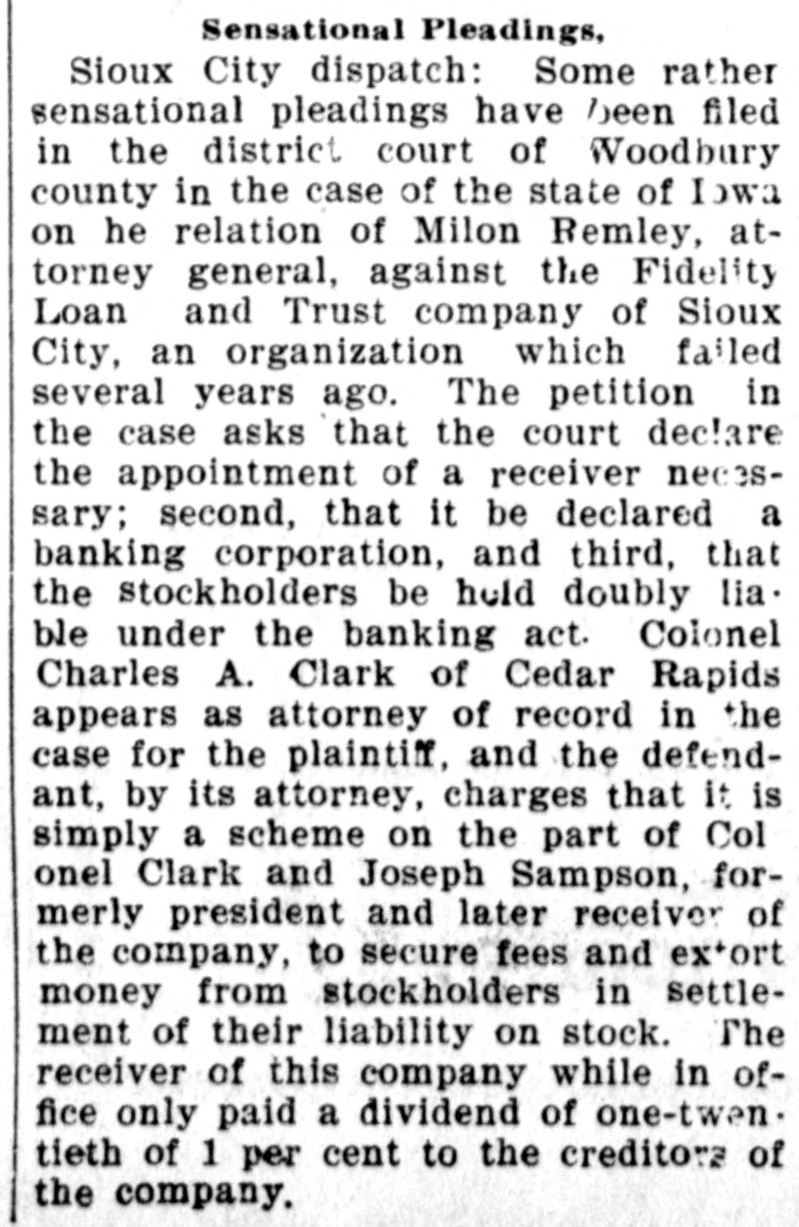
Sensational Pleadings, Sioux City dispatch: Some rather sensational pleadings have been filed in the district court of Woodbury county in the case of the state of Iowa on he relation of Milon Remley, attorney general, against the Fidelity Loan and Trust company of Sioux City, an organization which failed several years ago. The petition in the case asks that the court declare the appointment of a receiver necessary; second, that it be declared a banking corporation, and third, that the stockholders be held doubly lia. ble under the banking act. Colonel Charles A. Clark of Cedar Rapids appears as attorney of record in the case for the plaintiff, and the defendant, by its attorney, charges that it is simply a scheme on the part of Col onel Clark and Joseph Sampson, formerly president and later receiver of the company, to secure fees and ex*ort money from stockholders in settlement of their liability on stock. The receiver of this company while in office only paid a dividend of one-twen. tieth of 1 per cent to the creditors of the company.


Article from Twice-A-Week Plain Dealer, August 8, 1899

Click image to open full size in new tab

Article Text

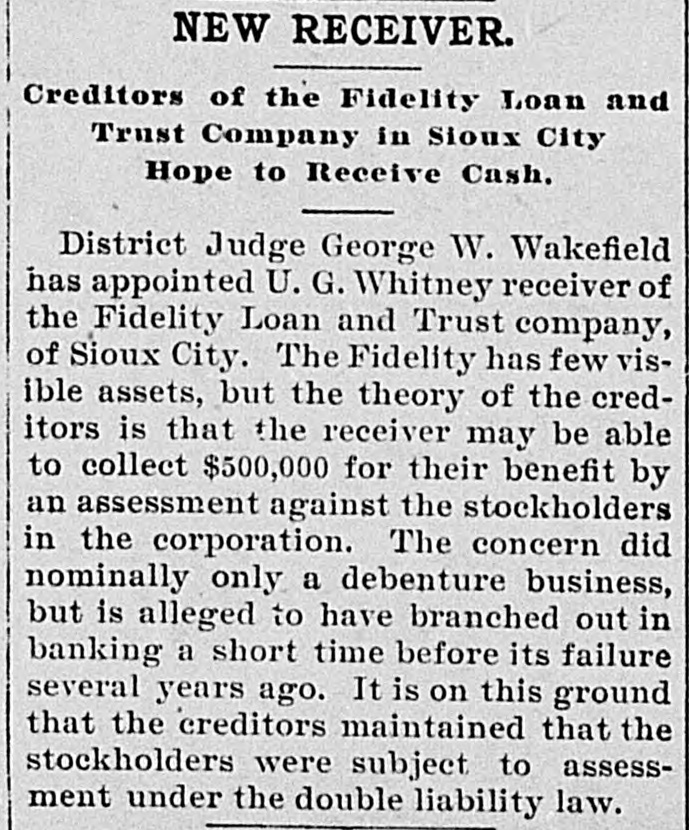
NEW RECEIVER. Creditors of the Fidelity Loan and Trust Company in Sioux City Hope to Receive Cash. District Judge George W. Wakefield has appointed U. G. Whitney receiver of the Fidelity Loan and Trust company, of Sioux City. The Fidelity has few visible assets, but the theory of the creditors is that the receiver may be able to collect $500,000 for their benefit by an assessment against the stockholders in the corporation. The concern did nominally only a debenture business, but is alleged to have branched out in banking a short time before its failure several years ago. It is on this ground that the creditors maintained that the stockholders were subject to assessment under the double liability law.


Article from The Leon Reporter, April 18, 1901

Click image to open full size in new tab

Article Text

THE NEWS IN IOWA A young man named Sylvester, living two miles south of Rockwell City, was accidentally shot through the leg by his brother while shooting fish in a pond. He never rallied from the shock and died a few hours later. The dismissal by the Iowa supreme court of the appeal of the suit of the state against the defunct Fidelity Loan and Trust company of Sioux City, means that the stockholders in the concern will be subject to a double liability. The capital stock was $500,000, and if the stockholders are responsible that sum can be collected by the law, and applied to creditors' claims. Stockholders are mostly eastern people. Fred Evans, a druggist at Sargeant Bluffs, dislocated his neck in a game of baseball between the Sioux City high school team and the Sergeant Bluffs nine at Sargeant Bluffs and it is feared he will not live. His lower limbs are paralyzed. The broken vertabrae is being held in place by straps and bandages. He was sliding to third base in the ninth inning and struck his head against the leg of Harry Jandl, who was guarding third base for Sioux City. In the district court at Des Moines Judge Holmes entered a compromise decree in the Carter & Hussey reteivership, a decree that it is claimed is acceptable to both parties to the controversy. L. A. Wilkenson, the expert accountant who was employed to go through the books, is appointed receiver and was required to give a bond for $1,000. He will serve without compensation. It was understood that Messrs. Carter and Hussey will continue in charge of their respective departments of the business until such a time as the plant can be sold. It was further ordered that the partnership be dissolved at the instance of Mr. Hussey. The court also ordered that the property be advertised for sale, but reserved to either partner their right to purchase it provided they bid $3,000 cash or more for it. Running at a high speed two BurlIngton freight trains collided three miles west of Creston in a deep cut and on a sharp curve. With these dangerous features to contend with It is remarkable and miraculous that the train men, especially those who occupied places in the engine cabs, escaped with their lives. The wreck (s the worst that has occurred on the Burlington west division for years and very expensive. When it is known that it required two wrecking crews with a large number of men fourteen hours to clear the track the extent of the disaster is better understood. The trains came together in a cut on a curve and the cars piled high. It was impossible to pull the cars to either side of the rails and a track could not be build around the wreck on account of the embankment. The engineer escaped by jumping. Of two carloads of hogs not more than a half dozen escaped alive. Some interesting new developments have occurred at Grinnell, which point to the conclusion that Dr. Geo. D. Herron will be married in a very short time to Miss Carrie Rand, his wealthy patroness, who has been so prominently mentioned in connection with the Herron divorce case. Miss Rand came to Grinnell a few days ago and disposed of all her property in that city by sale. She has purchased a palatial residence on Fifth avenue and Forty reet in New York, where Dr. Herron is living. According published plans, her family will to go Europe soon. and for this reason it is assumed that her marriage to Dr. Herron will take place soon; in fact, it was so understood and admitted by close friends. The marriage will be the outcome of the causes that have led up to the noted social reformer's divorce from his wife a few weeks ago. Miss Rand is in sympathy, heart and soul, with Dr. Herron's work. She is reputed to be worth about $1,000,000. Dr. Herron is known to be opposed to the marriage contract. It is his social idea that the marriage state is tyranny, and the ceremony will be a concession to the other party. Unless some federal question can be made to intervene James H. Easton, a wealthy banker of Decorah, must serve five years in the state penitentiary on a charge of fraudulent banking. The supreme court of Iowa has affirmed the decision of the Fayette county court, which sentenced Easton to the term stated. Easton was president of the First National bank of Decorah and for several years had been a wealthy man of that city August 21, 1896, he received a deposit of $100. Afterward on November 10 of the same year a receiver was appointed for the bank, and because of the $100 deposit he was indicted upon the charge of having received the deposit after the bank was known to be insolvent. He was convicted on the charge and appealed the case. It was claimed in the appeal that the law relating to Easton's crime does not apply to national banks, which are organized under national laws and that Easton's bank was not amenable to the state laws; and further that if held to be so the act was unconstitutional The supreme court has decided that the banking law under which Easton was convicted clearly applies to national banks. On the question hs to whether the law is constitutional the supreme court follows the rul-