Click image to open full size in new tab
Article Text
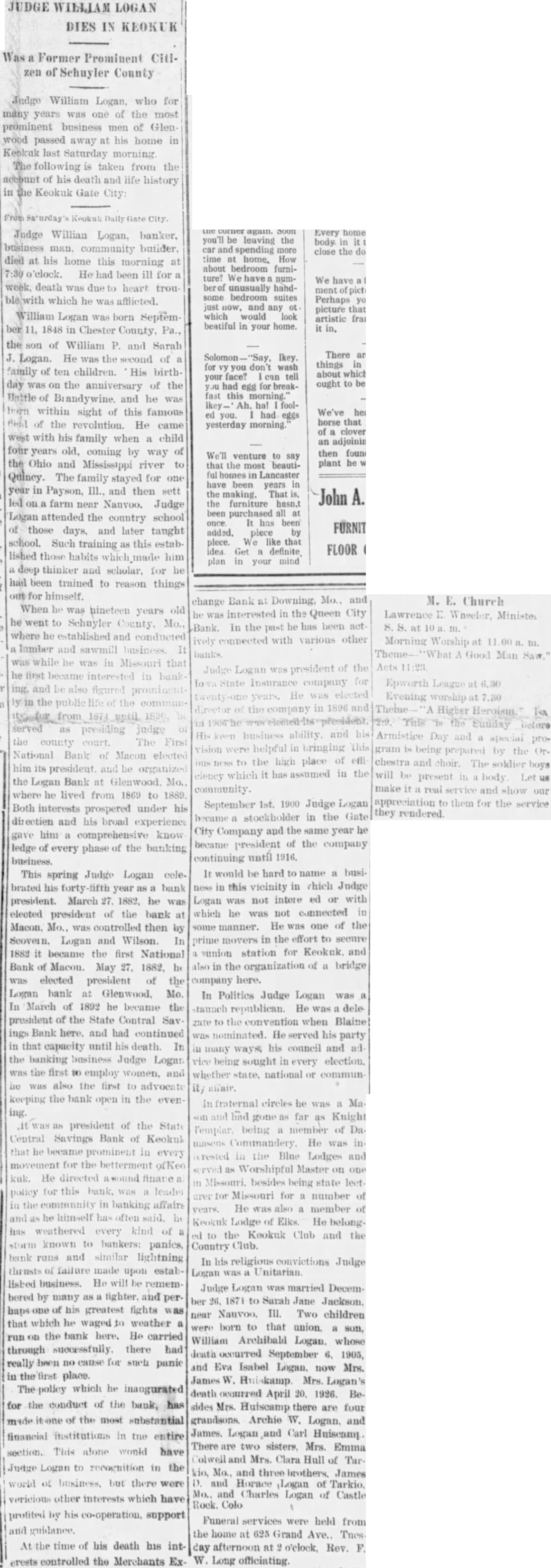
JUDGE WILLIAM LOGAN DIES IN KEOKUK
Was a Former Prominent Citizen of Schuyler County
Judge William Logan, who for many years was one of the most prominent business men of Glenwood passed away at his home in Keokuk last Saturday morning. The following is taken from the account of his death and life history in the Keokuk Gate City:
From Saturday's Keokuk Daily Gate City.
Judge Willian Logan, banker, business man. community builder. died at his home this morning at 7:30 o'clock. He had been ill for a week, death was due to heart trouble with which he was afflicted. illiam Logan was born September 11. 1848 in Chester County, Pa., the son of William P. and Sarah J. Logan. He was the second of a family of ten children. His birthday was on the anniversary of the Battle of Brandywine. and he was born within sight of this famous field of the revolution. He came west with his family when a child four years old. coming by way of the Ohio and Mississtppi river to Quincy. The family stayed for one year in Payson, III., and then sett led on a farm near Nanvoo. Judge Logan attended the country school of those days, and later taught school. Such training as this established those habits which made him a deep thinker and scholar, for he had been trained to reason things out for himself. When he was nineteen years old he went to Schuyler County. Mo., where he established and conducted a lumber and sawmill business. It was while he was in Missouri that he first became interested in bank. ing. and be also figured prominently in the public life of the communserved as presiding judge the county court. The First National Bank of Macon elected him its president. and he organized the Logan Bank at Glenwood. Mo., where he lived from 1869 to 1889. Both interests prospered under his direction and his broad experience gave him a comprehensive know ledge of every phase of the banking business.
This spring Judge Logan celebrated his forty-fifth year as a bank president. March 27. 1882, he was elected president of the bank at Macon. Mo., was controlled then by Scovern. Logan and Wilson. In 1882 it became the first National Bank of Macon. May 27, 1882, he was elected president of the Logan bank at Glenwood, Mo. In March of 1892 he became the president of the State Contral Savings Bank here. and had continued in that capacity until his death. In the banking business Judge Logan was the first to employ women, and he was also the first to advocate keeping the bank open in the evening.
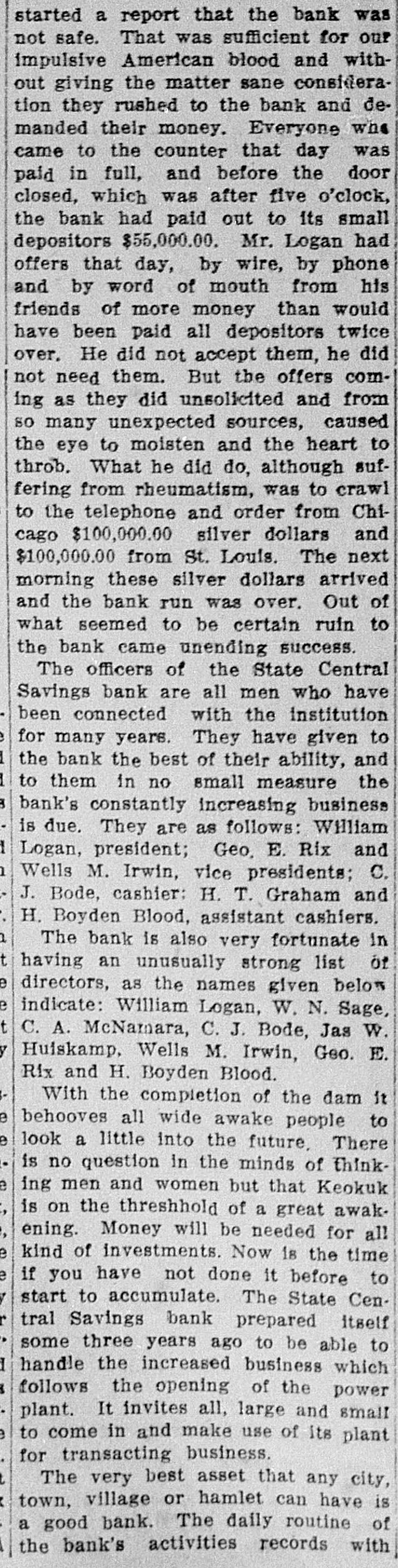
.It was as president of the State Central Savings Bank of Keokul that he became prominent in every movement for the betterment ofKeo kuk. He directed asound finane policy for this bank. was a leader in the community in banking affairs and as he himself has often said. he has weathered every kind of a storm known to bankers: panics, bank runs and similar lightning thrusts of failure made upon establisbed business. He will be remembered by many as a fighter, and perhaps of his greatest fights was that which he waged to weather a run on the bank here. He carried through successfully. there had really been no cause for such panic in the place. The policy which he inaugurated for the conduct of the bank, has made it-one of the most substantial financial institutions in the entire section. This alone would have Judge Logan to recognition in the world of business, but there were vericious other interests which have profited by his co-operation, support and guidance. At the time of his death his interests controlled the Merchants Ex- change Bank at Downing, Mo., and he was interested in the Queen City Bank. In the past he has been actively connected with various other
Judge Logan was president of the State Insurance company for years. He was elected director of the company in 1896 and in His keen business ability. and his vision were helpful in bringing this ous ness to the high place of effi ciency which it has assumed in the community. September 1st. 1900 Judge Logan became a stockholder in the Gate City Company and the same year he became president of the company continuing until 1916.
It would be hard to name a business in this vicinity in which Judge Logan was not intere ed or with which he was not connected in some manner. He was one of the prime movers in the effort to secure minion station for Keokuk, and also in the organization of a bridge company here. In Politics Judge Logan was a stannch republican. He was a delegate to the convention when Blaine was nominated. He served his party in many ways his council and advice being sought in every election. whether state, national or commun-
In fraternal circles he was a Mason and had gone as far as Knight Pemplar. being a member of Damasens Commandery. He was interested in the Blue Lodges and served as Worshipful Master on one in Missouri, besides being state leeturer for Missouri for a number of years. He was also a member of Keokuk Lodge of Elks. He belonged to the Keokuk Club and the Country Club.
In his religious convictions Judge Logan was a Unitarian.
Judge Logan was married December 26, 1871 to Sarah Jane Jackson, near Nauvoo, III. Two children were born to that union. a son, William Archibald Logan. whose death occurred September 6. 1905, and Eva Isabel Logan. now Mrs. James W. Huiskamp. Mrs. Logan's death occurred April 20, 1926. Besides Mrs. Huiscamp there are four grandsons. Archie W. Logan, and James. Logan and Carl Huiscamp. There are two sisters, Mrs. Emma Colwell and Mrs. Clara Hull of Tarkio, Mo., and three brothers, James D. and Horace Logan of Tarkio, Mo., and Charles Logan of Castle Rock. Colo
Funeral services were held from the home at 625 Grand Ave., Tues. day afternoon at 2 o'clock, Rev. F. W. Long officiating.
M. E. Church Lawrence E. Wheeler, Minister S. S. at 10 a. m. Morning Worship at m. Theme- A Good Man Saw."
Epworth League at 6.30 Evening worship at 7.30 This "is the Sunday Defore Armistice Day and a special program is being prepared by the Orchestra and choir. The soldier boys will be present in a body Let us make it a real service and show our appreciation to them for the service they rendered.