2805. American Commercial & Savings Bank (Davenport, IA)

Bank Information

Episode Type
Suspension โ†’ Closure
Bank Type
savings bank
Start Date
May 29, 1931
Location
Davenport, Iowa (41.524, -90.578)

Metadata

Model
gpt-5-mini
Short Digest
e9486b9bfc12e254

Response Measures

None

Description

Articles indicate the American Commercial & Savings Bank in Davenport closed in midโ€‘1931 and a receiver was appointed; by 1932 the receiver was disposing of bank property. No article describes a depositor run. Therefore this is a suspension (closure) with receivership. Dates are taken from article text: closure referenced around June 12, 1931; merger/receiver actions noted May 29, 1931 and receiver activity in 1932. OCR errors in Article 1 (repetition, garbled phrases) were corrected when interpreting references to receiver and merger.

Events (3)

1. May 29, 1931 Other
Newspaper Excerpt
Judge Holds Merger Valid of Davenport ... the merger held yesterday May 29, 1931 of the American Commercial and Savings bank, the Citizens Trust and Savings bank and the Trust company ... an action was brought by former stockholders of the Citizens bank ... the case was tried and the decision denied claims ... and the case is now in receiver's hands
Source
newspapers
2. June 12, 1931 Suspension
Cause
Government Action
Cause Details
Bank had closed and funds were tied up; receiver subsequently appointed (receiver referenced in later articles). Closure appears tied to formal closing/receivership rather than a depositor run.
Newspaper Excerpt
I was forced to drop my case ... I then received a telegram about noon from Washington advising me to close my station immediately, which I did. I wrote them that the American Savings Bank at Muscatine had closed and tied up my funds and that the American Commercial and Savings Bank at Davenport had closed and tied up the balance of my funds
Source
newspapers
3. June 15, 1932 Receivership
Newspaper Excerpt
Attorney James J. Lamb, of Lane & Waterman, appearing on behalf of the receiver for the American Commercial & Savings bank ... The application was filed a month ago by L. A. Andrew, receiver. The bank owns the property ... Agents of the receiver had arranged to dispose of the property ... the receiver asked the council to issue the required permit.
Source
newspapers

Newspaper Articles (3)

Article from The Burlington Hawk-Eye, April 28, 1932

Click image to open full size in new tab

Article Text

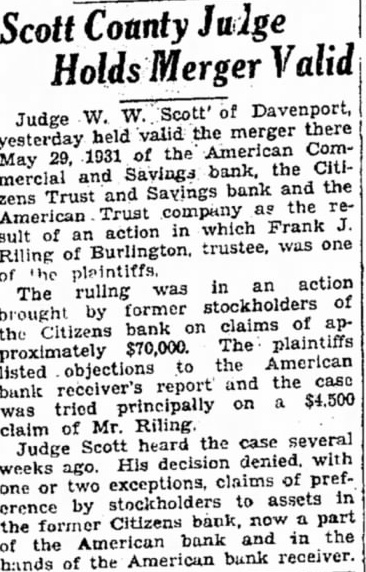
Scott County Julge Holds Merger Valid of Davenport, W. W. Judge there valid the merger held yesterday May 29, 1931 of the American Commercial and Savings bank, the Citizens Trust and Savings bank and the the reTrust company American which Frank an action in sult of was one Riling of of the in an action was brought The ruling by former stockholders of the Citizens bank on claims plaintiffs of ap$70,000. The proximately the American objections to listed and the case receiver's report bank $4,500 principally on a was tried of Mr. Riling. claim Judge Scott heard the case several weeks ago. His decision denied. with one or two exceptions, claims of preference by stockholders to assets in Citizens bank, now part former of the the American bank and in the bank receiver. of the American hands


Article from The Daily Times, June 15, 1932

Click image to open full size in new tab

Article Text

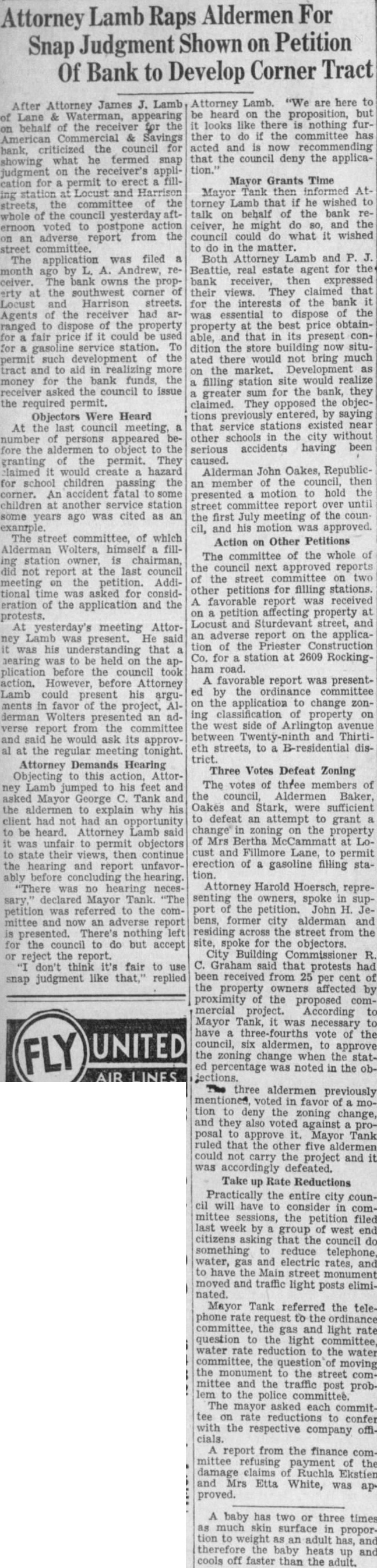
Attorney Lamb Raps Aldermen For Snap Judgment Shown on Petition Of Bank to Develop Corner Tract After Attorney James J. Lamb, of Lane & Waterman, appearing on behalf of the receiver for the American Commercial & Savings bank, criticized the council for showing what he termed snap judgment on the receiver's application for a permit to erect a filling station at Locust and Harrison streets, the committee of the whole of the council yesterday afternoon voted to postpone action on an adverse report from the street committee. The application was filed a month ago by L. A. Andrew, receiver. The bank owns the property at the southwest corner of Locust and Harrison streets. Agents of the receiver had arranged to dispose of the property for a fair price if it could be used for a gasoline service station. To permit such development of the tract and to aid in realizing more money for the bank funds, the receiver asked the council to issue the required permit. Objectors Were Heard At the last council meeting, a number of persons appeared before the aldermen to object to the granting of the permit. They claimed it would create a hazard for school children passing the corner. An accident fatal to some children at another service station some years ago was cited as an The street committee, of which Alderman Wolters, himself a filling station owner, is chairman, did not report at the last council meeting on the petition. Additional time was asked for consideration of the application and the protests. At yesterday's meeting Attorney Lamb was present. He said it was his understanding that a hearing was to be held on the application before the council took action. However, before Attorney Lamb could present his arguments in favor of the project, Alderman Wolters presented an adverse report from the committee and said he would ask its approval at the regular meeting tonight. Attorney Demands Hearing Objecting to this action, Attorney Lamb jumped to his feet and asked Mayor George C. Tank and the aldermen to explain why his client had not had an opportunity to be heard. Attorney Lamb said it was unfair to permit objectors to state their views, then continue the hearing and report unfavorably before concluding the hearing. "There was no hearing necessary," declared Mayor Tank "The petition was referred to the committee and now an adverse report is presented. There's nothing left for the council to do but accept or reject the report. "I don't think it's fair to use snap judgment like that," replied Attorney Lamb. "We are here to be heard on the proposition, but it looks like there is nothing further to do if the committee has acted and is now recommending that the council deny the application." Mayor Grants Time Mayor Tank then informed Attorney Lamb that if he wished to talk on behalf of the bank receiver, he might do so, and the council could do what it wished to do in the matter. Both Attorney Lamb and P. J. Beattie, real estate agent for the bank receiver, then expressed their views. They claimed that for the interests of the bank it was essential to dispose of the property at the best price obtainable, and that in its present condition the store building now situated there would not bring much on the market. Development as a filling station site would realize a greater sum for the bank, they claimed. They opposed the objections previously entered, by saying that service stations existed near other schools in the city without serious accidents having been caused. Alderman John Oakes, Republican member of the council, then presented a motion to hold the street committee report over until the first July meeting of the coun cil, and his motion was approved. Action on Other Petitions The committee of the whole of the council next approved reports of the street committee on two other petitions for filling stations. A. favorable report was received on a petition affecting property at Locust and Sturdevant street, and an adverse report on the application of the Priester Construction Co. for a station at 2609 Rockingham road. A favorable report was presented by the ordinance committee on the application to change zoning classification of property on the west side of Arlington avenue between Twenty-ninth and Thirtieth streets, to a B-residential district. Three Votes Defeat Zoning The votes of three members of the council, Aldermen Baker, Oakes and Stark, were sufficient to defeat an attempt to grant a change in zoning on the property of Mrs Bertha McCammatt at Locust and Fillmore Lane, to permit erection of a gasoline filling station. Attorney Harold Hoersch, representing the owners, spoke in support of the petition. John H. Jebens, former city alderman and residing across the street from the site, spoke for the objectors. City Building Commissioner R. C. Graham said that protests had been received from 25 per cent of the property owners affected by proximity of the proposed commercial project. According to Mayor Tank, it was necessary to have a three-fourths vote of the council, six aldermen, to approve the zoning change when the stated percentage was noted in the ob- The three aldermen previously mentioned, voted in favor of a motion to deny the zoning change, and they also voted against a proposal to approve it. Mayor Tank ruled that the other five aldermen could not carry the project and it was accordingly defeated. Take up Rate Reductions Practically the entire city council will have to consider in committee sessions, the petition filed last week by a group of west end citizens asking that the council do something to reduce telephone, water, gas and electric rates, and to have the Main street monument moved and traffic light posts eliminated. Mayor Tank referred the telephone rate request to the ordinance committee, the gas and light rate question to the light committee, water rate reduction to the water committee, the question of moving the monument to the street committee and the traffic post problem to the police committee. The mayor asked each committee on rate reductions to confer with the respective company officials. A report from the finance committee refusing payment of the damage claims of Ruchla Ekstien and Mrs Etta White, was approved. A baby has two or three times as much skin surface in proportion to weight as an adult has, and therefore the baby heats up and cools off faster than the adult.
Article from Mid-West Progressive, July 13, 1933

Click image to open full size in new tab

Article Text

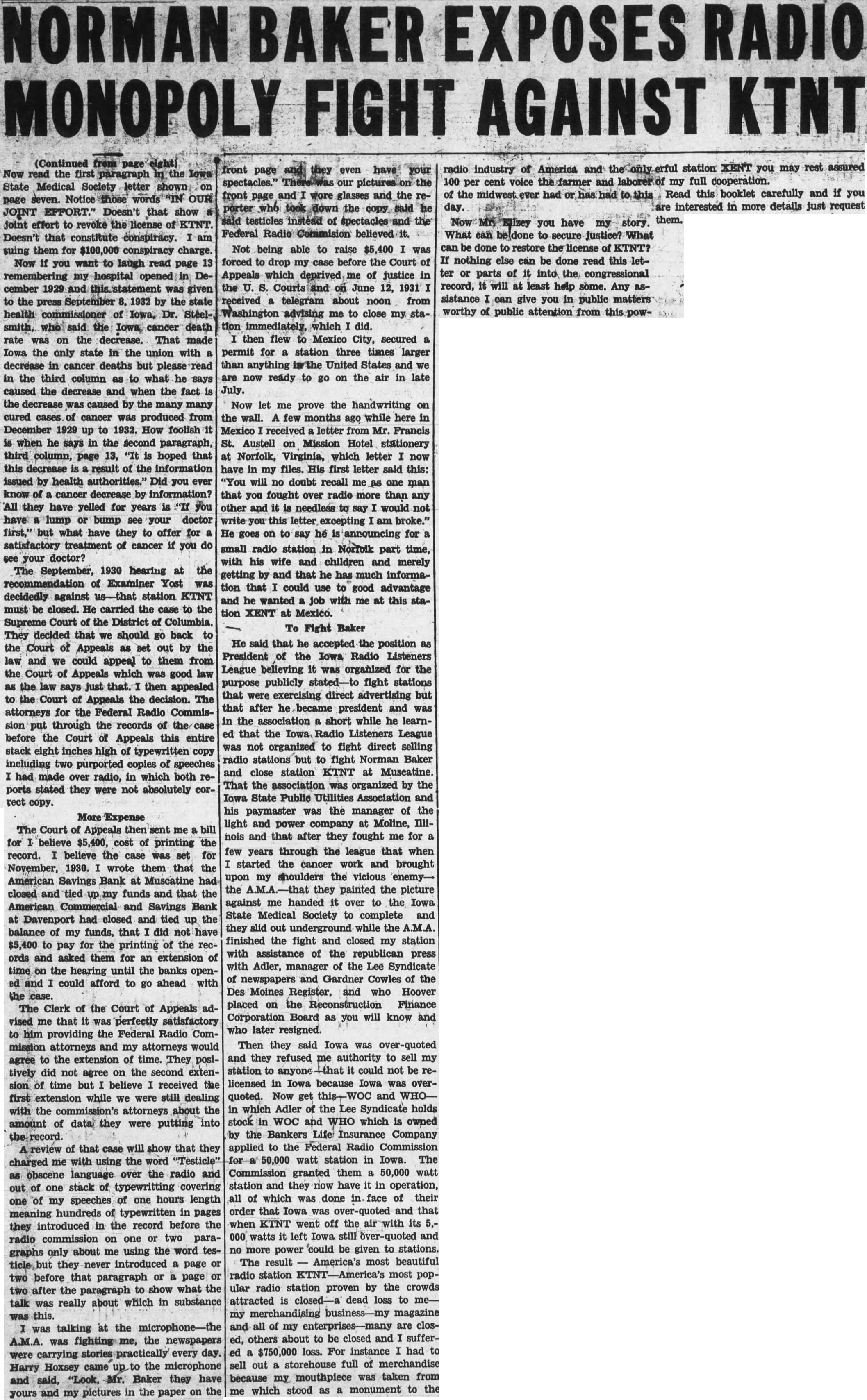
NORMAN BAKER EXPOSES RADIO MONOPOLY FIGHT AGAINST KTNT (Continued from page eight) Now read the first paragraph in the Iowa State Medical Society letter shown on page seven. Notice those words "IN OUR JOINT EFFORT." Doesn't that show a joint effort to revoke the license of KTNT. Doesn't that constitute conspiracy. I am suing them for $100,000 conspiracy charge. Now if you want to laugh read page 13 remembering my hospital opened in December 1929 and this statement was given to the press September 8, 1932 by the state health commissioner of Iowa, Dr. Steel-, smith, who said the Iowa, cancer death rate was on the decrease. That made Iowa the only state in the union with a decrease in cancer deaths but please read in the third column as to what he says caused the decrease and when the fact is the decrease was caused by the many many cured cases of cancer was produced from December 1929 up to 1932. How foolish it is when he says in the second paragraph, third column, page 13, "It is hoped that this decrease is a result of the information issued by health authorities." Did you ever know of a cancer decrease by information? All they have yelled for years is "If you have a lump or bump see your doctor first," but what have they to offer for a satisfactory treatment of cancer if you do see your doctor? The September, 1930 hearing at the recommendation of Examiner Yost was decidedly against us-that station KTNT must be closed. He carried the case to the Supreme Court of the District of Columbia. They decided that we should go back to the Court of Appeals as set out by the law and we could appeal to them from the Court of Appeals which was good law as the law says just that. I then appealed to the Court of Appeals the decision. The attorneys for the Federal Radio Commission put through the records of the case before the Court of Appeals this entire stack eight inches high of typewritten copy including two purported copies of speeches I had made over radio, in which both reports stated they were not absolutely correct copy. More Expense The Court of Appeals then sent me a bill for I believe $5,400, cost of printing the record. I believe the case was set for November, 1930. I wrote them that the American Savings Bank at Muscatine had closed and tied up my funds and that the American Commercial and Savings Bank at Davenport had closed and tied up the balance of my funds, that I did not have $5,400 to pay for the printing of the records and asked them for an extension of time on the hearing until the banks opened and I could afford to go ahead with the case. The Clerk of the Court of Appeals advised me that it was perfectly satisfactory to him providing the Federal Radio Commission attorneys and my attorneys would agree to the extension of time. They positively did not agree on the second extension of time but I believe I received the first extension while we were still dealing with the commission's attorneys about the amount of data they were putting into the record. A review of that case will show that they charged me with using the word "Testicle" as obscene language over the radio and out of one stack of typewritting covering one of my speeches of one hours length meaning hundreds of typewritten in pages they introduced in the record before the radio commission on one or two paragraphs only about me using the word testicle but they never introduced a page or two before that paragraph or a page or two after the paragraph to show what the talk was really about which in substance was this. I was talking at the microphone-the A.M.A. was fighting me, the newspapers were carrying stories practically every day. Harry Hoxsey came up to the microphone and said, "Look, Mr. Baker they have yours and my pictures in the paper on the front page and they even have your spectacles." There was our pictures on the front page and I wore glasses and the reporter who took down the copy said he said testicles instead of spectacles and the Federal Radio Commision believed it. Not being able to raise $5,400 I was forced to drop my case before the Court of Appeals which deprived me of justice in the U. S. Courts and on June 12, 1931 I received a telegram about noon from Washington advising me to close my station immediately, which I did. I then flew to Mexico City, secured a permit for a station three times larger than anything the United States and we are now ready to go on the air in late July. Now let me prove the handwriting on the wall. A few months ago while here in Mexico I received a letter from Mr. Francis St. Austell on Mission Hotel stationery at Norfolk, Virginia, which letter I now have in my files. His first letter said this: "You will no doubt recall me as one man that you fought over radio more than any other and it is needless to say I would not write you this letter excepting I am broke." He goes on to say he is announcing for a small radio station in Norfolk part time, with his wife and children and merely getting by and that he has much information that I could use to good advantage and he wanted a job with me at this station XENT at Mexico. To Fight Baker He said that he accepted the position as President of the Iowa Radio Listeners League believing it was organized for the purpose publicly stated-to fight stations that were exercising direct advertising but that after he became president and was in the association a short while he learned that the Iowa Radio Listeners League was not organized to fight direct selling radio stations but to fight Norman Baker and close station KTNT at Muscatine. That the association was organized by the Iowa State Public Utilities Association and his paymaster was the manager of the light and power company at Moline, IIIInois and that after they fought me for a few years through the league that when I started the cancer work and brought upon my shoulders the vicious enemythe A.M.A.-that they painted the picture against me handed it over to the Iowa State Medical Society to complete and they slid out underground while the A.M.A. finished the fight and closed my station with assistance of the republican press with Adler, manager of the Lee Syndicate of newspapers and Gardner Cowles of the Des Moines Register, and who Hoover placed on the Reconstruction Finance Corporation Board as you will know and who later resigned. Then they said Iowa was over-quoted and they refused me authority to sell my station to anyone that it could not be relicensed in Iowa because Iowa was overquoted. Now get this-WOC and WHOin which Adler of the Lee Syndicate holds stock in WOC and WHO which is owned by the Bankers Life Insurance Company applied to the Federal Radio Commission for 50,000 watt station in Iowa. The Commission granted them a 50,000 watt station and they now have it in operation, all of which was done in face of their order that Iowa was over-quoted and that when KTNT went off the air with its 5,000 watts it left Iowa still over-quoted and no more power could be given to stations. The result America's most beautiful radio station KTNT-America's most popular radio station proven by the crowds attracted is closed-a dead loss to memy merchandising business-my magazine and all of my enterprises-many are closed, others about to be closed and I suffered a $750,000 loss. For instance I had to sell out a storehouse full of merchandise because my mouthpiece was taken from me which stood as a monument to the radio industry of America and the only erful station XENT you may rest assured 100 per cent voice the farmer and laborer of my full cooperation. of the midwest ever had or has had to this Read this booklet carefully and if you day. are interested in more details just request Now Mr. Elizey you have my story. them. What can be done to secure justice? What can be done to restore the license of KTNT? If nothing else can be done read this letter or parts of it into the congressional record, it will at least help some. Any assistance I can give you in public matters worthy of public attention from this pow-